Region:Global
Author(s):Rebecca
Product Code:KRAA2412
Pages:85
Published On:August 2025
By Type:The market is segmented into various types of bone cement, including Polymethyl Methacrylate (PMMA) Cement, Calcium Phosphate Cement, Glass Polyalkenoate Cement, Bioactive Bone Cement, Antibiotic-loaded Bone Cement, and Others. Among these, Polymethyl Methacrylate (PMMA) Cement remains the most widely used due to its proven mechanical strength and ease of handling in surgical procedures. Calcium Phosphate Cement is gaining traction for its bioactivity and osteoconductive properties, facilitating bone regeneration. The demand for antibiotic-loaded bone cement continues to rise, as it plays a critical role in reducing the risk of post-operative infections, particularly in joint replacement and trauma surgeries .

By Application:The applications of bone cement include Arthroplasty (Joint Replacement), Spine Surgery, Trauma Surgery, Dental Surgery, and Others. Arthroplasty is the leading application segment, driven by the increasing number of hip and knee replacement surgeries globally. Spine surgery is also a significant application area, supported by the aging population and the rising prevalence of spinal disorders. The demand for bone cement in dental surgery is expanding due to the growth in dental implant procedures and the need for bone stabilization in maxillofacial surgeries .

The Global Bone Cement Market is characterized by a dynamic mix of regional and international players. Leading participants such as Stryker Corporation, Zimmer Biomet Holdings, Inc., DePuy Synthes (Johnson & Johnson), Medtronic plc, B. Braun Melsungen AG, Smith & Nephew plc, Heraeus Medical GmbH, DJO Global, Inc., Exactech, Inc., BONESUPPORT AB, Tecres S.p.A., Osteomed LLC, Aesculap AG (B. Braun), G21 S.r.l., Summit Medical LLC contribute to innovation, geographic expansion, and service delivery in this space.
The future of the bone cement market appears promising, driven by ongoing innovations and an increasing focus on patient-centric solutions. As the demand for minimally invasive surgeries rises, manufacturers are likely to invest in developing biodegradable and bioactive cements. Additionally, the integration of smart technologies in surgical procedures is expected to enhance the precision and effectiveness of bone cement applications, further solidifying its role in orthopedic care.
| Segment | Sub-Segments |
|---|---|
| By Type | Polymethyl Methacrylate (PMMA) Cement Calcium Phosphate Cement Glass Polyalkenoate Cement Bioactive Bone Cement Antibiotic-loaded Bone Cement Others |
| By Application | Arthroplasty (Joint Replacement) Spine Surgery Trauma Surgery Dental Surgery Others |
| By End-User | Hospitals Ambulatory Surgical Centers Specialty Orthopedic Clinics Others |
| By Distribution Channel | Direct Sales Distributors Online Sales Others |
| By Region | North America Europe Asia-Pacific Latin America Middle East & Africa |
| By Price Range | Low Price Medium Price High Price |
| By Product Formulation | Standard Formulation Customized Formulation Others |
| Scope Item/Segment | Sample Size | Target Respondent Profiles |
|---|---|---|
| Orthopedic Surgeons | 100 | Surgeons specializing in joint replacement and trauma |
| Hospital Procurement Managers | 60 | Managers responsible for purchasing medical supplies and devices |
| Healthcare Administrators | 40 | Administrators overseeing surgical departments and budgets |
| Patients with Joint Replacements | 80 | Patients who have undergone surgeries involving bone cement |
| Medical Device Regulatory Experts | 40 | Experts in compliance and regulatory affairs for medical devices |
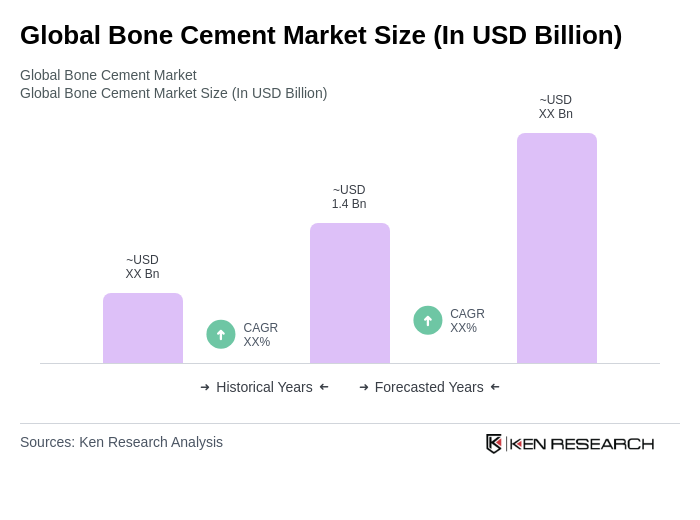
The Global Bone Cement Market is valued at approximately USD 1.4 billion, driven by factors such as the increasing prevalence of orthopedic surgeries, a growing geriatric population, and advancements in bone cement formulations.

What makes us stand out is that our consultants follow Robust, Refine and Result (RRR) methodology. Robust for clear definitions, approaches and sanity checking, Refine for differentiating respondents' facts and opinions, and Result for presenting data with story.

We have set a benchmark in the industry by offering our clients with syndicated and customized market research reports featuring coverage of entire market as well as meticulous research and analyst insights.

While we don't replace traditional research, we flip the method upside down. Our dual approach of Top Bottom & Bottom Top ensures quality deliverable by not just verifying company fundamentals but also looking at the sector and macroeconomic factors.

With one step in the future, our research team constantly tries to show you the bigger picture. We help with some of the tough questions you may encounter along the way: How is the industry positioned? Best marketing channel? KPI's of competitors? By aligning every element, we help maximize success.

Our report gives you instant access to the answers and sources that other companies might choose to hide. We elaborate each steps of research methodology we have used and showcase you the sample size to earn your trust.

If you need any support, we are here! We pride ourselves on universe strength, data quality, and quick, friendly, and professional service.













