KSA Resuscitative Endovascular Balloon Occlusion Aorta REBOA Market Report Size Share Growth Drivers Trends Opportunities & Forecast 2025–2030

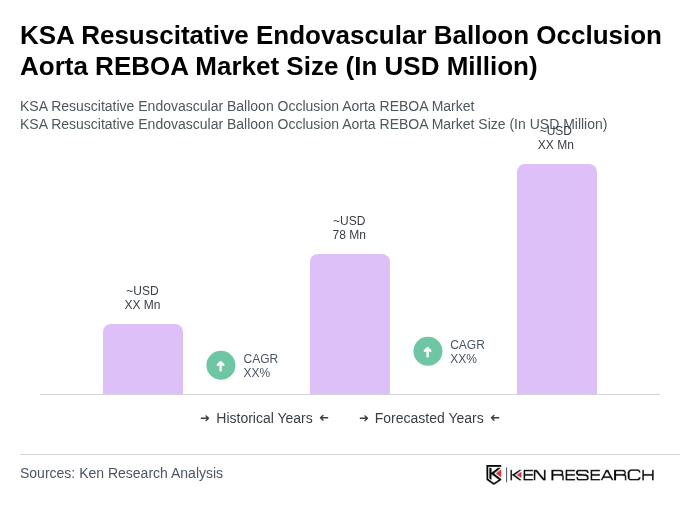
KSA REBOA market at USD 78M, driven by trauma cases and minimally invasive tech. Key cities: Riyadh, Jeddah, Dammam.

Region:Middle East

Author(s):Dev

Product Code:KRAC1595

Pages:88

Published On:December 2025
About the Report

Base Year 2024

KSA Resuscitative Endovascular Balloon Occlusion Aorta REBOA Market Overview

  • The KSA Resuscitative Endovascular Balloon Occlusion Aorta REBOA Market is valued at approximately USD 78 million, based on a five-year historical analysis. This growth is primarily driven by the rising incidence of trauma cases and the increasing adoption of minimally invasive hemorrhage control devices, supported by advancements in endovascular technologies, growing clinical awareness, and expanding healthcare infrastructure.
  • Key cities dominating the market include Riyadh, Jeddah, and Dammam, which are home to major healthcare institutions and trauma centers. The concentration of advanced medical facilities and a high volume of trauma cases in these urban areas contribute significantly to the market's growth.
  • In recent years, the Saudi government has implemented healthcare transformation initiatives aimed at enhancing trauma care infrastructure. This includes significant investments in emergency medical services and interventional technology procurement, which support the adoption of REBOA technology and improve overall healthcare delivery. The Health Sector Transformation Program, launched by the Ministry of Health in 2021, mandates advanced trauma care standards requiring level I trauma centers to maintain interventional capabilities for hemorrhage control procedures, including endovascular techniques, with compliance thresholds for equipment availability and specialist training.
KSA Resuscitative Endovascular Balloon Occlusion Aorta REBOA Market Size

KSA Resuscitative Endovascular Balloon Occlusion Aorta REBOA Market Segmentation

By Type:The market is segmented into various types of balloons used in REBOA procedures. Non-compliant balloons are designed to maintain a fixed volume and pressure, making them suitable for specific applications. Compliant balloons, on the other hand, can expand and contract, providing flexibility during procedures. Hybrid balloons combine features of both types, offering versatility. Other types may include specialized balloons for unique clinical scenarios. Non-compliant balloons currently dominate the market due to their reliability and effectiveness in critical situations.
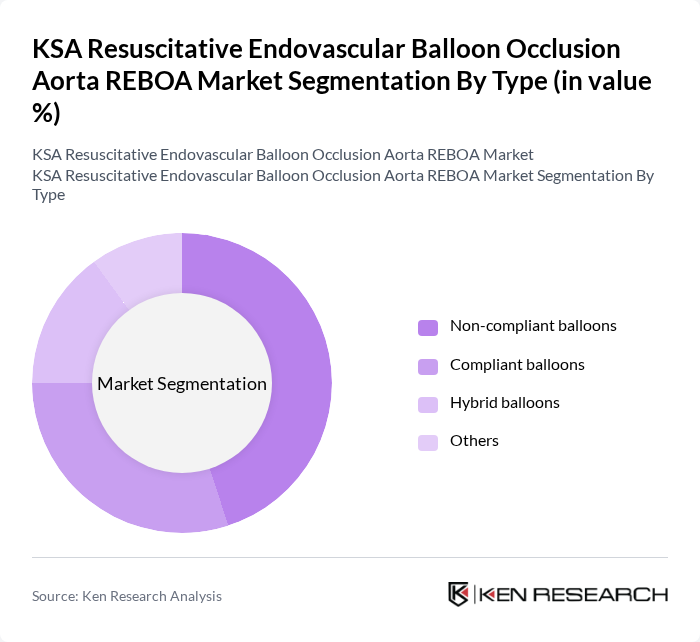
KSA Resuscitative Endovascular Balloon Occlusion Aorta REBOA Market segmentation by Type.

By End-User:The end-user segmentation includes hospitals, trauma centers, ambulance services, and other healthcare facilities. Hospitals are the primary users of REBOA technology, as they have the necessary infrastructure and trained personnel to perform these advanced procedures. Trauma centers also play a significant role, given their focus on emergency care. Ambulance services are increasingly integrating REBOA devices for pre-hospital care, enhancing patient outcomes during transport. Hospitals lead the market due to their comprehensive trauma care capabilities and resources.
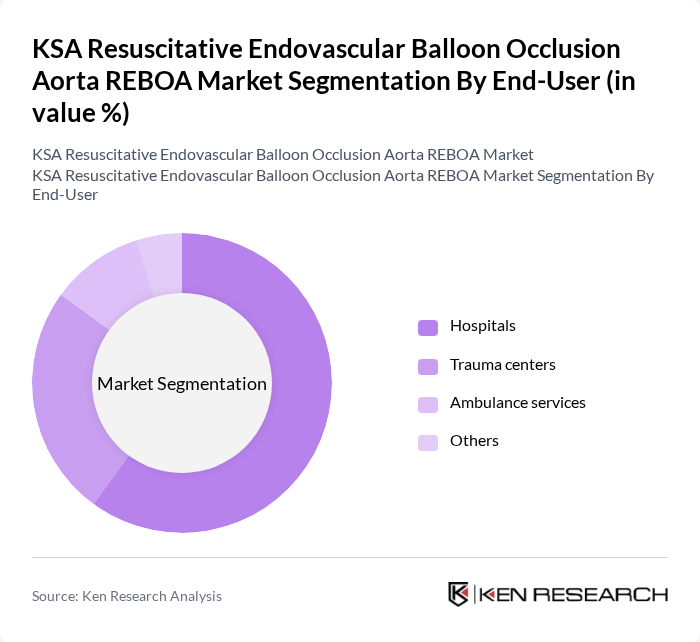
KSA Resuscitative Endovascular Balloon Occlusion Aorta REBOA Market segmentation by End-User.

KSA Resuscitative Endovascular Balloon Occlusion Aorta REBOA Market Competitive Landscape

The KSA Resuscitative Endovascular Balloon Occlusion Aorta REBOA Market is characterized by a dynamic mix of regional and international players. Leading participants such as Boston Scientific Corp, Medtronic PLC, Terumo Corp, Abbott Laboratories, and Cardinal Health Inc contribute to innovation, geographic expansion, and service delivery in this space.

Boston Scientific Corp

1979

Marlborough, Massachusetts, USA

Medtronic PLC

1949

Dublin, Ireland

Terumo Corp

1921

Tokyo, Japan

Abbott Laboratories

1888

Abbott Park, Illinois, USA

Cardinal Health Inc

1971

Dublin, Ohio, USA

Company

Establishment Year

Headquarters

Group Size (Large, Medium, or Small as per industry convention)

Revenue Growth Rate

Market Penetration Rate

Customer Retention Rate

Pricing Strategy

Product Innovation Rate

KSA Resuscitative Endovascular Balloon Occlusion Aorta REBOA Market Industry Analysis

Growth Drivers

  • Strong Non-Oil Sector Expansion:The non-oil sector in Saudi Arabia is projected to grow by SAR 69 billion in the future, driven by a 4.3% increase in non-oil economic activities. This expansion is crucial as it enhances the healthcare sector's capacity to invest in advanced medical technologies, including REBOA devices. The growth in healthcare services directly correlates with the rising demand for innovative medical solutions to address trauma cases effectively.
  • Healthcare Sector Profit and Revenue Growth:In the future, listed healthcare companies in Saudi Arabia reported a combined net profit of SAR 4.86 billion (USD 1.3 billion) and total revenues of SAR 33.87 billion (USD 9 billion). This financial health indicates a robust investment capacity within the healthcare sector, facilitating the procurement of advanced medical technologies like REBOA. The profitability of healthcare firms supports the adoption of innovative solutions to improve patient outcomes in emergency situations.
  • Large-Scale Government Investment in Healthcare Infrastructure:The Saudi government has allocated USD 69 billion (SAR 260 billion) for health and social development in the future, with significant infrastructure projects underway. This includes the inauguration of new hospital towers and clinics worth SAR 1.8 billion. Such investments enhance healthcare facilities' capabilities, enabling them to procure and utilize complex medical devices like REBOA systems, ultimately improving trauma care.

Market Challenges

  • Shortage of Skilled Healthcare Professionals:Saudi Arabia faces a deficit of approximately 15,000 doctors and 20,000 nurses, as reported by SAGIA in the future. This shortage poses a significant challenge for the adoption of complex medical interventions like REBOA, as the effective use of such devices requires adequately trained personnel. The lack of skilled professionals could hinder the implementation of advanced trauma care solutions in emergency settings.
  • Regulatory Complexity and High R&D/Compliance Costs:The Saudi Food and Drug Authority (SFDA) processed over 10,000 medical device applications in the future, with many being rejected due to non-compliance. The stringent regulatory environment and high costs associated with research and development can delay the introduction of specialized devices like REBOA. Navigating these complex regulations is essential for ensuring timely access to innovative medical technologies.

KSA Resuscitative Endovascular Balloon Occlusion Aorta REBOA Market Future Outlook

The future of the KSA REBOA market appears promising, driven by emerging technologies and increased government funding for healthcare innovation. With over USD 1.5 billion allocated to health technology under Vision 2030, the integration of digital health solutions will enhance procedural planning and training for REBOA. Additionally, public-private partnerships are expected to foster localized development of advanced medical devices, creating a conducive environment for the adoption of REBOA systems in trauma care.

Market Opportunities

  • Clinical Trials and Research Expansion:The initiation of a phase 3 clinical trial by AbbVie in Saudi Arabia in the future, among 242 global sites, signifies a growing clinical research presence. This expansion could facilitate procedural research and validation for REBOA, enhancing its adoption in local healthcare settings and improving trauma care outcomes.
  • Healthcare Privatization and Cluster Development:The Saudi government plans to privatize 290 hospitals and 2,300 primary healthcare centers in the future. This shift towards privatization may lead to more agile adoption of advanced technologies, including REBOA, by private providers, thereby expanding the market segments available for innovative medical solutions in trauma care.

Scope of the Report

SegmentSub-Segments
By Type

Non-compliant balloons

Compliant balloons

Hybrid balloons

Others

By End-User

Hospitals

Trauma centers

Ambulance services

Others

By Application

Trauma management

Surgical procedures

Research and development

Others

By Distribution Channel

Direct sales

Distributors

Online platforms

Others

By Region

Central Region

Eastern Region

Western Region

Southern Region

By Patient Demographics

Adults

Pediatric

Geriatric

Others

By Technology Integration

Standalone devices

Integrated systems

Telemedicine-enabled devices

Others

Key Target Audience

Investors and Venture Capitalist Firms

Government and Regulatory Bodies (e.g., Saudi Food and Drug Authority, Ministry of Health)

Manufacturers and Producers of Medical Devices

Distributors and Suppliers of Medical Equipment

Healthcare Providers and Hospitals

Emergency Medical Services (EMS) Organizations

Industry Associations and Societies (e.g., Saudi Society of Anesthesia)

Financial Institutions and Investment Banks

Players Mentioned in the Report:

Johnson & Johnson

Medtronic

Boston Scientific

Abbott Laboratories

Teleflex Incorporated

Stryker Corporation

B. Braun Melsungen AG

Cook Medical

Terumo Corporation

Merit Medical Systems

AngioDynamics

ConvaTec Group

HemoSonics

Inari Medical

ZOLL Medical Corporation

Table of Contents

Market Assessment Phase

1. Executive Summary and Approach


2. KSA Resuscitative Endovascular Balloon Occlusion Aorta REBOA Market Overview

2.1 Key Insights and Strategic Recommendations

2.2 KSA Resuscitative Endovascular Balloon Occlusion Aorta REBOA Market Overview

2.3 Definition and Scope

2.4 Evolution of Market Ecosystem

2.5 Timeline of Key Regulatory Milestones

2.6 Value Chain & Stakeholder Mapping

2.7 Business Cycle Analysis

2.8 Policy & Incentive Landscape


3. KSA Resuscitative Endovascular Balloon Occlusion Aorta REBOA Market Analysis

3.1 Growth Drivers

3.1.1 Increasing prevalence of trauma cases
3.1.2 Advancements in medical technology
3.1.3 Rising awareness and training in emergency medicine
3.1.4 Government initiatives to improve healthcare infrastructure

3.2 Market Challenges

3.2.1 High cost of REBOA devices
3.2.2 Limited availability of trained personnel
3.2.3 Regulatory hurdles in device approval
3.2.4 Competition from alternative resuscitation methods

3.3 Market Opportunities

3.3.1 Expansion of emergency medical services
3.3.2 Collaborations with healthcare institutions
3.3.3 Development of cost-effective REBOA solutions
3.3.4 Increasing investment in healthcare technology

3.4 Market Trends

3.4.1 Growing adoption of minimally invasive procedures
3.4.2 Integration of digital health solutions
3.4.3 Focus on patient-centered care
3.4.4 Rise in telemedicine for emergency care

3.5 Government Regulation

3.5.1 Standards for medical device safety
3.5.2 Guidelines for emergency medical services
3.5.3 Approval processes for new medical technologies
3.5.4 Policies promoting healthcare innovation

4. SWOT Analysis


5. Stakeholder Analysis


6. Porter's Five Forces Analysis


7. KSA Resuscitative Endovascular Balloon Occlusion Aorta REBOA Market Market Size, 2019-2024

7.1 By Value

7.2 By Volume

7.3 By Average Selling Price


8. KSA Resuscitative Endovascular Balloon Occlusion Aorta REBOA Market Segmentation

8.1 By Type

8.1.1 Non-compliant balloons
8.1.2 Compliant balloons
8.1.3 Hybrid balloons
8.1.4 Others

8.2 By End-User

8.2.1 Hospitals
8.2.2 Trauma centers
8.2.3 Ambulance services
8.2.4 Others

8.3 By Application

8.3.1 Trauma management
8.3.2 Surgical procedures
8.3.3 Research and development
8.3.4 Others

8.4 By Distribution Channel

8.4.1 Direct sales
8.4.2 Distributors
8.4.3 Online platforms
8.4.4 Others

8.5 By Region

8.5.1 Central Region
8.5.2 Eastern Region
8.5.3 Western Region
8.5.4 Southern Region

8.6 By Patient Demographics

8.6.1 Adults
8.6.2 Pediatric
8.6.3 Geriatric
8.6.4 Others

8.7 By Technology Integration

8.7.1 Standalone devices
8.7.2 Integrated systems
8.7.3 Telemedicine-enabled devices
8.7.4 Others

9. KSA Resuscitative Endovascular Balloon Occlusion Aorta REBOA Market Competitive Analysis

9.1 Market Share of Key Players

9.2 Cross Comparison of Key Players

9.2.1 Company Name
9.2.2 Group Size (Large, Medium, or Small as per industry convention)
9.2.3 Revenue Growth Rate
9.2.4 Market Penetration Rate
9.2.5 Customer Retention Rate
9.2.6 Pricing Strategy
9.2.7 Product Innovation Rate
9.2.8 Distribution Efficiency
9.2.9 Brand Recognition
9.2.10 Customer Satisfaction Index

9.3 SWOT Analysis of Top Players

9.4 Pricing Analysis

9.5 Detailed Profile of Major Companies

9.5.1 Johnson & Johnson
9.5.2 Medtronic
9.5.3 Boston Scientific
9.5.4 Abbott Laboratories
9.5.5 Teleflex Incorporated
9.5.6 Stryker Corporation
9.5.7 B. Braun Melsungen AG
9.5.8 Cook Medical
9.5.9 Terumo Corporation
9.5.10 Merit Medical Systems
9.5.11 AngioDynamics
9.5.12 ConvaTec Group
9.5.13 HemoSonics
9.5.14 Inari Medical
9.5.15 ZOLL Medical Corporation

10. KSA Resuscitative Endovascular Balloon Occlusion Aorta REBOA Market End-User Analysis

10.1 Procurement Behavior of Key Ministries

10.1.1 Budget allocation for emergency services
10.1.2 Decision-making processes
10.1.3 Supplier selection criteria
10.1.4 Contract management practices

10.2 Corporate Spend on Infrastructure & Energy

10.2.1 Investment in medical technology
10.2.2 Funding for training programs
10.2.3 Partnerships with healthcare providers
10.2.4 Others

10.3 Pain Point Analysis by End-User Category

10.3.1 Challenges in device procurement
10.3.2 Need for training and support
10.3.3 Integration with existing systems
10.3.4 Others

10.4 User Readiness for Adoption

10.4.1 Awareness of REBOA benefits
10.4.2 Training availability
10.4.3 Infrastructure readiness
10.4.4 Others

10.5 Post-Deployment ROI and Use Case Expansion

10.5.1 Measurement of patient outcomes
10.5.2 Cost savings analysis
10.5.3 Potential for new applications
10.5.4 Others

11. KSA Resuscitative Endovascular Balloon Occlusion Aorta REBOA Market Future Size, 2025-2030

11.1 By Value

11.2 By Volume

11.3 By Average Selling Price


Go-To-Market Strategy Phase

1. Whitespace Analysis + Business Model Canvas

1.1 Market gaps identification

1.2 Value proposition development

1.3 Revenue model exploration

1.4 Customer segmentation analysis

1.5 Competitive landscape assessment

1.6 Key partnerships identification

1.7 Risk assessment and mitigation


2. Marketing and Positioning Recommendations

2.1 Branding strategies

2.2 Product USPs

2.3 Target audience identification

2.4 Communication strategies

2.5 Digital marketing initiatives

2.6 Event marketing opportunities

2.7 Feedback and improvement mechanisms


3. Distribution Plan

3.1 Urban retail strategies

3.2 Rural NGO tie-ups

3.3 Online distribution channels

3.4 Direct sales force deployment

3.5 Logistics and supply chain management

3.6 Partnership with healthcare providers

3.7 Performance monitoring and evaluation


4. Channel & Pricing Gaps

4.1 Underserved routes analysis

4.2 Pricing bands evaluation

4.3 Competitor pricing comparison

4.4 Customer willingness to pay

4.5 Discount and promotion strategies

4.6 Pricing strategy alignment with value

4.7 Continuous pricing optimization


5. Unmet Demand & Latent Needs

5.1 Category gaps identification

5.2 Consumer segments analysis

5.3 Emerging trends and needs

5.4 Feedback from end-users

5.5 Innovation opportunities

5.6 Market entry barriers

5.7 Future demand forecasting


6. Customer Relationship

6.1 Loyalty programs development

6.2 After-sales service strategies

6.3 Customer engagement initiatives

6.4 Feedback collection mechanisms

6.5 Relationship management tools

6.6 Community building efforts

6.7 Customer education programs


7. Value Proposition

7.1 Sustainability initiatives

7.2 Integrated supply chains

7.3 Unique selling points

7.4 Customer-centric approach

7.5 Competitive advantages

7.6 Long-term value creation

7.7 Alignment with market needs


8. Key Activities

8.1 Regulatory compliance strategies

8.2 Branding initiatives

8.3 Distribution setup plans

8.4 Training and support programs

8.5 Performance tracking systems

8.6 Stakeholder engagement activities

8.7 Continuous improvement processes


9. Entry Strategy Evaluation

9.1 Domestic Market Entry Strategy

9.1.1 Product mix considerations
9.1.2 Pricing band analysis
9.1.3 Packaging strategies
9.1.4 Marketing approach
9.1.5 Distribution channels
9.1.6 Customer acquisition tactics
9.1.7 Risk management strategies

9.2 Export Entry Strategy

9.2.1 Target countries selection
9.2.2 Compliance roadmap development
9.2.3 Market research and analysis
9.2.4 Distribution partnerships
9.2.5 Marketing localization
9.2.6 Regulatory considerations
9.2.7 Risk assessment

10. Entry Mode Assessment

10.1 Joint Ventures

10.2 Greenfield Investments

10.3 Mergers & Acquisitions

10.4 Distributor Model

10.5 Strategic Alliances

10.6 Licensing Agreements

10.7 Franchising Opportunities


11. Capital and Timeline Estimation

11.1 Capital requirements analysis

11.2 Timelines for market entry

11.3 Funding sources identification

11.4 Financial projections

11.5 Risk management strategies

11.6 Milestones tracking

11.7 Resource allocation plans


12. Control vs Risk Trade-Off

12.1 Ownership considerations

12.2 Partnership dynamics

12.3 Risk assessment frameworks

12.4 Control mechanisms

12.5 Decision-making processes

12.6 Long-term sustainability

12.7 Exit strategies


13. Profitability Outlook

13.1 Breakeven analysis

13.2 Long-term sustainability strategies

13.3 Revenue growth projections

13.4 Cost management strategies

13.5 Profit margin analysis

13.6 Financial health indicators

13.7 Investment return expectations


14. Potential Partner List

14.1 Distributors identification

14.2 Joint venture opportunities

14.3 Acquisition targets

14.4 Strategic alliances

14.5 Collaboration with research institutions

14.6 Networking with industry leaders

14.7 Engagement with government bodies


15. Execution Roadmap

15.1 Phased Plan for Market Entry

15.1.1 Market Setup
15.1.2 Market Entry
15.1.3 Growth Acceleration
15.1.4 Scale & Stabilize

15.2 Key Activities and Milestones

15.2.1 Initial setup activities
15.2.2 Launch milestones
15.2.3 Growth targets
15.2.4 Performance evaluation

Research Methodology

ApproachModellingSample

Phase 1: Approach1

Desk Research

  • Analysis of published market reports and white papers on REBOA technology
  • Review of clinical guidelines and protocols from healthcare authorities in KSA
  • Examination of demographic and health statistics from the Saudi Ministry of Health

Primary Research

  • Interviews with trauma surgeons and emergency medicine specialists in KSA
  • Surveys with hospital procurement managers regarding REBOA device usage
  • Field interviews with medical device distributors and suppliers in the region

Validation & Triangulation

  • Cross-validation of findings through multiple expert interviews
  • Triangulation of data from clinical studies and market trends
  • Sanity checks through feedback from a panel of healthcare professionals

Phase 2: Market Size Estimation1

Top-down Assessment

  • Estimation of the total addressable market based on trauma incidence rates in KSA
  • Segmentation of market size by hospital type (public vs. private) and region
  • Incorporation of government healthcare spending and initiatives for trauma care

Bottom-up Modeling

  • Collection of sales data from leading REBOA device manufacturers operating in KSA
  • Estimation of average unit prices and projected sales volumes
  • Analysis of hospital purchasing patterns and frequency of REBOA usage

Forecasting & Scenario Analysis

  • Multi-factor regression analysis considering population growth and trauma care advancements
  • Scenario modeling based on potential changes in healthcare policies and funding
  • Baseline, optimistic, and pessimistic forecasts through 2030

Phase 3: CATI Sample Composition1

Scope Item/SegmentSample SizeTarget Respondent Profiles
Trauma Surgery Departments100Trauma Surgeons, Emergency Medicine Physicians
Hospital Procurement Teams80Procurement Managers, Supply Chain Coordinators
Medical Device Distributors60Sales Representatives, Regional Managers
Healthcare Policy Makers50Health Administrators, Policy Analysts
Clinical Researchers in Trauma Care70Clinical Researchers, Academic Physicians

Frequently Asked Questions

What is the current value of the KSA Resuscitative Endovascular Balloon Occlusion Aorta (REBOA) Market?

The KSA REBOA Market is valued at approximately USD 78 million, driven by the increasing incidence of trauma cases and the adoption of minimally invasive hemorrhage control devices, alongside advancements in endovascular technologies and healthcare infrastructure.

Which cities are key players in the KSA REBOA Market?

What government initiatives support the KSA REBOA Market?

What types of balloons are used in REBOA procedures?

Other Regional/Country Reports

Apac Resuscitative Endovascular Balloon Occlusion Aorta Reboa Market Report Size, Share, Growth Drivers, Trends, Opportunities & Forecast 2025–2030

Indonesia Resuscitative Endovascular Balloon Occlusion Aorta REBOA Market

Malaysia Resuscitative Endovascular Balloon Occlusion Aorta REBOA Market

SEA Resuscitative Endovascular Balloon Occlusion Aorta REBOA Market

Vietnam Resuscitative Endovascular Balloon Occlusion Aorta REBOA Market

Thailand Resuscitative Endovascular Balloon Occlusion Aorta REBOA Market

Why Buy From Us?

Refine Robust Result (RRR) Framework

What makes us stand out is that our consultants follow Robust, Refine and Result (RRR) methodology. Robust for clear definitions, approaches and sanity checking, Refine for differentiating respondents' facts and opinions, and Result for presenting data with story.

Our Reach Is Unmatched

We have set a benchmark in the industry by offering our clients with syndicated and customized market research reports featuring coverage of entire market as well as meticulous research and analyst insights.

Shifting the Research Paradigm

While we don't replace traditional research, we flip the method upside down. Our dual approach of Top Bottom & Bottom Top ensures quality deliverable by not just verifying company fundamentals but also looking at the sector and macroeconomic factors.

More Insights-Better Decisions

With one step in the future, our research team constantly tries to show you the bigger picture. We help with some of the tough questions you may encounter along the way: How is the industry positioned? Best marketing channel? KPI's of competitors? By aligning every element, we help maximize success.

Transparency and Trust

Our report gives you instant access to the answers and sources that other companies might choose to hide. We elaborate each steps of research methodology we have used and showcase you the sample size to earn your trust.

Round the Clock Support

If you need any support, we are here! We pride ourselves on universe strength, data quality, and quick, friendly, and professional service.

Why Clients Choose Us?

400000+
Reports in repository
150+
Consulting projects a year
100+
Analysts
8000+
Client Queries in 2022








