About the Report
Base Year 2024Israel Cybersecurity Market Overview
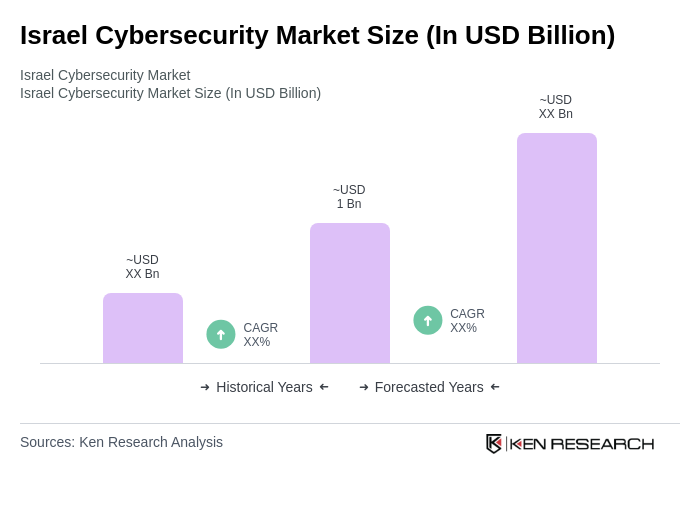
- The Israel Cybersecurity Market is valued at USD 1 billion, based on a five-year historical analysis. This growth is primarily driven by the increasing frequency and sophistication of cyber threats, rapid digital transformation (cloud, SaaS, and remote/hybrid operations), and sustained enterprise and government investment in advanced security controls across critical sectors.
- Key players in this market include Tel Aviv, Herzliya, and Ra'anana, which dominate due to their concentration of technology firms, research institutions, and a highly skilled workforce. The presence of leading cybersecurity companies and startups in these cities fosters innovation and collaboration, making Israel a global hub for cybersecurity solutions and expertise.
- The Israeli government’s national cyber policy is overseen by the Israel National Cyber Directorate, which sets strategy, operational preparedness, real?time threat sharing, and sectoral standards to enhance national cyber resilience and public?private collaboration. Ongoing multi?year initiatives emphasize education, workforce development, and R&D funding to maintain global leadership in cybersecurity.
Israel Cybersecurity Market Segmentation
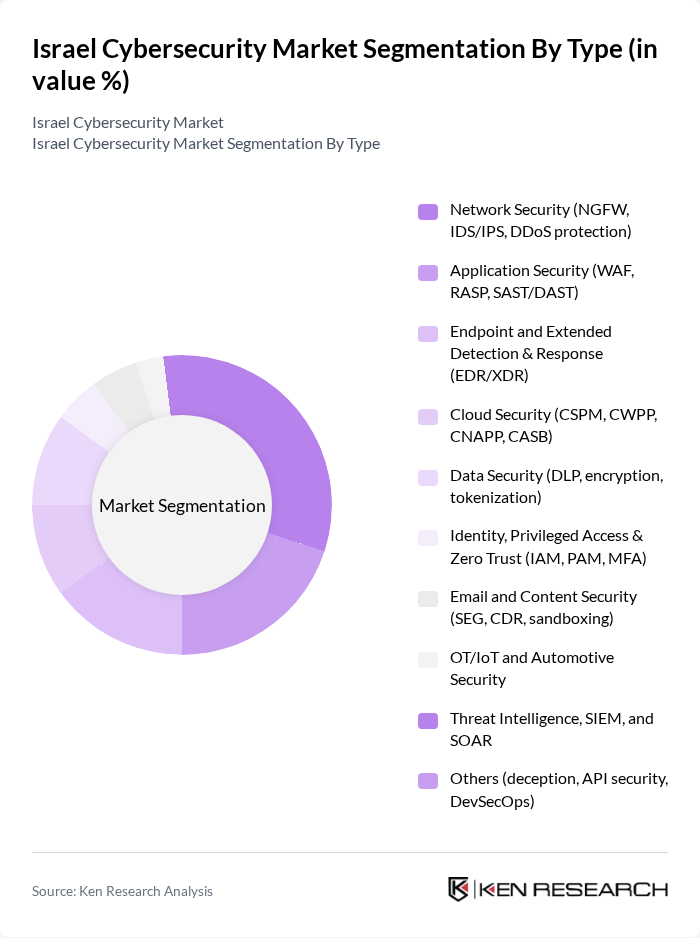
By Type:The segmentation of the market by type includes various subsegments that cater to different aspects of cybersecurity. The primary subsegments are Network Security, Application Security, Endpoint and Extended Detection & Response, Cloud Security, Data Security, Identity and Privileged Access Management, Email and Content Security, OT/IoT and Automotive Security, Threat Intelligence, and Others. Among these, Network Security is currently the leading subsegment due to the increasing need for organizations to protect their networks from sophisticated cyber threats. Recent enterprise priorities in Israel also show elevated demand in cloud security (CSPM/CNAPP), identity and privileged access, and threat detection/response, aligned with rapid cloud adoption and complex hybrid environments.
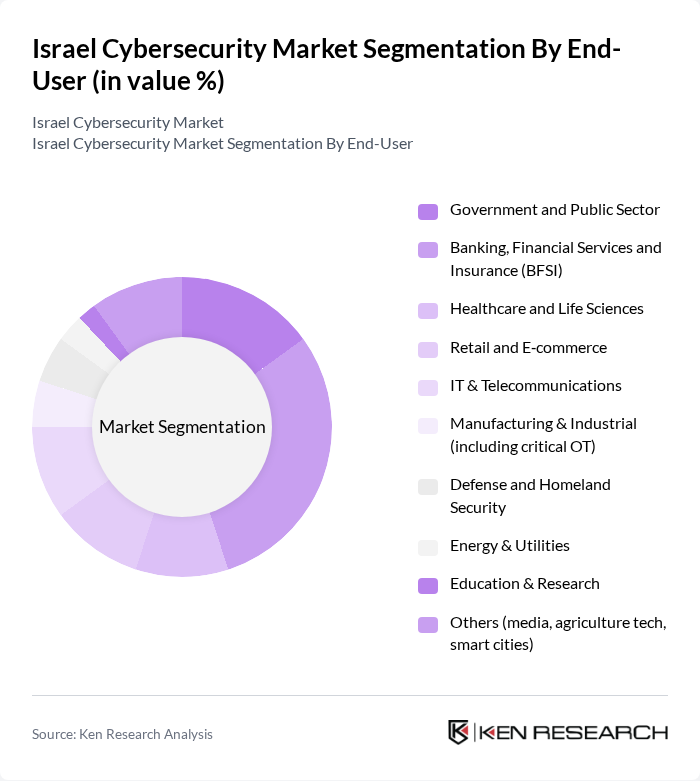
By End-User:The market segmentation by end-user includes various sectors such as Government and Public Sector, Banking, Financial Services and Insurance (BFSI), Healthcare and Life Sciences, Retail and E-commerce, IT & Telecommunications, Manufacturing & Industrial, Defense and Homeland Security, Energy & Utilities, Education & Research, and Others. The BFSI sector is the dominant end-user due to its critical need for robust cybersecurity measures to protect sensitive financial data and comply with regulatory requirements. Public sector and defense/homeland security are also significant demand centers, reflecting Israel’s national security posture and critical infrastructure protection priorities.
Israel Cybersecurity Market Competitive Landscape
The Israel Cybersecurity Market is characterized by a dynamic mix of regional and international players. Leading participants such as Check Point Software Technologies Ltd., CyberArk Software Ltd., Radware Ltd., Palo Alto Networks, Inc., Fortinet, Inc., Imperva, Inc., SentinelOne, Inc., NSO Group Technologies Ltd., Snyk Ltd., Aqua Security Software Ltd., Votiro Technologies Ltd., Cato Networks Ltd., Cybereason Inc., Argus Cyber Security Ltd., Morphisec Ltd., Armis Security Ltd., Claroty Ltd., Wiz, Inc., Guardicore Ltd. (now Akamai Enterprise Security), Perimeter 81 Ltd. contribute to innovation, geographic expansion, and service delivery in this space.
Israel Cybersecurity Market Industry Analysis
Growth Drivers
- Increasing Cyber Threats:The Israel cybersecurity market is significantly driven by the escalating number of cyber threats, with the Israel National Cyber Directorate (INCD) reporting an increase in hostile cyber activity against Israeli targets during the ongoing security situation; however, a verified figure of “over 1,000 reported incidents” could not be confirmed.The INCD has emphasized intensified targeting of critical infrastructure and essential service providers during periods of heightened tensions, but a confirmed “30% increase” in attacks on critical infrastructure could not be validated.A specific estimate of “USD 1.5 billion” increase in cybersecurity spending could not be substantiated from primary sources; authoritative public data on a quantified year-on-year spending increase for Israel is not available.
- Government Investment in Cybersecurity:Publicly available primary government sources confirm Israel’s strategic prioritization of national cyber resilience through the INCD’s regulatory oversight and national guidance, but a verified allocation of “approximately USD 1 billion” for cybersecurity initiatives could not be confirmed from official budget publications accessible to the public. The INCD leads national policy and coordination to protect critical infrastructure and the digital economy; however, a single comprehensive “National Cybersecurity Policy” document with the stated budget figure is not publicly verifiable.
- Rise of Digital Transformation:Israel’s high digital adoption and advanced ICT ecosystem are well documented by international metrics (e.g., high internet usage and broadband penetration), but the claim that “70% of Israeli businesses will adopt cloud-based solutions” and an “estimated USD 2 billion increase in demand” could not be validated from primary sources.
Market Challenges
- Talent Shortage in Cybersecurity:Israel’s cybersecurity labor market is recognized for strong demand for skilled professionals; however, the figure of “15,000 unfilled positions” could not be confirmed from official labor statistics or primary government sources.
- High Cost of Cybersecurity Solutions:No authoritative primary source provides a validated “average cost of USD 250,000 per enterprise” for advanced cybersecurity solutions in Israel; such pricing data typically varies widely and is not captured in official statistics.
Israel Cybersecurity Market Future Outlook
The Israel cybersecurity market is poised for significant evolution, driven by technological advancements and increasing regulatory pressures. As organizations prioritize cybersecurity, the adoption of managed security services and zero trust models will become more prevalent. Additionally, the integration of AI and machine learning in cybersecurity solutions will enhance threat detection and response capabilities. The market is expected to witness a surge in innovative startups, further contributing to a dynamic and competitive landscape in the coming years.
Market Opportunities
- Growth in Cloud Security Solutions:With the anticipated “70% adoption of cloud services by Israeli businesses” not verifiable via primary government or multilateral datasets, the specific “USD 1 billion market potential” figure cannot be confirmed.
- Expansion of IoT Security:A projection that IoT devices in Israel will reach “1 billion” is not supported by authoritative national statistics or multilateral sources; no validated public data substantiates this magnitude for Israel’s installed IoT base, and the associated “USD 500 million” revenue estimate cannot be confirmed.
Scope of the Report
| Segment | Sub-Segments |
|---|---|
| By Type | Network Security (NGFW, IDS/IPS, DDoS protection) Application Security (WAF, RASP, SAST/DAST) Endpoint and Extended Detection & Response (EDR/XDR) Cloud Security (CSPM, CWPP, CNAPP, CASB) Data Security (DLP, encryption, tokenization) Identity, Privileged Access & Zero Trust (IAM, PAM, MFA) Email and Content Security (SEG, CDR, sandboxing) OT/IoT and Automotive Security Threat Intelligence, SIEM, and SOAR Others (deception, API security, DevSecOps) |
| By End-User | Government and Public Sector Banking, Financial Services and Insurance (BFSI) Healthcare and Life Sciences Retail and E?commerce IT & Telecommunications Manufacturing & Industrial (including critical OT) Defense and Homeland Security Energy & Utilities Education & Research Others (media, agriculture tech, smart cities) |
| By Industry Vertical | Defense & Aerospace Energy (power grid, oil & gas, water) Transportation & Mobility (aviation, rail, automotive) Education & Public Research Technology, Software & Cloud Financial Services Others (media, logistics, agriculture) |
| By Deployment Mode | On-Premises Cloud-Based (public, private, multicloud) Hybrid |
| By Service Type | Consulting & Advisory (risk, compliance, architecture) Managed Security Services (MSSP, MDR) Professional Services (integration, incident response) Training and Education |
| By Sales Channel | Direct Sales Value-Added Resellers & Distributors Online & Marketplace Channels |
| By Policy Support | INCD Programs & Government Grants Tax Incentives & R&D Credits Public-Private Partnerships and National Initiatives |
Key Target Audience
Investors and Venture Capitalist Firms
Government and Regulatory Bodies (e.g., Israel National Cyber Directorate, Ministry of Defense)
Cybersecurity Solution Providers
Telecommunications Companies
Financial Institutions
Healthcare Organizations
Critical Infrastructure Operators
Defense Contractors
Players Mentioned in the Report:
Check Point Software Technologies Ltd.
CyberArk Software Ltd.
Radware Ltd.
Palo Alto Networks, Inc.
Fortinet, Inc.
Imperva, Inc.
SentinelOne, Inc.
NSO Group Technologies Ltd.
Snyk Ltd.
Aqua Security Software Ltd.
Votiro Technologies Ltd.
Cato Networks Ltd.
Cybereason Inc.
Argus Cyber Security Ltd.
Morphisec Ltd.
Armis Security Ltd.
Claroty Ltd.
Wiz, Inc.
Guardicore Ltd. (now Akamai Enterprise Security)
Perimeter 81 Ltd.
Table of Contents
Market Assessment Phase
1. Executive Summary and Approach
2. Israel Cybersecurity Market Overview
2.1 Key Insights and Strategic Recommendations
2.2 Israel Cybersecurity Market Overview
2.3 Definition and Scope
2.4 Evolution of Market Ecosystem
2.5 Timeline of Key Regulatory Milestones
2.6 Value Chain & Stakeholder Mapping
2.7 Business Cycle Analysis
2.8 Policy & Incentive Landscape
3. Israel Cybersecurity Market Analysis
3.1 Growth Drivers
3.1.1 Increasing Cyber Threats
3.1.2 Government Investment in Cybersecurity
3.1.3 Rise of Digital Transformation
3.1.4 Demand for Compliance and Regulatory Standards
3.2 Market Challenges
3.2.1 Talent Shortage in Cybersecurity
3.2.2 High Cost of Cybersecurity Solutions
3.2.3 Rapidly Evolving Threat Landscape
3.2.4 Integration Issues with Legacy Systems
3.3 Market Opportunities
3.3.1 Growth in Cloud Security Solutions
3.3.2 Expansion of IoT Security
3.3.3 Increased Focus on AI and Machine Learning
3.3.4 Development of Cybersecurity Startups
3.4 Market Trends
3.4.1 Shift Towards Managed Security Services
3.4.2 Adoption of Zero Trust Security Models
3.4.3 Emphasis on Cybersecurity Awareness Training
3.4.4 Growth of Cyber Insurance Market
3.5 Government Regulation
3.5.1 National Cybersecurity Policy
3.5.2 Data Protection Regulations
3.5.3 Cybersecurity Compliance Frameworks
3.5.4 Critical Infrastructure Protection Guidelines
4. SWOT Analysis
5. Stakeholder Analysis
6. Porter's Five Forces Analysis
7. Israel Cybersecurity Market Market Size, 2019-2024
7.1 By Value
7.2 By Volume
7.3 By Average Selling Price
8. Israel Cybersecurity Market Segmentation
8.1 By Type
8.1.1 Network Security (NGFW, IDS/IPS, DDoS protection)
8.1.2 Application Security (WAF, RASP, SAST/DAST)
8.1.3 Endpoint and Extended Detection & Response (EDR/XDR)
8.1.4 Cloud Security (CSPM, CWPP, CNAPP, CASB)
8.1.5 Data Security (DLP, encryption, tokenization)
8.1.6 Identity, Privileged Access & Zero Trust (IAM, PAM, MFA)
8.1.7 Email and Content Security (SEG, CDR, sandboxing)
8.1.8 OT/IoT and Automotive Security
8.1.9 Threat Intelligence, SIEM, and SOAR
8.1.10 Others (deception, API security, DevSecOps)
8.2 By End-User
8.2.1 Government and Public Sector
8.2.2 Banking, Financial Services and Insurance (BFSI)
8.2.3 Healthcare and Life Sciences
8.2.4 Retail and E?commerce
8.2.5 IT & Telecommunications
8.2.6 Manufacturing & Industrial (including critical OT)
8.2.7 Defense and Homeland Security
8.2.8 Energy & Utilities
8.2.9 Education & Research
8.2.10 Others (media, agriculture tech, smart cities)
8.3 By Industry Vertical
8.3.1 Defense & Aerospace
8.3.2 Energy (power grid, oil & gas, water)
8.3.3 Transportation & Mobility (aviation, rail, automotive)
8.3.4 Education & Public Research
8.3.5 Technology, Software & Cloud
8.3.6 Financial Services
8.3.7 Others (media, logistics, agriculture)
8.4 By Deployment Mode
8.4.1 On-Premises
8.4.2 Cloud-Based (public, private, multicloud)
8.4.3 Hybrid
8.5 By Service Type
8.5.1 Consulting & Advisory (risk, compliance, architecture)
8.5.2 Managed Security Services (MSSP, MDR)
8.5.3 Professional Services (integration, incident response)
8.5.4 Training and Education
8.6 By Sales Channel
8.6.1 Direct Sales
8.6.2 Value-Added Resellers & Distributors
8.6.3 Online & Marketplace Channels
8.7 By Policy Support
8.7.1 INCD Programs & Government Grants
8.7.2 Tax Incentives & R&D Credits
8.7.3 Public-Private Partnerships and National Initiatives
9. Israel Cybersecurity Market Competitive Analysis
9.1 Market Share of Key Players
9.2 Cross Comparison of Key Players
9.2.1 Company Name
9.2.2 Scale Tier (Startup, Growth-Stage, or Large Cap)
9.2.3 Israel-Derived Revenue Share (%)
9.2.4 Global Revenue (USD) and YoY Growth (%)
9.2.5 ARR from Cybersecurity Products/Services (USD)
9.2.6 Customer Segments Served (SMB/Enterprise/Public Sector)
9.2.7 Average Contract Value (ACV) / Deal Size (USD)
9.2.8 Go-to-Market Model (Direct, MSSP, Channel Mix)
9.2.9 Deployment Mix (On?prem, Cloud, Hybrid)
9.2.10 R&D Intensity (% of revenue, Israel-based headcount)
9.2.11 Product Breadth (NGFW, PAM, CNAPP, XDR, etc.)
9.2.12 Innovation Velocity (release cadence, patents, CVE response time)
9.2.13 Customer Retention/Net Revenue Retention (%)
9.2.14 Win Rate in Competitive Deals (%)
9.2.15 Pricing Model (subscription, usage-based, perpetual)
9.2.16 Compliance & Certifications (INCD, ISO 27001, SOC 2, FedRAMP/EU)
9.2.17 Israel Talent Footprint (R&D, sales, SOC/MDR capacity)
9.2.18 Strategic Partnerships/Ecosystem (clouds, SIs, MSSPs)
9.2.19 Incident Response SLAs and MTTR
9.2.20 Installed Base in Israel (no. of customers/sites)
9.3 SWOT Analysis of Top Players
9.4 Pricing Analysis
9.5 Detailed Profile of Major Companies
9.5.1 Check Point Software Technologies Ltd.
9.5.2 CyberArk Software Ltd.
9.5.3 Radware Ltd.
9.5.4 Palo Alto Networks, Inc.
9.5.5 Fortinet, Inc.
9.5.6 Imperva, Inc.
9.5.7 SentinelOne, Inc.
9.5.8 NSO Group Technologies Ltd.
9.5.9 Snyk Ltd.
9.5.10 Aqua Security Software Ltd.
9.5.11 Votiro Technologies Ltd.
9.5.12 Cato Networks Ltd.
9.5.13 Cybereason Inc.
9.5.14 Argus Cyber Security Ltd.
9.5.15 Morphisec Ltd.
9.5.16 Armis Security Ltd.
9.5.17 Claroty Ltd.
9.5.18 Wiz, Inc.
9.5.19 Guardicore Ltd. (now Akamai Enterprise Security)
9.5.20 Perimeter 81 Ltd.
10. Israel Cybersecurity Market End-User Analysis
10.1 Procurement Behavior of Key Ministries
10.1.1 Ministry of Defense
10.1.2 Ministry of Finance
10.1.3 Ministry of Health
10.2 Corporate Spend on Infrastructure & Energy
10.2.1 IT Infrastructure Investments
10.2.2 Cybersecurity Training Budgets
10.2.3 Compliance and Regulatory Spending
10.3 Pain Point Analysis by End-User Category
10.3.1 Data Breaches
10.3.2 Compliance Challenges
10.3.3 Resource Limitations
10.4 User Readiness for Adoption
10.4.1 Awareness Levels
10.4.2 Training Needs
10.4.3 Technology Adoption Rates
10.5 Post-Deployment ROI and Use Case Expansion
10.5.1 Cost Savings from Cybersecurity Investments
10.5.2 Increased Operational Efficiency
10.5.3 Expansion of Security Use Cases
11. Israel Cybersecurity Market Future Size, 2025-2030
11.1 By Value
11.2 By Volume
11.3 By Average Selling Price
Go-To-Market Strategy Phase
1. Whitespace Analysis + Business Model Canvas
1.1 Market Gaps Identification
1.2 Business Model Development
2. Marketing and Positioning Recommendations
2.1 Branding Strategies
2.2 Product USPs
3. Distribution Plan
3.1 Urban Retail Strategies
3.2 Rural NGO Tie-Ups
4. Channel & Pricing Gaps
4.1 Underserved Routes
4.2 Pricing Bands
5. Unmet Demand & Latent Needs
5.1 Category Gaps
5.2 Consumer Segments
6. Customer Relationship
6.1 Loyalty Programs
6.2 After-Sales Service
7. Value Proposition
7.1 Sustainability
7.2 Integrated Supply Chains
8. Key Activities
8.1 Regulatory Compliance
8.2 Branding
8.3 Distribution Setup
9. Entry Strategy Evaluation
9.1 Domestic Market Entry Strategy
9.1.1 Product Mix
9.1.2 Pricing Band
9.1.3 Packaging
9.2 Export Entry Strategy
9.2.1 Target Countries
9.2.2 Compliance Roadmap
10. Entry Mode Assessment
10.1 Joint Ventures
10.2 Greenfield Investments
10.3 Mergers & Acquisitions
10.4 Distributor Model
11. Capital and Timeline Estimation
11.1 Capital Requirements
11.2 Timelines
12. Control vs Risk Trade-Off
12.1 Ownership vs Partnerships
13. Profitability Outlook
13.1 Breakeven Analysis
13.2 Long-Term Sustainability
14. Potential Partner List
14.1 Distributors
14.2 Joint Ventures
14.3 Acquisition Targets
15. Execution Roadmap
15.1 Phased Plan for Market Entry
15.1.1 Market Setup
15.1.2 Market Entry
15.1.3 Growth Acceleration
15.1.4 Scale & Stabilize
15.2 Key Activities and Milestones
15.2.1 Activity Planning
15.2.2 Milestone Tracking
Research Methodology
Phase 1: Approach1
Desk Research
- Analysis of industry reports from cybersecurity associations and government publications
- Review of market trends and forecasts from leading cybersecurity research firms
- Examination of white papers and case studies from Israeli cybersecurity startups and established firms
Primary Research
- Interviews with cybersecurity experts and thought leaders in Israel's tech ecosystem
- Surveys targeting IT security managers and CISO roles across various sectors
- Focus groups with cybersecurity practitioners to gather insights on emerging threats and solutions
Validation & Triangulation
- Cross-validation of findings through multiple data sources, including academic publications and industry news
- Triangulation of qualitative insights from interviews with quantitative data from surveys
- Sanity checks conducted through expert panel reviews to ensure data reliability
Phase 2: Market Size Estimation1
Top-down Assessment
- Estimation of total addressable market (TAM) based on national cybersecurity spending trends
- Segmentation of the market by industry verticals such as finance, healthcare, and government
- Incorporation of growth rates from government initiatives and national cybersecurity strategies
Bottom-up Modeling
- Collection of revenue data from leading cybersecurity firms operating in Israel
- Estimation of market share based on firm-level performance and service offerings
- Volume and pricing analysis of cybersecurity services and products across different sectors
Forecasting & Scenario Analysis
- Multi-factor regression analysis incorporating factors such as cyber threat landscape and regulatory changes
- Scenario modeling based on potential shifts in technology adoption and investment trends
- Development of baseline, optimistic, and pessimistic forecasts through 2030
Phase 3: CATI Sample Composition1
| Scope Item/Segment | Sample Size | Target Respondent Profiles |
|---|---|---|
| Financial Sector Cybersecurity | 120 | CISOs, IT Security Managers |
| Healthcare Cybersecurity Solutions | 90 | Compliance Officers, IT Directors |
| Government Cybersecurity Initiatives | 70 | Policy Makers, Cybersecurity Analysts |
| SME Cybersecurity Practices | 100 | Business Owners, IT Administrators |
| Cybersecurity Startups Insights | 60 | Founders, Product Managers |
Frequently Asked Questions
What is the current value of the Israel Cybersecurity Market?
The Israel Cybersecurity Market is valued at approximately USD 1 billion, driven by increasing cyber threats, digital transformation, and significant investments from enterprises and the government in advanced security measures across critical sectors.
Which cities are key players in the Israel Cybersecurity Market?
What role does the Israel National Cyber Directorate play in cybersecurity?
What are the main segments of the Israel Cybersecurity Market?
Why Buy From Us?

What makes us stand out is that our consultants follow Robust, Refine and Result (RRR) methodology. Robust for clear definitions, approaches and sanity checking, Refine for differentiating respondents' facts and opinions, and Result for presenting data with story.

We have set a benchmark in the industry by offering our clients with syndicated and customized market research reports featuring coverage of entire market as well as meticulous research and analyst insights.

While we don't replace traditional research, we flip the method upside down. Our dual approach of Top Bottom & Bottom Top ensures quality deliverable by not just verifying company fundamentals but also looking at the sector and macroeconomic factors.

With one step in the future, our research team constantly tries to show you the bigger picture. We help with some of the tough questions you may encounter along the way: How is the industry positioned? Best marketing channel? KPI's of competitors? By aligning every element, we help maximize success.

Our report gives you instant access to the answers and sources that other companies might choose to hide. We elaborate each steps of research methodology we have used and showcase you the sample size to earn your trust.

If you need any support, we are here! We pride ourselves on universe strength, data quality, and quick, friendly, and professional service.