About the Report
Base Year 2024South Korea Cybersecurity Market Overview
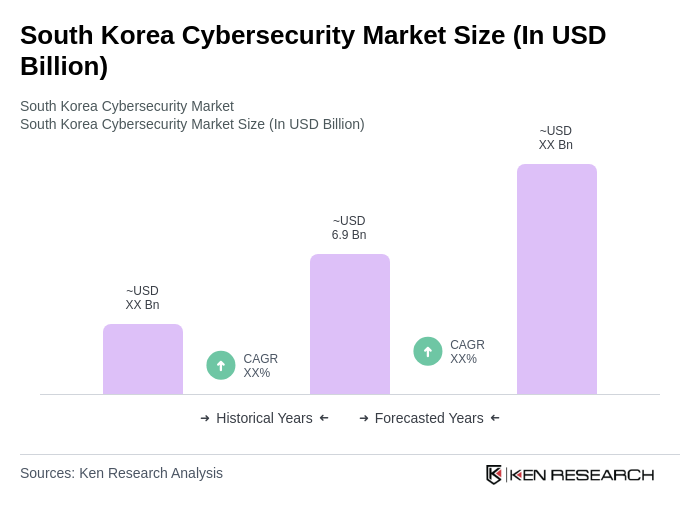
- The South Korea Cybersecurity Market is valued at USD 6.9 billion, based on a five-year historical analysis. This growth is primarily driven by the increasing frequency and sophistication of cyberattacks, ongoing digital transformation such as the adoption of cloud computing and IoT, and the implementation of data privacy regulations among businesses and consumers. The market is characterized by robust demand for advanced security solutions to protect sensitive information and critical infrastructure .
- Seoul, as the capital and largest city, dominates the South Korean cybersecurity market due to its concentration of technology firms, government agencies, and financial institutions. Other significant cities include Busan and Incheon, which are also emerging as technology hubs. The presence of major corporations and a strong government focus on cybersecurity initiatives further solidify South Korea's position as a leader in this sector .
- The Act on the Promotion of Information and Communications Network Utilization and Information Protection, etc. (ICNA), as amended by the Ministry of Science and ICT, requires all critical infrastructure sectors—including energy, transportation, and finance—to implement stringent cybersecurity measures. This regulation mandates the adoption of technical and managerial safeguards, incident reporting, and periodic security assessments to enhance national security and protect against cyber threats (ICNA, Ministry of Science and ICT, last amended 2023) .
South Korea Cybersecurity Market Segmentation
By Type:The market is segmented into various types of cybersecurity solutions, including Network Security, Application Security, Endpoint Security, Cloud Security, Data Security, Identity and Access Management, Infrastructure Security, Threat Intelligence, and Others. Each of these segments plays a crucial role in addressing specific security challenges faced by organizations .
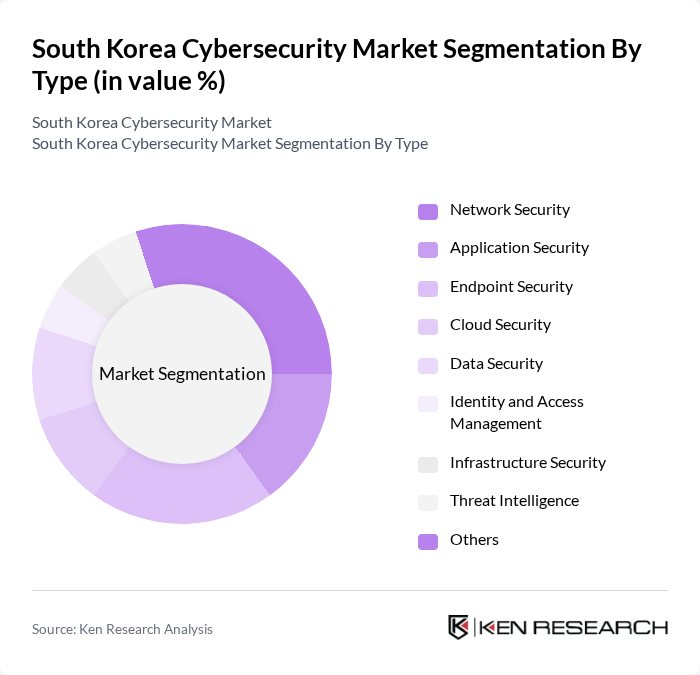
TheNetwork Securitysegment is currently dominating the market due to the increasing number of cyber threats targeting organizational networks. Companies are investing heavily in firewalls, intrusion detection systems, and other network protection technologies to safeguard their data and infrastructure. The rise of remote work, cloud services, and the proliferation of IoT devices has further amplified the need for robust network security solutions, making it a priority for businesses across various sectors .
South Korea Cybersecurity Market Segmentation
By End-User:The market is segmented by end-users, including Government, Financial Services (BFSI), Healthcare and Life Sciences, Retail, Manufacturing, Education, IT & Telecom, Energy and Utilities, Transportation, and Others. Each sector has unique cybersecurity needs and regulatory requirements that drive the demand for tailored solutions .
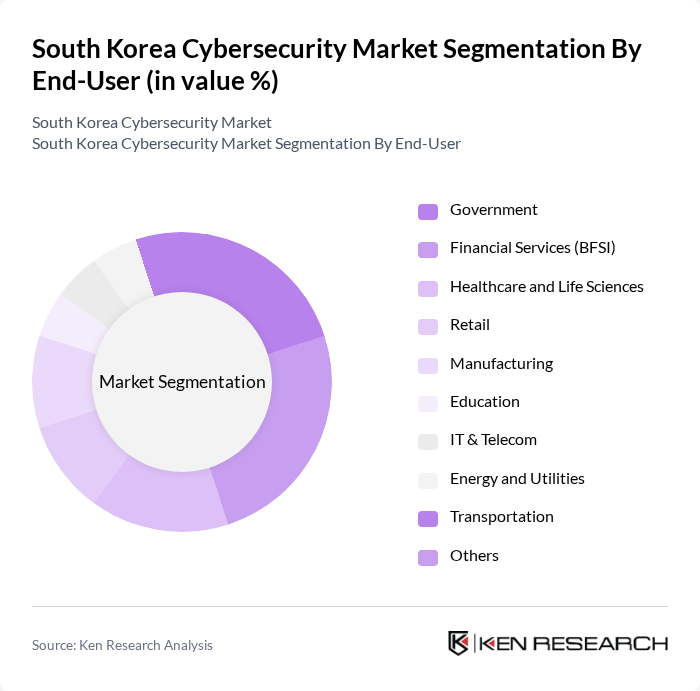
TheFinancial Services (BFSI)sector is the leading end-user in the cybersecurity market, driven by the need to protect sensitive financial data and comply with stringent regulations. With the increasing digitization of banking services and the rise of online transactions, financial institutions are prioritizing cybersecurity investments to mitigate risks associated with data breaches and fraud. This sector's high-value transactions and sensitive information make it a prime target for cybercriminals, necessitating advanced security measures .
South Korea Cybersecurity Market Competitive Landscape
The South Korea Cybersecurity Market is characterized by a dynamic mix of regional and international players. Leading participants such as Samsung SDS, SK shieldus (formerly SK Infosec), LG CNS, Hanwha Vision (formerly Hanwha Techwin), AhnLab, Softcamp, Penta Security Systems, Inca Internet, SecuLetter, S-1 Corporation, Duzon Bizon, IBM Korea, KT Corporation, Daou Technology, and Fortinet Korea contribute to innovation, geographic expansion, and service delivery in this space .
South Korea Cybersecurity Market Industry Analysis
Growth Drivers
- Increasing Cyber Threats:The South Korean cybersecurity landscape is significantly influenced by the rise in cyber threats, with reported incidents increasing by 30% in future, totaling over 1.3 million attacks. This surge is driven by sophisticated ransomware and phishing schemes targeting both public and private sectors. The government has allocated approximately $1.6 billion for cybersecurity enhancements in future, reflecting the urgent need for robust security measures to protect critical infrastructure and sensitive data.
- Government Initiatives and Investments:The South Korean government is actively investing in cybersecurity, with a projected budget of $1.3 billion in future aimed at strengthening national defenses. Initiatives include the establishment of the Cybersecurity Management Act, which mandates compliance for organizations handling personal data. This regulatory framework is expected to drive demand for cybersecurity solutions, as businesses seek to align with government standards and protect against potential penalties associated with non-compliance.
- Rising Demand for Cloud Security Solutions:As organizations increasingly migrate to cloud environments, the demand for cloud security solutions is surging. In future, the cloud security market in South Korea is expected to reach $900 million, driven by the need for secure data storage and compliance with regulations. This trend is further supported by the growth of remote work, which has necessitated enhanced security measures to protect sensitive information accessed from various locations and devices.
Market Challenges
- Shortage of Skilled Cybersecurity Professionals:The South Korean cybersecurity sector faces a critical shortage of skilled professionals, with an estimated gap of 60,000 cybersecurity experts in future. This shortage hampers organizations' ability to implement effective security measures and respond to incidents promptly. The lack of qualified personnel is exacerbated by the rapid evolution of cyber threats, making it challenging for existing staff to keep pace with necessary skills and knowledge.
- High Costs of Cybersecurity Solutions:The financial burden of implementing comprehensive cybersecurity solutions poses a significant challenge for many organizations. In future, the average cost of cybersecurity software and services is projected to exceed $250 million for large enterprises. Smaller businesses, in particular, struggle to allocate sufficient budgets for necessary security measures, leading to vulnerabilities that can be exploited by cybercriminals, ultimately affecting their operational integrity.
South Korea Cybersecurity Market Future Outlook
The South Korean cybersecurity market is poised for significant evolution, driven by technological advancements and regulatory pressures. The shift towards zero trust security models is expected to redefine security architectures, enhancing protection against sophisticated threats. Additionally, the integration of artificial intelligence in cybersecurity solutions will likely improve threat detection and response times. As organizations prioritize compliance with stringent regulations, the demand for innovative security solutions will continue to grow, fostering a more resilient cybersecurity landscape in the coming years.
Market Opportunities
- Expansion of IoT Devices:The proliferation of IoT devices in South Korea presents a substantial market opportunity, with over 35 million connected devices expected in future. This growth necessitates enhanced security measures to protect against vulnerabilities inherent in IoT ecosystems, driving demand for specialized cybersecurity solutions tailored to these devices.
- Increased Investment in AI and Machine Learning:The integration of AI and machine learning in cybersecurity is gaining traction, with investments projected to reach $600 million in future. These technologies enhance threat detection capabilities and automate responses, providing organizations with advanced tools to combat evolving cyber threats effectively, thereby creating a robust market opportunity.
Scope of the Report
| Segment | Sub-Segments |
|---|---|
| By Type | Network Security Application Security Endpoint Security Cloud Security Data Security Identity and Access Management Infrastructure Security Threat Intelligence Others |
| By End-User | Government Financial Services (BFSI) Healthcare and Life Sciences Retail Manufacturing Education IT & Telecom Energy and Utilities Transportation Others |
| By Deployment Mode | On-Premises Cloud-Based Hybrid |
| By Service Type | Consulting Services Managed Security Services Training and Education Implementation & Integration |
| By Industry Vertical | BFSI Government Healthcare and Life Sciences Aerospace and Defense Manufacturing IT & Telecom Energy and Utilities Transportation Media and Entertainment Others |
| By Security Type | Infrastructure Security Application Security Endpoint Security Cloud Security Data Security Threat Intelligence Incident Response Vulnerability Management |
| By Policy Support | Compliance Solutions Risk Management Frameworks Security Audits |
Key Target Audience
Investors and Venture Capitalist Firms
Government and Regulatory Bodies (e.g., Ministry of Science and ICT, Korea Internet & Security Agency)
Telecommunications Companies
Financial Services Institutions
Healthcare Organizations
Critical Infrastructure Operators
Cybersecurity Solution Providers
Insurance Companies
Players Mentioned in the Report:
Samsung SDS
SK shieldus (formerly SK Infosec)
LG CNS
Hanwha Vision (formerly Hanwha Techwin)
AhnLab
Softcamp
Penta Security Systems
Inca Internet
SecuLetter
S-1 Corporation
Duzon Bizon
IBM Korea
KT Corporation
Daou Technology
Fortinet Korea
Table of Contents
Market Assessment Phase
1. Executive Summary and Approach
2. South Korea Cybersecurity Market Overview
2.1 Key Insights and Strategic Recommendations
2.2 South Korea Cybersecurity Market Overview
2.3 Definition and Scope
2.4 Evolution of Market Ecosystem
2.5 Timeline of Key Regulatory Milestones
2.6 Value Chain & Stakeholder Mapping
2.7 Business Cycle Analysis
2.8 Policy & Incentive Landscape
3. South Korea Cybersecurity Market Analysis
3.1 Growth Drivers
3.1.1 Increasing Cyber Threats
3.1.2 Government Initiatives and Investments
3.1.3 Rising Demand for Cloud Security Solutions
3.1.4 Growing Awareness of Data Privacy Regulations
3.2 Market Challenges
3.2.1 Shortage of Skilled Cybersecurity Professionals
3.2.2 High Costs of Cybersecurity Solutions
3.2.3 Rapidly Evolving Cyber Threat Landscape
3.2.4 Integration Issues with Legacy Systems
3.3 Market Opportunities
3.3.1 Expansion of IoT Devices
3.3.2 Increased Investment in AI and Machine Learning
3.3.3 Growth of Managed Security Services
3.3.4 Demand for Compliance Solutions
3.4 Market Trends
3.4.1 Shift Towards Zero Trust Security Models
3.4.2 Adoption of Cybersecurity Mesh Architecture
3.4.3 Increased Focus on Endpoint Security
3.4.4 Rise of Cyber Insurance
3.5 Government Regulation
3.5.1 Personal Information Protection Act (PIPA)
3.5.2 Cybersecurity Management Act
3.5.3 National Cybersecurity Strategy
3.5.4 Data Breach Notification Requirements
4. SWOT Analysis
5. Stakeholder Analysis
6. Porter's Five Forces Analysis
7. South Korea Cybersecurity Market Market Size, 2019-2024
7.1 By Value
7.2 By Volume
7.3 By Average Selling Price
8. South Korea Cybersecurity Market Segmentation
8.1 By Type
8.1.1 Network Security
8.1.2 Application Security
8.1.3 Endpoint Security
8.1.4 Cloud Security
8.1.5 Data Security
8.1.6 Identity and Access Management
8.1.7 Infrastructure Security
8.1.8 Threat Intelligence
8.1.9 Others
8.2 By End-User
8.2.1 Government
8.2.2 Financial Services (BFSI)
8.2.3 Healthcare and Life Sciences
8.2.4 Retail
8.2.5 Manufacturing
8.2.6 Education
8.2.7 IT & Telecom
8.2.8 Energy and Utilities
8.2.9 Transportation
8.2.10 Others
8.3 By Deployment Mode
8.3.1 On-Premises
8.3.2 Cloud-Based
8.3.3 Hybrid
8.4 By Service Type
8.4.1 Consulting Services
8.4.2 Managed Security Services
8.4.3 Training and Education
8.4.4 Implementation & Integration
8.5 By Industry Vertical
8.5.1 BFSI
8.5.2 Government
8.5.3 Healthcare and Life Sciences
8.5.4 Aerospace and Defense
8.5.5 Manufacturing
8.5.6 IT & Telecom
8.5.7 Energy and Utilities
8.5.8 Transportation
8.5.9 Media and Entertainment
8.5.10 Others
8.6 By Security Type
8.6.1 Infrastructure Security
8.6.2 Application Security
8.6.3 Endpoint Security
8.6.4 Cloud Security
8.6.5 Data Security
8.6.6 Threat Intelligence
8.6.7 Incident Response
8.6.8 Vulnerability Management
8.7 By Policy Support
8.7.1 Compliance Solutions
8.7.2 Risk Management Frameworks
8.7.3 Security Audits
9. South Korea Cybersecurity Market Competitive Analysis
9.1 Market Share of Key Players
9.2 Cross Comparison of Key Players
9.2.1 Company Name
9.2.2 Group Size (Large, Medium, or Small as per industry convention)
9.2.3 Revenue (KRW/USD, Most Recent Fiscal Year)
9.2.4 Revenue Growth Rate (YoY %)
9.2.5 Market Share (%)
9.2.6 Number of Employees
9.2.7 Customer Segments (e.g., BFSI, Government, Healthcare)
9.2.8 Product/Service Portfolio Breadth
9.2.9 R&D Investment (% of Revenue)
9.2.10 Customer Retention Rate (%)
9.2.11 Market Penetration Rate (%)
9.2.12 Average Deal Size (KRW/USD)
9.2.13 Pricing Strategy (Premium, Value, Volume)
9.2.14 Customer Acquisition Cost (KRW/USD)
9.2.15 Return on Investment (ROI, %)
9.2.16 Net Promoter Score (NPS)
9.3 SWOT Analysis of Top Players
9.4 Pricing Analysis
9.5 Detailed Profile of Major Companies
9.5.1 Samsung SDS
9.5.2 SK shieldus (formerly SK Infosec)
9.5.3 LG CNS
9.5.4 Hanwha Vision (formerly Hanwha Techwin)
9.5.5 AhnLab
9.5.6 Softcamp
9.5.7 Penta Security Systems
9.5.8 Inca Internet
9.5.9 SecuLetter
9.5.10 S-1 Corporation
9.5.11 Duzon Bizon
9.5.12 IBM Korea
9.5.13 KT Corporation
9.5.14 Daou Technology
9.5.15 Fortinet Korea
10. South Korea Cybersecurity Market End-User Analysis
10.1 Procurement Behavior of Key Ministries
10.1.1 Ministry of Science and ICT
10.1.2 Ministry of Interior and Safety
10.1.3 Ministry of Defense
10.2 Corporate Spend on Infrastructure & Energy
10.2.1 IT Infrastructure Investments
10.2.2 Cybersecurity Training Budgets
10.2.3 Compliance and Regulatory Spending
10.3 Pain Point Analysis by End-User Category
10.3.1 Data Breaches
10.3.2 Compliance Challenges
10.3.3 Resource Limitations
10.4 User Readiness for Adoption
10.4.1 Awareness Levels
10.4.2 Training and Skill Development
10.4.3 Technology Adoption Rates
10.5 Post-Deployment ROI and Use Case Expansion
10.5.1 Performance Metrics
10.5.2 Use Case Diversification
10.5.3 Long-term Value Realization
11. South Korea Cybersecurity Market Future Size, 2025-2030
11.1 By Value
11.2 By Volume
11.3 By Average Selling Price
Go-To-Market Strategy Phase
1. Whitespace Analysis + Business Model Canvas
1.1 Market Gaps Identification
1.2 Business Model Framework
2. Marketing and Positioning Recommendations
2.1 Branding Strategies
2.2 Product USPs
3. Distribution Plan
3.1 Urban Retail Strategies
3.2 Rural NGO Tie-ups
4. Channel & Pricing Gaps
4.1 Underserved Routes
4.2 Pricing Bands
5. Unmet Demand & Latent Needs
5.1 Category Gaps
5.2 Consumer Segments
6. Customer Relationship
6.1 Loyalty Programs
6.2 After-sales Service
7. Value Proposition
7.1 Sustainability
7.2 Integrated Supply Chains
8. Key Activities
8.1 Regulatory Compliance
8.2 Branding
8.3 Distribution Setup
9. Entry Strategy Evaluation
9.1 Domestic Market Entry Strategy
9.1.1 Product Mix
9.1.2 Pricing Band
9.1.3 Packaging
9.2 Export Entry Strategy
9.2.1 Target Countries
9.2.2 Compliance Roadmap
10. Entry Mode Assessment
10.1 Joint Ventures
10.2 Greenfield Investments
10.3 Mergers & Acquisitions
10.4 Distributor Model
11. Capital and Timeline Estimation
11.1 Capital Requirements
11.2 Timelines
12. Control vs Risk Trade-Off
12.1 Ownership vs Partnerships
13. Profitability Outlook
13.1 Breakeven Analysis
13.2 Long-term Sustainability
14. Potential Partner List
14.1 Distributors
14.2 Joint Ventures
14.3 Acquisition Targets
15. Execution Roadmap
15.1 Phased Plan for Market Entry
15.1.1 Market Setup
15.1.2 Market Entry
15.1.3 Growth Acceleration
15.1.4 Scale & Stabilize
15.2 Key Activities and Milestones
15.2.1 Activity Timeline
15.2.2 Milestone Tracking
Research Methodology
Phase 1: Approach1
Desk Research
- Analysis of government publications and cybersecurity policies from the Ministry of Science and ICT
- Review of market reports from industry associations such as the Korea Internet & Security Agency (KISA)
- Examination of academic journals and white papers focusing on cybersecurity trends in South Korea
Primary Research
- Interviews with cybersecurity experts and consultants in South Korea
- Surveys targeting IT security managers across various sectors including finance, healthcare, and manufacturing
- Focus groups with end-users to understand perceptions and experiences regarding cybersecurity solutions
Validation & Triangulation
- Cross-validation of findings with data from international cybersecurity frameworks and standards
- Triangulation of insights from primary interviews with secondary data trends
- Sanity checks through expert panel reviews comprising industry veterans and academic researchers
Phase 2: Market Size Estimation1
Top-down Assessment
- Estimation of total cybersecurity spending based on national IT expenditure reports
- Segmentation of the market by industry verticals and types of cybersecurity solutions
- Incorporation of government initiatives aimed at enhancing national cybersecurity infrastructure
Bottom-up Modeling
- Data collection from leading cybersecurity firms regarding their revenue and service offerings
- Estimation of market penetration rates for various cybersecurity technologies
- Volume x pricing analysis for managed security services and software solutions
Forecasting & Scenario Analysis
- Multi-factor regression analysis incorporating factors such as cyber threat landscape and regulatory changes
- Scenario modeling based on potential shifts in technology adoption and investment trends
- Baseline, optimistic, and pessimistic forecasts through 2030 based on historical growth rates
Phase 3: CATI Sample Composition1
| Scope Item/Segment | Sample Size | Target Respondent Profiles |
|---|---|---|
| Financial Sector Cybersecurity | 100 | IT Security Managers, Compliance Officers |
| Healthcare Cybersecurity Solutions | 60 | Chief Information Officers, Data Protection Officers |
| Manufacturing Cybersecurity Practices | 50 | Operations Managers, IT Directors |
| Government Cybersecurity Initiatives | 40 | Policy Makers, Cybersecurity Analysts |
| SME Cybersecurity Awareness | 70 | Business Owners, IT Consultants |
Frequently Asked Questions
What is the current value of the South Korea Cybersecurity Market?
The South Korea Cybersecurity Market is valued at approximately USD 6.9 billion, reflecting significant growth driven by increasing cyber threats, digital transformation, and stringent data privacy regulations.
What factors are driving growth in the South Korea Cybersecurity Market?
Which city is the largest market for cybersecurity in South Korea?
What are the main types of cybersecurity solutions in South Korea?
Other Adjacent Reports
South Africa Digital Payment Market
UAE IT Outsourcing MarketWhy Buy From Us?

What makes us stand out is that our consultants follow Robust, Refine and Result (RRR) methodology. Robust for clear definitions, approaches and sanity checking, Refine for differentiating respondents' facts and opinions, and Result for presenting data with story.

We have set a benchmark in the industry by offering our clients with syndicated and customized market research reports featuring coverage of entire market as well as meticulous research and analyst insights.

While we don't replace traditional research, we flip the method upside down. Our dual approach of Top Bottom & Bottom Top ensures quality deliverable by not just verifying company fundamentals but also looking at the sector and macroeconomic factors.

With one step in the future, our research team constantly tries to show you the bigger picture. We help with some of the tough questions you may encounter along the way: How is the industry positioned? Best marketing channel? KPI's of competitors? By aligning every element, we help maximize success.

Our report gives you instant access to the answers and sources that other companies might choose to hide. We elaborate each steps of research methodology we have used and showcase you the sample size to earn your trust.

If you need any support, we are here! We pride ourselves on universe strength, data quality, and quick, friendly, and professional service.