About the Report
Base Year 2024Japan Digital Asset Exchanges and Web3 Platforms Market Overview
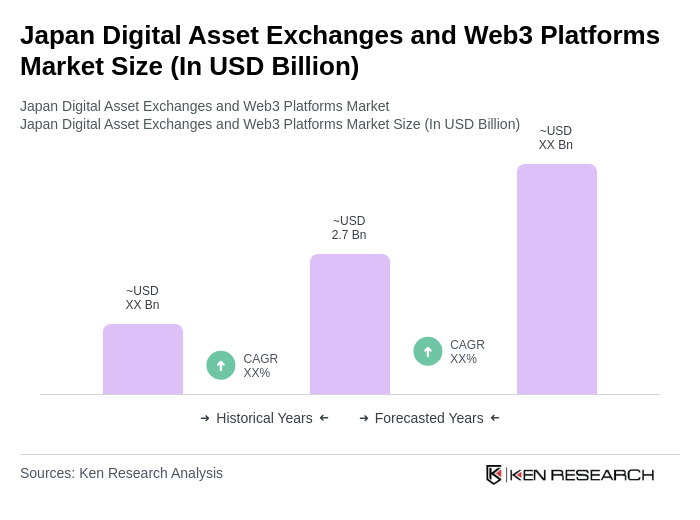
- The Japan Digital Asset Exchanges and Web3 Platforms Market is valued at USD 2.7 billion, based on a five-year historical analysis. This growth is primarily driven by the increasing adoption of cryptocurrencies, advancements in blockchain technology, and a growing interest in decentralized finance (DeFi) solutions. The market has seen a surge in trading volumes and user engagement, reflecting a robust ecosystem for digital assets .
- Key players in this market include Tokyo, Osaka, and Fukuoka, which dominate due to their technological infrastructure, high population density, and a strong financial services sector. These cities are hubs for innovation and investment, attracting both local and international players in the digital asset space, thereby fostering a competitive environment .
- In 2023, the Japanese government implemented a regulatory framework aimed at enhancing the security and transparency of digital asset exchanges. This framework mandates that all exchanges must register with the Financial Services Agency (FSA) and comply with strict anti-money laundering (AML) and know-your-customer (KYC) regulations, as stipulated by the Payment Services Act (amended 2020) issued by the Financial Services Agency of Japan. The Act requires digital asset exchanges to obtain a license, maintain segregated customer assets, and adhere to robust compliance standards .
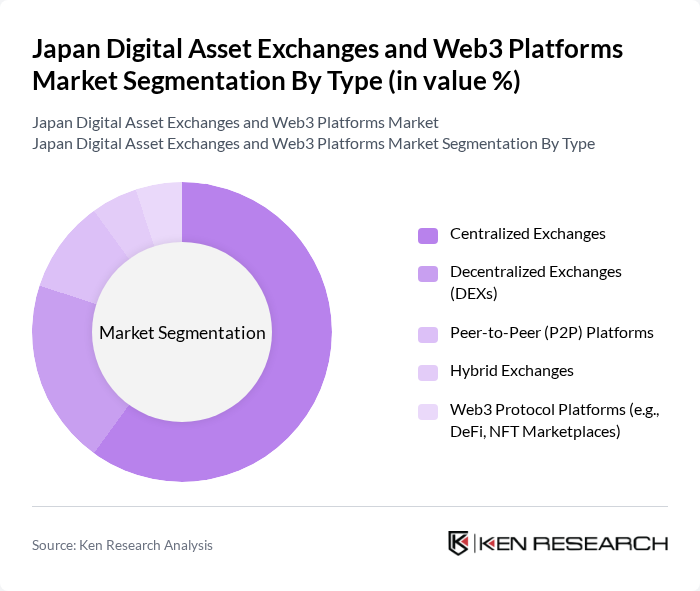
Japan Digital Asset Exchanges and Web3 Platforms Market Segmentation
By Type:The market is segmented into various types of exchanges and platforms that cater to different trading needs and preferences. Centralized exchanges dominate due to their user-friendly interfaces, high liquidity, and regulatory compliance. Decentralized exchanges (DEXs) are gaining traction for their privacy, security, and user control over funds. Peer-to-peer (P2P) platforms facilitate direct transactions between users, appealing to those seeking privacy and lower fees. Hybrid exchanges combine features of both centralized and decentralized models, offering flexibility and enhanced security. Web3 protocol platforms, including DeFi and NFT marketplaces, are emerging as significant players, driven by the growing interest in decentralized applications and tokenization of assets .
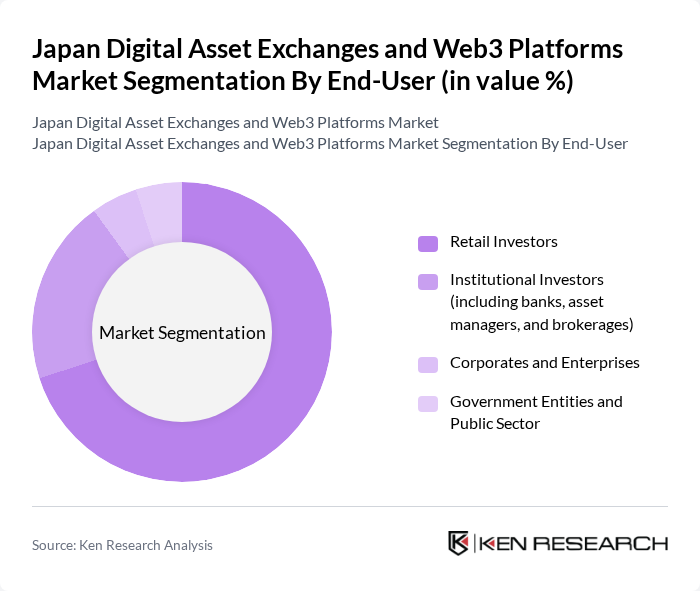
By End-User:The end-user segmentation includes retail investors, institutional investors, corporates, and government entities. Retail investors are the largest segment, driven by the increasing accessibility of digital assets, the rise of mobile trading applications, and a growing interest in wealth management among younger demographics. Institutional investors are also becoming significant players, as they seek to diversify portfolios and capitalize on the growing digital asset market, supported by evolving regulatory clarity. Corporates are exploring blockchain for operational efficiencies, payments, and supply chain transparency, while government entities are focusing on regulatory compliance, digital yen pilots, and public sector applications .
Japan Digital Asset Exchanges and Web3 Platforms Market Competitive Landscape
The Japan Digital Asset Exchanges and Web3 Platforms Market is characterized by a dynamic mix of regional and international players. Leading participants such as bitFlyer, Coincheck, Binance Japan, GMO Coin, DMM Bitcoin, Liquid by FTX Japan, Huobi Japan, OKCoin Japan, Rakuten Wallet, Fisco Cryptocurrency Exchange, Zaif, Bitbank, SBI VC Trade, JPYC Inc., Nomura Holdings / Laser Digital contribute to innovation, geographic expansion, and service delivery in this space.
Japan Digital Asset Exchanges and Web3 Platforms Market Industry Analysis
Growth Drivers
- Increasing Adoption of Cryptocurrencies:The number of cryptocurrency users in Japan reached approximately 5 million, reflecting a significant increase from 2.5 million. This surge is driven by a growing acceptance of digital currencies for transactions, with over 1,000 businesses now accepting Bitcoin. The Bank of Japan's initiatives to explore Central Bank Digital Currency (CBDC) further bolster this trend, indicating a robust shift towards digital asset integration in everyday financial activities.
- Rising Interest in Decentralized Finance (DeFi):The DeFi sector in Japan has seen a remarkable growth, with total value locked (TVL) in DeFi protocols increasing from ¥50 billion to approximately ¥150 billion. This growth is fueled by innovative financial products and services that offer higher yields compared to traditional banking. The increasing number of DeFi platforms, now exceeding 30, showcases the expanding interest among Japanese investors seeking alternative financial solutions.
- Government Support for Blockchain Technology:The Japanese government allocated ¥10 billion to support blockchain technology development, aiming to enhance the country's digital economy. This funding is part of a broader strategy to position Japan as a global leader in blockchain innovation. Additionally, the Financial Services Agency (FSA) has been actively promoting regulatory frameworks that encourage blockchain startups, fostering a conducive environment for digital asset exchanges and Web3 platforms.
Market Challenges
- Regulatory Uncertainty:Japan's regulatory landscape for digital assets remains complex, with ongoing discussions about the classification of cryptocurrencies. The FSA's evolving guidelines have created confusion among exchanges, leading to a decline in new market entrants. In future, only 5 new exchanges were licensed, compared to 10, highlighting the impact of regulatory uncertainty on market growth and innovation.
- Security Concerns and Cyber Threats:The digital asset sector in Japan has faced significant security challenges, with reported cyberattacks leading to losses exceeding ¥20 billion. High-profile incidents, such as the hack of a major exchange, have raised concerns among investors. As a result, exchanges are under pressure to enhance security measures, which can increase operational costs and impact profitability in a competitive market.
Japan Digital Asset Exchanges and Web3 Platforms Market Future Outlook
The future of Japan's digital asset exchanges and Web3 platforms is poised for transformative growth, driven by technological advancements and increasing consumer engagement. As institutional investment continues to rise, with over ¥1 trillion invested in digital assets, the market is likely to see enhanced liquidity and innovation. Furthermore, the integration of AI technologies in trading platforms is expected to optimize trading strategies, making them more efficient and user-friendly, thereby attracting a broader audience.
Market Opportunities
- Growth of Non-Fungible Tokens (NFTs):The NFT market in Japan is projected to reach ¥100 billion, driven by increasing interest in digital art and collectibles. This growth presents opportunities for exchanges to diversify their offerings and attract new users, particularly among younger demographics who are more engaged with digital assets.
- Integration of AI in Trading Platforms:The adoption of AI technologies in trading platforms is expected to enhance user experience and decision-making processes. In future, it is anticipated that 40% of trading platforms will incorporate AI-driven analytics, providing users with personalized insights and improving trading outcomes, thus expanding the user base significantly.
Scope of the Report
| Segment | Sub-Segments |
|---|---|
| By Type | Centralized Exchanges Decentralized Exchanges (DEXs) Peer-to-Peer (P2P) Platforms Hybrid Exchanges Web3 Protocol Platforms (e.g., DeFi, NFT Marketplaces) |
| By End-User | Retail Investors Institutional Investors (including banks, asset managers, and brokerages) Corporates and Enterprises Government Entities and Public Sector |
| By Trading Volume | High Volume Traders (e.g., whales, institutional desks) Medium Volume Traders Low Volume Traders |
| By Asset Class | Cryptocurrencies (e.g., BTC, ETH, XRP) Stablecoins (e.g., JPYC, USDC, USDT) Utility and Security Tokens Non-Fungible Tokens (NFTs) and Other Digital Assets |
| By Payment Method | Bank Transfers (including domestic and international wires) Credit/Debit Cards Digital Wallets (including e-money, prepaid cards) Crypto-to-Crypto Transfers |
| By Geographic Presence | Urban Areas (Tokyo, Osaka, etc.) Rural Areas International Markets (cross-border operations) |
| By Regulatory Compliance | Fully Compliant Exchanges (FSA-licensed) Partially Compliant Exchanges Non-Compliant/Unlicensed Exchanges |
Key Target Audience
Investors and Venture Capitalist Firms
Government and Regulatory Bodies (e.g., Financial Services Agency, Ministry of Finance)
Blockchain Technology Developers
Digital Asset Custodians
Payment Service Providers
Financial Institutions
Industry Associations (e.g., Japan Blockchain Association)
Crypto Exchanges and Trading Platforms
Players Mentioned in the Report:
bitFlyer
Coincheck
Binance Japan
GMO Coin
DMM Bitcoin
Liquid by FTX Japan
Huobi Japan
OKCoin Japan
Rakuten Wallet
Fisco Cryptocurrency Exchange
Zaif
Bitbank
SBI VC Trade
JPYC Inc.
Nomura Holdings / Laser Digital
Table of Contents
Market Assessment Phase
1. Executive Summary and Approach
2. Japan Digital Asset Exchanges and Web3 Platforms Market Overview
2.1 Key Insights and Strategic Recommendations
2.2 Japan Digital Asset Exchanges and Web3 Platforms Market Overview
2.3 Definition and Scope
2.4 Evolution of Market Ecosystem
2.5 Timeline of Key Regulatory Milestones
2.6 Value Chain & Stakeholder Mapping
2.7 Business Cycle Analysis
2.8 Policy & Incentive Landscape
3. Japan Digital Asset Exchanges and Web3 Platforms Market Analysis
3.1 Growth Drivers
3.1.1 Increasing Adoption of Cryptocurrencies
3.1.2 Rising Interest in Decentralized Finance (DeFi)
3.1.3 Government Support for Blockchain Technology
3.1.4 Expansion of Digital Payment Solutions
3.2 Market Challenges
3.2.1 Regulatory Uncertainty
3.2.2 Security Concerns and Cyber Threats
3.2.3 Market Volatility
3.2.4 Limited Consumer Awareness
3.3 Market Opportunities
3.3.1 Growth of Non-Fungible Tokens (NFTs)
3.3.2 Integration of AI in Trading Platforms
3.3.3 Expansion into Emerging Markets
3.3.4 Development of Regulatory Frameworks
3.4 Market Trends
3.4.1 Increased Institutional Investment
3.4.2 Rise of Layer 2 Solutions
3.4.3 Focus on Sustainable Blockchain Practices
3.4.4 Growth of Cross-Chain Interoperability
3.5 Government Regulation
3.5.1 Implementation of the Financial Instruments and Exchange Act
3.5.2 Licensing Requirements for Exchanges
3.5.3 Anti-Money Laundering (AML) Regulations
3.5.4 Consumer Protection Laws
4. SWOT Analysis
5. Stakeholder Analysis
6. Porter's Five Forces Analysis
7. Japan Digital Asset Exchanges and Web3 Platforms Market Market Size, 2019-2024
7.1 By Value
7.2 By Volume
7.3 By Average Selling Price
8. Japan Digital Asset Exchanges and Web3 Platforms Market Segmentation
8.1 By Type
8.1.1 Centralized Exchanges
8.1.2 Decentralized Exchanges (DEXs)
8.1.3 Peer-to-Peer (P2P) Platforms
8.1.4 Hybrid Exchanges
8.1.5 Web3 Protocol Platforms (e.g., DeFi, NFT Marketplaces)
8.2 By End-User
8.2.1 Retail Investors
8.2.2 Institutional Investors (including banks, asset managers, and brokerages)
8.2.3 Corporates and Enterprises
8.2.4 Government Entities and Public Sector
8.3 By Trading Volume
8.3.1 High Volume Traders (e.g., whales, institutional desks)
8.3.2 Medium Volume Traders
8.3.3 Low Volume Traders
8.4 By Asset Class
8.4.1 Cryptocurrencies (e.g., BTC, ETH, XRP)
8.4.2 Stablecoins (e.g., JPYC, USDC, USDT)
8.4.3 Utility and Security Tokens
8.4.4 Non-Fungible Tokens (NFTs) and Other Digital Assets
8.5 By Payment Method
8.5.1 Bank Transfers (including domestic and international wires)
8.5.2 Credit/Debit Cards
8.5.3 Digital Wallets (including e-money, prepaid cards)
8.5.4 Crypto-to-Crypto Transfers
8.6 By Geographic Presence
8.6.1 Urban Areas (Tokyo, Osaka, etc.)
8.6.2 Rural Areas
8.6.3 International Markets (cross-border operations)
8.7 By Regulatory Compliance
8.7.1 Fully Compliant Exchanges (FSA-licensed)
8.7.2 Partially Compliant Exchanges
8.7.3 Non-Compliant/Unlicensed Exchanges
9. Japan Digital Asset Exchanges and Web3 Platforms Market Competitive Analysis
9.1 Market Share of Key Players
9.2 Cross Comparison of Key Players
9.2.1 Company Name
9.2.2 Group Size (Large, Medium, or Small as per industry convention)
9.2.3 Total Trading Volume (annual, in JPY or USD)
9.2.4 Number of Active Users
9.2.5 User Growth Rate (YoY %)
9.2.6 Market Penetration Rate (share of Japan digital asset user base)
9.2.7 Customer Retention Rate (%)
9.2.8 Revenue Growth Rate (YoY %)
9.2.9 Average Transaction Fee (%)
9.2.10 Customer Satisfaction Score (NPS or equivalent)
9.2.11 Number of Listed Assets (tokens, coins, NFTs)
9.2.12 Regulatory Compliance Status (FSA license, etc.)
9.2.13 Security Incidents (reported breaches, if any)
9.2.14 Institutional Client Share (%)
9.3 SWOT Analysis of Top Players
9.4 Pricing Analysis
9.5 Detailed Profile of Major Companies
9.5.1 bitFlyer
9.5.2 Coincheck
9.5.3 Binance Japan
9.5.4 GMO Coin
9.5.5 DMM Bitcoin
9.5.6 Liquid by FTX Japan
9.5.7 Huobi Japan
9.5.8 OKCoin Japan
9.5.9 Rakuten Wallet
9.5.10 Fisco Cryptocurrency Exchange
9.5.11 Zaif
9.5.12 Bitbank
9.5.13 SBI VC Trade
9.5.14 JPYC Inc.
9.5.15 Nomura Holdings / Laser Digital
10. Japan Digital Asset Exchanges and Web3 Platforms Market End-User Analysis
10.1 Procurement Behavior of Key Ministries
10.1.1 Digital Asset Management Strategies
10.1.2 Budget Allocation for Blockchain Initiatives
10.1.3 Collaboration with Private Sector
10.2 Corporate Spend on Infrastructure & Energy
10.2.1 Investment in Blockchain Infrastructure
10.2.2 Spending on Cybersecurity Measures
10.2.3 Budget for Training and Development
10.3 Pain Point Analysis by End-User Category
10.3.1 Security Concerns
10.3.2 Regulatory Compliance Issues
10.3.3 Lack of User-Friendly Interfaces
10.4 User Readiness for Adoption
10.4.1 Awareness of Digital Assets
10.4.2 Technical Proficiency
10.4.3 Trust in Digital Platforms
10.5 Post-Deployment ROI and Use Case Expansion
10.5.1 Measurement of ROI
10.5.2 Expansion into New Use Cases
10.5.3 Long-term Value Creation
11. Japan Digital Asset Exchanges and Web3 Platforms Market Future Size, 2025-2030
11.1 By Value
11.2 By Volume
11.3 By Average Selling Price
Go-To-Market Strategy Phase
1. Whitespace Analysis + Business Model Canvas
1.1 Market Gaps Identification
1.2 Business Model Development
2. Marketing and Positioning Recommendations
2.1 Branding Strategies
2.2 Product USPs
3. Distribution Plan
3.1 Urban Retail vs Rural NGO Tie-ups
4. Channel & Pricing Gaps
4.1 Underserved Routes
4.2 Pricing Bands
5. Unmet Demand & Latent Needs
5.1 Category Gaps
5.2 Consumer Segments
6. Customer Relationship
6.1 Loyalty Programs
6.2 After-sales Service
7. Value Proposition
7.1 Sustainability
7.2 Integrated Supply Chains
8. Key Activities
8.1 Regulatory Compliance
8.2 Branding
8.3 Distribution Setup
9. Entry Strategy Evaluation
9.1 Domestic Market Entry Strategy
9.1.1 Product Mix
9.1.2 Pricing Band
9.1.3 Packaging
9.2 Export Entry Strategy
9.2.1 Target Countries
9.2.2 Compliance Roadmap
10. Entry Mode Assessment
10.1 JV
10.2 Greenfield
10.3 M&A
10.4 Distributor Model
11. Capital and Timeline Estimation
11.1 Capital Requirements
11.2 Timelines
12. Control vs Risk Trade-Off
12.1 Ownership vs Partnerships
13. Profitability Outlook
13.1 Breakeven Analysis
13.2 Long-term Sustainability
14. Potential Partner List
14.1 Distributors
14.2 JVs
14.3 Acquisition Targets
15. Execution Roadmap
15.1 Phased Plan for Market Entry
15.1.1 Market Setup
15.1.2 Market Entry
15.1.3 Growth Acceleration
15.1.4 Scale & Stabilize
15.2 Key Activities and Milestones
15.2.1 Activity Planning
15.2.2 Milestone Tracking
Research Methodology
Phase 1: Approach1
Desk Research
- Analysis of regulatory frameworks governing digital assets in Japan
- Review of market reports and white papers on Web3 technologies
- Examination of transaction volumes and user demographics from major exchanges
Primary Research
- Interviews with executives from leading digital asset exchanges
- Surveys targeting developers and users of Web3 platforms
- Focus groups with investors and crypto enthusiasts in Japan
Validation & Triangulation
- Cross-validation of findings with industry expert opinions
- Triangulation of data from regulatory bodies and market participants
- Sanity checks through comparative analysis with global market trends
Phase 2: Market Size Estimation1
Top-down Assessment
- Estimation of total market size based on national cryptocurrency adoption rates
- Segmentation by asset class, including NFTs, cryptocurrencies, and DeFi products
- Incorporation of macroeconomic indicators influencing digital asset investments
Bottom-up Modeling
- Data collection from transaction volumes reported by exchanges
- Analysis of user growth rates and average transaction values
- Estimation of revenue streams from trading fees and ancillary services
Forecasting & Scenario Analysis
- Multi-variable forecasting based on technological advancements and regulatory changes
- Scenario modeling considering bullish and bearish market conditions
- Projections for market growth through 2025 and beyond
Phase 3: CATI Sample Composition1
| Scope Item/Segment | Sample Size | Target Respondent Profiles |
|---|---|---|
| Digital Asset Exchange Users | 120 | Retail Investors, Crypto Traders |
| Web3 Platform Developers | 90 | Software Engineers, Product Managers |
| Institutional Investors in Crypto | 60 | Portfolio Managers, Financial Analysts |
| Regulatory Bodies and Compliance Officers | 40 | Legal Advisors, Compliance Managers |
| Blockchain Technology Experts | 70 | Research Analysts, Technology Consultants |
Frequently Asked Questions
What is the current value of the Japan Digital Asset Exchanges and Web3 Platforms Market?
The Japan Digital Asset Exchanges and Web3 Platforms Market is valued at approximately USD 2.7 billion, reflecting significant growth driven by increased cryptocurrency adoption, advancements in blockchain technology, and rising interest in decentralized finance (DeFi) solutions.
Which cities are the main hubs for digital asset exchanges in Japan?
What regulatory framework governs digital asset exchanges in Japan?
How has the adoption of cryptocurrencies changed in Japan?
Other Regional/Country Reports
Indonesia Digital Asset Exchanges and Web3 Platforms Market
Malaysia Digital Asset Exchanges and Web3 Platforms Market
KSA Digital Asset Exchanges and Web3 Platforms Market
APAC Digital Asset Exchanges and Web3 Platforms Market
SEA Digital Asset Exchanges and Web3 Platforms Market
Vietnam Digital Asset Exchanges and Web3 Platforms Market
Other Adjacent Reports
Germany Non-Fungible Token Market
Comoros Fintech MarketIndonesia Cybersecurity Market Size, Share & Forecast, By Solution Type, Deployment Model & End-Use Industry, 2025-2032GCC regulatory technology market size, share, growth drivers, trends, opportunities & forecast 2025–2030Thailand Digital Wallet Market
Bahrain AI in Finance Market
Japan Web3 Gaming Market
Why Buy From Us?

What makes us stand out is that our consultants follow Robust, Refine and Result (RRR) methodology. Robust for clear definitions, approaches and sanity checking, Refine for differentiating respondents' facts and opinions, and Result for presenting data with story.

We have set a benchmark in the industry by offering our clients with syndicated and customized market research reports featuring coverage of entire market as well as meticulous research and analyst insights.

While we don't replace traditional research, we flip the method upside down. Our dual approach of Top Bottom & Bottom Top ensures quality deliverable by not just verifying company fundamentals but also looking at the sector and macroeconomic factors.

With one step in the future, our research team constantly tries to show you the bigger picture. We help with some of the tough questions you may encounter along the way: How is the industry positioned? Best marketing channel? KPI's of competitors? By aligning every element, we help maximize success.

Our report gives you instant access to the answers and sources that other companies might choose to hide. We elaborate each steps of research methodology we have used and showcase you the sample size to earn your trust.

If you need any support, we are here! We pride ourselves on universe strength, data quality, and quick, friendly, and professional service.