About the Report
Base Year 2024Japan Flat Flexible Cables Market Overview
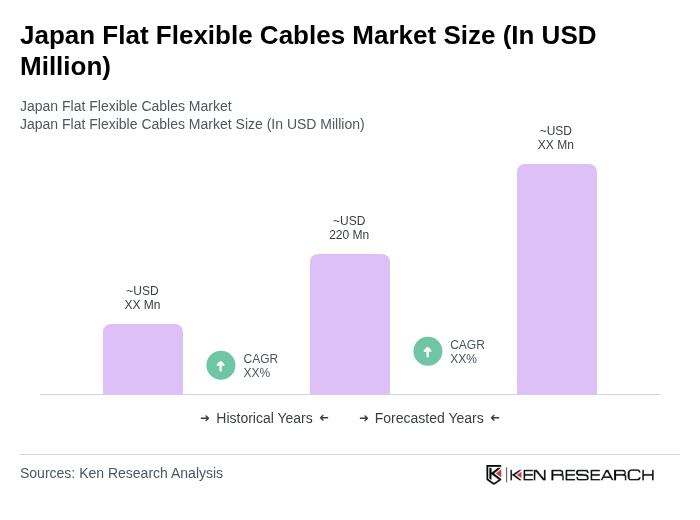
- The Japan Flat Flexible Cables Market is valued at USD 220 million, based on a five-year historical analysis and Japan’s share within the Asia Pacific and global flat flexible cables market. This growth is primarily driven by the increasing demand for compact and lightweight wiring solutions in consumer electronics, automotive, and industrial applications, in line with the broader global trend toward miniaturized electronic devices and enhanced automotive electronics. The rise in automation and the need for efficient power transmission and signal integrity in robotics, factory automation equipment, and high?density electronic assemblies have further fueled the market's expansion.
- Key cities such as Tokyo, Osaka, and Nagoya dominate the market due to their robust industrial base and technological advancements. These urban centers are home to numerous electronics manufacturers and automotive OEMs, which significantly contribute to the demand for flat flexible cables, as Japan remains a major hub for consumer electronics, automotive components, and industrial equipment within Asia Pacific. The concentration of innovation and manufacturing capabilities in these regions enhances their market leadership, supported by strong ecosystems in semiconductors, displays, automotive electrification, and precision machinery.
- In 2023, the Japanese government implemented regulations mandating the use of environmentally friendly materials in electrical components, including flat flexible cables, through measures such as the Act on Promotion of Effective Utilization of Resources, 2000 (revised by the Ministry of Economy, Trade and Industry) and the Act on the Reduction of the Environmental Impact of Electrical and Electronic Equipment, 2019, which promote resource efficiency and restrict hazardous substances in electrical and electronic products. This initiative aims to promote sustainability and reduce the environmental impact of electronic waste, encouraging manufacturers to adopt greener practices in their production processes, including halogen?reduced insulations, compliant soldering materials, and improved recyclability of cable components.
Japan Flat Flexible Cables Market Segmentation
By Cable Type:The market is segmented into Shielded Flat Flexible Cables and Unshielded Flat Flexible Cables. Shielded cables are preferred in applications requiring protection against electromagnetic interference, while unshielded cables are commonly used in less sensitive environments, such as basic consumer devices and internal connections where EMI exposure is limited.
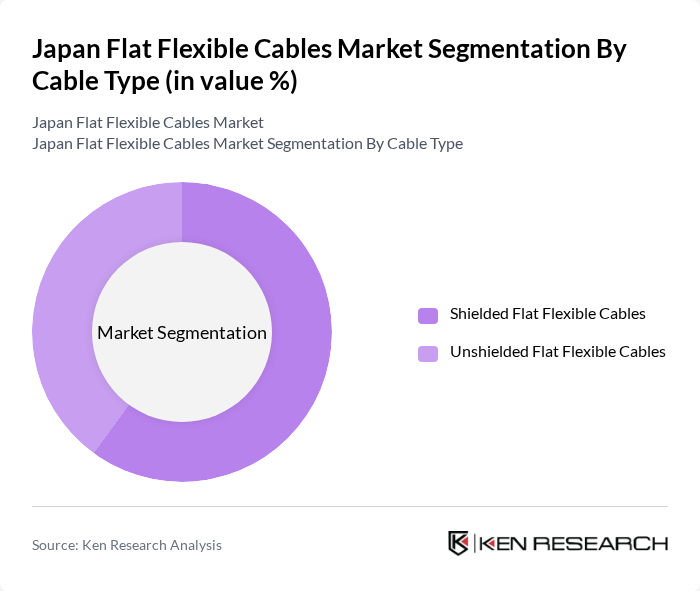
The Shielded Flat Flexible Cables segment is currently leading the market due to their essential role in applications that require protection from electromagnetic interference, such as in automotive infotainment, ADAS modules, and industrial automation control systems. The increasing complexity of electronic devices and the need for reliable performance in high?speed data transmission, compact displays, and densely packed circuit assemblies have driven the demand for shielded cables. As industries continue to prioritize safety, signal integrity, and functional reliability, this segment is expected to maintain its dominance.
By Pitch Size:The market is segmented into 0.500 mm Pitches, 1.00 mm Pitches, 1.250 mm Pitches, and Others. The choice of pitch size is crucial for ensuring compatibility with various electronic components and devices, with finer pitches typically used in compact consumer electronics and larger pitches favored in automotive and industrial modules.

The 1.00 mm Pitches segment is the most significant in the market, primarily due to its widespread application in consumer electronics and automotive industries, where it offers a practical balance between current?carrying capacity, mechanical robustness, and board?level density. This pitch size strikes a balance between flexibility and performance, making it suitable for devices such as televisions, office equipment, in?vehicle infotainment, and instrument clusters. As manufacturers continue to innovate and develop compact electronic solutions, particularly in smart appliances and electrified vehicles, the demand for 1.00 mm pitch cables is expected to grow, reinforcing its market leadership.
Japan Flat Flexible Cables Market Competitive Landscape
The Japan Flat Flexible Cables Market is characterized by a dynamic mix of regional and international players. Leading participants such as Fujikura Ltd., Sumitomo Electric Industries, Ltd., Hitachi Metals, Ltd., Nitto Denko Corporation, Mitsubishi Electric Corporation, Yazaki Corporation, Japan Aviation Electronics Industry, Ltd. (JAE), KMEW Co., Ltd., Kanto Denka Kogyo Co., Ltd., Kyocera Corporation, TDK Corporation, Daikin Industries, Ltd., Oki Electric Industry Co., Ltd., Asahi Kasei Corporation, Aisin Corporation contribute to innovation, geographic expansion, and service delivery in this space.
Japan Flat Flexible Cables Market Industry Analysis
Growth Drivers
- Increasing Demand for Lightweight and Flexible Wiring Solutions:The demand for lightweight and flexible wiring solutions in Japan is driven by the growing need for compact and efficient designs in consumer electronics. In future, the consumer electronics sector is projected to reach ¥12 trillion, with flat flexible cables playing a crucial role in reducing weight and enhancing performance. This trend is further supported by the increasing miniaturization of devices, which necessitates innovative wiring solutions that can fit into smaller spaces without compromising functionality.
- Growth in Consumer Electronics and Automotive Sectors:The consumer electronics market in Japan is expected to grow significantly, with a projected value of ¥12 trillion in future. This growth is mirrored in the automotive sector, which is anticipated to reach ¥18 trillion. The rising integration of advanced technologies, such as electric and hybrid vehicles, is driving the demand for flat flexible cables, which are essential for efficient power distribution and connectivity in these modern applications, thereby boosting market growth.
- Advancements in Manufacturing Technologies:The flat flexible cables market is benefiting from advancements in manufacturing technologies, which enhance production efficiency and reduce costs. In future, Japan's manufacturing sector is projected to grow by 3.5%, driven by innovations such as automation and smart manufacturing. These advancements enable manufacturers to produce high-quality flat flexible cables at competitive prices, meeting the increasing demand from various industries, including consumer electronics and automotive, thus propelling market growth.
Market Challenges
- High Competition and Price Sensitivity:The Japan flat flexible cables market faces intense competition, with numerous players vying for market share. This competitive landscape leads to price sensitivity among consumers, making it challenging for manufacturers to maintain profit margins. In future, the average selling price of flat flexible cables is expected to decline by 5%, pressuring companies to innovate and differentiate their products to remain competitive while ensuring profitability in a saturated market.
- Regulatory Compliance and Standards:Compliance with stringent regulatory standards poses a significant challenge for manufacturers in the flat flexible cables market. In future, Japan's regulatory framework will continue to evolve, requiring adherence to international safety and environmental standards. Companies must invest in quality assurance and testing processes to meet these regulations, which can increase operational costs and impact their ability to compete effectively in the market, particularly against lower-cost international competitors.
Japan Flat Flexible Cables Market Future Outlook
The future of the Japan flat flexible cables market appears promising, driven by technological advancements and increasing demand across various sectors. The integration of IoT in cable management is expected to enhance operational efficiency, while the shift towards eco-friendly materials will align with sustainability goals. Additionally, the automotive industry's transition towards electric vehicles will create new opportunities for flat flexible cables, as manufacturers seek innovative solutions to meet evolving consumer needs and regulatory requirements in the coming years.
Market Opportunities
- Expansion in Renewable Energy Applications:The growing focus on renewable energy in Japan presents significant opportunities for flat flexible cables. With the government aiming for a 36% increase in renewable energy capacity by 2030, the demand for efficient wiring solutions in solar and wind energy systems is expected to rise, creating a lucrative market for manufacturers to explore and innovate.
- Increasing Adoption of Smart Home Technologies:The smart home technology market in Japan is projected to reach ¥3 trillion in future, driving demand for flat flexible cables. As consumers increasingly adopt smart devices, the need for reliable and flexible wiring solutions will grow, providing manufacturers with opportunities to develop specialized products that cater to this expanding market segment.
Scope of the Report
| Segment | Sub-Segments |
|---|---|
| By Cable Type | Shielded Flat Flexible Cables Unshielded Flat Flexible Cables |
| By Pitch Size | mm Pitches mm Pitches mm Pitches Others |
| By Application | Consumer Electronics Automotive Electronics Industrial Automation Medical Devices Household Equipment & Appliances Others |
| By End-User | Electronics Manufacturers Automotive OEMs Industrial Equipment Manufacturers Medical Device Manufacturers Others |
| By Conductor Material | Copper Copper Alloy Others |
| By Insulation / Jacket Material | PVC Polyimide PET Others |
| By Voltage Rating | Signal / Low Voltage Medium Voltage Others |
Key Target Audience
Investors and Venture Capitalist Firms
Government and Regulatory Bodies (e.g., Ministry of Economy, Trade and Industry, Japan)
Manufacturers and Producers
Distributors and Retailers
Telecommunications Companies
Automotive Manufacturers
Consumer Electronics Companies
Financial Institutions
Players Mentioned in the Report:
Fujikura Ltd.
Sumitomo Electric Industries, Ltd.
Hitachi Metals, Ltd.
Nitto Denko Corporation
Mitsubishi Electric Corporation
Yazaki Corporation
Japan Aviation Electronics Industry, Ltd. (JAE)
KMEW Co., Ltd.
Kanto Denka Kogyo Co., Ltd.
Kyocera Corporation
TDK Corporation
Daikin Industries, Ltd.
Oki Electric Industry Co., Ltd.
Asahi Kasei Corporation
Aisin Corporation
Table of Contents
Market Assessment Phase
1. Executive Summary and Approach
2. Japan Flat Flexible Cables Market Overview
2.1 Key Insights and Strategic Recommendations
2.2 Japan Flat Flexible Cables Market Overview
2.3 Definition and Scope
2.4 Evolution of Market Ecosystem
2.5 Timeline of Key Regulatory Milestones
2.6 Value Chain & Stakeholder Mapping
2.7 Business Cycle Analysis
2.8 Policy & Incentive Landscape
3. Japan Flat Flexible Cables Market Analysis
3.1 Growth Drivers
3.1.1 Increasing demand for lightweight and flexible wiring solutions
3.1.2 Growth in consumer electronics and automotive sectors
3.1.3 Advancements in manufacturing technologies
3.1.4 Rising focus on energy efficiency and sustainability
3.2 Market Challenges
3.2.1 High competition and price sensitivity
3.2.2 Regulatory compliance and standards
3.2.3 Supply chain disruptions
3.2.4 Limited awareness of product benefits
3.3 Market Opportunities
3.3.1 Expansion in renewable energy applications
3.3.2 Increasing adoption of smart home technologies
3.3.3 Growth in electric vehicle infrastructure
3.3.4 Potential in emerging markets
3.4 Market Trends
3.4.1 Shift towards eco-friendly materials
3.4.2 Integration of IoT in cable management
3.4.3 Customization and personalization of cable solutions
3.4.4 Rise of automation in manufacturing processes
3.5 Government Regulation
3.5.1 Compliance with international safety standards
3.5.2 Incentives for energy-efficient products
3.5.3 Regulations on waste management and recycling
3.5.4 Standards for electromagnetic compatibility
4. SWOT Analysis
5. Stakeholder Analysis
6. Porter's Five Forces Analysis
7. Japan Flat Flexible Cables Market Market Size, 2019-2024
7.1 By Value
7.2 By Volume
7.3 By Average Selling Price
8. Japan Flat Flexible Cables Market Segmentation
8.1 By Cable Type
8.1.1 Shielded Flat Flexible Cables
8.1.2 Unshielded Flat Flexible Cables
8.2 By Pitch Size
8.2.1 0.500 mm Pitches
8.2.2 1.00 mm Pitches
8.2.3 1.250 mm Pitches
8.2.4 Others
8.3 By Application
8.3.1 Consumer Electronics
8.3.2 Automotive Electronics
8.3.3 Industrial Automation
8.3.4 Medical Devices
8.3.5 Household Equipment & Appliances
8.3.6 Others
8.4 By End-User
8.4.1 Electronics Manufacturers
8.4.2 Automotive OEMs
8.4.3 Industrial Equipment Manufacturers
8.4.4 Medical Device Manufacturers
8.4.5 Others
8.5 By Conductor Material
8.5.1 Copper
8.5.2 Copper Alloy
8.5.3 Others
8.6 By Insulation / Jacket Material
8.6.1 PVC
8.6.2 Polyimide
8.6.3 PET
8.6.4 Others
8.7 By Voltage Rating
8.7.1 Signal / Low Voltage
8.7.2 Medium Voltage
8.7.3 Others
9. Japan Flat Flexible Cables Market Competitive Analysis
9.1 Market Share of Key Players
9.2 Cross Comparison of Key Players
9.2.1 Company Name
9.2.2 Group Size (Large, Medium, or Small as per industry convention)
9.2.3 Japan FFC Revenue (USD Million)
9.2.4 3-Year Japan FFC Revenue CAGR (%)
9.2.5 Japan FFC Market Share (%)
9.2.6 R&D Intensity (% of Revenue)
9.2.7 Capex-to-Sales Ratio (%)
9.2.8 EBITDA Margin (%)
9.2.9 Return on Invested Capital (ROIC, %)
9.2.10 Product Innovation Index (New FFC Launches per Year)
9.2.11 Design-in Wins with Key OEMs (Number per Year)
9.2.12 Channel Coverage (Number of Distributors / Channel Partners in Japan)
9.2.13 Average Selling Price Positioning vs Market (%)
9.2.14 On-time Delivery Performance (%)
9.3 SWOT Analysis of Top Players
9.4 Pricing Analysis
9.5 Detailed Profile of Major Companies
9.5.1 Fujikura Ltd.
9.5.2 Sumitomo Electric Industries, Ltd.
9.5.3 Hitachi Metals, Ltd.
9.5.4 Nitto Denko Corporation
9.5.5 Mitsubishi Electric Corporation
9.5.6 Yazaki Corporation
9.5.7 Japan Aviation Electronics Industry, Ltd. (JAE)
9.5.8 KMEW Co., Ltd.
9.5.9 Kanto Denka Kogyo Co., Ltd.
9.5.10 Kyocera Corporation
9.5.11 TDK Corporation
9.5.12 Daikin Industries, Ltd.
9.5.13 Oki Electric Industry Co., Ltd.
9.5.14 Asahi Kasei Corporation
9.5.15 Aisin Corporation
10. Japan Flat Flexible Cables Market End-User Analysis
10.1 Procurement Behavior of Key Ministries
10.1.1 Ministry of Economy, Trade and Industry
10.1.2 Ministry of Land, Infrastructure, Transport and Tourism
10.1.3 Ministry of the Environment
10.1.4 Ministry of Education, Culture, Sports, Science and Technology
10.2 Corporate Spend on Infrastructure & Energy
10.2.1 Investment Trends in Infrastructure
10.2.2 Energy Sector Spending Patterns
10.3 Pain Point Analysis by End-User Category
10.3.1 Residential Sector Challenges
10.3.2 Commercial Sector Challenges
10.3.3 Industrial Sector Challenges
10.3.4 Government Sector Challenges
10.4 User Readiness for Adoption
10.4.1 Awareness Levels
10.4.2 Training and Support Needs
10.5 Post-Deployment ROI and Use Case Expansion
10.5.1 ROI Measurement Techniques
10.5.2 Use Case Expansion Opportunities
11. Japan Flat Flexible Cables Market Future Size, 2025-2030
11.1 By Value
11.2 By Volume
11.3 By Average Selling Price
Go-To-Market Strategy Phase
1. Whitespace Analysis + Business Model Canvas
1.1 Market Gaps Identification
1.2 Business Model Development
2. Marketing and Positioning Recommendations
2.1 Branding Strategies
2.2 Product USPs
3. Distribution Plan
3.1 Urban Retail vs Rural NGO Tie-ups
4. Channel & Pricing Gaps
4.1 Underserved Routes
4.2 Pricing Bands
5. Unmet Demand & Latent Needs
5.1 Category Gaps
5.2 Consumer Segments
6. Customer Relationship
6.1 Loyalty Programs
6.2 After-sales Service
7. Value Proposition
7.1 Sustainability
7.2 Integrated Supply Chains
8. Key Activities
8.1 Regulatory Compliance
8.2 Branding
8.3 Distribution Setup
9. Entry Strategy Evaluation
9.1 Domestic Market Entry Strategy
9.1.1 Product Mix
9.1.2 Pricing Band
9.1.3 Packaging
9.2 Export Entry Strategy
9.2.1 Target Countries
9.2.2 Compliance Roadmap
10. Entry Mode Assessment
10.1 JV
10.2 Greenfield
10.3 M&A
10.4 Distributor Model
11. Capital and Timeline Estimation
11.1 Capital Requirements
11.2 Timelines
12. Control vs Risk Trade-Off
12.1 Ownership vs Partnerships
13. Profitability Outlook
13.1 Breakeven Analysis
13.2 Long-term Sustainability
14. Potential Partner List
14.1 Distributors
14.2 JVs
14.3 Acquisition Targets
15. Execution Roadmap
15.1 Phased Plan for Market Entry
15.1.1 Market Setup
15.1.2 Market Entry
15.1.3 Growth Acceleration
15.1.4 Scale & Stabilize
15.2 Key Activities and Milestones
15.2.1 Milestone Planning
15.2.2 Activity Tracking
Research Methodology
Phase 1: Approach1
Desk Research
- Industry reports from Japanese electronics and cable manufacturing associations
- Market analysis publications focusing on flat flexible cables and their applications
- Government publications and trade statistics related to electrical components and exports
Primary Research
- Interviews with product managers at leading flat flexible cable manufacturers
- Surveys with electrical engineers and designers in the automotive and consumer electronics sectors
- Field interviews with procurement specialists in major manufacturing firms
Validation & Triangulation
- Cross-validation of data through multiple industry sources and expert opinions
- Triangulation of market trends using sales data, production statistics, and import/export figures
- Sanity checks through feedback from industry panels and focus groups
Phase 2: Market Size Estimation1
Top-down Assessment
- Analysis of the overall electronics market size in Japan to estimate cable demand
- Segmentation of the market by application areas such as automotive, consumer electronics, and industrial machinery
- Incorporation of growth trends in sectors utilizing flat flexible cables
Bottom-up Modeling
- Volume estimates based on production capacities of key manufacturers in Japan
- Cost analysis derived from pricing models of flat flexible cables across different applications
- Estimation of market share based on sales data from major distributors and retailers
Forecasting & Scenario Analysis
- Multi-variable forecasting using historical growth rates and emerging technology trends
- Scenario analysis based on potential regulatory changes and shifts in consumer preferences
- Development of baseline, optimistic, and pessimistic market projections through 2030
Phase 3: CATI Sample Composition1
| Scope Item/Segment | Sample Size | Target Respondent Profiles |
|---|---|---|
| Automotive Industry Applications | 120 | Design Engineers, Procurement Managers |
| Consumer Electronics Manufacturing | 100 | Product Development Managers, Quality Assurance Leads |
| Industrial Equipment Sector | 90 | Operations Managers, Supply Chain Coordinators |
| Telecommunications Equipment | 80 | Technical Directors, R&D Engineers |
| Medical Device Manufacturing | 70 | Regulatory Affairs Specialists, Manufacturing Engineers |
Frequently Asked Questions
What is the current value of the Japan Flat Flexible Cables Market?
The Japan Flat Flexible Cables Market is valued at approximately USD 220 million, reflecting a five-year historical analysis and Japan's position within the Asia Pacific and global flat flexible cables market.
What are the main drivers of growth in the Japan Flat Flexible Cables Market?
Which cities in Japan are leading the Flat Flexible Cables Market?
What regulations has the Japanese government implemented regarding flat flexible cables?
Other Regional/Country Reports
Other Adjacent Reports
Singapore Robotics Market
Global Semiconductor Market Size, Share & Forecast, By Product Type, End-Use Industry & Technology, 2025-2032Japan Display Technology Market
India Electric Vehicle Market Size, Share & Forecast, By Vehicle Type, Powertrain & Sales Channel, 2025-2030APAC Renewable Energy Market Size, Share & Forecast, By Energy Source, Application & Project Scale, 2025-2032Middle East & Africa Smart Home Market Outlook to 2030: Size, Share, Growth and TrendsKSA Wiring Harness Market
Why Buy From Us?

What makes us stand out is that our consultants follow Robust, Refine and Result (RRR) methodology. Robust for clear definitions, approaches and sanity checking, Refine for differentiating respondents' facts and opinions, and Result for presenting data with story.

We have set a benchmark in the industry by offering our clients with syndicated and customized market research reports featuring coverage of entire market as well as meticulous research and analyst insights.

While we don't replace traditional research, we flip the method upside down. Our dual approach of Top Bottom & Bottom Top ensures quality deliverable by not just verifying company fundamentals but also looking at the sector and macroeconomic factors.

With one step in the future, our research team constantly tries to show you the bigger picture. We help with some of the tough questions you may encounter along the way: How is the industry positioned? Best marketing channel? KPI's of competitors? By aligning every element, we help maximize success.

Our report gives you instant access to the answers and sources that other companies might choose to hide. We elaborate each steps of research methodology we have used and showcase you the sample size to earn your trust.

If you need any support, we are here! We pride ourselves on universe strength, data quality, and quick, friendly, and professional service.