About the Report
Base Year 2024Japan Hydropower Market Overview
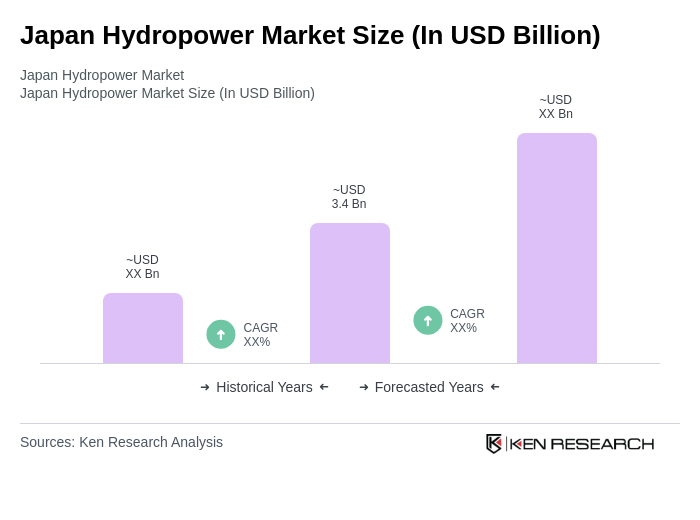
- The Japan Hydropower Market is valued at USD 3.4 billion, based on a five-year historical analysis. This growth is primarily driven by increasing demand for renewable energy, government decarbonization policies, and ongoing refurbishment of aging hydro assets to improve efficiency and flexibility. The market continues to see investment in modernization, digitalization (IIoT/advanced monitoring), and life-extension programs for existing plants, supporting stable expansion.
- Key players in this market include Tokyo Electric Power Company Holdings, Inc., Chubu Electric Power Co., Inc., and J-POWER. These companies operate significant hydro and pumped-storage fleets and lead refurbishment and uprating programs that align with Japan’s renewable and grid-resilience goals.
- No official “Hydropower Development Promotion Act” was enacted in 2023. Japan’s hydropower development is guided by energy policy frameworks (e.g., Strategic Energy Plan), renewable support schemes, environmental regulations, and streamlined permitting/refurbishment initiatives rather than a dedicated 2023 act by that name. Modernization incentives and policy support focus on efficiency upgrades, pumped-storage for grid stability, and integration with variable renewables.
Japan Hydropower Market Segmentation
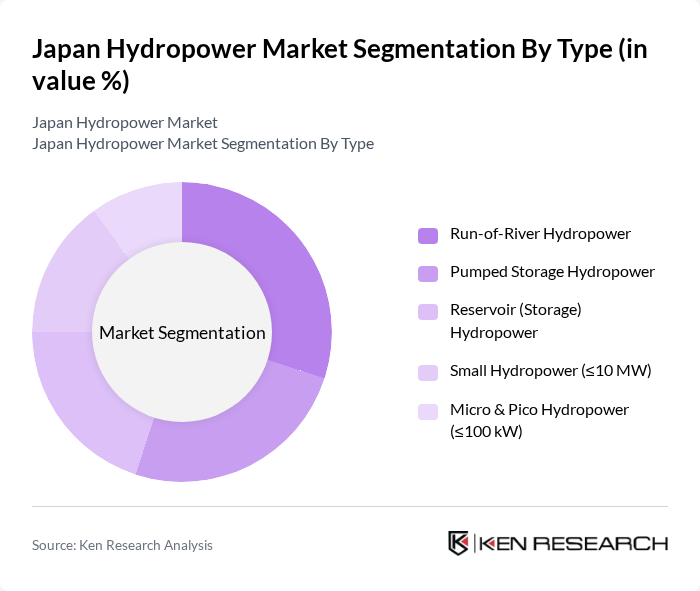
By Type:The hydropower market can be segmented into various types, including Run-of-River Hydropower, Pumped Storage Hydropower, Reservoir (Storage) Hydropower, Small Hydropower (?10 MW), and Micro & Pico Hydropower (?100 kW). Among these, Run-of-River Hydropower continues to gain traction where feasible due to lower reservoir impacts, while most of Japan’s installed base is conventional reservoir and pumped-storage assets located in mountainous regions. Pumped Storage Hydropower remains critical for grid balancing, load shifting, and integrating solar and wind, given Japan’s growing variable renewables and peak demand needs.
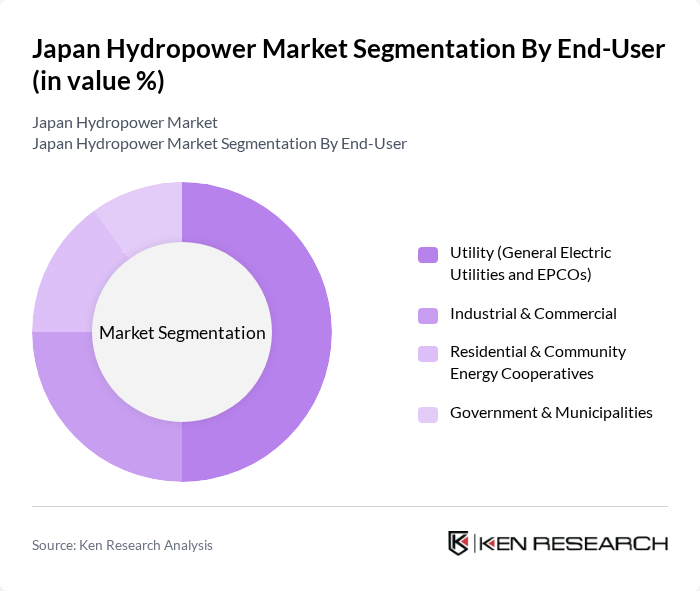
By End-User:The end-user segmentation includes Utility (General Electric Utilities and EPCOs), Industrial & Commercial, Residential & Community Energy Cooperatives, and Government & Municipalities. The Utility segment is the largest because EPCOs own and operate most hydropower and pumped-storage assets and lead refurbishment and capacity uprating. Industrial and commercial users participate mainly through small hydro and on-site/community projects, while municipalities support distributed small hydro and river improvements tied to local energy goals.
Japan Hydropower Market Competitive Landscape
The Japan Hydropower Market is characterized by a dynamic mix of regional and international players. Leading participants such as Tokyo Electric Power Company Holdings, Inc. (TEPCO), Chubu Electric Power Co., Inc. (Chubu Electric Power Company), The Kansai Electric Power Co., Inc. (Kansai Electric Power Company), Tohoku Electric Power Co., Inc. (Tohoku Electric Power Company), Kyushu Electric Power Co., Inc. (Kyushu Electric Power Company), J-POWER (Electric Power Development Co., Ltd.), Shikoku Electric Power Co., Inc. (Shikoku Electric Power Company), Hokkaido Electric Power Co., Inc. (Hokkaido Electric Power Company), Renewable Japan Co., Ltd. (Renewable Japan), Hitachi Mitsubishi Hydro Corporation (HM Hydro), Toshiba Energy Systems & Solutions Corporation, Hitachi, Ltd., IHI Corporation, Marubeni Corporation, and Sumitomo Corporation contribute to innovation, geographic expansion, and service delivery in this space.
Japan Hydropower Market Industry Analysis
Growth Drivers
- Increasing Demand for Renewable Energy:Japan's energy landscape is shifting significantly, with renewable energy sources accounting for approximately 20% of the total energy mix in future. The government aims to increase this share to 36-38% by future, driven by public demand for cleaner energy. The rising global emphasis on reducing carbon emissions, alongside Japan's commitment to the Paris Agreement, is propelling investments in hydropower, which is expected to generate around 60 terawatt-hours (TWh) annually by future.
- Government Support and Incentives:The Japanese government has implemented various policies to promote hydropower development, including subsidies and tax incentives. In future, the government allocated approximately ¥200 billion (around $1.5 billion) to support renewable energy projects, with a significant portion directed towards hydropower. This financial backing is crucial for enhancing infrastructure and encouraging private sector participation, which is projected to lead to the commissioning of 15 new hydropower plants by the end of the year.
- Technological Advancements in Hydropower:Innovations in hydropower technology are enhancing efficiency and reducing operational costs. In future, the introduction of advanced turbine designs and digital monitoring systems is expected to improve energy conversion rates by up to 10%. Additionally, the integration of artificial intelligence in predictive maintenance is projected to reduce downtime by 15%, making existing plants more competitive and increasing overall output, which is anticipated to reach 90 TWh by year-end.
Market Challenges
- Aging Infrastructure:A significant portion of Japan's hydropower infrastructure is over 30 years old, leading to inefficiencies and increased maintenance costs. In future, it is estimated that nearly 40% of existing plants require substantial upgrades or retrofitting to meet modern standards. This aging infrastructure poses a challenge to maintaining reliable energy production, with potential output losses estimated at 5 TWh annually if not addressed promptly, impacting overall energy security.
- Environmental Concerns and Regulations:The hydropower sector faces stringent environmental regulations aimed at protecting aquatic ecosystems. In future, compliance costs related to environmental impact assessments are projected to exceed ¥50 billion ($450 million) for new projects. These regulations can delay project approvals and increase operational costs, making it challenging for developers to balance energy production with ecological preservation, potentially hindering growth in the sector.
Japan Hydropower Market Future Outlook
The future of Japan's hydropower market appears promising, driven by a combination of technological advancements and increasing government support. As the country aims to achieve its renewable energy targets, investments in small-scale hydropower projects are expected to rise significantly. Furthermore, the integration of smart grid technologies will enhance energy distribution efficiency, allowing for better management of renewable resources. This evolving landscape will likely attract both domestic and international investments, fostering innovation and sustainability in the hydropower sector.
Market Opportunities
- Expansion of Small-Scale Hydropower Projects:The Japanese government is actively promoting small-scale hydropower projects, which are less environmentally invasive and can be developed more quickly. In future, the government aims to support the installation of 200 MW of new capacity through these projects, providing a significant opportunity for local developers and investors to contribute to the renewable energy landscape.
- Technological Innovations in Energy Storage:The rise of energy storage technologies presents a unique opportunity for the hydropower sector. In future, advancements in battery storage systems are expected to enhance the reliability of hydropower by allowing for better energy management. This integration can lead to increased grid stability and efficiency, potentially boosting hydropower's contribution to Japan's energy mix by an additional 10 TWh annually.
Scope of the Report
| Segment | Sub-Segments |
|---|---|
| By Type | Run-of-River Hydropower Pumped Storage Hydropower Reservoir (Storage) Hydropower Small Hydropower (?10 MW) Micro & Pico Hydropower (?100 kW) |
| By End-User | Utility (General Electric Utilities and EPCOs) Industrial & Commercial Residential & Community Energy Cooperatives Government & Municipalities |
| By Application | Grid-Connected Systems Off-Grid and Remote Area Supply Pumped-Storage for Grid Balancing Rehabilitation & Repowering of Existing Plants |
| By Investment Source | Domestic Investment Foreign Direct Investment (FDI) Public-Private Partnerships (PPP) Government Programs & FIT Schemes |
| By Policy Support | Feed-in Tariffs (FIT) & Feed-in Premiums (FIP) Tax Incentives & Accelerated Depreciation Renewable Energy Certificates (RECs) Environmental Permitting & Water Rights Frameworks |
| By Technology | Turbines (Francis, Kaplan, Pelton) Balance of Plant & Control Systems (SCADA, IIoT) Energy Storage (Pumped-Storage Integration) Civil Works & Dam Safety Upgrades |
| By Distribution Mode | Direct EPC/IPP Contracts OEM to Utility Procurement Engineering Consultants & Integrators Distributors & Local Agents |
Key Target Audience
Investors and Venture Capitalist Firms
Government and Regulatory Bodies (e.g., Ministry of the Environment, Agency for Natural Resources and Energy)
Hydropower Project Developers
Utility Companies
Environmental NGOs
Energy Policy Makers
Infrastructure Investment Funds
Energy Equipment Manufacturers
Players Mentioned in the Report:
Tokyo Electric Power Company Holdings, Inc. (TEPCO)
Chubu Electric Power Co., Inc. (Chubu Electric Power Company)
The Kansai Electric Power Co., Inc. (Kansai Electric Power Company)
Tohoku Electric Power Co., Inc. (Tohoku Electric Power Company)
Kyushu Electric Power Co., Inc. (Kyushu Electric Power Company)
J-POWER (Electric Power Development Co., Ltd.)
Shikoku Electric Power Co., Inc. (Shikoku Electric Power Company)
Hokkaido Electric Power Co., Inc. (Hokkaido Electric Power Company)
Renewable Japan Co., Ltd. (Renewable Japan)
Hitachi Mitsubishi Hydro Corporation (HM Hydro)
Toshiba Energy Systems & Solutions Corporation
Hitachi, Ltd.
IHI Corporation
Marubeni Corporation
Sumitomo Corporation
Table of Contents
Market Assessment Phase
1. Executive Summary and Approach
2. Japan Hydropower Market Overview
2.1 Key Insights and Strategic Recommendations
2.2 Japan Hydropower Market Overview
2.3 Definition and Scope
2.4 Evolution of Market Ecosystem
2.5 Timeline of Key Regulatory Milestones
2.6 Value Chain & Stakeholder Mapping
2.7 Business Cycle Analysis
2.8 Policy & Incentive Landscape
3. Japan Hydropower Market Analysis
3.1 Growth Drivers
3.1.1 Increasing Demand for Renewable Energy
3.1.2 Government Support and Incentives
3.1.3 Technological Advancements in Hydropower
3.1.4 Environmental Sustainability Initiatives
3.2 Market Challenges
3.2.1 Aging Infrastructure
3.2.2 Environmental Concerns and Regulations
3.2.3 Competition from Other Renewable Sources
3.2.4 High Initial Capital Investment
3.3 Market Opportunities
3.3.1 Expansion of Small-Scale Hydropower Projects
3.3.2 Technological Innovations in Energy Storage
3.3.3 International Collaboration and Investment
3.3.4 Integration with Smart Grid Technologies
3.4 Market Trends
3.4.1 Shift Towards Decentralized Energy Production
3.4.2 Increased Focus on Energy Efficiency
3.4.3 Rise of Hybrid Energy Systems
3.4.4 Growing Public Awareness of Renewable Energy
3.5 Government Regulation
3.5.1 Feed-in Tariff Policies
3.5.2 Environmental Impact Assessments
3.5.3 Licensing and Permitting Requirements
3.5.4 Renewable Portfolio Standards
4. SWOT Analysis
5. Stakeholder Analysis
6. Porter's Five Forces Analysis
7. Japan Hydropower Market Market Size, 2019-2024
7.1 By Value
7.2 By Volume
7.3 By Average Selling Price
8. Japan Hydropower Market Segmentation
8.1 By Type
8.1.1 Run-of-River Hydropower
8.1.2 Pumped Storage Hydropower
8.1.3 Reservoir (Storage) Hydropower
8.1.4 Small Hydropower (?10 MW)
8.1.5 Micro & Pico Hydropower (?100 kW)
8.2 By End-User
8.2.1 Utility (General Electric Utilities and EPCOs)
8.2.2 Industrial & Commercial
8.2.3 Residential & Community Energy Cooperatives
8.2.4 Government & Municipalities
8.3 By Application
8.3.1 Grid-Connected Systems
8.3.2 Off-Grid and Remote Area Supply
8.3.3 Pumped-Storage for Grid Balancing
8.3.4 Rehabilitation & Repowering of Existing Plants
8.4 By Investment Source
8.4.1 Domestic Investment
8.4.2 Foreign Direct Investment (FDI)
8.4.3 Public-Private Partnerships (PPP)
8.4.4 Government Programs & FIT Schemes
8.5 By Policy Support
8.5.1 Feed-in Tariffs (FIT) & Feed-in Premiums (FIP)
8.5.2 Tax Incentives & Accelerated Depreciation
8.5.3 Renewable Energy Certificates (RECs)
8.5.4 Environmental Permitting & Water Rights Frameworks
8.6 By Technology
8.6.1 Turbines (Francis, Kaplan, Pelton)
8.6.2 Balance of Plant & Control Systems (SCADA, IIoT)
8.6.3 Energy Storage (Pumped-Storage Integration)
8.6.4 Civil Works & Dam Safety Upgrades
8.7 By Distribution Mode
8.7.1 Direct EPC/IPP Contracts
8.7.2 OEM to Utility Procurement
8.7.3 Engineering Consultants & Integrators
8.7.4 Distributors & Local Agents
9. Japan Hydropower Market Competitive Analysis
9.1 Market Share of Key Players
9.2 Cross Comparison of Key Players
9.2.1 Company Name
9.2.2 Installed Hydropower Capacity in Japan (MW)
9.2.3 Annual Generation from Hydro (TWh)
9.2.4 Share of Pumped-Storage Capacity (%)
9.2.5 Project Pipeline and Refurbishment Backlog (MW)
9.2.6 Average Capacity Factor (%)
9.2.7 LCOE for New/Refurbished Hydro (USD/MWh)
9.2.8 CAPEX per kW for New Builds (USD/kW)
9.2.9 O&M Cost Intensity (USD/kW-year)
9.2.10 Turbine/Generator Efficiency (% at design head)
9.2.11 Grid Services Revenue from Pumped-Storage (% of hydro revenue)
9.2.12 Environmental Compliance Metrics (fish passage, water use permits)
9.3 SWOT Analysis of Top Players
9.4 Pricing Analysis
9.5 Detailed Profile of Major Companies
9.5.1 Tokyo Electric Power Company Holdings, Inc. (TEPCO)
9.5.2 Chubu Electric Power Co., Inc. (Chubu Electric Power Company)
9.5.3 The Kansai Electric Power Co., Inc. (Kansai Electric Power Company)
9.5.4 Tohoku Electric Power Co., Inc. (Tohoku Electric Power Company)
9.5.5 Kyushu Electric Power Co., Inc. (Kyushu Electric Power Company)
9.5.6 J-POWER (Electric Power Development Co., Ltd.)
9.5.7 Shikoku Electric Power Co., Inc. (Shikoku Electric Power Company)
9.5.8 Hokkaido Electric Power Co., Inc. (Hokkaido Electric Power Company)
9.5.9 Renewable Japan Co., Ltd. (Renewable Japan)
9.5.10 Hitachi Mitsubishi Hydro Corporation (HM Hydro)
9.5.11 Toshiba Energy Systems & Solutions Corporation
9.5.12 Hitachi, Ltd.
9.5.13 IHI Corporation
9.5.14 Marubeni Corporation
9.5.15 Sumitomo Corporation
10. Japan Hydropower Market End-User Analysis
10.1 Procurement Behavior of Key Ministries
10.1.1 Ministry of the Environment
10.1.2 Ministry of Economy, Trade and Industry
10.1.3 Ministry of Land, Infrastructure, Transport and Tourism
10.2 Corporate Spend on Infrastructure & Energy
10.2.1 Investment Trends in Renewable Energy
10.2.2 Budget Allocations for Hydropower Projects
10.3 Pain Point Analysis by End-User Category
10.3.1 Cost of Energy Production
10.3.2 Regulatory Compliance Challenges
10.3.3 Infrastructure Maintenance Issues
10.4 User Readiness for Adoption
10.4.1 Awareness of Hydropower Benefits
10.4.2 Financial Readiness for Investment
10.5 Post-Deployment ROI and Use Case Expansion
10.5.1 Performance Metrics Evaluation
10.5.2 Opportunities for Scaling Operations
11. Japan Hydropower Market Future Size, 2025-2030
11.1 By Value
11.2 By Volume
11.3 By Average Selling Price
Go-To-Market Strategy Phase
1. Whitespace Analysis + Business Model Canvas
1.1 Market Gaps Identification
1.2 Value Proposition Development
1.3 Revenue Streams Analysis
1.4 Cost Structure Evaluation
1.5 Key Partnerships Exploration
1.6 Customer Segmentation
1.7 Channels of Distribution
2. Marketing and Positioning Recommendations
2.1 Branding Strategies
2.2 Product USPs
2.3 Target Market Identification
2.4 Communication Strategies
2.5 Digital Marketing Approaches
3. Distribution Plan
3.1 Urban Retail Strategies
3.2 Rural NGO Tie-Ups
3.3 Direct Sales Channels
3.4 Online Distribution Strategies
4. Channel & Pricing Gaps
4.1 Underserved Routes
4.2 Pricing Bands Analysis
4.3 Competitor Pricing Strategies
5. Unmet Demand & Latent Needs
5.1 Category Gaps Identification
5.2 Consumer Segments Analysis
5.3 Emerging Trends Exploration
6. Customer Relationship
6.1 Loyalty Programs Development
6.2 After-Sales Service Strategies
6.3 Customer Feedback Mechanisms
7. Value Proposition
7.1 Sustainability Initiatives
7.2 Integrated Supply Chains
7.3 Competitive Advantages
8. Key Activities
8.1 Regulatory Compliance
8.2 Branding Initiatives
8.3 Distribution Setup
9. Entry Strategy Evaluation
9.1 Domestic Market Entry Strategy
9.1.1 Product Mix Considerations
9.1.2 Pricing Band Strategies
9.1.3 Packaging Innovations
9.2 Export Entry Strategy
9.2.1 Target Countries Identification
9.2.2 Compliance Roadmap Development
10. Entry Mode Assessment
10.1 Joint Ventures
10.2 Greenfield Investments
10.3 Mergers & Acquisitions
10.4 Distributor Model Evaluation
11. Capital and Timeline Estimation
11.1 Capital Requirements Analysis
11.2 Timelines for Implementation
12. Control vs Risk Trade-Off
12.1 Ownership vs Partnerships
12.2 Risk Management Strategies
13. Profitability Outlook
13.1 Breakeven Analysis
13.2 Long-Term Sustainability Strategies
14. Potential Partner List
14.1 Distributors Identification
14.2 Joint Ventures Opportunities
14.3 Acquisition Targets
15. Execution Roadmap
15.1 Phased Plan for Market Entry
15.1.1 Market Setup
15.1.2 Market Entry
15.1.3 Growth Acceleration
15.1.4 Scale & Stabilize
15.2 Key Activities and Milestones
15.2.1 Milestone Planning
15.2.2 Activity Tracking
Research Methodology
Phase 1: Approach1
Desk Research
- Analysis of hydropower generation statistics from the Ministry of the Environment, Japan
- Review of industry reports from the Japan Hydropower Association and related organizations
- Examination of government policy documents and renewable energy initiatives
Primary Research
- Interviews with executives from leading hydropower companies in Japan
- Surveys targeting energy policy experts and environmental consultants
- Field interviews with project managers involved in hydropower plant operations
Validation & Triangulation
- Cross-validation of data through multiple industry reports and government publications
- Triangulation of findings from expert interviews and secondary data sources
- Sanity checks conducted through peer reviews with industry specialists
Phase 2: Market Size Estimation1
Top-down Assessment
- Estimation of total hydropower capacity based on national energy consumption data
- Segmentation of market size by region and type of hydropower technology
- Incorporation of future government targets for renewable energy adoption
Bottom-up Modeling
- Collection of operational data from existing hydropower plants across Japan
- Cost analysis based on capital expenditure and operational expenditure of hydropower projects
- Volume of electricity generated multiplied by average market price per kWh
Forecasting & Scenario Analysis
- Multi-variable regression analysis incorporating economic growth and energy demand trends
- Scenario modeling based on potential regulatory changes and technological advancements
- Development of baseline, optimistic, and pessimistic forecasts through 2035
Phase 3: CATI Sample Composition1
| Scope Item/Segment | Sample Size | Target Respondent Profiles |
|---|---|---|
| Hydropower Plant Operators | 100 | Plant Managers, Operations Directors |
| Energy Policy Experts | 75 | Government Officials, Regulatory Analysts |
| Environmental Consultants | 50 | Sustainability Advisors, Environmental Engineers |
| Investors in Renewable Energy | 60 | Investment Analysts, Portfolio Managers |
| Technology Providers for Hydropower | 40 | Product Managers, R&D Engineers |
Frequently Asked Questions
What is the current value of the Japan Hydropower Market?
The Japan Hydropower Market is valued at approximately USD 3.4 billion, reflecting a significant investment in renewable energy driven by government policies and modernization efforts in existing hydro assets.
What are the main drivers of growth in the Japan Hydropower Market?
Who are the major players in the Japan Hydropower Market?
What types of hydropower are prevalent in Japan?
Other Regional/Country Reports
Indonesia Hydropower Market
Malaysia Hydropower Market
KSA Hydropower Market
APAC Hydropower Market
SEA Hydropower Market
Why Buy From Us?

What makes us stand out is that our consultants follow Robust, Refine and Result (RRR) methodology. Robust for clear definitions, approaches and sanity checking, Refine for differentiating respondents' facts and opinions, and Result for presenting data with story.

We have set a benchmark in the industry by offering our clients with syndicated and customized market research reports featuring coverage of entire market as well as meticulous research and analyst insights.

While we don't replace traditional research, we flip the method upside down. Our dual approach of Top Bottom & Bottom Top ensures quality deliverable by not just verifying company fundamentals but also looking at the sector and macroeconomic factors.

With one step in the future, our research team constantly tries to show you the bigger picture. We help with some of the tough questions you may encounter along the way: How is the industry positioned? Best marketing channel? KPI's of competitors? By aligning every element, we help maximize success.

Our report gives you instant access to the answers and sources that other companies might choose to hide. We elaborate each steps of research methodology we have used and showcase you the sample size to earn your trust.

If you need any support, we are here! We pride ourselves on universe strength, data quality, and quick, friendly, and professional service.