About the Report
Base Year 2024South America Hydropower Market Overview
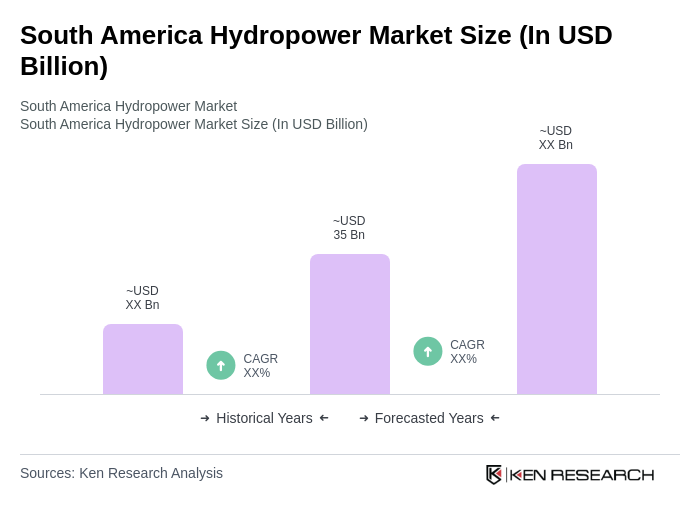
- The South America Hydropower Market is valued at USD 35 billion, based on a five-year historical analysis. This growth is primarily driven by the region's abundant water resources, increasing electricity demand, and a strong push towards renewable energy sources. The hydropower sector remains pivotal in meeting the energy needs of both urban and rural populations, while also contributing significantly to the reduction of greenhouse gas emissions .
- Brazil and Argentina dominate the hydropower market due to their vast river systems and established infrastructure. Brazil, with its extensive Amazon River basin, has the largest installed capacity in the region, while Argentina benefits from ongoing investments in renewable energy. Both countries have implemented supportive policies that encourage the development of hydropower projects, making them key players in the market .
- Brazil has recently enacted regulatory reforms aimed at streamlining the licensing process for hydropower projects. These measures are designed to reduce bureaucratic delays and promote investment in renewable energy, with a focus on sustainability and environmental protection. The initiative is expected to facilitate the development of new hydropower plants and enhance the overall efficiency of existing facilities .
South America Hydropower Market Segmentation
By Type:The hydropower market can be segmented into various types, including Large Hydropower (>30 MW), Small Hydropower (<10 MW), Pumped Storage Hydropower, Run-of-River, and Mini and Micro Hydropower. Each of these segments plays a crucial role in the overall energy landscape, catering to different energy needs and operational scales .
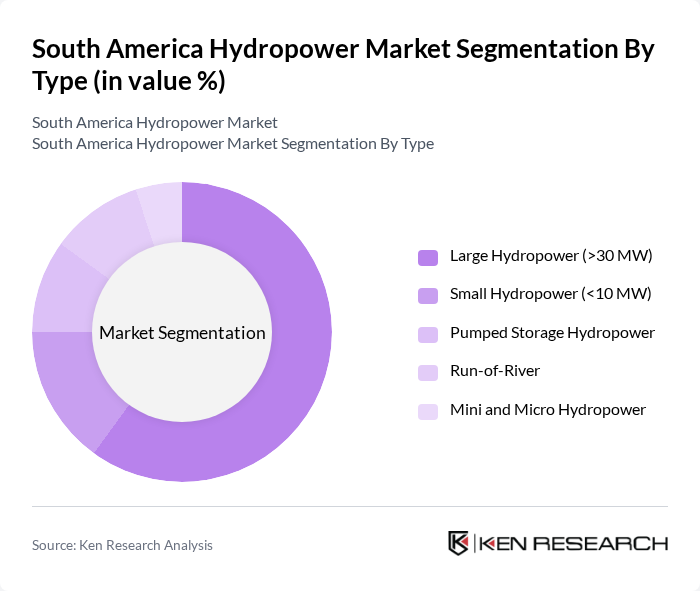
TheLarge Hydropowersegment dominates the market due to its ability to generate significant amounts of electricity, making it a preferred choice for large-scale energy projects. Countries like Brazil have invested heavily in large hydropower plants, which provide a stable and reliable energy source. The trend towards renewable energy and government incentives further bolster this segment's growth, as it aligns with sustainability goals and energy security .
By Geography:The hydropower market can also be segmented geographically into Brazil, Argentina, Chile, Colombia, Venezuela, Paraguay, and the Rest of South America. Each region has unique characteristics and resources that influence its hydropower development .
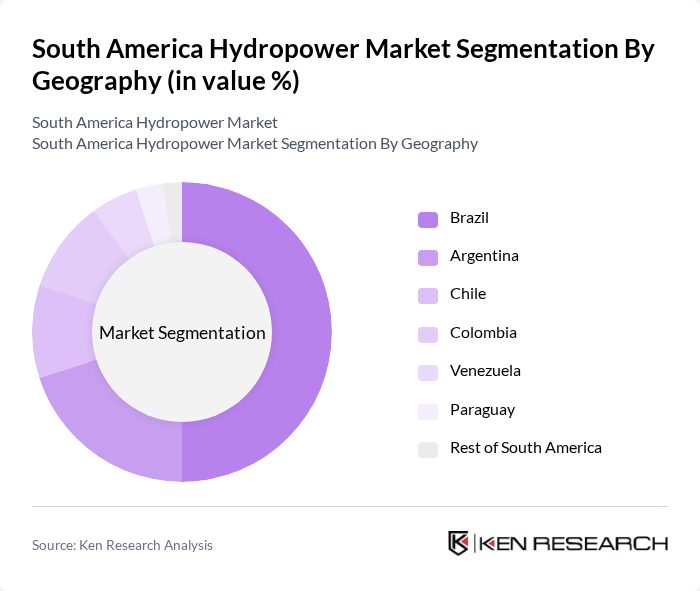
Brazilleads the geographical segmentation due to its vast river systems and established hydropower infrastructure, including the iconic Itaipu Dam. Argentina follows, benefiting from significant investments in renewable energy and a growing focus on sustainability. Other countries like Chile and Colombia are also making strides in hydropower development, but they currently lag behind the leaders in terms of installed capacity and market presence .
South America Hydropower Market Competitive Landscape
The South America Hydropower Market is characterized by a dynamic mix of regional and international players. Leading participants such as Eletrobras, Enel Américas S.A., Engie Brasil Energia S.A., AES Brasil Energia S.A., Copel (Companhia Paranaense de Energia), CEMIG (Companhia Energética de Minas Gerais), Duke Energy International Geração Paranapanema, Norte Energia S.A., Tractebel Energia S.A. (now Engie Brasil Energia S.A.), EDP Energias do Brasil S.A., Furnas Centrais Elétricas S.A., Companhia Hidro Elétrica do São Francisco (CHESF), Itaipu Binacional, ODEBRECHT Energia, ContourGlobal plc contribute to innovation, geographic expansion, and service delivery in this space .
South America Hydropower Market Industry Analysis
Growth Drivers
- Increasing Energy Demand:South America is experiencing a significant rise in energy demand, projected to reach 1,200 terawatt-hours (TWh) in future, driven by urbanization and industrial growth. Countries like Brazil and Argentina are leading this surge, with Brazil's energy consumption expected to increase by approximately 3% annually. This growing demand necessitates the expansion of renewable energy sources, particularly hydropower, which currently accounts for approximately 60% of the region's electricity generation, making it a critical component of energy strategy.
- Government Support for Renewable Energy:Governments across South America are increasingly prioritizing renewable energy, with over $10 billion allocated to hydropower projects in future. Brazil's National Energy Plan aims for 45% of its energy matrix to come from renewables in future, while Colombia has set a target of 10% for non-conventional renewable sources. This supportive regulatory environment fosters investment and development in hydropower, enhancing its role in achieving energy security and sustainability.
- Technological Advancements in Hydropower:The hydropower sector in South America is benefiting from technological innovations, such as improved turbine efficiency and advanced monitoring systems. For instance, the introduction of variable-speed turbines can increase energy output by up to 15%. Additionally, investments in digital technologies are projected to enhance operational efficiency, with an estimated $1.5 billion earmarked for smart grid integration in future, further optimizing hydropower generation and distribution.
Market Challenges
- High Initial Capital Investment:The hydropower sector faces significant financial barriers, with initial capital investments averaging $2,000–$5,000 per installed kilowatt. For large-scale projects, this translates to investments exceeding $1 billion, which can deter potential investors. Additionally, the lengthy project development timelines, often spanning 5–10 years, further complicate financing efforts, especially in a region where access to affordable capital remains a challenge.
- Environmental Concerns and Regulatory Hurdles:Environmental regulations pose substantial challenges for hydropower development in South America. Projects often require extensive environmental impact assessments, which can take up to two years to complete. For example, Brazil's licensing process can involve over 20 regulatory approvals, leading to project delays. Furthermore, public opposition due to ecological concerns can hinder project implementation, complicating the path to sustainable energy development.
South America Hydropower Market Future Outlook
The South American hydropower market is poised for transformative growth, driven by increasing energy demands and supportive government policies. In future, the integration of smart grid technologies and advancements in energy storage will enhance operational efficiency and reliability. Additionally, the focus on climate resilience will encourage investments in sustainable hydropower projects. As private sector participation rises, innovative financing models will emerge, facilitating the development of new projects and the expansion of existing facilities, ultimately strengthening the region's energy landscape.
Market Opportunities
- Expansion of Existing Hydropower Plants:There is a significant opportunity to expand existing hydropower facilities, with potential increases in capacity estimated at 15,000 megawatts (MW) across the region. Upgrading infrastructure and optimizing operations can yield additional energy output, addressing the rising demand without the need for new sites, thus minimizing environmental impact and costs.
- Investment in Small-Scale Hydropower Projects:Small-scale hydropower projects, defined as those under 10 MW, present a lucrative opportunity, particularly in remote areas. With an estimated 2,000 MW of untapped potential, these projects can provide localized energy solutions, enhance energy access, and attract investments of approximately $500 million in future, fostering sustainable development in underserved communities.
Scope of the Report
| Segment | Sub-Segments |
|---|---|
| By Type | Large Hydropower (>30 MW) Small Hydropower (<10 MW) Pumped Storage Hydropower Run-of-River Mini and Micro Hydropower |
| By Geography | Brazil Argentina Chile Colombia Venezuela Paraguay Rest of South America |
| By End-User | Utilities Independent Power Producers (IPPs) Industrial Commercial & Residential |
| By Application | Electricity Generation Grid Stability & Ancillary Services Renewable Energy Integration Off-Grid Solutions |
| By Technology | Turbine Technology Generator Technology Control Systems Hybrid Systems (e.g., Hydro-Solar) |
| By Investment Source | Domestic Investment Foreign Direct Investment (FDI) Public-Private Partnerships (PPP) Government Schemes |
Key Target Audience
Investors and Venture Capitalist Firms
Government and Regulatory Bodies (e.g., National Electric Energy Agency, Ministry of Mines and Energy)
Hydropower Project Developers
Utility Companies
Environmental NGOs and Advocacy Groups
Energy Sector Analysts
Infrastructure Investment Funds
International Development Organizations
Players Mentioned in the Report:
Eletrobras
Enel Americas S.A.
Engie Brasil Energia S.A.
AES Brasil Energia S.A.
Copel (Companhia Paranaense de Energia)
CEMIG (Companhia Energetica de Minas Gerais)
Duke Energy International Geracao Paranapanema
Norte Energia S.A.
Tractebel Energia S.A. (now Engie Brasil Energia S.A.)
EDP Energias do Brasil S.A.
Furnas Centrais Eletricas S.A.
Companhia Hidro Eletrica do Sao Francisco (CHESF)
Itaipu Binacional
ODEBRECHT Energia
ContourGlobal plc
Table of Contents
Market Assessment Phase
1. Executive Summary and Approach
2. South America Hydropower Market Overview
2.1 Key Insights and Strategic Recommendations
2.2 South America Hydropower Market Overview
2.3 Definition and Scope
2.4 Evolution of Market Ecosystem
2.5 Timeline of Key Regulatory Milestones
2.6 Value Chain & Stakeholder Mapping
2.7 Business Cycle Analysis
2.8 Policy & Incentive Landscape
3. South America Hydropower Market Analysis
3.1 Growth Drivers
3.1.1 Increasing Energy Demand
3.1.2 Government Support for Renewable Energy
3.1.3 Technological Advancements in Hydropower
3.1.4 Environmental Sustainability Initiatives
3.2 Market Challenges
3.2.1 High Initial Capital Investment
3.2.2 Environmental Concerns and Regulatory Hurdles
3.2.3 Competition from Other Renewable Sources
3.2.4 Infrastructure Limitations
3.3 Market Opportunities
3.3.1 Expansion of Existing Hydropower Plants
3.3.2 Investment in Small-Scale Hydropower Projects
3.3.3 Cross-Border Energy Trade
3.3.4 Technological Innovations in Energy Storage
3.4 Market Trends
3.4.1 Increasing Private Sector Participation
3.4.2 Integration of Smart Grid Technologies
3.4.3 Focus on Climate Resilience
3.4.4 Shift Towards Sustainable Financing
3.5 Government Regulation
3.5.1 Renewable Energy Policies
3.5.2 Environmental Impact Assessments
3.5.3 Feed-in Tariffs for Hydropower
3.5.4 Licensing and Permitting Requirements
4. SWOT Analysis
5. Stakeholder Analysis
6. Porter's Five Forces Analysis
7. South America Hydropower Market Market Size, 2019-2024
7.1 By Value
7.2 By Volume
7.3 By Average Selling Price
8. South America Hydropower Market Segmentation
8.1 By Type
8.1.1 Large Hydropower (>30 MW)
8.1.2 Small Hydropower (<10 MW)
8.1.3 Pumped Storage Hydropower
8.1.4 Run-of-River
8.1.5 Mini and Micro Hydropower
8.2 By Geography
8.2.1 Brazil
8.2.2 Argentina
8.2.3 Chile
8.2.4 Colombia
8.2.5 Venezuela
8.2.6 Paraguay
8.2.7 Rest of South America
8.3 By End-User
8.3.1 Utilities
8.3.2 Independent Power Producers (IPPs)
8.3.3 Industrial
8.3.4 Commercial & Residential
8.4 By Application
8.4.1 Electricity Generation
8.4.2 Grid Stability & Ancillary Services
8.4.3 Renewable Energy Integration
8.4.4 Off-Grid Solutions
8.5 By Technology
8.5.1 Turbine Technology
8.5.2 Generator Technology
8.5.3 Control Systems
8.5.4 Hybrid Systems (e.g., Hydro-Solar)
8.6 By Investment Source
8.6.1 Domestic Investment
8.6.2 Foreign Direct Investment (FDI)
8.6.3 Public-Private Partnerships (PPP)
8.6.4 Government Schemes
9. South America Hydropower Market Competitive Analysis
9.1 Market Share of Key Players
9.2 Cross Comparison of Key Players
9.2.1 Company Name
9.2.2 Installed Hydropower Capacity (MW)
9.2.3 Annual Electricity Generation (GWh)
9.2.4 Revenue from Hydropower Operations (USD Million)
9.2.5 Market Share (%)
9.2.6 Number of Hydropower Plants
9.2.7 Project Pipeline (Under Construction/Planned MW)
9.2.8 Capacity Utilization Rate (%)
9.2.9 O&M Efficiency (Operational Expenditure per MW)
9.2.10 Emissions Reduction (tCO?e avoided/year)
9.2.11 ESG/Sustainability Ratings
9.2.12 Innovation Index (Patents, R&D Spend)
9.3 SWOT Analysis of Top Players
9.4 Pricing Analysis
9.5 Detailed Profile of Major Companies
9.5.1 Eletrobras
9.5.2 Enel Américas S.A.
9.5.3 Engie Brasil Energia S.A.
9.5.4 AES Brasil Energia S.A.
9.5.5 Copel (Companhia Paranaense de Energia)
9.5.6 CEMIG (Companhia Energética de Minas Gerais)
9.5.7 Duke Energy International Geração Paranapanema
9.5.8 Norte Energia S.A.
9.5.9 Tractebel Energia S.A. (now Engie Brasil Energia S.A.)
9.5.10 EDP Energias do Brasil S.A.
9.5.11 Furnas Centrais Elétricas S.A.
9.5.12 Companhia Hidro Elétrica do São Francisco (CHESF)
9.5.13 Itaipu Binacional
9.5.14 ODEBRECHT Energia
9.5.15 ContourGlobal plc
10. South America Hydropower Market End-User Analysis
10.1 Procurement Behavior of Key Ministries
10.1.1 Budget Allocation Trends
10.1.2 Decision-Making Processes
10.1.3 Key Procurement Criteria
10.2 Corporate Spend on Infrastructure & Energy
10.2.1 Investment Priorities
10.2.2 Spending Patterns
10.2.3 Long-term Contracts
10.3 Pain Point Analysis by End-User Category
10.3.1 Reliability of Supply
10.3.2 Cost of Energy
10.3.3 Regulatory Compliance
10.4 User Readiness for Adoption
10.4.1 Awareness of Hydropower Benefits
10.4.2 Financial Readiness
10.4.3 Technical Capability
10.5 Post-Deployment ROI and Use Case Expansion
10.5.1 Performance Metrics
10.5.2 Scalability of Solutions
10.5.3 Future Investment Plans
11. South America Hydropower Market Future Size, 2025-2030
11.1 By Value
11.2 By Volume
11.3 By Average Selling Price
Go-To-Market Strategy Phase
1. Whitespace Analysis + Business Model Canvas
1.1 Market Gaps Identification
1.2 Value Proposition Development
1.3 Revenue Streams Analysis
1.4 Cost Structure Evaluation
1.5 Key Partnerships Exploration
1.6 Customer Segmentation
1.7 Competitive Advantage Assessment
2. Marketing and Positioning Recommendations
2.1 Branding Strategies
2.2 Product USPs
2.3 Target Market Identification
2.4 Communication Strategy
2.5 Digital Marketing Approaches
3. Distribution Plan
3.1 Urban Retail Strategies
3.2 Rural NGO Tie-ups
3.3 Direct Sales Channels
3.4 Online Distribution Platforms
4. Channel & Pricing Gaps
4.1 Underserved Routes
4.2 Pricing Bands Analysis
4.3 Competitor Pricing Strategies
5. Unmet Demand & Latent Needs
5.1 Category Gaps
5.2 Consumer Segments Analysis
5.3 Emerging Trends Identification
6. Customer Relationship
6.1 Loyalty Programs
6.2 After-sales Service
6.3 Customer Feedback Mechanisms
7. Value Proposition
7.1 Sustainability Initiatives
7.2 Integrated Supply Chains
7.3 Competitive Differentiation
8. Key Activities
8.1 Regulatory Compliance
8.2 Branding Efforts
8.3 Distribution Setup
9. Entry Strategy Evaluation
9.1 Domestic Market Entry Strategy
9.1.1 Product Mix Considerations
9.1.2 Pricing Band Strategy
9.1.3 Packaging Options
9.2 Export Entry Strategy
9.2.1 Target Countries
9.2.2 Compliance Roadmap
10. Entry Mode Assessment
10.1 Joint Ventures
10.2 Greenfield Investments
10.3 Mergers & Acquisitions
10.4 Distributor Model
11. Capital and Timeline Estimation
11.1 Capital Requirements
11.2 Timelines for Implementation
12. Control vs Risk Trade-Off
12.1 Ownership Considerations
12.2 Partnerships Evaluation
13. Profitability Outlook
13.1 Breakeven Analysis
13.2 Long-term Sustainability
14. Potential Partner List
14.1 Distributors
14.2 Joint Ventures
14.3 Acquisition Targets
15. Execution Roadmap
15.1 Phased Plan for Market Entry
15.1.1 Market Setup
15.1.2 Market Entry
15.1.3 Growth Acceleration
15.1.4 Scale & Stabilize
15.2 Key Activities and Milestones
15.2.1 Milestone Planning
15.2.2 Activity Tracking
Research Methodology
Phase 1: Approach1
Desk Research
- Analysis of hydropower capacity reports from the International Hydropower Association
- Review of government publications and energy policies from South American countries
- Examination of market reports and white papers from energy consultancy firms
Primary Research
- Interviews with energy policy makers and regulators in key South American nations
- Surveys with project developers and operators of existing hydropower plants
- Field interviews with environmental NGOs and community stakeholders
Validation & Triangulation
- Cross-validation of data through multiple sources including government and industry reports
- Triangulation of findings from primary interviews with secondary data insights
- Sanity checks conducted through expert panel discussions and feedback sessions
Phase 2: Market Size Estimation1
Top-down Assessment
- Estimation of total hydropower generation capacity based on national energy statistics
- Segmentation of market size by country and type of hydropower technology
- Incorporation of projected growth rates based on government renewable energy targets
Bottom-up Modeling
- Analysis of installed capacity and operational efficiency of existing hydropower plants
- Cost analysis of new project developments including CAPEX and OPEX estimates
- Volume of electricity generated and sold, multiplied by average market prices
Forecasting & Scenario Analysis
- Multi-variable forecasting using historical growth trends and policy impacts
- Scenario modeling based on potential changes in regulatory frameworks and investment flows
- Development of baseline, optimistic, and pessimistic market projections through 2035
Phase 3: CATI Sample Composition1
| Scope Item/Segment | Sample Size | Target Respondent Profiles |
|---|---|---|
| Government Energy Policy Makers | 60 | Energy Ministers, Regulatory Authority Officials |
| Hydropower Project Developers | 50 | Project Managers, Business Development Executives |
| Environmental NGOs and Advocacy Groups | 40 | Environmental Analysts, Program Directors |
| Utility Companies and Energy Distributors | 55 | Operations Managers, Energy Traders |
| Academic and Research Institutions | 45 | Energy Researchers, Professors in Renewable Energy |
Frequently Asked Questions
What is the current value of the South America Hydropower Market?
The South America Hydropower Market is valued at approximately USD 35 billion, driven by abundant water resources, increasing electricity demand, and a strong emphasis on renewable energy sources, which are crucial for reducing greenhouse gas emissions in the region.
Which countries dominate the South America Hydropower Market?
What regulatory reforms has Brazil implemented for hydropower projects?
What types of hydropower are present in the South America market?
Other Regional/Country Reports
Indonesia Hydropower Market
Malaysia Hydropower Market
KSA Hydropower Market
APAC Hydropower Market
SEA Hydropower Market
Why Buy From Us?

What makes us stand out is that our consultants follow Robust, Refine and Result (RRR) methodology. Robust for clear definitions, approaches and sanity checking, Refine for differentiating respondents' facts and opinions, and Result for presenting data with story.

We have set a benchmark in the industry by offering our clients with syndicated and customized market research reports featuring coverage of entire market as well as meticulous research and analyst insights.

While we don't replace traditional research, we flip the method upside down. Our dual approach of Top Bottom & Bottom Top ensures quality deliverable by not just verifying company fundamentals but also looking at the sector and macroeconomic factors.

With one step in the future, our research team constantly tries to show you the bigger picture. We help with some of the tough questions you may encounter along the way: How is the industry positioned? Best marketing channel? KPI's of competitors? By aligning every element, we help maximize success.

Our report gives you instant access to the answers and sources that other companies might choose to hide. We elaborate each steps of research methodology we have used and showcase you the sample size to earn your trust.

If you need any support, we are here! We pride ourselves on universe strength, data quality, and quick, friendly, and professional service.