Japan Lactation Massager Market Report Size Share Growth Drivers Trends Opportunities & Forecast 2025–2030

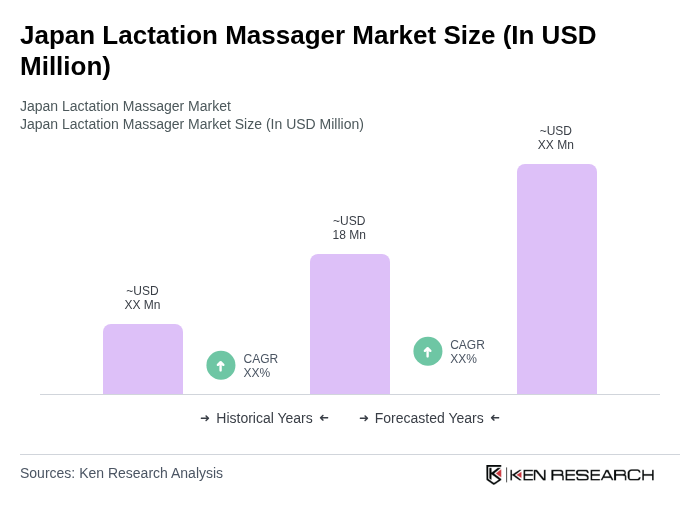
The Japan lactation massager market, valued at USD 18 million, is growing due to rising breastfeeding awareness, technological advancements, and demand in cities like Tokyo and Osaka.

Region:Asia

Author(s):Dev

Product Code:KRAC4978

Pages:87

Published On:January 2026
About the Report

Base Year 2024

Japan Lactation Massager Market Overview

  • The Japan Lactation Massager Market is valued at USD 18 million, based on a five-year historical analysis and its share within the broader Japan breastfeeding accessories market, which generated around USD 175.9 million in revenue in 2023. This growth is primarily driven by increasing awareness of maternal health, the rise in breastfeeding-support initiatives, and the growing demand for postpartum care products such as breastfeeding accessories and lactation support tools. The market has seen a surge in consumer interest due to the emphasis on the benefits of lactation massagers and related devices in alleviating discomfort from engorgement, improving milk flow, and supporting continued breastfeeding among new mothers.
  • Tokyo, Osaka, and Yokohama are the dominant cities in the Japan Lactation Massager Market, in line with their role as the largest metropolitan areas with high population density, higher concentration of women of childbearing age, and strong availability of hospitals, maternity clinics, and pharmacies that stock breastfeeding accessories. The urban lifestyle and better access to advanced healthcare services, online retail, and specialty maternity stores contribute to the increased demand for lactation support products, making these cities key demand centers for lactation massagers and broader breastfeeding accessories.
  • In 2021, the Ministry of Health, Labour and Welfare (MHLW) implemented the Pharmaceuticals and Medical Devices Act (PMD Act) Enforcement Regulations (amended under the Act on Securing Quality, Efficacy and Safety of Products Including Pharmaceuticals and Medical Devices, 2014, as subsequently updated), which govern the safety, quality, and performance of medical devices in Japan, including certain electrically powered breast-care and breastfeeding support devices marketed with health-related claims. Under these regulations, relevant products must comply with technical and safety standards, undergo pre?market review or notification depending on classification, and adhere to labeling and post?marketing surveillance requirements to support the validity of product performance and safety claims. Such requirements aim to protect consumers and enhance the credibility of lactation-related products in the market when they fall within the scope of regulated medical devices.
Japan Lactation Massager Market Size

Japan Lactation Massager Market Segmentation

By Product Type:The market is segmented into heated lactation massagers and non-heated lactation massagers, consistent with global categorization of these devices into heated and non-heated segments. Heated lactation massagers are gaining popularity due to their ability to provide soothing warmth combined with vibration, which helps in relieving discomfort from engorgement and clogged ducts and in promoting milk flow. Non-heated options are also widely used, particularly for their convenience, lower price points, and ease of use without the need for temperature settings. The heated segment is currently leading the market, driven by consumer preference for enhanced comfort, multipurpose features (heat plus massage), and recommendations from lactation consultants and online maternal health communities.
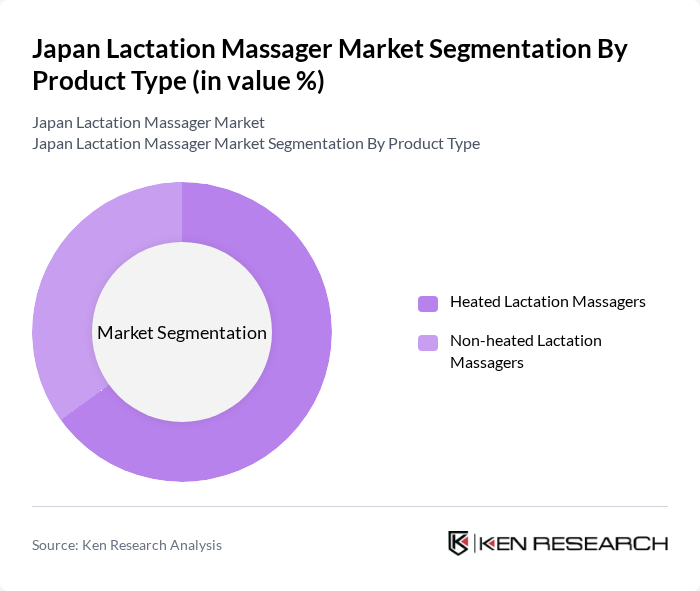
Japan Lactation Massager Market segmentation by Product Type.

By Application:The applications of lactation massagers include relief for engorged breasts, relief for clogged milk ducts, and prevention and management of mastitis, which are the primary clinical and comfort-related issues addressed by these devices. Relief for engorged breasts is the most significant application, as many new mothers experience discomfort due to milk accumulation and swelling, especially in the early postpartum phase. Growing awareness from healthcare professionals, lactation consultants, and digital health content on the importance of addressing engorgement and duct blockage early has led to increased adoption of lactation massagers for these purposes, with additional use in supporting mastitis management as part of broader breastfeeding care routines.
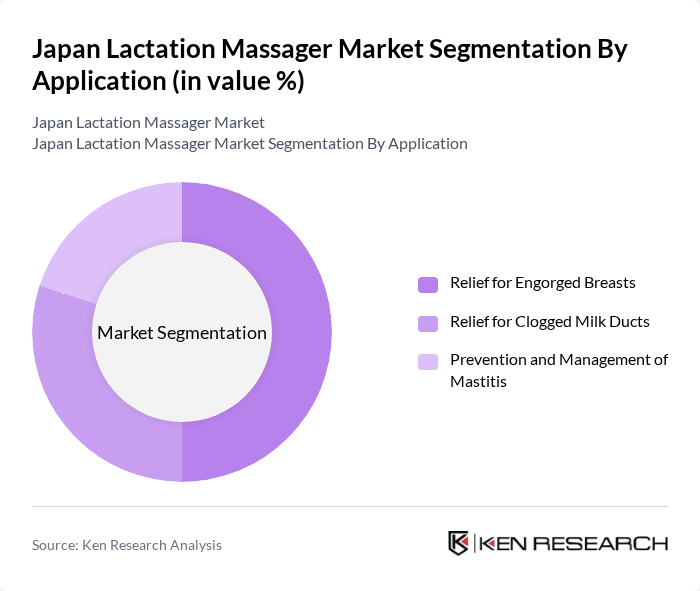
Japan Lactation Massager Market segmentation by Application.

Japan Lactation Massager Market Competitive Landscape

The Japan Lactation Massager Market is characterized by a dynamic mix of regional and international players. Leading participants such as Medela, Philips Avent, Lansinoh, Spectra Baby, Haakaa, Bellababy, Frida Mom, Momcozy, Elvie, Youha, Pigeon Corporation, Combi Corporation, Aprica Children’s Products, ChuChuBaby (JEX Co., Ltd.), Sakura Global / Other Emerging Domestic Brands contribute to innovation, geographic expansion, and service delivery in this space, in line with the broader global lactation massager and breastfeeding accessories markets where these brands have a strong presence.

Medela

1961

Switzerland

Philips Avent

1984

Netherlands

Lansinoh

1984

USA

Haakaa

2014

New Zealand

Bellababy

2015

China

Company

Establishment Year

Headquarters

Group Size (Large, Medium, or Small as per industry convention)

Japan Lactation Massager Revenues (USD Million)

3-year Revenue CAGR in Japan (%)

Japan Market Share (%)

Average Selling Price Positioning (Entry / Mid / Premium)

Gross Margin (%) – Lactation Massager Portfolio

Japan Lactation Massager Market Industry Analysis

Growth Drivers

  • Increasing Awareness of Breastfeeding Benefits:The Japanese government has reported that approximately 91% of mothers initiate breastfeeding, highlighting a growing awareness of its benefits. This trend is supported by the World Health Organization's recommendation for exclusive breastfeeding for the first six months. As more mothers recognize the health advantages for both infants and themselves, the demand for lactation massagers, which facilitate breastfeeding, is expected to rise significantly, contributing to market growth.
  • Rising Demand for Postpartum Care Products:The postpartum care market in Japan is projected to reach ¥320 billion, driven by an increasing focus on maternal health. This surge is attributed to a growing number of women prioritizing recovery and wellness after childbirth. Lactation massagers are becoming essential tools in this segment, as they help alleviate discomfort and promote effective breastfeeding, thus enhancing their appeal among new mothers seeking comprehensive postpartum solutions.
  • Technological Advancements in Lactation Massage Devices:The introduction of innovative features in lactation massagers, such as smart technology and customizable settings, is transforming the market landscape. In future, it is estimated that 45% of lactation massagers will incorporate smart technology, enhancing user experience and effectiveness. These advancements not only improve product functionality but also attract tech-savvy consumers, further driving market growth in Japan's lactation massager sector.

Market Challenges

  • High Competition from Alternative Breastfeeding Aids:The lactation massager market faces intense competition from various breastfeeding aids, including breast pumps and nursing pillows. In future, the breast pump market in Japan was valued at approximately ¥55 billion, indicating a strong preference for these alternatives. This competition poses a significant challenge for lactation massager manufacturers, as they must differentiate their products to capture market share effectively.
  • Limited Consumer Awareness about Lactation Massagers:Despite the benefits, consumer awareness of lactation massagers remains low, with only 30% of new mothers familiar with these products. This lack of awareness can hinder market growth, as potential customers may not recognize the advantages of using lactation massagers for breastfeeding support. Effective marketing strategies and educational campaigns are essential to increase visibility and understanding of these products among target consumers.

Japan Lactation Massager Market Future Outlook

The Japan lactation massager market is poised for significant growth as awareness of maternal health continues to rise. With an increasing number of working mothers and a focus on postpartum care, the demand for lactation massagers is expected to expand. Additionally, technological innovations and collaborations with healthcare providers will likely enhance product offerings, making them more appealing. As e-commerce platforms grow, accessibility will improve, further driving market penetration and consumer adoption in the coming years.

Market Opportunities

  • Expansion of E-commerce Platforms for Product Sales:The e-commerce sector in Japan is projected to grow by 12% annually, providing a significant opportunity for lactation massager sales. Online platforms enable manufacturers to reach a broader audience, facilitating easier access to products. This trend is particularly beneficial for new mothers who prefer the convenience of online shopping, thus enhancing market penetration.
  • Collaborations with Healthcare Providers:Partnering with healthcare professionals can enhance the credibility and visibility of lactation massagers. In future, it is anticipated that 35% of lactation massager brands will engage in collaborations with hospitals and clinics. Such partnerships can lead to increased recommendations and endorsements, driving consumer trust and expanding market reach significantly.

Scope of the Report

SegmentSub-Segments
By Product Type

Heated Lactation Massagers

Non-heated Lactation Massagers

By Application

Relief for Engorged Breasts

Relief for Clogged Milk Ducts

Prevention and Management of Mastitis

By Distribution Channel

E-commerce Platforms

Pharmacy and Drugstores

Mother & Baby Specialty Stores

Hospital and Clinic Channels

By Price Range

Economy

Mid-range

Premium

By End-User

Individual Consumers (Home Use)

Hospitals and Maternity Clinics

Lactation Consultants and Postpartum Care Centers

By Technology / Features

Heat-only Massagers

Vibration-only Massagers

Heat & Vibration Combination Devices

Smart / App-connected Devices

By Origin of Brand

Domestic Japanese Brands

International Brands

Key Target Audience

Investors and Venture Capitalist Firms

Government and Regulatory Bodies (e.g., Ministry of Health, Labour and Welfare)

Manufacturers and Producers

Distributors and Retailers

Healthcare Providers and Clinics

Industry Associations (e.g., Japan Lactation Consultants Association)

Insurance Companies

Market Analysts and Industry Experts

Players Mentioned in the Report:

Medela

Philips Avent

Lansinoh

Spectra Baby

Haakaa

Bellababy

Frida Mom

Momcozy

Elvie

Youha

Pigeon Corporation

Combi Corporation

Aprica Childrens Products

ChuChuBaby (JEX Co., Ltd.)

Sakura Global / Other Emerging Domestic Brands

Table of Contents

Market Assessment Phase

1. Executive Summary and Approach


2. Japan Lactation Massager Market Overview

2.1 Key Insights and Strategic Recommendations

2.2 Japan Lactation Massager Market Overview

2.3 Definition and Scope

2.4 Evolution of Market Ecosystem

2.5 Timeline of Key Regulatory Milestones

2.6 Value Chain & Stakeholder Mapping

2.7 Business Cycle Analysis

2.8 Policy & Incentive Landscape


3. Japan Lactation Massager Market Analysis

3.1 Growth Drivers

3.1.1 Increasing awareness of breastfeeding benefits
3.1.2 Rising demand for postpartum care products
3.1.3 Technological advancements in lactation massage devices
3.1.4 Growing number of working mothers

3.2 Market Challenges

3.2.1 High competition from alternative breastfeeding aids
3.2.2 Limited consumer awareness about lactation massagers
3.2.3 Regulatory hurdles in product approvals
3.2.4 Price sensitivity among target consumers

3.3 Market Opportunities

3.3.1 Expansion of e-commerce platforms for product sales
3.3.2 Collaborations with healthcare providers
3.3.3 Development of innovative product features
3.3.4 Increasing focus on maternal health and wellness

3.4 Market Trends

3.4.1 Shift towards natural and organic products
3.4.2 Integration of smart technology in lactation massagers
3.4.3 Rise in online reviews and social media influence
3.4.4 Growing popularity of subscription-based models

3.5 Government Regulation

3.5.1 Safety standards for lactation products
3.5.2 Labeling requirements for consumer information
3.5.3 Import regulations for foreign products
3.5.4 Incentives for manufacturers promoting maternal health

4. SWOT Analysis


5. Stakeholder Analysis


6. Porter's Five Forces Analysis


7. Japan Lactation Massager Market Market Size, 2019-2024

7.1 By Value

7.2 By Volume

7.3 By Average Selling Price


8. Japan Lactation Massager Market Segmentation

8.1 By Product Type

8.1.1 Heated Lactation Massagers
8.1.2 Non-heated Lactation Massagers

8.2 By Application

8.2.1 Relief for Engorged Breasts
8.2.2 Relief for Clogged Milk Ducts
8.2.3 Prevention and Management of Mastitis

8.3 By Distribution Channel

8.3.1 E-commerce Platforms
8.3.2 Pharmacy and Drugstores
8.3.3 Mother & Baby Specialty Stores
8.3.4 Hospital and Clinic Channels

8.4 By Price Range

8.4.1 Economy
8.4.2 Mid-range
8.4.3 Premium

8.5 By End-User

8.5.1 Individual Consumers (Home Use)
8.5.2 Hospitals and Maternity Clinics
8.5.3 Lactation Consultants and Postpartum Care Centers

8.6 By Technology / Features

8.6.1 Heat-only Massagers
8.6.2 Vibration-only Massagers
8.6.3 Heat & Vibration Combination Devices
8.6.4 Smart / App-connected Devices

8.7 By Origin of Brand

8.7.1 Domestic Japanese Brands
8.7.2 International Brands

9. Japan Lactation Massager Market Competitive Analysis

9.1 Market Share of Key Players

9.2 Cross Comparison of Key Players

9.2.1 Company Name
9.2.2 Group Size (Large, Medium, or Small as per industry convention)
9.2.3 Japan Lactation Massager Revenues (USD Million)
9.2.4 3-year Revenue CAGR in Japan (%)
9.2.5 Japan Market Share (%)
9.2.6 Average Selling Price Positioning (Entry / Mid / Premium)
9.2.7 Gross Margin (%) – Lactation Massager Portfolio
9.2.8 R&D Intensity (% of Revenue)
9.2.9 Online vs Offline Sales Mix (%)
9.2.10 Japan Distribution Footprint (No. of Retail / Pharmacy Outlets Reached)
9.2.11 Customer Ratings (Average Star Rating on Key E-commerce Platforms)
9.2.12 Share of Revenues from New Products (<3 Years Old) (%)

9.3 SWOT Analysis of Top Players

9.4 Pricing Analysis

9.5 Detailed Profile of Major Companies

9.5.1 Medela
9.5.2 Philips Avent
9.5.3 Lansinoh
9.5.4 Spectra Baby
9.5.5 Haakaa
9.5.6 Bellababy
9.5.7 Frida Mom
9.5.8 Momcozy
9.5.9 Elvie
9.5.10 Youha
9.5.11 Pigeon Corporation
9.5.12 Combi Corporation
9.5.13 Aprica Children’s Products
9.5.14 ChuChuBaby (JEX Co., Ltd.)
9.5.15 Sakura Global / Other Emerging Domestic Brands

10. Japan Lactation Massager Market End-User Analysis

10.1 Procurement Behavior of Key Ministries

10.1.1 Government health initiatives
10.1.2 Budget allocation for maternal health
10.1.3 Collaboration with NGOs
10.1.4 Others

10.2 Corporate Spend on Infrastructure & Energy

10.2.1 Investment in maternal health programs
10.2.2 Funding for lactation support services
10.2.3 Others

10.3 Pain Point Analysis by End-User Category

10.3.1 Lack of awareness about lactation massagers
10.3.2 Accessibility issues in rural areas
10.3.3 High costs of lactation products
10.3.4 Others

10.4 User Readiness for Adoption

10.4.1 Awareness campaigns
10.4.2 Training programs for healthcare providers
10.4.3 Others

10.5 Post-Deployment ROI and Use Case Expansion

10.5.1 Measurement of user satisfaction
10.5.2 Expansion into new markets
10.5.3 Others

11. Japan Lactation Massager Market Future Size, 2025-2030

11.1 By Value

11.2 By Volume

11.3 By Average Selling Price


Go-To-Market Strategy Phase

1. Whitespace Analysis + Business Model Canvas

1.1 Market Gaps Identification

1.2 Business Model Development


2. Marketing and Positioning Recommendations

2.1 Branding Strategies

2.2 Product USPs


3. Distribution Plan

3.1 Urban Retail vs Rural NGO Tie-ups


4. Channel & Pricing Gaps

4.1 Underserved Routes

4.2 Pricing Bands


5. Unmet Demand & Latent Needs

5.1 Category Gaps

5.2 Consumer Segments


6. Customer Relationship

6.1 Loyalty Programs

6.2 After-sales Service


7. Value Proposition

7.1 Sustainability

7.2 Integrated Supply Chains


8. Key Activities

8.1 Regulatory Compliance

8.2 Branding

8.3 Distribution Setup


9. Entry Strategy Evaluation

9.1 Domestic Market Entry Strategy

9.1.1 Product Mix
9.1.2 Pricing Band
9.1.3 Packaging

9.2 Export Entry Strategy

9.2.1 Target Countries
9.2.2 Compliance Roadmap

10. Entry Mode Assessment

10.1 JV

10.2 Greenfield

10.3 M&A

10.4 Distributor Model


11. Capital and Timeline Estimation

11.1 Capital Requirements

11.2 Timelines


12. Control vs Risk Trade-Off

12.1 Ownership vs Partnerships


13. Profitability Outlook

13.1 Breakeven Analysis

13.2 Long-term Sustainability


14. Potential Partner List

14.1 Distributors

14.2 JVs

14.3 Acquisition Targets


15. Execution Roadmap

15.1 Phased Plan for Market Entry

15.1.1 Market Setup
15.1.2 Market Entry
15.1.3 Growth Acceleration
15.1.4 Scale & Stabilize

15.2 Key Activities and Milestones

15.2.1 Milestone Planning
15.2.2 Activity Tracking

Research Methodology

ApproachModellingSample

Phase 1: Approach1

Desk Research

  • Analysis of market reports from Japanese health and wellness organizations
  • Review of academic journals focusing on lactation and maternal health
  • Examination of government publications on maternal care and breastfeeding initiatives

Primary Research

  • Interviews with lactation consultants and healthcare professionals specializing in maternal care
  • Surveys conducted with new mothers regarding their experiences and preferences for lactation massagers
  • Focus groups with retailers and distributors of lactation products to gather insights on market trends

Validation & Triangulation

  • Cross-validation of findings through multiple expert interviews and consumer feedback
  • Triangulation of data from healthcare professionals, market reports, and consumer surveys
  • Sanity checks through expert panel reviews to ensure data accuracy and relevance

Phase 2: Market Size Estimation1

Top-down Assessment

  • Estimation of market size based on national healthcare expenditure on maternal health
  • Segmentation of the market by product type, including electric and manual lactation massagers
  • Incorporation of demographic data on childbirth rates and breastfeeding trends in Japan

Bottom-up Modeling

  • Collection of sales data from leading lactation massager manufacturers in Japan
  • Estimation of average selling prices and volume sold across different retail channels
  • Analysis of consumer purchasing behavior and frequency of lactation massager usage

Forecasting & Scenario Analysis

  • Multi-factor regression analysis incorporating trends in maternal health awareness and breastfeeding rates
  • Scenario modeling based on potential changes in healthcare policies and consumer preferences
  • Development of baseline, optimistic, and pessimistic market projections through 2030

Phase 3: CATI Sample Composition1

Scope Item/SegmentSample SizeTarget Respondent Profiles
Healthcare Professionals90Lactation Consultants, Pediatricians
New Mothers140First-time Mothers, Mothers with Multiple Children
Retailers of Lactation Products70Store Managers, Product Buyers
Maternal Health Organizations60Program Directors, Outreach Coordinators
Market Analysts40Industry Analysts, Market Researchers

Frequently Asked Questions

What is the current value of the Japan Lactation Massager Market?

The Japan Lactation Massager Market is valued at approximately USD 18 million as of 2023, reflecting its share within the broader breastfeeding accessories market, which generated around USD 175.9 million in revenue.

What factors are driving the growth of the Japan Lactation Massager Market?

Which cities are the primary markets for lactation massagers in Japan?

What are the main applications of lactation massagers?

Other Adjacent Reports

South Africa Breast Pump Market

Bahrain Breastfeeding Accessories Market

South Korea Postpartum Care Products Market

KSA Maternal Health Devices Market

Thailand Nursing Pillow Market

KSA Breast Milk Storage Market

Malaysia Nipple Care Products Market

Bahrain Maternity Support Products Market

Egypt Infant Feeding Products Market

Qatar Womens Wellness Products Market

Why Buy From Us?

Refine Robust Result (RRR) Framework

What makes us stand out is that our consultants follow Robust, Refine and Result (RRR) methodology. Robust for clear definitions, approaches and sanity checking, Refine for differentiating respondents' facts and opinions, and Result for presenting data with story.

Our Reach Is Unmatched

We have set a benchmark in the industry by offering our clients with syndicated and customized market research reports featuring coverage of entire market as well as meticulous research and analyst insights.

Shifting the Research Paradigm

While we don't replace traditional research, we flip the method upside down. Our dual approach of Top Bottom & Bottom Top ensures quality deliverable by not just verifying company fundamentals but also looking at the sector and macroeconomic factors.

More Insights-Better Decisions

With one step in the future, our research team constantly tries to show you the bigger picture. We help with some of the tough questions you may encounter along the way: How is the industry positioned? Best marketing channel? KPI's of competitors? By aligning every element, we help maximize success.

Transparency and Trust

Our report gives you instant access to the answers and sources that other companies might choose to hide. We elaborate each steps of research methodology we have used and showcase you the sample size to earn your trust.

Round the Clock Support

If you need any support, we are here! We pride ourselves on universe strength, data quality, and quick, friendly, and professional service.

Why Clients Choose Us?

400000+
Reports in repository
150+
Consulting projects a year
100+
Analysts
8000+
Client Queries in 2022








