About the Report
Base Year 2024Japan Recycled Base Oil Market Overview
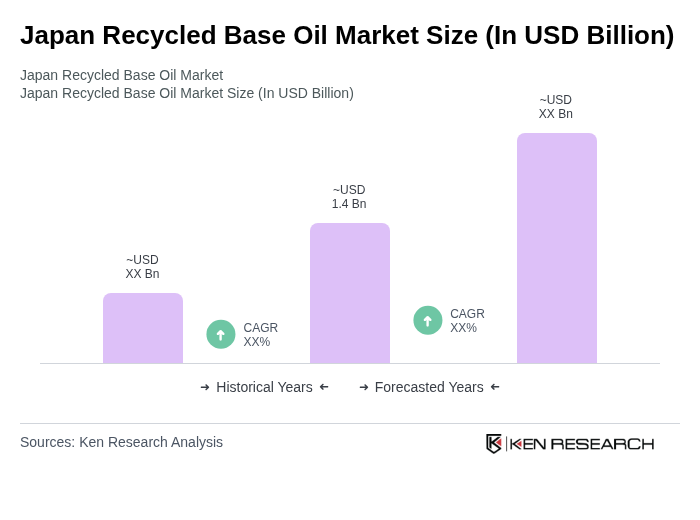
- The Japan Recycled Base Oil Market is valued at USD 1.4 billion, based on a five-year historical analysis of Japan’s base oil and waste oil recycling revenues. This growth is primarily driven by increasingly stringent environmental regulations on used oil management, growing demand for sustainable and circular-economy products, and the automotive and industrial sectors’ shift towards eco-friendly lubricants. The market is also supported by advancements in re?refining technologies—such as hydrotreating and hydrocracking—that improve the quality of recycled base oils to near?virgin standards, enhancing their competitiveness versus conventional base oils.
- Key demand hubs for recycled base oil in Japan include major industrial and automotive corridors anchored by metropolitan areas such as Tokyo, Osaka, and Nagoya, which have dense manufacturing clusters, high vehicle ownership, and strong lubricant consumption. These areas host major automotive OEMs, component suppliers, and lubricant blenders, supporting consistent demand for high-quality lubricants that can incorporate recycled base oil. In addition, collection and treatment networks for used lubricants are well developed around these regions, supporting efficient feedstock availability for re?refining operations.
- Japan’s policy framework for resource circulation, particularly the Basic Act on Establishing a Sound Material-Cycle Society enacted by the Government of Japan, promotes waste reduction, recycling, and the efficient use of resources across industries, including lubricants and waste oil streams. Under this act and related implementing measures, used lubricating oil is prioritized for recycling and regeneration into base oils, encouraging the use of recycled base oils in automotive, industrial, and manufacturing applications through requirements on proper collection, treatment, and promotion of recycled materials.
Japan Recycled Base Oil Market Segmentation
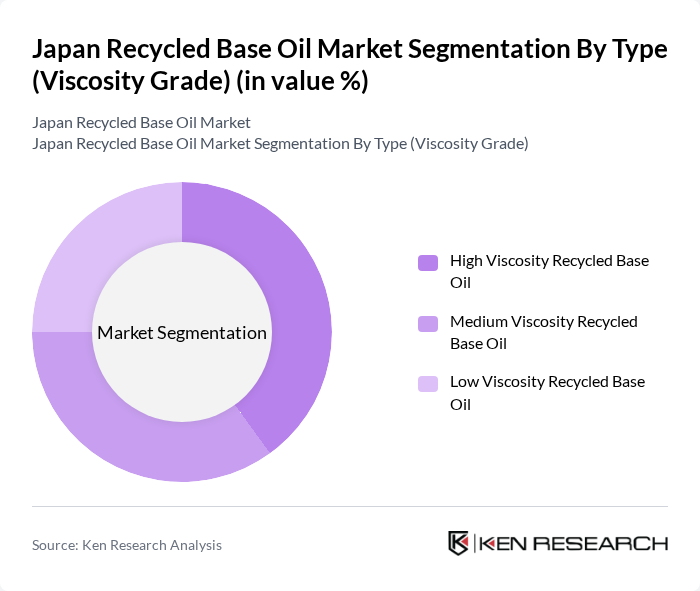
By Type (Viscosity Grade):The market is segmented into high viscosity, medium viscosity, and low viscosity recycled base oils. High viscosity recycled base oils are primarily used in heavy-duty applications such as commercial vehicle engines, off?highway equipment, and certain industrial gear and hydraulic systems where thicker film strength is required. Medium viscosity oils cater to a broad range of passenger car engine oils, transmission fluids, and general industrial lubricants, benefiting from the balance between protection and pumpability. Low viscosity recycled base oils are increasingly popular in modern fuel?efficient engine oils and industrial fluids, as they support lower friction, improved fuel economy, and better cold?start performance while meeting OEM specifications when produced via advanced hydrotreating and hydro?refining processes.
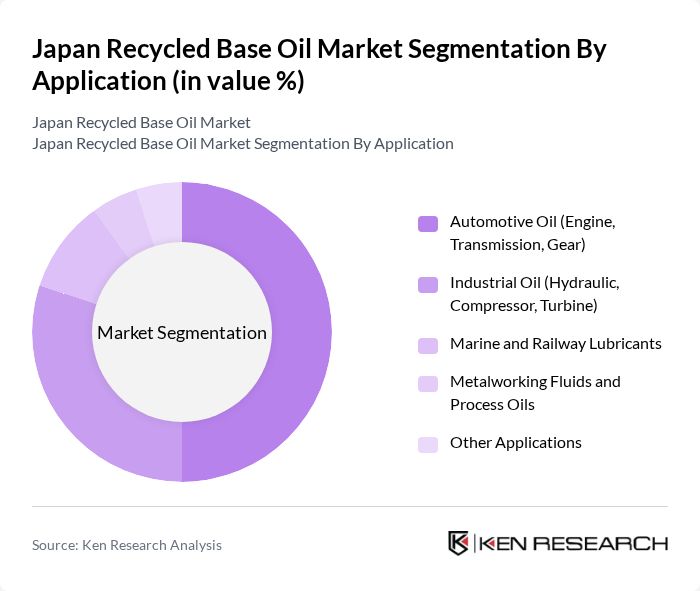
By Application:The applications of recycled base oils include automotive oil, industrial oil, marine and railway lubricants, metalworking fluids, and other applications. Automotive oils are the largest segment, supported by Japan’s sizable vehicle parc and stable engine oil demand, and by OEM and aftermarket interest in lower?carbon, cost?effective lubricants incorporating recycled base oil. Industrial oils are also significant, as manufacturers increasingly adopt recycled base oil in hydraulic, compressor, and turbine oils to meet corporate sustainability targets and reduce lifecycle emissions while maintaining performance.
Japan Recycled Base Oil Market Competitive Landscape
The Japan Recycled Base Oil Market is characterized by a dynamic mix of regional and international players. Leading participants such as ENEOS Holdings, Inc., Idemitsu Kosan Co., Ltd., Cosmo Oil Co., Ltd., Taiyo Oil Co., Ltd., Fuji Oil Company, Ltd., Toa Oil Co., Ltd., Showa Shell Sekiyu K.K. (now part of Idemitsu), Toyota Tsusho Corporation, Mitsubishi Corporation, Marubeni Corporation, Sumitomo Corporation, JX Nippon Oil & Gas Exploration Corporation, Local Re-refiners & Collectors (e.g., regional waste oil recyclers), International Re-refined Base Oil Suppliers Active in Japan, Additive & Blending Partners Supporting Recycled Base Oils contribute to innovation, geographic expansion, and service delivery in this space.
Japan Recycled Base Oil Market Industry Analysis
Growth Drivers
- Increasing Environmental Regulations:Japan's stringent environmental regulations are a significant driver for the recycled base oil market. The government has set a target to reduce greenhouse gas emissions by 26% by 2030, which encourages industries to adopt sustainable practices. In future, the Ministry of the Environment plans to implement stricter waste management laws, promoting recycling initiatives. This regulatory framework is expected to increase the demand for recycled base oils, which are seen as a more environmentally friendly alternative to virgin oils.
- Rising Demand for Sustainable Products:The growing consumer preference for sustainable products is propelling the recycled base oil market in Japan. In future, the eco-friendly product market is projected to reach ¥3.45 trillion, reflecting a 15% increase from the previous year. This trend is driven by heightened awareness of environmental issues and corporate sustainability commitments. As businesses seek to enhance their green credentials, the demand for recycled base oils, which offer a lower carbon footprint, is expected to rise significantly, aligning with consumer values.
- Cost-Effectiveness of Recycled Oils:The cost-effectiveness of recycled base oils is a crucial growth driver in Japan. In future, the average cost of recycled base oil is estimated to be ¥85,000 per kiloliter, compared to ¥100,000 for virgin oils. This price differential encourages manufacturers to switch to recycled options, especially in industries like automotive and manufacturing, where operational costs are critical. The economic advantage of using recycled oils, combined with their performance benefits, is likely to boost market penetration in various sectors.
Market Challenges
- Limited Awareness Among Consumers:A significant challenge facing the recycled base oil market in Japan is the limited awareness among consumers regarding the benefits of recycled products. Despite the growing trend towards sustainability, only 30% of consumers are familiar with recycled base oils. This lack of knowledge hampers market growth, as many potential buyers remain unaware of the performance and environmental advantages of these products. Educational initiatives are essential to bridge this awareness gap and stimulate demand.
- Competition from Virgin Base Oils:The recycled base oil market faces stiff competition from virgin base oils, which are often perceived as superior in quality. In future, the virgin base oil market in Japan is projected to be valued at ¥550 billion, overshadowing the recycled segment. This competition is exacerbated by the established supply chains and brand loyalty associated with virgin oils. To overcome this challenge, recycled oil producers must focus on enhancing product quality and marketing their environmental benefits effectively.
Japan Recycled Base Oil Market Future Outlook
The future outlook for the Japan recycled base oil market appears promising, driven by increasing environmental awareness and regulatory support. As Japan moves towards a circular economy, the demand for recycled products is expected to rise significantly. Innovations in recycling technologies will enhance product quality, making recycled oils more competitive against virgin alternatives. Additionally, strategic partnerships with automotive and manufacturing sectors will further bolster market growth, positioning recycled base oils as a viable and sustainable option in the industry.
Market Opportunities
- Expansion into Emerging Markets:There is a significant opportunity for Japanese recycled base oil producers to expand into emerging markets in Southeast Asia. With a projected growth rate of 10% in these regions, the demand for sustainable lubricants is increasing. By leveraging Japan's advanced recycling technologies, companies can tap into this growing market, enhancing their global footprint and driving revenue growth.
- Government Incentives for Recycling Initiatives:The Japanese government is expected to introduce new incentives for recycling initiatives in future, including tax breaks and subsidies for companies using recycled materials. These incentives will encourage more businesses to adopt recycled base oils, creating a favorable environment for market expansion. Companies that align with these initiatives can benefit from reduced operational costs and enhanced brand reputation.
Scope of the Report
| Segment | Sub-Segments |
|---|---|
| By Type (Viscosity Grade) | High Viscosity Recycled Base Oil Medium Viscosity Recycled Base Oil Low Viscosity Recycled Base Oil |
| By Application | Automotive Oil (Engine, Transmission, Gear) Industrial Oil (Hydraulic, Compressor, Turbine) Marine and Railway Lubricants Metalworking Fluids and Process Oils Other Applications |
| By End-Use Industry | Automotive and Transportation Fleets Industrial & Manufacturing Marine & Shipyards Government & Municipal Fleets Others |
| By Processing Technology | Hydrotreating / Hydroprocessing Vacuum Distillation Solvent Extraction / Clay Treatment Others |
| By Source of Used Oil Collection | Automotive Service Stations & Dealerships Independent Garages & Quick Lube Centers Industrial Waste Oil Generators Municipal Collection Programs Others |
| By Distribution Channel | Direct Sales to OEMs and Large Fleets Distributors & Trading Companies Oil Marketers & Blenders Online / E-commerce Channels Others |
| By Region (Within Japan) | Kanto Kansai Chubu Kyushu & Okinawa Tohoku, Hokkaido & Others |
Key Target Audience
Investors and Venture Capitalist Firms
Government and Regulatory Bodies (e.g., Ministry of the Environment, Japan)
Manufacturers and Producers of Recycled Base Oils
Oil and Lubricant Distributors
Automotive Industry Stakeholders
Environmental NGOs and Advocacy Groups
Recycling and Waste Management Companies
Financial Institutions and Banks
Players Mentioned in the Report:
ENEOS Holdings, Inc.
Idemitsu Kosan Co., Ltd.
Cosmo Oil Co., Ltd.
Taiyo Oil Co., Ltd.
Fuji Oil Company, Ltd.
Toa Oil Co., Ltd.
Showa Shell Sekiyu K.K. (now part of Idemitsu)
Toyota Tsusho Corporation
Mitsubishi Corporation
Marubeni Corporation
Sumitomo Corporation
JX Nippon Oil & Gas Exploration Corporation
Local Re-refiners & Collectors (e.g., regional waste oil recyclers)
International Re-refined Base Oil Suppliers Active in Japan
Additive & Blending Partners Supporting Recycled Base Oils
Table of Contents
Market Assessment Phase
1. Executive Summary and Approach
2. Japan Recycled Base Oil Market Overview
2.1 Key Insights and Strategic Recommendations
2.2 Japan Recycled Base Oil Market Overview
2.3 Definition and Scope
2.4 Evolution of Market Ecosystem
2.6 Value Chain & Stakeholder Mapping
2.7 Business Cycle Analysis
2.8 Policy & Incentive Landscape
3. Japan Recycled Base Oil Market Analysis
3.1 Growth Drivers
3.1.1 Increasing Environmental Regulations
3.1.2 Rising Demand for Sustainable Products
3.1.3 Cost-Effectiveness of Recycled Oils
3.1.4 Technological Advancements in Recycling Processes
3.2 Market Challenges
3.2.1 Limited Awareness Among Consumers
3.2.2 Competition from Virgin Base Oils
3.2.3 Fluctuating Raw Material Prices
3.2.4 Regulatory Compliance Costs
3.3 Market Opportunities
3.3.1 Expansion into Emerging Markets
3.3.2 Development of New Product Lines
3.3.3 Strategic Partnerships with Automotive Industries
3.3.4 Government Incentives for Recycling Initiatives
3.4 Market Trends
3.4.1 Shift Towards Circular Economy
3.4.2 Increased Investment in R&D
3.4.3 Growing Popularity of Eco-Friendly Products
3.4.4 Digital Transformation in Supply Chain Management
3.5 Government Regulation
3.5.1 Waste Management and Recycling Laws
3.5.2 Environmental Protection Standards
3.5.3 Incentives for Recycled Product Usage
3.5.4 Import and Export Regulations on Base Oils
4. SWOT Analysis
5. Stakeholder Analysis
6. Porter's Five Forces Analysis
7. Japan Recycled Base Oil Market Market Size, 2019-2024
7.1 By Value
7.2 By Volume
7.3 By Average Selling Price
8. Japan Recycled Base Oil Market Segmentation
8.1 By Type (Viscosity Grade)
8.1.1 High Viscosity Recycled Base Oil
8.1.2 Medium Viscosity Recycled Base Oil
8.1.3 Low Viscosity Recycled Base Oil
8.2 By Application
8.2.1 Automotive Oil (Engine, Transmission, Gear)
8.2.2 Industrial Oil (Hydraulic, Compressor, Turbine)
8.2.3 Marine and Railway Lubricants
8.2.4 Metalworking Fluids and Process Oils
8.2.5 Other Applications
8.3 By End-Use Industry
8.3.1 Automotive and Transportation Fleets
8.3.2 Industrial & Manufacturing
8.3.3 Marine & Shipyards
8.3.4 Government & Municipal Fleets
8.3.5 Others
8.4 By Processing Technology
8.4.1 Hydrotreating / Hydroprocessing
8.4.2 Vacuum Distillation
8.4.3 Solvent Extraction / Clay Treatment
8.4.4 Others
8.5 By Source of Used Oil Collection
8.5.1 Automotive Service Stations & Dealerships
8.5.2 Independent Garages & Quick Lube Centers
8.5.3 Industrial Waste Oil Generators
8.5.4 Municipal Collection Programs
8.5.5 Others
8.6 By Distribution Channel
8.6.1 Direct Sales to OEMs and Large Fleets
8.6.2 Distributors & Trading Companies
8.6.3 Oil Marketers & Blenders
8.6.4 Online / E-commerce Channels
8.6.5 Others
8.7 By Region (Within Japan)
8.7.1 Kanto
8.7.2 Kansai
8.7.3 Chubu
8.7.4 Kyushu & Okinawa
8.7.5 Tohoku, Hokkaido & Others
9. Japan Recycled Base Oil Market Competitive Analysis
9.1 Market Share of Key Players
9.2 Cross Comparison of Key Players
9.2.1 Company Name
9.2.2 Japan Recycled Base Oil Revenue (Latest Year, USD Million)
9.2.3 3-Year CAGR in Recycled Base Oil Revenue
9.2.4 Re-refined Capacity Installed in Japan (kilo tonnes per annum)
9.2.5 Capacity Utilization Rate (%)
9.2.6 EBITDA Margin from Recycled Base Oil Business (%)
9.2.7 Market Share in Japan Recycled Base Oil (%)
9.2.8 Share of Recycled Base Oil in Total Lubricant/Base Oil Portfolio (%)
9.2.9 Average Realization per Tonne (USD/Tonne)
9.2.10 R&D / Sustainability Spend as % of Recycled Base Oil Revenue
9.2.11 Number of Long-term Supply Contracts / Key OEM & Fleet Tie-ups
9.2.12 Geographic Coverage Within Japan (No. of Prefectures Served)
9.3 SWOT Analysis of Top Players
9.4 Pricing Analysis
9.5 Detailed Profile of Major Companies
9.5.1 ENEOS Holdings, Inc.
9.5.2 Idemitsu Kosan Co., Ltd.
9.5.3 Cosmo Oil Co., Ltd.
9.5.4 Taiyo Oil Co., Ltd.
9.5.5 Fuji Oil Company, Ltd.
9.5.6 Toa Oil Co., Ltd.
9.5.7 Showa Shell Sekiyu K.K. (now part of Idemitsu)
9.5.8 Toyota Tsusho Corporation
9.5.9 Mitsubishi Corporation
9.5.10 Marubeni Corporation
9.5.11 Sumitomo Corporation
9.5.12 JX Nippon Oil & Gas Exploration Corporation
9.5.13 Local Re-refiners & Collectors (e.g., regional waste oil recyclers)
9.5.14 International Re-refined Base Oil Suppliers Active in Japan
9.5.15 Additive & Blending Partners Supporting Recycled Base Oils
10. Japan Recycled Base Oil Market End-User Analysis
10.1 Procurement Behavior of Key Ministries
10.1.1 Ministry of the Environment
10.1.2 Ministry of Economy, Trade and Industry
10.1.3 Ministry of Land, Infrastructure, Transport and Tourism
10.1.4 Others
10.2 Corporate Spend on Infrastructure & Energy
10.2.1 Automotive Sector Investments
10.2.2 Industrial Sector Investments
10.2.3 Government Infrastructure Projects
10.2.4 Others
10.3 Pain Point Analysis by End-User Category
10.3.1 Automotive Manufacturers
10.3.2 Industrial Equipment Manufacturers
10.3.3 Government Agencies
10.3.4 Others
10.4 User Readiness for Adoption
10.4.1 Awareness Levels
10.4.2 Training and Support Needs
10.4.3 Financial Readiness
10.4.4 Others
10.5 Post-Deployment ROI and Use Case Expansion
10.5.1 Performance Metrics
10.5.2 Cost Savings Analysis
10.5.3 User Feedback and Adaptation
10.5.4 Others
11. Japan Recycled Base Oil Market Future Size, 2025-2030
11.1 By Value
11.2 By Volume
11.3 By Average Selling Price
Go-To-Market Strategy Phase
1. Whitespace Analysis + Business Model Canvas
1.1 Market Gaps Identification
1.2 Business Model Development
2. Marketing and Positioning Recommendations
2.1 Branding Strategies
2.2 Product USPs
3. Distribution Plan
3.1 Urban Retail vs Rural NGO Tie-ups
4. Channel & Pricing Gaps
4.1 Underserved Routes
4.2 Pricing Bands
5. Unmet Demand & Latent Needs
5.1 Category Gaps
5.2 Consumer Segments
6. Customer Relationship
6.1 Loyalty Programs
6.2 After-sales Service
7. Value Proposition
7.1 Sustainability
7.2 Integrated Supply Chains
8. Key Activities
8.1 Regulatory Compliance
8.2 Branding
8.3 Distribution Setup
9. Entry Strategy Evaluation
9.1 Domestic Market Entry Strategy
9.1.1 Product Mix
9.1.2 Pricing Band
9.1.3 Packaging
9.2 Export Entry Strategy
9.2.1 Target Countries
9.2.2 Compliance Roadmap
10. Entry Mode Assessment
10.1 JV
10.2 Greenfield
10.3 M&A
10.4 Distributor Model
11. Capital and Timeline Estimation
11.1 Capital Requirements
11.2 Timelines
12. Control vs Risk Trade-Off
12.1 Ownership vs Partnerships
13. Profitability Outlook
13.1 Breakeven Analysis
13.2 Long-term Sustainability
14. Potential Partner List
14.1 Distributors
14.2 JVs
14.3 Acquisition Targets
15. Execution Roadmap
15.1 Phased Plan for Market Entry
15.1.1 Market Setup
15.1.2 Market Entry
15.1.3 Growth Acceleration
15.1.4 Scale & Stabilize
15.2 Key Activities and Milestones
15.2.1 Activity Planning
15.2.2 Milestone Tracking
Research Methodology
Phase 1: Approach1
Desk Research
- Analysis of industry reports from Japanese environmental agencies and recycling associations
- Review of academic publications on recycled base oil technologies and market trends
- Examination of government policy documents related to waste management and recycling initiatives
Primary Research
- Interviews with executives from leading recycled base oil manufacturers in Japan
- Surveys targeting automotive and industrial lubricant companies regarding their sourcing practices
- Field interviews with waste management and recycling facility operators
Validation & Triangulation
- Cross-validation of findings through multiple data sources including trade publications and market surveys
- Triangulation of insights from industry experts and regulatory bodies
- Sanity checks through feedback from a panel of industry specialists
Phase 2: Market Size Estimation1
Top-down Assessment
- Estimation of total lubricant consumption in Japan and the proportion attributed to recycled base oils
- Analysis of market penetration rates of recycled oils across various end-user industries
- Incorporation of government incentives and regulations promoting recycled oil usage
Bottom-up Modeling
- Collection of production data from key recycled base oil producers in Japan
- Estimation of average selling prices based on market surveys and competitor pricing
- Volume calculations based on recycling rates and oil recovery efficiencies
Forecasting & Scenario Analysis
- Multi-variable forecasting model incorporating economic indicators and environmental regulations
- Scenario analysis based on potential shifts in consumer preferences towards sustainability
- Development of baseline, optimistic, and pessimistic market growth projections through 2030
Phase 3: CATI Sample Composition1
| Scope Item/Segment | Sample Size | Target Respondent Profiles |
|---|---|---|
| Automotive Lubricant Manufacturers | 120 | Product Managers, R&D Directors |
| Industrial Oil Users | 90 | Procurement Managers, Operations Directors |
| Recycling Facility Operators | 70 | Facility Managers, Environmental Compliance Officers |
| Government Regulatory Bodies | 50 | Policy Makers, Environmental Analysts |
| Research Institutions and Academia | 40 | Researchers, Professors in Environmental Science |
Frequently Asked Questions
What is the current value of the Japan Recycled Base Oil Market?
The Japan Recycled Base Oil Market is valued at approximately USD 1.4 billion, driven by stringent environmental regulations, increasing demand for sustainable products, and advancements in re-refining technologies that enhance the quality of recycled base oils.
What factors are driving growth in the Japan Recycled Base Oil Market?
What are the main applications of recycled base oils in Japan?
How is the Japan Recycled Base Oil Market segmented by viscosity grade?
Other Regional/Country Reports
Other Adjacent Reports
Mexico Automotive Oil Market
Bahrain Industrial Oil Market
APAC Metalworking Fluids Market Report Size Share Growth Drivers Trends Opportunities & Forecast 2025–2030Indonesia Marine Lubricants Market Size, Share & Forecast, By Product Type, Oil Type & Ship Type, 2025–2032South Africa Railway Lubricants Market
Thailand Waste Oil Recycling Market
UAE Virgin Base Oil Market
KSA Sustainable Lubricants Market
Why Buy From Us?

What makes us stand out is that our consultants follow Robust, Refine and Result (RRR) methodology. Robust for clear definitions, approaches and sanity checking, Refine for differentiating respondents' facts and opinions, and Result for presenting data with story.

We have set a benchmark in the industry by offering our clients with syndicated and customized market research reports featuring coverage of entire market as well as meticulous research and analyst insights.

While we don't replace traditional research, we flip the method upside down. Our dual approach of Top Bottom & Bottom Top ensures quality deliverable by not just verifying company fundamentals but also looking at the sector and macroeconomic factors.

With one step in the future, our research team constantly tries to show you the bigger picture. We help with some of the tough questions you may encounter along the way: How is the industry positioned? Best marketing channel? KPI's of competitors? By aligning every element, we help maximize success.

Our report gives you instant access to the answers and sources that other companies might choose to hide. We elaborate each steps of research methodology we have used and showcase you the sample size to earn your trust.

If you need any support, we are here! We pride ourselves on universe strength, data quality, and quick, friendly, and professional service.