About the Report
Base Year 2024Kuwait Recycled Base Oil Market Overview
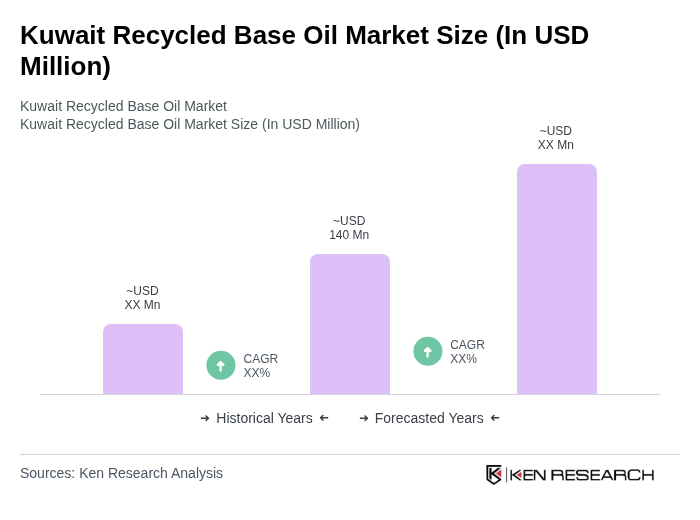
- The Kuwait Recycled Base Oil Market is valued at USD 140 million, based on a five-year historical analysis and its share within the broader Kuwait base oil market, which is valued at about USD 1.05 billion and includes a distinct re-refined base oil segment driven by sustainability initiatives and demand for high-quality lubricants. This growth is primarily driven by increasingly stringent environmental requirements on handling used lubricants and a rising demand for sustainable lubricants from automotive, industrial and fleet operators. The market is also supported by the growing automotive and transportation sector in Kuwait, where high vehicle density, heavy-duty fleets, and extended-drain lubricant requirements emphasize the need for high-quality recycled oils that can meet OEM performance and emission-control standards.
- Kuwait City is the dominant region in the market due to its industrial base, concentration of automotive service centers, logistics hubs, and manufacturing activities, aligning with the central-region dominance highlighted for base oil and lubricant demand in Kuwait. Additionally, Al Ahmadi and Al Farwaniyah are significant contributors, as Al Ahmadi hosts major refining and downstream complexes associated with Kuwait National Petroleum Company and related facilities, while both governorates concentrate workshops, garages, and lubricant distributors that facilitate efficient collection and processing of used oils.
- In 2023, the Kuwaiti government implemented a regulation mandating that all automotive service centers must recycle a minimum of 50% of the used oil they collect. This initiative aligns with broader environmental and waste-management obligations under instruments such as the Environmental Protection Law No. 42 of 2014 (as amended by Law No. 99 of 2015), issued by the Environment Public Authority, which governs hazardous waste handling, mandates safe collection and treatment of used oils, and requires licensed facilities to comply with approved disposal and recycling standards.
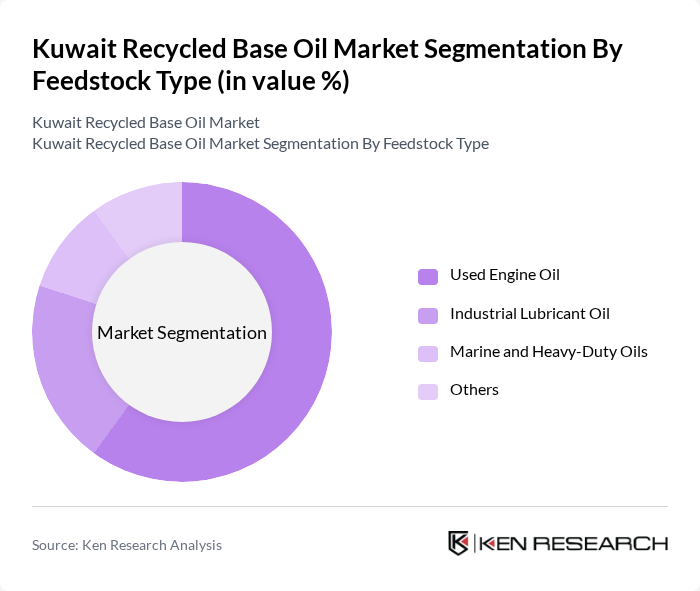
Kuwait Recycled Base Oil Market Segmentation
By Feedstock Type:The feedstock type segmentation includes various sources of used oils that are processed to produce recycled base oils. The primary subsegments are used engine oil, industrial lubricant oil, marine and heavy-duty oils, and others. Among these, used engine oil is the most significant contributor due to its high volume generated from automotive maintenance and repair activities, consistent with global waste oil trends where used engine oil is the largest single waste oil stream. The increasing awareness of environmental sustainability, regulatory pressure to manage hazardous waste, and the economic benefits of recycling have further propelled the demand for used engine oil as a preferred feedstock in the market.
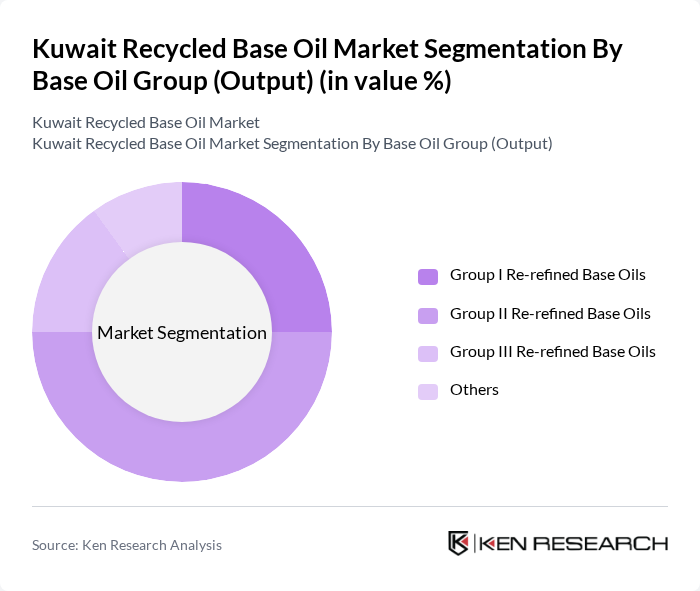
By Base Oil Group (Output):This segmentation categorizes recycled base oils based on their quality and refining process. The subsegments include Group I re-refined base oils, Group II re-refined base oils, Group III re-refined base oils, and others. Group II re-refined base oils dominate the market due to their superior performance characteristics, higher purity, and compatibility with modern engine technologies, mirroring the broader Kuwait base oil market where Group II and Group III are increasingly favored for advanced lubricant formulations and emission-compliant engines. The increasing demand for high-performance lubricants in the automotive and industrial sectors, along with OEM requirements for low-sulfur, low-volatility formulations, has significantly boosted the production and consumption of Group II oils.
Kuwait Recycled Base Oil Market Competitive Landscape
The Kuwait Recycled Base Oil Market is characterized by a dynamic mix of regional and international players. Leading participants such as Kuwait Lube Oil Company (KLOC), Al Qurain Petrochemical Industries Company, Kuwait Waste Oil Recycling Co., Gulf Oil International, Petromin Corporation, Al Sayer Group, Al Zayani Group, Al Jazeera Petrochemicals & Lubricants, United Oil Recycling Co., Al Kout Industrial Projects Company, Kuwait Oil Company (KOC), Independent Garages and Ta??mac?l?k Fleets (Aggregated), Regional Re-refiners Supplying Kuwait Market, OEM-affiliated Service Networks, Other Local Collectors and Aggregators contribute to innovation, geographic expansion, and service delivery in this space.
Kuwait Recycled Base Oil Market Industry Analysis
Growth Drivers
- Increasing Environmental Awareness:The growing environmental consciousness among consumers and industries in Kuwait is driving the demand for recycled base oils. In future, approximately 70% of Kuwaiti consumers expressed a preference for eco-friendly products, according to a local survey. This shift is supported by the country's commitment to reducing carbon emissions by 15% by 2030, as outlined in its National Climate Change Action Plan. Such initiatives are fostering a favorable environment for recycled oil adoption.
- Government Initiatives for Recycling:The Kuwaiti government has implemented various initiatives to promote recycling, including the establishment of the Kuwait Environment Public Authority (KEPA). In future, KEPA allocated $50 million to enhance recycling infrastructure and public awareness campaigns. These efforts aim to increase recycling rates from 10% to 30% in future, significantly boosting the recycled base oil market. Such government backing is crucial for industry growth and sustainability.
- Cost-Effectiveness of Recycled Base Oils:Recycled base oils offer a cost-effective alternative to virgin oils, with production costs estimated at 20% lower. In future, the average price of virgin base oil is projected to be $1,200 per ton, while recycled oils are expected to be around $960 per ton. This price differential is attracting businesses looking to reduce operational costs while maintaining quality, thus driving the market for recycled base oils in Kuwait.
Market Challenges
- Quality Perception of Recycled Oils:Despite the environmental benefits, there remains a significant challenge regarding the perception of recycled oils' quality. A study indicated that 60% of industrial users in Kuwait are hesitant to switch to recycled oils due to concerns about performance and reliability. This perception can hinder market growth, as companies prioritize quality and performance in their operations, impacting adoption rates.
- Limited Infrastructure for Collection:The lack of adequate infrastructure for collecting used oils poses a significant challenge to the recycled base oil market. Currently, only 15% of used oils are collected for recycling in Kuwait, according to KEPA reports. This limited collection infrastructure restricts the availability of feedstock for recycling facilities, ultimately affecting the supply of recycled base oils and hindering market expansion.
Kuwait Recycled Base Oil Market Future Outlook
The future of the Kuwait recycled base oil market appears promising, driven by increasing environmental regulations and a shift towards sustainable practices. As the government intensifies its recycling initiatives, the market is expected to witness significant growth. Additionally, advancements in recycling technologies will enhance the quality and efficiency of recycled oils, making them more competitive against virgin oils. This evolving landscape will likely attract new investments and partnerships, further solidifying the market's position in the region.
Market Opportunities
- Expansion into New Industrial Sectors:There is a growing opportunity for recycled base oils to penetrate new industrial sectors, such as construction and manufacturing. With Kuwait's construction sector projected to grow in future, the demand for lubricants and oils in these industries presents a significant opportunity for recycled products, enhancing market diversification.
- Partnerships with Automotive Industries:Collaborating with automotive manufacturers can create substantial opportunities for recycled base oils. As the automotive sector in Kuwait is expected to grow in future, partnerships can facilitate the integration of recycled oils into vehicle maintenance and manufacturing processes, promoting sustainability and reducing costs for manufacturers.
Scope of the Report
| Segment | Sub-Segments |
|---|---|
| By Feedstock Type | Used Engine Oil Industrial Lubricant Oil Marine and Heavy-Duty Oils Others |
| By Base Oil Group (Output) | Group I Re-refined Base Oils Group II Re-refined Base Oils Group III Re-refined Base Oils Others |
| By Application | Engine Oils Industrial Oils and Metalworking Fluids Hydraulic and Transmission Fluids Greases and Other Lubricants |
| By End-Use Industry | Automotive and Transportation Manufacturing and Heavy Industries Power Generation and Utilities Marine and Off-shore Others |
| By Collection & Processing Channel | In-house Captive Re-refining Third-party Collectors and Re-refiners Authorized Service Centers and Garages Others |
| By Quality/Performance Grade | API Licensed Grades OEM-approved Grades Standard/Unbranded Grades Others |
| By Kuwait Region | Al Asimah (Kuwait City) Al Ahmadi Al Farwaniyah & Al Jahra Hawalli & Mubarak Al-Kabeer |
Key Target Audience
Investors and Venture Capitalist Firms
Government and Regulatory Bodies (e.g., Kuwait Environment Public Authority)
Manufacturers and Producers of Recycled Base Oil
Oil and Gas Industry Stakeholders
Logistics and Supply Chain Companies
Environmental NGOs and Advocacy Groups
Automotive Industry Players
Petroleum Refining Companies
Players Mentioned in the Report:
Kuwait Lube Oil Company (KLOC)
Al Qurain Petrochemical Industries Company
Kuwait Waste Oil Recycling Co.
Gulf Oil International
Petromin Corporation
Al Sayer Group
Al Zayani Group
Al Jazeera Petrochemicals & Lubricants
United Oil Recycling Co.
Al Kout Industrial Projects Company
Kuwait Oil Company (KOC)
Independent Garages and Tasmaclk Fleets (Aggregated)
Regional Re-refiners Supplying Kuwait Market
OEM-affiliated Service Networks
Other Local Collectors and Aggregators
Table of Contents
Market Assessment Phase
1. Executive Summary and Approach
2. Kuwait Recycled Base Oil Market Overview
2.1 Key Insights and Strategic Recommendations
2.2 Kuwait Recycled Base Oil Market Overview
2.3 Definition and Scope
2.4 Evolution of Market Ecosystem
2.5 Timeline of Key Regulatory Milestones
2.6 Value Chain & Stakeholder Mapping
2.7 Business Cycle Analysis
2.8 Policy & Incentive Landscape
3. Kuwait Recycled Base Oil Market Analysis
3.1 Growth Drivers
3.1.1 Increasing Environmental Awareness
3.1.2 Government Initiatives for Recycling
3.1.3 Rising Demand for Sustainable Products
3.1.4 Cost-Effectiveness of Recycled Base Oils
3.2 Market Challenges
3.2.1 Quality Perception of Recycled Oils
3.2.2 Limited Infrastructure for Collection
3.2.3 Regulatory Compliance Issues
3.2.4 Competition from Virgin Base Oils
3.3 Market Opportunities
3.3.1 Expansion into New Industrial Sectors
3.3.2 Technological Advancements in Recycling
3.3.3 Partnerships with Automotive Industries
3.3.4 Export Potential to Neighboring Markets
3.4 Market Trends
3.4.1 Shift Towards Circular Economy
3.4.2 Increased Investment in Recycling Technologies
3.4.3 Growing Consumer Preference for Eco-Friendly Products
3.4.4 Development of Biodegradable Additives
3.5 Government Regulation
3.5.1 Waste Management Policies
3.5.2 Environmental Protection Standards
3.5.3 Incentives for Recycling Initiatives
3.5.4 Import Regulations on Base Oils
4. SWOT Analysis
5. Stakeholder Analysis
6. Porter's Five Forces Analysis
7. Kuwait Recycled Base Oil Market Market Size, 2019-2024
7.1 By Value
7.2 By Volume
7.3 By Average Selling Price
8. Kuwait Recycled Base Oil Market Segmentation
8.1 By Feedstock Type
8.1.1 Used Engine Oil
8.1.2 Industrial Lubricant Oil
8.1.3 Marine and Heavy-Duty Oils
8.1.4 Others
8.2 By Base Oil Group (Output)
8.2.1 Group I Re-refined Base Oils
8.2.2 Group II Re-refined Base Oils
8.2.3 Group III Re-refined Base Oils
8.2.4 Others
8.3 By Application
8.3.1 Engine Oils
8.3.2 Industrial Oils and Metalworking Fluids
8.3.3 Hydraulic and Transmission Fluids
8.3.4 Greases and Other Lubricants
8.4 By End-Use Industry
8.4.1 Automotive and Transportation
8.4.2 Manufacturing and Heavy Industries
8.4.3 Power Generation and Utilities
8.4.4 Marine and Off-shore
8.4.5 Others
8.5 By Collection & Processing Channel
8.5.1 In-house Captive Re-refining
8.5.2 Third-party Collectors and Re-refiners
8.5.3 Authorized Service Centers and Garages
8.5.4 Others
8.6 By Quality/Performance Grade
8.6.1 API Licensed Grades
8.6.2 OEM-approved Grades
8.6.3 Standard/Unbranded Grades
8.6.4 Others
8.7 By Kuwait Region
8.7.1 Al Asimah (Kuwait City)
8.7.2 Al Ahmadi
8.7.3 Al Farwaniyah & Al Jahra
8.7.4 Hawalli & Mubarak Al-Kabeer
9. Kuwait Recycled Base Oil Market Competitive Analysis
9.1 Market Share of Key Players
9.2 Cross Comparison of Key Players
9.2.1 Company Name
9.2.2 Installed Re-refining Capacity (kilo tonnes per annum)
9.2.3 Capacity Utilization Rate (%)
9.2.4 Revenue from Recycled Base Oil (USD million)
9.2.5 EBITDA Margin from Re-refining Operations (%)
9.2.6 Volume Growth Rate of Recycled Base Oil Sales (%)
9.2.7 Market Share in Kuwait Re-refined Base Oil (%)
9.2.8 Feedstock Collection Coverage (no. of collection points / tonnes collected)
9.2.9 Average Realization per Tonne (USD/tonne)
9.2.10 Export Share in Total Sales (%)
9.2.11 R&D / Capex Intensity (% of revenue)
9.3 SWOT Analysis of Top Players
9.4 Pricing Analysis
9.5 Detailed Profile of Major Companies
9.5.1 Kuwait Lube Oil Company (KLOC)
9.5.2 Al Qurain Petrochemical Industries Company
9.5.3 Kuwait Waste Oil Recycling Co.
9.5.4 Gulf Oil International
9.5.5 Petromin Corporation
9.5.6 Al Sayer Group
9.5.7 Al Zayani Group
9.5.8 Al Jazeera Petrochemicals & Lubricants
9.5.9 United Oil Recycling Co.
9.5.10 Al Kout Industrial Projects Company
9.5.11 Kuwait Oil Company (KOC)
9.5.12 Independent Garages and Ta??mac?l?k Fleets (Aggregated)
9.5.13 Regional Re-refiners Supplying Kuwait Market
9.5.14 OEM-affiliated Service Networks
9.5.15 Other Local Collectors and Aggregators
10. Kuwait Recycled Base Oil Market End-User Analysis
10.1 Procurement Behavior of Key Ministries
10.1.1 Ministry of Oil
10.1.2 Ministry of Environment
10.1.3 Ministry of Commerce
10.1.4 Others
10.2 Corporate Spend on Infrastructure & Energy
10.2.1 Investment Trends
10.2.2 Budget Allocations
10.2.3 Project Prioritization
10.2.4 Others
10.3 Pain Point Analysis by End-User Category
10.3.1 Automotive Sector
10.3.2 Industrial Sector
10.3.3 Government Sector
10.3.4 Others
10.4 User Readiness for Adoption
10.4.1 Awareness Levels
10.4.2 Training Needs
10.4.3 Infrastructure Readiness
10.4.4 Others
10.5 Post-Deployment ROI and Use Case Expansion
10.5.1 Performance Metrics
10.5.2 Case Studies
10.5.3 User Feedback
10.5.4 Others
11. Kuwait Recycled Base Oil Market Future Size, 2025-2030
11.1 By Value
11.2 By Volume
11.3 By Average Selling Price
Go-To-Market Strategy Phase
1. Whitespace Analysis + Business Model Canvas
1.1 Market Gaps Identification
1.2 Business Model Development
2. Marketing and Positioning Recommendations
2.1 Branding Strategies
2.2 Product USPs
3. Distribution Plan
3.1 Urban Retail vs Rural NGO Tie-ups
4. Channel & Pricing Gaps
4.1 Underserved Routes
4.2 Pricing Bands
5. Unmet Demand & Latent Needs
5.1 Category Gaps
5.2 Consumer Segments
6. Customer Relationship
6.1 Loyalty Programs
6.2 After-sales Service
7. Value Proposition
7.1 Sustainability
7.2 Integrated Supply Chains
8. Key Activities
8.1 Regulatory Compliance
8.2 Branding
8.3 Distribution Setup
9. Entry Strategy Evaluation
9.1 Domestic Market Entry Strategy
9.1.1 Product Mix
9.1.2 Pricing Band
9.1.3 Packaging
9.2 Export Entry Strategy
9.2.1 Target Countries
9.2.2 Compliance Roadmap
10. Entry Mode Assessment
10.1 JV
10.2 Greenfield
10.3 M&A
10.4 Distributor Model
11. Capital and Timeline Estimation
11.1 Capital Requirements
11.2 Timelines
12. Control vs Risk Trade-Off
12.1 Ownership vs Partnerships
13. Profitability Outlook
13.1 Breakeven Analysis
13.2 Long-term Sustainability
14. Potential Partner List
14.1 Distributors
14.2 JVs
14.3 Acquisition Targets
15. Execution Roadmap
15.1 Phased Plan for Market Entry
15.1.1 Market Setup
15.1.2 Market Entry
15.1.3 Growth Acceleration
15.1.4 Scale & Stabilize
15.2 Key Activities and Milestones
15.2.1 Activity Timeline
15.2.2 Milestone Tracking
Research Methodology
Phase 1: Approach1
Desk Research
- Analysis of industry reports from the Kuwait Ministry of Oil and Environmental Public Authority
- Review of academic journals and publications on recycled base oil technologies and market trends
- Examination of trade publications and market analysis reports specific to the Middle East oil sector
Primary Research
- Interviews with key stakeholders in the recycled base oil industry, including manufacturers and distributors
- Surveys conducted with environmental consultants and regulatory bodies involved in waste management
- Field interviews with operational managers at recycling facilities and oil refineries
Validation & Triangulation
- Cross-validation of findings through multiple data sources, including government statistics and industry reports
- Triangulation of insights from primary interviews with secondary data trends
- Sanity checks performed through expert panel discussions and feedback sessions
Phase 2: Market Size Estimation1
Top-down Assessment
- Estimation of total market size based on national oil consumption and recycling rates
- Segmentation of the market by end-user industries such as automotive, industrial, and marine
- Incorporation of government initiatives promoting recycling and sustainability in the oil sector
Bottom-up Modeling
- Collection of data on production capacities and output from major recycled base oil producers in Kuwait
- Operational cost analysis based on input materials and processing technologies
- Volume and pricing analysis to establish a comprehensive market value estimation
Forecasting & Scenario Analysis
- Development of forecasting models based on historical growth rates and market dynamics
- Scenario analysis considering regulatory changes and shifts in consumer preferences towards sustainability
- Creation of baseline, optimistic, and pessimistic forecasts through 2030
Phase 3: CATI Sample Composition1
| Scope Item/Segment | Sample Size | Target Respondent Profiles |
|---|---|---|
| Recycled Base Oil Producers | 90 | Production Managers, Operations Directors |
| Environmental Regulatory Bodies | 45 | Policy Makers, Environmental Analysts |
| End-Users in Automotive Sector | 70 | Fleet Managers, Maintenance Supervisors |
| Industrial Oil Consumers | 65 | Procurement Managers, Facility Managers |
| Recycling Facility Operators | 55 | Plant Managers, Technical Directors |
Frequently Asked Questions
What is the current value of the Kuwait Recycled Base Oil Market?
The Kuwait Recycled Base Oil Market is valued at approximately USD 140 million, representing a significant segment of the broader Kuwait base oil market, which is valued at around USD 1.05 billion. This growth is driven by sustainability initiatives and demand for high-quality lubricants.
What factors are driving the growth of the recycled base oil market in Kuwait?
Which regions in Kuwait dominate the recycled base oil market?
What are the main feedstock types used in the Kuwait Recycled Base Oil Market?
Other Regional/Country Reports
Other Adjacent Reports
Qatar Waste Oil Recycling Market
Saudi Arabia automotive lubricants market size, share, growth drivers, trends, opportunities & forecast 2025–2030Global Industrial Lubricants Market Size, Share & Forecast, By Product Type, End-Use Industry & Application, 2025-2032Global Petrochemicals Market Outlook to 2030Saudi Arabia Oil Refining Market Report Size Share Growth Drivers Trends Opportunities & Forecast 2025–2030Brazil Sustainable Chemicals Market
KSA Environmental Services Market
Canada Fleet Management Market Size, Share & Forecast, By Solution Type, Deployment Model & End-Use Industry, 2025-2032Why Buy From Us?

What makes us stand out is that our consultants follow Robust, Refine and Result (RRR) methodology. Robust for clear definitions, approaches and sanity checking, Refine for differentiating respondents' facts and opinions, and Result for presenting data with story.

We have set a benchmark in the industry by offering our clients with syndicated and customized market research reports featuring coverage of entire market as well as meticulous research and analyst insights.

While we don't replace traditional research, we flip the method upside down. Our dual approach of Top Bottom & Bottom Top ensures quality deliverable by not just verifying company fundamentals but also looking at the sector and macroeconomic factors.

With one step in the future, our research team constantly tries to show you the bigger picture. We help with some of the tough questions you may encounter along the way: How is the industry positioned? Best marketing channel? KPI's of competitors? By aligning every element, we help maximize success.

Our report gives you instant access to the answers and sources that other companies might choose to hide. We elaborate each steps of research methodology we have used and showcase you the sample size to earn your trust.

If you need any support, we are here! We pride ourselves on universe strength, data quality, and quick, friendly, and professional service.