About the Report
Base Year 2024Bahrain Recycled Base Oil Market Overview
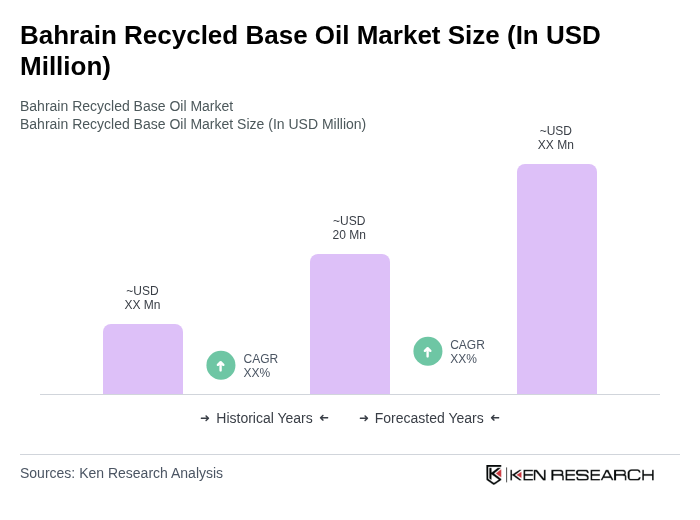
- The Bahrain Recycled Base Oil Market is valued at USD 20 million, based on a five-year historical analysis and Bahrain’s share in the global recycled/re?refined base oil pool relative to its lubricant demand and refining base. This growth is primarily driven by increasing environmental regulations on waste oil handling, rising awareness of sustainability and circular economy concepts, and the growing demand for high-quality lubricants formulated with re-refined base stocks. The market is also supported by the expansion and modernization of the automotive and industrial sectors in the GCC, which require efficient and eco-friendly oil solutions, including lubricants blended with recycled base oils.
- Key players in this market include Bahrain Petroleum Company (Bapco Energies), Bahrain Lube Base Oil Company (BLBOC), and other regional refiners and re?refiners in neighboring GCC countries that supply re?refined base oils into Bahrain. Bahrain's strategic location on key maritime routes and its well-established oil and gas infrastructure, including large base oil production capacity at Bapco/BLBOC, support its role as a regional hub for base oils and lubricants, with growing integration of recycled and re?refined base oil streams in the wider GCC trade.
- Bahrain regulates waste oil collection, transport, and treatment under environmental and hazardous waste frameworks rather than prescribing a fixed recycled content in finished lubricants. A key instrument is the Environmental Law promulgated by Legislative Decree No. 21 of 1996, issued by the Government of Bahrain, which empowers the Supreme Council for Environment to set standards for waste management, including used oil handling, storage, and disposal. Under this framework, lubricant and industrial operators are required to manage used oil through licensed collectors and approved treatment or recycling routes to minimize environmental impact, which indirectly promotes the development and use of recycled base oil without a statutory minimum recycled content mandate such as a 20 percent requirement for all lubricants.
Bahrain Recycled Base Oil Market Segmentation
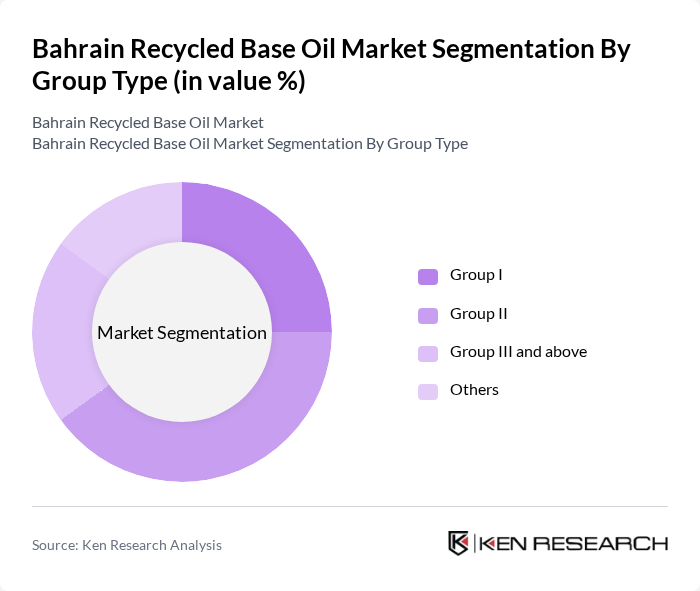
By Group Type:The market is segmented into various group types, including Group I, Group II, Group III and above, and Others, in line with global API base oil classifications. Group II is currently the leading segment in newer formulations because hydrotreating and hydrocracking technologies used in modern re?refining can yield Group II/II+ cuts with improved oxidation stability, lower sulfur, and better volatility, which are compatible with modern engine technologies and OEM specifications. The demand for Group II oils is driven by the automotive sector's shift towards higher efficiency, lower emissions, and longer drain intervals, making re?refined Group II base oils an increasingly preferred choice among lubricant manufacturers and fleet operators seeking cost-effective and sustainable solutions.
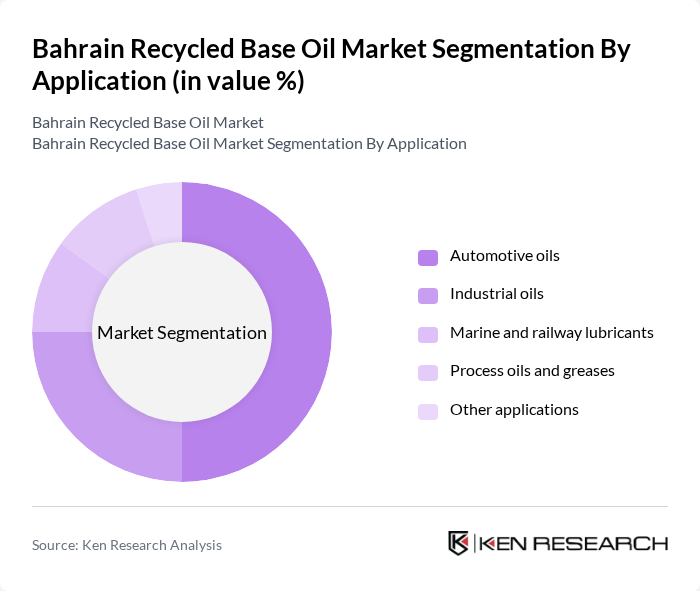
By Application:The applications of recycled base oil include automotive oils, industrial oils, marine and railway lubricants, process oils and greases, and other applications, mirroring the global utilization pattern for re?refined base stocks in lubricant blending. Automotive oils dominate the market due to the increasing number of vehicles in the GCC region, the high lubricant consumption associated with passenger cars and commercial fleets, and the growing emphasis on engine performance, fuel economy, and drain-interval optimization. The trend towards synthetic and semi-synthetic oils, which often use high-quality Group II/III or Group II+ re?refined base oils as part of their formulation, is also contributing to the rising demand for high-quality recycled base oils in this segment, particularly for fleet, workshop, and industrial users seeking both cost savings and improved environmental profiles.
Bahrain Recycled Base Oil Market Competitive Landscape
The Bahrain Recycled Base Oil Market is characterized by a dynamic mix of regional and international players. Leading participants such as Bahrain Petroleum Company (Bapco Energies), Bahrain Lube Base Oil Company (BLBOC), Bapco Gasoline & Lubricants Marketing, GPIC (Gulf Petrochemical Industries Company), Nogaholding (The Oil and Gas Holding Company B.S.C.), Al Jazeera Oil & Lubricants, Ahlia Oil Company, Al Haddad International Group – Lubricants & Oil Services, Key regional re-refiners supplying Bahrain (e.g., UAE- and Saudi-based players), Major used-oil collectors and aggregators in Bahrain, Leading lubricant blenders using recycled base oils in Bahrain, Global strategic players active in GCC recycled base oil trade, Logistics and storage operators handling used and recycled base oils, Environmental services firms active in waste oil management, Potential new entrants / JV partners for recycled base oil in Bahrain contribute to innovation, geographic expansion, and service delivery in this space.
Bahrain Recycled Base Oil Market Industry Analysis
Growth Drivers
- Increasing Environmental Awareness:The growing concern for environmental sustainability has led to a significant increase in the demand for recycled base oils. In Bahrain, the population's awareness of environmental issues has risen, with 78% of citizens supporting recycling initiatives, according to a government survey. This shift in consumer behavior is driving businesses to adopt eco-friendly practices, resulting in a projected increase in recycled oil consumption by 15,500 metric tons annually in future.
- Government Initiatives for Recycling:The Bahraini government has implemented various initiatives to promote recycling, including the establishment of the National Recycling Program, which allocated $5.5 million in future for recycling infrastructure. These initiatives aim to enhance the recycling rate, which currently stands at 20%. In future, the government aims to increase this rate to 35%, thereby boosting the demand for recycled base oils and supporting local businesses engaged in this sector.
- Rising Demand for Sustainable Products:The global trend towards sustainability is reflected in Bahrain, where the demand for eco-friendly products is increasing. In future, the market for sustainable lubricants, including recycled base oils, reached $11 million. With an expected annual growth rate of 12%, this segment is anticipated to reach $12.4 million in future. This trend is driven by both consumer preferences and corporate responsibility initiatives, further propelling the recycled base oil market.
Market Challenges
- Limited Consumer Awareness:Despite the growth in environmental awareness, consumer knowledge about recycled base oils remains limited. A study indicated that only 35% of consumers in Bahrain are aware of the benefits of using recycled oils. This lack of awareness poses a significant barrier to market growth, as many potential customers continue to prefer virgin oils, which are perceived as more reliable, thus hindering the adoption of recycled alternatives.
- Regulatory Compliance Costs:Companies in the recycled base oil sector face substantial regulatory compliance costs, which can reach up to $250,000 annually for small to medium enterprises. These costs arise from the need to meet stringent environmental regulations and quality standards set by the Bahraini government. As a result, many businesses may struggle to maintain profitability while adhering to these regulations, limiting their ability to invest in growth and innovation.
Bahrain Recycled Base Oil Market Future Outlook
The future of the Bahrain recycled base oil market appears promising, driven by increasing environmental regulations and a shift towards sustainable practices. As the government intensifies its recycling initiatives, the market is expected to see enhanced infrastructure and support for local businesses. Additionally, technological advancements in recycling processes will likely improve the quality and efficiency of recycled oils, making them more competitive against virgin oils. This evolving landscape presents significant opportunities for growth and innovation in the sector.
Market Opportunities
- Expansion into New Industrial Sectors:The recycled base oil market in Bahrain has the potential to expand into sectors such as construction and manufacturing, where demand for sustainable lubricants is growing. By targeting these industries, companies can tap into a market worth approximately $9 million in future, driven by increased regulatory pressure for sustainable practices.
- Partnerships with Automotive Industries:Collaborating with automotive manufacturers presents a lucrative opportunity for recycled base oil producers. With the automotive sector in Bahrain projected to grow by 12% in future, partnerships can facilitate the integration of recycled oils into vehicle maintenance programs, potentially increasing market penetration and driving sales by an estimated $2.5 million annually.
Scope of the Report
| Segment | Sub-Segments |
|---|---|
| By Group Type | Group I Group II Group III and above Others |
| By Application | Automotive oils Industrial oils Marine and railway lubricants Process oils and greases Other applications |
| By End User | Lubricant manufacturers Industrial operators Automotive service providers (workshops, garages, quick-lube centers) Government and commercial fleets Other end users |
| By Feedstock Source | Used automotive lubricants Industrial used oils Marine and shipping used oils Mixed and other used oil streams |
| By Technology | Clay treatment Vacuum distillation Solvent extraction Hydrotreating / hydroprocessing Other technologies |
| By Sales Channel | Direct sales to industrial and fleet customers Sales via lubricant blenders and distributors Trader / spot market sales Other sales channels |
| By Region (Bahrain) | Capital Governorate (Manama) Muharraq Governorate Northern Governorate Southern Governorate |
Key Target Audience
Investors and Venture Capitalist Firms
Government and Regulatory Bodies (e.g., Ministry of Industry, Commerce and Tourism)
Manufacturers and Producers of Recycled Base Oil
Oil and Lubricant Distributors
Environmental Protection Agencies (e.g., Supreme Council for Environment)
Automotive and Industrial Equipment Manufacturers
Recycling and Waste Management Companies
Logistics and Supply Chain Firms
Players Mentioned in the Report:
Bahrain Petroleum Company (Bapco Energies)
Bahrain Lube Base Oil Company (BLBOC)
Bapco Gasoline & Lubricants Marketing
GPIC (Gulf Petrochemical Industries Company)
Nogaholding (The Oil and Gas Holding Company B.S.C.)
Al Jazeera Oil & Lubricants
Ahlia Oil Company
Al Haddad International Group Lubricants & Oil Services
Key regional re-refiners supplying Bahrain (e.g., UAE- and Saudi-based players)
Major used-oil collectors and aggregators in Bahrain
Leading lubricant blenders using recycled base oils in Bahrain
Global strategic players active in GCC recycled base oil trade
Logistics and storage operators handling used and recycled base oils
Environmental services firms active in waste oil management
Potential new entrants / JV partners for recycled base oil in Bahrain
Table of Contents
Market Assessment Phase
1. Executive Summary and Approach
2. Bahrain Recycled Base Oil Market Overview
2.1 Key Insights and Strategic Recommendations
2.2 Bahrain Recycled Base Oil Market Overview
2.3 Definition and Scope
2.4 Evolution of Market Ecosystem
2.5 Timeline of Key Regulatory Milestones
2.6 Value Chain & Stakeholder Mapping
2.7 Business Cycle Analysis
2.8 Policy & Incentive Landscape
3. Bahrain Recycled Base Oil Market Analysis
3.1 Growth Drivers
3.1.1 Increasing Environmental Awareness
3.1.2 Government Initiatives for Recycling
3.1.3 Rising Demand for Sustainable Products
3.1.4 Cost-Effectiveness of Recycled Base Oils
3.2 Market Challenges
3.2.1 Limited Consumer Awareness
3.2.2 Regulatory Compliance Costs
3.2.3 Competition from Virgin Oils
3.2.4 Quality Perception Issues
3.3 Market Opportunities
3.3.1 Expansion into New Industrial Sectors
3.3.2 Technological Advancements in Recycling
3.3.3 Partnerships with Automotive Industries
3.3.4 Export Potential to Neighboring Markets
3.4 Market Trends
3.4.1 Shift Towards Circular Economy
3.4.2 Increased Investment in Recycling Technologies
3.4.3 Growing Popularity of Eco-Friendly Products
3.4.4 Development of New Blending Techniques
3.5 Government Regulation
3.5.1 Waste Management Regulations
3.5.2 Environmental Protection Laws
3.5.3 Standards for Recycled Products
3.5.4 Incentives for Recycling Initiatives
4. SWOT Analysis
5. Stakeholder Analysis
6. Porter's Five Forces Analysis
7. Bahrain Recycled Base Oil Market Market Size, 2019-2024
7.1 By Value
7.2 By Volume
7.3 By Average Selling Price
8. Bahrain Recycled Base Oil Market Segmentation
8.1 By Group Type
8.1.1 Group I
8.1.2 Group II
8.1.3 Group III and above
8.1.4 Others
8.2 By Application
8.2.1 Automotive oils
8.2.2 Industrial oils
8.2.3 Marine and railway lubricants
8.2.4 Process oils and greases
8.2.5 Other applications
8.3 By End User
8.3.1 Lubricant manufacturers
8.3.2 Industrial operators
8.3.3 Automotive service providers (workshops, garages, quick-lube centers)
8.3.4 Government and commercial fleets
8.3.5 Other end users
8.4 By Feedstock Source
8.4.1 Used automotive lubricants
8.4.2 Industrial used oils
8.4.3 Marine and shipping used oils
8.4.4 Mixed and other used oil streams
8.5 By Technology
8.5.1 Clay treatment
8.5.2 Vacuum distillation
8.5.3 Solvent extraction
8.5.4 Hydrotreating / hydroprocessing
8.5.5 Other technologies
8.6 By Sales Channel
8.6.1 Direct sales to industrial and fleet customers
8.6.2 Sales via lubricant blenders and distributors
8.6.3 Trader / spot market sales
8.6.4 Other sales channels
8.7 By Region (Bahrain)
8.7.1 Capital Governorate (Manama)
8.7.2 Muharraq Governorate
8.7.3 Northern Governorate
8.7.4 Southern Governorate
9. Bahrain Recycled Base Oil Market Competitive Analysis
9.1 Market Share of Key Players
9.2 Cross Comparison of Key Players
9.2.1 Company name
9.2.2 Installed re-refining capacity (kiloliters per year)
9.2.3 Capacity utilization (%)
9.2.4 Bahrain recycled base oil revenue (USD million, latest year)
9.2.5 Revenue CAGR from recycled base oils (last 3–5 years, %)
9.2.6 EBITDA margin from recycled base oil operations (%)
9.2.7 Share of recycled base oils in total lubricant/base oil portfolio (%)
9.2.8 Average realisation per kiloliter (USD/kL)
9.2.9 Market share in Bahrain recycled base oil market (%)
9.2.10 Export share of recycled base oil sales (%)
9.2.11 Customer concentration (top 5 customers’ share, %)
9.2.12 R&D / technology upgrade spend (% of recycled base oil revenue)
9.2.13 Collection network coverage (number of collection points / contracts)
9.2.14 ESG and compliance score (certifications, audits, incidents)
9.3 SWOT Analysis of Top Players
9.4 Pricing Analysis
9.5 Detailed Profile of Major Companies
9.5.1 Bahrain Petroleum Company (Bapco Energies)
9.5.2 Bahrain Lube Base Oil Company (BLBOC)
9.5.3 Bapco Gasoline & Lubricants Marketing
9.5.4 GPIC (Gulf Petrochemical Industries Company)
9.5.5 Nogaholding (The Oil and Gas Holding Company B.S.C.)
9.5.6 Al Jazeera Oil & Lubricants
9.5.7 Ahlia Oil Company
9.5.8 Al Haddad International Group – Lubricants & Oil Services
9.5.9 Key regional re-refiners supplying Bahrain (e.g., UAE- and Saudi-based players)
9.5.10 Major used-oil collectors and aggregators in Bahrain
9.5.11 Leading lubricant blenders using recycled base oils in Bahrain
9.5.12 Global strategic players active in GCC recycled base oil trade
9.5.13 Logistics and storage operators handling used and recycled base oils
9.5.14 Environmental services firms active in waste oil management
9.5.15 Potential new entrants / JV partners for recycled base oil in Bahrain
10. Bahrain Recycled Base Oil Market End-User Analysis
10.1 Procurement Behavior of Key Ministries
10.1.1 Ministry of Oil
10.1.2 Ministry of Industry
10.1.3 Ministry of Environment
10.1.4 Others
10.2 Corporate Spend on Infrastructure & Energy
10.2.1 Investment in Sustainable Practices
10.2.2 Budget Allocation for Recycling Initiatives
10.2.3 Corporate Social Responsibility Spending
10.2.4 Others
10.3 Pain Point Analysis by End-User Category
10.3.1 Automotive Sector
10.3.2 Industrial Sector
10.3.3 Government Sector
10.3.4 Others
10.4 User Readiness for Adoption
10.4.1 Awareness Levels
10.4.2 Training and Support Needs
10.4.3 Financial Readiness
10.4.4 Others
10.5 Post-Deployment ROI and Use Case Expansion
10.5.1 Performance Metrics
10.5.2 Case Studies
10.5.3 Future Expansion Plans
10.5.4 Others
11. Bahrain Recycled Base Oil Market Future Size, 2025-2030
11.1 By Value
11.2 By Volume
11.3 By Average Selling Price
Go-To-Market Strategy Phase
1. Whitespace Analysis + Business Model Canvas
1.1 Market Gaps Identification
1.2 Business Model Development
2. Marketing and Positioning Recommendations
2.1 Branding Strategies
2.2 Product USPs
3. Distribution Plan
3.1 Urban Retail Strategies
3.2 Rural NGO Tie-Ups
4. Channel & Pricing Gaps
4.1 Underserved Routes
4.2 Pricing Bands
5. Unmet Demand & Latent Needs
5.1 Category Gaps
5.2 Consumer Segments
6. Customer Relationship
6.1 Loyalty Programs
6.2 After-Sales Service
7. Value Proposition
7.1 Sustainability Initiatives
7.2 Integrated Supply Chains
8. Key Activities
8.1 Regulatory Compliance
8.2 Branding Efforts
8.3 Distribution Setup
9. Entry Strategy Evaluation
9.1 Domestic Market Entry Strategy
9.1.1 Product Mix
9.1.2 Pricing Band
9.1.3 Packaging
9.2 Export Entry Strategy
9.2.1 Target Countries
9.2.2 Compliance Roadmap
10. Entry Mode Assessment
10.1 Joint Ventures
10.2 Greenfield Investments
10.3 Mergers & Acquisitions
10.4 Distributor Model
11. Capital and Timeline Estimation
11.1 Capital Requirements
11.2 Timelines
12. Control vs Risk Trade-Off
12.1 Ownership vs Partnerships
13. Profitability Outlook
13.1 Breakeven Analysis
13.2 Long-Term Sustainability
14. Potential Partner List
14.1 Distributors
14.2 Joint Ventures
14.3 Acquisition Targets
15. Execution Roadmap
15.1 Phased Plan for Market Entry
15.1.1 Market Setup
15.1.2 Market Entry
15.1.3 Growth Acceleration
15.1.4 Scale & Stabilize
15.2 Key Activities and Milestones
15.2.1 Activity Planning
15.2.2 Milestone Tracking
Research Methodology
Phase 1: Approach1
Desk Research
- Industry reports from Bahrain's Ministry of Industry and Commerce
- Market analysis publications from environmental agencies and oil recycling associations
- Statistical data from the Bahrain Economic Development Board on oil consumption and recycling rates
Primary Research
- Interviews with executives from recycled oil processing companies in Bahrain
- Surveys targeting automotive service centers and lubricant distributors
- Field visits to recycling facilities to gather operational insights
Validation & Triangulation
- Cross-validation of findings with regional market trends and forecasts
- Triangulation of data from government reports, industry publications, and expert interviews
- Sanity checks through feedback from a panel of industry experts
Phase 2: Market Size Estimation1
Top-down Assessment
- Analysis of Bahrain's total oil consumption and the proportion attributed to recycled base oils
- Segmentation of the market by end-user industries such as automotive, industrial, and marine sectors
- Incorporation of government initiatives promoting recycling and sustainability
Bottom-up Modeling
- Volume estimates based on production capacities of existing recycling facilities
- Cost analysis derived from operational expenses and pricing strategies of recycled oils
- Estimation of market share based on sales data from key players in the industry
Forecasting & Scenario Analysis
- Multi-variable regression analysis considering factors like oil price fluctuations and environmental regulations
- Scenario modeling based on potential shifts in consumer preferences towards sustainable products
- Development of baseline, optimistic, and pessimistic forecasts through 2030
Phase 3: CATI Sample Composition1
| Scope Item/Segment | Sample Size | Target Respondent Profiles |
|---|---|---|
| Automotive Service Centers | 100 | Service Managers, Workshop Owners |
| Industrial Lubricant Distributors | 90 | Sales Managers, Product Line Managers |
| Recycling Facility Operators | 70 | Plant Managers, Operations Supervisors |
| Government Regulatory Bodies | 50 | Policy Makers, Environmental Officers |
| End-Users in Marine Sector | 80 | Fleet Managers, Procurement Officers |
Frequently Asked Questions
What is the current value of the Bahrain Recycled Base Oil Market?
The Bahrain Recycled Base Oil Market is valued at approximately USD 20 million, reflecting its share in the global recycled base oil pool and the increasing demand for eco-friendly lubricants in the region.
What factors are driving the growth of the recycled base oil market in Bahrain?
Who are the major players in the Bahrain Recycled Base Oil Market?
What are the main applications of recycled base oil in Bahrain?
Other Regional/Country Reports
Other Adjacent Reports
Singapore Waste Oil Recycling Market
Global Petrochemicals Market Outlook to 2030Saudi Arabia Oil Refining Market Report Size Share Growth Drivers Trends Opportunities & Forecast 2025–2030Thailand Environmental Services Market
Philippines Sustainable Chemicals Market
Why Buy From Us?

What makes us stand out is that our consultants follow Robust, Refine and Result (RRR) methodology. Robust for clear definitions, approaches and sanity checking, Refine for differentiating respondents' facts and opinions, and Result for presenting data with story.

We have set a benchmark in the industry by offering our clients with syndicated and customized market research reports featuring coverage of entire market as well as meticulous research and analyst insights.

While we don't replace traditional research, we flip the method upside down. Our dual approach of Top Bottom & Bottom Top ensures quality deliverable by not just verifying company fundamentals but also looking at the sector and macroeconomic factors.

With one step in the future, our research team constantly tries to show you the bigger picture. We help with some of the tough questions you may encounter along the way: How is the industry positioned? Best marketing channel? KPI's of competitors? By aligning every element, we help maximize success.

Our report gives you instant access to the answers and sources that other companies might choose to hide. We elaborate each steps of research methodology we have used and showcase you the sample size to earn your trust.

If you need any support, we are here! We pride ourselves on universe strength, data quality, and quick, friendly, and professional service.