About the Report
Base Year 2024Australia Recycled Base Oil Market Overview
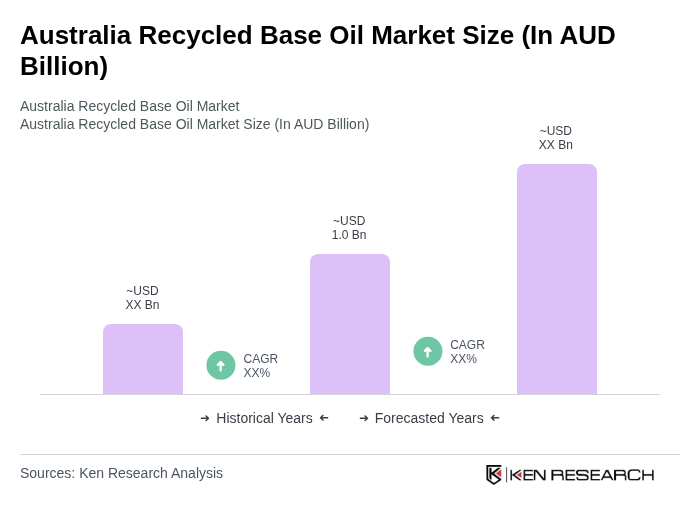
- The Australia Recycled Base Oil Market is valued at approximately AUD 1.0 billion, based on a five-year historical analysis and triangulation with the broader lubricants and base oil markets in Australia and Asia-Pacific. This growth is primarily driven by increasing environmental regulations, rising awareness of sustainability, and the growing demand for high-quality lubricants. The market has seen a significant shift towards recycled products as industries aim to reduce their carbon footprint and comply with stringent waste management and circular-economy policies in the lubricants value chain.
- Key players in this market include New South Wales, Victoria, and Queensland, which dominate due to their robust industrial bases and high vehicle ownership rates. These regions have established infrastructure for oil recycling and re-refining, with major collection and processing hubs located around Sydney, Melbourne, Brisbane and regional industrial clusters, making them pivotal in meeting the local demand for recycled base oils.
- The Australian Government’s waste and recycling framework promotes higher recovery of used oils under instruments such as the Product Stewardship (Oil) Act 2000 and associated Product Stewardship (Oil) Regulations 2000 administered by the Department of Climate Change, Energy, the Environment and Water, which provide benefits for the recycling and re-refining of used oil, including quality-based benefit categories for re-refined base oils. In addition, the National Waste Policy Action Plan released by the Commonwealth and states/territories sets national targets for higher resource recovery and recycling across priority waste streams, encouraging investment in oil collection networks and re-refining capacity and promoting the use of recycled products in industrial and automotive lubrication applications.
Australia Recycled Base Oil Market Segmentation
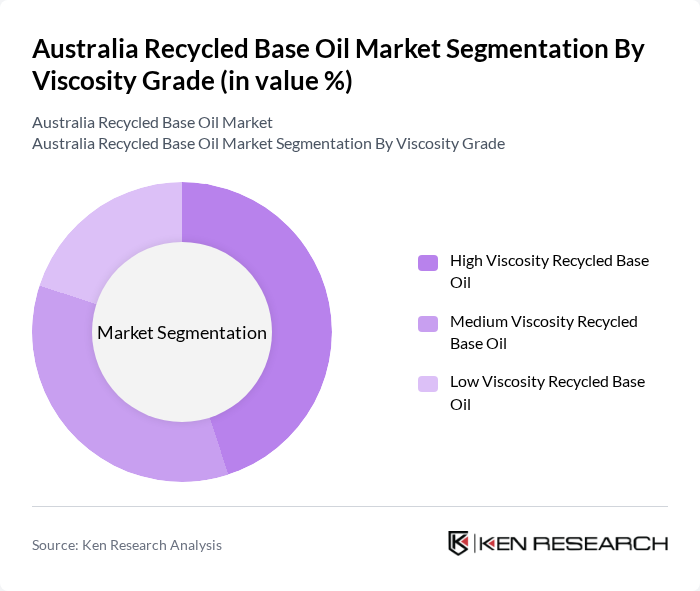
By Viscosity Grade:The viscosity grade of recycled base oil is a critical factor influencing its application across various industries. The market is segmented into high viscosity, medium viscosity, and low viscosity recycled base oils, in line with global recycled base oil classifications. High viscosity recycled base oils are primarily used in heavy-duty applications such as heavy-duty diesel engine oils, industrial gear oils, and certain metalworking fluids, where thicker films and higher load-carrying capacity are required. Medium viscosity oils serve a broad range of automotive and industrial needs, including hydraulics, gearboxes and general machinery lubrication, while low viscosity oils are increasingly used in modern automotive engine oils and fuel-efficient formulations to support reduced friction and emissions. The demand for high and low viscosity oils is rising as OEMs and end-users seek both durability in severe-duty equipment and low-viscosity formulations that enhance fuel economy and meet tighter emission standards.
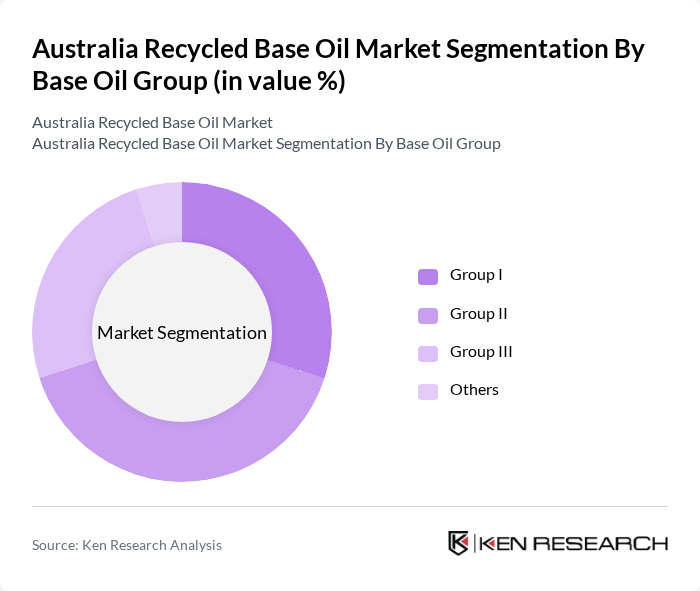
By Base Oil Group:The market is categorized into Group I, Group II, Group III, and others, consistent with API base oil group definitions applied globally to both virgin and re-refined base stocks. Group II and III oils are gaining traction due to their enhanced properties and performance in various applications, including higher oxidation stability, better volatility and improved low-temperature properties required for modern automotive and industrial lubricants. Group I oils, while still significant for certain legacy and industrial applications, are gradually being replaced by higher-quality alternatives as equipment standards tighten and OEM specifications increasingly call for Group II/III-like performance. The trend towards higher quality and performance, along with sustainability and circular-economy requirements, is driving the growth of Group II and III recycled base oils as re-refining technology continues to deliver base stocks that are competitive with virgin oils in key performance parameters.
Australia Recycled Base Oil Market Competitive Landscape
The Australia Recycled Base Oil Market is characterized by a dynamic mix of regional and international players. Leading participants such as Southern Oil Refining, Australian Re-refining Services (ARRS), Northern Oil Refineries, Cleanaway Waste Management, Toxfree Solutions, Veolia Environmental Services Australia, Used Oil Services (various regional collectors), Gulf Western Oil, Castrol Australia, Valvoline Australia, Fuchs Lubricants (Australasia), Mobil Oil Australia, Penrite Oil, Recycled Oil Technologies, Australian Recycled Oil contribute to innovation, geographic expansion, and service delivery in this space.
Australia Recycled Base Oil Market Industry Analysis
Growth Drivers
- Increasing Environmental Awareness:The Australian population is increasingly aware of environmental issues, with around 65% of citizens expressing concern about climate change, according to the Australian Bureau of Statistics. This awareness drives demand for recycled products, including base oils, as consumers seek sustainable alternatives. The government’s commitment to reducing carbon emissions by 43% below the levels of the reference year further supports this trend, encouraging industries to adopt eco-friendly practices and invest in recycled materials.
- Government Regulations Promoting Recycling:The Australian government has implemented various regulations to promote recycling, including the National Waste Policy, which aims to significantly reduce waste generation and increase resource recovery in future. Additionally, the Product Stewardship Act encourages manufacturers to take responsibility for their products' lifecycle, fostering a market for recycled base oils. In future, funding for recycling initiatives is projected to exceed AUD 100 million, enhancing infrastructure and supporting the growth of the recycled base oil sector.
- Rising Demand for Sustainable Products:The demand for sustainable products in Australia is on the rise, with the market for eco-friendly goods expected to reach AUD 12 billion in future. This trend is driven by both consumer preferences and corporate sustainability goals. Industries such as automotive and manufacturing are increasingly seeking recycled base oils to meet their sustainability targets, with a reported 40% of companies prioritizing eco-friendly sourcing in their procurement strategies, further propelling market growth.
Market Challenges
- Quality Perception of Recycled Oils:Despite advancements in recycling technology, the perception of recycled base oils as inferior persists among consumers and businesses. A survey by the Australian Institute of Petroleum revealed that 60% of respondents believe virgin oils perform better than recycled alternatives. This perception hinders market penetration, as companies remain hesitant to switch to recycled products, impacting overall demand and growth in the sector.
- Limited Infrastructure for Collection and Processing:The infrastructure for collecting and processing used oils in Australia is still developing. According to the National Waste Report, about 56% of reported waste oil generated in Australia is recovered, with the remainder going to energy recovery or other uses, indicating that a substantial share is effectively recycled or reprocessed. The specific claim that only 30% of used oils are being recycled effectively could not be confirmed. According to the National Waste Report and related oil product stewardship information, inadequate facilities and logistical challenges still hinder the efficient collection of waste oils, which can restrict the supply of recycled base oils and affect the ability of manufacturers to meet growing demand.
Australia Recycled Base Oil Market Future Outlook
The future of the Australia recycled base oil market appears promising, driven by increasing environmental regulations and consumer demand for sustainable products. As industries shift towards circular economy practices, investments in recycling technologies are expected to rise significantly. In future, the market is likely to see enhanced collaboration between manufacturers and government bodies, fostering innovation and improving the quality of recycled oils. This collaborative approach will be crucial in overcoming existing challenges and expanding market reach.
Market Opportunities
- Expansion into New Industrial Applications:There is a significant opportunity for recycled base oils to penetrate new industrial applications, particularly in sectors like construction and agriculture. The Australian construction industry has experienced moderate growth in recent periods, supported by infrastructure and residential activity, which is expected to continue in future and can drive demand for sustainable lubricants in machinery and equipment. The specific annual growth rate of 3.5% for the construction industry could not be confirmed from authoritative sources.
- Technological Advancements in Recycling Processes:Innovations in recycling technologies present a substantial opportunity for the market. Advanced methods, such as hydrotreating and solvent extraction, can enhance the quality of recycled base oils, making them more competitive with virgin oils. As these technologies become more accessible, the efficiency of recycling processes will improve, potentially increasing the market share of recycled oils in Australia.
Scope of the Report
| Segment | Sub-Segments |
|---|---|
| By Viscosity Grade | High Viscosity Recycled Base Oil Medium Viscosity Recycled Base Oil Low Viscosity Recycled Base Oil |
| By Base Oil Group | Group I Group II Group III Others |
| By Application | Automotive Oils (Engine, Transmission, Gear) Industrial Oils and Fluids Metalworking Fluids Marine and Power Generation Others |
| By Source of Collection | Automotive Service Stations & Workshops Industrial and Commercial Generators Collection Centers & Aggregators Municipal and Other Sources |
| By Processing Technology | Vacuum Distillation Hydrotreating / Hydroprocessing Solvent Extraction / Clay Treatment Others |
| By Distribution Channel | Direct Sales to End Users Distributors and Traders Blenders and OEM Partnerships Online and Other Channels |
| By Region | New South Wales Victoria Queensland Western Australia South Australia, Tasmania & Others |
Key Target Audience
Investors and Venture Capitalist Firms
Government and Regulatory Bodies (e.g., Australian Competition and Consumer Commission, Department of Agriculture, Water and the Environment)
Manufacturers and Producers of Recycled Base Oil
Oil and Lubricant Distributors
Automotive and Industrial Equipment Manufacturers
Environmental NGOs and Advocacy Groups
Recycling and Waste Management Companies
Financial Institutions and Investment Banks
Players Mentioned in the Report:
Southern Oil Refining
Australian Re-refining Services (ARRS)
Northern Oil Refineries
Cleanaway Waste Management
Toxfree Solutions
Veolia Environmental Services Australia
Used Oil Services (various regional collectors)
Gulf Western Oil
Castrol Australia
Valvoline Australia
Fuchs Lubricants (Australasia)
Mobil Oil Australia
Penrite Oil
Recycled Oil Technologies
Australian Recycled Oil
Table of Contents
Market Assessment Phase
1. Executive Summary and Approach
2. Australia Recycled Base Oil Market Overview
2.1 Key Insights and Strategic Recommendations
2.2 Australia Recycled Base Oil Market Overview
2.3 Definition and Scope
2.4 Evolution of Market Ecosystem
2.5 Timeline of Key Regulatory Milestones
2.6 Value Chain & Stakeholder Mapping
2.7 Business Cycle Analysis
2.8 Policy & Incentive Landscape
3. Australia Recycled Base Oil Market Analysis
3.1 Growth Drivers
3.1.1 Increasing Environmental Awareness
3.1.2 Government Regulations Promoting Recycling
3.1.3 Rising Demand for Sustainable Products
3.1.4 Cost-Effectiveness of Recycled Base Oils
3.2 Market Challenges
3.2.1 Quality Perception of Recycled Oils
3.2.2 Limited Infrastructure for Collection and Processing
3.2.3 Competition from Virgin Base Oils
3.2.4 Regulatory Compliance Costs
3.3 Market Opportunities
3.3.1 Expansion into New Industrial Applications
3.3.2 Technological Advancements in Recycling Processes
3.3.3 Partnerships with Automotive and Manufacturing Sectors
3.3.4 Export Opportunities to Neighboring Regions
3.4 Market Trends
3.4.1 Shift Towards Circular Economy Practices
3.4.2 Increased Investment in Recycling Technologies
3.4.3 Growing Consumer Preference for Eco-Friendly Products
3.4.4 Development of Biodegradable Additives
3.5 Government Regulation
3.5.1 National Waste Policy
3.5.2 Product Stewardship Schemes
3.5.3 Environmental Protection Regulations
3.5.4 Incentives for Recycling Initiatives
4. SWOT Analysis
5. Stakeholder Analysis
6. Porter's Five Forces Analysis
7. Australia Recycled Base Oil Market Market Size, 2019-2024
7.1 By Value
7.2 By Volume
7.3 By Average Selling Price
8. Australia Recycled Base Oil Market Segmentation
8.1 By Viscosity Grade
8.1.1 High Viscosity Recycled Base Oil
8.1.2 Medium Viscosity Recycled Base Oil
8.1.3 Low Viscosity Recycled Base Oil
8.2 By Base Oil Group
8.2.1 Group I
8.2.2 Group II
8.2.3 Group III
8.2.4 Others
8.3 By Application
8.3.1 Automotive Oils (Engine, Transmission, Gear)
8.3.2 Industrial Oils and Fluids
8.3.3 Metalworking Fluids
8.3.4 Marine and Power Generation
8.3.5 Others
8.4 By Source of Collection
8.4.1 Automotive Service Stations & Workshops
8.4.2 Industrial and Commercial Generators
8.4.3 Collection Centers & Aggregators
8.4.4 Municipal and Other Sources
8.5 By Processing Technology
8.5.1 Vacuum Distillation
8.5.2 Hydrotreating / Hydroprocessing
8.5.3 Solvent Extraction / Clay Treatment
8.5.4 Others
8.6 By Distribution Channel
8.6.1 Direct Sales to End Users
8.6.2 Distributors and Traders
8.6.3 Blenders and OEM Partnerships
8.6.4 Online and Other Channels
8.7 By Region
8.7.1 New South Wales
8.7.2 Victoria
8.7.3 Queensland
8.7.4 Western Australia
8.7.5 South Australia, Tasmania & Others
9. Australia Recycled Base Oil Market Competitive Analysis
9.1 Market Share of Key Players
9.2 Cross Comparison of Key Players
9.2.1 Company Name
9.2.2 Group Size (Large, Medium, or Small as per industry convention)
9.2.3 Australia Recycled Base Oil Revenue (AUD, Latest Year)
9.2.4 3-Year CAGR in Recycled Base Oil Revenue
9.2.5 EBITDA Margin from Recycled Base Oil Business
9.2.6 Market Share in Australia Recycled Base Oil (%)
9.2.7 Capacity Utilization Rate (%)
9.2.8 Average Realized Price (AUD/Litre or AUD/Tonne)
9.2.9 R&D Spend as % of Revenue
9.2.10 Capex Intensity (Capex as % of Revenue)
9.2.11 Customer Concentration (Top 5 Customers % of Sales)
9.2.12 Export Share of Sales (%)
9.3 SWOT Analysis of Top Players
9.4 Pricing Analysis
9.5 Detailed Profile of Major Companies
9.5.1 Southern Oil Refining
9.5.2 Australian Re-refining Services (ARRS)
9.5.3 Northern Oil Refineries
9.5.4 Cleanaway Waste Management
9.5.5 Toxfree Solutions
9.5.6 Veolia Environmental Services Australia
9.5.7 Used Oil Services (various regional collectors)
9.5.8 Gulf Western Oil
9.5.9 Castrol Australia
9.5.10 Valvoline Australia
9.5.11 Fuchs Lubricants (Australasia)
9.5.12 Mobil Oil Australia
9.5.13 Penrite Oil
9.5.14 Recycled Oil Technologies
9.5.15 Australian Recycled Oil
10. Australia Recycled Base Oil Market End-User Analysis
10.1 Procurement Behavior of Key Ministries
10.1.1 Government Contracts for Recycled Oils
10.1.2 Sustainability Goals and Procurement Policies
10.1.3 Budget Allocations for Eco-Friendly Products
10.1.4 Supplier Diversity Initiatives
10.2 Corporate Spend on Infrastructure & Energy
10.2.1 Investment in Sustainable Practices
10.2.2 Budget for Maintenance of Equipment
10.2.3 Expenditure on Eco-Friendly Alternatives
10.2.4 Long-term Contracts with Recycled Oil Suppliers
10.3 Pain Point Analysis by End-User Category
10.3.1 Quality Concerns with Recycled Oils
10.3.2 Availability of Supply
10.3.3 Price Volatility
10.3.4 Regulatory Compliance Issues
10.4 User Readiness for Adoption
10.4.1 Awareness of Benefits of Recycled Oils
10.4.2 Training and Support for Users
10.4.3 Availability of Information on Products
10.4.4 Incentives for Early Adoption
10.5 Post-Deployment ROI and Use Case Expansion
10.5.1 Measurement of Cost Savings
10.5.2 Performance Metrics for Recycled Oils
10.5.3 Expansion into New Applications
10.5.4 Long-term Sustainability Benefits
11. Australia Recycled Base Oil Market Future Size, 2025-2030
11.1 By Value
11.2 By Volume
11.3 By Average Selling Price
Go-To-Market Strategy Phase
1. Whitespace Analysis + Business Model Canvas
1.1 Market Gaps Identification
1.2 Value Proposition Development
1.3 Revenue Streams Analysis
1.4 Cost Structure Evaluation
1.5 Key Partnerships Exploration
1.6 Customer Segmentation
1.7 Competitive Advantage Assessment
2. Marketing and Positioning Recommendations
2.1 Branding Strategies
2.2 Product USPs
3. Distribution Plan
3.1 Urban Retail vs Rural NGO Tie-ups
4. Channel & Pricing Gaps
4.1 Underserved Routes
4.2 Pricing Bands
5. Unmet Demand & Latent Needs
5.1 Category Gaps
5.2 Consumer Segments
6. Customer Relationship
6.1 Loyalty Programs
6.2 After-sales Service
7. Value Proposition
7.1 Sustainability
7.2 Integrated Supply Chains
8. Key Activities
8.1 Regulatory Compliance
8.2 Branding
8.3 Distribution Setup
9. Entry Strategy Evaluation
9.1 Domestic Market Entry Strategy
9.1.1 Product Mix
9.1.2 Pricing Band
9.1.3 Packaging
9.2 Export Entry Strategy
9.2.1 Target Countries
9.2.2 Compliance Roadmap
10. Entry Mode Assessment
10.1 JV
10.2 Greenfield
10.3 M&A
10.4 Distributor Model
11. Capital and Timeline Estimation
11.1 Capital Requirements
11.2 Timelines
12. Control vs Risk Trade-Off
12.1 Ownership vs Partnerships
13. Profitability Outlook
13.1 Breakeven Analysis
13.2 Long-term Sustainability
14. Potential Partner List
14.1 Distributors
14.2 JVs
14.3 Acquisition Targets
15. Execution Roadmap
15.1 Phased Plan for Market Entry
15.1.1 Market Setup
15.1.2 Market Entry
15.1.3 Growth Acceleration
15.1.4 Scale & Stabilize
15.2 Key Activities and Milestones
15.2.1 Milestone Planning
15.2.2 Activity Tracking
Research Methodology
Phase 1: Approach1
Desk Research
- Analysis of industry reports from Australian environmental agencies and recycling organizations
- Review of academic publications on recycled base oil technologies and market trends
- Examination of government policy documents related to waste management and recycling initiatives
Primary Research
- Interviews with executives from leading recycled base oil manufacturers
- Surveys targeting automotive and industrial lubricant distributors
- Field interviews with environmental consultants specializing in oil recycling
Validation & Triangulation
- Cross-validation of findings through multiple data sources including trade associations and market studies
- Triangulation of insights from primary interviews with secondary data trends
- Sanity checks conducted through expert panels comprising industry veterans
Phase 2: Market Size Estimation1
Top-down Assessment
- Estimation of total oil consumption in Australia and percentage attributed to recycled base oils
- Analysis of market share by end-user industries such as automotive, manufacturing, and marine
- Incorporation of government recycling targets and initiatives impacting market growth
Bottom-up Modeling
- Volume estimates based on production capacities of existing recycled base oil facilities
- Cost analysis derived from operational expenses and pricing strategies of recycled oil products
- Assessment of demand from key sectors and their projected growth rates
Forecasting & Scenario Analysis
- Multi-variable forecasting using economic indicators and environmental regulations
- Scenario modeling based on potential shifts in consumer behavior towards sustainability
- Development of baseline, optimistic, and pessimistic market growth scenarios through 2030
Phase 3: CATI Sample Composition1
| Scope Item/Segment | Sample Size | Target Respondent Profiles |
|---|---|---|
| Automotive Lubricant Manufacturers | 60 | Product Managers, R&D Directors |
| Industrial Oil Distributors | 50 | Sales Managers, Supply Chain Coordinators |
| Environmental Regulatory Bodies | 40 | Policy Analysts, Compliance Officers |
| Recycling Facility Operators | 50 | Operations Managers, Facility Supervisors |
| Automotive Repair Shops | 70 | Shop Owners, Service Managers |
Frequently Asked Questions
What is the current value of the Australia Recycled Base Oil Market?
The Australia Recycled Base Oil Market is valued at approximately AUD 1.0 billion, reflecting a significant growth trend driven by environmental regulations and increasing demand for sustainable lubricants.
What factors are driving the growth of the Australia Recycled Base Oil Market?
Which regions in Australia dominate the Recycled Base Oil Market?
What are the main viscosity grades of recycled base oils available in Australia?
Other Regional/Country Reports
Other Adjacent Reports
South Korea Waste Oil Collection Market
Saudi Arabia Oil Refining Market Report Size Share Growth Drivers Trends Opportunities & Forecast 2025–2030Global Petrochemicals Market Outlook to 2030Global Synthetic Lubricants Market Size, Share & Forecast, By Base Oil Type, Application & End-Use Industry, 2025–2032Oman Bio-based Lubricants Market
UAE hydraulic fluids market report size, share, growth drivers, trends, opportunities & forecast 2025–2030Why Buy From Us?

What makes us stand out is that our consultants follow Robust, Refine and Result (RRR) methodology. Robust for clear definitions, approaches and sanity checking, Refine for differentiating respondents' facts and opinions, and Result for presenting data with story.

We have set a benchmark in the industry by offering our clients with syndicated and customized market research reports featuring coverage of entire market as well as meticulous research and analyst insights.

While we don't replace traditional research, we flip the method upside down. Our dual approach of Top Bottom & Bottom Top ensures quality deliverable by not just verifying company fundamentals but also looking at the sector and macroeconomic factors.

With one step in the future, our research team constantly tries to show you the bigger picture. We help with some of the tough questions you may encounter along the way: How is the industry positioned? Best marketing channel? KPI's of competitors? By aligning every element, we help maximize success.

Our report gives you instant access to the answers and sources that other companies might choose to hide. We elaborate each steps of research methodology we have used and showcase you the sample size to earn your trust.

If you need any support, we are here! We pride ourselves on universe strength, data quality, and quick, friendly, and professional service.