














Region:Middle East
Author(s):Geetanshi
Product Code:KRAC9419
Pages:94
Published On:November 2025
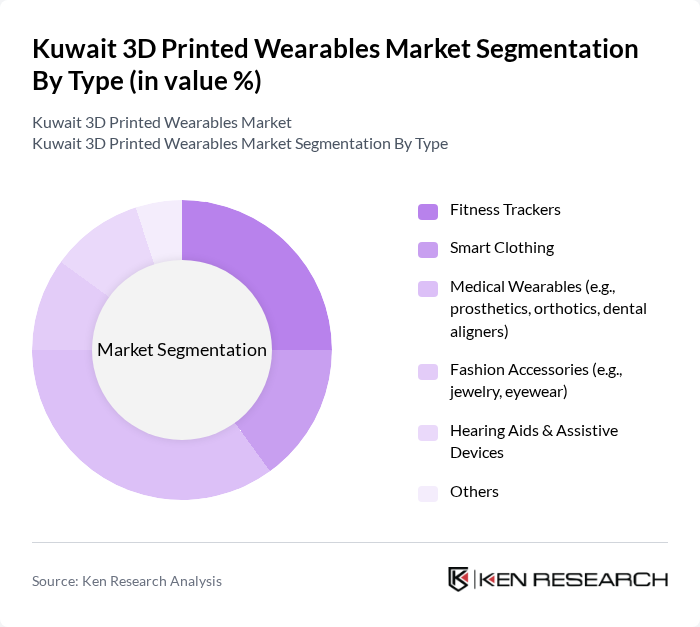
By Type:The market is segmented into various types of 3D printed wearables, including fitness trackers, smart clothing, medical wearables, fashion accessories, hearing aids, and others. Among these, medical wearables—such as prosthetics, orthotics, and dental aligners—are gaining significant traction due to the increasing demand for personalized healthcare solutions and the adoption of patient-specific devices in rehabilitation and dental care. Fitness trackers remain popular, driven by rising health consciousness and the integration of biometric sensors. The trend toward smart clothing is emerging, as consumers seek multifunctional apparel that integrates technology for enhanced athletic performance and health monitoring.
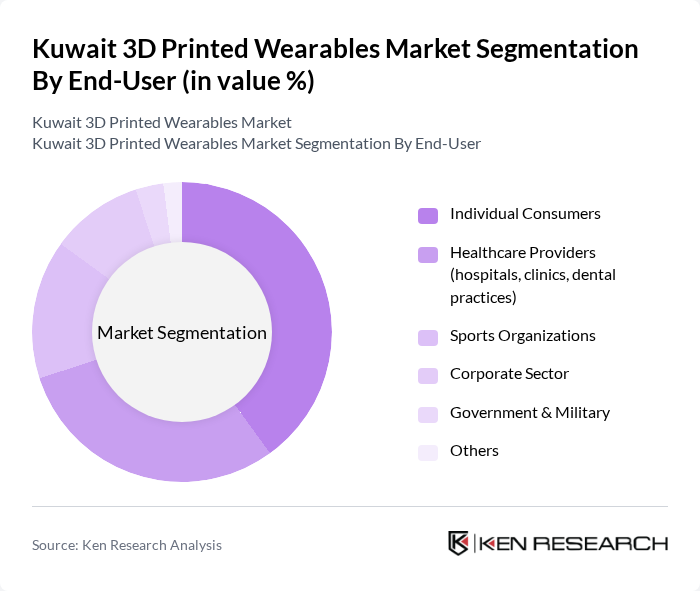
By End-User:The end-user segmentation includes individual consumers, healthcare providers, sports organizations, the corporate sector, government and military, and others. Individual consumers are the largest segment, driven by the increasing adoption of fitness and health monitoring devices. Healthcare providers are significant users, utilizing 3D printed medical wearables for patient care, rehabilitation, and dental applications. The corporate sector is gradually adopting wearables for employee wellness and occupational health programs, while sports organizations leverage these technologies for athlete performance enhancement and injury prevention.
The Kuwait 3D Printed Wearables Market is characterized by a dynamic mix of regional and international players. Leading participants such as 3D Systems Corporation, Stratasys Ltd., Materialise NV, HP Inc., Formlabs, Carbon, Inc., Sculpteo, Shapeways, Proto Labs, Inc., Xometry, Tinkerine Studios Ltd., 3D Hubs (now Hubs, a Protolabs company), Voodoo Manufacturing, Zortrax, Ultimaker, Gulf 3D Printing Company (Kuwait), Medtronic (for 3D printed medical wearables), Align Technology (Invisalign, dental aligners), Kuwait Digital Fabrication Lab, and Alghanim Healthcare Solutions contribute to innovation, geographic expansion, and service delivery in this space.
The future of the Kuwait 3D printed wearables market appears promising, driven by technological advancements and increasing consumer demand for personalized products. As the market evolves, we can expect a rise in collaborations between tech companies and local manufacturers, enhancing product offerings. Additionally, the integration of sustainable materials in production processes will likely gain traction, aligning with global sustainability trends and consumer preferences for eco-friendly products, further propelling market growth.
| Segment | Sub-Segments |
|---|---|
| By Type | Fitness Trackers Smart Clothing Medical Wearables (e.g., prosthetics, orthotics, dental aligners) Fashion Accessories (e.g., jewelry, eyewear) Hearing Aids & Assistive Devices Others |
| By End-User | Individual Consumers Healthcare Providers (hospitals, clinics, dental practices) Sports Organizations Corporate Sector Government & Military Others |
| By Application | Health Monitoring Fitness Tracking Fashion and Lifestyle Rehabilitation & Assistive Technology Dental & Orthopedic Applications Others |
| By Material | Biocompatible Plastics (e.g., PLA, ABS, PETG) Metals (e.g., titanium, stainless steel) Fabrics & Smart Textiles Composite Materials Silicone & Elastomers Others |
| By Distribution Channel | Online Retail Offline Retail Direct Sales B2B Sales Medical Supply Distributors Others |
| By Price Range | Budget Mid-Range Premium Luxury Others |
| By User Demographics | Age Group Gender Income Level Lifestyle Chronic Condition Prevalence Others |
| Scope Item/Segment | Sample Size | Target Respondent Profiles |
|---|---|---|
| Healthcare Wearables Adoption | 100 | Healthcare Providers, Medical Device Distributors |
| Fitness and Lifestyle Wearables | 80 | Fitness Trainers, Health Coaches |
| Consumer Electronics Retailers | 70 | Retail Managers, Product Buyers |
| 3D Printing Technology Providers | 50 | Manufacturing Engineers, Product Development Managers |
| End-User Experience with Wearables | 90 | Consumers, Tech Enthusiasts |
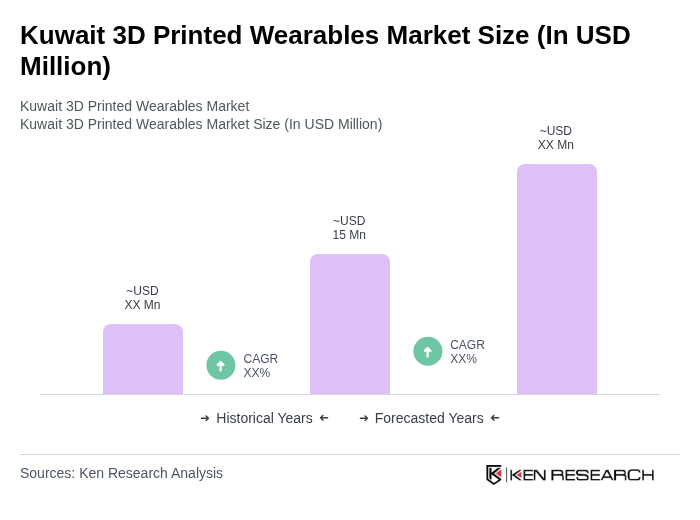
The Kuwait 3D Printed Wearables Market is valued at approximately USD 15 million, reflecting a five-year historical analysis. This growth is driven by advancements in 3D printing technology and increasing demand for personalized healthcare solutions.

What makes us stand out is that our consultants follow Robust, Refine and Result (RRR) methodology. Robust for clear definitions, approaches and sanity checking, Refine for differentiating respondents' facts and opinions, and Result for presenting data with story.

We have set a benchmark in the industry by offering our clients with syndicated and customized market research reports featuring coverage of entire market as well as meticulous research and analyst insights.

While we don't replace traditional research, we flip the method upside down. Our dual approach of Top Bottom & Bottom Top ensures quality deliverable by not just verifying company fundamentals but also looking at the sector and macroeconomic factors.

With one step in the future, our research team constantly tries to show you the bigger picture. We help with some of the tough questions you may encounter along the way: How is the industry positioned? Best marketing channel? KPI's of competitors? By aligning every element, we help maximize success.

Our report gives you instant access to the answers and sources that other companies might choose to hide. We elaborate each steps of research methodology we have used and showcase you the sample size to earn your trust.

If you need any support, we are here! We pride ourselves on universe strength, data quality, and quick, friendly, and professional service.