Kuwait Air Electrode Battery Market Size, Share, Growth Drivers, Trends, Opportunities & Forecast 2025–2030

The Kuwait Air Electrode Battery Market, valued at USD 160 million, is growing due to investments in renewables, electric mobility, and advanced battery technologies.

Region:Middle East

Author(s):Rebecca

Product Code:KRAD7572

Pages:88

Published On:December 2025

About the Report

Base Year 2024

Kuwait Air Electrode Battery Market Overview

  • The Kuwait Air Electrode Battery Market is valued at USD 160 million, based on a five-year historical analysis. This growth is primarily driven by the increasing demand for energy storage solutions in utility-scale and commercial projects, the expansion of electric mobility, and the broader uptake of advanced batteries across Kuwait’s battery market, which itself is valued at about USD 1.2 billion. The market is further supported by advancements in air electrode and metal–air battery technologies that enhance energy density, cycle life, and cost-efficiency.
  • Kuwait, together with other Gulf Cooperation Council (GCC) countries, is emerging as a key adopter of advanced battery and energy storage technologies, underpinned by strategic investments in renewable energy projects and a growing focus on sustainability. National initiatives to diversify energy sources and reduce reliance on conventional fossil fuel–based generation are driving demand for high-performance storage, including zinc–air and other metal–air systems for backup power, grid support, and distributed applications, particularly around Kuwait City and major industrial corridors.
  • In 2023, Kuwait advanced its policy framework for batteries and energy storage through measures that support cleaner technologies and low-emission transport, complementing the implementation of the Environment Protection Law No. 42 of 2014 (as amended by Law No. 99 of 2015) issued by the Environment Public Authority. Under this framework, industrial and energy projects must comply with environmental permitting, emissions control, and waste management requirements for battery manufacturing, handling, and disposal, while incentives linked to national energy-efficiency and renewable targets encourage the deployment of advanced batteries, including air electrode and metal–air systems, in mobility and stationary storage applications.
Kuwait Air Electrode Battery Market Size

Kuwait Air Electrode Battery Market Segmentation

By Type:

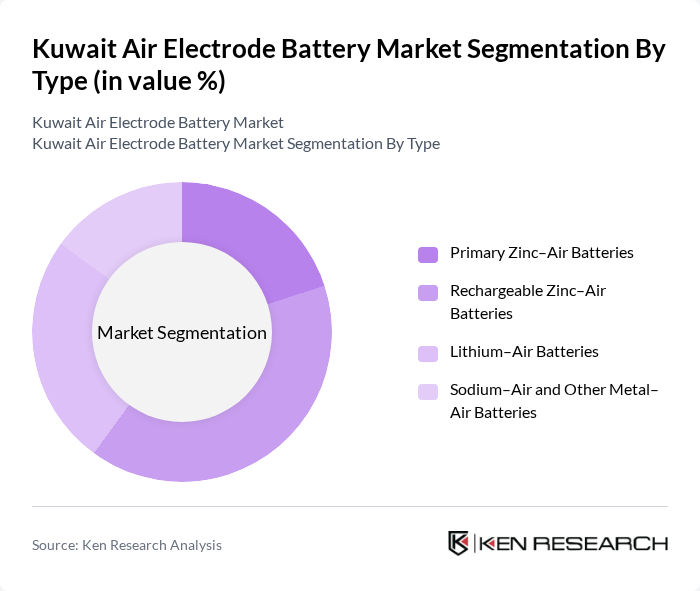
Kuwait Air Electrode Battery Market segmentation by Type.

The market is segmented into four main types: Primary Zinc–Air Batteries, Rechargeable Zinc–Air Batteries, Lithium–Air Batteries, and Sodium–Air and Other Metal–Air Batteries. Primary zinc–air batteries remain widely used in hearing aids and select consumer devices due to their high energy density and cost-effective single-use format. Rechargeable zinc–air and other rechargeable metal–air chemistries are gaining traction for stationary storage and longer-duration applications because they offer high specific energy and the potential for lower material costs compared with many conventional chemistries. Lithium–air and sodium–air batteries are at an earlier commercialization stage, with activity concentrated in pilot and R&D deployments, but they are increasingly considered for future electric mobility and grid-scale storage due to their theoretical ultra-high energy density. In Kuwait, demand is currently strongest for zinc–air and related metal–air solutions in backup power, telecom, and specialized industrial uses, with growing interest from project developers in integrating these chemistries alongside lithium-ion systems for renewable and long-duration storage.

By End-User:
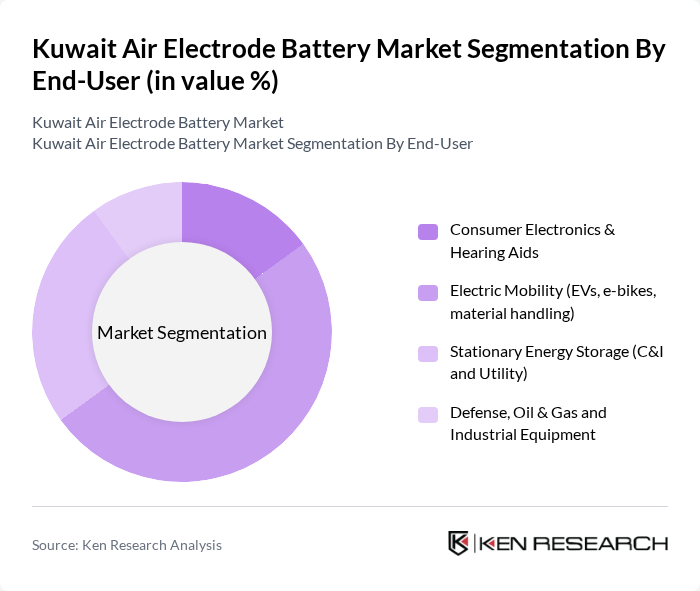
Kuwait Air Electrode Battery Market segmentation by End-User.

The end-user segmentation includes Consumer Electronics & Hearing Aids, Electric Mobility (EVs, e-bikes, material handling), Stationary Energy Storage (C&I and Utility), and Defense, Oil & Gas and Industrial Equipment. Consumer electronics and hearing aids represent a stable demand base for primary zinc–air cells, which are a standard power source in many hearing aid models due to their high energy density and steady voltage profile. Electric mobility and broader transportation uses are a key long-term opportunity for air electrode batteries globally, supported by the rapid growth of the EV and e-mobility ecosystem in GCC markets and the need for higher-range, lightweight storage solutions. Stationary energy storage for commercial, industrial, and utility applications is an increasingly important segment, where metal–air systems are being evaluated for renewable integration, backup power, and long-duration storage to complement lithium-ion installations. Defense, oil & gas, and industrial users in Kuwait are also exploring metal–air technologies for remote operations, emergency backup, and mission-critical equipment, driven by requirements for compact, high-energy solutions capable of operating in harsh environments.

Kuwait Air Electrode Battery Market Competitive Landscape

The Kuwait Air Electrode Battery Market is characterized by a dynamic mix of regional and international players. Leading participants such as Panasonic Energy Co., Ltd., Duracell Inc., Energizer Holdings, Inc., GP Batteries International Limited, VARTA AG, Spectrum Brands Holdings, Inc. (Rayovac), LG Energy Solution Ltd., Samsung SDI Co., Ltd., Saft Groupe S.A., Zinc8 Energy Solutions Inc., NantEnergy, Inc., Phinergy Ltd., POLY PLUS Battery Company, ZAF Energy Systems, Inc., EnerVenue Inc. contribute to innovation, geographic expansion, and service delivery in this space.

Panasonic Energy Co., Ltd.

2022

Osaka, Japan

Duracell Inc.

1924

Bethel, Connecticut, USA

Energizer Holdings, Inc.

2000

St. Louis, Missouri, USA

GP Batteries International Limited

1964

Hong Kong, China

VARTA AG

1887

Ellwangen, Germany

Company

Establishment Year

Headquarters

Global Air Electrode / Metal–Air Battery Revenue (USD)

Revenue Share from Middle East & Kuwait (%)

Installed Energy Storage Capacity in Kuwait (MWh)

CAGR of Air Electrode Battery Sales in Kuwait (%)

R&D Intensity (R&D Spend as % of Revenue)

Portfolio Breadth (Number of Metal–Air / Air Electrode SKUs)

Kuwait Air Electrode Battery Market Industry Analysis

Growth Drivers

  • Increasing Demand for Renewable Energy Storage Solutions:The global push for renewable energy has led to a significant increase in demand for energy storage solutions. In Kuwait, the renewable energy sector is projected to reach $1.8 billion in future, driven by solar and wind energy initiatives. This surge in investment is expected to create a robust market for air electrode batteries, which are essential for storing energy generated from renewable sources, thus supporting grid stability and energy efficiency.
  • Government Initiatives Promoting Sustainable Energy:The Kuwaiti government has committed to generating 20% of its energy from renewable sources in future, translating to approximately 5,000 MW of renewable capacity. This commitment is supported by various initiatives, including the Kuwait National Development Plan, which allocates $2.5 billion for sustainable energy projects. Such initiatives are expected to enhance the adoption of air electrode batteries as a viable energy storage solution, fostering market growth.
  • Technological Advancements in Battery Efficiency:Recent advancements in battery technology have significantly improved the efficiency and lifespan of air electrode batteries. For instance, new materials and designs have increased energy density by 35%, making these batteries more competitive against traditional lithium-ion batteries. As Kuwait's energy landscape evolves, these innovations are likely to drive adoption, with the market for advanced battery technologies projected to grow by $600 million in future, enhancing overall market dynamics.

Market Challenges

  • High Initial Investment Costs:The high upfront costs associated with air electrode battery technology pose a significant barrier to market entry. The average installation cost for renewable energy storage systems in Kuwait is approximately $1,300 per kWh, which can deter potential investors. This financial hurdle is compounded by the need for substantial infrastructure development, making it challenging for new players to penetrate the market effectively.
  • Limited Awareness and Understanding of Technology:There is a notable lack of awareness regarding air electrode battery technology among potential users in Kuwait. A recent survey indicated that only 30% of businesses are familiar with the benefits of this technology. This knowledge gap can hinder adoption rates, as stakeholders may prefer established battery technologies, thereby slowing the growth of the air electrode battery market in the region.

Kuwait Air Electrode Battery Market Future Outlook

The future of the air electrode battery market in Kuwait appears promising, driven by increasing investments in renewable energy and technological advancements. As the government continues to implement policies supporting sustainable energy, the market is expected to witness a surge in adoption rates. Additionally, the growing focus on energy efficiency and environmental sustainability will likely encourage further research and development, paving the way for innovative solutions that enhance battery performance and reduce costs.

Market Opportunities

  • Expansion into Emerging Markets:Kuwait's strategic location offers a gateway to emerging markets in the Middle East and North Africa. By leveraging this position, companies can tap into a growing demand for energy storage solutions, potentially increasing market share and revenue. The projected growth in these regions is expected to reach $1.2 billion in future, presenting significant opportunities for air electrode battery manufacturers.
  • Partnerships with Technology Innovators:Collaborating with technology innovators can enhance the development of advanced air electrode batteries. By forming strategic partnerships, companies can access cutting-edge research and development, leading to improved battery efficiency and performance. This collaboration is crucial as the market is expected to see a 25% increase in R&D investments in future, fostering innovation and competitiveness.

Scope of the Report

SegmentSub-Segments
By Type

Primary Zinc–Air Batteries

Rechargeable Zinc–Air Batteries

Lithium–Air Batteries

Sodium–Air and Other Metal–Air Batteries

By End-User

Consumer Electronics & Hearing Aids

Electric Mobility (EVs, e-bikes, material handling)

Stationary Energy Storage (C&I and Utility)

Defense, Oil & Gas and Industrial Equipment

By Application

Grid-Scale and Behind-the-Meter Energy Storage

Electric and Hybrid Vehicles

Portable and Wearable Electronics

Backup Power and Remote / Off-Grid Systems

By Distribution Channel

Direct OEM Supply & Project Sales

Industrial Distributors & System Integrators

Retail and Online Channels

EPC / Turnkey Energy Solution Providers

By Technology

Metal–Air (Zinc–Air, Lithium–Air, Sodium–Air)

Hybrid Metal–Air with Lithium-Ion Systems

Advanced Air Electrode & Catalyst Technologies

By Market Segment

Utility-Scale Renewable Integration

Commercial & Industrial Microgrids

Residential & Small Commercial Storage

Specialized and Niche Applications

By Policy Support

Renewable Energy & Storage Procurement Targets

Import Duty & Tax Incentives for Advanced Batteries

R&D Grants and Pilot Project Support

Local Content & Industrial Diversification Programs

Key Target Audience

Investors and Venture Capitalist Firms

Government and Regulatory Bodies (e.g., Kuwait Ministry of Electricity and Water)

Manufacturers and Producers

Energy Storage Solution Providers

Battery Technology Developers

Utility Companies

Environmental Agencies (e.g., Kuwait Environment Public Authority)

Infrastructure Development Agencies

Players Mentioned in the Report:

Panasonic Energy Co., Ltd.

Duracell Inc.

Energizer Holdings, Inc.

GP Batteries International Limited

VARTA AG

Spectrum Brands Holdings, Inc. (Rayovac)

LG Energy Solution Ltd.

Samsung SDI Co., Ltd.

Saft Groupe S.A.

Zinc8 Energy Solutions Inc.

NantEnergy, Inc.

Phinergy Ltd.

POLY PLUS Battery Company

ZAF Energy Systems, Inc.

EnerVenue Inc.

Table of Contents

Market Assessment Phase

1. Executive Summary and Approach


2. Kuwait Air Electrode Battery Market Overview

2.1 Key Insights and Strategic Recommendations

2.2 Kuwait Air Electrode Battery Market Overview

2.3 Definition and Scope

2.4 Evolution of Market Ecosystem

2.5 Timeline of Key Regulatory Milestones

2.6 Value Chain & Stakeholder Mapping

2.7 Business Cycle Analysis

2.8 Policy & Incentive Landscape


3. Kuwait Air Electrode Battery Market Analysis

3.1 Growth Drivers

3.1.1 Increasing demand for renewable energy storage solutions
3.1.2 Government initiatives promoting sustainable energy
3.1.3 Technological advancements in battery efficiency
3.1.4 Rising environmental concerns and regulations

3.2 Market Challenges

3.2.1 High initial investment costs
3.2.2 Limited awareness and understanding of technology
3.2.3 Supply chain disruptions
3.2.4 Competition from established battery technologies

3.3 Market Opportunities

3.3.1 Expansion into emerging markets
3.3.2 Partnerships with technology innovators
3.3.3 Development of hybrid energy systems
3.3.4 Government funding for research and development

3.4 Market Trends

3.4.1 Shift towards decentralized energy systems
3.4.2 Increasing investment in battery recycling technologies
3.4.3 Growth in electric vehicle adoption
3.4.4 Focus on sustainability and circular economy practices

3.5 Government Regulation

3.5.1 Incentives for renewable energy projects
3.5.2 Standards for battery safety and performance
3.5.3 Environmental regulations on battery disposal
3.5.4 Policies promoting local manufacturing of batteries

4. SWOT Analysis


5. Stakeholder Analysis


6. Porter's Five Forces Analysis


7. Kuwait Air Electrode Battery Market Market Size, 2019-2024

7.1 By Value

7.2 By Volume

7.3 By Average Selling Price


8. Kuwait Air Electrode Battery Market Segmentation

8.1 By Type

8.1.1 Primary Zinc–Air Batteries
8.1.2 Rechargeable Zinc–Air Batteries
8.1.3 Lithium–Air Batteries
8.1.4 Sodium–Air and Other Metal–Air Batteries

8.2 By End-User

8.2.1 Consumer Electronics & Hearing Aids
8.2.2 Electric Mobility (EVs, e-bikes, material handling)
8.2.3 Stationary Energy Storage (C&I and Utility)
8.2.4 Defense, Oil & Gas and Industrial Equipment

8.3 By Application

8.3.1 Grid-Scale and Behind-the-Meter Energy Storage
8.3.2 Electric and Hybrid Vehicles
8.3.3 Portable and Wearable Electronics
8.3.4 Backup Power and Remote / Off-Grid Systems

8.4 By Distribution Channel

8.4.1 Direct OEM Supply & Project Sales
8.4.2 Industrial Distributors & System Integrators
8.4.3 Retail and Online Channels
8.4.4 EPC / Turnkey Energy Solution Providers

8.5 By Technology

8.5.1 Metal–Air (Zinc–Air, Lithium–Air, Sodium–Air)
8.5.2 Hybrid Metal–Air with Lithium-Ion Systems
8.5.3 Advanced Air Electrode & Catalyst Technologies

8.6 By Market Segment

8.6.1 Utility-Scale Renewable Integration
8.6.2 Commercial & Industrial Microgrids
8.6.3 Residential & Small Commercial Storage
8.6.4 Specialized and Niche Applications

8.7 By Policy Support

8.7.1 Renewable Energy & Storage Procurement Targets
8.7.2 Import Duty & Tax Incentives for Advanced Batteries
8.7.3 R&D Grants and Pilot Project Support
8.7.4 Local Content & Industrial Diversification Programs

9. Kuwait Air Electrode Battery Market Competitive Analysis

9.1 Market Share of Key Players

9.2 Cross Comparison of Key Players

9.2.1 Company Name
9.2.2 Global Air Electrode / Metal–Air Battery Revenue (USD)
9.2.3 Revenue Share from Middle East & Kuwait (%)
9.2.4 Installed Energy Storage Capacity in Kuwait (MWh)
9.2.5 CAGR of Air Electrode Battery Sales in Kuwait (%)
9.2.6 R&D Intensity (R&D Spend as % of Revenue)
9.2.7 Portfolio Breadth (Number of Metal–Air / Air Electrode SKUs)
9.2.8 Average System Cost per kWh in Kuwait (USD/kWh)
9.2.9 Project Pipeline in Kuwait (Number and MWh)
9.2.10 Strategic Partnerships in GCC (Utilities, EPCs, OEMs)

9.3 SWOT Analysis of Top Players

9.4 Pricing Analysis

9.5 Detailed Profile of Major Companies

9.5.1 Panasonic Energy Co., Ltd.
9.5.2 Duracell Inc.
9.5.3 Energizer Holdings, Inc.
9.5.4 GP Batteries International Limited
9.5.5 VARTA AG
9.5.6 Spectrum Brands Holdings, Inc. (Rayovac)
9.5.7 LG Energy Solution Ltd.
9.5.8 Samsung SDI Co., Ltd.
9.5.9 Saft Groupe S.A.
9.5.10 Zinc8 Energy Solutions Inc.
9.5.11 NantEnergy, Inc.
9.5.12 Phinergy Ltd.
9.5.13 POLY PLUS Battery Company
9.5.14 ZAF Energy Systems, Inc.
9.5.15 EnerVenue Inc.

10. Kuwait Air Electrode Battery Market End-User Analysis

10.1 Procurement Behavior of Key Ministries

10.1.1 Government procurement policies
10.1.2 Budget allocation for energy projects
10.1.3 Evaluation criteria for suppliers
10.1.4 Collaboration with private sector

10.2 Corporate Spend on Infrastructure & Energy

10.2.1 Investment trends in energy infrastructure
10.2.2 Corporate sustainability initiatives
10.2.3 Budgeting for renewable energy projects
10.2.4 Partnerships with energy providers

10.3 Pain Point Analysis by End-User Category

10.3.1 Cost of energy storage solutions
10.3.2 Reliability of energy supply
10.3.3 Integration with existing systems
10.3.4 Regulatory compliance challenges

10.4 User Readiness for Adoption

10.4.1 Awareness of air electrode battery technology
10.4.2 Training and support needs
10.4.3 Financial readiness for investment
10.4.4 Infrastructure readiness

10.5 Post-Deployment ROI and Use Case Expansion

10.5.1 Measurement of energy savings
10.5.2 Expansion into new applications
10.5.3 Long-term performance evaluation
10.5.4 User feedback and improvement

11. Kuwait Air Electrode Battery Market Future Size, 2025-2030

11.1 By Value

11.2 By Volume

11.3 By Average Selling Price


Go-To-Market Strategy Phase

1. Whitespace Analysis + Business Model Canvas

1.1 Market gaps and opportunities

1.2 Business model components


2. Marketing and Positioning Recommendations

2.1 Branding strategies

2.2 Product USPs


3. Distribution Plan

3.1 Urban retail vs rural NGO tie-ups


4. Channel & Pricing Gaps

4.1 Underserved routes

4.2 Pricing bands


5. Unmet Demand & Latent Needs

5.1 Category gaps

5.2 Consumer segments


6. Customer Relationship

6.1 Loyalty programs

6.2 After-sales service


7. Value Proposition

7.1 Sustainability

7.2 Integrated supply chains


8. Key Activities

8.1 Regulatory compliance

8.2 Branding

8.3 Distribution setup


9. Entry Strategy Evaluation

9.1 Domestic Market Entry Strategy

9.1.1 Product mix
9.1.2 Pricing band
9.1.3 Packaging

9.2 Export Entry Strategy

9.2.1 Target countries
9.2.2 Compliance roadmap

10. Entry Mode Assessment

10.1 JV, Greenfield, M&A, Distributor Model


11. Capital and Timeline Estimation

11.1 Capital requirements

11.2 Timelines


12. Control vs Risk Trade-Off

12.1 Ownership vs Partnerships


13. Profitability Outlook

13.1 Breakeven analysis

13.2 Long-term sustainability


14. Potential Partner List

14.1 Distributors

14.2 JVs

14.3 Acquisition targets


15. Execution Roadmap

15.1 Phased Plan for Market Entry

15.1.1 Market Setup
15.1.2 Market Entry
15.1.3 Growth Acceleration
15.1.4 Scale & Stabilize

15.2 Key Activities and Milestones

15.2.1 Milestone planning
15.2.2 Activity tracking

Research Methodology

ApproachModellingSample

Phase 1: Approach1

Desk Research

  • Industry reports from the Kuwait Ministry of Electricity and Water
  • Market analysis publications from energy research organizations
  • Academic journals focusing on battery technology and energy storage solutions

Primary Research

  • Interviews with R&D heads at local battery manufacturing firms
  • Surveys with energy policy experts and government officials
  • Field interviews with engineers involved in battery technology development

Validation & Triangulation

  • Cross-validation using historical sales data and market trends
  • Triangulation of insights from industry experts and market reports
  • Sanity check through feedback from a panel of energy sector analysts

Phase 2: Market Size Estimation1

Top-down Assessment

  • Analysis of national energy consumption patterns and battery usage
  • Segmentation by application areas such as electric vehicles and renewable energy storage
  • Incorporation of government initiatives promoting clean energy technologies

Bottom-up Modeling

  • Volume estimates based on production capacities of local battery manufacturers
  • Cost analysis derived from raw material prices and manufacturing expenses
  • Estimation of market share based on sales data from key players

Forecasting & Scenario Analysis

  • Multi-variable regression analysis considering technological advancements and market demand
  • Scenario planning based on regulatory changes and environmental policies
  • Projections for market growth under various economic conditions through 2030

Phase 3: CATI Sample Composition1

Scope Item/SegmentSample SizeTarget Respondent Profiles
Electric Vehicle Battery Manufacturers45Production Managers, Technical Directors
Renewable Energy Storage Solutions40Project Managers, Energy Consultants
Government Energy Policy Makers30Policy Analysts, Regulatory Affairs Managers
Research Institutions in Battery Technology35Lead Researchers, Academic Professors
Battery Recycling and Disposal Companies40Operations Managers, Environmental Compliance Officers

Frequently Asked Questions

What is the current value of the Kuwait Air Electrode Battery Market?

The Kuwait Air Electrode Battery Market is valued at approximately USD 160 million, driven by the increasing demand for energy storage solutions, electric mobility, and advancements in battery technologies that enhance energy density and cost-efficiency.

What types of air electrode batteries are available in Kuwait?

What are the primary applications of air electrode batteries in Kuwait?

How is the Kuwaiti government supporting the air electrode battery market?

Other Regional/Country Reports

Indonesia Air Electrode Battery Market

Malaysia Air Electrode Battery Market

KSA Air Electrode Battery Market

APAC Air Electrode Battery Market

SEA Air Electrode Battery Market

Vietnam Air Electrode Battery Market

Why Buy From Us?

Refine Robust Result (RRR) Framework

What makes us stand out is that our consultants follow Robust, Refine and Result (RRR) methodology. Robust for clear definitions, approaches and sanity checking, Refine for differentiating respondents' facts and opinions, and Result for presenting data with story.

Our Reach Is Unmatched

We have set a benchmark in the industry by offering our clients with syndicated and customized market research reports featuring coverage of entire market as well as meticulous research and analyst insights.

Shifting the Research Paradigm

While we don't replace traditional research, we flip the method upside down. Our dual approach of Top Bottom & Bottom Top ensures quality deliverable by not just verifying company fundamentals but also looking at the sector and macroeconomic factors.

More Insights-Better Decisions

With one step in the future, our research team constantly tries to show you the bigger picture. We help with some of the tough questions you may encounter along the way: How is the industry positioned? Best marketing channel? KPI's of competitors? By aligning every element, we help maximize success.

Transparency and Trust

Our report gives you instant access to the answers and sources that other companies might choose to hide. We elaborate each steps of research methodology we have used and showcase you the sample size to earn your trust.

Round the Clock Support

If you need any support, we are here! We pride ourselves on universe strength, data quality, and quick, friendly, and professional service.

Why Clients Choose Us?

400000+
Reports in repository
150+
Consulting projects a year
100+
Analysts
8000+
Client Queries in 2022