Ken Research Logo

Kuwait Biocides Industry Size, Share, Growth Drivers, Trends, Opportunities & Forecast 2025–2030

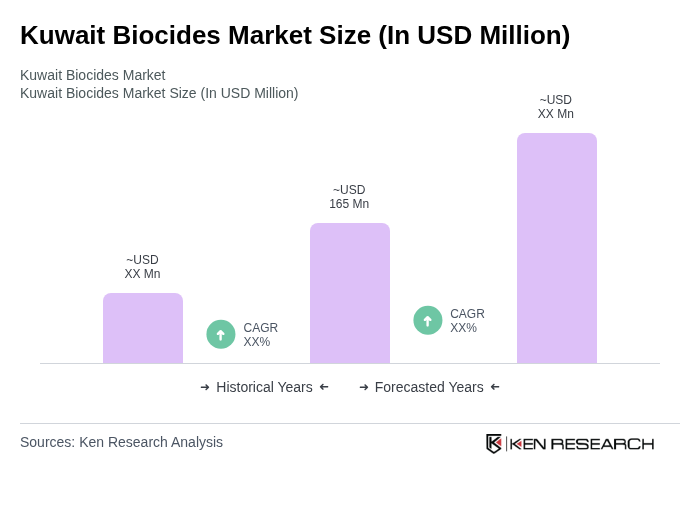
Kuwait Biocides Market, valued at USD 165 million, grows due to rising hygiene demands, regulatory frameworks, and sectors like water treatment and construction.

Region:Middle East

Author(s):Dev

Product Code:KRAD1793

Pages:81

Published On:November 2025
About the Report

Base Year 2024

Kuwait Biocides Market Overview

  • The Kuwait Biocides Market is valued at approximately USD 165 million, based on a five-year historical analysis. This growth is primarily driven by increasing awareness of hygiene and sanitation, particularly in the healthcare and food processing sectors. The rising demand for effective biocidal products to combat microbial threats has significantly contributed to market expansion.
  • Kuwait City is the dominant region in the biocides market due to its concentration of industrial activities and healthcare facilities. The presence of major oil and gas companies in the region also drives demand for biocides in oilfield applications. Additionally, the growing population and urbanization in Kuwait City further enhance the market's growth potential.
  • The Kuwaiti government has established regulatory frameworks governing biocide usage, with the Ministry of Health overseeing the registration and approval of biocidal products. This regulatory oversight aims to ensure safety and efficacy, requiring manufacturers to provide comprehensive data on product performance and environmental impact before market entry.
Kuwait Biocides Market Size

Kuwait Biocides Market Segmentation

By Type:The biocides market can be segmented into various types, including Halogen-based Biocides, Metallic Biocides, Organic Acid Biocides, Quaternary Ammonium Compounds, Isothiazolinones, and Others. Among these, Halogen-based Biocides are leading due to their widespread application in water treatment and sanitation processes. Their effectiveness against a broad spectrum of microorganisms makes them a preferred choice in various industries.
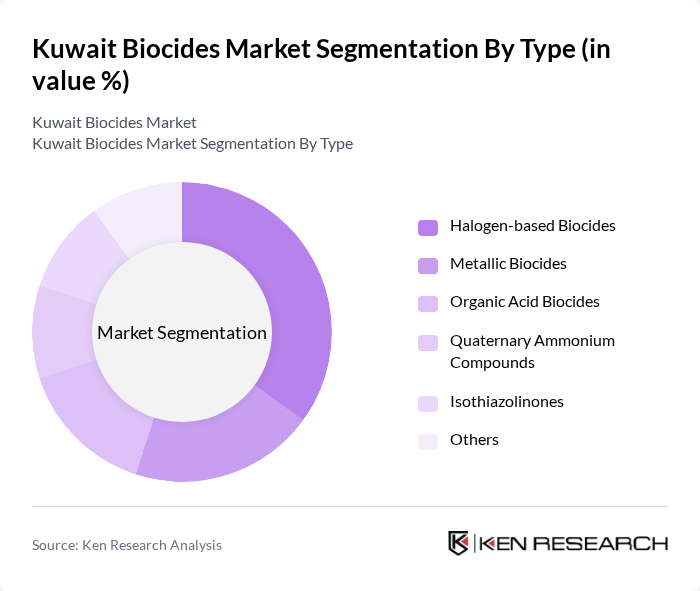
Kuwait Biocides Market segmentation by Type.

By End-User:The end-user segmentation includes Water Treatment, Oil & Gas, Healthcare, Food & Beverage Processing, Agriculture, Paints & Coatings, and Others. The Water Treatment sector is the largest consumer of biocides, driven by the need for safe drinking water and effective wastewater management. The increasing focus on environmental sustainability and regulatory compliance further boosts the demand in this sector.
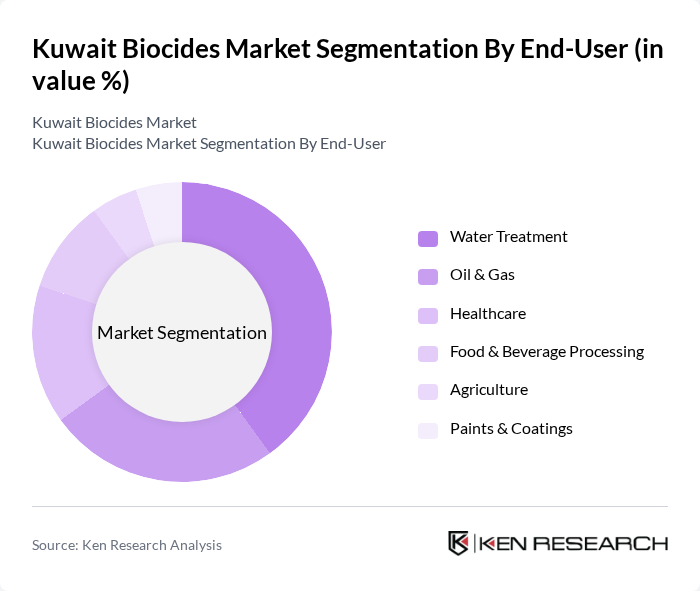
Kuwait Biocides Market segmentation by End-User.

Kuwait Biocides Market Competitive Landscape

The Kuwait Biocides Market is characterized by a dynamic mix of regional and international players. Leading participants such as BASF SE, Dow Chemical Company, Ecolab Inc., Lonza Group AG, Clariant AG, AkzoNobel N.V., Huntsman Corporation, Solvay S.A., Albemarle Corporation, Troy Corporation, BioSafe Systems LLC, Syngenta AG, FMC Corporation, UPL Limited, PeroxyChem LLC, Gulf Cryo, Al Sanea Chemical Products, Kuwait Chemical Manufacturing Company (KCMC), Veolia Middle East, Nalco Water (an Ecolab Company) contribute to innovation, geographic expansion, and service delivery in this space.

BASF SE

1865

Ludwigshafen, Germany

Dow Chemical Company

1897

Midland, Michigan, USA

Ecolab Inc.

1923

St. Paul, Minnesota, USA

Lonza Group AG

1897

Basel, Switzerland

Clariant AG

1995

Muttenz, Switzerland

Company

Establishment Year

Headquarters

Group Size (Large, Medium, or Small as per industry convention)

Revenue (USD, Kuwait Market)

Revenue Growth Rate (Kuwait Biocides Segment)

Market Share (%)

Number of Major End-User Segments Served

Product Portfolio Breadth (Number of Biocide Types)

Kuwait Biocides Market Industry Analysis

Growth Drivers

  • Increasing Demand for Hygiene and Sanitation Products:The Kuwait biocides market is experiencing a surge in demand for hygiene and sanitation products, driven by a heightened focus on public health. In future, the hygiene products sector is projected to reach approximately KWD 160 million, reflecting a 10% increase from the previous year. This growth is largely attributed to the ongoing efforts to combat infectious diseases and the rising consumer awareness regarding cleanliness, particularly in healthcare and food service sectors.
  • Stringent Regulations on Chemical Usage:Kuwait's government has implemented stringent regulations regarding chemical usage, particularly in biocides. In future, the Ministry of Health is expected to enforce new guidelines that require biocide manufacturers to comply with safety standards, impacting over 220 registered products. This regulatory environment is driving manufacturers to innovate and improve product formulations, thereby enhancing market growth and ensuring consumer safety.
  • Growth in the Construction and Manufacturing Sectors:The construction and manufacturing sectors in Kuwait are projected to grow by 6% in future, contributing significantly to the demand for biocides. With an investment of KWD 1.3 billion in infrastructure projects, the need for effective biocidal products to prevent microbial growth in construction materials is increasing. This trend is expected to bolster the biocides market as companies seek to ensure product longevity and safety in their operations.

Market Challenges

  • Regulatory Compliance Complexities:Navigating the regulatory landscape in Kuwait poses significant challenges for biocide manufacturers. The introduction of new compliance requirements in future is expected to increase operational costs by up to 16% for many companies. This complexity can hinder market entry for smaller firms and may lead to delays in product launches, ultimately affecting overall market growth and innovation.
  • High Competition from Alternative Products:The biocides market in Kuwait faces intense competition from alternative products, such as natural and organic disinfectants. In future, the market share of these alternatives is anticipated to reach 32%, driven by consumer preference for eco-friendly solutions. This shift poses a challenge for traditional biocide manufacturers, compelling them to adapt their strategies to maintain market relevance and consumer trust.

Kuwait Biocides Market Future Outlook

The future of the Kuwait biocides market appears promising, with a strong emphasis on sustainability and innovation. As consumer preferences shift towards eco-friendly products, manufacturers are likely to invest in research and development to create biodegradable biocides. Additionally, strategic partnerships with local distributors will enhance market penetration and accessibility, allowing companies to tap into emerging sectors such as agriculture and food safety, which are expected to drive significant growth in the coming years.

Market Opportunities

  • Expansion into Emerging Sectors:The biocides market has significant opportunities for expansion into emerging sectors such as agriculture and food safety. With the agricultural sector projected to grow by 5% in future, biocide applications in pest control and crop protection are expected to increase, providing a lucrative avenue for manufacturers to diversify their product offerings and enhance revenue streams.
  • Development of Eco-Friendly Biocides:There is a growing demand for eco-friendly biocides, driven by consumer awareness and regulatory pressures. In future, the market for green biocides is expected to grow by 22%, presenting an opportunity for manufacturers to innovate and develop sustainable products. This shift not only aligns with global sustainability trends but also positions companies favorably in a competitive market landscape.

Scope of the Report

SegmentSub-Segments
By Type

Halogen-based Biocides

Metallic Biocides

Organic Acid Biocides

Quaternary Ammonium Compounds

Isothiazolinones

Others

By End-User

Water Treatment

Oil & Gas

Healthcare

Food & Beverage Processing

Agriculture

Paints & Coatings

Others

By Application

Industrial Water Treatment

Cooling Towers

Boilers

Wood Preservation

Paints & Coatings

Oilfield Applications

Others

By Formulation

Liquid

Powder

Granular

Others

By Distribution Channel

Direct Sales

Distributors

Online Retail

Others

By Region

Central Kuwait

Southern Kuwait

Northern Kuwait

Eastern Kuwait

By Regulatory Compliance

ISO Certified Products

Non-ISO Certified Products

Others

Key Target Audience

Investors and Venture Capitalist Firms

Government and Regulatory Bodies (e.g., Kuwait Environment Public Authority, Ministry of Health)

Manufacturers and Producers

Distributors and Retailers

Importers and Exporters

Industry Associations (e.g., Kuwait Chemical Society)

Health and Safety Regulatory Agencies

Environmental NGOs and Advocacy Groups

Players Mentioned in the Report:

BASF SE

Dow Chemical Company

Ecolab Inc.

Lonza Group AG

Clariant AG

AkzoNobel N.V.

Huntsman Corporation

Solvay S.A.

Albemarle Corporation

Troy Corporation

BioSafe Systems LLC

Syngenta AG

FMC Corporation

UPL Limited

PeroxyChem LLC

Gulf Cryo

Al Sanea Chemical Products

Kuwait Chemical Manufacturing Company (KCMC)

Veolia Middle East

Nalco Water (an Ecolab Company)

Table of Contents

Market Assessment Phase

1. Executive Summary and Approach


2. Kuwait Biocides Market Overview

2.1 Key Insights and Strategic Recommendations

2.2 Kuwait Biocides Market Overview

2.3 Definition and Scope

2.4 Evolution of Market Ecosystem

2.5 Timeline of Key Regulatory Milestones

2.6 Value Chain & Stakeholder Mapping

2.7 Business Cycle Analysis

2.8 Policy & Incentive Landscape


3. Kuwait Biocides Market Analysis

3.1 Growth Drivers

3.1.1 Increasing demand for hygiene and sanitation products
3.1.2 Stringent regulations on chemical usage
3.1.3 Growth in the construction and manufacturing sectors
3.1.4 Rising awareness of environmental safety

3.2 Market Challenges

3.2.1 Regulatory compliance complexities
3.2.2 High competition from alternative products
3.2.3 Fluctuating raw material prices
3.2.4 Limited consumer awareness

3.3 Market Opportunities

3.3.1 Expansion into emerging sectors
3.3.2 Development of eco-friendly biocides
3.3.3 Strategic partnerships with local distributors
3.3.4 Increasing export potential

3.4 Market Trends

3.4.1 Shift towards sustainable and biodegradable products
3.4.2 Technological advancements in biocide formulations
3.4.3 Growing preference for multifunctional products
3.4.4 Increased focus on research and development

3.5 Government Regulation

3.5.1 Implementation of stricter environmental regulations
3.5.2 Mandatory registration of biocides
3.5.3 Guidelines for safe usage and disposal
3.5.4 Incentives for green product development

4. SWOT Analysis


5. Stakeholder Analysis


6. Porter's Five Forces Analysis


7. Kuwait Biocides Market Market Size, 2019-2024

7.1 By Value

7.2 By Volume

7.3 By Average Selling Price


8. Kuwait Biocides Market Segmentation

8.1 By Type

8.1.1 Halogen-based Biocides
8.1.2 Metallic Biocides
8.1.3 Organic Acid Biocides
8.1.4 Quaternary Ammonium Compounds
8.1.5 Isothiazolinones
8.1.6 Others

8.2 By End-User

8.2.1 Water Treatment
8.2.2 Oil & Gas
8.2.3 Healthcare
8.2.4 Food & Beverage Processing
8.2.5 Agriculture
8.2.6 Paints & Coatings
8.2.7 Others

8.3 By Application

8.3.1 Industrial Water Treatment
8.3.2 Cooling Towers
8.3.3 Boilers
8.3.4 Wood Preservation
8.3.5 Paints & Coatings
8.3.6 Oilfield Applications
8.3.7 Others

8.4 By Formulation

8.4.1 Liquid
8.4.2 Powder
8.4.3 Granular
8.4.4 Others

8.5 By Distribution Channel

8.5.1 Direct Sales
8.5.2 Distributors
8.5.3 Online Retail
8.5.4 Others

8.6 By Region

8.6.1 Central Kuwait
8.6.2 Southern Kuwait
8.6.3 Northern Kuwait
8.6.4 Eastern Kuwait

8.7 By Regulatory Compliance

8.7.1 ISO Certified Products
8.7.2 Non-ISO Certified Products
8.7.3 Others

9. Kuwait Biocides Market Competitive Analysis

9.1 Market Share of Key Players

9.2 Cross Comparison of Key Players

9.2.1 Company Name
9.2.2 Group Size (Large, Medium, or Small as per industry convention)
9.2.3 Revenue (USD, Kuwait Market)
9.2.4 Revenue Growth Rate (Kuwait Biocides Segment)
9.2.5 Market Share (%)
9.2.6 Number of Major End-User Segments Served
9.2.7 Product Portfolio Breadth (Number of Biocide Types)
9.2.8 Local Distribution Network Strength
9.2.9 Regulatory Compliance Record (e.g., ISO, local)
9.2.10 R&D Investment as % of Revenue
9.2.11 Customer Retention Rate (%)
9.2.12 Average Lead Time (Days)
9.2.13 Sustainability/Green Product Share (%)

9.3 SWOT Analysis of Top Players

9.4 Pricing Analysis

9.5 Detailed Profile of Major Companies

9.5.1 BASF SE
9.5.2 Dow Chemical Company
9.5.3 Ecolab Inc.
9.5.4 Lonza Group AG
9.5.5 Clariant AG
9.5.6 AkzoNobel N.V.
9.5.7 Huntsman Corporation
9.5.8 Solvay S.A.
9.5.9 Albemarle Corporation
9.5.10 Troy Corporation
9.5.11 BioSafe Systems LLC
9.5.12 Syngenta AG
9.5.13 FMC Corporation
9.5.14 UPL Limited
9.5.15 PeroxyChem LLC
9.5.16 Gulf Cryo
9.5.17 Al Sanea Chemical Products
9.5.18 Kuwait Chemical Manufacturing Company (KCMC)
9.5.19 Veolia Middle East
9.5.20 Nalco Water (an Ecolab Company)

10. Kuwait Biocides Market End-User Analysis

10.1 Procurement Behavior of Key Ministries

10.1.1 Key procurement processes
10.1.2 Budget allocation trends
10.1.3 Preferred suppliers
10.1.4 Compliance requirements

10.2 Corporate Spend on Infrastructure & Energy

10.2.1 Investment trends
10.2.2 Major projects
10.2.3 Funding sources
10.2.4 Strategic partnerships

10.3 Pain Point Analysis by End-User Category

10.3.1 Common challenges faced
10.3.2 Solutions sought
10.3.3 Service expectations
10.3.4 Feedback mechanisms

10.4 User Readiness for Adoption

10.4.1 Awareness levels
10.4.2 Training needs
10.4.3 Adoption barriers
10.4.4 Support requirements

10.5 Post-Deployment ROI and Use Case Expansion

10.5.1 Measurement of success
10.5.2 Case studies
10.5.3 Future expansion plans
10.5.4 Lessons learned

11. Kuwait Biocides Market Future Size, 2025-2030

11.1 By Value

11.2 By Volume

11.3 By Average Selling Price


Go-To-Market Strategy Phase

1. Whitespace Analysis + Business Model Canvas

1.1 Market gaps identification

1.2 Value proposition development

1.3 Revenue model exploration

1.4 Customer segmentation

1.5 Key partnerships

1.6 Cost structure analysis

1.7 Competitive advantage assessment


2. Marketing and Positioning Recommendations

2.1 Branding strategies

2.2 Product USPs

2.3 Target audience identification

2.4 Communication channels

2.5 Promotional tactics


3. Distribution Plan

3.1 Urban retail strategies

3.2 Rural NGO tie-ups

3.3 Online distribution channels

3.4 Logistics and supply chain management


4. Channel & Pricing Gaps

4.1 Underserved routes

4.2 Pricing bands analysis

4.3 Competitor pricing strategies

4.4 Customer willingness to pay


5. Unmet Demand & Latent Needs

5.1 Category gaps

5.2 Consumer segments analysis

5.3 Product development opportunities

5.4 Market entry barriers


6. Customer Relationship

6.1 Loyalty programs

6.2 After-sales service

6.3 Customer feedback mechanisms

6.4 Relationship management strategies


7. Value Proposition

7.1 Sustainability initiatives

7.2 Integrated supply chains

7.3 Customer-centric approaches

7.4 Competitive differentiation


8. Key Activities

8.1 Regulatory compliance

8.2 Branding efforts

8.3 Distribution setup

8.4 Market research and analysis


9. Entry Strategy Evaluation

9.1 Domestic Market Entry Strategy

9.1.1 Product mix considerations
9.1.2 Pricing band strategies
9.1.3 Packaging innovations

9.2 Export Entry Strategy

9.2.1 Target countries analysis
9.2.2 Compliance roadmap development

10. Entry Mode Assessment

10.1 Joint Ventures

10.2 Greenfield investments

10.3 Mergers & Acquisitions

10.4 Distributor Model


11. Capital and Timeline Estimation

11.1 Capital requirements

11.2 Timelines for market entry


12. Control vs Risk Trade-Off

12.1 Ownership considerations

12.2 Partnerships evaluation


13. Profitability Outlook

13.1 Breakeven analysis

13.2 Long-term sustainability strategies


14. Potential Partner List

14.1 Distributors

14.2 Joint Ventures

14.3 Acquisition targets


15. Execution Roadmap

15.1 Phased Plan for Market Entry

15.1.1 Market Setup
15.1.2 Market Entry
15.1.3 Growth Acceleration
15.1.4 Scale & Stabilize

15.2 Key Activities and Milestones

15.2.1 Milestone tracking
15.2.2 Activity scheduling

Research Methodology

ApproachModellingSample

Phase 1: Approach1

Desk Research

  • Analysis of market reports from industry associations such as the Kuwait Chemical Society
  • Review of government publications and regulations related to biocides from the Kuwait Ministry of Health
  • Examination of academic journals and white papers focusing on biocide applications and market trends

Primary Research

  • Interviews with key stakeholders in the biocides supply chain, including manufacturers and distributors
  • Surveys conducted with end-users in sectors such as agriculture, healthcare, and food processing
  • Field visits to production facilities to gather insights on operational practices and product usage

Validation & Triangulation

  • Cross-referencing data from multiple sources to ensure consistency and reliability
  • Engaging with industry experts for qualitative insights and validation of quantitative findings
  • Conducting peer reviews with internal teams to assess the robustness of the data collected

Phase 2: Market Size Estimation1

Top-down Assessment

  • Estimation of total market size based on national consumption data and import/export statistics
  • Segmentation of the market by application areas such as agriculture, healthcare, and industrial use
  • Incorporation of macroeconomic indicators and growth forecasts for relevant sectors

Bottom-up Modeling

  • Collection of sales data from leading biocide manufacturers operating in Kuwait
  • Estimation of market share based on product categories and end-user segments
  • Analysis of pricing strategies and volume sales to derive revenue projections

Forecasting & Scenario Analysis

  • Utilization of time-series analysis to project future market trends based on historical data
  • Scenario modeling to assess the impact of regulatory changes and environmental policies
  • Development of best-case, worst-case, and most-likely scenarios through 2030

Phase 3: CATI Sample Composition1

Scope Item/SegmentSample SizeTarget Respondent Profiles
Agricultural Biocides Usage45Agronomists, Farm Managers
Healthcare Disinfectants38Hospital Procurement Officers, Infection Control Specialists
Industrial Biocide Applications32Facility Managers, Quality Assurance Directors
Consumer Product Biocides28Product Managers, Marketing Executives
Regulatory Compliance Insights22Regulatory Affairs Specialists, Compliance Managers

Frequently Asked Questions

What is the current value of the Kuwait Biocides Market?

The Kuwait Biocides Market is valued at approximately USD 165 million, reflecting a significant growth driven by increased awareness of hygiene and sanitation, particularly in healthcare and food processing sectors.

What factors are driving the growth of the Kuwait Biocides Market?

Which region in Kuwait dominates the Biocides Market?

What types of biocides are prevalent in the Kuwait market?

Other Regional/Country Reports

Indonesia Biocides Industry

Malaysia Biocides Industry

KSA Biocides Industry

APAC Biocides Industry

SEA Biocides Industry

Vietnam Biocides Industry

Why Buy From Us?

Refine Robust Result (RRR) Framework

What makes us stand out is that our consultants follow Robust, Refine and Result (RRR) methodology. Robust for clear definitions, approaches and sanity checking, Refine for differentiating respondents' facts and opinions, and Result for presenting data with story.

Our Reach Is Unmatched

We have set a benchmark in the industry by offering our clients with syndicated and customized market research reports featuring coverage of entire market as well as meticulous research and analyst insights.

Shifting the Research Paradigm

While we don't replace traditional research, we flip the method upside down. Our dual approach of Top Bottom & Bottom Top ensures quality deliverable by not just verifying company fundamentals but also looking at the sector and macroeconomic factors.

More Insights-Better Decisions

With one step in the future, our research team constantly tries to show you the bigger picture. We help with some of the tough questions you may encounter along the way: How is the industry positioned? Best marketing channel? KPI's of competitors? By aligning every element, we help maximize success.

Transparency and Trust

Our report gives you instant access to the answers and sources that other companies might choose to hide. We elaborate each steps of research methodology we have used and showcase you the sample size to earn your trust.

Round the Clock Support

If you need any support, we are here! We pride ourselves on universe strength, data quality, and quick, friendly, and professional service.

Why Clients Choose Us?

400000+
Reports in repository
150+
Consulting projects a year
100+
Analysts
8000+
Client Queries in 2022








