Kuwait Cell Culture Media Storage Containers Market Report Size Share Growth Drivers Trends Opportunities & Forecast 2025–2030

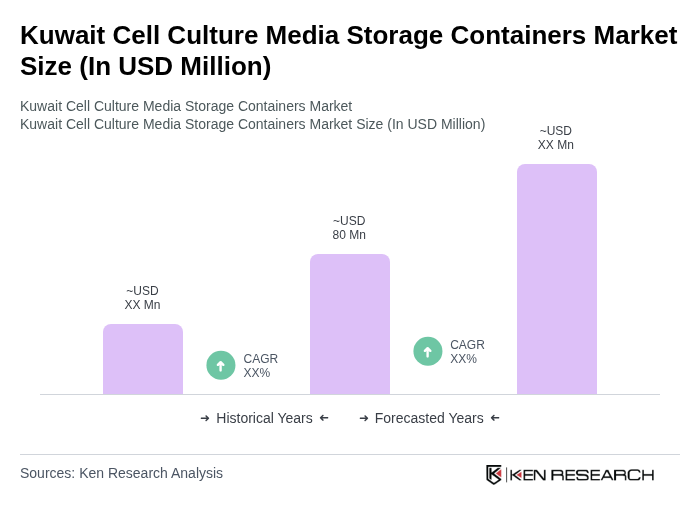
The Kuwait cell culture media storage containers market, valued at USD 80 million, is driven by biopharmaceutical growth and stem cell research, with key segments in storage bottles and pharma companies.

Region:Middle East

Author(s):Dev

Product Code:KRAB1847

Pages:89

Published On:January 2026
About the Report

Base Year 2024

Kuwait Cell Culture Media Storage Containers Market Overview

  • The Kuwait Cell Culture Media Storage Containers market is valued at USD 80 million, based on a five-year historical analysis of Kuwait’s broader cell culture and primary cell culture markets and their storage and consumables intensity. This growth is primarily driven by the increasing demand for biopharmaceuticals, expansion of primary cell culture and stem cell programs, and advancements in cell culture technologies, which necessitate efficient, contamination-resistant, and temperature-stable storage solutions for cell culture media.
  • Kuwait's market is dominated by cities such as Al Asimah (Kuwait City) and Hawalli, which host major hospitals, Kuwait University’s medical and research centers, and specialized laboratories that drive demand for advanced cell culture systems and associated storage containers. The concentration of research institutions and healthcare facilities in these areas further enhances their market dominance, as they require high-quality, compliant storage solutions for cell culture media to support drug discovery, metabolic disease research, and clinical diagnostics.
  • Kuwaiti laboratories handling human cells, tissues, blood products, vaccines, and other biological materials used in cell culture media preparation and storage are required to comply with biosafety and quality requirements set out in binding instruments such as the Gulf Technical Regulation for “Requirements of Laboratories Implementing Medical Tests” issued by the Gulf Standardization Organization and adopted by Kuwait’s Public Authority for Industry, together with national enforcement of Good Laboratory Practice and Good Manufacturing Practice standards under the Ministry of Health. These frameworks drive the use of certified storage containers that support traceability, sterility, correct labeling, and controlled storage conditions for cell culture media in research and clinical laboratories, thereby increasing demand for compliant storage solutions.
Kuwait Cell Culture Media Storage Containers Market Size

Kuwait Cell Culture Media Storage Containers Market Segmentation

By Product Type:

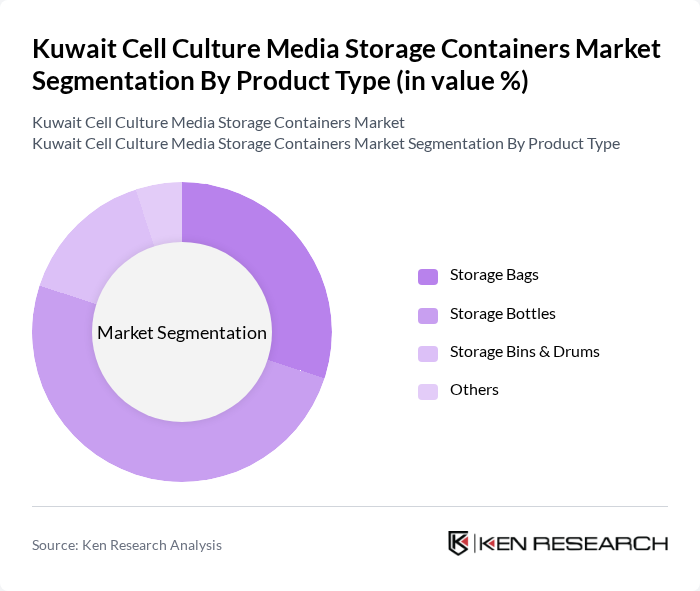
Kuwait Cell Culture Media Storage Containers Market segmentation by Product Type.

The product type segmentation includes Storage Bags, Storage Bottles, Storage Bins & Drums, and Others. Among these, Storage Bottles hold a substantial share of the market due to their versatility, compatibility with a wide range of cell culture media, and effectiveness in maintaining sterility and chemical stability during handling and incubation workflows, which aligns with the global preference for rigid, high-clarity vessels in research and bioprocessing environments. They are preferred for their ease of use, graduated volume markings, secure closure systems, and suitability for routine laboratory processes. Storage Bags are also gaining traction, particularly in large-scale and single-use bioprocessing applications where they support closed-system operations and reduce cleaning validation, but Storage Bottles remain the leading choice for most laboratories and small to mid-scale media storage needs.

By End-Use:
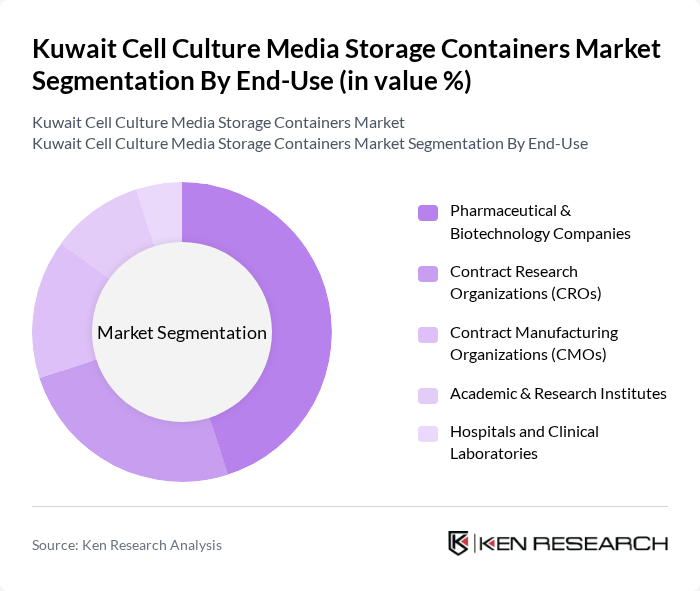
Kuwait Cell Culture Media Storage Containers Market segmentation by End-Use.

The end-use segmentation includes Pharmaceutical & Biotechnology Companies, Contract Research Organizations (CROs), Contract Manufacturing Organizations (CMOs), Academic & Research Institutes, Hospitals and Clinical Laboratories, and Others. Pharmaceutical & Biotechnology Companies lead this segment, supported by rising biopharmaceutical research, vaccine development, and primary cell culture applications that require validated storage of media, supplements, and intermediate solutions. The demand from CROs and CMOs is also significant, as outsourcing of drug discovery, preclinical testing, and biologics manufacturing grows in the Gulf region, driving the need for standardized storage containers that meet sponsor and regulatory quality expectations. Academic & Research Institutes, particularly Kuwait University and government-funded research centers, represent an important and expanding user base due to increased activity in metabolic disease, cardiovascular, and stem cell research that relies on consistent cell culture media handling and storage practices.

Kuwait Cell Culture Media Storage Containers Market Competitive Landscape

The Kuwait Cell Culture Media Storage Containers Market is characterized by a dynamic mix of regional and international players. Leading participants such as Thermo Fisher Scientific Inc., Corning Incorporated, BD (Becton, Dickinson and Company), Merck KGaA, Sartorius AG, Eppendorf SE, Lonza Group AG, Greiner Bio-One International GmbH, VWR International, LLC, CellGenix GmbH, Sigma-Aldrich (Merck Group), Bio-Rad Laboratories, Inc., F. Hoffmann-La Roche AG, PHC Holdings Corporation (Panasonic Healthcare), Starlab International GmbH contribute to innovation, geographic expansion, and service delivery in this space.

Thermo Fisher Scientific Inc.

1956

Waltham, Massachusetts, USA

Corning Incorporated

1851

Corning, New York, USA

BD (Becton, Dickinson and Company)

1897

Franklin Lakes, New Jersey, USA

Merck KGaA

1668

Darmstadt, Germany

Sartorius AG

1870

Göttingen, Germany

Company

Establishment Year

Headquarters

Group Size (Global, Regional, or Local Player)

Kuwait Revenues from Cell Culture Media Storage Containers

3–5 Year Revenue CAGR in Target Segment

EBITDA Margin in Kuwait (or Middle East, where Kuwait not disclosed)

Market Share in Kuwait (Value / Volume)

Average Selling Price Positioning vs Global Benchmarks

Kuwait Cell Culture Media Storage Containers Market Industry Analysis

Growth Drivers

  • Increasing Demand for Biopharmaceuticals:The biopharmaceutical sector in Kuwait is projected to reach a value of approximately $1.5 billion in future, driven by the rising need for innovative therapies. This surge is attributed to the growing focus on personalized medicine and advanced treatment options, which require efficient cell culture media storage solutions. The increasing number of biopharmaceutical companies, estimated at 60 in future, further amplifies the demand for specialized storage containers to ensure the integrity of cell cultures.
  • Rising Investments in Research and Development:Kuwait's government has allocated around $400 million for biotechnology research in future, reflecting a commitment to advancing healthcare solutions. This investment is expected to foster innovation in cell culture technologies, necessitating the use of high-quality storage containers. The establishment of new research facilities, projected to increase by 25% in the next year, will further drive the demand for reliable storage solutions to support ongoing scientific endeavors.
  • Growing Prevalence of Chronic Diseases:Chronic diseases, such as diabetes and cardiovascular conditions, are on the rise in Kuwait, with an estimated 1.8 million people affected in future. This increase necessitates the development of new therapeutic approaches, including cell-based therapies. Consequently, the demand for cell culture media storage containers is expected to grow, as healthcare providers and researchers require efficient solutions to maintain the viability of cell cultures used in treatment development and clinical trials.

Market Challenges

  • High Costs of Advanced Storage Solutions:The initial investment for advanced cell culture media storage containers can exceed $12,000, posing a significant barrier for smaller laboratories and research institutions in Kuwait. This high cost limits accessibility to cutting-edge storage technologies, which are essential for maintaining the quality of cell cultures. As a result, many facilities may resort to less efficient, lower-cost alternatives that could compromise research outcomes and product development timelines.
  • Regulatory Compliance Complexities:Navigating the regulatory landscape in Kuwait can be challenging for companies involved in cell culture media storage. Compliance with international quality standards, such as ISO 13485, requires substantial documentation and quality assurance processes. The cost of ensuring compliance can reach up to $60,000 annually for mid-sized companies, diverting resources away from innovation and impacting overall market growth. This complexity can deter new entrants and slow down the adoption of advanced storage solutions.

Kuwait Cell Culture Media Storage Containers Market Future Outlook

The future of the Kuwait cell culture media storage containers market appears promising, driven by technological advancements and increased healthcare investments. As the biopharmaceutical sector expands, the demand for innovative storage solutions will likely rise. Additionally, the integration of IoT technologies in storage systems is expected to enhance monitoring and efficiency. With a focus on sustainability, manufacturers are likely to explore eco-friendly materials, aligning with global trends while addressing local market needs for improved storage solutions.

Market Opportunities

  • Expansion of Healthcare Infrastructure:Kuwait's healthcare sector is set to grow significantly, with an investment of $1.5 billion in new facilities in future. This expansion will create a heightened demand for cell culture media storage containers, as hospitals and research centers require reliable solutions to support their growing operations and research initiatives.
  • Increasing Collaborations Between Research Institutions:Collaborative efforts among Kuwait's research institutions are expected to increase by 35% in future, fostering innovation in biotechnology. These partnerships will drive the need for advanced storage solutions, as shared research projects often require high-quality cell culture media storage to ensure consistent results and data integrity across multiple facilities.

Scope of the Report

SegmentSub-Segments
By Product Type

Storage Bags

Storage Bottles

Storage Bins & Drums

Others

By End-Use

Pharmaceutical & Biotechnology Companies

Contract Research Organizations (CROs)

Contract Manufacturing Organizations (CMOs)

Academic & Research Institutes

Hospitals and Clinical Laboratories

Others

By Material

Plastic (Polypropylene, Polyethylene, PET, Others)

Glass

Stainless Steel

Others

By Capacity

Less than 1 Litre

Litre to 10 Litres

More than 10 Litres

Others

By Application

Biopharmaceutical Production

Vaccine Production

Cell & Gene Therapy

Tissue Engineering & Regenerative Medicine

Others

By Distribution Channel

Direct Sales

Third-party Distributors

Online Channels

Others

By Region

Al Asimah (Capital Governorate)

Hawalli Governorate

Al Farwaniyah Governorate

Al Ahmadi Governorate

Al Jahra Governorate

Mubarak Al-Kabeer Governorate

Key Target Audience

Investors and Venture Capitalist Firms

Government and Regulatory Bodies (e.g., Kuwait Ministry of Health, Kuwait Food and Drug Administration)

Manufacturers and Producers

Distributors and Retailers

Biotechnology and Pharmaceutical Companies

Healthcare Providers and Laboratories

Industry Associations and Trade Organizations

Financial Institutions and Investment Banks

Players Mentioned in the Report:

Thermo Fisher Scientific Inc.

Corning Incorporated

BD (Becton, Dickinson and Company)

Merck KGaA

Sartorius AG

Eppendorf SE

Lonza Group AG

Greiner Bio-One International GmbH

VWR International, LLC

CellGenix GmbH

Sigma-Aldrich (Merck Group)

Bio-Rad Laboratories, Inc.

F. Hoffmann-La Roche AG

PHC Holdings Corporation (Panasonic Healthcare)

Starlab International GmbH

Table of Contents

Market Assessment Phase

1. Executive Summary and Approach


2. Kuwait Cell Culture Media Storage Containers Market Overview

2.1 Key Insights and Strategic Recommendations

2.2 Kuwait Cell Culture Media Storage Containers Market Overview

2.3 Definition and Scope

2.4 Evolution of Market Ecosystem

2.5 Timeline of Key Regulatory Milestones

2.6 Value Chain & Stakeholder Mapping

2.7 Business Cycle Analysis

2.8 Policy & Incentive Landscape


3. Kuwait Cell Culture Media Storage Containers Market Analysis

3.1 Growth Drivers

3.1.1 Increasing demand for biopharmaceuticals
3.1.2 Rising investments in research and development
3.1.3 Growing prevalence of chronic diseases
3.1.4 Advancements in cell culture technologies

3.2 Market Challenges

3.2.1 High costs of advanced storage solutions
3.2.2 Regulatory compliance complexities
3.2.3 Limited awareness among end-users
3.2.4 Supply chain disruptions

3.3 Market Opportunities

3.3.1 Expansion of healthcare infrastructure
3.3.2 Increasing collaborations between research institutions
3.3.3 Growth in personalized medicine
3.3.4 Technological innovations in storage solutions

3.4 Market Trends

3.4.1 Shift towards sustainable and eco-friendly materials
3.4.2 Integration of IoT in storage solutions
3.4.3 Customization of storage containers
3.4.4 Rise in demand for automated storage systems

3.5 Government Regulation

3.5.1 Compliance with international quality standards
3.5.2 Regulations on biowaste management
3.5.3 Guidelines for storage and handling of cell cultures
3.5.4 Incentives for research and development in biotechnology

4. SWOT Analysis


5. Stakeholder Analysis


6. Porter's Five Forces Analysis


7. Kuwait Cell Culture Media Storage Containers Market Size, 2019-2024

7.1 By Value

7.2 By Volume

7.3 By Average Selling Price


8. Kuwait Cell Culture Media Storage Containers Market Segmentation

8.1 By Product Type

8.1.1 Storage Bags
8.1.2 Storage Bottles
8.1.3 Storage Bins & Drums
8.1.4 Others

8.2 By End-Use

8.2.1 Pharmaceutical & Biotechnology Companies
8.2.2 Contract Research Organizations (CROs)
8.2.3 Contract Manufacturing Organizations (CMOs)
8.2.4 Academic & Research Institutes
8.2.5 Hospitals and Clinical Laboratories
8.2.6 Others

8.3 By Material

8.3.1 Plastic (Polypropylene, Polyethylene, PET, Others)
8.3.2 Glass
8.3.3 Stainless Steel
8.3.4 Others

8.4 By Capacity

8.4.1 Less than 1 Litre
8.4.2 1 Litre to 10 Litres
8.4.3 More than 10 Litres
8.4.4 Others

8.5 By Application

8.5.1 Biopharmaceutical Production
8.5.2 Vaccine Production
8.5.3 Cell & Gene Therapy
8.5.4 Tissue Engineering & Regenerative Medicine
8.5.5 Others

8.6 By Distribution Channel

8.6.1 Direct Sales
8.6.2 Third-party Distributors
8.6.3 Online Channels
8.6.4 Others

8.7 By Region

8.7.1 Al Asimah (Capital Governorate)
8.7.2 Hawalli Governorate
8.7.3 Al Farwaniyah Governorate
8.7.4 Al Ahmadi Governorate
8.7.5 Al Jahra Governorate
8.7.6 Mubarak Al-Kabeer Governorate

9. Kuwait Cell Culture Media Storage Containers Market Competitive Analysis

9.1 Market Share of Key Players

9.2 Cross Comparison of Key Players

9.2.1 Company Name
9.2.2 Group Size (Global, Regional, or Local Player)
9.2.3 Kuwait Revenues from Cell Culture Media Storage Containers
9.2.4 3–5 Year Revenue CAGR in Target Segment
9.2.5 EBITDA Margin in Kuwait (or Middle East, where Kuwait not disclosed)
9.2.6 Market Share in Kuwait (Value / Volume)
9.2.7 Average Selling Price Positioning vs Global Benchmarks
9.2.8 Number of Active SKUs / Product Lines in Kuwait
9.2.9 R&D Intensity (% of Revenue Spent on R&D)
9.2.10 New Product Launches in Last 3 Years (Kuwait / GCC)
9.2.11 Distribution Footprint (Number of Distributors / Direct Accounts)
9.2.12 Key Kuwait / GCC Reference Customers
9.2.13 Average Contract Tenure with Major Customers
9.2.14 Tender Win Rate (% of Relevant Tenders Won)
9.2.15 On-time Delivery Performance (%)
9.2.16 Inventory Turnover (for Relevant Product Segment)
9.2.17 Average Selling Price Growth (YoY)
9.2.18 Kuwait-specific Capex over Last 3 Years
9.2.19 Return on Invested Capital (ROIC) – Regional / Segment Level
9.2.20 Customer Satisfaction / Net Promoter Score (Where Available)

9.3 SWOT Analysis of Top Players

9.4 Pricing Analysis

9.5 Detailed Profile of Major Companies

9.5.1 Thermo Fisher Scientific Inc.
9.5.2 Corning Incorporated
9.5.3 BD (Becton, Dickinson and Company)
9.5.4 Merck KGaA
9.5.5 Sartorius AG
9.5.6 Eppendorf SE
9.5.7 Lonza Group AG
9.5.8 Greiner Bio-One International GmbH
9.5.9 VWR International, LLC
9.5.10 CellGenix GmbH
9.5.11 Sigma-Aldrich (Merck Group)
9.5.12 Bio-Rad Laboratories, Inc.
9.5.13 F. Hoffmann-La Roche AG
9.5.14 PHC Holdings Corporation (Panasonic Healthcare)
9.5.15 Starlab International GmbH

10. Kuwait Cell Culture Media Storage Containers Market End-User Analysis

10.1 Procurement Behavior of Key Ministries

10.1.1 Budget Allocation Trends
10.1.2 Procurement Processes
10.1.3 Supplier Selection Criteria
10.1.4 Contract Management Practices

10.2 Corporate Spend on Infrastructure & Energy

10.2.1 Investment Trends in Biotechnology
10.2.2 Spending on Research Facilities
10.2.3 Budget for Equipment and Supplies
10.2.4 Others

10.3 Pain Point Analysis by End-User Category

10.3.1 Challenges in Supply Chain Management
10.3.2 Issues with Product Quality
10.3.3 Regulatory Compliance Difficulties
10.3.4 Others

10.4 User Readiness for Adoption

10.4.1 Awareness of New Technologies
10.4.2 Training and Support Needs
10.4.3 Financial Readiness
10.4.4 Others

10.5 Post-Deployment ROI and Use Case Expansion

10.5.1 Measurement of ROI
10.5.2 Expansion into New Applications
10.5.3 Long-term Benefits Realization
10.5.4 Others

11. Kuwait Cell Culture Media Storage Containers Market Future Size, 2025-2030

11.1 By Value

11.2 By Volume

11.3 By Average Selling Price


Go-To-Market Strategy Phase

1. Whitespace Analysis + Business Model Canvas

1.1 Market Gaps Identification

1.2 Business Model Development


2. Marketing and Positioning Recommendations

2.1 Branding Strategies

2.2 Product USPs


3. Distribution Plan

3.1 Urban Retail vs Rural NGO Tie-ups


4. Channel & Pricing Gaps

4.1 Underserved Routes

4.2 Pricing Bands


5. Unmet Demand & Latent Needs

5.1 Category Gaps

5.2 Consumer Segments


6. Customer Relationship

6.1 Loyalty Programs

6.2 After-sales Service


7. Value Proposition

7.1 Sustainability

7.2 Integrated Supply Chains


8. Key Activities

8.1 Regulatory Compliance

8.2 Branding

8.3 Distribution Setup


9. Entry Strategy Evaluation

9.1 Domestic Market Entry Strategy

9.1.1 Product Mix
9.1.2 Pricing Band
9.1.3 Packaging

9.2 Export Entry Strategy

9.2.1 Target Countries
9.2.2 Compliance Roadmap

10. Entry Mode Assessment

10.1 JV

10.2 Greenfield

10.3 M&A

10.4 Distributor Model


11. Capital and Timeline Estimation

11.1 Capital Requirements

11.2 Timelines


12. Control vs Risk Trade-Off

12.1 Ownership vs Partnerships


13. Profitability Outlook

13.1 Breakeven Analysis

13.2 Long-term Sustainability


14. Potential Partner List

14.1 Distributors

14.2 JVs

14.3 Acquisition Targets


15. Execution Roadmap

15.1 Phased Plan for Market Entry

15.1.1 Market Setup
15.1.2 Market Entry
15.1.3 Growth Acceleration
15.1.4 Scale & Stabilize

15.2 Key Activities and Milestones

15.2.1 Milestone Planning
15.2.2 Activity Tracking

Research Methodology

ApproachModellingSample

Phase 1: Approach1

Desk Research

  • Analysis of industry reports from local and international biotechnology associations
  • Review of scientific publications and journals focusing on cell culture technologies
  • Examination of market trends and forecasts from government and trade publications

Primary Research

  • Interviews with laboratory managers and procurement specialists in Kuwait's biotech sector
  • Surveys targeting researchers and scientists involved in cell culture applications
  • Field visits to research institutions and universities to gather qualitative insights

Validation & Triangulation

  • Cross-validation of findings through multiple data sources including academic and industry reports
  • Triangulation of market data with insights from expert interviews and surveys
  • Sanity checks conducted through feedback from a panel of industry experts

Phase 2: Market Size Estimation1

Top-down Assessment

  • Estimation of market size based on national healthcare and research funding allocations
  • Segmentation of the market by application areas such as pharmaceuticals, research, and diagnostics
  • Incorporation of growth rates from related sectors such as biotechnology and pharmaceuticals

Bottom-up Modeling

  • Collection of sales data from key suppliers of cell culture media storage containers
  • Estimation of market demand based on laboratory usage rates and research output
  • Volume and pricing analysis based on product specifications and customer segments

Forecasting & Scenario Analysis

  • Development of forecasts using historical data trends and projected growth in biotechnology
  • Scenario analysis based on potential regulatory changes and technological advancements
  • Creation of baseline, optimistic, and pessimistic market scenarios through 2030

Phase 3: CATI Sample Composition1

Scope Item/SegmentSample SizeTarget Respondent Profiles
Biotechnology Research Institutions90Lab Managers, Research Scientists
Pharmaceutical Companies80Procurement Officers, Quality Control Managers
Academic Research Labs70Principal Investigators, Graduate Researchers
Clinical Research Organizations60Clinical Trial Managers, Regulatory Affairs Specialists
Healthcare Facilities50Laboratory Technicians, Biomedical Engineers

Frequently Asked Questions

What is the current value of the Kuwait Cell Culture Media Storage Containers market?

The Kuwait Cell Culture Media Storage Containers market is valued at approximately USD 80 million, driven by the increasing demand for biopharmaceuticals and advancements in cell culture technologies that require efficient storage solutions.

What factors are driving the growth of the Kuwait Cell Culture Media Storage Containers market?

Which cities in Kuwait are leading in the demand for cell culture media storage containers?

What are the main product types in the Kuwait Cell Culture Media Storage Containers market?

Other Regional/Country Reports

Indonesia Cell Culture Media Storage Containers Market

Malaysia Cell Culture Media Storage Containers Market

KSA Cell Culture Media Storage Containers Market

APAC Cell Culture Media Storage Containers Market

SEA Cell Culture Media Storage Containers Market

Vietnam Cell Culture Media Storage Containers Market

Why Buy From Us?

Refine Robust Result (RRR) Framework

What makes us stand out is that our consultants follow Robust, Refine and Result (RRR) methodology. Robust for clear definitions, approaches and sanity checking, Refine for differentiating respondents' facts and opinions, and Result for presenting data with story.

Our Reach Is Unmatched

We have set a benchmark in the industry by offering our clients with syndicated and customized market research reports featuring coverage of entire market as well as meticulous research and analyst insights.

Shifting the Research Paradigm

While we don't replace traditional research, we flip the method upside down. Our dual approach of Top Bottom & Bottom Top ensures quality deliverable by not just verifying company fundamentals but also looking at the sector and macroeconomic factors.

More Insights-Better Decisions

With one step in the future, our research team constantly tries to show you the bigger picture. We help with some of the tough questions you may encounter along the way: How is the industry positioned? Best marketing channel? KPI's of competitors? By aligning every element, we help maximize success.

Transparency and Trust

Our report gives you instant access to the answers and sources that other companies might choose to hide. We elaborate each steps of research methodology we have used and showcase you the sample size to earn your trust.

Round the Clock Support

If you need any support, we are here! We pride ourselves on universe strength, data quality, and quick, friendly, and professional service.

Why Clients Choose Us?

400000+
Reports in repository
150+
Consulting projects a year
100+
Analysts
8000+
Client Queries in 2022