About the Report
Base Year 2024Kuwait Peptide Drug Conjugates Market Overview
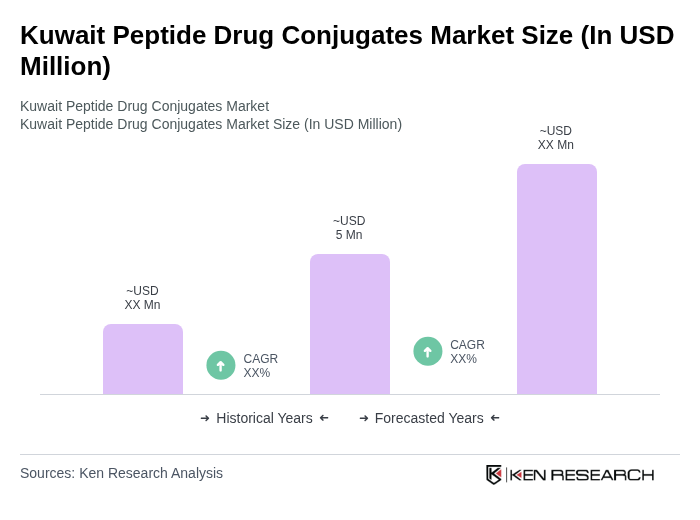
- The Kuwait Peptide Drug Conjugates Market is valued at USD 5 million, based on a five-year historical analysis. This growth is primarily driven by advancements in targeted therapies and increasing investments in biopharmaceutical research, aligned with the rapid expansion of the global peptide drug conjugates market and its application in oncology. The rising prevalence of cancer and other chronic diseases in Kuwait, particularly solid tumors and hematologic malignancies, has further fueled the demand for innovative treatment options and precision oncology approaches, supporting the development and clinical adoption of peptide drug conjugates.
- Kuwait City is the dominant hub for the peptide drug conjugates market, owing to its advanced healthcare infrastructure and the presence of leading tertiary and oncology centers, including Kuwait Cancer Control Center and major Ministry of Health hospitals located in the capital. The capital region's strategic location, concentration of specialized oncology services, and investment in healthcare innovation have made it a focal point for research and development activities, attracting collaborations with international biopharmaceutical companies and contract research organizations active in peptide-based and radioligand therapies across the Middle East.
- In 2023, the Kuwaiti government continued to strengthen the regulatory and approval pathway for advanced therapies, including peptide-based and radioligand products, under the framework of the Pharmacy and Drug Control Department and the Central Drug Registration system administered by the Ministry of Health. Key operational requirements for such products are governed by the Ministerial Decree No. 302 of 1983 Concerning the Registration of Pharmaceuticals and Regulation of Their Importation and Sale, issued by the Ministry of Health – Kuwait, which sets provisions for product registration, clinical data submission, quality, safety and efficacy evaluation, as well as pharmacovigilance obligations for human medicines. These measures collectively support more predictable approval timelines for innovative oncology and peptide-based therapies and are part of broader national strategies to enhance access to advanced medical treatments and position Kuwait as a regional center for specialized care.
Kuwait Peptide Drug Conjugates Market Segmentation
By Molecule Type:The molecule type segmentation of the market includes various subsegments that cater to different therapeutic needs. Among these, cytotoxic payload peptide-drug conjugates are leading due to their effectiveness in targeting cancer cells while minimizing damage to healthy tissues, in line with global trends where therapeutic peptide drug conjugates are predominantly developed for oncology indications. Radioligand peptide-drug conjugates are also gaining traction, particularly in oncology, as radiolabeled peptides such as lutetium-177–based agents have demonstrated strong clinical utility in neuroendocrine tumors and prostate cancer through targeted delivery to tumor receptors. The increasing focus on personalized medicine and precision oncology, supported by biomarker-driven patient selection, is driving the demand for these advanced therapeutic options across the Middle East, including Kuwait.

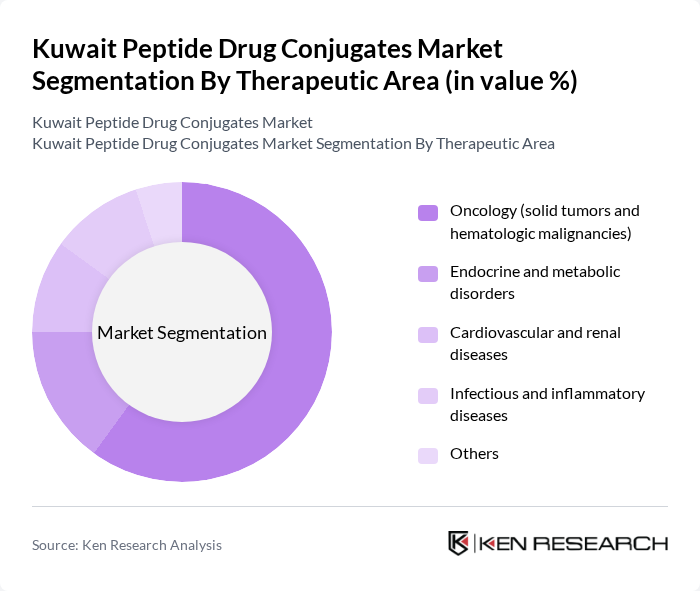
By Therapeutic Area:The therapeutic area segmentation highlights the diverse applications of peptide drug conjugates. Oncology remains the leading therapeutic area, driven by the increasing incidence of cancer and the need for targeted therapies that improve tumor selectivity and reduce systemic toxicity. The focus on solid tumors and hematologic malignancies is particularly pronounced, as these areas present significant unmet medical needs and are the primary focus of most peptide drug conjugate pipelines and approved products worldwide. Other therapeutic areas, such as endocrine and metabolic disorders, cardiovascular and renal diseases, and infectious and inflammatory diseases, are also witnessing growth as research expands into non-oncology indications, but oncology continues to dominate due to the high demand for effective cancer treatments and the strong alignment of peptide drug conjugate mechanisms with tumor-targeted delivery.
Kuwait Peptide Drug Conjugates Market Competitive Landscape
The Kuwait Peptide Drug Conjugates Market is characterized by a dynamic mix of regional and international players. Leading participants such as Novartis AG, F. Hoffmann-La Roche Ltd, Takeda Pharmaceutical Company Limited, Ipsen Pharma, RayzeBio, Inc., Oncopeptides AB, Bicycle Therapeutics plc, CordenPharma International GmbH, WuXi STA (WuXi AppTec Co., Ltd.), Bachem Holding AG, PolyPeptide Group AG, Ajinomoto Bio-Pharma Services, Kuwait Cancer Control Center (KCCC), Ministry of Health – Kuwait (MoH Kuwait), Kuwait University – Faculty of Medicine & Health Sciences Research Center contribute to innovation, geographic expansion, and service delivery in this space.
Kuwait Peptide Drug Conjugates Market Industry Analysis
Growth Drivers
- Increasing Prevalence of Cancer and Chronic Diseases:The rise in cancer cases in Kuwait is alarming, with the Kuwait Cancer Registry reporting over 3,500 new cases annually. Chronic diseases, including diabetes and cardiovascular conditions, are also on the rise, affecting approximately 25% of the adult population. This growing patient base drives the demand for innovative treatments, including peptide drug conjugates, which offer targeted therapeutic options, thereby enhancing treatment efficacy and patient outcomes.
- Advancements in Peptide Synthesis Technologies:The peptide synthesis market in Kuwait is experiencing significant technological advancements, with investments exceeding $60 million in future. These innovations enhance the efficiency and scalability of peptide production, allowing for the development of more complex and effective drug conjugates. Improved synthesis methods are expected to reduce lead times and production costs, making peptide drug conjugates more accessible to healthcare providers and patients alike.
- Rising Demand for Targeted Therapies:The global shift towards personalized medicine is reflected in Kuwait, where the demand for targeted therapies is increasing. In future, the biopharmaceutical sector allocated approximately $250 million towards research and development of targeted therapies. This trend is driven by the need for more effective treatments with fewer side effects, positioning peptide drug conjugates as a preferred option for oncologists and healthcare professionals in the region.
Market Challenges
- High Production Costs of Peptide Drug Conjugates:The production costs for peptide drug conjugates in Kuwait can exceed $1,200 per gram, significantly impacting market accessibility. These high costs are attributed to complex synthesis processes and stringent quality control measures. As a result, many healthcare providers may hesitate to adopt these therapies, limiting their availability to patients who could benefit from them, thus hindering market growth.
- Regulatory Hurdles and Lengthy Approval Processes:The regulatory landscape in Kuwait presents significant challenges for peptide drug conjugates, with approval processes often taking over 20 months. The Kuwait Ministry of Health enforces stringent guidelines that can delay market entry for new therapies. These regulatory hurdles can discourage investment in peptide drug conjugate development, limiting innovation and the introduction of new treatment options for patients.
Kuwait Peptide Drug Conjugates Market Future Outlook
The future of the peptide drug conjugates market in Kuwait appears promising, driven by ongoing advancements in biotechnology and a growing emphasis on personalized medicine. As healthcare infrastructure continues to expand, the integration of innovative therapies is expected to accelerate. Additionally, increased collaboration between pharmaceutical companies and research institutions will likely enhance the development of novel peptide-based therapies, addressing unmet medical needs and improving patient outcomes in the region.
Market Opportunities
- Expansion of Healthcare Infrastructure in Kuwait:The Kuwaiti government is investing over $1.5 billion in healthcare infrastructure improvements in future. This expansion will facilitate better access to advanced therapies, including peptide drug conjugates, thereby increasing their adoption among healthcare providers and patients, ultimately enhancing treatment outcomes.
- Development of Personalized Medicine:The focus on personalized medicine is gaining traction, with an estimated $200 million allocated for research in this area in future. This trend presents significant opportunities for peptide drug conjugates, as they can be tailored to individual patient profiles, improving efficacy and minimizing side effects, thus attracting more investment and interest from healthcare professionals.
Scope of the Report
| Segment | Sub-Segments |
|---|---|
| By Molecule Type | Cytotoxic payload peptide-drug conjugates Radioligand peptide-drug conjugates Peptide–siRNA/oligonucleotide conjugates Peptide–polymer conjugates Others |
| By Therapeutic Area | Oncology (solid tumors and hematologic malignancies) Endocrine and metabolic disorders Cardiovascular and renal diseases Infectious and inflammatory diseases Others |
| By Development Stage | Preclinical candidates Phase I clinical candidates Phase II–III clinical candidates Commercially approved products |
| By End-User | Tertiary care and cancer specialty hospitals Contract research organizations (CROs) Biopharmaceutical and biotech companies Academic and government research institutes Others |
| By Distribution Channel | Hospital pharmacies Specialty and oncology pharmacies Direct tender and institutional sales Others |
| By Manufacturing Approach | In-house GMP manufacturing Contract development and manufacturing organizations (CDMOs) Hybrid and partnered manufacturing models |
| By Kuwait Health System Cluster | Capital Region (Kuwait City and surrounding areas) Hawalli and Farwaniya Governorates Ahmadi and Mubarak Al-Kabeer Governorates Northern and border governorates |
Key Target Audience
Investors and Venture Capitalist Firms
Government and Regulatory Bodies (e.g., Kuwait Ministry of Health, Kuwait Food and Drug Administration)
Pharmaceutical Manufacturers
Biotechnology Companies
Healthcare Providers and Hospitals
Contract Research Organizations (CROs)
Pharmaceutical Distributors
Health Insurance Companies
Players Mentioned in the Report:
Novartis AG
F. Hoffmann-La Roche Ltd
Takeda Pharmaceutical Company Limited
Ipsen Pharma
RayzeBio, Inc.
Oncopeptides AB
Bicycle Therapeutics plc
CordenPharma International GmbH
WuXi STA (WuXi AppTec Co., Ltd.)
Bachem Holding AG
PolyPeptide Group AG
Ajinomoto Bio-Pharma Services
Kuwait Cancer Control Center (KCCC)
Ministry of Health Kuwait (MoH Kuwait)
Kuwait University Faculty of Medicine & Health Sciences Research Center
Table of Contents
Market Assessment Phase
1. Executive Summary and Approach
2. Kuwait Peptide Drug Conjugates Market Overview
2.1 Key Insights and Strategic Recommendations
2.2 Kuwait Peptide Drug Conjugates Market Overview
2.3 Definition and Scope
2.4 Evolution of Market Ecosystem
2.5 Timeline of Key Regulatory Milestones
2.6 Value Chain & Stakeholder Mapping
2.7 Business Cycle Analysis
2.8 Policy & Incentive Landscape
3. Kuwait Peptide Drug Conjugates Market Analysis
3.1 Growth Drivers
3.1.1 Increasing prevalence of cancer and chronic diseases
3.1.2 Advancements in peptide synthesis technologies
3.1.3 Rising demand for targeted therapies
3.1.4 Growing investment in biopharmaceutical R&D
3.2 Market Challenges
3.2.1 High production costs of peptide drug conjugates
3.2.2 Regulatory hurdles and lengthy approval processes
3.2.3 Limited awareness among healthcare professionals
3.2.4 Competition from alternative therapies
3.3 Market Opportunities
3.3.1 Expansion of healthcare infrastructure in Kuwait
3.3.2 Collaborations with research institutions
3.3.3 Development of personalized medicine
3.3.4 Increasing focus on orphan drugs
3.4 Market Trends
3.4.1 Growing adoption of combination therapies
3.4.2 Rise in biosimilars and biobetters
3.4.3 Shift towards patient-centric drug development
3.4.4 Integration of AI in drug discovery
3.5 Government Regulation
3.5.1 Implementation of stringent quality control measures
3.5.2 Supportive policies for biopharmaceutical innovation
3.5.3 Guidelines for clinical trials and approvals
3.5.4 Incentives for local manufacturing of drugs
4. SWOT Analysis
5. Stakeholder Analysis
6. Porter's Five Forces Analysis
7. Kuwait Peptide Drug Conjugates Market Market Size, 2019-2024
7.1 By Value
7.2 By Volume
7.3 By Average Selling Price
8. Kuwait Peptide Drug Conjugates Market Segmentation
8.1 By Molecule Type
8.1.1 Cytotoxic payload peptide-drug conjugates
8.1.2 Radioligand peptide-drug conjugates
8.1.3 Peptide–siRNA/oligonucleotide conjugates
8.1.4 Peptide–polymer conjugates
8.1.5 Others
8.2 By Therapeutic Area
8.2.1 Oncology (solid tumors and hematologic malignancies)
8.2.2 Endocrine and metabolic disorders
8.2.3 Cardiovascular and renal diseases
8.2.4 Infectious and inflammatory diseases
8.2.5 Others
8.3 By Development Stage
8.3.1 Preclinical candidates
8.3.2 Phase I clinical candidates
8.3.3 Phase II–III clinical candidates
8.3.4 Commercially approved products
8.4 By End-User
8.4.1 Tertiary care and cancer specialty hospitals
8.4.2 Contract research organizations (CROs)
8.4.3 Biopharmaceutical and biotech companies
8.4.4 Academic and government research institutes
8.4.5 Others
8.5 By Distribution Channel
8.5.1 Hospital pharmacies
8.5.2 Specialty and oncology pharmacies
8.5.3 Direct tender and institutional sales
8.5.4 Others
8.6 By Manufacturing Approach
8.6.1 In-house GMP manufacturing
8.6.2 Contract development and manufacturing organizations (CDMOs)
8.6.3 Hybrid and partnered manufacturing models
8.7 By Kuwait Health System Cluster
8.7.1 Capital Region (Kuwait City and surrounding areas)
8.7.2 Hawalli and Farwaniya Governorates
8.7.3 Ahmadi and Mubarak Al-Kabeer Governorates
8.7.4 Northern and border governorates
9. Kuwait Peptide Drug Conjugates Market Competitive Analysis
9.1 Market Share of Key Players
9.2 Cross Comparison of Key Players
9.2.1 Company name
9.2.2 Kuwait presence type (direct subsidiary, distributor-led, or partnership-based)
9.2.3 Estimated Kuwait peptide drug conjugates revenue
9.2.4 Kuwait peptide drug conjugates revenue growth rate (CAGR)
9.2.5 Number of peptide drug conjugate assets (marketed + pipeline) relevant to Kuwait
9.2.6 Share of oncology-focused peptide drug conjugate portfolio
9.2.7 Clinical trial footprint in GCC / Middle East (number of active or completed trials)
9.2.8 Time-to-market for new peptide drug conjugate launches in Kuwait (regulatory and access timeline)
9.2.9 Breadth of local partnerships (hospitals, CROs, distributors)
9.2.10 Average Kuwait tender / contract size for peptide drug conjugates
9.2.11 Kuwait market access strength (formulary listings and reimbursement coverage)
9.2.12 R&D intensity (R&D spend as % of global revenue)
9.3 SWOT Analysis of Top Players
9.4 Pricing Analysis
9.5 Detailed Profile of Major Companies
9.5.1 Novartis AG
9.5.2 F. Hoffmann-La Roche Ltd
9.5.3 Takeda Pharmaceutical Company Limited
9.5.4 Ipsen Pharma
9.5.5 RayzeBio, Inc.
9.5.6 Oncopeptides AB
9.5.7 Bicycle Therapeutics plc
9.5.8 CordenPharma International GmbH
9.5.9 WuXi STA (WuXi AppTec Co., Ltd.)
9.5.10 Bachem Holding AG
9.5.11 PolyPeptide Group AG
9.5.12 Ajinomoto Bio-Pharma Services
9.5.13 Kuwait Cancer Control Center (KCCC)
9.5.14 Ministry of Health – Kuwait (MoH Kuwait)
9.5.15 Kuwait University – Faculty of Medicine & Health Sciences Research Center
10. Kuwait Peptide Drug Conjugates Market End-User Analysis
10.1 Procurement Behavior of Key Ministries
10.1.1 Budget Allocation for Healthcare
10.1.2 Procurement Processes and Timelines
10.1.3 Preferred Suppliers and Partnerships
10.1.4 Evaluation Criteria for Bids
10.2 Corporate Spend on Infrastructure & Energy
10.2.1 Investment in Healthcare Facilities
10.2.2 Funding for Research and Development
10.2.3 Expenditure on Technology Upgrades
10.2.4 Budget for Training and Development
10.3 Pain Point Analysis by End-User Category
10.3.1 Access to Innovative Therapies
10.3.2 Cost of Treatment
10.3.3 Availability of Skilled Professionals
10.3.4 Regulatory Compliance Challenges
10.4 User Readiness for Adoption
10.4.1 Awareness of Peptide Drug Conjugates
10.4.2 Training Needs for Healthcare Providers
10.4.3 Infrastructure Readiness
10.4.4 Patient Acceptance Levels
10.5 Post-Deployment ROI and Use Case Expansion
10.5.1 Measurement of Treatment Outcomes
10.5.2 Cost-Benefit Analysis
10.5.3 Opportunities for Scaling
10.5.4 Feedback Mechanisms for Improvement
11. Kuwait Peptide Drug Conjugates Market Future Size, 2025-2030
11.1 By Value
11.2 By Volume
11.3 By Average Selling Price
Go-To-Market Strategy Phase
1. Whitespace Analysis + Business Model Canvas
1.1 Market Gaps Identification
1.2 Value Proposition Development
1.3 Revenue Streams Analysis
1.4 Cost Structure Evaluation
1.5 Key Partnerships Exploration
1.6 Customer Segmentation
1.7 Channels of Distribution
2. Marketing and Positioning Recommendations
2.1 Branding Strategies
2.2 Product USPs
2.3 Target Market Identification
2.4 Communication Strategies
2.5 Digital Marketing Approaches
3. Distribution Plan
3.1 Urban Retail Strategies
3.2 Rural NGO Tie-ups
3.3 Online Distribution Channels
3.4 Partnerships with Healthcare Providers
4. Channel & Pricing Gaps
4.1 Underserved Routes
4.2 Pricing Bands Analysis
4.3 Competitor Pricing Strategies
4.4 Customer Willingness to Pay
5. Unmet Demand & Latent Needs
5.1 Category Gaps Identification
5.2 Consumer Segments Analysis
5.3 Emerging Trends Exploration
5.4 Future Needs Assessment
6. Customer Relationship
6.1 Loyalty Programs Development
6.2 After-sales Service Strategies
6.3 Customer Feedback Mechanisms
6.4 Engagement Strategies
7. Value Proposition
7.1 Sustainability Initiatives
7.2 Integrated Supply Chains
7.3 Customer-Centric Approaches
7.4 Innovation in Product Offerings
8. Key Activities
8.1 Regulatory Compliance
8.2 Branding Initiatives
8.3 Distribution Setup
8.4 Training and Development
9. Entry Strategy Evaluation
9.1 Domestic Market Entry Strategy
9.1.1 Product Mix Considerations
9.1.2 Pricing Band Strategy
9.1.3 Packaging Innovations
9.2 Export Entry Strategy
9.2.1 Target Countries Identification
9.2.2 Compliance Roadmap Development
10. Entry Mode Assessment
10.1 Joint Ventures
10.2 Greenfield Investments
10.3 Mergers & Acquisitions
10.4 Distributor Model Evaluation
11. Capital and Timeline Estimation
11.1 Capital Requirements Analysis
11.2 Timelines for Market Entry
12. Control vs Risk Trade-Off
12.1 Ownership vs Partnerships
12.2 Risk Mitigation Strategies
13. Profitability Outlook
13.1 Breakeven Analysis
13.2 Long-term Sustainability Strategies
14. Potential Partner List
14.1 Distributors
14.2 Joint Ventures
14.3 Acquisition Targets
15. Execution Roadmap
15.1 Phased Plan for Market Entry
15.1.1 Market Setup
15.1.2 Market Entry
15.1.3 Growth Acceleration
15.1.4 Scale & Stabilize
15.2 Key Activities and Milestones
15.2.1 Milestone Planning
15.2.2 Activity Tracking
Research Methodology
Phase 1: Approach1
Desk Research
- Analysis of market reports from pharmaceutical and biotechnology associations in Kuwait
- Review of scientific literature on peptide drug conjugates from academic journals
- Examination of regulatory frameworks and guidelines from the Kuwait Ministry of Health
Primary Research
- Interviews with key opinion leaders in the pharmaceutical industry, including researchers and clinicians
- Surveys with procurement managers at hospitals and healthcare institutions
- Field interviews with R&D heads at biotechnology firms focusing on peptide drug development
Validation & Triangulation
- Cross-validation of findings through multiple data sources, including industry reports and expert insights
- Triangulation of market trends using sales data, clinical trial outcomes, and regulatory updates
- Sanity checks conducted through expert panel discussions to ensure data reliability
Phase 2: Market Size Estimation1
Top-down Assessment
- Estimation of the total addressable market based on healthcare expenditure in Kuwait
- Segmentation of the market by therapeutic areas and types of peptide drug conjugates
- Incorporation of government healthcare initiatives and funding for biotechnology research
Bottom-up Modeling
- Collection of sales data from leading pharmaceutical companies involved in peptide drug conjugates
- Estimation of market share based on product launches and clinical trial successes
- Volume and pricing analysis based on historical sales data and projected growth rates
Forecasting & Scenario Analysis
- Multi-variable forecasting using factors such as disease prevalence and healthcare policy changes
- Scenario analysis based on potential market disruptions, including technological advancements and regulatory shifts
- Development of baseline, optimistic, and pessimistic market projections through 2030
Phase 3: CATI Sample Composition1
| Scope Item/Segment | Sample Size | Target Respondent Profiles |
|---|---|---|
| Oncology Peptide Drug Conjugates | 100 | Oncologists, Clinical Researchers |
| Cardiovascular Peptide Applications | 80 | Cardiologists, Pharmacologists |
| Neurological Disorders Treatments | 70 | Neurologists, Biotech R&D Managers |
| Regulatory Affairs in Peptide Development | 60 | Regulatory Affairs Specialists, Compliance Officers |
| Market Access and Pricing Strategies | 90 | Market Access Managers, Health Economists |
Frequently Asked Questions
What is the current value of the Kuwait Peptide Drug Conjugates Market?
The Kuwait Peptide Drug Conjugates Market is valued at approximately USD 5 million, reflecting a five-year historical analysis. This valuation is influenced by advancements in targeted therapies and increasing investments in biopharmaceutical research.
What factors are driving the growth of the Kuwait Peptide Drug Conjugates Market?
Which therapeutic area dominates the Kuwait Peptide Drug Conjugates Market?
What are the main challenges facing the Kuwait Peptide Drug Conjugates Market?
Other Regional/Country Reports
Indonesia Peptide Drug Conjugates Market
Malaysia Peptide Drug Conjugates Market
APAC Peptide Drug Conjugates Market
SEA Peptide Drug Conjugates Market
Vietnam Peptide Drug Conjugates Market
Other Adjacent Reports
Qatar Oncology Drug Market
Mexico Radioligand Therapy Market
Indonesia Biopharmaceutical Manufacturing Market
Indonesia Targeted Therapy Market
Saudi Arabia Cancer Diagnostics Market Size, Share, Growth Drivers, Trends, Opportunities & Forecast 2025–2030UAE Precision Medicine MarketBelgium Clinical Research Market
Saudi Arabia Pharmaceutical Distribution Market Size, Share, Growth Drivers, Trends, Opportunities & Forecast 2025–2030Qatar Healthcare Infrastructure Market
Why Buy From Us?

What makes us stand out is that our consultants follow Robust, Refine and Result (RRR) methodology. Robust for clear definitions, approaches and sanity checking, Refine for differentiating respondents' facts and opinions, and Result for presenting data with story.

We have set a benchmark in the industry by offering our clients with syndicated and customized market research reports featuring coverage of entire market as well as meticulous research and analyst insights.

While we don't replace traditional research, we flip the method upside down. Our dual approach of Top Bottom & Bottom Top ensures quality deliverable by not just verifying company fundamentals but also looking at the sector and macroeconomic factors.

With one step in the future, our research team constantly tries to show you the bigger picture. We help with some of the tough questions you may encounter along the way: How is the industry positioned? Best marketing channel? KPI's of competitors? By aligning every element, we help maximize success.

Our report gives you instant access to the answers and sources that other companies might choose to hide. We elaborate each steps of research methodology we have used and showcase you the sample size to earn your trust.

If you need any support, we are here! We pride ourselves on universe strength, data quality, and quick, friendly, and professional service.