About the Report
Base Year 2024Listen to the audio summary
Saudi Arabia Peptide Drug Conjugates Market Overview
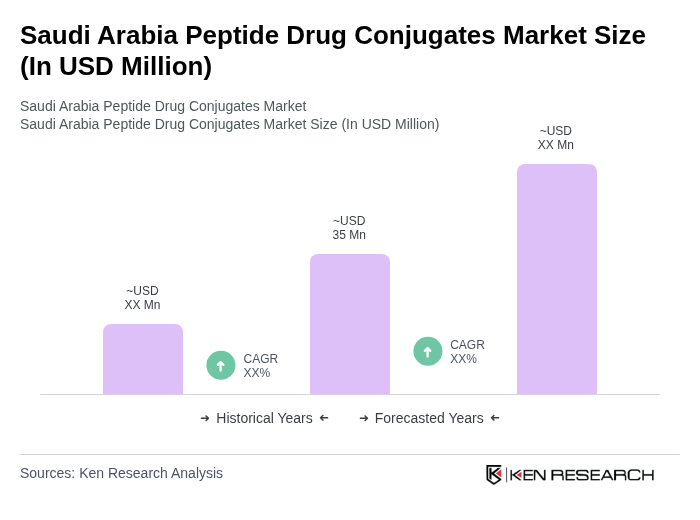
- The Saudi Arabia Peptide Drug Conjugates Market is valued at USD 35 million, based on a five-year historical analysis. This growth is primarily driven by advancements in targeted therapies, including radiolabeled peptide drug conjugates such as lutetium-177–based products, the increasing prevalence of cancer in the Kingdom, and rising investments in biopharmaceutical and nuclear medicine research and infrastructure. The market is also supported by the growing demand for personalized medicine and precision oncology in Saudi Arabia’s tertiary care centers, which enhances the efficacy of treatments while minimizing systemic side effects.
- Key geographic hubs in this market include Riyadh, Jeddah, and Dammam/Al Khobar, which dominate due to their advanced healthcare infrastructure, presence of leading tertiary hospitals and cancer centers, and academic research institutions such as King Faisal Specialist Hospital & Research Centre and National Guard Health Affairs facilities. These cities are also focal points for multinational pharmaceutical companies, nuclear medicine departments, and oncology clinical trials, contributing to the overall growth and clinical adoption of peptide drug conjugates in the country.
- In 2023, the Saudi Food and Drug Authority (SFDA) continued to apply and refine regulatory frameworks relevant to advanced therapies and radiopharmaceuticals, including peptide-based radioligand therapies, under instruments such as the “Executive Regulations of the Law of Pharmaceutical Establishments and Preparations” issued by SFDA in 2019 and related SFDA guidance on registration of human medicinal products and radiopharmaceuticals. These regulations aim to streamline the approval and post?marketing surveillance of innovative products, enhance patient access to advanced peptide-based therapies, and ensure safety, quality, and efficacy across manufacturing, importation, distribution, and clinical use.
Saudi Arabia Peptide Drug Conjugates Market Segmentation
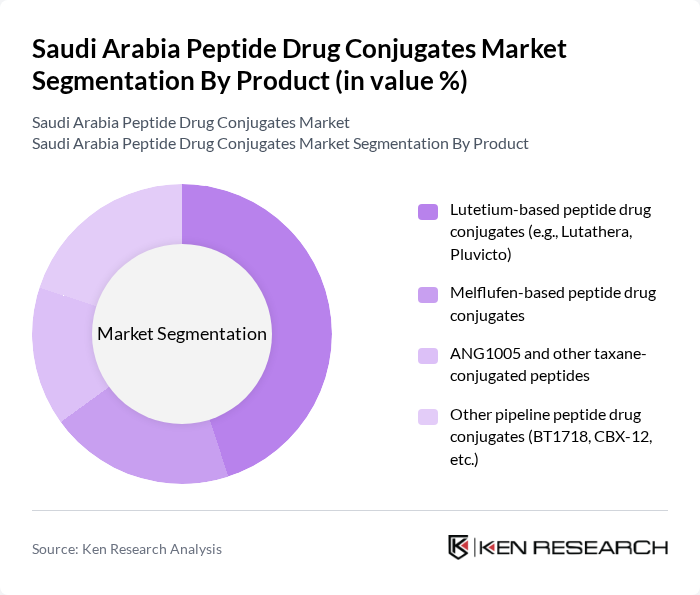
By Product:The product segmentation includes various types of peptide drug conjugates that cater to different therapeutic needs. Radiolabeled, lutetium-177–based peptide drug conjugates constitute the dominant sub-segment in the Saudi context, as agents such as lutetium-177–DOTATATE and related radioligand therapies are widely used in oncology for neuroendocrine tumors and prostate cancer due to their targeted delivery mechanisms and effectiveness in treating specific tumor types. Melflufen-based peptide drug conjugates, exemplified by melphalan flufenamide (Pepaxto/PepaxTO), have shown clinical utility in hematologic malignancies globally, although their availability and use have been more limited and subject to evolving regulatory decisions in major markets. The market is witnessing a growing interest in ANG1005 (paclitaxel trevatide) and other taxane-conjugated peptides in the global pipeline, which are being explored for their potential in treating various solid tumors, including breast and brain cancers. Other pipeline peptide drug conjugates such as BT1718 and CBX?12 are in clinical development internationally, indicating a robust global pipeline that is expected to progressively influence availability and clinical research opportunities in Saudi Arabia as partnerships and technology transfers expand.
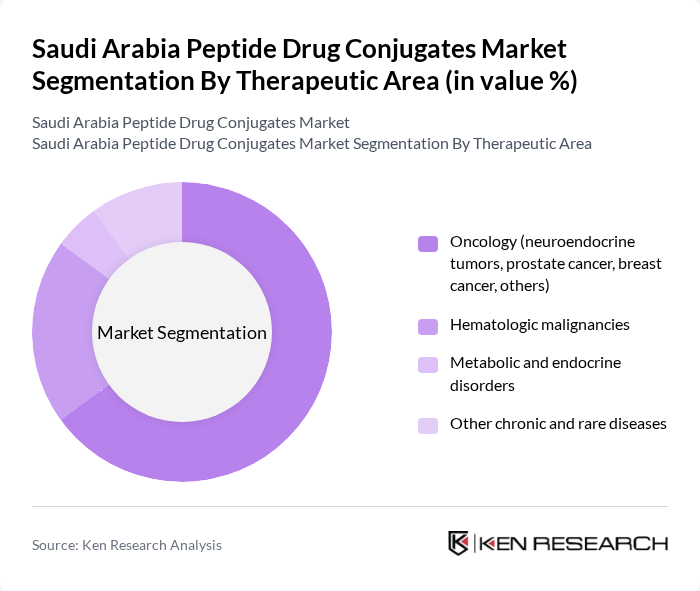
By Therapeutic Area:The therapeutic area segmentation highlights the various medical conditions addressed by peptide drug conjugates. Oncology is the leading therapeutic area, driven by the increasing incidence of cancer in Saudi Arabia and the need for targeted therapies that can deliver cytotoxic or radiolabeled payloads directly to tumor cells. Within oncology, neuroendocrine tumors and metastatic castration?resistant prostate cancer are key focus indications for lutetium-based radioligand PDCs, while breast and other solid tumors remain priority areas for peptide?based conjugate development. Hematologic malignancies are also a crucial segment, with peptide drug conjugates and peptide?linked cytotoxics showing promising results in multiple myeloma and other blood cancers in global clinical studies. Additionally, metabolic and endocrine disorders and other chronic diseases are emerging as important exploratory therapeutic areas for peptide-based conjugates, reflecting the broader recognition of peptide platforms in managing chronic and rare conditions beyond oncology.
Saudi Arabia Peptide Drug Conjugates Market Competitive Landscape
The Saudi Arabia Peptide Drug Conjugates Market is characterized by a dynamic mix of regional and international players. Leading participants such as Novartis AG, Advanced Accelerator Applications S.A. (a Novartis company), Amgen Inc., AstraZeneca PLC, Takeda Pharmaceutical Company Limited, Bayer AG, Pfizer Inc., F. Hoffmann-La Roche Ltd, Merck & Co., Inc., Sanofi S.A., Eli Lilly and Company, Gilead Sciences, Inc., Regeneron Pharmaceuticals, Inc., King Faisal Specialist Hospital & Research Centre (KFSH&RC), King Abdulaziz Medical City – Ministry of National Guard Health Affairs contribute to innovation, geographic expansion, and service delivery in this space.
Saudi Arabia Peptide Drug Conjugates Market Industry Analysis
Growth Drivers
- Increasing Prevalence of Cancer and Chronic Diseases:The incidence of cancer in Saudi Arabia is projected to reach approximately 30,000 new cases annually in future, according to the Saudi Cancer Registry. Chronic diseases, including diabetes and cardiovascular conditions, affect over 8 million people in the country. This rising prevalence drives the demand for innovative treatments, including peptide drug conjugates, which offer targeted therapeutic options, thereby enhancing patient outcomes and aligning with the healthcare system's focus on advanced treatment modalities.
- Advancements in Peptide Synthesis Technologies:The peptide synthesis market in Saudi Arabia is expected to grow significantly, with investments in advanced technologies projected to reach around $160 million in future. Innovations such as solid-phase peptide synthesis and automated synthesizers are enhancing the efficiency and scalability of peptide production. These advancements facilitate the development of peptide drug conjugates, making them more accessible and cost-effective, thus driving their adoption in clinical settings across the region.
- Rising Demand for Targeted Therapies:The global shift towards personalized medicine is reflected in Saudi Arabia, where the demand for targeted therapies is increasing. In future, the market for targeted cancer therapies in Saudi Arabia is expected to exceed $1.2 billion. Peptide drug conjugates, known for their specificity and reduced side effects, are becoming a preferred choice among healthcare providers. This trend is supported by government initiatives aimed at enhancing the biopharmaceutical sector, further propelling market growth.
Market Challenges
- High Development Costs of Peptide Drug Conjugates:The development costs for peptide drug conjugates can exceed $2.5 billion for a new innovative drug when considering discovery, development, and clinical trials, consistent with global estimates for novel biopharmaceuticals. This high financial burden is compounded by the need for extensive research and clinical trials, which can take several years. As a result, smaller firms may struggle to enter the market, limiting innovation and competition within the Saudi Arabian peptide drug conjugate landscape.
- Regulatory Hurdles and Lengthy Approval Processes:The regulatory environment in Saudi Arabia poses challenges for peptide drug conjugates, with approval processes often extending beyond 6 years. Compliance with the Saudi Food and Drug Authority (SFDA) guidelines requires substantial documentation and rigorous testing. These lengthy approval timelines can delay market entry for new therapies, hindering the overall growth of the peptide drug conjugate market in the region.
Saudi Arabia Peptide Drug Conjugates Market Future Outlook
The future of the peptide drug conjugates market in Saudi Arabia appears promising, driven by ongoing advancements in biotechnology and a growing emphasis on personalized medicine. As the healthcare sector continues to evolve, the integration of artificial intelligence in drug development is expected to streamline processes and enhance efficiency. Furthermore, increased collaboration between pharmaceutical companies and academic institutions will likely foster innovation, leading to the development of novel therapies that address unmet medical needs in the region.
Market Opportunities
- Expansion of Research and Development Activities:With government funding projected to reach $250 million in future, there is a significant opportunity for increased R&D in peptide drug conjugates. This investment will facilitate the exploration of new therapeutic applications and enhance the competitive landscape, positioning Saudi Arabia as a hub for biopharmaceutical innovation.
- Collaborations with Academic Institutions:Partnerships between pharmaceutical companies and universities are expected to grow, with at least 12 new collaborations anticipated in future. These alliances will promote knowledge exchange and accelerate the development of peptide drug conjugates, ultimately leading to more effective treatments and improved patient care in Saudi Arabia.
Scope of the Report
| Segment | Sub-Segments |
|---|---|
| By Product | Lutetium-based peptide drug conjugates (e.g., Lutathera, Pluvicto) Melflufen-based peptide drug conjugates ANG1005 and other taxane-conjugated peptides Other pipeline peptide drug conjugates (BT1718, CBX-12, etc.) |
| By Therapeutic Area | Oncology (neuroendocrine tumors, prostate cancer, breast cancer, others) Hematologic malignancies Metabolic and endocrine disorders Other chronic and rare diseases |
| By Type | Therapeutic peptide drug conjugates Diagnostic peptide drug conjugates Combination therapy-based peptide conjugates Others |
| By Technology / Linker Type | Peptide linker-based conjugation Site-specific conjugation technologies Cleavable linker technologies Non-cleavable and other linker technologies |
| By End-User | Tertiary care and specialty hospitals Oncology centers and ambulatory care centers Research and academic institutions Contract research and manufacturing organizations (CROs/CMOs) |
| By Distribution Channel | Hospital and institutional pharmacies Direct tenders and government procurement (NUPCO, MOH) Retail and specialty pharmacies Online and other channels |
| By Region | Central Region (including Riyadh) Western Region (including Jeddah, Makkah, Madinah) Eastern Region (including Dammam, Al Khobar, Dhahran) Southern and Northern Regions |
| By Development Stage | Preclinical candidates Clinical trials (Phase I–III) conducted in/including Saudi Arabia Commercially marketed products Compassionate use and expanded access programs |
Key Target Audience
Investors and Venture Capitalist Firms
Government and Regulatory Bodies (e.g., Saudi Food and Drug Authority, Ministry of Health)
Pharmaceutical Manufacturers
Biotechnology Companies
Healthcare Providers and Hospitals
Contract Research Organizations (CROs)
Pharmaceutical Distributors
Health Insurance Companies
Players Mentioned in the Report:
Novartis AG
Advanced Accelerator Applications S.A. (a Novartis company)
Amgen Inc.
AstraZeneca PLC
Takeda Pharmaceutical Company Limited
Bayer AG
Pfizer Inc.
F. Hoffmann-La Roche Ltd
Merck & Co., Inc.
Sanofi S.A.
Eli Lilly and Company
Gilead Sciences, Inc.
Regeneron Pharmaceuticals, Inc.
King Faisal Specialist Hospital & Research Centre (KFSH&RC)
King Abdulaziz Medical City Ministry of National Guard Health Affairs
Table of Contents
Market Assessment Phase
1. Executive Summary and Approach
2. Saudi Arabia Peptide Drug Conjugates Market Overview
2.1 Key Insights and Strategic Recommendations
2.2 Saudi Arabia Peptide Drug Conjugates Market Overview
2.3 Definition and Scope
2.4 Evolution of Market Ecosystem
2.5 Timeline of Key Regulatory Milestones
2.6 Value Chain & Stakeholder Mapping
2.7 Business Cycle Analysis
2.8 Policy & Incentive Landscape
3. Saudi Arabia Peptide Drug Conjugates Market Analysis
3.1 Growth Drivers
3.1.1 Increasing prevalence of cancer and chronic diseases
3.1.2 Advancements in peptide synthesis technologies
3.1.3 Rising demand for targeted therapies
3.1.4 Government initiatives to support biopharmaceuticals
3.2 Market Challenges
3.2.1 High development costs of peptide drug conjugates
3.2.2 Regulatory hurdles and lengthy approval processes
3.2.3 Limited awareness among healthcare professionals
3.2.4 Competition from traditional therapies
3.3 Market Opportunities
3.3.1 Expansion of research and development activities
3.3.2 Collaborations with academic institutions
3.3.3 Growing investment in personalized medicine
3.3.4 Increasing focus on orphan drugs
3.4 Market Trends
3.4.1 Shift towards combination therapies
3.4.2 Rise in biosimilars and biobetters
3.4.3 Integration of artificial intelligence in drug development
3.4.4 Emphasis on sustainable manufacturing practices
3.5 Government Regulation
3.5.1 Implementation of the Saudi Food and Drug Authority (SFDA) guidelines
3.5.2 Compliance with international quality standards
3.5.3 Incentives for local manufacturing of biopharmaceuticals
3.5.4 Policies promoting research and innovation in healthcare
4. SWOT Analysis
5. Stakeholder Analysis
6. Porter's Five Forces Analysis
7. Saudi Arabia Peptide Drug Conjugates Market Market Size, 2019-2024
7.1 By Value
7.2 By Volume
7.3 By Average Selling Price
8. Saudi Arabia Peptide Drug Conjugates Market Segmentation
8.1 By Product
8.1.1 Lutetium-based peptide drug conjugates (e.g., Lutathera, Pluvicto)
8.1.2 Melflufen-based peptide drug conjugates
8.1.3 ANG1005 and other taxane-conjugated peptides
8.1.4 Other pipeline peptide drug conjugates (BT1718, CBX-12, etc.)
8.2 By Therapeutic Area
8.2.1 Oncology (neuroendocrine tumors, prostate cancer, breast cancer, others)
8.2.2 Hematologic malignancies
8.2.3 Metabolic and endocrine disorders
8.2.4 Other chronic and rare diseases
8.3 By Type
8.3.1 Therapeutic peptide drug conjugates
8.3.2 Diagnostic peptide drug conjugates
8.3.3 Combination therapy-based peptide conjugates
8.3.4 Others
8.4 By Technology / Linker Type
8.4.1 Peptide linker-based conjugation
8.4.2 Site-specific conjugation technologies
8.4.3 Cleavable linker technologies
8.4.4 Non-cleavable and other linker technologies
8.5 By End-User
8.5.1 Tertiary care and specialty hospitals
8.5.2 Oncology centers and ambulatory care centers
8.5.3 Research and academic institutions
8.5.4 Contract research and manufacturing organizations (CROs/CMOs)
8.6 By Distribution Channel
8.6.1 Hospital and institutional pharmacies
8.6.2 Direct tenders and government procurement (NUPCO, MOH)
8.6.3 Retail and specialty pharmacies
8.6.4 Online and other channels
8.7 By Region
8.7.1 Central Region (including Riyadh)
8.7.2 Western Region (including Jeddah, Makkah, Madinah)
8.7.3 Eastern Region (including Dammam, Al Khobar, Dhahran)
8.7.4 Southern and Northern Regions
8.8 By Development Stage
8.8.1 Preclinical candidates
8.8.2 Clinical trials (Phase I–III) conducted in/including Saudi Arabia
8.8.3 Commercially marketed products
8.8.4 Compassionate use and expanded access programs
9. Saudi Arabia Peptide Drug Conjugates Market Competitive Analysis
9.1 Market Share of Key Players
9.2 Cross Comparison of Key Players
9.2.1 Company name and headquarters (global vs. local presence)
9.2.2 Group size (global revenue, R&D scale, Saudi Arabia footprint)
9.2.3 Saudi Arabia peptide drug conjugates revenue and 5-year CAGR
9.2.4 Number of SFDA-approved peptide drug conjugate products
9.2.5 Number of active peptide drug conjugate clinical trials in Saudi Arabia
9.2.6 Market access coverage (NUPCO listing, MOH and private sector contracts)
9.2.7 Average treatment cost per patient and pricing strategy (value- vs. volume-based)
9.2.8 Time-to-market / regulatory approval lead time with SFDA
9.2.9 Local partnership depth (distributors, JV, local manufacturing, tech transfer)
9.2.10 Portfolio breadth (oncology indications, diagnostic vs. therapeutic mix)
9.2.11 R&D intensity (% of global revenue invested in PDC R&D)
9.2.12 Pharmacovigilance and real-world evidence coverage in Saudi Arabia
9.3 SWOT Analysis of Top Players
9.4 Pricing Analysis
9.5 Detailed Profile of Major Companies
9.5.1 Novartis AG
9.5.2 Advanced Accelerator Applications S.A. (a Novartis company)
9.5.3 Amgen Inc.
9.5.4 AstraZeneca PLC
9.5.5 Takeda Pharmaceutical Company Limited
9.5.6 Bayer AG
9.5.7 Pfizer Inc.
9.5.8 F. Hoffmann-La Roche Ltd
9.5.9 Merck & Co., Inc.
9.5.10 Sanofi S.A.
9.5.11 Eli Lilly and Company
9.5.12 Gilead Sciences, Inc.
9.5.13 Regeneron Pharmaceuticals, Inc.
9.5.14 King Faisal Specialist Hospital & Research Centre (KFSH&RC)
9.5.15 King Abdulaziz Medical City – Ministry of National Guard Health Affairs
10. Saudi Arabia Peptide Drug Conjugates Market End-User Analysis
10.1 Procurement Behavior of Key Ministries
10.1.1 Key procurement processes
10.1.2 Budget allocation trends
10.1.3 Preferred suppliers
10.1.4 Evaluation criteria for procurement
10.2 Corporate Spend on Infrastructure & Energy
10.2.1 Investment trends in healthcare infrastructure
10.2.2 Corporate partnerships for drug development
10.2.3 Funding sources for healthcare projects
10.2.4 Impact of corporate spend on market growth
10.3 Pain Point Analysis by End-User Category
10.3.1 Challenges faced by hospitals
10.3.2 Issues in research institutions
10.3.3 Concerns of pharmaceutical companies
10.3.4 Others
10.4 User Readiness for Adoption
10.4.1 Awareness levels among healthcare professionals
10.4.2 Training needs for effective implementation
10.4.3 Infrastructure readiness
10.4.4 Others
10.5 Post-Deployment ROI and Use Case Expansion
10.5.1 Metrics for measuring ROI
10.5.2 Case studies of successful implementations
10.5.3 Potential for scaling use cases
10.5.4 Others
11. Saudi Arabia Peptide Drug Conjugates Market Future Size, 2025-2030
11.1 By Value
11.2 By Volume
11.3 By Average Selling Price
Go-To-Market Strategy Phase
1. Whitespace Analysis + Business Model Canvas
1.1 Market gaps identification
1.2 Value proposition development
1.3 Revenue model exploration
1.4 Customer segmentation analysis
1.5 Competitive landscape overview
1.6 Key partnerships identification
1.7 Risk assessment
2. Marketing and Positioning Recommendations
2.1 Branding strategies
2.2 Product USPs
2.3 Target audience identification
2.4 Communication strategies
2.5 Digital marketing approaches
2.6 Event marketing opportunities
2.7 Feedback mechanisms
3. Distribution Plan
3.1 Urban retail strategies
3.2 Rural NGO tie-ups
3.3 E-commerce integration
3.4 Logistics and supply chain management
3.5 Distribution partnerships
3.6 Inventory management
3.7 Performance metrics
4. Channel & Pricing Gaps
4.1 Underserved routes
4.2 Pricing bands analysis
4.3 Competitor pricing strategies
4.4 Customer willingness to pay
4.5 Value-based pricing models
4.6 Discount strategies
4.7 Price elasticity considerations
5. Unmet Demand & Latent Needs
5.1 Category gaps identification
5.2 Consumer segments analysis
5.3 Product development opportunities
5.4 Market entry strategies
5.5 Customer feedback integration
5.6 Future trends forecasting
5.7 Competitive advantage development
6. Customer Relationship
6.1 Loyalty programs
6.2 After-sales service
6.3 Customer engagement strategies
6.4 Feedback collection methods
6.5 Relationship management tools
6.6 Retention strategies
6.7 Customer satisfaction metrics
7. Value Proposition
7.1 Sustainability initiatives
7.2 Integrated supply chains
7.3 Unique selling points
7.4 Customer-centric approaches
7.5 Competitive differentiation
7.6 Long-term value creation
7.7 Market positioning
8. Key Activities
8.1 Regulatory compliance
8.2 Branding efforts
8.3 Distribution setup
8.4 Market research activities
8.5 Training and development
8.6 Performance monitoring
8.7 Stakeholder engagement
9. Entry Strategy Evaluation
9.1 Domestic Market Entry Strategy
9.1.1 Product mix considerations
9.1.2 Pricing band analysis
9.1.3 Packaging strategies
9.2 Export Entry Strategy
9.2.1 Target countries identification
9.2.2 Compliance roadmap development
10. Entry Mode Assessment
10.1 Joint Ventures
10.2 Greenfield Investments
10.3 Mergers & Acquisitions
10.4 Distributor Model
10.5 Risk assessment
10.6 Strategic fit evaluation
10.7 Long-term sustainability considerations
11. Capital and Timeline Estimation
11.1 Capital requirements
11.2 Timelines for market entry
11.3 Budget allocation
11.4 Financial projections
11.5 Funding sources
11.6 Cost management strategies
11.7 Risk mitigation plans
12. Control vs Risk Trade-Off
12.1 Ownership considerations
12.2 Partnerships evaluation
12.3 Risk management strategies
12.4 Control mechanisms
12.5 Long-term implications
12.6 Stakeholder interests
12.7 Strategic alignment
13. Profitability Outlook
13.1 Breakeven analysis
13.2 Long-term sustainability
13.3 Profit margin considerations
13.4 Revenue growth projections
13.5 Cost structure analysis
13.6 Financial health indicators
Research Methodology
Phase 1: Approach1
Desk Research
- Analysis of market reports from pharmaceutical and biotechnology associations in Saudi Arabia
- Review of scientific literature on peptide drug conjugates from academic journals and databases
- Examination of regulatory frameworks and guidelines from the Saudi Food and Drug Authority (SFDA)
Primary Research
- Interviews with key opinion leaders in the pharmaceutical industry, including researchers and clinicians
- Surveys with pharmaceutical companies involved in peptide drug development and commercialization
- Focus groups with healthcare professionals to understand market needs and trends
Validation & Triangulation
- Cross-validation of findings through multiple data sources, including industry reports and expert interviews
- Triangulation of quantitative data with qualitative insights from primary research
- Sanity checks through expert panel reviews to ensure data accuracy and relevance
Phase 2: Market Size Estimation1
Top-down Assessment
- Estimation of the total addressable market based on national healthcare expenditure and pharmaceutical sales
- Segmentation of the market by therapeutic areas and types of peptide drug conjugates
- Incorporation of growth rates from historical data and emerging trends in biotechnology
Bottom-up Modeling
- Collection of sales data from leading pharmaceutical companies involved in peptide drug conjugates
- Estimation of market share based on product pipeline and clinical trial outcomes
- Volume and pricing analysis to derive revenue projections for each segment
Forecasting & Scenario Analysis
- Development of forecasting models using historical growth rates and market drivers
- Scenario analysis based on potential regulatory changes and advancements in peptide technology
- Creation of baseline, optimistic, and pessimistic forecasts through 2030
Phase 3: CATI Sample Composition1
| Scope Item/Segment | Sample Size | Target Respondent Profiles |
|---|---|---|
| Pharmaceutical Manufacturers | 120 | R&D Directors, Product Managers |
| Healthcare Providers | 90 | Oncologists, Pharmacists |
| Regulatory Bodies | 50 | Regulatory Affairs Specialists, Compliance Officers |
| Academic Institutions | 70 | Research Scientists, Professors |
| Market Analysts | 40 | Market Research Analysts, Industry Consultants |
Frequently Asked Questions
What is the current value of the Saudi Arabia Peptide Drug Conjugates Market?
The Saudi Arabia Peptide Drug Conjugates Market is valued at approximately USD 35 million, reflecting a five-year historical analysis that highlights growth driven by advancements in targeted therapies and increasing cancer prevalence in the Kingdom.
What are the key factors driving the growth of the peptide drug conjugates market in Saudi Arabia?
Which cities are the main hubs for the peptide drug conjugates market in Saudi Arabia?
What regulatory frameworks govern peptide drug conjugates in Saudi Arabia?
Other Regional/Country Reports
Indonesia Peptide Drug Conjugates Market
Malaysia Peptide Drug Conjugates Market
KSA Peptide Drug Conjugates Market
APAC Peptide Drug Conjugates Market
SEA Peptide Drug Conjugates Market
Other Adjacent Reports
Japan Targeted Therapeutics Market
Japan Oncology Drugs Market
UAE Biopharmaceuticals MarketGlobal peptide therapeutics market Size, Share, Growth Drivers, Trends, Opportunities & Forecast 2025–2030Oman Drug Delivery Systems Market
Saudi Arabia Nuclear Medicine Market Report Size Share Growth Drivers Trends Opportunities & Forecast 2025–2030US personalized medicine market Size, Share, Growth Drivers, Trends, Opportunities & Forecast 2025–2030Saudi Arabia Cancer Diagnostics Market Size, Share, Growth Drivers, Trends, Opportunities & Forecast 2025–2030North America Clinical Trials Market Outlook to 2030: Size, Share, Growth and TrendsWhy Buy From Us?

What makes us stand out is that our consultants follow Robust, Refine and Result (RRR) methodology. Robust for clear definitions, approaches and sanity checking, Refine for differentiating respondents' facts and opinions, and Result for presenting data with story.

We have set a benchmark in the industry by offering our clients with syndicated and customized market research reports featuring coverage of entire market as well as meticulous research and analyst insights.

While we don't replace traditional research, we flip the method upside down. Our dual approach of Top Bottom & Bottom Top ensures quality deliverable by not just verifying company fundamentals but also looking at the sector and macroeconomic factors.

With one step in the future, our research team constantly tries to show you the bigger picture. We help with some of the tough questions you may encounter along the way: How is the industry positioned? Best marketing channel? KPI's of competitors? By aligning every element, we help maximize success.

Our report gives you instant access to the answers and sources that other companies might choose to hide. We elaborate each steps of research methodology we have used and showcase you the sample size to earn your trust.

If you need any support, we are here! We pride ourselves on universe strength, data quality, and quick, friendly, and professional service.