Region:Asia
Author(s):Shubham
Product Code:KRAC5178
Pages:82
Published On:January 2026
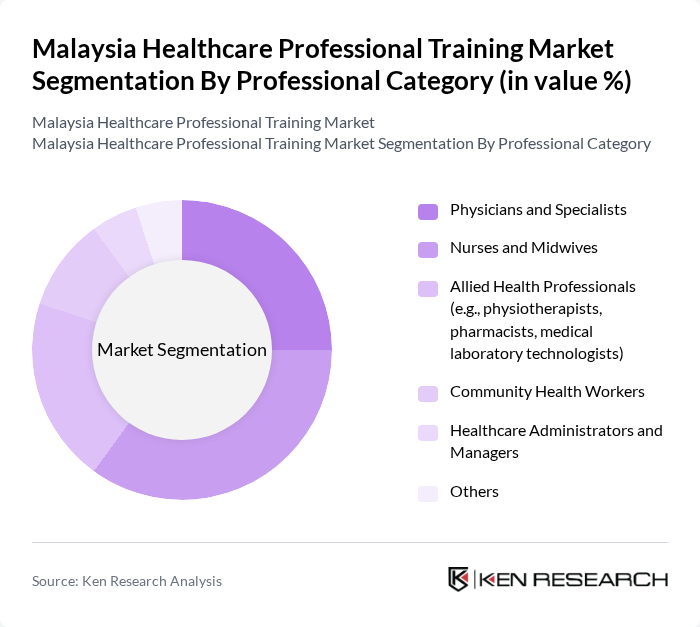
By Professional Category:The professional category segmentation includes various healthcare roles that require specialized training. The dominant sub-segment in this category is Nurses and Midwives, supported by the structural shortage of nursing staff and broader workforce gaps reported in Malaysia, which drive sustained demand for upskilling and reskilling in both public and private healthcare settings. The growing emphasis on patient care quality, infection control, and chronic disease management has led to a surge in competency-based training programs tailored for this group. Other significant sub-segments include Physicians and Specialists, who require ongoing education to keep pace with medical advancements, new clinical guidelines, and technology-enabled care, and Allied Health Professionals, who play a crucial role in diagnostics, rehabilitation, pharmacy services, and laboratory operations that underpin effective healthcare delivery.
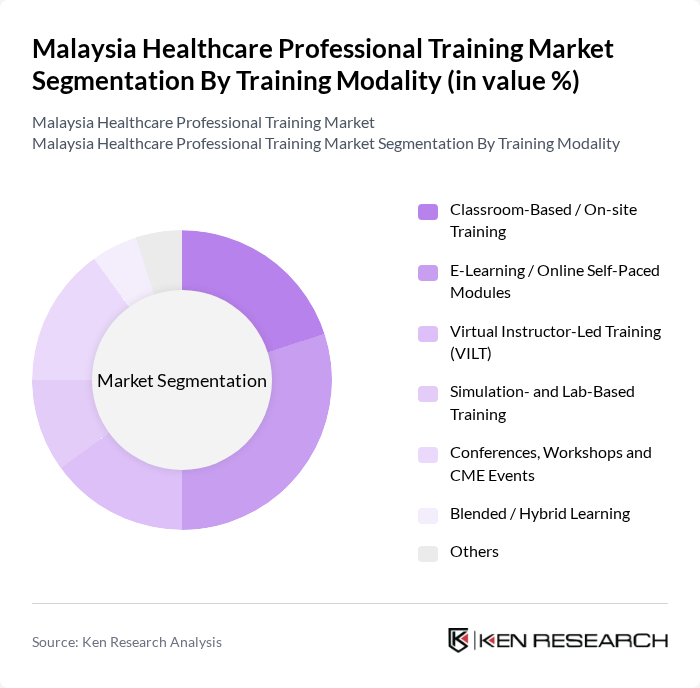
By Training Modality:The training modality segmentation reflects the various methods employed to deliver healthcare training. The leading sub-segment is E-Learning / Online Self-Paced Modules, which has gained popularity due to its flexibility and accessibility, aligning with global healthcare education trends where digital and online solutions are increasingly adopted to meet ongoing CME/CPD requirements. This modality allows healthcare professionals to learn at their own pace and supports scalable dissemination of updated clinical content and technology training. Classroom-Based / On-site Training remains significant, particularly for hands-on skills development, procedures, and simulation-based competencies, while Virtual Instructor-Led Training (VILT) is emerging as a preferred option for real-time interaction and multidisciplinary case discussions, especially in geographically dispersed settings. Other modalities, such as Simulation- and Lab-Based Training, are also crucial for practical skill enhancement and team-based scenarios, and are increasingly incorporated into hospital education centers and university skills labs in Malaysia.
The Malaysia Healthcare Professional Training Market is characterized by a dynamic mix of regional and international players. Leading participants such as KPJ Healthcare Berhad, IHH Healthcare Berhad (Pantai and Gleneagles Hospitals), Sunway Medical Centre, International Medical University (IMU), Universiti Malaya (UM), Universiti Kebangsaan Malaysia (UKM), KPJ Healthcare University College, Universiti Cyberjaya (formerly Cyberjaya University College of Medical Sciences), Monash University Malaysia, SEGi University, Taylor's University, UCSI University, Perdana University, MAHSA University, Penang Medical College (RCSI & UCD Malaysia Campus) contribute to innovation, geographic expansion, and service delivery in this space through residency training, postgraduate programs, CPD/CME activities, simulation centers, and structured corporate training initiatives.
The future of the Malaysia healthcare professional training market appears promising, driven by increasing investments in technology and government support. As the healthcare sector evolves, there will be a greater emphasis on innovative training methods, such as blended learning and simulation-based training. Additionally, the focus on continuous professional development will ensure that healthcare professionals remain updated with the latest practices, ultimately enhancing the quality of care provided to patients across the nation.
| Segment | Sub-Segments |
|---|---|
| By Professional Category | Physicians and Specialists Nurses and Midwives Allied Health Professionals (e.g., physiotherapists, pharmacists, medical laboratory technologists) Community Health Workers Healthcare Administrators and Managers Others |
| By Training Modality | Classroom-Based / On-site Training E-Learning / Online Self-Paced Modules Virtual Instructor-Led Training (VILT) Simulation- and Lab-Based Training Conferences, Workshops and CME Events Blended / Hybrid Learning Others |
| By Clinical vs Non-Clinical Focus | Clinical Skills and Procedure Training Specialty and Sub-Specialty Training Primary Care and Community Health Management, Leadership and Administration Digital Health, Informatics and Technology-Enabled Care Quality, Patient Safety and Regulatory Compliance Others |
| By End-User Institution | Public Hospitals and MOH Facilities Private Hospitals and Specialist Centres Clinics and Primary Care Networks Universities and Medical / Nursing Schools Professional Associations and Councils Corporate and Private Training Providers Others |
| By Funding Source | Government and Public Grants Employer-Sponsored / Corporate Training Budgets Self-Funded by Individuals International and NGO Funding Others |
| By Certification Outcome | Mandatory CPD / CME Credits Board, College or Council-Accredited Certifications Institutional Certificates of Completion Micro-Credentials and Digital Badges Others |
| By Geography (Malaysia) | Greater Klang Valley (including Kuala Lumpur and Selangor) Penang and Northern Region Southern Region (including Johor) East Coast Region East Malaysia (Sabah and Sarawak) Others |
| Scope Item/Segment | Sample Size | Target Respondent Profiles |
|---|---|---|
| Healthcare Training Providers | 80 | Training Coordinators, Program Directors |
| Healthcare Professionals | 120 | Nurses, Doctors, Allied Health Professionals |
| Healthcare Administrators | 60 | Hospital Managers, HR Directors |
| Regulatory Bodies | 40 | Policy Makers, Compliance Officers |
| Healthcare Educators | 50 | University Professors, Training Facilitators |
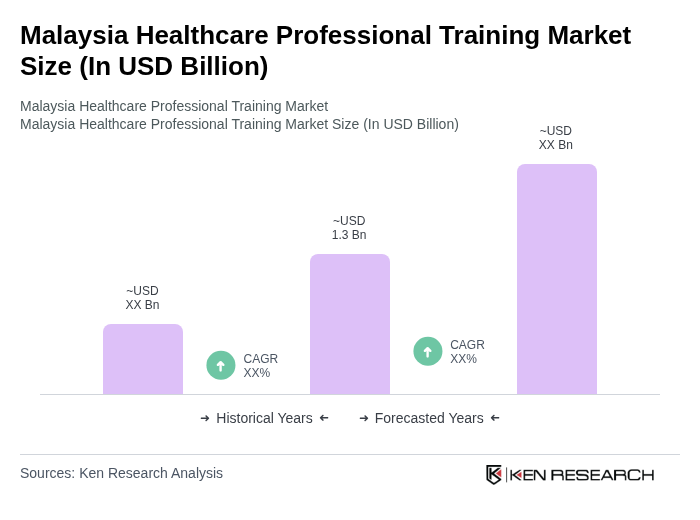
The Malaysia Healthcare Professional Training Market is valued at approximately USD 1.3 billion. This figure reflects the growing demand for skilled healthcare professionals and the government's commitment to enhancing healthcare services through continuous professional development programs.

What makes us stand out is that our consultants follow Robust, Refine and Result (RRR) methodology. Robust for clear definitions, approaches and sanity checking, Refine for differentiating respondents' facts and opinions, and Result for presenting data with story.

We have set a benchmark in the industry by offering our clients with syndicated and customized market research reports featuring coverage of entire market as well as meticulous research and analyst insights.

While we don't replace traditional research, we flip the method upside down. Our dual approach of Top Bottom & Bottom Top ensures quality deliverable by not just verifying company fundamentals but also looking at the sector and macroeconomic factors.

With one step in the future, our research team constantly tries to show you the bigger picture. We help with some of the tough questions you may encounter along the way: How is the industry positioned? Best marketing channel? KPI's of competitors? By aligning every element, we help maximize success.

Our report gives you instant access to the answers and sources that other companies might choose to hide. We elaborate each steps of research methodology we have used and showcase you the sample size to earn your trust.

If you need any support, we are here! We pride ourselves on universe strength, data quality, and quick, friendly, and professional service.













