About the Report
Base Year 2024Listen to the audio summary
Malaysia Hospital Emergency Department Market Overview
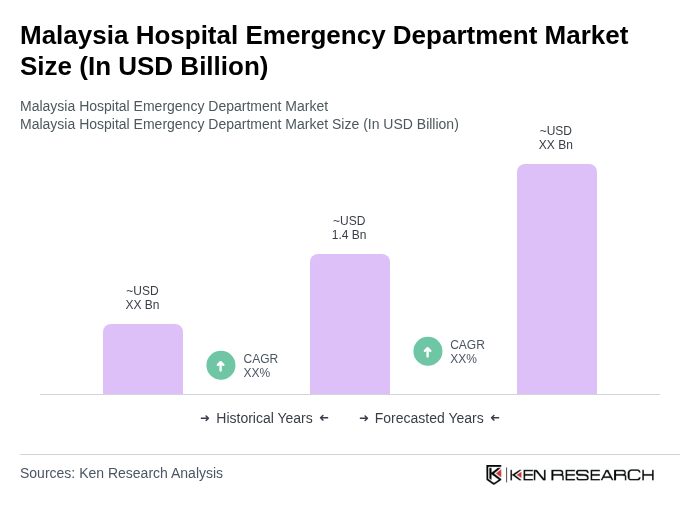
- The Malaysia Hospital Emergency Department market is valued at USD 1.4 billion, based on a five-year historical analysis and by relating Malaysia’s share of the global hospital emergency department market to the overall Malaysia healthcare market size. This growth is primarily driven by the increasing demand for emergency medical services, rising population, and the prevalence of chronic diseases such as cardiovascular disease and diabetes that require immediate medical attention. The expansion of healthcare infrastructure, including new public and private hospitals, and advancements in medical technology such as digital imaging, point?of?care diagnostics, and health information systems have also significantly contributed to the market's growth.
- Key cities dominating the market include Kuala Lumpur, Selangor, and Penang. These regions are characterized by a high concentration of healthcare facilities, tertiary referral hospitals, and advanced medical technologies, together with a large urban population that drives the demand for emergency services. The presence of major public hospitals such as Hospital Kuala Lumpur and Hospital Serdang, as well as leading private hospitals and specialized medical centers in these areas, further enhances their market dominance.
- In 2023, the Malaysian government implemented the Healthcare Services Act 2023 (Act 808), issued by the Ministry of Health, which provides a comprehensive regulatory framework for healthcare facilities and services, including emergency care in both public and private hospitals. This regulation requires facilities to obtain a licence, comply with standards on staffing, equipment, triage, and patient safety, and maintain specified minimum service capabilities in emergency and critical care, thereby ensuring that emergency departments are adequately equipped and staffed to handle the increasing number of patients and improving overall healthcare delivery in the country.
Malaysia Hospital Emergency Department Market Segmentation
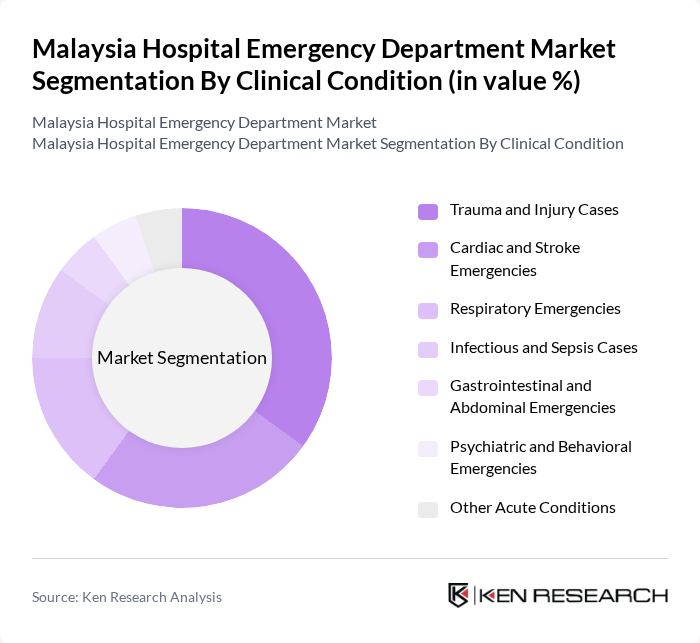
By Clinical Condition:This segmentation includes various clinical conditions that emergency departments typically handle. The subsegments are Trauma and Injury Cases, Cardiac and Stroke Emergencies, Respiratory Emergencies, Infectious and Sepsis Cases, Gastrointestinal and Abdominal Emergencies, Psychiatric and Behavioral Emergencies, and Other Acute Conditions. Among these, Trauma and Injury Cases dominate the market due to the high incidence of road traffic accidents and workplace injuries, which necessitate immediate medical intervention. The increasing awareness of health issues, enhanced pre?hospital emergency medical services, and the need for timely treatment for time?sensitive conditions such as stroke, acute coronary syndromes, and sepsis further drive the demand for emergency services in this category.
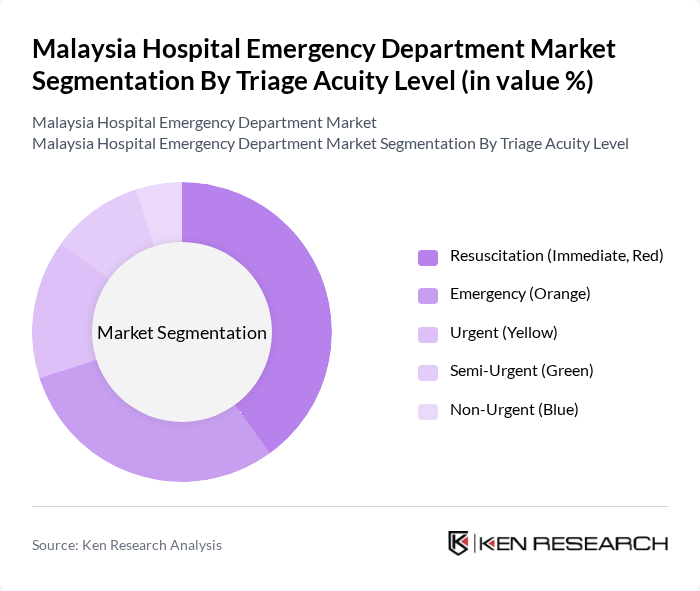
By Triage Acuity Level:This segmentation categorizes emergency cases based on the urgency of care required. The subsegments include Resuscitation (Immediate, Red), Emergency (Orange), Urgent (Yellow), Semi-Urgent (Green), and Non-Urgent (Blue). The Resuscitation category represents a critical but smaller share of total encounters and includes life?threatening presentations such as cardiac arrest, major trauma, and shock that require immediate attention. In Malaysia, most emergency department attendances fall within urgent and semi?urgent categories under the Malaysian Triage Category system, while policy efforts to improve rapid response times, door?to?balloon times, and stroke thrombolysis are strengthening practices across all high?acuity levels and supporting the growth of emergency services overall.
Malaysia Hospital Emergency Department Market Competitive Landscape
The Malaysia Hospital Emergency Department Market is characterized by a dynamic mix of regional and international players. Leading participants such as KPJ Healthcare Berhad, Pantai Hospitals (IHH Healthcare), Sunway Medical Centre, Columbia Asia Hospitals Malaysia, Gleneagles Hospitals Malaysia, Hospital Kuala Lumpur, KPJ Tawakkal Specialist Hospital, Ramsay Sime Darby Health Care, Mahkota Medical Centre, Penang Adventist Hospital, Hospital Putrajaya, Hospital Sultanah Aminah, Hospital Serdang, Hospital Canselor Tuanku Muhriz UKM, Hospital Ampang contribute to innovation, geographic expansion, and service delivery in this space.
Malaysia Hospital Emergency Department Market Industry Analysis
Growth Drivers
- Increasing Population and Urbanization:Malaysia's population is projected to reach approximately 36 million in future, with urbanization rates exceeding 80%. This demographic shift drives higher demand for emergency services, as urban areas typically experience increased incidents of accidents and health emergencies. The concentration of population in cities necessitates enhanced emergency department capabilities to manage the growing patient influx effectively, thereby supporting the overall healthcare infrastructure.
- Rising Incidence of Emergencies and Accidents:The Malaysian Health Ministry reported over 1.5 million emergency cases annually, with road traffic accidents contributing significantly to this figure. In future, the number of emergency cases is expected to rise due to increased vehicle ownership, which has already surpassed 20 million registered vehicles including passenger cars and motorcycles. This surge in emergencies necessitates robust emergency department services to handle the escalating patient volume and ensure timely medical intervention.
- Advancements in Medical Technology:The integration of advanced medical technologies, such as telemedicine and AI-driven diagnostic tools, is transforming emergency care in Malaysia. In future, investments in healthcare technology are expected to continue to grow, enhancing the efficiency and effectiveness of emergency departments. These innovations facilitate quicker diagnosis and treatment, improving patient outcomes and increasing the overall capacity of emergency services to manage complex cases.
Market Challenges
- Limited Resources and Infrastructure:Despite the growing demand for emergency services, many hospitals in Malaysia face resource constraints. This inadequacy hampers the ability to provide timely and effective treatment, leading to increased patient wait times and potentially adverse health outcomes, particularly in rural areas.
- High Patient Volume Leading to Overcrowding:Emergency departments in Malaysia are experiencing significant overcrowding, with some facilities reporting high patient-to-staff ratios. This situation is exacerbated by the limited number of emergency beds, which stood at approximately 2,500 in future. Overcrowding not only strains resources but also compromises the quality of care, resulting in longer wait times and increased pressure on medical personnel.
Malaysia Hospital Emergency Department Market Future Outlook
The future of Malaysia's hospital emergency department market is poised for transformation, driven by technological advancements and evolving patient care models. As the government continues to invest in healthcare infrastructure, the integration of telemedicine and AI will enhance service delivery. Additionally, the focus on preventive healthcare measures will likely reduce emergency cases, allowing departments to allocate resources more efficiently. Overall, these trends indicate a shift towards more responsive and patient-centered emergency care in Malaysia.
Market Opportunities
- Expansion of Private Emergency Services:The private healthcare sector in Malaysia is expected to grow, with private emergency services projected to increase steadily in future. This growth presents opportunities for investment in state-of-the-art facilities and services, catering to the rising demand for quality emergency care among affluent populations seeking faster treatment options.
- Integration of Telemedicine Solutions:The adoption of telemedicine in emergency care is gaining traction. This shift not only enhances access to care but also optimizes resource utilization, allowing emergency departments to focus on critical cases while managing non-urgent consultations effectively.
Scope of the Report
| Segment | Sub-Segments |
|---|---|
| By Clinical Condition | Trauma and Injury Cases Cardiac and Stroke Emergencies Respiratory Emergencies Infectious and Sepsis Cases Gastrointestinal and Abdominal Emergencies Psychiatric and Behavioral Emergencies Other Acute Conditions |
| By Triage Acuity Level | Resuscitation (Immediate, Red) Emergency (Orange) Urgent (Yellow) Semi-Urgent (Green) Non-Urgent (Blue) |
| By Type of Hospital | Public / MOH Hospitals University and Teaching Hospitals Private Hospitals Specialized and Tertiary Referral Centres |
| By Service Type | Adult Emergency Care Pediatric Emergency Care Obstetric and Gynecologic Emergency Care Trauma and Surgical Emergency Care |
| By Visit Type | Walk-in / Self-referred GP / Clinic Referred Inter-hospital Transfers EMS / Ambulance Arrivals |
| By Payer Type | Government-funded / Public Subsidy Private Insurance Corporate / Panel Schemes Self-pay / Out-of-Pocket |
| By Region | Central Region (Kuala Lumpur, Selangor, Putrajaya) Northern Region Southern Region East Coast Region East Malaysia (Sabah & Sarawak) |
Key Target Audience
Investors and Venture Capitalist Firms
Government and Regulatory Bodies (e.g., Ministry of Health Malaysia, National Institute of Health)
Healthcare Providers and Hospital Administrators
Medical Equipment Manufacturers
Pharmaceutical Companies
Health Insurance Companies
Emergency Medical Services (EMS) Providers
Healthcare Technology Startups
Players Mentioned in the Report:
KPJ Healthcare Berhad
Pantai Hospitals (IHH Healthcare)
Sunway Medical Centre
Columbia Asia Hospitals Malaysia
Gleneagles Hospitals Malaysia
Hospital Kuala Lumpur
KPJ Tawakkal Specialist Hospital
Ramsay Sime Darby Health Care
Mahkota Medical Centre
Penang Adventist Hospital
Hospital Putrajaya
Hospital Sultanah Aminah
Hospital Serdang
Hospital Canselor Tuanku Muhriz UKM
Hospital Ampang
Table of Contents
Market Assessment Phase
1. Executive Summary and Approach
2. Malaysia Hospital Emergency Department Market Overview
2.1 Key Insights and Strategic Recommendations
2.2 Malaysia Hospital Emergency Department Market Overview
2.3 Definition and Scope
2.4 Evolution of Market Ecosystem
2.5 Timeline of Key Regulatory Milestones
2.6 Value Chain & Stakeholder Mapping
2.7 Business Cycle Analysis
2.8 Policy & Incentive Landscape
3. Malaysia Hospital Emergency Department Market Analysis
3.1 Growth Drivers
3.1.1 Increasing Population and Urbanization
3.1.2 Rising Incidence of Emergencies and Accidents
3.1.3 Advancements in Medical Technology
3.1.4 Government Initiatives to Improve Healthcare Access
3.2 Market Challenges
3.2.1 Limited Resources and Infrastructure
3.2.2 High Patient Volume Leading to Overcrowding
3.2.3 Shortage of Skilled Medical Personnel
3.2.4 Regulatory Compliance and Bureaucratic Hurdles
3.3 Market Opportunities
3.3.1 Expansion of Private Emergency Services
3.3.2 Integration of Telemedicine Solutions
3.3.3 Investment in Emergency Medical Training Programs
3.3.4 Partnerships with NGOs for Community Health Initiatives
3.4 Market Trends
3.4.1 Increasing Use of AI and Data Analytics
3.4.2 Focus on Patient-Centric Care Models
3.4.3 Growth of Mobile Emergency Services
3.4.4 Emphasis on Preventive Healthcare Measures
3.5 Government Regulation
3.5.1 Licensing and Accreditation Requirements
3.5.2 Emergency Medical Services Act
3.5.3 Health Ministry Guidelines for Emergency Care
3.5.4 Patient Rights and Safety Regulations
4. SWOT Analysis
5. Stakeholder Analysis
6. Porter's Five Forces Analysis
7. Malaysia Hospital Emergency Department Market Size, 2019-2024
7.1 By Value
7.2 By Volume
7.3 By Average Selling Price
8. Malaysia Hospital Emergency Department Market Segmentation
8.1 By Clinical Condition
8.1.1 Trauma and Injury Cases
8.1.2 Cardiac and Stroke Emergencies
8.1.3 Respiratory Emergencies
8.1.4 Infectious and Sepsis Cases
8.1.5 Gastrointestinal and Abdominal Emergencies
8.1.6 Psychiatric and Behavioral Emergencies
8.1.7 Other Acute Conditions
8.2 By Triage Acuity Level
8.2.1 Resuscitation (Immediate, Red)
8.2.2 Emergency (Orange)
8.2.3 Urgent (Yellow)
8.2.4 Semi-Urgent (Green)
8.2.5 Non-Urgent (Blue)
8.3 By Type of Hospital
8.3.1 Public / MOH Hospitals
8.3.2 University and Teaching Hospitals
8.3.3 Private Hospitals
8.3.4 Specialized and Tertiary Referral Centres
8.4 By Service Type
8.4.1 Adult Emergency Care
8.4.2 Pediatric Emergency Care
8.4.3 Obstetric and Gynecologic Emergency Care
8.4.4 Trauma and Surgical Emergency Care
8.5 By Visit Type
8.5.1 Walk-in / Self-referred
8.5.2 GP / Clinic Referred
8.5.3 Inter-hospital Transfers
8.5.4 EMS / Ambulance Arrivals
8.6 By Payer Type
8.6.1 Government-funded / Public Subsidy
8.6.2 Private Insurance
8.6.3 Corporate / Panel Schemes
8.6.4 Self-pay / Out-of-Pocket
8.7 By Region
8.7.1 Central Region (Kuala Lumpur, Selangor, Putrajaya)
8.7.2 Northern Region
8.7.3 Southern Region
8.7.4 East Coast Region
8.7.5 East Malaysia (Sabah & Sarawak)
9. Malaysia Hospital Emergency Department Market Competitive Analysis
9.1 Market Share of Key Players
9.2 Cross Comparison of Key Players
9.2.1 Company Name
9.2.2 Group Size (Large, Medium, or Small as per industry convention)
9.2.3 Annual Emergency Department Visit Volume
9.2.4 Bed Capacity (Total and ED-specific)
9.2.5 Average Length of Stay in ED (Hours)
9.2.6 Median Door-to-Doctor Time (Minutes)
9.2.7 Median Door-to-Needle / Door-to-Balloon Time (Minutes)
9.2.8 Emergency Room Left-Without-Being-Seen (LWBS) Rate
9.2.9 72-hour ED Revisit Rate
9.2.10 ED-related Inpatient Admission Rate
9.2.11 Patient Satisfaction / Net Promoter Score (NPS)
9.2.12 Revenue from Emergency Services
9.2.13 Revenue per ED Visit
9.2.14 Operating Margin on ED Services
9.2.15 Investment in ED Infrastructure & Digitalization (Capex)
9.3 SWOT Analysis of Top Players
9.4 Pricing Analysis
9.5 Detailed Profile of Major Companies
9.5.1 KPJ Healthcare Berhad
9.5.2 Pantai Hospitals (IHH Healthcare)
9.5.3 Sunway Medical Centre
9.5.4 Columbia Asia Hospitals Malaysia
9.5.5 Gleneagles Hospitals Malaysia
9.5.6 Hospital Kuala Lumpur
9.5.7 KPJ Tawakkal Specialist Hospital
9.5.8 Ramsay Sime Darby Health Care
9.5.9 Mahkota Medical Centre
9.5.10 Penang Adventist Hospital
9.5.11 Hospital Putrajaya
9.5.12 Hospital Sultanah Aminah
9.5.13 Hospital Serdang
9.5.14 Hospital Canselor Tuanku Muhriz UKM
9.5.15 Hospital Ampang
10. Malaysia Hospital Emergency Department Market End-User Analysis
10.1 Procurement Behavior of Key Ministries
10.1.1 Ministry of Health
10.1.2 Ministry of Finance
10.1.3 Ministry of Education
10.1.4 Others
10.2 Corporate Spend on Infrastructure & Energy
10.2.1 Hospital Infrastructure Development
10.2.2 Emergency Equipment Procurement
10.2.3 Staff Training and Development
10.2.4 Others
10.3 Pain Point Analysis by End-User Category
10.3.1 Public Hospitals
10.3.2 Private Hospitals
10.3.3 Urgent Care Centers
10.3.4 Others
10.4 User Readiness for Adoption
10.4.1 Technology Adoption
10.4.2 Training and Support Needs
10.4.3 Financial Readiness
10.4.4 Others
10.5 Post-Deployment ROI and Use Case Expansion
10.5.1 Cost Savings Analysis
10.5.2 Patient Outcome Improvements
10.5.3 Service Expansion Opportunities
10.5.4 Others
11. Malaysia Hospital Emergency Department Market Future Size, 2025-2030
11.1 By Value
11.2 By Volume
11.3 By Average Selling Price
Go-To-Market Strategy Phase
1. Whitespace Analysis + Business Model Canvas
1.1 Market Gaps Identification
1.2 Business Model Development
2. Marketing and Positioning Recommendations
2.1 Branding Strategies
2.2 Product USPs
3. Distribution Plan
3.1 Urban Retail vs Rural NGO Tie-Ups
4. Channel & Pricing Gaps
4.1 Underserved Routes
4.2 Pricing Bands
5. Unmet Demand & Latent Needs
5.1 Category Gaps
5.2 Consumer Segments
6. Customer Relationship
6.1 Loyalty Programs
6.2 After-Sales Service
7. Value Proposition
7.1 Sustainability
7.2 Integrated Supply Chains
8. Key Activities
8.1 Regulatory Compliance
8.2 Branding
8.3 Distribution Setup
9. Entry Strategy Evaluation
9.1 Domestic Market Entry Strategy
9.1.1 Product Mix
9.1.2 Pricing Band
9.1.3 Packaging
9.2 Export Entry Strategy
9.2.1 Target Countries
9.2.2 Compliance Roadmap
10. Entry Mode Assessment
10.1 JV
10.2 Greenfield
10.3 M&A
10.4 Distributor Model
11. Capital and Timeline Estimation
11.1 Capital Requirements
11.2 Timelines
12. Control vs Risk Trade-Off
12.1 Ownership vs Partnerships
13. Profitability Outlook
13.1 Breakeven Analysis
13.2 Long-Term Sustainability
14. Potential Partner List
14.1 Distributors
14.2 JVs
14.3 Acquisition Targets
15. Execution Roadmap
15.1 Phased Plan for Market Entry
15.1.1 Market Setup
15.1.2 Market Entry
15.1.3 Growth Acceleration
15.1.4 Scale & Stabilize
15.2 Key Activities and Milestones
15.2.1 Activity Planning
15.2.2 Milestone Tracking
Research Methodology
Phase 1: Approach1
Desk Research
- Analysis of government health statistics and reports from the Ministry of Health Malaysia
- Review of published studies and white papers on emergency department performance metrics
- Examination of healthcare expenditure reports and hospital accreditation data
Primary Research
- Interviews with emergency department heads and hospital administrators across Malaysia
- Surveys conducted with healthcare professionals working in emergency services
- Focus group discussions with patients who have utilized emergency services recently
Validation & Triangulation
- Cross-validation of findings through multiple data sources including government and private sector reports
- Triangulation of qualitative insights from interviews with quantitative data from surveys
- Sanity checks through expert panel reviews comprising healthcare analysts and emergency care specialists
Phase 2: Market Size Estimation1
Top-down Assessment
- Estimation of total healthcare spending in Malaysia and allocation to emergency services
- Analysis of patient volume trends in emergency departments across various regions
- Incorporation of demographic data to assess population growth and its impact on emergency care demand
Bottom-up Modeling
- Collection of operational data from leading hospitals regarding patient throughput and service costs
- Estimation of average treatment costs per patient visit in emergency departments
- Volume x cost analysis to derive total market size for emergency services
Forecasting & Scenario Analysis
- Multi-factor regression analysis incorporating population health trends and emergency service utilization rates
- Scenario modeling based on potential changes in healthcare policy and funding
- Baseline, optimistic, and pessimistic projections for emergency department market growth through 2030
Phase 3: CATI Sample Composition1
| Scope Item/Segment | Sample Size | Target Respondent Profiles |
|---|---|---|
| Urban Emergency Departments | 140 | Emergency Physicians, Hospital Administrators |
| Rural Emergency Services | 90 | Healthcare Workers, Community Health Officers |
| Patient Experience in Emergency Care | 120 | Recent Emergency Patients, Caregivers |
| Emergency Response Protocols | 80 | Emergency Medical Technicians, Paramedics |
| Healthcare Policy Impact on Emergency Services | 70 | Health Policy Analysts, Government Officials |
Frequently Asked Questions
What is the current value of the Malaysia Hospital Emergency Department market?
The Malaysia Hospital Emergency Department market is valued at approximately USD 1.4 billion. This valuation is based on a five-year historical analysis and reflects Malaysia's share of the global hospital emergency department market within the overall healthcare market.
What factors are driving the growth of the emergency department market in Malaysia?
Which cities are the main contributors to the Malaysia Hospital Emergency Department market?
What are the main clinical conditions treated in Malaysian emergency departments?
Other Regional/Country Reports
Other Adjacent Reports
Malaysia Health Information Systems Market
Africa Telemedicine Market Size, Share & Opportunity Analysis, By Service Type, Care Setting & Technology, 2025-2032South Korea Critical Care Equipment Market
South Africa Trauma Care Market
South Korea Cardiovascular Emergency Market
Indonesia Respiratory Emergency Market
Why Buy From Us?

What makes us stand out is that our consultants follow Robust, Refine and Result (RRR) methodology. Robust for clear definitions, approaches and sanity checking, Refine for differentiating respondents' facts and opinions, and Result for presenting data with story.

We have set a benchmark in the industry by offering our clients with syndicated and customized market research reports featuring coverage of entire market as well as meticulous research and analyst insights.

While we don't replace traditional research, we flip the method upside down. Our dual approach of Top Bottom & Bottom Top ensures quality deliverable by not just verifying company fundamentals but also looking at the sector and macroeconomic factors.

With one step in the future, our research team constantly tries to show you the bigger picture. We help with some of the tough questions you may encounter along the way: How is the industry positioned? Best marketing channel? KPI's of competitors? By aligning every element, we help maximize success.

Our report gives you instant access to the answers and sources that other companies might choose to hide. We elaborate each steps of research methodology we have used and showcase you the sample size to earn your trust.

If you need any support, we are here! We pride ourselves on universe strength, data quality, and quick, friendly, and professional service.