Malaysia Living Dining Room Market Report Size, Share, Growth Drivers, Trends, Opportunities And Forecast 2025–2030

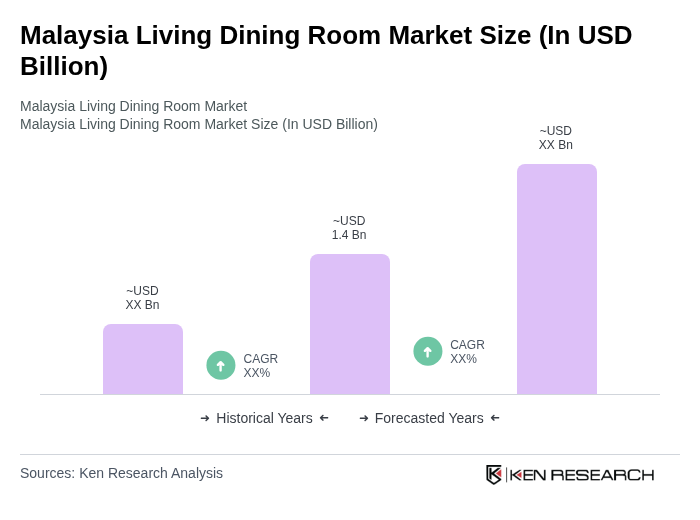
Malaysia Living Dining Room Market, valued at USD 1.4 Bn, grows with urbanization reaching 78.9% and rising incomes, boosting demand for sofas, dining sets, and sustainable options.

Region:Asia

Author(s):Dev

Product Code:KRAE3526

Pages:93

Published On:March 2026
About the Report

Base Year 2024

Malaysia Living Dining Room Market Overview

  • The Malaysia Living Dining Room Market is valued at approximately USD 1.4 billion, based on a five-year historical analysis. This growth is primarily driven by increasing disposable incomes, urbanization, and a growing trend towards home improvement and interior design. The rise in consumer spending on home furnishings and decor has significantly contributed to the market's expansion, as more households invest in creating comfortable and aesthetically pleasing living spaces. Malaysia's urban population reached approximately 27,007,541 in 2024, accounting for around 78.9% of the country's total population, which has intensified demand for convenient home furnishing solutions.
  • Key cities such as Kuala Lumpur, Penang, and Johor Bahru dominate the market due to their high population density and economic activity. Kuala Lumpur, as the capital, serves as a hub for retail and commerce, attracting both local and international furniture brands. Penang and Johor Bahru also benefit from their strategic locations and growing middle-class populations, which drive demand for quality living and dining room products.
  • The Malaysian government has implemented housing and home ownership initiatives aimed at promoting affordable housing and encouraging home ownership. These initiatives include incentives for first-time homebuyers and aim to stimulate the furniture market by increasing demand for living and dining room furnishings as new homeowners seek to furnish their spaces. Additionally, there is a growing demand for modular and space-saving furniture as urban living spaces become smaller and more compact, with customers increasingly seeking kitchen and dining furniture that combines functionality with aesthetic appeal while being durable and easy to clean.
Malaysia Living Dining Room Market Size

Malaysia Living Dining Room Market Segmentation

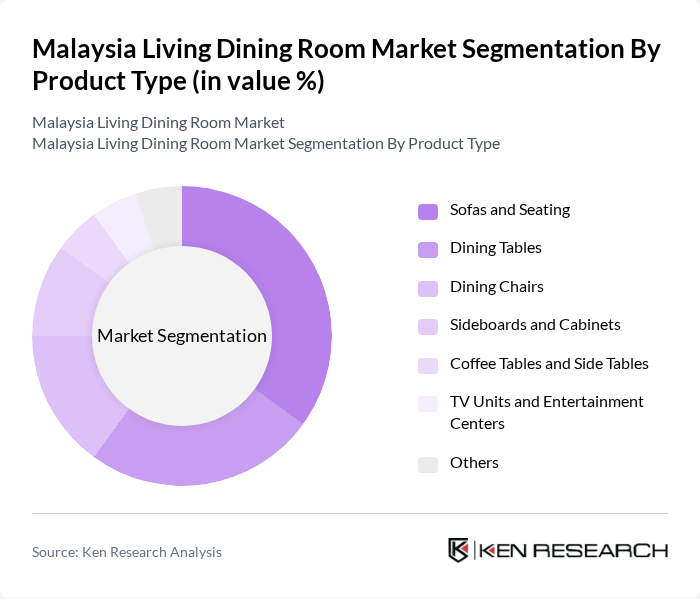
By Product Type:The product type segmentation includes various categories such as sofas and seating, dining tables, dining chairs, sideboards and cabinets, coffee tables and side tables, TV units and entertainment centers, and others. Among these, sofas and seating are the most popular due to their essential role in living spaces, reflecting consumer preferences for comfort and style. Dining tables and chairs also see significant demand as they are central to family gatherings and social interactions. The trend towards multifunctional furniture is driving innovation in this segment.
Malaysia Living Dining Room Market segmentation by Product Type.

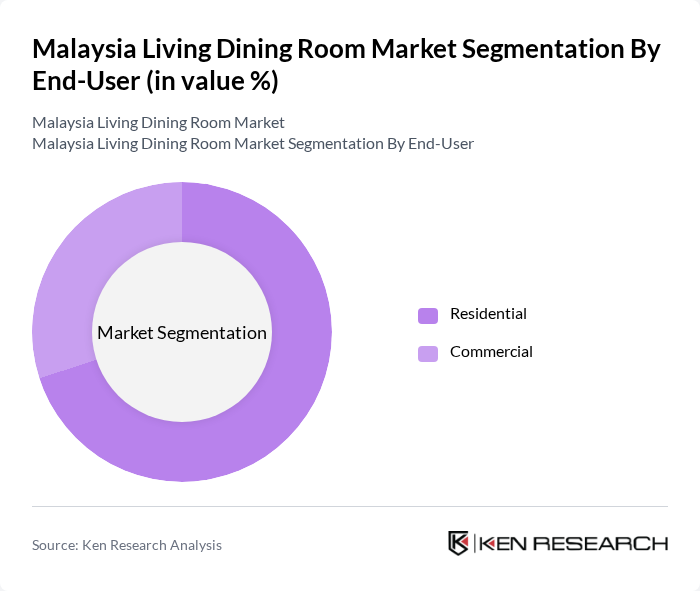
By End-User:The end-user segmentation is divided into residential and commercial categories. The residential segment dominates the market, driven by the increasing number of households and the trend of home renovations. Consumers are investing in quality furniture to enhance their living spaces, reflecting a shift towards more personalized and comfortable home environments. The commercial segment, while smaller, is growing as businesses seek to create inviting spaces for customers and employees.
Malaysia Living Dining Room Market segmentation by End-User.

Malaysia Living Dining Room Market Competitive Landscape

The Malaysia Living Dining Room Market is characterized by a dynamic mix of regional and international players. Leading participants such as IKEA Malaysia, Courts Malaysia, Harvey Norman Malaysia, HomePro Malaysia, Lotte Mart Malaysia, Senheng, MajuHome, Tansu Furniture, Informa Furniture, Kaison, Nitori Malaysia, Ogawa Malaysia, Atria Shopping Gallery, Mistral contribute to innovation, geographic expansion, and service delivery in this space.

IKEA Malaysia

1996

Shah Alam, Malaysia

Courts Malaysia

1987

Kuala Lumpur, Malaysia

Harvey Norman Malaysia

2003

Kuala Lumpur, Malaysia

HomePro Malaysia

2007

Kuala Lumpur, Malaysia

Lotte Mart Malaysia

2015

Kuala Lumpur, Malaysia

Company

Establishment Year

Headquarters

Revenue (USD Million)

Revenue Growth Rate (CAGR %)

Market Share (%)

EBITDA Margin (%)

Customer Acquisition Cost (CAC)

Net Promoter Score (NPS)

Malaysia Living Dining Room Market Industry Analysis

Growth Drivers

  • Increasing Urbanization:Malaysia's urban population is projected to reach 80% in future, up from 77% in 2020, according to the World Bank. This rapid urbanization drives demand for living and dining room furniture as more individuals and families move into urban areas, seeking stylish and functional home furnishings. The urban housing market is expected to see an increase in new residential units, further boosting the demand for living and dining room products.
  • Rising Disposable Income:The average disposable income in Malaysia is anticipated to rise to MYR 4,500 per month in future, reflecting a growth from MYR 4,000 in 2020. This increase allows consumers to invest more in home furnishings, particularly in enhancing their living and dining spaces. As disposable income rises, consumers are more likely to prioritize quality and aesthetics in their furniture purchases, driving market growth.
  • Expansion of E-commerce Platforms:E-commerce sales in Malaysia are projected to reach MYR 30 billion in future, up from MYR 20 billion in 2020, as reported by the Malaysian Communications and Multimedia Commission. The growth of online shopping platforms facilitates easier access to a variety of living and dining room furniture options. This trend not only increases consumer convenience but also encourages competitive pricing and diverse product offerings, further stimulating market growth.

Market Challenges

  • Intense Competition:The Malaysian living dining room market is characterized by a high level of competition, with over 500 registered furniture manufacturers as of 2023. This saturation leads to price wars and reduced profit margins for companies. Additionally, the presence of international brands intensifies competition, compelling local manufacturers to innovate and differentiate their products to maintain market share.
  • Fluctuating Raw Material Prices:The cost of raw materials, such as wood and metal, has seen significant volatility, with prices increasing by 15% in 2023 due to supply chain disruptions. This fluctuation poses a challenge for manufacturers in the living dining room market, as it affects production costs and pricing strategies. Companies must navigate these challenges to maintain profitability while ensuring product affordability for consumers.

Malaysia Living Dining Room Market Future Outlook

The future of the Malaysia living dining room market appears promising, driven by ongoing urbanization and rising disposable incomes. As consumers increasingly prioritize home aesthetics, the demand for stylish and functional furniture is expected to grow in future. Additionally, the integration of technology in home furnishings, such as smart furniture, will likely gain traction. Companies that adapt to these trends and focus on sustainability will be well-positioned to capture market share in the evolving landscape.

Market Opportunities

  • Sustainable and Eco-friendly Products:There is a growing consumer preference for sustainable furniture, with 60% of Malaysian consumers willing to pay more for eco-friendly options. This trend presents an opportunity for manufacturers to innovate and offer products made from sustainable materials, appealing to environmentally conscious buyers and enhancing brand loyalty.
  • Customization and Personalization Trends:The demand for customized furniture solutions is on the rise, with 45% of consumers expressing interest in personalized designs. This trend allows companies to differentiate themselves by offering tailored products that meet specific consumer needs, thereby enhancing customer satisfaction and driving sales growth in the living dining room segment.

Scope of the Report

SegmentSub-Segments
By Product Type

Sofas and Seating

Dining Tables

Dining Chairs

Sideboards and Cabinets

Coffee Tables and Side Tables

TV Units and Entertainment Centers

Others

By End-User

Residential

Commercial

By Material

Wood

Metal

Glass

Fabric and Leather

Others

By Distribution Channel

Online Retail

Offline Retail (Specialty Stores)

Hypermarkets and Supermarkets

Others

Key Target Audience

Investors and Venture Capitalist Firms

Government and Regulatory Bodies (e.g., Ministry of Housing and Local Government, Ministry of International Trade and Industry)

Manufacturers and Producers

Distributors and Retailers

Interior Designers and Architects

Home Improvement and Renovation Companies

Real Estate Developers

Financial Institutions

Players Mentioned in the Report:

IKEA Malaysia

Courts Malaysia

Harvey Norman Malaysia

HomePro Malaysia

Lotte Mart Malaysia

Senheng

MajuHome

Tansu Furniture

Informa Furniture

Kaison

Nitori Malaysia

Ogawa Malaysia

Atria Shopping Gallery

Mistral

Table of Contents

Market Assessment Phase

1. Executive Summary and Approach


2. Malaysia Living Dining Room Market Overview

2.1 Key Insights and Strategic Recommendations

2.2 Malaysia Living Dining Room Market Overview

2.3 Definition and Scope

2.4 Evolution of Market Ecosystem

2.5 Timeline of Key Regulatory Milestones

2.6 Value Chain & Stakeholder Mapping

2.7 Business Cycle Analysis

2.8 Policy & Incentive Landscape


3. Malaysia Living Dining Room Market Analysis

3.1 Growth Drivers

3.1.1 Increasing Urbanization
3.1.2 Rising Disposable Income
3.1.3 Growing Demand for Home Aesthetics
3.1.4 Expansion of E-commerce Platforms

3.2 Market Challenges

3.2.1 Intense Competition
3.2.2 Fluctuating Raw Material Prices
3.2.3 Changing Consumer Preferences
3.2.4 Economic Uncertainty

3.3 Market Opportunities

3.3.1 Sustainable and Eco-friendly Products
3.3.2 Smart Home Integration
3.3.3 Customization and Personalization Trends
3.3.4 Expansion into Rural Markets

3.4 Market Trends

3.4.1 Minimalist Design Preferences
3.4.2 Multi-functional Furniture
3.4.3 Online Shopping Growth
3.4.4 Increased Focus on Health and Wellness

3.5 Government Regulation

3.5.1 Import Tariffs on Furniture
3.5.2 Environmental Regulations
3.5.3 Consumer Protection Laws
3.5.4 Standards for Safety and Quality

4. SWOT Analysis


5. Stakeholder Analysis


6. Porter's Five Forces Analysis


7. Malaysia Living Dining Room Market Market Size, 2019-2024

7.1 By Value

7.2 By Volume

7.3 By Average Selling Price


8. Malaysia Living Dining Room Market Segmentation

8.1 By Product Type

8.1.1 Sofas and Seating
8.1.2 Dining Tables
8.1.3 Dining Chairs
8.1.4 Sideboards and Cabinets
8.1.5 Coffee Tables and Side Tables
8.1.6 TV Units and Entertainment Centers
8.1.7 Others

8.2 By End-User

8.2.1 Residential
8.2.2 Commercial

8.3 By Material

8.3.1 Wood
8.3.2 Metal
8.3.3 Glass
8.3.4 Fabric and Leather
8.3.5 Others

8.4 By Distribution Channel

8.4.1 Online Retail
8.4.2 Offline Retail (Specialty Stores)
8.4.3 Hypermarkets and Supermarkets
8.4.4 Others

9. Malaysia Living Dining Room Market Competitive Analysis

9.1 Market Share of Key Players

9.2 Cross Comparison of Key Players

9.2.1 Company Name
9.2.2 Revenue (USD Million)
9.2.3 Revenue Growth Rate (CAGR %)
9.2.4 Market Share (%)
9.2.5 EBITDA Margin (%)
9.2.6 Customer Acquisition Cost (CAC)
9.2.7 Net Promoter Score (NPS)
9.2.8 Return on Assets (ROA %)
9.2.9 Distribution Network Coverage
9.2.10 Product Portfolio Breadth

9.3 SWOT Analysis of Top Players

9.4 Pricing Analysis

9.5 Detailed Profile of Major Companies

9.5.1 IKEA Malaysia
9.5.2 Courts Malaysia
9.5.3 Harvey Norman Malaysia
9.5.4 HomePro Malaysia
9.5.5 Lotte Mart Malaysia
9.5.6 Senheng
9.5.7 MajuHome
9.5.8 Tansu Furniture
9.5.9 Informa Furniture
9.5.10 Kaison
9.5.11 Nitori Malaysia
9.5.12 Ogawa Malaysia
9.5.13 Atria Shopping Gallery
9.5.14 Mistral

10. Malaysia Living Dining Room Market End-User Analysis

10.1 Procurement Behavior of Key Ministries

10.1.1 Government Procurement Policies
10.1.2 Budget Allocation Trends
10.1.3 Supplier Selection Criteria
10.1.4 Contract Management Practices

10.2 Corporate Spend on Infrastructure & Energy

10.2.1 Investment Trends in Furniture
10.2.2 Budgeting for Renovations
10.2.3 Spending on Sustainable Products
10.2.4 Corporate Social Responsibility Initiatives

10.3 Pain Point Analysis by End-User Category

10.3.1 Quality Concerns
10.3.2 Delivery Timeliness
10.3.3 After-sales Support
10.3.4 Customization Needs

10.4 User Readiness for Adoption

10.4.1 Awareness of New Products
10.4.2 Willingness to Pay for Quality
10.4.3 Adoption of E-commerce Solutions
10.4.4 Feedback Mechanisms

10.5 Post-Deployment ROI and Use Case Expansion

10.5.1 Measurement of ROI
10.5.2 Use Case Scenarios
10.5.3 Customer Feedback Integration
10.5.4 Future Investment Plans

11. Malaysia Living Dining Room Market Future Size, 2025-2030

11.1 By Value

11.2 By Volume

11.3 By Average Selling Price


Go-To-Market Strategy Phase

1. Whitespace Analysis + Business Model Canvas

1.1 Market Gaps Identification

1.2 Business Model Development


2. Marketing and Positioning Recommendations

2.1 Branding Strategies

2.2 Product USPs


3. Distribution Plan

3.1 Urban Retail vs Rural NGO Tie-ups


4. Channel & Pricing Gaps

4.1 Underserved Routes

4.2 Pricing Bands


5. Unmet Demand & Latent Needs

5.1 Category Gaps

5.2 Consumer Segments


6. Customer Relationship

6.1 Loyalty Programs

6.2 After-sales Service


7. Value Proposition

7.1 Sustainability

7.2 Integrated Supply Chains


8. Key Activities

8.1 Regulatory Compliance

8.2 Branding

8.3 Distribution Setup


9. Entry Strategy Evaluation

9.1 Domestic Market Entry Strategy

9.1.1 Product Mix
9.1.2 Pricing Band
9.1.3 Packaging

9.2 Export Entry Strategy

9.2.1 Target Countries
9.2.2 Compliance Roadmap

10. Entry Mode Assessment

10.1 JV

10.2 Greenfield

10.3 M&A

10.4 Distributor Model


11. Capital and Timeline Estimation

11.1 Capital Requirements

11.2 Timelines


12. Control vs Risk Trade-Off

12.1 Ownership vs Partnerships


13. Profitability Outlook

13.1 Breakeven Analysis

13.2 Long-term Sustainability


14. Potential Partner List

14.1 Distributors

14.2 JVs

14.3 Acquisition Targets


15. Execution Roadmap

15.1 Phased Plan for Market Entry

15.1.1 Market Setup
15.1.2 Market Entry
15.1.3 Growth Acceleration
15.1.4 Scale & Stabilize

15.2 Key Activities and Milestones

15.2.1 Activity Planning
15.2.2 Milestone Tracking

Research Methodology

ApproachModellingSample

Phase 1: Approach1

Desk Research

  • Analysis of market reports from Malaysian furniture associations and trade bodies
  • Review of government publications on housing and interior design trends
  • Examination of consumer behavior studies related to home furnishings in Malaysia

Primary Research

  • Interviews with interior designers and architects specializing in residential projects
  • Surveys conducted with homeowners regarding their living and dining room preferences
  • Focus groups with furniture retailers to understand market dynamics and consumer trends

Validation & Triangulation

  • Cross-validation of findings through multiple data sources, including sales data and consumer insights
  • Triangulation of qualitative insights from interviews with quantitative data from surveys
  • Sanity checks through expert panel reviews comprising industry veterans and market analysts

Phase 2: Market Size Estimation1

Top-down Assessment

  • Estimation of market size based on national housing statistics and average household spending on furniture
  • Segmentation of the market by urban vs. rural demographics and income levels
  • Incorporation of trends in home renovation and interior design preferences

Bottom-up Modeling

  • Collection of sales data from leading furniture retailers and manufacturers in Malaysia
  • Estimation of average transaction values and frequency of purchases in living and dining segments
  • Analysis of product categories, including materials, styles, and price ranges

Forecasting & Scenario Analysis

  • Multi-factor regression analysis incorporating economic indicators and consumer confidence levels
  • Scenario modeling based on potential shifts in consumer preferences and economic conditions
  • Baseline, optimistic, and pessimistic forecasts through 2030, considering market disruptions

Phase 3: CATI Sample Composition1

Scope Item/SegmentSample SizeTarget Respondent Profiles
Urban Homeowners120Homeowners aged 25-45, middle to upper-middle class
Interior Designers45Professional interior designers and decorators
Furniture Retailers35Store managers and sales representatives from furniture outlets
Home Renovation Contractors30Contractors specializing in residential renovations and refurbishments
Market Analysts25Industry analysts and market researchers focused on home furnishings

Frequently Asked Questions

What is the current value of the Malaysia Living Dining Room Market?

The Malaysia Living Dining Room Market is valued at approximately USD 1.4 billion, driven by increasing disposable incomes, urbanization, and a growing trend towards home improvement and interior design.

Which cities are the key players in the Malaysia Living Dining Room Market?

What factors are driving growth in the Malaysia Living Dining Room Market?

What challenges does the Malaysia Living Dining Room Market face?

Why Buy From Us?

Refine Robust Result (RRR) Framework

What makes us stand out is that our consultants follow Robust, Refine and Result (RRR) methodology. Robust for clear definitions, approaches and sanity checking, Refine for differentiating respondents' facts and opinions, and Result for presenting data with story.

Our Reach Is Unmatched

We have set a benchmark in the industry by offering our clients with syndicated and customized market research reports featuring coverage of entire market as well as meticulous research and analyst insights.

Shifting the Research Paradigm

While we don't replace traditional research, we flip the method upside down. Our dual approach of Top Bottom & Bottom Top ensures quality deliverable by not just verifying company fundamentals but also looking at the sector and macroeconomic factors.

More Insights-Better Decisions

With one step in the future, our research team constantly tries to show you the bigger picture. We help with some of the tough questions you may encounter along the way: How is the industry positioned? Best marketing channel? KPI's of competitors? By aligning every element, we help maximize success.

Transparency and Trust

Our report gives you instant access to the answers and sources that other companies might choose to hide. We elaborate each steps of research methodology we have used and showcase you the sample size to earn your trust.

Round the Clock Support

If you need any support, we are here! We pride ourselves on universe strength, data quality, and quick, friendly, and professional service.

Why Clients Choose Us?

400000+
Reports in repository
150+
Consulting projects a year
100+
Analysts
8000+
Client Queries in 2022








