About the Report
Base Year 2024Malaysia Parental Control Software Market Overview
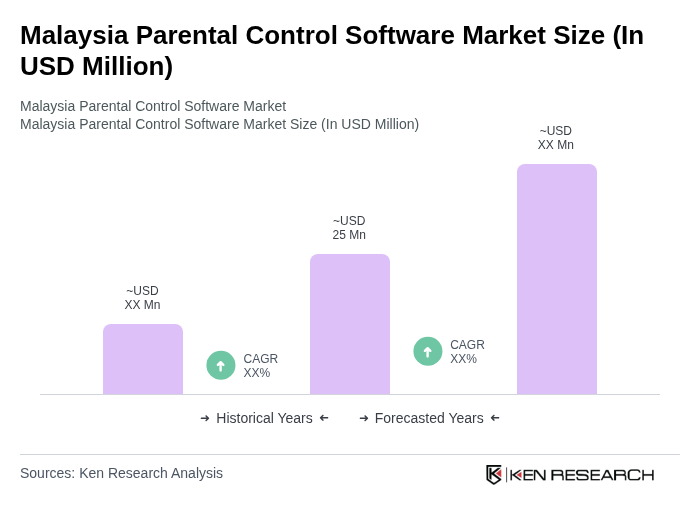
- The Malaysia Parental Control Software Market is valued at USD 25 million, based on a five-year historical analysis. This growth is primarily driven by increasing concerns over children's online safety, the rise in internet penetration, the growing adoption of smart devices among families, and the expansion of digital wellbeing initiatives. The demand for effective parental control solutions has surged as parents seek to monitor and manage their children's digital activities.
- Key cities dominating this market include Kuala Lumpur, Penang, and Johor Bahru. These urban centers have a high concentration of tech-savvy families and educational institutions, which contribute to the demand for parental control software. The presence of numerous tech companies and startups in these regions also fosters innovation and accessibility to advanced parental control solutions.
- The Child Act 2001, issued by the Parliament of Malaysia, protects children under 18 from harm, including online exploitation. This binding legislation requires service providers to implement safeguards against child abuse material, mandates reporting of online threats exceeding specified thresholds, and establishes licensing standards for digital platforms to ensure child safety compliance.
Malaysia Parental Control Software Market Segmentation
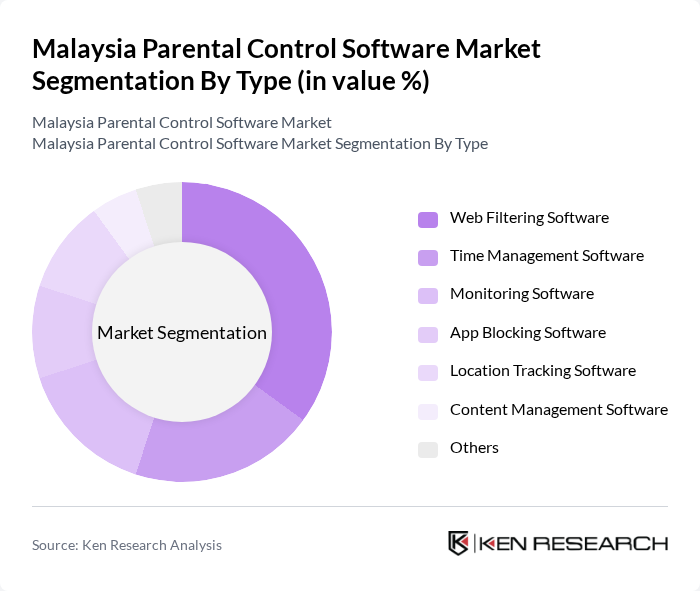
By Type:The parental control software market is segmented into various types, including web filtering software, time management software, monitoring software, app blocking software, location tracking software, content management software, and others. Among these, web filtering software is currently the most dominant segment, as it allows parents to restrict access to inappropriate content and ensure a safer online environment for their children. The increasing awareness of online dangers and the need for effective content management are driving the demand for this type of software.
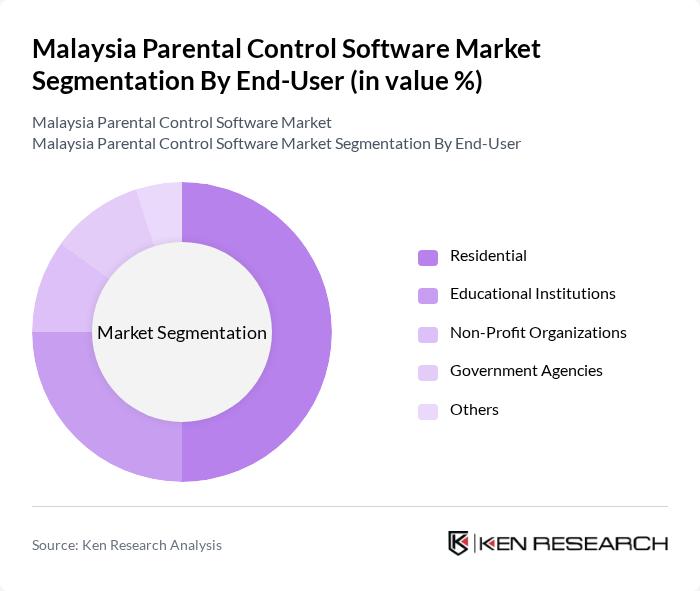
By End-User:The market is also segmented by end-user, which includes residential users, educational institutions, non-profit organizations, government agencies, and others. The residential segment is the leading end-user category, driven by the increasing number of families seeking to protect their children from online risks. The growing trend of remote learning and digital engagement among children has further amplified the need for parental control solutions in households.
Malaysia Parental Control Software Market Competitive Landscape
The Malaysia Parental Control Software Market is characterized by a dynamic mix of regional and international players. Leading participants such as Kaspersky Lab, NortonLifeLock, Qustodio, Net Nanny, FamilyTime, Bark Technologies, McAfee, Bitdefender, ESET, FamiSafe, Norton Family, KidLogger, OurPact, Screen Time Labs, Safe Lagoon contribute to innovation, geographic expansion, and service delivery in this space.
Malaysia Parental Control Software Market Industry Analysis
Growth Drivers
- Increasing Internet Penetration:Malaysia's internet penetration rate reached approximately 97.4%, with over 30 million users accessing the web. This growth is driven by affordable mobile data plans and widespread smartphone adoption, which is projected to increase further in future. As more families connect online, the demand for parental control software rises, enabling parents to monitor and manage their children's online activities effectively, ensuring a safer digital environment.
- Rising Concerns Over Online Safety:A survey conducted indicated that 78% of Malaysian parents expressed concerns about their children's online safety, particularly regarding exposure to inappropriate content and cyberbullying. This heightened awareness has led to an increased demand for parental control solutions, as parents seek tools to protect their children from potential online threats. The growing emphasis on digital safety is expected to drive market growth significantly in the coming years.
- Growth in Mobile Device Usage Among Children:As of now, approximately 60% of Malaysian children aged 6-12 own a smartphone, a figure that is anticipated to rise in future. This surge in mobile device usage among children has prompted parents to seek effective parental control software to monitor app usage and screen time. The increasing reliance on mobile devices for education and entertainment further fuels the demand for comprehensive monitoring solutions tailored for young users.
Market Challenges
- High Competition Among Providers:The Malaysian parental control software market is characterized by intense competition, with over 20 established providers vying for market share. This saturation leads to price wars and challenges in differentiating products. As companies strive to innovate and capture consumer attention, maintaining profitability becomes increasingly difficult, potentially stalling growth for smaller players in the market.
- Data Privacy Concerns:With the implementation of the Personal Data Protection Act (PDPA) in Malaysia, concerns regarding data privacy have escalated. Parents are increasingly wary of how their children's data is collected and used by software providers. This skepticism can hinder the adoption of parental control solutions, as families prioritize services that ensure robust data protection and transparency in data handling practices.
Malaysia Parental Control Software Market Future Outlook
The future of the Malaysian parental control software market appears promising, driven by technological advancements and increasing digital engagement among families. As more parents recognize the importance of safeguarding their children's online experiences, the demand for innovative solutions will likely rise. Companies that prioritize user-friendly interfaces and robust security features will be well-positioned to capture market share. Additionally, the integration of AI technologies will enhance the effectiveness of monitoring tools, making them more appealing to tech-savvy parents.
Market Opportunities
- Expansion into Emerging Markets:As internet access improves in rural areas of Malaysia, there is a significant opportunity for parental control software providers to expand their offerings. Targeting these emerging markets can lead to increased user adoption, as families seek solutions to manage their children's online activities effectively in newly connected regions.
- Development of AI-Driven Solutions:The integration of AI technologies into parental control software presents a unique opportunity for innovation. AI can enhance features such as content filtering and behavior analysis, providing parents with more effective tools to monitor their children's online interactions. This technological advancement can differentiate products in a competitive market, attracting more users seeking advanced solutions.
Scope of the Report
| Segment | Sub-Segments |
|---|---|
| By Type | Web Filtering Software Time Management Software Monitoring Software App Blocking Software Location Tracking Software Content Management Software Others |
| By End-User | Residential Educational Institutions Non-Profit Organizations Government Agencies Others |
| By Device Type | Smartphones Tablets Laptops Desktops Smart TVs Others |
| By Distribution Channel | Online Sales Retail Stores Direct Sales Resellers Others |
| By Subscription Model | Monthly Subscription Annual Subscription One-Time Purchase Freemium Model Others |
| By Age Group | Children (0-12 years) Teenagers (13-19 years) Young Adults (20-30 years) Others |
| By Policy Support | Government Initiatives Educational Programs Community Awareness Campaigns Others |
Key Target Audience
Investors and Venture Capitalist Firms
Government and Regulatory Bodies (e.g., Malaysian Communications and Multimedia Commission, Ministry of Education Malaysia)
Manufacturers and Producers
Distributors and Retailers
Telecommunication Companies
Child Protection Organizations
Technology Providers
Financial Institutions
Players Mentioned in the Report:
Kaspersky Lab
NortonLifeLock
Qustodio
Net Nanny
FamilyTime
Bark Technologies
McAfee
Bitdefender
ESET
FamiSafe
Norton Family
KidLogger
OurPact
Screen Time Labs
Safe Lagoon
Table of Contents
Market Assessment Phase
1. Executive Summary and Approach
2. Malaysia Parental Control Software Market Overview
2.1 Key Insights and Strategic Recommendations
2.2 Malaysia Parental Control Software Market Overview
2.3 Definition and Scope
2.4 Evolution of Market Ecosystem
2.5 Timeline of Key Regulatory Milestones
2.6 Value Chain & Stakeholder Mapping
2.7 Business Cycle Analysis
2.8 Policy & Incentive Landscape
3. Malaysia Parental Control Software Market Analysis
3.1 Growth Drivers
3.1.1 Increasing Internet Penetration
3.1.2 Rising Concerns Over Online Safety
3.1.3 Growth in Mobile Device Usage Among Children
3.1.4 Demand for Remote Monitoring Solutions
3.2 Market Challenges
3.2.1 High Competition Among Providers
3.2.2 Rapid Technological Changes
3.2.3 Consumer Awareness and Education Gaps
3.2.4 Data Privacy Concerns
3.3 Market Opportunities
3.3.1 Expansion into Emerging Markets
3.3.2 Development of AI-Driven Solutions
3.3.3 Partnerships with Educational Institutions
3.3.4 Customization and Personalization of Services
3.4 Market Trends
3.4.1 Increased Adoption of Subscription Models
3.4.2 Integration of Parental Control Features in Devices
3.4.3 Focus on User-Friendly Interfaces
3.4.4 Emphasis on Multi-Device Compatibility
3.5 Government Regulation
3.5.1 Implementation of Data Protection Laws
3.5.2 Guidelines for Online Safety Education
3.5.3 Regulations on Digital Content for Minors
3.5.4 Support for Cybersecurity Initiatives
4. SWOT Analysis
5. Stakeholder Analysis
6. Porter's Five Forces Analysis
7. Malaysia Parental Control Software Market Market Size, 2019-2024
7.1 By Value
7.2 By Volume
7.3 By Average Selling Price
8. Malaysia Parental Control Software Market Segmentation
8.1 By Type
8.1.1 Web Filtering Software
8.1.2 Time Management Software
8.1.3 Monitoring Software
8.1.4 App Blocking Software
8.1.5 Location Tracking Software
8.1.6 Content Management Software
8.1.7 Others
8.2 By End-User
8.2.1 Residential
8.2.2 Educational Institutions
8.2.3 Non-Profit Organizations
8.2.4 Government Agencies
8.2.5 Others
8.3 By Device Type
8.3.1 Smartphones
8.3.2 Tablets
8.3.3 Laptops
8.3.4 Desktops
8.3.5 Smart TVs
8.3.6 Others
8.4 By Distribution Channel
8.4.1 Online Sales
8.4.2 Retail Stores
8.4.3 Direct Sales
8.4.4 Resellers
8.4.5 Others
8.5 By Subscription Model
8.5.1 Monthly Subscription
8.5.2 Annual Subscription
8.5.3 One-Time Purchase
8.5.4 Freemium Model
8.5.5 Others
8.6 By Age Group
8.6.1 Children (0-12 years)
8.6.2 Teenagers (13-19 years)
8.6.3 Young Adults (20-30 years)
8.6.4 Others
8.7 By Policy Support
8.7.1 Government Initiatives
8.7.2 Educational Programs
8.7.3 Community Awareness Campaigns
8.7.4 Others
9. Malaysia Parental Control Software Market Competitive Analysis
9.1 Market Share of Key Players
9.2 Cross Comparison of Key Players
9.2.1 Company Name
9.2.2 Group Size (Large, Medium, or Small as per industry convention)
9.2.3 Customer Acquisition Cost
9.2.4 Customer Retention Rate
9.2.5 Monthly Active Users
9.2.6 Average Revenue Per User (ARPU)
9.2.7 Pricing Strategy
9.2.8 Churn Rate
9.2.9 Market Penetration Rate
9.2.10 Customer Satisfaction Score
9.3 SWOT Analysis of Top Players
9.4 Pricing Analysis
9.5 Detailed Profile of Major Companies
9.5.1 Kaspersky Lab
9.5.2 NortonLifeLock
9.5.3 Qustodio
9.5.4 Net Nanny
9.5.5 FamilyTime
9.5.6 Bark Technologies
9.5.7 McAfee
9.5.8 Bitdefender
9.5.9 ESET
9.5.10 FamiSafe
9.5.11 Norton Family
9.5.12 KidLogger
9.5.13 OurPact
9.5.14 Screen Time Labs
9.5.15 Safe Lagoon
10. Malaysia Parental Control Software Market End-User Analysis
10.1 Procurement Behavior of Key Ministries
10.1.1 Budget Allocation for Digital Safety
10.1.2 Decision-Making Process
10.1.3 Preferred Vendors
10.1.4 Evaluation Criteria
10.2 Corporate Spend on Infrastructure & Energy
10.2.1 Investment in Cybersecurity
10.2.2 Budget for Parental Control Solutions
10.2.3 Trends in Corporate Spending
10.3 Pain Point Analysis by End-User Category
10.3.1 Concerns Over Online Predators
10.3.2 Difficulty in Monitoring Usage
10.3.3 Lack of Awareness
10.3.4 Need for Custom Solutions
10.4 User Readiness for Adoption
10.4.1 Awareness of Available Solutions
10.4.2 Willingness to Pay
10.4.3 Technical Proficiency
10.4.4 Support from Educational Institutions
10.5 Post-Deployment ROI and Use Case Expansion
10.5.1 Measurement of Effectiveness
10.5.2 User Feedback and Adaptation
10.5.3 Expansion of Features
10.5.4 Long-Term Engagement Strategies
11. Malaysia Parental Control Software Market Future Size, 2025-2030
11.1 By Value
11.2 By Volume
11.3 By Average Selling Price
Go-To-Market Strategy Phase
1. Whitespace Analysis + Business Model Canvas
1.1 Market Gaps Identification
1.2 Value Proposition Development
1.3 Revenue Streams
1.4 Key Partnerships
1.5 Customer Segments
1.6 Cost Structure
1.7 Channels
2. Marketing and Positioning Recommendations
2.1 Branding Strategies
2.2 Product USPs
3. Distribution Plan
3.1 Urban Retail vs Rural NGO Tie-Ups
4. Channel & Pricing Gaps
4.1 Underserved Routes
4.2 Pricing Bands
5. Unmet Demand & Latent Needs
5.1 Category Gaps
5.2 Consumer Segments
6. Customer Relationship
6.1 Loyalty Programs
6.2 After-Sales Service
7. Value Proposition
7.1 Sustainability
7.2 Integrated Supply Chains
8. Key Activities
8.1 Regulatory Compliance
8.2 Branding
8.3 Distribution Setup
9. Entry Strategy Evaluation
9.1 Domestic Market Entry Strategy
9.1.1 Product Mix
9.1.2 Pricing Band
9.1.3 Packaging
9.2 Export Entry Strategy
9.2.1 Target Countries
9.2.2 Compliance Roadmap
10. Entry Mode Assessment
10.1 JV
10.2 Greenfield
10.3 M&A
10.4 Distributor Model
11. Capital and Timeline Estimation
11.1 Capital Requirements
11.2 Timelines
12. Control vs Risk Trade-Off
12.1 Ownership vs Partnerships
13. Profitability Outlook
13.1 Breakeven Analysis
13.2 Long-Term Sustainability
14. Potential Partner List
14.1 Distributors
14.2 JVs
14.3 Acquisition Targets
15. Execution Roadmap
15.1 Phased Plan for Market Entry
15.1.1 Market Setup
15.1.2 Market Entry
15.1.3 Growth Acceleration
15.1.4 Scale & Stabilize
15.2 Key Activities and Milestones
15.2.1 Milestone Planning
15.2.2 Activity Tracking
Research Methodology
Phase 1: Approach1
Desk Research
- Analysis of existing market reports and white papers on parental control software in Malaysia
- Review of government publications and regulations related to digital safety and child protection
- Examination of online forums, blogs, and consumer reviews to gauge user sentiment and preferences
Primary Research
- Interviews with software developers specializing in parental control solutions
- Surveys targeting parents to understand their needs and concerns regarding digital monitoring
- Focus groups with educators and child psychologists to discuss the impact of parental control software
Validation & Triangulation
- Cross-validation of findings through multiple data sources, including industry reports and expert opinions
- Triangulation of qualitative insights from interviews with quantitative data from surveys
- Sanity checks conducted through expert panel reviews to ensure data reliability
Phase 2: Market Size Estimation1
Top-down Assessment
- Estimation of market size based on national internet usage statistics and demographic data
- Segmentation of the market by software type, including mobile apps and desktop solutions
- Incorporation of trends in digital parenting and increasing screen time among children
Bottom-up Modeling
- Collection of sales data from leading parental control software providers in Malaysia
- Estimation of average pricing models based on subscription and one-time purchase options
- Volume estimates based on user adoption rates and market penetration strategies
Forecasting & Scenario Analysis
- Multi-factor regression analysis incorporating factors such as internet penetration and smartphone usage
- Scenario planning based on potential regulatory changes and shifts in consumer behavior
- Development of baseline, optimistic, and pessimistic forecasts through 2028
Phase 3: CATI Sample Composition1
| Scope Item/Segment | Sample Size | Target Respondent Profiles |
|---|---|---|
| Parental Control Software Users | 120 | Parents of children aged 5-18 |
| Educators and School Administrators | 100 | Teachers, School Counselors, IT Coordinators |
| Child Psychologists and Counselors | 80 | Child Development Specialists, Family Therapists |
| Software Developers in EdTech | 70 | Product Managers, Software Engineers |
| Consumer Technology Advocates | 60 | Tech Bloggers, Digital Safety Advocates |
Frequently Asked Questions
What is the current value of the Malaysia Parental Control Software Market?
The Malaysia Parental Control Software Market is valued at approximately USD 25 million, reflecting a growing demand for solutions that help parents monitor and manage their children's online activities amidst rising internet penetration and digital safety concerns.
What factors are driving the growth of parental control software in Malaysia?
Which cities in Malaysia are leading in the parental control software market?
What types of parental control software are available in Malaysia?
Other Regional/Country Reports
Other Adjacent Reports
South Africa Internet Security Market
Qatar Digital Wellbeing Market
Thailand Child Safety Technology Market
Middle East mobile device management market report Size, Share, Growth Drivers, Trends, Opportunities & Forecast 2025–2030South Africa Web Filtering Software Market
Germany Educational Technology Market
Kuwait Content Management Software Market Size, Share, Growth Drivers, Trends, Opportunities & Forecast 2025–2030Malaysia Location Tracking Market
Kuwait Data Privacy Solutions Market
Why Buy From Us?

What makes us stand out is that our consultants follow Robust, Refine and Result (RRR) methodology. Robust for clear definitions, approaches and sanity checking, Refine for differentiating respondents' facts and opinions, and Result for presenting data with story.

We have set a benchmark in the industry by offering our clients with syndicated and customized market research reports featuring coverage of entire market as well as meticulous research and analyst insights.

While we don't replace traditional research, we flip the method upside down. Our dual approach of Top Bottom & Bottom Top ensures quality deliverable by not just verifying company fundamentals but also looking at the sector and macroeconomic factors.

With one step in the future, our research team constantly tries to show you the bigger picture. We help with some of the tough questions you may encounter along the way: How is the industry positioned? Best marketing channel? KPI's of competitors? By aligning every element, we help maximize success.

Our report gives you instant access to the answers and sources that other companies might choose to hide. We elaborate each steps of research methodology we have used and showcase you the sample size to earn your trust.

If you need any support, we are here! We pride ourselves on universe strength, data quality, and quick, friendly, and professional service.