About the Report
Base Year 2024Malaysia Seeds Market Overview
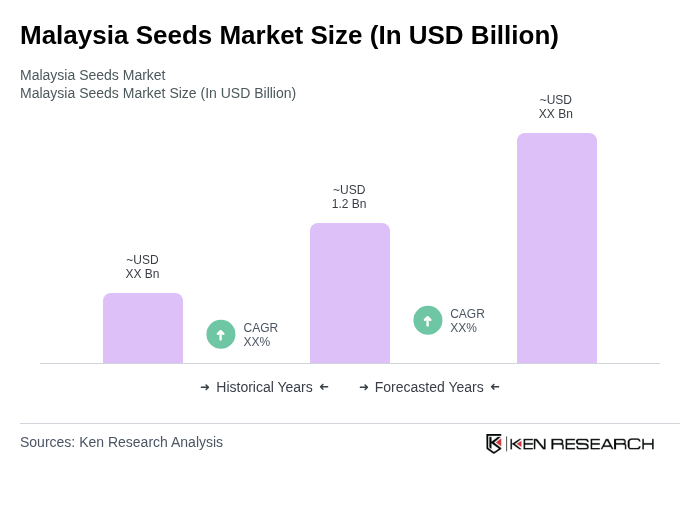
- The Malaysia Seeds Market is valued at USD 1.2 billion, based on a five-year historical analysis. This growth is primarily driven by the increasing demand for high-yield and disease-resistant seed varieties, alongside the expansion of agricultural practices in both commercial and smallholder sectors. The market is also influenced by advancements in biotechnology and seed treatment technologies, which enhance crop productivity and sustainability.
- Key players in this market include Peninsular Malaysia, Sabah, and Sarawak. These regions dominate due to their favorable climatic conditions, fertile soil, and established agricultural infrastructure. The concentration of commercial farming activities and research institutions in these areas further supports the growth of the seeds market, making them pivotal in meeting the increasing food demand.
- In 2023, the Malaysian government implemented the National Agro-Food Policy, which aims to enhance food security and promote sustainable agricultural practices. This policy includes initiatives to support seed research and development, encouraging the use of certified seeds among farmers to improve crop yields and ensure food safety.
Malaysia Seeds Market Segmentation
By Type:The seeds market can be segmented into various types, including vegetable seeds, fruit seeds, flower seeds, cereal seeds, oilseed varieties, legume seeds, and others. Each of these subsegments caters to different agricultural needs and consumer preferences, with specific varieties being favored based on regional agricultural practices and market demand.
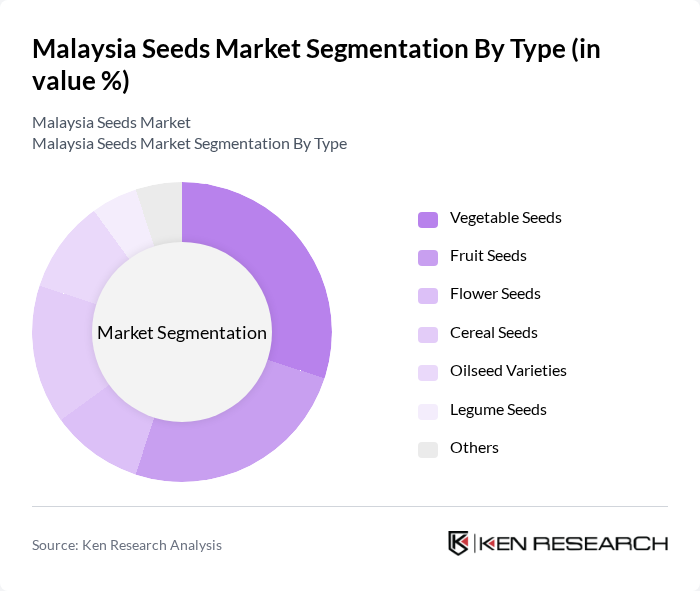
The vegetable seeds segment is currently dominating the market due to the rising consumer preference for fresh produce and the increasing trend of home gardening. This segment benefits from innovations in hybrid and genetically modified seeds that offer better yields and pest resistance. Additionally, the growing health consciousness among consumers is driving demand for organic and locally sourced vegetables, further solidifying the position of vegetable seeds in the market.
By End-User:The market can also be segmented based on end-users, which include commercial farmers, smallholder farmers, agricultural cooperatives, research institutions, and others. Each of these segments plays a crucial role in the overall dynamics of the seeds market, with varying needs and purchasing behaviors.
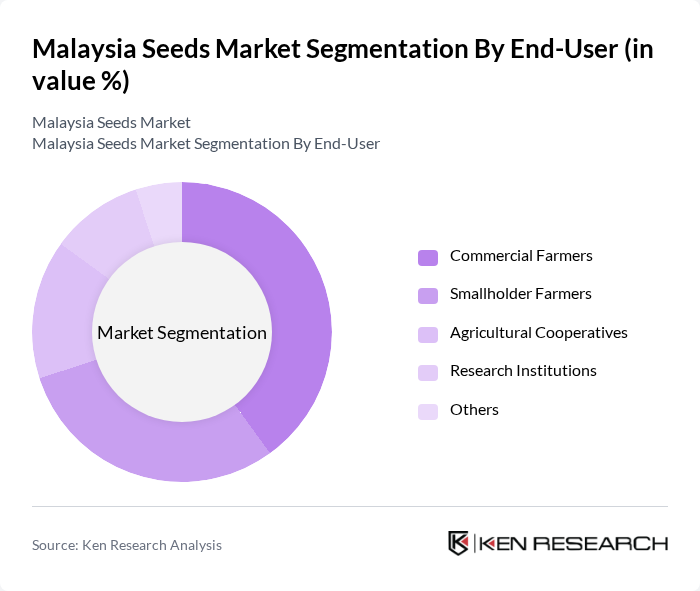
Commercial farmers are the leading end-user segment, accounting for a significant share of the market. This dominance is attributed to their larger scale of operations and the need for high-quality seeds to maximize crop yields. Additionally, commercial farmers are more likely to invest in advanced seed technologies and practices, which enhances their productivity and profitability, thereby driving the demand for various seed types.
Malaysia Seeds Market Competitive Landscape
The Malaysia Seeds Market is characterized by a dynamic mix of regional and international players. Leading participants such as Syngenta Malaysia, Bayer Crop Science, DuPont Pioneer, Limagrain, East-West Seed, BASF, Mahindra Agribusiness, SeedAsia, AgriLife, Green World Genetics, KWS SAAT SE, Rijk Zwaan, Sakata Seed Corporation, Takii Seed, Seminis contribute to innovation, geographic expansion, and service delivery in this space.
Malaysia Seeds Market Industry Analysis
Growth Drivers
- Increasing Demand for High-Yield Seeds:The Malaysian seeds market is experiencing a surge in demand for high-yield seeds, driven by the need to enhance agricultural productivity. In future, the average yield of rice in Malaysia is expected to be approximately 4.5 tons per hectare, with high-yield varieties contributing significantly to this figure. The government aims to increase overall agricultural output by 20% in future, further emphasizing the importance of high-yield seeds in achieving food security and economic stability.
- Government Initiatives Promoting Agricultural Innovation:The Malaysian government has allocated RM 1.5 billion (approximately USD 360 million) for agricultural innovation initiatives in future. This funding supports research and development in seed technology, aiming to improve crop resilience and yield. Additionally, programs like the National Agro-Food Policy 2.0 encourage the adoption of innovative seed varieties, which are crucial for meeting the growing food demand projected to reach 40 million tons in future.
- Rising Awareness of Sustainable Farming Practices:There is a growing awareness among Malaysian farmers regarding sustainable farming practices, with over 60% of farmers now adopting eco-friendly methods. This shift is supported by the government’s commitment to sustainable agriculture, which includes a target of increasing organic farming land to 10% of total agricultural land in future. The demand for seeds that support sustainable practices is expected to rise, aligning with global trends towards environmentally responsible agriculture.
Market Challenges
- Stringent Regulatory Requirements:The Malaysian seeds market faces significant challenges due to stringent regulatory requirements. The Seed Act 2004 mandates rigorous testing and certification processes, which can take up to 18 months. This lengthy approval process can hinder the timely introduction of new seed varieties, limiting innovation and competitiveness in the market. Compliance costs can also be burdensome for smaller seed companies, affecting their market participation.
- Competition from Imported Seeds:The Malaysian seeds market is increasingly challenged by competition from imported seeds, which accounted for 35% of the total seed market in future. Imported seeds often come from countries with advanced agricultural technologies, offering higher yields and better disease resistance. This competition pressures local seed producers to innovate and improve their offerings, as they strive to maintain market share against well-established international brands.
Malaysia Seeds Market Future Outlook
The future of the Malaysian seeds market appears promising, driven by technological advancements and a focus on sustainability. As the government continues to invest in agricultural innovation, the development of climate-resilient seed varieties is expected to gain momentum. Additionally, the increasing adoption of precision agriculture techniques will likely enhance productivity and efficiency. With a growing emphasis on local sourcing, the market is poised for significant transformation, aligning with global trends towards sustainable and responsible farming practices.
Market Opportunities
- Development of Genetically Modified Seeds:The development of genetically modified (GM) seeds presents a significant opportunity for the Malaysian seeds market. With the potential to increase crop yields by up to 30%, GM seeds can address food security challenges. The government’s support for biotechnology research, with an investment of RM 500 million (approximately USD 120 million) in future, is expected to accelerate the adoption of GM technology in agriculture.
- Growth in Organic Farming Sector:The organic farming sector in Malaysia is projected to grow at a rate of 15% annually, driven by rising consumer demand for organic produce. This trend creates opportunities for seed companies to develop and market organic seed varieties. The government’s goal to increase organic farmland to 10% in future further supports this growth, providing a favorable environment for organic seed producers to thrive.
Scope of the Report
| Segment | Sub-Segments |
|---|---|
| By Type | Vegetable Seeds Fruit Seeds Flower Seeds Cereal Seeds Oilseed Varieties Legume Seeds Others |
| By End-User | Commercial Farmers Smallholder Farmers Agricultural Cooperatives Research Institutions Others |
| By Region | Peninsular Malaysia Sabah Sarawak Others |
| By Application | Crop Production Horticulture Landscaping Research and Development Others |
| By Distribution Channel | Direct Sales Retail Outlets Online Platforms Agricultural Shows and Expos Others |
| By Seed Treatment Method | Chemical Treatment Biological Treatment Physical Treatment Others |
| By Certification Type | Certified Seeds Non-Certified Seeds Organic Seeds Others |
Key Target Audience
Investors and Venture Capitalist Firms
Government and Regulatory Bodies (e.g., Ministry of Agriculture and Food Security, Department of Agriculture Malaysia)
Seed Manufacturers and Producers
Distributors and Retailers
Agri-tech Companies
Industry Associations (e.g., Malaysian Seed Association)
Financial Institutions
Exporters and Importers of Seeds
Players Mentioned in the Report:
Syngenta Malaysia
Bayer Crop Science
DuPont Pioneer
Limagrain
East-West Seed
BASF
Mahindra Agribusiness
SeedAsia
AgriLife
Green World Genetics
KWS SAAT SE
Rijk Zwaan
Sakata Seed Corporation
Takii Seed
Seminis
Table of Contents
Market Assessment Phase
1. Executive Summary and Approach
2. Malaysia Seeds Market Overview
2.1 Key Insights and Strategic Recommendations
2.2 Malaysia Seeds Market Overview
2.3 Definition and Scope
2.4 Evolution of Market Ecosystem
2.5 Timeline of Key Regulatory Milestones
2.6 Value Chain & Stakeholder Mapping
2.7 Business Cycle Analysis
2.8 Policy & Incentive Landscape
3. Malaysia Seeds Market Analysis
3.1 Growth Drivers
3.1.1 Increasing demand for high-yield seeds
3.1.2 Government initiatives promoting agricultural innovation
3.1.3 Rising awareness of sustainable farming practices
3.1.4 Expansion of export markets for Malaysian seeds
3.2 Market Challenges
3.2.1 Stringent regulatory requirements
3.2.2 Competition from imported seeds
3.2.3 Climate change impacts on agriculture
3.2.4 Limited access to advanced agricultural technology
3.3 Market Opportunities
3.3.1 Development of genetically modified seeds
3.3.2 Growth in organic farming sector
3.3.3 Investment in agricultural research and development
3.3.4 Collaboration with international seed companies
3.4 Market Trends
3.4.1 Shift towards precision agriculture
3.4.2 Increasing use of digital platforms for seed distribution
3.4.3 Focus on climate-resilient seed varieties
3.4.4 Rise in consumer preference for locally sourced seeds
3.5 Government Regulation
3.5.1 Seed certification and quality control regulations
3.5.2 Import/export regulations for seeds
3.5.3 Intellectual property rights for seed varieties
3.5.4 Subsidies for local seed production
4. SWOT Analysis
5. Stakeholder Analysis
6. Porter's Five Forces Analysis
7. Malaysia Seeds Market Market Size, 2019-2024
7.1 By Value
7.2 By Volume
7.3 By Average Selling Price
8. Malaysia Seeds Market Segmentation
8.1 By Type
8.1.1 Vegetable Seeds
8.1.2 Fruit Seeds
8.1.3 Flower Seeds
8.1.4 Cereal Seeds
8.1.5 Oilseed Varieties
8.1.6 Legume Seeds
8.1.7 Others
8.2 By End-User
8.2.1 Commercial Farmers
8.2.2 Smallholder Farmers
8.2.3 Agricultural Cooperatives
8.2.4 Research Institutions
8.2.5 Others
8.3 By Region
8.3.1 Peninsular Malaysia
8.3.2 Sabah
8.3.3 Sarawak
8.3.4 Others
8.4 By Application
8.4.1 Crop Production
8.4.2 Horticulture
8.4.3 Landscaping
8.4.4 Research and Development
8.4.5 Others
8.5 By Distribution Channel
8.5.1 Direct Sales
8.5.2 Retail Outlets
8.5.3 Online Platforms
8.5.4 Agricultural Shows and Expos
8.5.5 Others
8.6 By Seed Treatment Method
8.6.1 Chemical Treatment
8.6.2 Biological Treatment
8.6.3 Physical Treatment
8.6.4 Others
8.7 By Certification Type
8.7.1 Certified Seeds
8.7.2 Non-Certified Seeds
8.7.3 Organic Seeds
8.7.4 Others
9. Malaysia Seeds Market Competitive Analysis
9.1 Market Share of Key Players
9.2 Cross Comparison of Key Players
9.2.1 Company Name
9.2.2 Group Size (Large, Medium, or Small as per industry convention)
9.2.3 Revenue Growth Rate
9.2.4 Market Penetration Rate
9.2.5 Customer Retention Rate
9.2.6 Product Diversification Index
9.2.7 Pricing Strategy
9.2.8 Distribution Efficiency
9.2.9 Brand Recognition Score
9.2.10 Innovation Rate
9.3 SWOT Analysis of Top Players
9.4 Pricing Analysis
9.5 Detailed Profile of Major Companies
9.5.1 Syngenta Malaysia
9.5.2 Bayer Crop Science
9.5.3 DuPont Pioneer
9.5.4 Limagrain
9.5.5 East-West Seed
9.5.6 BASF
9.5.7 Mahindra Agribusiness
9.5.8 SeedAsia
9.5.9 AgriLife
9.5.10 Green World Genetics
9.5.11 KWS SAAT SE
9.5.12 Rijk Zwaan
9.5.13 Sakata Seed Corporation
9.5.14 Takii Seed
9.5.15 Seminis
10. Malaysia Seeds Market End-User Analysis
10.1 Procurement Behavior of Key Ministries
10.1.1 Ministry of Agriculture and Food Security
10.1.2 Ministry of Finance
10.1.3 Ministry of Environment and Water
10.1.4 Others
10.2 Corporate Spend on Infrastructure & Energy
10.2.1 Investment in Agricultural Infrastructure
10.2.2 Funding for Research and Development
10.2.3 Expenditure on Sustainable Practices
10.2.4 Others
10.3 Pain Point Analysis by End-User Category
10.3.1 Commercial Farmers
10.3.2 Smallholder Farmers
10.3.3 Agricultural Cooperatives
10.3.4 Others
10.4 User Readiness for Adoption
10.4.1 Awareness of New Seed Varieties
10.4.2 Training and Support Needs
10.4.3 Financial Readiness
10.4.4 Others
10.5 Post-Deployment ROI and Use Case Expansion
10.5.1 Yield Improvement Metrics
10.5.2 Cost Savings Analysis
10.5.3 Market Expansion Opportunities
10.5.4 Others
11. Malaysia Seeds Market Future Size, 2025-2030
11.1 By Value
11.2 By Volume
11.3 By Average Selling Price
Go-To-Market Strategy Phase
1. Whitespace Analysis + Business Model Canvas
1.1 Market Gaps Identification
1.2 Business Model Development
2. Marketing and Positioning Recommendations
2.1 Branding Strategies
2.2 Product USPs
3. Distribution Plan
3.1 Urban Retail vs Rural NGO Tie-ups
4. Channel & Pricing Gaps
4.1 Underserved Routes
4.2 Pricing Bands
5. Unmet Demand & Latent Needs
5.1 Category Gaps
5.2 Consumer Segments
6. Customer Relationship
6.1 Loyalty Programs
6.2 After-sales Service
7. Value Proposition
7.1 Sustainability
7.2 Integrated Supply Chains
8. Key Activities
8.1 Regulatory Compliance
8.2 Branding
8.3 Distribution Setup
9. Entry Strategy Evaluation
9.1 Domestic Market Entry Strategy
9.1.1 Product Mix
9.1.2 Pricing Band
9.1.3 Packaging
9.2 Export Entry Strategy
9.2.1 Target Countries
9.2.2 Compliance Roadmap
10. Entry Mode Assessment
10.1 JV
10.2 Greenfield
10.3 M&A
10.4 Distributor Model
11. Capital and Timeline Estimation
11.1 Capital Requirements
11.2 Timelines
12. Control vs Risk Trade-Off
12.1 Ownership vs Partnerships
13. Profitability Outlook
13.1 Breakeven Analysis
13.2 Long-term Sustainability
14. Potential Partner List
14.1 Distributors
14.2 JVs
14.3 Acquisition Targets
15. Execution Roadmap
15.1 Phased Plan for Market Entry
15.1.1 Market Setup
15.1.2 Market Entry
15.1.3 Growth Acceleration
15.1.4 Scale & Stabilize
15.2 Key Activities and Milestones
15.2.1 Activity Timeline
15.2.2 Milestone Tracking
Research Methodology
Phase 1: Approach1
Desk Research
- Analysis of agricultural reports from the Malaysian Ministry of Agriculture and Food Security
- Review of market studies published by local agricultural associations and research institutions
- Examination of trade statistics and import/export data from the Department of Statistics Malaysia
Primary Research
- Interviews with seed distributors and retailers across various Malaysian states
- Surveys conducted with farmers to understand seed preferences and purchasing behavior
- Focus group discussions with agricultural experts and agronomists on seed innovation trends
Validation & Triangulation
- Cross-validation of findings through multiple data sources including government reports and industry publications
- Triangulation of qualitative insights from interviews with quantitative data from surveys
- Sanity checks performed by consulting with a panel of agricultural economists
Phase 2: Market Size Estimation1
Top-down Assessment
- Estimation of total market size based on national agricultural output and seed usage rates
- Segmentation of the market by crop type, including paddy, vegetables, and fruits
- Incorporation of government initiatives promoting local seed production and usage
Bottom-up Modeling
- Collection of sales data from major seed companies operating in Malaysia
- Estimation of average seed prices across different crop categories
- Volume calculations based on farmer adoption rates and area under cultivation
Forecasting & Scenario Analysis
- Utilization of historical growth rates to project future market trends through 2030
- Scenario modeling based on potential impacts of climate change on crop yields
- Analysis of regulatory changes affecting seed importation and local production
Phase 3: CATI Sample Composition1
| Scope Item/Segment | Sample Size | Target Respondent Profiles |
|---|---|---|
| Vegetable Seed Retailers | 100 | Store Managers, Procurement Officers |
| Paddy Seed Distributors | 80 | Distribution Managers, Sales Representatives |
| Farmers in High-Value Crops | 150 | Smallholder Farmers, Commercial Growers |
| Seed Research Institutions | 60 | Research Scientists, Agronomists |
| Agricultural Extension Officers | 70 | Extension Agents, Field Officers |
Frequently Asked Questions
What is the current value of the Malaysia Seeds Market?
The Malaysia Seeds Market is valued at approximately USD 1.2 billion, reflecting a significant growth driven by the demand for high-yield and disease-resistant seed varieties, as well as advancements in agricultural practices and biotechnology.
What are the main drivers of growth in the Malaysia Seeds Market?
Which regions in Malaysia dominate the seeds market?
What types of seeds are most popular in Malaysia?
Other Regional/Country Reports
Other Adjacent Reports
Philippines Pesticide Market
Italy Agricultural Machinery Market (2022-2027)Thailand Irrigation Systems MarketNorth America Precision Agriculture Market Outlook to 2030: Size, Share, Growth and TrendsSouth Korea Organic Farming Market
Asia Pacific Seed Treatment Market Outlook to 2030: Size, Share, Growth and TrendsQatar Plant Nutrition Market
Why Buy From Us?

What makes us stand out is that our consultants follow Robust, Refine and Result (RRR) methodology. Robust for clear definitions, approaches and sanity checking, Refine for differentiating respondents' facts and opinions, and Result for presenting data with story.

We have set a benchmark in the industry by offering our clients with syndicated and customized market research reports featuring coverage of entire market as well as meticulous research and analyst insights.

While we don't replace traditional research, we flip the method upside down. Our dual approach of Top Bottom & Bottom Top ensures quality deliverable by not just verifying company fundamentals but also looking at the sector and macroeconomic factors.

With one step in the future, our research team constantly tries to show you the bigger picture. We help with some of the tough questions you may encounter along the way: How is the industry positioned? Best marketing channel? KPI's of competitors? By aligning every element, we help maximize success.

Our report gives you instant access to the answers and sources that other companies might choose to hide. We elaborate each steps of research methodology we have used and showcase you the sample size to earn your trust.

If you need any support, we are here! We pride ourselves on universe strength, data quality, and quick, friendly, and professional service.