About the Report
Base Year 2024Philippines Seeds Market Overview
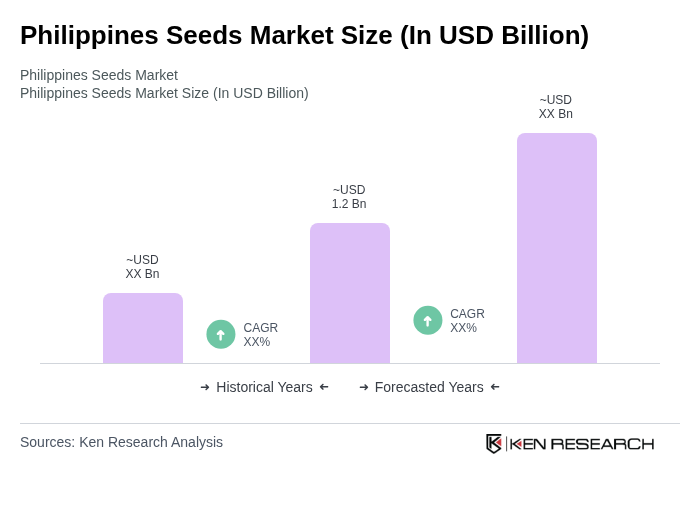
- The Philippines Seeds Market is valued at USD 1.2 billion, based on a five-year historical analysis. This growth is primarily driven by the increasing demand for high-yield and disease-resistant seeds, as well as the government's push for agricultural modernization and food security. The market has seen a significant rise in the adoption of hybrid and genetically modified seeds, which are crucial for enhancing crop productivity and sustainability.
- Key regions dominating the market include Luzon, Visayas, and Mindanao. Luzon, being the most populous island, has a high concentration of agricultural activities and infrastructure, making it a hub for seed distribution. Visayas and Mindanao also contribute significantly due to their diverse agricultural landscapes and favorable climatic conditions, which support various crop types.
- In 2023, the Philippine government implemented the Seed Industry Development Act, which aims to promote the development and commercialization of high-quality seeds. This regulation encourages research and development in seed technology, ensuring that farmers have access to improved seed varieties that can withstand climate change and enhance food production.
Philippines Seeds Market Segmentation
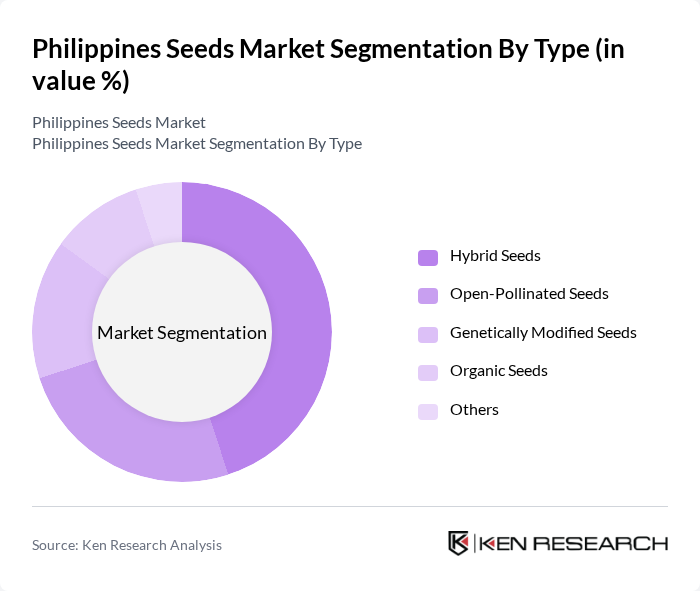
By Type:The market is segmented into various types of seeds, including hybrid seeds, open-pollinated seeds, genetically modified seeds, organic seeds, and others. Hybrid seeds are gaining traction due to their higher yields and resistance to pests and diseases. Open-pollinated seeds are preferred by traditional farmers for their cost-effectiveness and ability to save seeds for future planting. Genetically modified seeds are increasingly adopted for their enhanced traits, while organic seeds cater to the growing demand for sustainable farming practices.
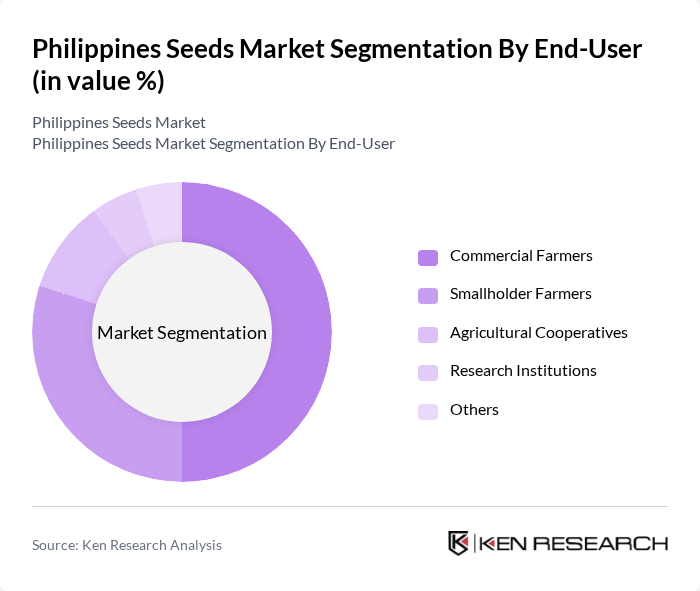
By End-User:The end-user segmentation includes commercial farmers, smallholder farmers, agricultural cooperatives, research institutions, and others. Commercial farmers dominate the market due to their larger scale of operations and ability to invest in advanced seed technologies. Smallholder farmers, while significant, often rely on traditional seed varieties. Agricultural cooperatives play a crucial role in seed distribution and education, while research institutions contribute to the development of new seed varieties.
Philippines Seeds Market Competitive Landscape
The Philippines Seeds Market is characterized by a dynamic mix of regional and international players. Leading participants such as East-West Seed Company, Syngenta Philippines, Inc., Pioneer Hi-Bred Philippines, Inc., Bayer CropScience Philippines, Monsanto Philippines, Inc., SeedWorks Philippines, Inc., Agrinurture, Inc., International Rice Research Institute (IRRI), Philippine Seed Industry Association (PSIA), All-Asia Seed Company, Bioseed Research Philippines, Inc., Greenfields Agricultural Supply, Davao Seed Company, Horticultural Enterprises, Inc., Philippine Agricultural Development and Commercial Corporation contribute to innovation, geographic expansion, and service delivery in this space.
Philippines Seeds Market Industry Analysis
Growth Drivers
- Increasing Demand for High-Yield Seeds:The Philippines has seen a significant rise in the demand for high-yield seeds, driven by the need to enhance food security. In future, the agricultural sector is projected to require approximately 1.65 million tons of high-yield seeds, reflecting a 10% increase from the previous year. This demand is fueled by a growing population, which is expected to reach 120 million, necessitating improved agricultural productivity to meet food needs (Philippine Statistics Authority).
- Government Support for Agricultural Innovation:The Philippine government has allocated around PHP 5.5 billion (approximately USD 110 million) for agricultural innovation initiatives in future. This funding aims to support research and development in seed technology, enhancing the availability of improved seed varieties. Such initiatives are crucial as they align with the government's goal to increase agricultural productivity by 20% over the next five years, thereby fostering a more resilient agricultural sector (Department of Agriculture).
- Rising Awareness of Sustainable Farming Practices:There is a growing trend among Filipino farmers towards sustainable farming practices, with an estimated 35% of farmers adopting organic methods in future. This shift is supported by the increasing consumer preference for sustainably sourced products, which has led to a 20% rise in organic seed demand. The government’s promotion of sustainable agriculture is expected to further enhance the market for eco-friendly seed varieties (Organic Certification Center of the Philippines).
Market Challenges
- Climate Change Impacts on Crop Yields:Climate change poses a significant threat to agricultural productivity in the Philippines, with projections indicating a potential 25% decrease in crop yields in future due to extreme weather events. The country is particularly vulnerable to typhoons and droughts, which disrupt planting seasons and reduce overall agricultural output. This challenge necessitates the development of climate-resilient seed varieties to mitigate adverse effects (Philippine Atmospheric, Geophysical and Astronomical Services Administration).
- Limited Access to Advanced Agricultural Technology:Many farmers in the Philippines face barriers to accessing advanced agricultural technology, with only 30% of farmers utilizing modern farming techniques in future. This limitation hampers productivity and innovation in seed usage. The lack of infrastructure and financial resources further exacerbates this issue, making it difficult for farmers to adopt new technologies that could enhance seed performance and crop yields (World Bank).
Philippines Seeds Market Future Outlook
The Philippines seeds market is poised for significant transformation as it adapts to emerging trends in agricultural practices and technology. With a focus on precision agriculture and the integration of digital platforms for seed distribution, the sector is expected to enhance efficiency and accessibility. Additionally, the increasing consumer preference for locally sourced products will drive demand for native seed varieties, fostering a more sustainable agricultural ecosystem. These trends indicate a promising future for the seeds market, emphasizing innovation and resilience.
Market Opportunities
- Development of Genetically Modified Seeds:The potential for developing genetically modified seeds presents a significant opportunity for the Philippines. With an estimated market value of PHP 2.2 billion (USD 44 million) in future, these seeds can enhance crop resilience and yield, addressing food security challenges effectively. This innovation could lead to increased adoption among farmers seeking higher productivity (Department of Agriculture).
- Investment in Research and Development:Increased investment in research and development is crucial for advancing seed technology in the Philippines. The government and private sector are expected to invest around PHP 3.3 billion (USD 66 million) in R&D initiatives in future. This investment will facilitate the creation of improved seed varieties, enhancing agricultural productivity and sustainability in the long term (Philippine Council for Agriculture, Aquatic and Natural Resources Research and Development).
Scope of the Report
| Segment | Sub-Segments |
|---|---|
| By Type | Hybrid Seeds Open-Pollinated Seeds Genetically Modified Seeds Organic Seeds Others |
| By End-User | Commercial Farmers Smallholder Farmers Agricultural Cooperatives Research Institutions Others |
| By Crop Type | Cereals Vegetables Fruits Pulses Others |
| By Distribution Channel | Direct Sales Retail Outlets Online Platforms Agricultural Shows and Expos Others |
| By Region | Luzon Visayas Mindanao Others |
| By Seed Treatment Method | Chemical Treatment Biological Treatment Physical Treatment Others |
| By Market Segment | Commercial Market Subsistence Market Export Market Others |
Key Target Audience
Investors and Venture Capitalist Firms
Government and Regulatory Bodies (e.g., Department of Agriculture, Bureau of Plant Industry)
Seed Manufacturers and Producers
Distributors and Retailers
Agri-tech Companies
Industry Associations (e.g., Philippine Seed Industry Association)
Financial Institutions
Exporters and Importers of Seeds
Players Mentioned in the Report:
East-West Seed Company
Syngenta Philippines, Inc.
Pioneer Hi-Bred Philippines, Inc.
Bayer CropScience Philippines
Monsanto Philippines, Inc.
SeedWorks Philippines, Inc.
Agrinurture, Inc.
International Rice Research Institute (IRRI)
Philippine Seed Industry Association (PSIA)
All-Asia Seed Company
Bioseed Research Philippines, Inc.
Greenfields Agricultural Supply
Davao Seed Company
Horticultural Enterprises, Inc.
Philippine Agricultural Development and Commercial Corporation
Table of Contents
Market Assessment Phase
1. Executive Summary and Approach
2. Philippines Seeds Market Overview
2.1 Key Insights and Strategic Recommendations
2.2 Philippines Seeds Market Overview
2.3 Definition and Scope
2.4 Evolution of Market Ecosystem
2.5 Timeline of Key Regulatory Milestones
2.6 Value Chain & Stakeholder Mapping
2.7 Business Cycle Analysis
2.8 Policy & Incentive Landscape
3. Philippines Seeds Market Analysis
3.1 Growth Drivers
3.1.1 Increasing demand for high-yield seeds
3.1.2 Government support for agricultural innovation
3.1.3 Rising awareness of sustainable farming practices
3.1.4 Expansion of export markets for Philippine agricultural products
3.2 Market Challenges
3.2.1 Climate change impacts on crop yields
3.2.2 Limited access to advanced agricultural technology
3.2.3 Regulatory hurdles in seed approval processes
3.2.4 Competition from imported seeds
3.3 Market Opportunities
3.3.1 Development of genetically modified seeds
3.3.2 Investment in research and development
3.3.3 Collaboration with local farmers for tailored solutions
3.3.4 Growth in organic farming practices
3.4 Market Trends
3.4.1 Shift towards precision agriculture
3.4.2 Increasing use of digital platforms for seed distribution
3.4.3 Focus on climate-resilient seed varieties
3.4.4 Rise in consumer preference for locally sourced products
3.5 Government Regulation
3.5.1 Seed certification requirements
3.5.2 Intellectual property rights for seed varieties
3.5.3 Import/export regulations for seeds
3.5.4 Subsidies for local seed production
4. SWOT Analysis
5. Stakeholder Analysis
6. Porter's Five Forces Analysis
7. Philippines Seeds Market Market Size, 2019-2024
7.1 By Value
7.2 By Volume
7.3 By Average Selling Price
8. Philippines Seeds Market Segmentation
8.1 By Type
8.1.1 Hybrid Seeds
8.1.2 Open-Pollinated Seeds
8.1.3 Genetically Modified Seeds
8.1.4 Organic Seeds
8.1.5 Others
8.2 By End-User
8.2.1 Commercial Farmers
8.2.2 Smallholder Farmers
8.2.3 Agricultural Cooperatives
8.2.4 Research Institutions
8.2.5 Others
8.3 By Crop Type
8.3.1 Cereals
8.3.2 Vegetables
8.3.3 Fruits
8.3.4 Pulses
8.3.5 Others
8.4 By Distribution Channel
8.4.1 Direct Sales
8.4.2 Retail Outlets
8.4.3 Online Platforms
8.4.4 Agricultural Shows and Expos
8.4.5 Others
8.5 By Region
8.5.1 Luzon
8.5.2 Visayas
8.5.3 Mindanao
8.5.4 Others
8.6 By Seed Treatment Method
8.6.1 Chemical Treatment
8.6.2 Biological Treatment
8.6.3 Physical Treatment
8.6.4 Others
8.7 By Market Segment
8.7.1 Commercial Market
8.7.2 Subsistence Market
8.7.3 Export Market
8.7.4 Others
9. Philippines Seeds Market Competitive Analysis
9.1 Market Share of Key Players
9.2 Cross Comparison of Key Players
9.2.1 Company Name
9.2.2 Group Size (Large, Medium, or Small as per industry convention)
9.2.3 Revenue Growth Rate
9.2.4 Market Penetration Rate
9.2.5 Customer Retention Rate
9.2.6 Pricing Strategy
9.2.7 Product Diversification Index
9.2.8 Distribution Efficiency
9.2.9 Brand Recognition Score
9.2.10 Innovation Index
9.3 SWOT Analysis of Top Players
9.4 Pricing Analysis
9.5 Detailed Profile of Major Companies
9.5.1 East-West Seed Company
9.5.2 Syngenta Philippines, Inc.
9.5.3 Pioneer Hi-Bred Philippines, Inc.
9.5.4 Bayer CropScience Philippines
9.5.5 Monsanto Philippines, Inc.
9.5.6 SeedWorks Philippines, Inc.
9.5.7 Agrinurture, Inc.
9.5.8 International Rice Research Institute (IRRI)
9.5.9 Philippine Seed Industry Association (PSIA)
9.5.10 All-Asia Seed Company
9.5.11 Bioseed Research Philippines, Inc.
9.5.12 Greenfields Agricultural Supply
9.5.13 Davao Seed Company
9.5.14 Horticultural Enterprises, Inc.
9.5.15 Philippine Agricultural Development and Commercial Corporation
10. Philippines Seeds Market End-User Analysis
10.1 Procurement Behavior of Key Ministries
10.1.1 Department of Agriculture
10.1.2 Department of Trade and Industry
10.1.3 Local Government Units
10.1.4 Agricultural Research Institutions
10.2 Corporate Spend on Infrastructure & Energy
10.2.1 Investment in Seed Production Facilities
10.2.2 Funding for Agricultural Research
10.2.3 Expenditure on Sustainable Practices
10.3 Pain Point Analysis by End-User Category
10.3.1 Access to Quality Seeds
10.3.2 Price Volatility of Seeds
10.3.3 Availability of Technical Support
10.4 User Readiness for Adoption
10.4.1 Awareness of New Seed Varieties
10.4.2 Training and Education Needs
10.5 Post-Deployment ROI and Use Case Expansion
10.5.1 Yield Improvement Metrics
10.5.2 Cost Savings Analysis
11. Philippines Seeds Market Future Size, 2025-2030
11.1 By Value
11.2 By Volume
11.3 By Average Selling Price
Go-To-Market Strategy Phase
1. Whitespace Analysis + Business Model Canvas
1.1 Market Gaps Identification
1.2 Business Model Development
2. Marketing and Positioning Recommendations
2.1 Branding Strategies
2.2 Product USPs
3. Distribution Plan
3.1 Urban Retail vs Rural NGO Tie-ups
4. Channel & Pricing Gaps
4.1 Underserved Routes
4.2 Pricing Bands
5. Unmet Demand & Latent Needs
5.1 Category Gaps
5.2 Consumer Segments
6. Customer Relationship
6.1 Loyalty Programs
6.2 After-sales Service
7. Value Proposition
7.1 Sustainability
7.2 Integrated Supply Chains
8. Key Activities
8.1 Regulatory Compliance
8.2 Branding
8.3 Distribution Setup
9. Entry Strategy Evaluation
9.1 Domestic Market Entry Strategy
9.1.1 Product Mix
9.1.2 Pricing Band
9.1.3 Packaging
9.2 Export Entry Strategy
9.2.1 Target Countries
9.2.2 Compliance Roadmap
10. Entry Mode Assessment
10.1 JV
10.2 Greenfield
10.3 M&A
10.4 Distributor Model
11. Capital and Timeline Estimation
11.1 Capital Requirements
11.2 Timelines
12. Control vs Risk Trade-Off
12.1 Ownership vs Partnerships
13. Profitability Outlook
13.1 Breakeven Analysis
13.2 Long-term Sustainability
14. Potential Partner List
14.1 Distributors
14.2 JVs
14.3 Acquisition Targets
15. Execution Roadmap
15.1 Phased Plan for Market Entry
15.1.1 Market Setup
15.1.2 Market Entry
15.1.3 Growth Acceleration
15.1.4 Scale & Stabilize
15.2 Key Activities and Milestones
15.2.1 Activity Timeline
15.2.2 Milestone Tracking
Research Methodology
Phase 1: Approach1
Desk Research
- Analysis of agricultural production statistics from the Philippine Statistics Authority (PSA)
- Review of market reports from industry associations such as the Philippine Seed Industry Association (PSIA)
- Examination of government policies and regulations affecting seed production and distribution
Primary Research
- Interviews with seed producers and distributors to gather insights on market dynamics
- Surveys targeting farmers to understand seed preferences and purchasing behavior
- Focus group discussions with agricultural experts and agronomists to assess market trends
Validation & Triangulation
- Cross-validation of findings with data from agricultural extension services and NGOs
- Triangulation of insights from primary research with secondary data sources
- Sanity checks through expert panel reviews involving agribusiness stakeholders
Phase 2: Market Size Estimation1
Top-down Assessment
- Estimation of total seed market size based on national agricultural output and crop area
- Segmentation of the market by crop type (e.g., rice, corn, vegetables) and seed variety
- Incorporation of growth rates from government agricultural forecasts
Bottom-up Modeling
- Collection of sales data from leading seed companies to establish volume benchmarks
- Analysis of pricing strategies across different seed categories and regions
- Calculation of market size based on volume sold and average selling price
Forecasting & Scenario Analysis
- Multi-factor regression analysis incorporating factors such as climate change and technology adoption
- Scenario modeling based on potential changes in agricultural policies and consumer preferences
- Development of baseline, optimistic, and pessimistic market projections through 2030
Phase 3: CATI Sample Composition1
| Scope Item/Segment | Sample Size | Target Respondent Profiles |
|---|---|---|
| Seed Producers | 100 | Farm Owners, Production Managers |
| Seed Distributors | 80 | Distribution Managers, Sales Representatives |
| Farmers | 150 | Crop Farmers, Agricultural Cooperatives |
| Agricultural Experts | 60 | Agronomists, Extension Workers |
| Government Officials | 50 | Policy Makers, Agricultural Bureau Staff |
Frequently Asked Questions
What is the current value of the Philippines Seeds Market?
The Philippines Seeds Market is valued at approximately USD 1.2 billion, reflecting a significant growth driven by the demand for high-yield and disease-resistant seeds, as well as government initiatives for agricultural modernization and food security.
What types of seeds are popular in the Philippines?
Which regions in the Philippines dominate the seeds market?
What is the Seed Industry Development Act?
Other Regional/Country Reports
Other Adjacent Reports
Thailand Pesticide Market
Italy Agricultural Machinery Market (2022-2027)Thailand Irrigation Systems MarketNorth America Precision Agriculture Market Outlook to 2030: Size, Share, Growth and TrendsFrance Crop Protection Market Outlook to 2030: Size, Share, Growth and TrendsSaudi Arabia biotechnology market Size, Share, Growth Drivers, Trends, Opportunities & Forecast 2025–2030Singapore Organic Farming Market
Indonesia Plant Breeding Market
Why Buy From Us?

What makes us stand out is that our consultants follow Robust, Refine and Result (RRR) methodology. Robust for clear definitions, approaches and sanity checking, Refine for differentiating respondents' facts and opinions, and Result for presenting data with story.

We have set a benchmark in the industry by offering our clients with syndicated and customized market research reports featuring coverage of entire market as well as meticulous research and analyst insights.

While we don't replace traditional research, we flip the method upside down. Our dual approach of Top Bottom & Bottom Top ensures quality deliverable by not just verifying company fundamentals but also looking at the sector and macroeconomic factors.

With one step in the future, our research team constantly tries to show you the bigger picture. We help with some of the tough questions you may encounter along the way: How is the industry positioned? Best marketing channel? KPI's of competitors? By aligning every element, we help maximize success.

Our report gives you instant access to the answers and sources that other companies might choose to hide. We elaborate each steps of research methodology we have used and showcase you the sample size to earn your trust.

If you need any support, we are here! We pride ourselves on universe strength, data quality, and quick, friendly, and professional service.