Middle East mustard market report Size, Share, Growth Drivers, Trends, Opportunities & Forecast 2025–2030

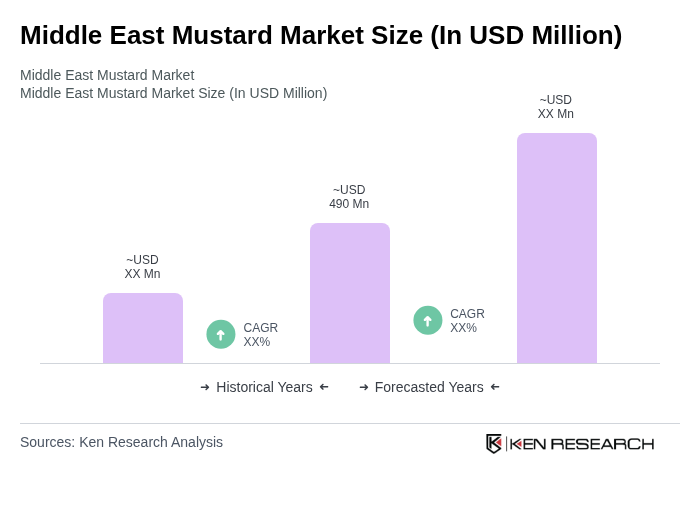
The Middle East Mustard Market, valued at USD 490 million, is growing due to rising demand for natural condiments and health-conscious eating in key regions like UAE and Saudi Arabia.

Region:Middle East

Author(s):Geetanshi

Product Code:KRAC8202

Pages:82

Published On:November 2025
About the Report

Base Year 2024

Middle East Mustard Market Overview

  • The Middle East Mustard Market is valued at USD 490 million, based on a five-year historical analysis. This growth is primarily driven by increasing consumer demand for mustard in culinary applications, coupled with the rising popularity of healthy eating trends. The market has also benefited from the expansion of food processing industries and the growing use of mustard oil in various sectors, particularly in the foodservice and retail segments .
  • Key players in this market include countries like the United Arab Emirates, Saudi Arabia, and Egypt. The UAE leads due to its strategic location as a trade hub and its diverse culinary culture, while Saudi Arabia's large population and increasing food consumption drive significant demand. Egypt's agricultural capacity and local production further enhance its market presence .
  • In 2023, the Saudi Arabian government implemented the National Food Security Strategy, which includes measures to promote the use of locally sourced mustard seeds in food production. This initiative aims to enhance food security and support local farmers, thereby reducing dependency on imports and fostering sustainable agricultural practices.
Middle East Mustard Market Size

Middle East Mustard Market Segmentation

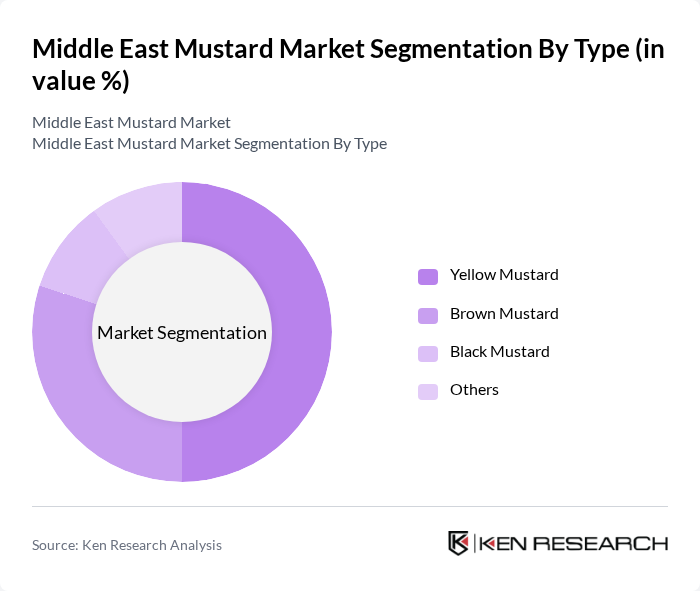
By Type:The mustard market is segmented into various types, including Yellow Mustard, Brown Mustard, Black Mustard, and Others. Yellow Mustard is the most widely consumed type due to its mild flavor and versatility in culinary applications. Brown Mustard is gaining popularity for its robust taste, particularly in gourmet cooking. Black Mustard, while less common, is favored in specific regional cuisines. The "Others" category includes specialty mustards that cater to niche markets.
Middle East Mustard Market segmentation by Type.

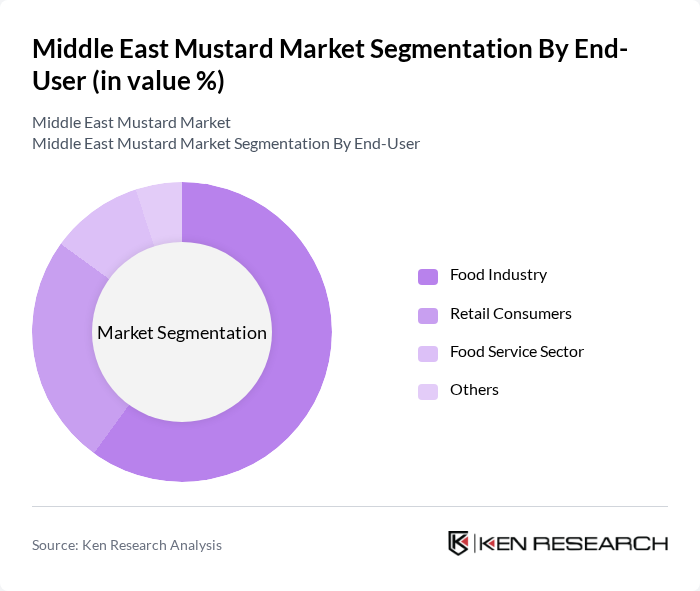
By End-User:The market is segmented by end-users, including the Food Industry, Retail Consumers, Food Service Sector, and Others. The Food Industry dominates the market due to the high demand for mustard in food processing and manufacturing. Retail Consumers are increasingly purchasing mustard for home cooking, while the Food Service Sector, including restaurants and catering services, also contributes significantly to market growth. The "Others" category encompasses various smaller segments.
Middle East Mustard Market segmentation by End-User.

Middle East Mustard Market Competitive Landscape

The Middle East Mustard Market is characterized by a dynamic mix of regional and international players. Leading participants such as Al Watania Agriculture, Al Ghurair Foods, Al Ain Farms, Al Safi Danone, Almarai, Emirates Snack Foods, Al-Fakher Tobacco, Al-Hokair Group, Al-Mansoori Specialized Engineering, Al-Muhaidib Group, Al-Qudra Holding, Al-Rajhi Group, Al-Safi Group, Al-Tamimi Group, Al-Zamil Group contribute to innovation, geographic expansion, and service delivery in this space.

Al Watania Agriculture

1976

Riyadh, Saudi Arabia

Al Ghurair Foods

1976

Dubai, UAE

Al Ain Farms

1981

Abu Dhabi, UAE

Al Safi Danone

1999

Riyadh, Saudi Arabia

Almarai

1977

Riyadh, Saudi Arabia

Company

Establishment Year

Headquarters

Group Size (Large, Medium, or Small as per industry convention)

Revenue Growth Rate (YoY %)

Market Penetration Rate (%)

Customer Retention Rate (%)

Pricing Strategy (Premium, Mid-tier, Value)

Product Diversification Index (Number of SKUs/Brands)

Middle East Mustard Market Industry Analysis

Growth Drivers

  • Increasing Health Consciousness:The Middle East has seen a significant rise in health awareness, with 70% of consumers actively seeking healthier food options. This trend is supported by the World Health Organization's report indicating that 40% of the population is now prioritizing nutrition. Mustard, known for its low-calorie content and health benefits, is increasingly favored as a condiment, driving demand. The health food market in the region is projected to reach $25 billion in future, further boosting mustard consumption.
  • Rising Demand for Natural Condiments:The shift towards natural and organic food products is evident, with the natural condiment market in the Middle East valued at approximately $2 billion in future. This growth is fueled by consumer preferences for clean-label products, as 55% of consumers express a desire for transparency in food sourcing. Mustard, being a natural condiment, is well-positioned to benefit from this trend, with sales expected to increase by 20% annually in future.
  • Expansion of Food Processing Industry:The food processing sector in the Middle East is projected to grow to $120 billion in future, driven by increased investment and modernization. This expansion is creating a higher demand for ingredients like mustard, which is used in various processed foods. The sector's growth is supported by government initiatives aimed at enhancing food security, with a focus on local sourcing, thereby increasing the availability of mustard in the market.

Market Challenges

  • Price Volatility of Raw Materials:The mustard seed market is subject to significant price fluctuations, with prices varying by up to 30% annually due to factors like climate change and supply chain disruptions. This volatility poses a challenge for manufacturers, as it affects production costs and profit margins. The International Monetary Fund has noted that agricultural commodity prices are expected to remain unstable, impacting the overall mustard market in the region.
  • Limited Awareness of Mustard Varieties:Despite the growing popularity of mustard, consumer awareness regarding different mustard varieties remains low. A survey indicated that only 40% of consumers can identify more than one type of mustard. This lack of knowledge limits market growth, as consumers may not explore diverse mustard options. Educational initiatives are needed to enhance awareness and drive consumption, particularly in emerging markets within the region.

Middle East Mustard Market Future Outlook

The Middle East mustard market is poised for significant growth, driven by increasing health consciousness and a shift towards natural condiments. As the food processing industry expands, the demand for mustard as a key ingredient will rise. Additionally, consumer preferences for organic and sustainably sourced products will shape market dynamics. Innovations in packaging and distribution channels, particularly through e-commerce, will further enhance accessibility and consumer engagement, positioning the mustard market for robust development in the coming years.

Market Opportunities

  • Development of Organic Mustard Products:The organic food market in the Middle East is expected to reach $7 billion in future. This presents a significant opportunity for mustard producers to develop organic variants, catering to health-conscious consumers. By leveraging this trend, companies can enhance their product offerings and capture a larger market share.
  • E-commerce Growth for Food Products:E-commerce in the food sector is projected to grow by 25% annually, reaching $15 billion in future. This growth offers mustard brands a chance to expand their online presence, making products more accessible to consumers. Investing in digital marketing and online sales platforms can significantly boost sales and brand visibility in the competitive market.

Scope of the Report

SegmentSub-Segments
By Type

Yellow Mustard

Brown Mustard

Black Mustard

Others

By End-User

Food Industry

Retail Consumers

Food Service Sector

Others

By Packaging Type

Glass Bottles

Plastic Containers

Pouches

Others

By Distribution Channel

Supermarkets/Hypermarkets

Online Retail

Specialty Stores

Others

By Region

GCC Countries

Levant Region

North Africa

Others

By Application

Culinary Uses

Industrial Uses

Cosmetic Uses

Others

By Product Form

Whole Seeds

Ground Mustard

Mustard Oil

Others

Key Target Audience

Investors and Venture Capitalist Firms

Government and Regulatory Bodies (e.g., Ministry of Agriculture, Food and Drug Authority)

Manufacturers and Producers

Distributors and Retailers

Food Processing Companies

Importers and Exporters

Industry Associations (e.g., Middle East Food Industry Association)

Financial Institutions

Players Mentioned in the Report:

Al Watania Agriculture

Al Ghurair Foods

Al Ain Farms

Al Safi Danone

Almarai

Emirates Snack Foods

Al-Fakher Tobacco

Al-Hokair Group

Al-Mansoori Specialized Engineering

Al-Muhaidib Group

Al-Qudra Holding

Al-Rajhi Group

Al-Safi Group

Al-Tamimi Group

Al-Zamil Group

Table of Contents

Market Assessment Phase

1. Executive Summary and Approach


2. Middle East Mustard Market Overview

2.1 Key Insights and Strategic Recommendations

2.2 Middle East Mustard Market Overview

2.3 Definition and Scope

2.4 Evolution of Market Ecosystem

2.5 Timeline of Key Regulatory Milestones

2.6 Value Chain & Stakeholder Mapping

2.7 Business Cycle Analysis

2.8 Policy & Incentive Landscape


3. Middle East Mustard Market Analysis

3.1 Growth Drivers

3.1.1 Increasing Health Consciousness
3.1.2 Rising Demand for Natural Condiments
3.1.3 Expansion of Food Processing Industry
3.1.4 Growing Export Opportunities

3.2 Market Challenges

3.2.1 Price Volatility of Raw Materials
3.2.2 Limited Awareness of Mustard Varieties
3.2.3 Regulatory Compliance Issues
3.2.4 Competition from Alternative Condiments

3.3 Market Opportunities

3.3.1 Development of Organic Mustard Products
3.3.2 E-commerce Growth for Food Products
3.3.3 Innovations in Packaging
3.3.4 Collaborations with Local Farmers

3.4 Market Trends

3.4.1 Increasing Use of Mustard in Culinary Applications
3.4.2 Shift Towards Sustainable Sourcing
3.4.3 Rise of Mustard Oil in Cooking
3.4.4 Popularity of Mustard in Health Foods

3.5 Government Regulation

3.5.1 Food Safety Standards Compliance
3.5.2 Labeling Regulations for Food Products
3.5.3 Import Tariffs on Mustard Seeds
3.5.4 Agricultural Subsidies for Mustard Cultivation

4. SWOT Analysis


5. Stakeholder Analysis


6. Porter's Five Forces Analysis


7. Middle East Mustard Market Market Size, 2019-2024

7.1 By Value

7.2 By Volume

7.3 By Average Selling Price


8. Middle East Mustard Market Segmentation

8.1 By Type

8.1.1 Yellow Mustard
8.1.2 Brown Mustard
8.1.3 Black Mustard
8.1.4 Others

8.2 By End-User

8.2.1 Food Industry
8.2.2 Retail Consumers
8.2.3 Food Service Sector
8.2.4 Others

8.3 By Packaging Type

8.3.1 Glass Bottles
8.3.2 Plastic Containers
8.3.3 Pouches
8.3.4 Others

8.4 By Distribution Channel

8.4.1 Supermarkets/Hypermarkets
8.4.2 Online Retail
8.4.3 Specialty Stores
8.4.4 Others

8.5 By Region

8.5.1 GCC Countries
8.5.2 Levant Region
8.5.3 North Africa
8.5.4 Others

8.6 By Application

8.6.1 Culinary Uses
8.6.2 Industrial Uses
8.6.3 Cosmetic Uses
8.6.4 Others

8.7 By Product Form

8.7.1 Whole Seeds
8.7.2 Ground Mustard
8.7.3 Mustard Oil
8.7.4 Others

9. Middle East Mustard Market Competitive Analysis

9.1 Market Share of Key Players

9.2 Cross Comparison of Key Players

9.2.1 Company Name
9.2.2 Group Size (Large, Medium, or Small as per industry convention)
9.2.3 Revenue Growth Rate (YoY %)
9.2.4 Market Penetration Rate (%)
9.2.5 Customer Retention Rate (%)
9.2.6 Pricing Strategy (Premium, Mid-tier, Value)
9.2.7 Product Diversification Index (Number of SKUs/Brands)
9.2.8 Supply Chain Efficiency (Lead Time, Inventory Turnover)
9.2.9 Brand Recognition Score (Consumer Survey Index)
9.2.10 Distribution Network Coverage (Number of Countries/Regions Served)

9.3 SWOT Analysis of Top Players

9.4 Pricing Analysis

9.5 Detailed Profile of Major Companies

9.5.1 Al Watania Agriculture
9.5.2 Al Ghurair Foods
9.5.3 Al Ain Farms
9.5.4 Al Safi Danone
9.5.5 Almarai
9.5.6 Emirates Snack Foods
9.5.7 Al-Fakher Tobacco
9.5.8 Al-Hokair Group
9.5.9 Al-Mansoori Specialized Engineering
9.5.10 Al-Muhaidib Group
9.5.11 Al-Qudra Holding
9.5.12 Al-Rajhi Group
9.5.13 Al-Safi Group
9.5.14 Al-Tamimi Group
9.5.15 Al-Zamil Group

10. Middle East Mustard Market End-User Analysis

10.1 Procurement Behavior of Key Ministries

10.1.1 Ministry of Agriculture
10.1.2 Ministry of Health
10.1.3 Ministry of Trade
10.1.4 Others

10.2 Corporate Spend on Infrastructure & Energy

10.2.1 Food Processing Companies
10.2.2 Retail Chains
10.2.3 Exporters
10.2.4 Others

10.3 Pain Point Analysis by End-User Category

10.3.1 Food Manufacturers
10.3.2 Retailers
10.3.3 Consumers
10.3.4 Others

10.4 User Readiness for Adoption

10.4.1 Awareness Levels
10.4.2 Availability of Products
10.4.3 Price Sensitivity
10.4.4 Others

10.5 Post-Deployment ROI and Use Case Expansion

10.5.1 Cost Savings
10.5.2 Increased Sales
10.5.3 Market Expansion
10.5.4 Others

11. Middle East Mustard Market Future Size, 2025-2030

11.1 By Value

11.2 By Volume

11.3 By Average Selling Price


Go-To-Market Strategy Phase

1. Whitespace Analysis + Business Model Canvas

1.1 Market Gaps Identification

1.2 Business Model Framework


2. Marketing and Positioning Recommendations

2.1 Branding Strategies

2.2 Product USPs


3. Distribution Plan

3.1 Urban Retail Strategies

3.2 Rural NGO Tie-ups


4. Channel & Pricing Gaps

4.1 Underserved Routes

4.2 Pricing Bands


5. Unmet Demand & Latent Needs

5.1 Category Gaps

5.2 Consumer Segments


6. Customer Relationship

6.1 Loyalty Programs

6.2 After-sales Service


7. Value Proposition

7.1 Sustainability Initiatives

7.2 Integrated Supply Chains


8. Key Activities

8.1 Regulatory Compliance

8.2 Branding Efforts

8.3 Distribution Setup


9. Entry Strategy Evaluation

9.1 Domestic Market Entry Strategy

9.1.1 Product Mix
9.1.2 Pricing Band
9.1.3 Packaging Considerations

9.2 Export Entry Strategy

9.2.1 Target Countries
9.2.2 Compliance Roadmap

10. Entry Mode Assessment

10.1 Joint Ventures

10.2 Greenfield Investments

10.3 Mergers & Acquisitions

10.4 Distributor Model


11. Capital and Timeline Estimation

11.1 Capital Requirements

11.2 Timelines


12. Control vs Risk Trade-Off

12.1 Ownership vs Partnerships


13. Profitability Outlook

13.1 Breakeven Analysis

13.2 Long-term Sustainability


14. Potential Partner List

14.1 Distributors

14.2 Joint Ventures

14.3 Acquisition Targets


15. Execution Roadmap

15.1 Phased Plan for Market Entry

15.1.1 Market Setup
15.1.2 Market Entry
15.1.3 Growth Acceleration
15.1.4 Scale & Stabilize

15.2 Key Activities and Milestones

15.2.1 Milestone Planning
15.2.2 Activity Tracking

Research Methodology

ApproachModellingSample

Phase 1: Approach1

Desk Research

  • Analysis of trade statistics from the Middle East Food and Agriculture Organization
  • Review of market reports from agricultural and food industry associations
  • Examination of published research papers and articles on mustard cultivation and consumption trends

Primary Research

  • Interviews with agricultural experts and agronomists specializing in mustard crops
  • Surveys with distributors and retailers in the Middle East mustard market
  • Field visits to mustard farms to gather firsthand insights on production practices

Validation & Triangulation

  • Cross-validation of data from multiple sources including government reports and industry publications
  • Triangulation of findings from primary interviews with secondary data insights
  • Sanity checks through expert panel discussions to ensure data reliability

Phase 2: Market Size Estimation1

Top-down Assessment

  • Estimation of market size based on regional agricultural output and consumption patterns
  • Analysis of import/export data to gauge market dynamics and demand-supply balance
  • Incorporation of demographic trends and dietary preferences influencing mustard consumption

Bottom-up Modeling

  • Collection of production data from key mustard-producing countries in the region
  • Estimation of market share based on sales data from major distributors and retailers
  • Volume and pricing analysis to derive revenue estimates for the mustard market

Forecasting & Scenario Analysis

  • Utilization of historical growth rates to project future market trends through 2030
  • Scenario modeling based on potential changes in agricultural policies and trade agreements
  • Assessment of consumer behavior shifts towards organic and health-focused mustard products

Phase 3: CATI Sample Composition1

Scope Item/SegmentSample SizeTarget Respondent Profiles
Mustard Seed Producers60Agricultural Managers, Farm Owners
Mustard Oil Manufacturers50Production Managers, Quality Control Officers
Retailers of Mustard Products40Store Managers, Category Buyers
Exporters of Mustard Seeds40Export Managers, Trade Compliance Officers
Consumers of Mustard Products100Health-conscious Consumers, Culinary Enthusiasts

Frequently Asked Questions

What is the current value of the Middle East Mustard Market?

The Middle East Mustard Market is valued at approximately USD 490 million, reflecting a five-year historical analysis. This growth is driven by increasing consumer demand for mustard in culinary applications and the rising popularity of healthy eating trends.

Which countries are the key players in the Middle East Mustard Market?

What are the main types of mustard available in the Middle East?

How is the Middle East Mustard Market segmented by end-user?

Other Regional/Country Reports

Indonesia Mustard Market

Malaysia Mustard Market

KSA Mustard Market

APAC Mustard Market

SEA Mustard Market

Vietnam Mustard Market

Other Adjacent Reports

Global Condiments Market Outlook 2030India Spices Market Outlook to FY 2018India Edible Oils Market Outlook 2030

Thailand Organic Foods Market

India Food Processing Market Outlook to 2030

KSA Health Foods Market

Thailand E-commerce Food Market

Bahrain Agricultural Seeds Market

Thailand Snack Foods Market

Vietnam Gourmet Foods Market

Why Buy From Us?

Refine Robust Result (RRR) Framework

What makes us stand out is that our consultants follow Robust, Refine and Result (RRR) methodology. Robust for clear definitions, approaches and sanity checking, Refine for differentiating respondents' facts and opinions, and Result for presenting data with story.

Our Reach Is Unmatched

We have set a benchmark in the industry by offering our clients with syndicated and customized market research reports featuring coverage of entire market as well as meticulous research and analyst insights.

Shifting the Research Paradigm

While we don't replace traditional research, we flip the method upside down. Our dual approach of Top Bottom & Bottom Top ensures quality deliverable by not just verifying company fundamentals but also looking at the sector and macroeconomic factors.

More Insights-Better Decisions

With one step in the future, our research team constantly tries to show you the bigger picture. We help with some of the tough questions you may encounter along the way: How is the industry positioned? Best marketing channel? KPI's of competitors? By aligning every element, we help maximize success.

Transparency and Trust

Our report gives you instant access to the answers and sources that other companies might choose to hide. We elaborate each steps of research methodology we have used and showcase you the sample size to earn your trust.

Round the Clock Support

If you need any support, we are here! We pride ourselves on universe strength, data quality, and quick, friendly, and professional service.

Why Clients Choose Us?

400000+
Reports in repository
150+
Consulting projects a year
100+
Analysts
8000+
Client Queries in 2022








