Middle East Polyethylene Terephthalate PET Compounding Market Size Share Growth Drivers Trends Opportunities & Forecast 2025–2030

Middle East PET compounding market grows with demand for sustainable packaging and robust recycling infrastructure.

Region:Middle East

Author(s):Shubham

Product Code:KRAD1164

Pages:88

Published On:December 2025
About the Report

Base Year 2024

Middle East Polyethylene Terephthalate PET Compounding Market Overview

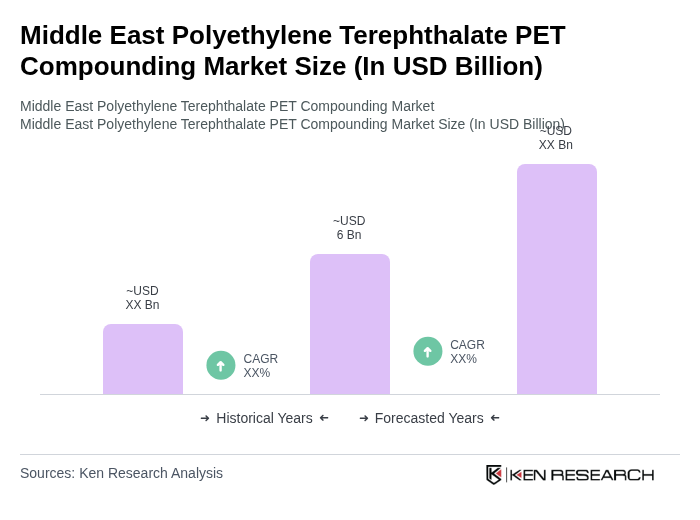
  • The Middle East Polyethylene Terephthalate PET Compounding Market is valued at USD 6 billion, based on recent analysis. Growth is driven by robust demand in food, beverage, and convenience packaging and boosted by rising urbanization and consumer preferences for lightweight, durable, and recyclable containers. The increasing focus on sustainability and development of recycling infrastructure further underpin expansion.
  • Key countries dominating the market include Saudi Arabia and the UAE, which are home to significant petrochemical hubs. These nations benefit from integrated supply chains for feedstocks such as PTA and MEG, facilitating strong compounding activities. The presence of major chemical conglomerates like SABIC and Indorama Ventures enhances local production capabilities, catering to the regional packaging and industrial sectors.
  • In 2024, the UAE government announced a strategic initiative to establish a 12,000-tonnes-per-annum food-grade PET recycling plant in Abu Dhabi. This project, supported by a memorandum of understanding between Repeet, BEEAH, and Agthia, aims to recycle PET bottles, create approximately 100 jobs, and reduce COemissions by 18,000 metric tonnes annually.
Middle East Polyethylene Terephthalate PET Compounding Market Size

Middle East Polyethylene Terephthalate PET Compounding Market Segmentation

By Type:The market is segmented into Recycled PET, Virgin PET, Specialty PET Compounds, and Others. Among these, Virgin PET is the leading sub-segment due to its extensive use in the food and beverage industry, where purity and safety are paramount. The demand for high-quality packaging materials drives the preference for Virgin PET, while Recycled PET is gaining traction due to increasing sustainability efforts.
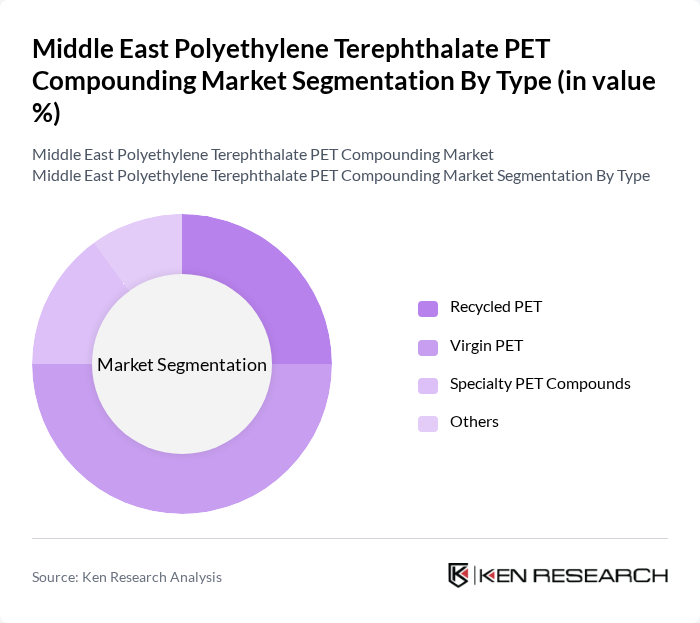
Middle East Polyethylene Terephthalate PET Compounding Market segmentation by Type.

By End-User:The end-user segmentation includes Food and Beverage, Consumer Goods, Healthcare, and Others. The Food and Beverage sector dominates this market segment, driven by the increasing demand for safe and convenient packaging solutions. The rise in consumer awareness regarding health and safety standards further propels the growth of this segment, as companies seek to provide high-quality packaging that meets regulatory requirements.
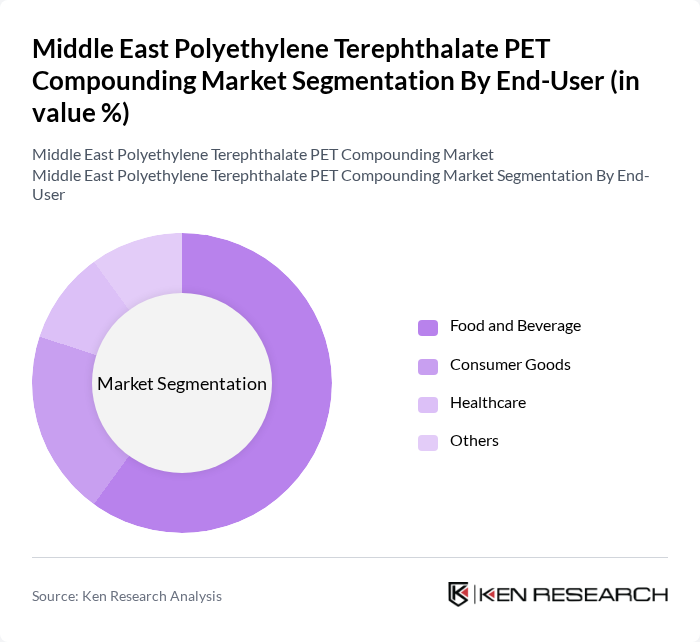
Middle East Polyethylene Terephthalate PET Compounding Market segmentation by End-User.

Middle East Polyethylene Terephthalate PET Compounding Market Competitive Landscape

The Middle East Polyethylene Terephthalate PET Compounding Market is characterized by a dynamic mix of regional and international players. Leading participants such as SABIC, Indorama Ventures, Alpek Polyester, Lotte Chemical, DAK Americas, Reliance Industries, Eastman Chemical Company, BASF SE, Huntsman Corporation, KRAIBURG TPE, M&G Chemicals, Perpetual Industries, Teijin Limited, Formosa Plastics Corporation, Covestro AG contribute to innovation, geographic expansion, and service delivery in this space.

SABIC

1976

Riyadh, Saudi Arabia

Indorama Ventures

1994

Bangkok, Thailand

Alpek Polyester

2002

Monterrey, Mexico

Lotte Chemical

1976

Seoul, South Korea

Reliance Industries

1960

Mumbai, India

Company

Establishment Year

Headquarters

Group Size (Large, Medium, or Small as per industry convention)

Revenue Growth Rate

Market Penetration Rate

Customer Retention Rate

Pricing Strategy

Product Diversification Index

Middle East Polyethylene Terephthalate PET Compounding Market Industry Analysis

Growth Drivers

  • High Regional PET Market Revenue:The Middle East and Africa (MEA) PET market revenue is projected to reach USD 5,153.9 million in future. This substantial revenue indicates a robust demand for PET, which directly supports the growth of downstream compounding activities. The increasing consumption of PET in various sectors, including packaging and automotive, is a key driver for compounding investments in the region. This trend is expected to continue as industries seek sustainable solutions.
  • GCC PET Demand Volumes:The Gulf Cooperation Council (GCC) region's PET demand was recorded at 2.20 million tons in future, with expectations to rise to 3.61 million tons in future. This significant increase in demand volumes is indicative of expanding applications across multiple sectors, including food and beverage packaging. The anticipated growth in demand will necessitate the expansion of compounding capacities to meet the rising needs of the market.
  • Volume Growth Forecast:The Middle East PET market is estimated to reach 1.84 million tons in future, with projections indicating growth to 2.38 million tons in future. This forecasted increase in volume reflects a solid momentum in the market, encouraging investments in compounding technologies and processes. The growth trajectory is driven by rising consumer preferences for PET products, particularly in sustainable packaging solutions.

Market Challenges

  • Low Post-Consumer PET Collection Rates:The region's collection systems capture less than 10% of post-consumer PET, presenting a significant challenge for the compounding industry. This low collection rate limits the availability of recycled PET (rPET) feedstock, hindering the progress towards a circular economy. The scarcity of rPET complicates the compounding of sustainable products, which is increasingly demanded by consumers and regulatory bodies.
  • Feedstock Cost Pressure and Virgin Resin Pricing:Integrated producers benefit from a feedstock cost advantage of USD 200–300 per ton, creating a competitive disadvantage for smaller compounders. This cost disparity is particularly pronounced during periods of low crude oil prices, which can lead to increased pricing pressures on virgin resin. As a result, smaller players may struggle to maintain profitability while competing with larger, integrated manufacturers.

Middle East Polyethylene Terephthalate PET Compounding Market Future Outlook

The future of the Middle East PET compounding market appears promising, driven by increasing investments in recycling infrastructure and a growing emphasis on sustainability. The rise of electrical and electronics applications for PET, projected to grow at a rate of 7.67% through future, presents new avenues for compounders. Additionally, regulatory mandates, such as the UAE's requirement for 30% rPET in bottles by future, will further accelerate the shift towards sustainable practices in the industry.

Market Opportunities

  • Untapped Electronics Segment:The electrical and electronics segment is expected to grow at a rate of 7.67% through future. This growth presents a significant opportunity for compounders to develop specialized PET grades, such as flame-retardant and high-dielectric materials, catering to the evolving needs of the electronics industry. This diversification can enhance market competitiveness and profitability.
  • Growth of rPET Capacity:Nile Plastic Recycling's investment of USD 15 million to add 20,000 tons of rPET capacity in future exemplifies the growing focus on sustainability. This expansion enables compounders to integrate recycled feedstock into their products, aligning with consumer demand for environmentally friendly solutions. The increased rPET capacity will support the industry's transition towards more sustainable manufacturing practices.

Scope of the Report

SegmentSub-Segments
By Type

Recycled PET

Virgin PET

Specialty PET Compounds

Others

By End-User

Food and Beverage

Consumer Goods

Healthcare

Others

By Application

Bottles

Films and Sheets

Fibers

Others

By Distribution Channel

Direct Sales

Distributors

Online Sales

Others

By Geography

GCC Countries

Levant Region

North Africa

Others

By Product Form

Granules

Pellets

Sheets

Others

By End-Use Industry

Automotive

Electronics

Construction

Others

Key Target Audience

Investors and Venture Capitalist Firms

Government and Regulatory Bodies (e.g., Ministry of Industry and Advanced Technology, Saudi Standards, Metrology and Quality Organization)

Manufacturers and Producers

Distributors and Retailers

Packaging Companies

Recycling and Waste Management Firms

Industry Associations (e.g., Gulf Petrochemicals and Chemicals Association)

Financial Institutions

Players Mentioned in the Report:

SABIC

Indorama Ventures

Alpek Polyester

Lotte Chemical

DAK Americas

Reliance Industries

Eastman Chemical Company

BASF SE

Huntsman Corporation

KRAIBURG TPE

M&G Chemicals

Perpetual Industries

Teijin Limited

Formosa Plastics Corporation

Covestro AG

Table of Contents

Market Assessment Phase

1. Executive Summary and Approach


2. Middle East Polyethylene Terephthalate PET Compounding Market Overview

2.1 Key Insights and Strategic Recommendations

2.2 Middle East Polyethylene Terephthalate PET Compounding Market Overview

2.3 Definition and Scope

2.4 Evolution of Market Ecosystem

2.5 Timeline of Key Regulatory Milestones

2.6 Value Chain & Stakeholder Mapping

2.7 Business Cycle Analysis

2.8 Policy & Incentive Landscape


3. Middle East Polyethylene Terephthalate PET Compounding Market Analysis

3.1 Growth Drivers

3.1.1 Increasing Demand for Sustainable Packaging
3.1.2 Expansion of the Automotive Industry
3.1.3 Technological Advancements in Compounding Processes
3.1.4 Rising Consumer Awareness of Recyclable Materials

3.2 Market Challenges

3.2.1 Fluctuating Raw Material Prices
3.2.2 Stringent Environmental Regulations
3.2.3 Competition from Alternative Materials
3.2.4 Limited Recycling Infrastructure

3.3 Market Opportunities

3.3.1 Growth in E-commerce Packaging
3.3.2 Development of Biodegradable PET Compounds
3.3.3 Strategic Partnerships with Local Manufacturers
3.3.4 Expansion into Emerging Markets

3.4 Market Trends

3.4.1 Shift Towards Circular Economy Practices
3.4.2 Increased Investment in R&D for PET Compounding
3.4.3 Adoption of Smart Manufacturing Technologies
3.4.4 Growing Popularity of Lightweight Materials

3.5 Government Regulation

3.5.1 Implementation of Recycling Targets
3.5.2 Introduction of Eco-labeling Standards
3.5.3 Incentives for Sustainable Manufacturing Practices
3.5.4 Regulations on Single-Use Plastics

4. SWOT Analysis


5. Stakeholder Analysis


6. Porter's Five Forces Analysis


7. Middle East Polyethylene Terephthalate PET Compounding Market Market Size, 2019-2024

7.1 By Value

7.2 By Volume

7.3 By Average Selling Price


8. Middle East Polyethylene Terephthalate PET Compounding Market Segmentation

8.1 By Type

8.1.1 Recycled PET
8.1.2 Virgin PET
8.1.3 Specialty PET Compounds
8.1.4 Others

8.2 By End-User

8.2.1 Food and Beverage
8.2.2 Consumer Goods
8.2.3 Healthcare
8.2.4 Others

8.3 By Application

8.3.1 Bottles
8.3.2 Films and Sheets
8.3.3 Fibers
8.3.4 Others

8.4 By Distribution Channel

8.4.1 Direct Sales
8.4.2 Distributors
8.4.3 Online Sales
8.4.4 Others

8.5 By Geography

8.5.1 GCC Countries
8.5.2 Levant Region
8.5.3 North Africa
8.5.4 Others

8.6 By Product Form

8.6.1 Granules
8.6.2 Pellets
8.6.3 Sheets
8.6.4 Others

8.7 By End-Use Industry

8.7.1 Automotive
8.7.2 Electronics
8.7.3 Construction
8.7.4 Others

9. Middle East Polyethylene Terephthalate PET Compounding Market Competitive Analysis

9.1 Market Share of Key Players

9.2 Cross Comparison of Key Players

9.2.1 Company Name
9.2.2 Group Size (Large, Medium, or Small as per industry convention)
9.2.3 Revenue Growth Rate
9.2.4 Market Penetration Rate
9.2.5 Customer Retention Rate
9.2.6 Pricing Strategy
9.2.7 Product Diversification Index
9.2.8 Supply Chain Efficiency
9.2.9 Innovation Rate
9.2.10 Brand Equity Score

9.3 SWOT Analysis of Top Players

9.4 Pricing Analysis

9.5 Detailed Profile of Major Companies

9.5.1 SABIC
9.5.2 Indorama Ventures
9.5.3 Alpek Polyester
9.5.4 Lotte Chemical
9.5.5 DAK Americas
9.5.6 Reliance Industries
9.5.7 Eastman Chemical Company
9.5.8 BASF SE
9.5.9 Huntsman Corporation
9.5.10 KRAIBURG TPE
9.5.11 M&G Chemicals
9.5.12 Perpetual Industries
9.5.13 Teijin Limited
9.5.14 Formosa Plastics Corporation
9.5.15 Covestro AG

10. Middle East Polyethylene Terephthalate PET Compounding Market End-User Analysis

10.1 Procurement Behavior of Key Ministries

10.1.1 Government Procurement Policies
10.1.2 Budget Allocations for PET Products
10.1.3 Supplier Selection Criteria
10.1.4 Contract Management Practices

10.2 Corporate Spend on Infrastructure & Energy

10.2.1 Investment Trends in PET Infrastructure
10.2.2 Energy Consumption Patterns
10.2.3 Budgeting for Sustainable Practices
10.2.4 Corporate Social Responsibility Initiatives

10.3 Pain Point Analysis by End-User Category

10.3.1 Quality Assurance Issues
10.3.2 Supply Chain Disruptions
10.3.3 Cost Management Challenges
10.3.4 Regulatory Compliance Difficulties

10.4 User Readiness for Adoption

10.4.1 Awareness of PET Benefits
10.4.2 Training and Support Needs
10.4.3 Adoption Barriers
10.4.4 Feedback Mechanisms

10.5 Post-Deployment ROI and Use Case Expansion

10.5.1 Measurement of ROI
10.5.2 Case Studies of Successful Implementations
10.5.3 Future Use Case Opportunities
10.5.4 Lessons Learned from Deployments

11. Middle East Polyethylene Terephthalate PET Compounding Market Future Size, 2025-2030

11.1 By Value

11.2 By Volume

11.3 By Average Selling Price


Go-To-Market Strategy Phase

1. Whitespace Analysis + Business Model Canvas

1.1 Market Gaps Identification

1.2 Business Model Development


2. Marketing and Positioning Recommendations

2.1 Branding Strategies

2.2 Product USPs


3. Distribution Plan

3.1 Urban Retail Strategies

3.2 Rural NGO Tie-ups


4. Channel & Pricing Gaps

4.1 Underserved Routes

4.2 Pricing Bands Analysis


5. Unmet Demand & Latent Needs

5.1 Category Gaps

5.2 Consumer Segments


6. Customer Relationship

6.1 Loyalty Programs

6.2 After-sales Service


7. Value Proposition

7.1 Sustainability Initiatives

7.2 Integrated Supply Chains


8. Key Activities

8.1 Regulatory Compliance

8.2 Branding Efforts

8.3 Distribution Setup


9. Entry Strategy Evaluation

9.1 Domestic Market Entry Strategy

9.1.1 Product Mix Considerations
9.1.2 Pricing Band Strategy
9.1.3 Packaging Solutions

9.2 Export Entry Strategy

9.2.1 Target Countries Identification
9.2.2 Compliance Roadmap Development

10. Entry Mode Assessment

10.1 Joint Ventures

10.2 Greenfield Investments

10.3 Mergers & Acquisitions

10.4 Distributor Model Evaluation


11. Capital and Timeline Estimation

11.1 Capital Requirements Analysis

11.2 Timelines for Implementation


12. Control vs Risk Trade-Off

12.1 Ownership Considerations

12.2 Partnerships Evaluation


13. Profitability Outlook

13.1 Breakeven Analysis

13.2 Long-term Sustainability Strategies


14. Potential Partner List

14.1 Distributors Identification

14.2 Joint Ventures Opportunities

14.3 Acquisition Targets


15. Execution Roadmap

15.1 Phased Plan for Market Entry

15.1.1 Market Setup Activities
15.1.2 Market Entry Steps
15.1.3 Growth Acceleration Strategies
15.1.4 Scale & Stabilize Actions

15.2 Key Activities and Milestones

15.2.1 Milestone Identification
15.2.2 Activity Scheduling

Research Methodology

ApproachModellingSample

Phase 1: Approach1

Desk Research

  • Industry reports from regional petrochemical associations and trade bodies
  • Market analysis publications focusing on the Middle East's polymer sector
  • Government publications and policy documents related to plastic production and recycling

Primary Research

  • Interviews with key stakeholders in the PET compounding supply chain, including manufacturers and distributors
  • Surveys targeting end-users in sectors such as packaging, automotive, and textiles
  • Field visits to production facilities to gather insights on operational practices and challenges

Validation & Triangulation

  • Cross-referencing data from multiple sources to ensure consistency and reliability
  • Engaging industry experts for qualitative insights and validation of quantitative findings
  • Sanity checks through comparison with historical market trends and growth patterns

Phase 2: Market Size Estimation1

Top-down Assessment

  • Analysis of regional PET production capacities and consumption rates
  • Segmentation of the market by application areas such as packaging, textiles, and automotive
  • Incorporation of macroeconomic indicators influencing demand, such as GDP growth and industrial output

Bottom-up Modeling

  • Collection of production volume data from leading PET compounding manufacturers in the region
  • Estimation of market share based on sales data and production capabilities
  • Cost analysis of raw materials and production processes to determine pricing strategies

Forecasting & Scenario Analysis

  • Utilization of historical growth rates to project future market trends through 2030
  • Scenario modeling based on potential regulatory changes and sustainability initiatives
  • Assessment of market resilience against economic fluctuations and supply chain disruptions

Phase 3: CATI Sample Composition1

Scope Item/SegmentSample SizeTarget Respondent Profiles
PET Packaging Applications150Product Managers, Packaging Engineers
Textile Industry Usage100Textile Manufacturers, R&D Specialists
Automotive Component Production80Procurement Managers, Production Supervisors
Consumer Goods Sector120Brand Managers, Supply Chain Analysts
Recycling and Sustainability Initiatives70Sustainability Officers, Environmental Compliance Managers

Frequently Asked Questions

What is the current value of the Middle East Polyethylene Terephthalate (PET) Compounding Market?

The Middle East Polyethylene Terephthalate (PET) Compounding Market is valued at approximately USD 6 billion, driven by increasing demand in food, beverage, and convenience packaging, along with a focus on sustainability and recycling infrastructure development.

Which countries are leading in the Middle East PET Compounding Market?

What are the main types of PET in the market?

What are the primary end-user segments for PET compounding?

Other Regional/Country Reports

Indonesia Polyethylene Terephthalate PET Compounding Market

Malaysia Polyethylene Terephthalate PET Compounding Market

KSA Polyethylene Terephthalate PET Compounding Market

APAC Polyethylene Terephthalate PET Compounding Market

SEA Polyethylene Terephthalate PET Compounding Market

Vietnam Polyethylene Terephthalate PET Compounding Market

Why Buy From Us?

Refine Robust Result (RRR) Framework

What makes us stand out is that our consultants follow Robust, Refine and Result (RRR) methodology. Robust for clear definitions, approaches and sanity checking, Refine for differentiating respondents' facts and opinions, and Result for presenting data with story.

Our Reach Is Unmatched

We have set a benchmark in the industry by offering our clients with syndicated and customized market research reports featuring coverage of entire market as well as meticulous research and analyst insights.

Shifting the Research Paradigm

While we don't replace traditional research, we flip the method upside down. Our dual approach of Top Bottom & Bottom Top ensures quality deliverable by not just verifying company fundamentals but also looking at the sector and macroeconomic factors.

More Insights-Better Decisions

With one step in the future, our research team constantly tries to show you the bigger picture. We help with some of the tough questions you may encounter along the way: How is the industry positioned? Best marketing channel? KPI's of competitors? By aligning every element, we help maximize success.

Transparency and Trust

Our report gives you instant access to the answers and sources that other companies might choose to hide. We elaborate each steps of research methodology we have used and showcase you the sample size to earn your trust.

Round the Clock Support

If you need any support, we are here! We pride ourselves on universe strength, data quality, and quick, friendly, and professional service.

Why Clients Choose Us?

400000+
Reports in repository
150+
Consulting projects a year
100+
Analysts
8000+
Client Queries in 2022








