Middle East Wound Wash Market Report Size, Share, Growth Drivers, Trends, Opportunities & Forecast 2025–2030

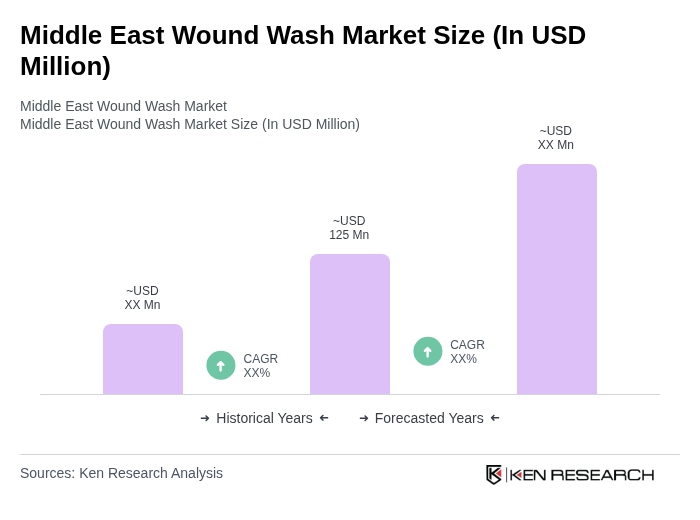
Middle East Wound Wash Market, valued at USD 125 million, grows due to rising chronic wounds, advanced technologies, and expanding healthcare in key countries like Saudi Arabia and UAE.

Region:Middle East

Author(s):Rebecca

Product Code:KRAD4913

Pages:91

Published On:December 2025
About the Report

Base Year 2024

Middle East Wound Wash Market Overview

  • The Middle East Wound Wash Market is valued at USD 125 million, based on a five-year historical analysis, in line with the broader regional wound cleanser products market. This growth is primarily driven by the increasing prevalence of chronic wounds linked to diabetes, vascular diseases, and trauma, rising awareness regarding infection prevention in wound care, and advancements in wound management technologies such as advanced irrigants and ready-to-use sterile solutions. The market is also supported by the growing healthcare infrastructure, expansion of hospital and surgical capacity, and the increasing number of surgical procedures across key Middle Eastern countries.
  • Key country-level markets in this space include Saudi Arabia, the United Arab Emirates, and Egypt. These countries contribute a significant share of regional demand due to their relatively robust healthcare systems, higher per-capita health expenditure, and sustained investment in medical technologies and hospital infrastructure. A growing population with a rising burden of lifestyle diseases such as diabetes and obesity increases the incidence of chronic and post-surgical wounds, which in turn drives demand for effective wound care and wound cleansing solutions. Additionally, the presence of major tertiary care facilities, specialized wound care centers, and an expanding base of trained healthcare professionals supports their market leadership in advanced wound care and wound wash adoption.
  • In Saudi Arabia, the regulation of wound wash and other wound care solutions is embedded within the broader medical devices and supplies framework under the Medical Devices Interim Regulation issued by the Saudi Food and Drug Authority (SFDA) in 2010, along with associated implementing rules and guidance on marketing authorization, classification, and conformity assessment for medical devices. These rules require that wound irrigation and wound cleanser products marketed in hospitals and clinics obtain SFDA marketing authorization, comply with quality and safety standards, and follow procurement policies that prioritize approved and clinically validated products, which collectively support the use of high-quality wound care solutions in medical settings.
Middle East Wound Wash Market Size

Middle East Wound Wash Market Segmentation

By Type:The market is segmented into various types of wound wash products, including antiseptic, saline, herbal, foam, spray, gel, and others. Antiseptic wound wash is gaining traction due to its effectiveness in reducing microbial load and preventing infections, particularly in high-risk or contaminated wounds. Saline wound wash is widely preferred as an isotonic, non-cytotoxic solution compatible with a broad range of acute and chronic wound types, and is frequently used in hospital and surgical settings. Herbal and naturally derived wound washes are also becoming popular in parts of the Middle East due to increasing consumer preference for natural or plant-based products and the presence of local manufacturers promoting such formulations. Foam and spray formats are favored for their ease of application, precise dosing, and convenience in emergency departments, outpatient clinics, and field or home-based care, while gel-based irrigants are used where longer contact time and moisture balance are desired.
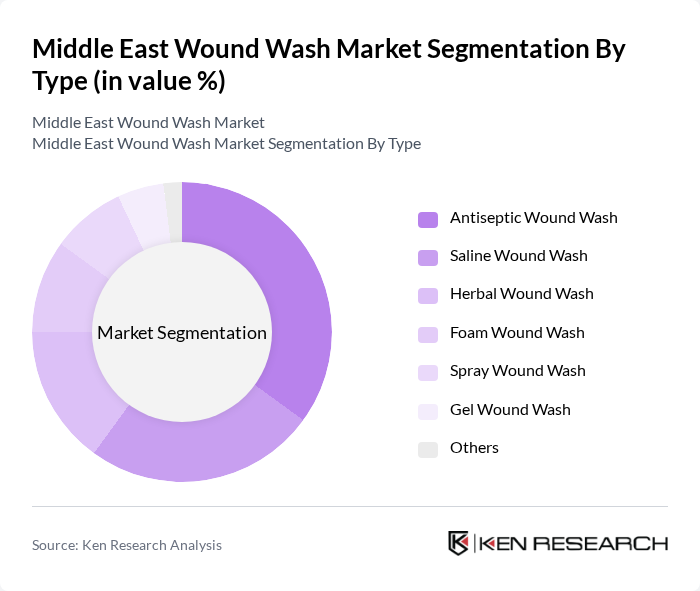
Middle East Wound Wash Market segmentation by Type.

By End-User:The end-user segmentation includes hospitals, clinics, home care settings, long-term care facilities, emergency services, military & defense, and others. Hospitals are the largest end-users due to the high volume of acute and chronic wound cases, surgical procedures, and trauma cases requiring consistent wound cleansing solutions, which is consistent with hospital dominance observed in wound wash usage in markets such as the United Arab Emirates. Clinics and home care settings are also significant contributors, driven by the increasing shift toward outpatient care, early discharge protocols, and home-based management of chronic wounds among the growing elderly and diabetic populations. Emergency services and military applications further enhance the demand for portable, easy-to-use wound wash products to manage trauma and battlefield injuries where rapid irrigation and infection prevention are critical.
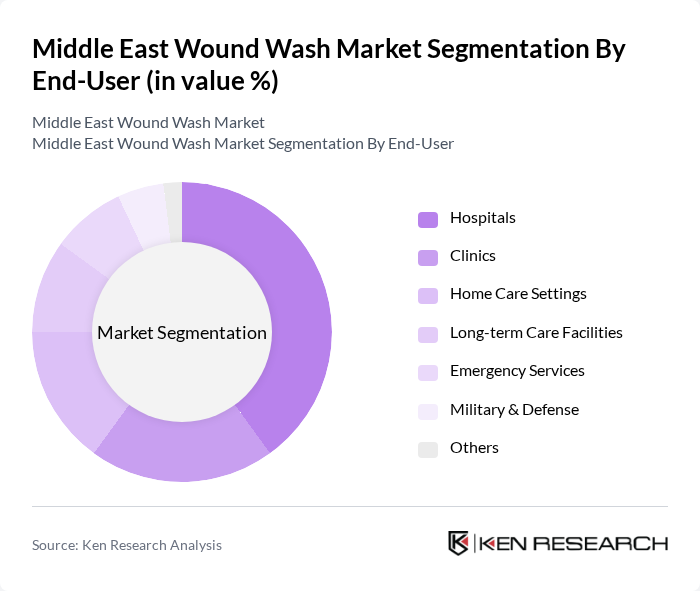
Middle East Wound Wash Market segmentation by End-User.

Middle East Wound Wash Market Competitive Landscape

The Middle East Wound Wash Market is characterized by a dynamic mix of regional and international players. Leading participants such as Johnson & Johnson (Kenvue / Ethicon / Janssen), 3M Company, Medline Industries, Inc., Smith & Nephew plc, B. Braun Melsungen AG, ConvaTec Group PLC, Coloplast A/S, Mölnlycke Health Care AB, Hartmann Group (Paul Hartmann AG), Medtronic plc, Cardinal Health, Inc., Fresenius Kabi AG, Becton, Dickinson and Company (BD), Terumo Corporation, Stryker Corporation, Nolato AB (via wound care subsidiaries), Al Futtaim Healthcare (Regional distributor & operator), Al Borg Diagnostics (Saudi Arabia), Al Hayat Medical Equipment & Supplies (UAE), TCDD Ta??mac?l?k A.?. contribute to innovation, geographic expansion, and service delivery in this space.

Johnson & Johnson

1886

New Brunswick, New Jersey, USA

3M Company

1902

Maplewood, Minnesota, USA

Medline Industries, Inc.

1966

Northfield, Illinois, USA

Smith & Nephew plc

1856

London, England, UK

B. Braun Melsungen AG

1839

Melsungen, Germany

Company

Establishment Year

Headquarters

Regional Revenue (Middle East Wound Wash Segment)

Revenue Growth Rate (CAGR, 2020–2025)

Market Share in Middle East Wound Wash Market

Product Portfolio Breadth (Number of Wound Wash SKUs)

Geographic Coverage in Middle East

Distribution Network Strength (Direct vs. Distributor-based)

Middle East Wound Wash Market Industry Analysis

Growth Drivers

  • Increasing Prevalence of Chronic Wounds:The Middle East has seen a significant rise in chronic wounds, with an estimated 2.7 million people affected annually. Conditions such as diabetes, which affects approximately 12% of the adult population in the region, contribute to this increase. The World Health Organization reports that chronic wounds are a leading cause of morbidity, necessitating advanced wound care solutions. This growing patient population drives demand for effective wound wash products, creating a robust market environment.
  • Rising Awareness About Wound Care:Public awareness regarding wound care has surged, with educational campaigns reaching over 65% of the population in urban areas. The Ministry of Health in various Middle Eastern countries has initiated programs to educate citizens on proper wound management, leading to increased demand for wound wash products. This heightened awareness is expected to drive market growth, as consumers seek effective solutions to prevent infections and promote healing in chronic wounds.
  • Growth in Healthcare Infrastructure:The Middle East is investing heavily in healthcare infrastructure, with expenditures projected to reach $120 billion in future. This investment includes the establishment of new hospitals and clinics, particularly in underserved areas. Enhanced healthcare facilities are crucial for providing advanced wound care services, thereby increasing the availability and accessibility of wound wash products. As healthcare systems improve, the demand for quality wound care solutions is expected to rise significantly.

Market Challenges

  • High Cost of Advanced Wound Care Products:The cost of advanced wound care products remains a significant barrier, with prices ranging from $60 to $250 per unit. Many healthcare facilities, especially in rural areas, struggle to afford these products, limiting patient access to necessary treatments. This financial strain can hinder the adoption of effective wound wash solutions, impacting overall market growth and patient outcomes in the region.
  • Limited Access to Healthcare in Rural Areas:Approximately 30% of the Middle Eastern population resides in rural areas, where healthcare access is severely limited. Many rural clinics lack the resources to provide advanced wound care, including wound wash products. This disparity creates a significant challenge for market penetration, as patients in these regions often resort to substandard care, which can lead to complications and increased healthcare costs.

Middle East Wound Wash Market Future Outlook

The future of the Middle East wound wash market appears promising, driven by technological advancements and a shift towards patient-centric care. As healthcare providers increasingly adopt telemedicine and home healthcare solutions, the demand for accessible wound care products is expected to rise. Additionally, the integration of smart technologies in wound management will enhance treatment efficacy, further propelling market growth. Stakeholders must remain agile to capitalize on these evolving trends and meet the needs of a diverse patient population.

Market Opportunities

  • Expansion of E-commerce in Healthcare:The rise of e-commerce platforms in the Middle East presents a significant opportunity for wound wash products. With online sales projected to grow by 25% annually, companies can reach a broader audience, particularly in remote areas. This shift allows for increased accessibility and convenience, enabling patients to obtain necessary wound care products without geographical constraints.
  • Increasing Investment in Healthcare R&D:Investment in healthcare research and development is expected to exceed $7 billion in future in the Middle East. This funding will facilitate innovation in wound care technologies, including advanced wound washes. Companies that leverage this investment to develop new, effective products can gain a competitive edge, addressing the growing demand for improved wound management solutions in the region.

Scope of the Report

SegmentSub-Segments
By Type

Antiseptic Wound Wash

Saline Wound Wash

Herbal Wound Wash

Foam Wound Wash

Spray Wound Wash

Gel Wound Wash

Others

By End-User

Hospitals

Clinics

Home Care Settings

Long-term Care Facilities

Emergency Services

Military & Defense

Others

By Distribution Channel

Online Retail

Pharmacies

Hospitals

Direct Sales

Medical Supply Stores

Others

By Packaging Type

Bottles

Sachets

Tubes

Sprays

Pre-moistened Wipes

Others

By Region

GCC Countries (Saudi Arabia, UAE, Qatar, Kuwait, Oman, Bahrain)

Levant Region (Jordan, Lebanon, Syria, Palestine)

North Africa (Egypt, Morocco, Algeria, Tunisia, Others)

Turkey

Others

By Product Formulation

Alcohol-based Formulations

Non-alcohol-based Formulations

Antimicrobial Formulations

Bioactive Formulations

Others

By Consumer Demographics

Age Group (Children, Adults, Elderly)

Gender (Male, Female)

Socioeconomic Status (Low, Middle, High)

Others

Key Target Audience

Investors and Venture Capitalist Firms

Government and Regulatory Bodies (e.g., Ministry of Health, Food and Drug Administration of

Manufacturers and Producers

Distributors and Retailers

Healthcare Providers (e.g., Hospitals, Clinics)

Pharmaceutical Companies

Medical Device Suppliers

Health Insurance Companies

Players Mentioned in the Report:

Johnson & Johnson (Kenvue / Ethicon / Janssen)

3M Company

Medline Industries, Inc.

Smith & Nephew plc

B. Braun Melsungen AG

ConvaTec Group PLC

Coloplast A/S

Molnlycke Health Care AB

Hartmann Group (Paul Hartmann AG)

Medtronic plc

Cardinal Health, Inc.

Fresenius Kabi AG

Becton, Dickinson and Company (BD)

Terumo Corporation

Stryker Corporation

Nolato AB (via wound care subsidiaries)

Al Futtaim Healthcare (Regional distributor & operator)

Al Borg Diagnostics (Saudi Arabia)

Al Hayat Medical Equipment & Supplies (UAE)

TCDD Tasmaclk A.S.

Table of Contents

Market Assessment Phase

1. Executive Summary and Approach


2. Middle East Wound Wash Market Overview

2.1 Key Insights and Strategic Recommendations

2.2 Middle East Wound Wash Market Overview

2.3 Definition and Scope

2.4 Evolution of Market Ecosystem

2.5 Timeline of Key Regulatory Milestones

2.6 Value Chain & Stakeholder Mapping

2.7 Business Cycle Analysis

2.8 Policy & Incentive Landscape


3. Middle East Wound Wash Market Analysis

3.1 Growth Drivers

3.1.1 Increasing prevalence of chronic wounds
3.1.2 Rising awareness about wound care
3.1.3 Growth in healthcare infrastructure
3.1.4 Technological advancements in wound care products

3.2 Market Challenges

3.2.1 High cost of advanced wound care products
3.2.2 Limited access to healthcare in rural areas
3.2.3 Regulatory hurdles in product approvals
3.2.4 Competition from alternative wound care solutions

3.3 Market Opportunities

3.3.1 Expansion of e-commerce in healthcare
3.3.2 Increasing investment in healthcare R&D
3.3.3 Collaborations with local healthcare providers
3.3.4 Growing demand for natural and organic wound care products

3.4 Market Trends

3.4.1 Shift towards home healthcare solutions
3.4.2 Rising popularity of telemedicine for wound care
3.4.3 Increased focus on patient-centric wound care
3.4.4 Adoption of smart wound care technologies

3.5 Government Regulation

3.5.1 Stricter regulations on wound care product safety
3.5.2 Guidelines for wound care management
3.5.3 Incentives for local manufacturing of wound care products
3.5.4 Compliance requirements for importation of medical devices

4. SWOT Analysis


5. Stakeholder Analysis


6. Porter's Five Forces Analysis


7. Middle East Wound Wash Market Market Size, 2019-2024

7.1 By Value

7.2 By Volume

7.3 By Average Selling Price


8. Middle East Wound Wash Market Segmentation

8.1 By Type

8.1.1 Antiseptic Wound Wash
8.1.2 Saline Wound Wash
8.1.3 Herbal Wound Wash
8.1.4 Foam Wound Wash
8.1.5 Spray Wound Wash
8.1.6 Gel Wound Wash
8.1.7 Others

8.2 By End-User

8.2.1 Hospitals
8.2.2 Clinics
8.2.3 Home Care Settings
8.2.4 Long-term Care Facilities
8.2.5 Emergency Services
8.2.6 Military & Defense
8.2.7 Others

8.3 By Distribution Channel

8.3.1 Online Retail
8.3.2 Pharmacies
8.3.3 Hospitals
8.3.4 Direct Sales
8.3.5 Medical Supply Stores
8.3.6 Others

8.4 By Packaging Type

8.4.1 Bottles
8.4.2 Sachets
8.4.3 Tubes
8.4.4 Sprays
8.4.5 Pre-moistened Wipes
8.4.6 Others

8.5 By Region

8.5.1 GCC Countries (Saudi Arabia, UAE, Qatar, Kuwait, Oman, Bahrain)
8.5.2 Levant Region (Jordan, Lebanon, Syria, Palestine)
8.5.3 North Africa (Egypt, Morocco, Algeria, Tunisia, Others)
8.5.4 Turkey
8.5.5 Others

8.6 By Product Formulation

8.6.1 Alcohol-based Formulations
8.6.2 Non-alcohol-based Formulations
8.6.3 Antimicrobial Formulations
8.6.4 Bioactive Formulations
8.6.5 Others

8.7 By Consumer Demographics

8.7.1 Age Group (Children, Adults, Elderly)
8.7.2 Gender (Male, Female)
8.7.3 Socioeconomic Status (Low, Middle, High)
8.7.4 Others

9. Middle East Wound Wash Market Competitive Analysis

9.1 Market Share of Key Players

9.2 Cross Comparison of Key Players

9.2.1 Company Name
9.2.2 Regional Revenue (Middle East Wound Wash Segment)
9.2.3 Revenue Growth Rate (CAGR, 2020–2025)
9.2.4 Market Share in Middle East Wound Wash Market
9.2.5 Product Portfolio Breadth (Number of Wound Wash SKUs)
9.2.6 Geographic Coverage in Middle East
9.2.7 Distribution Network Strength (Direct vs. Distributor-based)
9.2.8 Pricing Tier (Premium / Mid / Economy)
9.2.9 R&D Intensity (R&D Spend as % of Revenue)
9.2.10 Regulatory Approvals (Number of Local Approvals in Key Middle East Countries)

9.3 SWOT Analysis of Top Players

9.4 Pricing Analysis

9.5 Detailed Profile of Major Companies

9.5.1 Johnson & Johnson (Kenvue / Ethicon / Janssen)
9.5.2 3M Company
9.5.3 Medline Industries, Inc.
9.5.4 Smith & Nephew plc
9.5.5 B. Braun Melsungen AG
9.5.6 ConvaTec Group PLC
9.5.7 Coloplast A/S
9.5.8 Mölnlycke Health Care AB
9.5.9 Hartmann Group (Paul Hartmann AG)
9.5.10 Medtronic plc
9.5.11 Cardinal Health, Inc.
9.5.12 Fresenius Kabi AG
9.5.13 Becton, Dickinson and Company (BD)
9.5.14 Terumo Corporation
9.5.15 Stryker Corporation
9.5.16 Nolato AB (via wound care subsidiaries)
9.5.17 Al Futtaim Healthcare (Regional distributor & operator)
9.5.18 Al Borg Diagnostics (Saudi Arabia)
9.5.19 Al Hayat Medical Equipment & Supplies (UAE)
9.5.20 TCDD Ta??mac?l?k A.?.

Research Methodology

ApproachModellingSample

Phase 1: Approach1

Desk Research

  • Analysis of market reports from healthcare associations and industry publications
  • Review of government health statistics and demographic data relevant to wound care
  • Examination of academic journals and clinical studies on wound management practices

Primary Research

  • Interviews with healthcare professionals, including surgeons and wound care specialists
  • Surveys conducted with hospital procurement departments and medical supply distributors
  • Focus groups with patients and caregivers to understand user experiences and preferences

Validation & Triangulation

  • Cross-validation of findings through multiple data sources, including sales data and clinical outcomes
  • Triangulation of insights from primary interviews with secondary research findings
  • Sanity checks through expert panel reviews comprising industry veterans and market analysts

Phase 2: Market Size Estimation1

Top-down Assessment

  • Estimation of total healthcare expenditure in the Middle East and its allocation to wound care
  • Segmentation of the market by product type, including antiseptics, dressings, and advanced wound care products
  • Incorporation of regional healthcare initiatives and government spending on wound management

Bottom-up Modeling

  • Collection of sales data from leading wound care product manufacturers and distributors
  • Estimation of market penetration rates based on hospital and clinic adoption of wound care solutions
  • Volume x price analysis to derive revenue estimates for each product category

Forecasting & Scenario Analysis

  • Multi-factor regression analysis incorporating population growth, aging demographics, and chronic disease prevalence
  • Scenario modeling based on potential changes in healthcare policies and reimbursement rates
  • Development of baseline, optimistic, and pessimistic market growth projections through 2030

Phase 3: CATI Sample Composition1

Scope Item/SegmentSample SizeTarget Respondent Profiles
Hospital Wound Care Departments100Wound Care Specialists, Nursing Staff
Medical Supply Distributors80Sales Managers, Product Line Managers
Patient Experience Surveys120Patients with chronic wounds, Caregivers
Healthcare Policy Makers60Health Administrators, Policy Analysts
Clinical Research Institutions70Clinical Researchers, Medical Directors

Frequently Asked Questions

What is the current value of the Middle East Wound Wash Market?

The Middle East Wound Wash Market is valued at approximately USD 125 million, reflecting a significant growth trend driven by the increasing prevalence of chronic wounds and advancements in wound management technologies.

What factors are driving the growth of the Middle East Wound Wash Market?

Which countries are the largest markets for wound wash in the Middle East?

What types of wound wash products are available in the Middle East?

Other Regional/Country Reports

Indonesia Wound Wash Market

Malaysia Wound Wash Market

KSA Wound Wash Market

APAC Wound Wash Market

SEA Wound Wash Market

Vietnam Wound Wash Market

Other Adjacent Reports

Saudi Arabia Wound Dressing Market

Vietnam Antiseptic Solutions Market

Germany Saline Solutions Market

UAE Chronic Wound Management Market

Qatar Diabetes Care Market

Oman Surgical Supplies Market

Brazil Infection Prevention Market

Saudi Arabia Africa Home Healthcare Market Report Size Share Growth Drivers Trends Opportunities & Forecast 2025–2030Poland Medical Devices Market

Oman Healthcare Infrastructure Market

Why Buy From Us?

Refine Robust Result (RRR) Framework

What makes us stand out is that our consultants follow Robust, Refine and Result (RRR) methodology. Robust for clear definitions, approaches and sanity checking, Refine for differentiating respondents' facts and opinions, and Result for presenting data with story.

Our Reach Is Unmatched

We have set a benchmark in the industry by offering our clients with syndicated and customized market research reports featuring coverage of entire market as well as meticulous research and analyst insights.

Shifting the Research Paradigm

While we don't replace traditional research, we flip the method upside down. Our dual approach of Top Bottom & Bottom Top ensures quality deliverable by not just verifying company fundamentals but also looking at the sector and macroeconomic factors.

More Insights-Better Decisions

With one step in the future, our research team constantly tries to show you the bigger picture. We help with some of the tough questions you may encounter along the way: How is the industry positioned? Best marketing channel? KPI's of competitors? By aligning every element, we help maximize success.

Transparency and Trust

Our report gives you instant access to the answers and sources that other companies might choose to hide. We elaborate each steps of research methodology we have used and showcase you the sample size to earn your trust.

Round the Clock Support

If you need any support, we are here! We pride ourselves on universe strength, data quality, and quick, friendly, and professional service.

Why Clients Choose Us?

400000+
Reports in repository
150+
Consulting projects a year
100+
Analysts
8000+
Client Queries in 2022








