About the Report
Base Year 2024New Zealand Emergency Blankets Market Overview
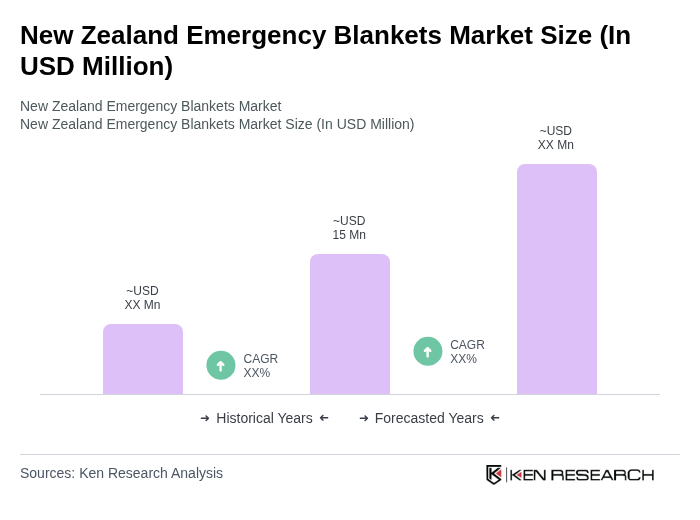
- The New Zealand Emergency Blankets Market is valued at USD 15 million, based on a five-year historical analysis. This growth is primarily driven by increasing awareness of emergency preparedness, rising incidences of natural disasters, and a growing outdoor recreational culture. The demand for emergency blankets has surged as consumers seek reliable and portable solutions for warmth and protection during emergencies.
- Key cities such as Auckland, Wellington, and Christchurch dominate the market due to their higher population density and increased outdoor activities. These urban centers have a significant number of outdoor enthusiasts and emergency services, leading to a higher demand for emergency blankets. Additionally, the presence of major retailers and distributors in these cities facilitates easier access to these products.
- In 2023, the New Zealand government implemented regulations mandating that all emergency preparedness kits include essential items such as emergency blankets. This regulation aims to enhance public safety and ensure that citizens are better equipped to handle emergencies, thereby driving the demand for emergency blankets in the market.
New Zealand Emergency Blankets Market Segmentation
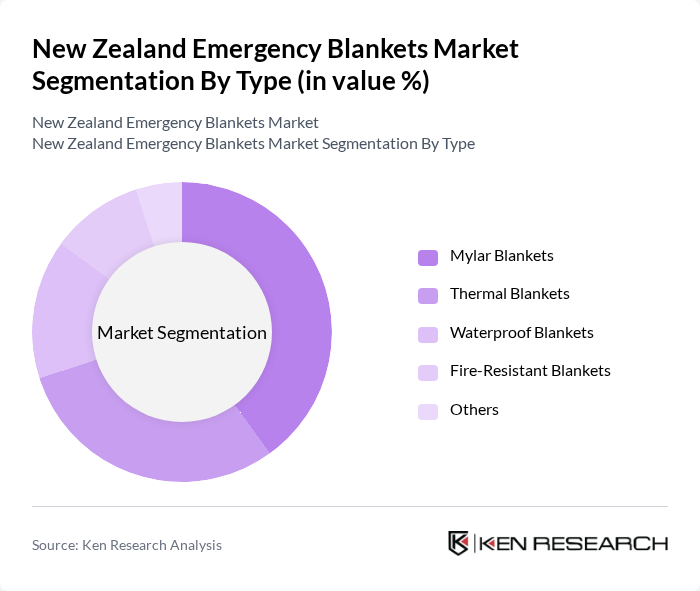
By Type:The market is segmented into various types of emergency blankets, including Mylar Blankets, Thermal Blankets, Waterproof Blankets, Fire-Resistant Blankets, and Others. Among these, Mylar Blankets are particularly popular due to their lightweight and compact nature, making them ideal for emergency kits and outdoor activities. Thermal Blankets also see significant usage, especially in healthcare settings, where maintaining body temperature is crucial.
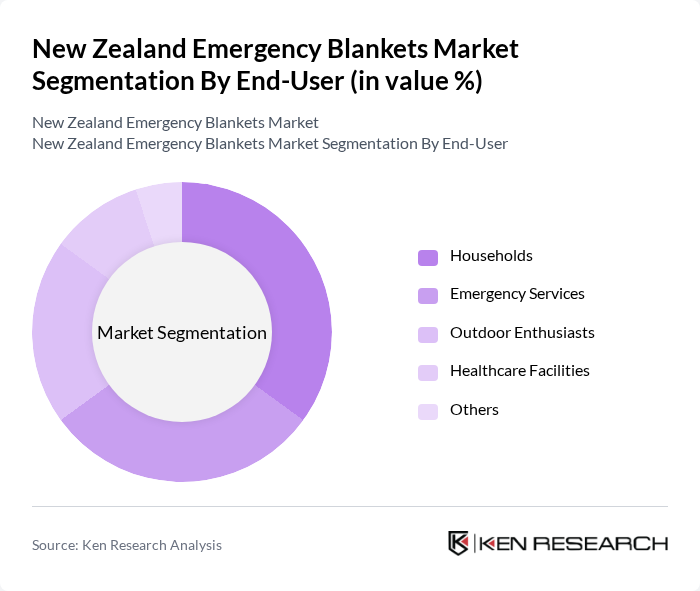
By End-User:The end-user segmentation includes Households, Emergency Services, Outdoor Enthusiasts, Healthcare Facilities, and Others. Households represent a significant portion of the market as families increasingly prepare for emergencies. Emergency Services also play a crucial role, as they require reliable and effective blankets for rescue operations. Outdoor Enthusiasts are another key segment, utilizing these blankets for camping and hiking activities.
New Zealand Emergency Blankets Market Competitive Landscape
The New Zealand Emergency Blankets Market is characterized by a dynamic mix of regional and international players. Leading participants such as St John New Zealand, ResQTech, Emergency Essentials, Kiwi Camping, The Warehouse Group, Bivouac Outdoor, Kathmandu Holdings, Macpac, NZ Safety Blackwoods, Cactus Outdoor, Outdoor Action, Trade Me, Mitre 10, Pak'nSave, Countdown contribute to innovation, geographic expansion, and service delivery in this space.
New Zealand Emergency Blankets Market Industry Analysis
Growth Drivers
- Increasing Awareness of Emergency Preparedness:The New Zealand government has reported a 30% increase in public participation in emergency preparedness programs since 2020. This heightened awareness is driven by campaigns emphasizing the importance of being ready for natural disasters, which have become more frequent. In future, over 60% of households reported having emergency kits, including blankets, reflecting a growing recognition of the need for preparedness in the face of climate change and natural calamities.
- Rising Incidences of Natural Disasters:New Zealand has experienced a notable rise in natural disasters, with the number of significant events increasing from 12 in 2019 to 18 in future. This trend has heightened the demand for emergency supplies, including blankets. The Ministry of Civil Defence and Emergency Management reported that 75% of New Zealanders are now more likely to purchase emergency supplies, including blankets, due to recent earthquakes and flooding, underscoring the urgency of preparedness.
- Government Initiatives for Disaster Management:The New Zealand government allocated NZD 150 million in future for disaster management initiatives, which include the distribution of emergency supplies. This funding supports local councils in enhancing their emergency response capabilities. As a result, partnerships with manufacturers of emergency blankets have increased, leading to a projected 20% rise in blanket distribution through government channels, thereby boosting market growth and accessibility.
Market Challenges
- High Competition Among Manufacturers:The New Zealand emergency blankets market is characterized by intense competition, with over 50 manufacturers vying for market share. This saturation has led to price wars, reducing profit margins for many companies. In future, the average profit margin in the industry fell to 10%, down from 15% in 2021, as companies struggle to differentiate their products in a crowded marketplace, impacting overall market stability.
- Fluctuating Raw Material Prices:The cost of raw materials for emergency blankets, such as mylar and polyethylene, has seen significant volatility, with prices increasing by 25% in future due to supply chain disruptions. This fluctuation poses a challenge for manufacturers, who must balance production costs with consumer pricing. As a result, many companies are facing increased operational costs, which could lead to higher retail prices and reduced consumer demand in the long term.
New Zealand Emergency Blankets Market Future Outlook
The future of the New Zealand emergency blankets market appears promising, driven by ongoing government support and increasing consumer awareness. As natural disasters become more frequent, the demand for reliable emergency supplies is expected to rise. Innovations in material technology and a shift towards sustainable practices will likely enhance product offerings. Additionally, the integration of e-commerce platforms will facilitate broader access to these essential products, ensuring that consumers can easily obtain emergency blankets when needed.
Market Opportunities
- Expansion into E-commerce Platforms:The growth of online shopping in New Zealand, which saw a 25% increase in future, presents a significant opportunity for emergency blanket manufacturers. By leveraging e-commerce, companies can reach a wider audience, particularly younger consumers who prefer online purchasing. This shift could enhance sales and brand visibility, making emergency supplies more accessible to the public.
- Development of Eco-friendly Products:With a growing emphasis on sustainability, the demand for eco-friendly emergency blankets is on the rise. In future, 40% of consumers expressed a preference for environmentally sustainable products. Manufacturers who invest in developing biodegradable or recyclable blankets can tap into this market segment, potentially increasing their customer base and aligning with global sustainability trends.
Scope of the Report
| Segment | Sub-Segments |
|---|---|
| By Type | Mylar Blankets Thermal Blankets Waterproof Blankets Fire-Resistant Blankets Others |
| By End-User | Households Emergency Services Outdoor Enthusiasts Healthcare Facilities Others |
| By Distribution Channel | Online Retail Supermarkets Specialty Stores Direct Sales Others |
| By Material | Aluminum Foil Polyester Cotton Synthetic Fabrics Others |
| By Application | Disaster Relief Medical Use Outdoor Activities Emergency Preparedness Kits Others |
| By Packaging Type | Individual Packs Bulk Packs Retail Packs Custom Packs Others |
| By Price Range | Budget Mid-Range Premium Others |
Key Target Audience
Investors and Venture Capitalist Firms
Government and Regulatory Bodies (e.g., Ministry of Civil Defence and Emergency Management)
Manufacturers and Producers
Distributors and Retailers
Emergency Services Organizations (e.g., New Zealand Fire Service)
Non-Governmental Organizations (e.g., Red Cross New Zealand)
Health and Safety Authorities (e.g., WorkSafe New Zealand)
Logistics and Supply Chain Companies
Players Mentioned in the Report:
St John New Zealand
ResQTech
Emergency Essentials
Kiwi Camping
The Warehouse Group
Bivouac Outdoor
Kathmandu Holdings
Macpac
NZ Safety Blackwoods
Cactus Outdoor
Outdoor Action
Trade Me
Mitre 10
Pak'nSave
Countdown
Table of Contents
Market Assessment Phase
1. Executive Summary and Approach
2. New Zealand Emergency Blankets Market Overview
2.1 Key Insights and Strategic Recommendations
2.2 New Zealand Emergency Blankets Market Overview
2.3 Definition and Scope
2.4 Evolution of Market Ecosystem
2.5 Timeline of Key Regulatory Milestones
2.6 Value Chain & Stakeholder Mapping
2.7 Business Cycle Analysis
2.8 Policy & Incentive Landscape
3. New Zealand Emergency Blankets Market Analysis
3.1 Growth Drivers
3.1.1 Increasing awareness of emergency preparedness
3.1.2 Rising incidences of natural disasters
3.1.3 Government initiatives for disaster management
3.1.4 Growth in outdoor recreational activities
3.2 Market Challenges
3.2.1 High competition among manufacturers
3.2.2 Fluctuating raw material prices
3.2.3 Limited consumer awareness about product benefits
3.2.4 Regulatory compliance costs
3.3 Market Opportunities
3.3.1 Expansion into e-commerce platforms
3.3.2 Development of eco-friendly products
3.3.3 Partnerships with emergency services
3.3.4 Increasing demand from the healthcare sector
3.4 Market Trends
3.4.1 Growing popularity of multi-functional emergency products
3.4.2 Innovations in material technology
3.4.3 Shift towards sustainable manufacturing practices
3.4.4 Rising online sales channels
3.5 Government Regulation
3.5.1 Compliance with safety standards
3.5.2 Environmental regulations on materials
3.5.3 Import/export regulations
3.5.4 Product labeling requirements
4. SWOT Analysis
5. Stakeholder Analysis
6. Porter's Five Forces Analysis
7. New Zealand Emergency Blankets Market Size, 2019-2024
7.1 By Value
7.2 By Volume
7.3 By Average Selling Price
8. New Zealand Emergency Blankets Market Segmentation
8.1 By Type
8.1.1 Mylar Blankets
8.1.2 Thermal Blankets
8.1.3 Waterproof Blankets
8.1.4 Fire-Resistant Blankets
8.1.5 Others
8.2 By End-User
8.2.1 Households
8.2.2 Emergency Services
8.2.3 Outdoor Enthusiasts
8.2.4 Healthcare Facilities
8.2.5 Others
8.3 By Distribution Channel
8.3.1 Online Retail
8.3.2 Supermarkets
8.3.3 Specialty Stores
8.3.4 Direct Sales
8.3.5 Others
8.4 By Material
8.4.1 Aluminum Foil
8.4.2 Polyester
8.4.3 Cotton
8.4.4 Synthetic Fabrics
8.4.5 Others
8.5 By Application
8.5.1 Disaster Relief
8.5.2 Medical Use
8.5.3 Outdoor Activities
8.5.4 Emergency Preparedness Kits
8.5.5 Others
8.6 By Packaging Type
8.6.1 Individual Packs
8.6.2 Bulk Packs
8.6.3 Retail Packs
8.6.4 Custom Packs
8.6.5 Others
8.7 By Price Range
8.7.1 Budget
8.7.2 Mid-Range
8.7.3 Premium
8.7.4 Others
9. New Zealand Emergency Blankets Market Competitive Analysis
9.1 Market Share of Key Players
9.2 Cross Comparison of Key Players
9.2.1 Company Name
9.2.2 Group Size (Large, Medium, or Small as per industry convention)
9.2.3 Revenue Growth Rate
9.2.4 Market Penetration Rate
9.2.5 Customer Retention Rate
9.2.6 Product Diversification Index
9.2.7 Pricing Strategy
9.2.8 Distribution Efficiency
9.2.9 Brand Recognition Score
9.2.10 Customer Satisfaction Index
9.3 SWOT Analysis of Top Players
9.4 Pricing Analysis
9.5 Detailed Profile of Major Companies
9.5.1 St John New Zealand
9.5.2 ResQTech
9.5.3 Emergency Essentials
9.5.4 Kiwi Camping
9.5.5 The Warehouse Group
9.5.6 Bivouac Outdoor
9.5.7 Kathmandu Holdings
9.5.8 Macpac
9.5.9 NZ Safety Blackwoods
9.5.10 Cactus Outdoor
9.5.11 Outdoor Action
9.5.12 Trade Me
9.5.13 Mitre 10
9.5.14 Pak'nSave
9.5.15 Countdown
10. New Zealand Emergency Blankets Market End-User Analysis
10.1 Procurement Behavior of Key Ministries
10.1.1 Emergency Management Procurement
10.1.2 Health Sector Procurement
10.1.3 Education Sector Procurement
10.1.4 Local Government Procurement
10.2 Corporate Spend on Infrastructure & Energy
10.2.1 Budget Allocation for Emergency Supplies
10.2.2 Investment in Safety Equipment
10.2.3 Funding for Disaster Preparedness
10.3 Pain Point Analysis by End-User Category
10.3.1 Households
10.3.2 Emergency Services
10.3.3 Outdoor Enthusiasts
10.3.4 Healthcare Facilities
10.4 User Readiness for Adoption
10.4.1 Awareness of Emergency Preparedness
10.4.2 Availability of Products
10.4.3 Affordability of Emergency Blankets
10.5 Post-Deployment ROI and Use Case Expansion
10.5.1 Effectiveness in Emergency Situations
10.5.2 User Feedback and Improvement
10.5.3 Expansion into New Markets
11. New Zealand Emergency Blankets Market Future Size, 2025-2030
11.1 By Value
11.2 By Volume
11.3 By Average Selling Price
Go-To-Market Strategy Phase
1. Whitespace Analysis + Business Model Canvas
1.1 Market Gaps Identification
1.2 Value Proposition Development
1.3 Revenue Streams Analysis
1.4 Customer Segmentation
1.5 Key Partnerships
1.6 Cost Structure
1.7 Channels of Distribution
2. Marketing and Positioning Recommendations
2.1 Branding Strategies
2.2 Product USPs
3. Distribution Plan
3.1 Urban Retail vs Rural NGO Tie-ups
4. Channel & Pricing Gaps
4.1 Underserved Routes
4.2 Pricing Bands
5. Unmet Demand & Latent Needs
5.1 Category Gaps
5.2 Consumer Segments
6. Customer Relationship
6.1 Loyalty Programs
6.2 After-sales Service
7. Value Proposition
7.1 Sustainability
7.2 Integrated Supply Chains
8. Key Activities
8.1 Regulatory Compliance
8.2 Branding
8.3 Distribution Setup
9. Entry Strategy Evaluation
9.1 Domestic Market Entry Strategy
9.1.1 Product Mix
9.1.2 Pricing Band
9.1.3 Packaging
9.2 Export Entry Strategy
9.2.1 Target Countries
9.2.2 Compliance Roadmap
10. Entry Mode Assessment
10.1 JV
10.2 Greenfield
10.3 M&A
10.4 Distributor Model
11. Capital and Timeline Estimation
11.1 Capital Requirements
11.2 Timelines
12. Control vs Risk Trade-Off
12.1 Ownership vs Partnerships
13. Profitability Outlook
13.1 Breakeven Analysis
13.2 Long-term Sustainability
14. Potential Partner List
14.1 Distributors
14.2 JVs
14.3 Acquisition Targets
15. Execution Roadmap
15.1 Phased Plan for Market Entry
15.1.1 Market Setup
15.1.2 Market Entry
15.1.3 Growth Acceleration
15.1.4 Scale & Stabilize
15.2 Key Activities and Milestones
Research Methodology
Phase 1: Approach1
Desk Research
- Analysis of industry reports from New Zealand's Ministry of Civil Defence and Emergency Management
- Review of market trends and statistics from New Zealand's National Emergency Management Agency
- Examination of academic publications and white papers on emergency preparedness and response
Primary Research
- Interviews with emergency management officials and disaster response coordinators
- Surveys conducted with suppliers and distributors of emergency supplies
- Field interviews with healthcare professionals involved in disaster response
Validation & Triangulation
- Cross-validation of findings through multiple data sources, including government and NGO reports
- Triangulation of qualitative insights from interviews with quantitative data from surveys
- Sanity checks through expert panel discussions with industry veterans
Phase 2: Market Size Estimation1
Top-down Assessment
- Estimation of total market size based on national emergency preparedness budgets
- Segmentation of the market by end-user categories such as government agencies, NGOs, and private sector
- Incorporation of historical data on emergency incidents and corresponding blanket usage
Bottom-up Modeling
- Volume estimates derived from sales data of leading emergency blanket manufacturers
- Cost analysis based on procurement prices and distribution expenses
- Calculation of market size based on projected demand from various emergency scenarios
Forecasting & Scenario Analysis
- Multi-factor regression analysis incorporating climate change impacts and population growth
- Scenario modeling based on potential increases in natural disasters and public health emergencies
- Development of baseline, optimistic, and pessimistic forecasts through 2030
Phase 3: CATI Sample Composition1
| Scope Item/Segment | Sample Size | Target Respondent Profiles |
|---|---|---|
| Government Emergency Management Agencies | 100 | Emergency Managers, Policy Advisors |
| Non-Governmental Organizations (NGOs) | 80 | Disaster Response Coordinators, Program Managers |
| Healthcare Providers in Emergency Services | 70 | Emergency Room Directors, Paramedics |
| Retailers of Emergency Supplies | 60 | Supply Chain Managers, Product Buyers |
| Manufacturers of Emergency Blankets | 50 | Production Managers, Sales Directors |
Frequently Asked Questions
What is the current value of the New Zealand Emergency Blankets Market?
The New Zealand Emergency Blankets Market is valued at approximately USD 15 million, reflecting a five-year historical analysis. This growth is attributed to increased awareness of emergency preparedness and rising incidences of natural disasters.
What factors are driving the growth of the emergency blankets market in New Zealand?
Which cities in New Zealand have the highest demand for emergency blankets?
What types of emergency blankets are available in the New Zealand market?
Other Regional/Country Reports
Other Adjacent Reports
Japan Emergency Kits Market
Bahrain First Aid Supplies Market
Qatar Survival Gear Market
SEA Camping Equipment MarketUAE Disaster Response Equipment Market
Southeast Asia Personal Protective Equipment Market Outlook to 2030: Size, Share, Growth and TrendsGlobal Outdoor Apparel Market Size, Share & Forecast, By Product Type, Activity Type, End User & Distribution Channel, 2026-2031Middle East Medical Textiles Market Size, Share, Growth Drivers, Trends, Opportunities & Forecast 2025–2030Australia Fire Safety Equipment Market Size, Share & Forecast, By Product Type, End-Use Industry, Technology & Sales Channel, 2025–2032Vietnam Thermal Insulation Products Market
Why Buy From Us?

What makes us stand out is that our consultants follow Robust, Refine and Result (RRR) methodology. Robust for clear definitions, approaches and sanity checking, Refine for differentiating respondents' facts and opinions, and Result for presenting data with story.

We have set a benchmark in the industry by offering our clients with syndicated and customized market research reports featuring coverage of entire market as well as meticulous research and analyst insights.

While we don't replace traditional research, we flip the method upside down. Our dual approach of Top Bottom & Bottom Top ensures quality deliverable by not just verifying company fundamentals but also looking at the sector and macroeconomic factors.

With one step in the future, our research team constantly tries to show you the bigger picture. We help with some of the tough questions you may encounter along the way: How is the industry positioned? Best marketing channel? KPI's of competitors? By aligning every element, we help maximize success.

Our report gives you instant access to the answers and sources that other companies might choose to hide. We elaborate each steps of research methodology we have used and showcase you the sample size to earn your trust.

If you need any support, we are here! We pride ourselves on universe strength, data quality, and quick, friendly, and professional service.