About the Report
Base Year 2024New Zealand Sanitary Food Beverage Packaging Market Overview
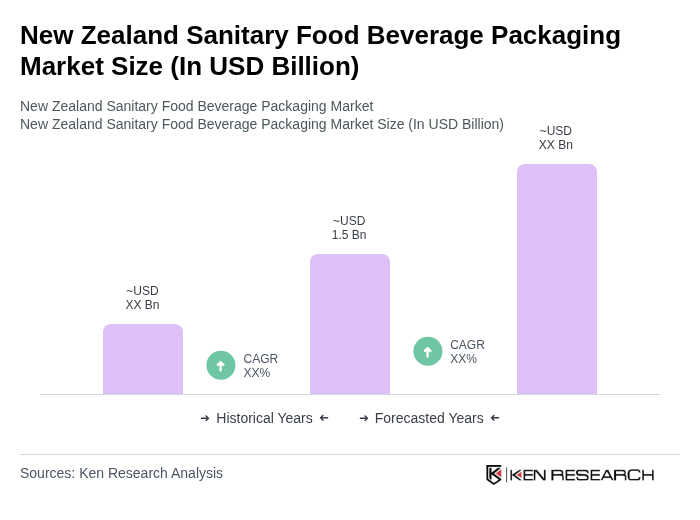
- The New Zealand Sanitary Food Beverage Packaging Market is valued at USD 1.5 billion, based on a five-year historical analysis. This growth is primarily driven by increasing consumer demand for convenience and sustainability in food and beverage packaging. The rise in e-commerce and food delivery services has further accelerated the need for efficient and protective packaging solutions.
- Auckland, Wellington, and Christchurch are the dominant cities in the New Zealand Sanitary Food Beverage Packaging Market. Auckland, being the largest city, serves as a commercial hub with a high concentration of food and beverage manufacturers. Wellington, the capital, has a strong regulatory framework supporting sustainable packaging, while Christchurch is known for its innovative packaging solutions.
- The Waste Minimisation Act 2008, issued by the New Zealand Parliament, sets targets for reducing waste to landfill and requires packaging producers to take responsibility for end-of-life management through stewardship schemes with mandatory reporting and compliance thresholds for large volume producers exceeding 5,000 tonnes annually. This regulation aims to reduce landfill waste and promote sustainable practices within the packaging industry, encouraging manufacturers to adopt eco-friendly materials and processes.
New Zealand Sanitary Food Beverage Packaging Market Segmentation
By Packaging Type:The packaging type segmentation includes various materials used for food and beverage packaging. The subsegments are Paperboard, Rigid Plastic, Glass, Flexible Plastic, Metal, and Others. Each of these packaging types serves different consumer needs and preferences, with some being more sustainable than others.
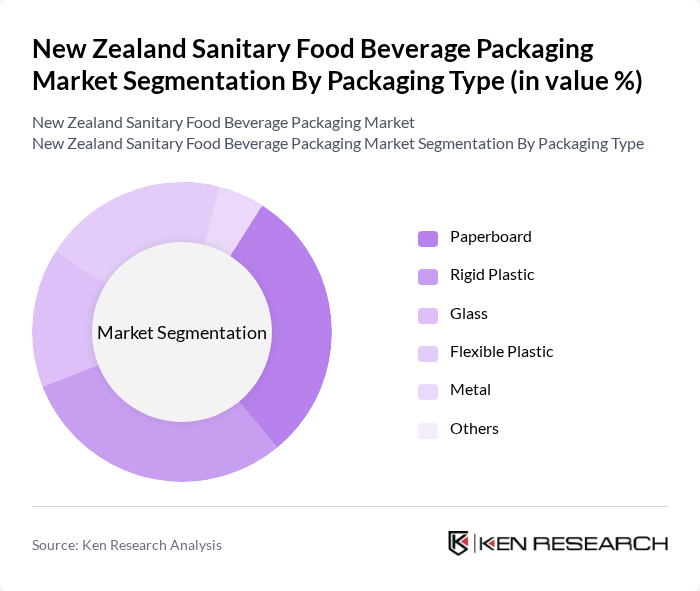
The Rigid Plastic segment is currently dominating the market due to its lightweight, durability, and versatility in packaging various food and beverage products. Consumer preferences are shifting towards convenience, and rigid plastic packaging offers easy handling and storage. Additionally, advancements in recycling technologies are enhancing the sustainability of rigid plastic, making it a preferred choice among manufacturers and consumers alike.
By Product Type:The product type segmentation includes Milk & Other Beverage Cartons, Cups & Liquid-Tight Containers, Folding Food Containers, Boards & Trays, and Others. Each product type caters to specific market needs, with varying levels of demand based on consumer preferences and industry trends.
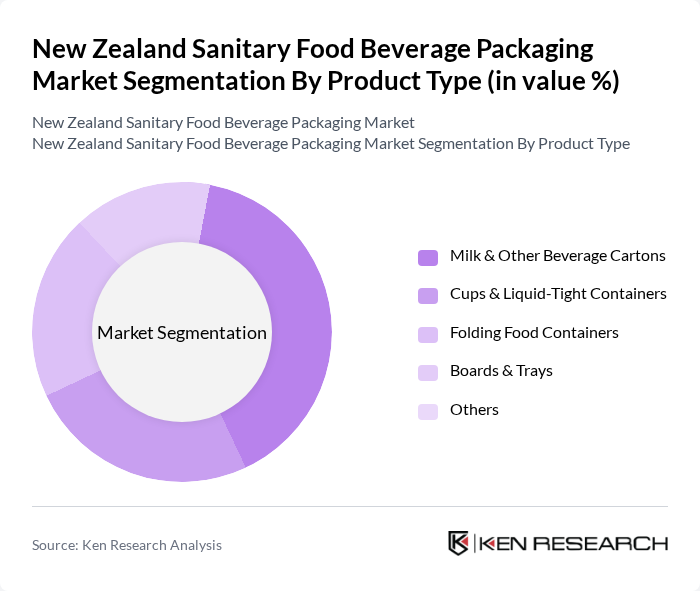
The Milk & Other Beverage Cartons segment is leading the market, driven by the increasing consumption of dairy and non-dairy beverages. The convenience of ready-to-drink options and the growing trend of health-conscious consumers are propelling the demand for these cartons. Additionally, innovations in carton design and functionality are enhancing their appeal, making them a popular choice among manufacturers.
New Zealand Sanitary Food Beverage Packaging Market Competitive Landscape
The New Zealand Sanitary Food Beverage Packaging Market is characterized by a dynamic mix of regional and international players. Leading participants such as Visy Industries, Amcor Limited, Oji Fibre Solutions, PACT Group, Sealed Air Corporation, Crown Holdings, Ball Corporation, Tetra Pak, Huhtamaki, Smurfit Kappa Group, Sappi Limited, Mondi Group, DS Smith, Graphic Packaging International, International Paper contribute to innovation, geographic expansion, and service delivery in this space.
New Zealand Sanitary Food Beverage Packaging Market Industry Analysis
Growth Drivers
- Increasing Demand for Sustainable Packaging Solutions:The New Zealand packaging market is witnessing a significant shift towards sustainable solutions, driven by consumer preferences. In future, the demand for eco-friendly packaging is projected to reach NZD 1.3 billion, reflecting a 15% increase from the previous year. This growth is fueled by government initiatives promoting sustainability, such as the New Zealand Waste Strategy, which aims to reduce plastic waste by 50% in future, encouraging companies to adopt greener practices.
- Growth in the Food and Beverage Industry:The food and beverage sector in New Zealand is expected to generate NZD 31.5 billion in revenue in future, marking a 5% increase from the previous year. This growth is attributed to rising consumer spending and a robust export market, particularly in dairy and meat products. As the industry expands, the demand for sanitary packaging solutions that ensure product safety and quality is becoming increasingly critical, driving market growth.
- Rising Consumer Awareness Regarding Food Safety:Consumer awareness of food safety is at an all-time high, with 80% of New Zealanders prioritizing safe packaging. In future, the market for food safety packaging solutions is projected to reach NZD 850 million, driven by increased scrutiny on foodborne illnesses. This trend is prompting manufacturers to invest in advanced packaging technologies that enhance product integrity and extend shelf life, further propelling market growth.
Market Challenges
- High Costs of Sustainable Materials:The transition to sustainable packaging materials poses a significant challenge due to their higher costs. In future, the average cost of biodegradable materials is expected to be 35% higher than traditional plastics. This price disparity can deter smaller companies from adopting eco-friendly options, limiting the overall market growth. Additionally, the volatility in raw material prices further complicates the financial feasibility of sustainable packaging solutions.
- Stringent Regulatory Requirements:The New Zealand government enforces strict regulations on food packaging, which can be a barrier for manufacturers. Compliance with the Food Safety Standards and Environmental Protection Regulations requires significant investment in quality control and testing. In future, companies may face compliance costs averaging NZD 550,000 annually, which can strain resources, particularly for smaller businesses, hindering their ability to innovate and compete effectively in the market.
New Zealand Sanitary Food Beverage Packaging Market Future Outlook
The New Zealand sanitary food beverage packaging market is poised for transformative growth, driven by increasing consumer demand for sustainable and safe packaging solutions. As e-commerce continues to expand, companies are likely to invest in innovative packaging technologies that enhance product safety and sustainability. Furthermore, collaborations between packaging manufacturers and local food producers are expected to foster the development of customized solutions, addressing specific market needs and enhancing competitiveness in the global market.
Market Opportunities
- Expansion of E-commerce in Food and Beverage:The rise of e-commerce is creating new opportunities for sanitary packaging solutions. In future, online food and beverage sales are projected to reach NZD 5.5 billion, necessitating packaging that ensures product safety during transit. This trend presents a lucrative opportunity for packaging companies to innovate and provide tailored solutions that meet the unique demands of online retailers.
- Innovations in Biodegradable Packaging:The market for biodegradable packaging is set to grow significantly, with an expected value of NZD 450 million in future. Innovations in materials and production processes are driving this growth, as companies seek to meet consumer demand for environmentally friendly options. This presents an opportunity for manufacturers to invest in research and development, positioning themselves as leaders in sustainable packaging solutions.
Scope of the Report
| Segment | Sub-Segments |
|---|---|
| By Packaging Type | Paperboard Rigid Plastic Glass Flexible Plastic Metal Others |
| By Product Type | Milk & Other Beverage Cartons Cups & Liquid-Tight Containers Folding Food Containers Boards & Trays Others |
| By Material | Plastic Glass Metal Paper & Cardboard Others |
| By Application | Dairy Products Beverages Bakery & Confectionery Meat & Seafood Ready-to-Eat Meals |
| By End-User | Food Manufacturers Beverage Producers Restaurants & Food Chains Retailers Others |
| By Region | North Island South Island Others |
Key Target Audience
Investors and Venture Capitalist Firms
Government and Regulatory Bodies (e.g., Ministry for Primary Industries, Environmental Protection Authority)
Manufacturers and Producers
Distributors and Retailers
Packaging Material Suppliers
Food and Beverage Industry Associations
Logistics and Supply Chain Companies
Environmental NGOs and Advocacy Groups
Players Mentioned in the Report:
Visy Industries
Amcor Limited
Oji Fibre Solutions
PACT Group
Sealed Air Corporation
Crown Holdings
Ball Corporation
Tetra Pak
Huhtamaki
Smurfit Kappa Group
Sappi Limited
Mondi Group
DS Smith
Graphic Packaging International
International Paper
Table of Contents
Market Assessment Phase
1. Executive Summary and Approach
2. New Zealand Sanitary Food Beverage Packaging Market Overview
2.1 Key Insights and Strategic Recommendations
2.2 New Zealand Sanitary Food Beverage Packaging Market Overview
2.3 Definition and Scope
2.4 Evolution of Market Ecosystem
2.5 Timeline of Key Regulatory Milestones
2.6 Value Chain & Stakeholder Mapping
2.7 Business Cycle Analysis
2.8 Policy & Incentive Landscape
3. New Zealand Sanitary Food Beverage Packaging Market Analysis
3.1 Growth Drivers
3.1.1 Increasing demand for sustainable packaging solutions
3.1.2 Growth in the food and beverage industry
3.1.3 Rising consumer awareness regarding food safety
3.1.4 Technological advancements in packaging materials
3.2 Market Challenges
3.2.1 High costs of sustainable materials
3.2.2 Stringent regulatory requirements
3.2.3 Competition from alternative packaging solutions
3.2.4 Supply chain disruptions
3.3 Market Opportunities
3.3.1 Expansion of e-commerce in food and beverage
3.3.2 Innovations in biodegradable packaging
3.3.3 Increasing exports of New Zealand food products
3.3.4 Collaborations with local producers
3.4 Market Trends
3.4.1 Shift towards eco-friendly packaging
3.4.2 Customization in packaging designs
3.4.3 Adoption of smart packaging technologies
3.4.4 Growth in reusable packaging solutions
3.5 Government Regulation
3.5.1 Food Safety Standards
3.5.2 Environmental Protection Regulations
3.5.3 Packaging Waste Management Policies
3.5.4 Import and Export Regulations
4. SWOT Analysis
5. Stakeholder Analysis
6. Porter's Five Forces Analysis
7. New Zealand Sanitary Food Beverage Packaging Market Size, 2019-2024
7.1 By Value
7.2 By Volume
7.3 By Average Selling Price
8. New Zealand Sanitary Food Beverage Packaging Market Segmentation
8.1 By Packaging Type
8.1.1 Paperboard
8.1.2 Rigid Plastic
8.1.3 Glass
8.1.4 Flexible Plastic
8.1.5 Metal
8.1.6 Others
8.2 By Product Type
8.2.1 Milk & Other Beverage Cartons
8.2.2 Cups & Liquid-Tight Containers
8.2.3 Folding Food Containers
8.2.4 Boards & Trays
8.2.5 Others
8.3 By Material
8.3.1 Plastic
8.3.2 Glass
8.3.3 Metal
8.3.4 Paper & Cardboard
8.3.5 Others
8.4 By Application
8.4.1 Dairy Products
8.4.2 Beverages
8.4.3 Bakery & Confectionery
8.4.4 Meat & Seafood
8.4.5 Ready-to-Eat Meals
8.5 By End-User
8.5.1 Food Manufacturers
8.5.2 Beverage Producers
8.5.3 Restaurants & Food Chains
8.5.4 Retailers
8.5.5 Others
8.6 By Region
8.6.1 North Island
8.6.2 South Island
8.6.3 Others
9. New Zealand Sanitary Food Beverage Packaging Market Competitive Analysis
9.1 Market Share of Key Players
9.2 Cross Comparison of Key Players
9.2.1 Company Name
9.2.2 Revenue Growth Rate (CAGR %)
9.2.3 Market Share (%)
9.2.4 EBITDA Margin (%)
9.2.5 Return on Equity (ROE %)
9.2.6 Customer Acquisition Cost (CAC)
9.2.7 Net Promoter Score (NPS)
9.2.8 Production Capacity Utilization (%)
9.2.9 R&D Investment as % of Revenue
9.2.10 Sustainability Score (ESG Rating)
9.3 SWOT Analysis of Top Players
9.4 Pricing Analysis
9.5 Detailed Profile of Major Companies
9.5.1 Visy Industries
9.5.2 Amcor Limited
9.5.3 Oji Fibre Solutions
9.5.4 PACT Group
9.5.5 Sealed Air Corporation
9.5.6 Crown Holdings
9.5.7 Ball Corporation
9.5.8 Tetra Pak
9.5.9 Huhtamaki
9.5.10 Smurfit Kappa Group
9.5.11 Sappi Limited
9.5.12 Mondi Group
9.5.13 DS Smith
9.5.14 Graphic Packaging International
9.5.15 International Paper
10. New Zealand Sanitary Food Beverage Packaging Market End-User Analysis
10.1 Procurement Behavior of Key Ministries
10.1.1 Ministry of Health
10.1.2 Ministry for Primary Industries
10.1.3 Ministry of Business, Innovation and Employment
10.1.4 Others
10.2 Corporate Spend on Infrastructure & Energy
10.2.1 Food and Beverage Sector Investments
10.2.2 Packaging Technology Upgrades
10.2.3 Sustainability Initiatives
10.2.4 Others
10.3 Pain Point Analysis by End-User Category
10.3.1 Food Manufacturers
10.3.2 Beverage Producers
10.3.3 Retailers
10.3.4 Food Service Providers
10.3.5 Others
10.4 User Readiness for Adoption
10.4.1 Awareness of Sustainable Packaging
10.4.2 Willingness to Invest in New Technologies
10.4.3 Training and Support Needs
10.4.4 Others
10.5 Post-Deployment ROI and Use Case Expansion
10.5.1 Measurement of ROI
10.5.2 Case Studies of Successful Implementations
10.5.3 Future Use Case Opportunities
10.5.4 Others
11. New Zealand Sanitary Food Beverage Packaging Market Future Size, 2025-2030
11.1 By Value
11.2 By Volume
11.3 By Average Selling Price
Go-To-Market Strategy Phase
1. Whitespace Analysis + Business Model Canvas
1.1 Market Gaps Identification
1.2 Business Model Development
2. Marketing and Positioning Recommendations
2.1 Branding Strategies
2.2 Product USPs
3. Distribution Plan
3.1 Urban Retail vs Rural NGO Tie-ups
4. Channel & Pricing Gaps
4.1 Underserved Routes
4.2 Pricing Bands
5. Unmet Demand & Latent Needs
5.1 Category Gaps
5.2 Consumer Segments
6. Customer Relationship
6.1 Loyalty Programs
6.2 After-sales Service
7. Value Proposition
7.1 Sustainability
7.2 Integrated Supply Chains
8. Key Activities
8.1 Regulatory Compliance
8.2 Branding
8.3 Distribution Setup
9. Entry Strategy Evaluation
9.1 Domestic Market Entry Strategy
9.1.1 Product Mix
9.1.2 Pricing Band
9.1.3 Packaging
9.2 Export Entry Strategy
9.2.1 Target Countries
9.2.2 Compliance Roadmap
10. Entry Mode Assessment
10.1 JV
10.2 Greenfield
10.3 M&A
10.4 Distributor Model
11. Capital and Timeline Estimation
11.1 Capital Requirements
11.2 Timelines
12. Control vs Risk Trade-Off
12.1 Ownership vs Partnerships
13. Profitability Outlook
13.1 Breakeven Analysis
13.2 Long-term Sustainability
14. Potential Partner List
14.1 Distributors
14.2 JVs
14.3 Acquisition Targets
15. Execution Roadmap
15.1 Phased Plan for Market Entry
15.1.1 Market Setup
15.1.2 Market Entry
15.1.3 Growth Acceleration
15.1.4 Scale & Stabilize
15.2 Key Activities and Milestones
15.2.1 Milestone Planning
15.2.2 Activity Tracking
Research Methodology
Phase 1: Approach1
Desk Research
- Analysis of industry reports from New Zealand Food Safety and relevant government agencies
- Review of market trends and forecasts from trade associations and packaging industry publications
- Examination of consumer behavior studies related to food and beverage packaging preferences
Primary Research
- Interviews with packaging manufacturers and suppliers in the food and beverage sector
- Surveys conducted with food and beverage companies regarding their packaging choices and sustainability practices
- Focus groups with consumers to gather insights on packaging preferences and perceptions
Validation & Triangulation
- Cross-validation of findings through multiple data sources, including sales data and market reports
- Triangulation of insights from primary interviews with secondary research findings
- Sanity checks through expert panel reviews comprising industry veterans and market analysts
Phase 2: Market Size Estimation1
Top-down Assessment
- Estimation of market size based on national food and beverage sales data and packaging expenditure
- Segmentation of the market by packaging type (e.g., flexible, rigid, and sustainable options)
- Incorporation of growth rates from related sectors such as e-commerce and food delivery services
Bottom-up Modeling
- Collection of data on production volumes from leading packaging firms in New Zealand
- Estimation of average packaging costs based on material types and production processes
- Calculation of market size using volume x cost methodology for each packaging segment
Forecasting & Scenario Analysis
- Multi-factor regression analysis incorporating economic indicators and consumer trends
- Scenario modeling based on potential regulatory changes and shifts in consumer preferences towards sustainability
- Development of baseline, optimistic, and pessimistic forecasts through 2030
Phase 3: CATI Sample Composition1
| Scope Item/Segment | Sample Size | Target Respondent Profiles |
|---|---|---|
| Food Packaging Manufacturers | 45 | Production Managers, R&D Heads |
| Beverage Packaging Suppliers | 40 | Sales Directors, Product Managers |
| Retail Food and Beverage Companies | 50 | Procurement Officers, Marketing Managers |
| Consumer Focus Groups | 8 | General Consumers, Eco-conscious Shoppers |
| Regulatory Bodies and Industry Experts | 12 | Policy Makers, Industry Analysts |
Frequently Asked Questions
What is the current value of the New Zealand Sanitary Food Beverage Packaging Market?
The New Zealand Sanitary Food Beverage Packaging Market is valued at approximately USD 1.5 billion, reflecting a significant growth trend driven by consumer demand for convenience and sustainability in packaging solutions.
Which cities are the key players in the New Zealand Sanitary Food Beverage Packaging Market?
What are the main drivers of growth in the New Zealand Sanitary Food Beverage Packaging Market?
What challenges does the New Zealand Sanitary Food Beverage Packaging Market face?
Other Regional/Country Reports
Other Adjacent Reports
KSA E-commerce Packaging Market
Global Packaging Machinery Market Size, Share & Forecast, By Machine Type, End-Use Industry & Technology, 2025-2032Why Buy From Us?

What makes us stand out is that our consultants follow Robust, Refine and Result (RRR) methodology. Robust for clear definitions, approaches and sanity checking, Refine for differentiating respondents' facts and opinions, and Result for presenting data with story.

We have set a benchmark in the industry by offering our clients with syndicated and customized market research reports featuring coverage of entire market as well as meticulous research and analyst insights.

While we don't replace traditional research, we flip the method upside down. Our dual approach of Top Bottom & Bottom Top ensures quality deliverable by not just verifying company fundamentals but also looking at the sector and macroeconomic factors.

With one step in the future, our research team constantly tries to show you the bigger picture. We help with some of the tough questions you may encounter along the way: How is the industry positioned? Best marketing channel? KPI's of competitors? By aligning every element, we help maximize success.

Our report gives you instant access to the answers and sources that other companies might choose to hide. We elaborate each steps of research methodology we have used and showcase you the sample size to earn your trust.

If you need any support, we are here! We pride ourselves on universe strength, data quality, and quick, friendly, and professional service.