About the Report
Base Year 2024New Zealand Specialty Insurance Market Overview
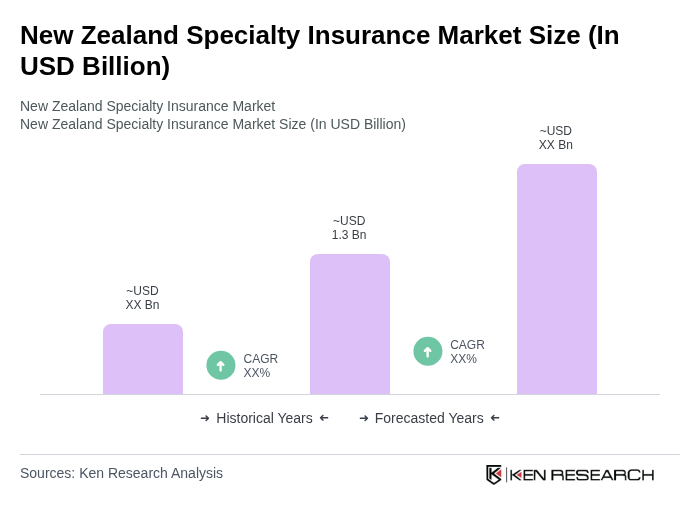
- The New Zealand Specialty Insurance Market is valued at USD 1.3 billion, based on a five-year historical analysis. This growth is primarily driven by increasing demand for specialized coverage options, particularly in sectors such as healthcare, technology, and construction, where unique risks necessitate tailored insurance solutions, alongside rising cyber threats, climate-related events, and digital transformation in commercial lines.
- Auckland, Wellington, and Christchurch are the dominant cities in the New Zealand Specialty Insurance Market. Auckland leads due to its status as the largest city and economic hub, while Wellington is significant for its government and public sector presence, and Christchurch is pivotal for its rebuilding efforts post-earthquake, driving demand for various insurance products.
- The Insurance (Prudential Supervision) Act 2010, issued by the Reserve Bank of New Zealand, mandates that all insurers maintain prescribed capital levels based on solvency margins, conduct regular solvency assessments, and submit quarterly financial reports including balance sheets and risk exposures. This regulation requires compliance with licensing standards for non-life insurers, minimum capital thresholds starting at NZD 5 million, and ongoing prudential supervision to ensure financial soundness and policyholder protection.
New Zealand Specialty Insurance Market Segmentation
By Type:
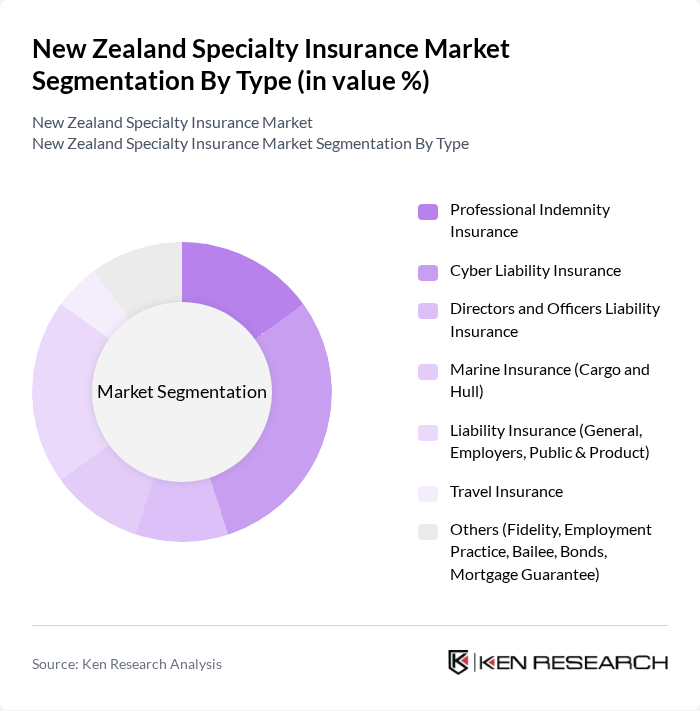
The specialty insurance market is segmented into various types, including Professional Indemnity Insurance, Cyber Liability Insurance, Directors and Officers Liability Insurance, Marine Insurance (Cargo and Hull), Liability Insurance (General, Employers, Public & Product), Travel Insurance, and Others (Fidelity, Employment Practice, Bailee, Bonds, Mortgage Guarantee). Among these, Cyber Liability Insurance is currently dominating the market due to the increasing frequency of cyberattacks and data breaches, prompting businesses to seek comprehensive coverage to protect against potential financial losses and reputational damage. The growing awareness of cybersecurity risks has led to a surge in demand for this type of insurance, making it a critical component of risk management strategies for organizations across various sectors.
By End-User:
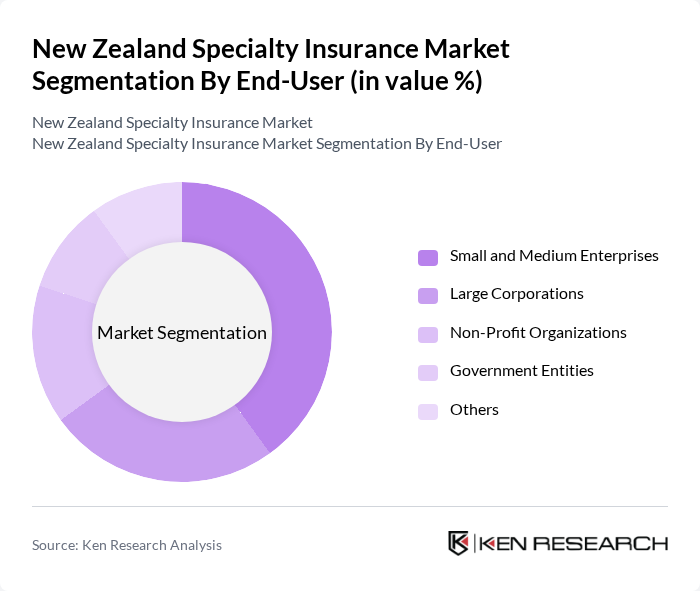
The end-user segmentation includes Small and Medium Enterprises, Large Corporations, Non-Profit Organizations, Government Entities, and Others. Small and Medium Enterprises (SMEs) are currently the leading end-user segment, driven by the increasing recognition of the importance of insurance in safeguarding business operations against unforeseen risks. SMEs are increasingly investing in specialty insurance products to protect their assets and ensure business continuity, particularly in sectors vulnerable to liability claims and operational disruptions. This trend is further supported by government initiatives aimed at promoting entrepreneurship and business resilience, with large corporations also showing strong demand for tailored cyber and compliance solutions.
New Zealand Specialty Insurance Market Competitive Landscape
The New Zealand Specialty Insurance Market is characterized by a dynamic mix of regional and international players. Leading participants such as AIG Insurance New Zealand, Vero Insurance New Zealand, QBE Insurance New Zealand, IAG New Zealand, FMG Insurance, Southern Cross Medical Care Society, Tower Insurance, Partners Life, AA Insurance, Chubb Insurance New Zealand, Berkshire Hathaway Specialty Insurance New Zealand, Zurich Australian Insurance (New Zealand), nib New Zealand, AIA New Zealand, Resolution Life Australasia contribute to innovation, geographic expansion, and service delivery in this space.
New Zealand Specialty Insurance Market Industry Analysis
Growth Drivers
- Increasing Demand for Niche Insurance Products:The New Zealand specialty insurance market is experiencing a surge in demand for niche products, driven by unique consumer needs. In future, the market for specialty insurance is projected to reach NZD 1.3 billion, reflecting a growing recognition of tailored coverage. This demand is particularly evident in sectors like cyber insurance, which has seen a 30% increase in inquiries, as businesses seek protection against evolving digital threats, according to the Insurance Council of New Zealand.
- Rise in Natural Disasters and Climate-Related Risks:New Zealand's geographical vulnerability to natural disasters, including earthquakes and floods, has heightened the need for specialized insurance products. In future, the country is expected to allocate NZD 600 million for disaster recovery efforts, underscoring the urgency for comprehensive coverage. The increasing frequency of climate-related events, with a reported 25% rise in claims related to such incidents, further propels the demand for specialty insurance solutions tailored to mitigate these risks.
- Expansion of the Digital Insurance Landscape:The digital transformation within the insurance sector is a significant growth driver for specialty insurance in New Zealand. By future, it is estimated that 70% of insurance transactions will occur online, facilitating easier access to niche products. Insurtech innovations, such as AI-driven underwriting and personalized policy offerings, are expected to enhance customer engagement, with a projected 30% increase in online policy purchases, according to industry reports from the Financial Markets Authority.
Market Challenges
- Regulatory Compliance Complexities:Navigating the regulatory landscape poses a significant challenge for specialty insurance providers in New Zealand. The Insurance Prudential Supervision Act and the Financial Markets Conduct Act impose stringent compliance requirements, which can lead to increased operational costs. In future, compliance-related expenses are projected to rise by 20%, impacting profitability and hindering the ability to innovate and offer competitive products in the market.
- Limited Consumer Understanding of Specialty Products:A major barrier to growth in the specialty insurance market is the limited understanding among consumers regarding niche products. Approximately 45% of potential customers are unaware of available options, leading to underutilization of specialized coverage. This lack of awareness can result in missed opportunities for insurers, as many consumers opt for standard policies that may not adequately address their unique risks, according to recent surveys conducted by the Insurance Council of New Zealand.
New Zealand Specialty Insurance Market Future Outlook
The future of the New Zealand specialty insurance market appears promising, driven by technological advancements and evolving consumer needs. As insurtech continues to reshape the industry, insurers are likely to adopt more personalized offerings, enhancing customer satisfaction. Additionally, the increasing focus on sustainability will encourage the development of green insurance products, catering to environmentally conscious consumers. These trends indicate a dynamic market landscape, with opportunities for growth and innovation in the coming years.
Market Opportunities
- Development of Tailored Insurance Solutions:There is a significant opportunity for insurers to create customized products that address specific consumer needs. By leveraging data analytics, companies can identify gaps in coverage and develop solutions that cater to niche markets, potentially increasing market share by 25% in underserved sectors.
- Partnerships with Technology Firms for Innovation:Collaborating with technology firms can drive innovation in the specialty insurance sector. By integrating advanced technologies such as AI and machine learning, insurers can enhance underwriting processes and improve risk assessment, leading to more accurate pricing and a projected 20% reduction in claims processing time.
Scope of the Report
| Segment | Sub-Segments |
|---|---|
| By Type | Professional Indemnity Insurance Cyber Liability Insurance Directors and Officers Liability Insurance Marine Insurance (Cargo and Hull) Liability Insurance (General, Employers, Public & Product) Travel Insurance Others (Fidelity, Employment Practice, Bailee, Bonds, Mortgage Guarantee) |
| By End-User | Small and Medium Enterprises Large Corporations Non-Profit Organizations Government Entities Others |
| By Industry | Construction and Engineering Financial Services Healthcare and Professional Services Agriculture and Dairy Others |
| By Coverage Type | Comprehensive Coverage Limited Coverage Customized Coverage Others |
| By Distribution Channel | Direct Sales Brokers Online Platforms Agents Others |
| By Policy Duration | Short-Term Policies Long-Term Policies Others |
| By Risk Type | Operational Risks Financial Risks Reputational Risks Others |
Key Target Audience
Investors and Venture Capitalist Firms
Government and Regulatory Bodies (e.g., Reserve Bank of New Zealand, Financial Markets Authority)
Insurance Brokers and Agents
Risk Management Professionals
Corporate Risk Managers
Underwriters and Actuaries
Industry Associations (e.g., Insurance Council of New Zealand)
Reinsurers and Specialty Insurers
Players Mentioned in the Report:
AIG Insurance New Zealand
Vero Insurance New Zealand
QBE Insurance New Zealand
IAG New Zealand
FMG Insurance
Southern Cross Medical Care Society
Tower Insurance
Partners Life
AA Insurance
Chubb Insurance New Zealand
Berkshire Hathaway Specialty Insurance New Zealand
Zurich Australian Insurance (New Zealand)
nib New Zealand
AIA New Zealand
Resolution Life Australasia
Table of Contents
Market Assessment Phase
1. Executive Summary and Approach
2. New Zealand Specialty Insurance Market Overview
2.1 Key Insights and Strategic Recommendations
2.2 New Zealand Specialty Insurance Market Overview
2.3 Definition and Scope
2.4 Evolution of Market Ecosystem
2.5 Timeline of Key Regulatory Milestones
2.6 Value Chain & Stakeholder Mapping
2.7 Business Cycle Analysis
2.8 Policy & Incentive Landscape
3. New Zealand Specialty Insurance Market Analysis
3.1 Growth Drivers
3.1.1 Increasing demand for niche insurance products
3.1.2 Rise in natural disasters and climate-related risks
3.1.3 Growing awareness of specialized coverage options
3.1.4 Expansion of the digital insurance landscape
3.2 Market Challenges
3.2.1 Regulatory compliance complexities
3.2.2 Intense competition among providers
3.2.3 Limited consumer understanding of specialty products
3.2.4 Economic fluctuations impacting premium affordability
3.3 Market Opportunities
3.3.1 Development of tailored insurance solutions
3.3.2 Partnerships with technology firms for innovation
3.3.3 Expansion into underinsured sectors
3.3.4 Increased focus on sustainability and green insurance
3.4 Market Trends
3.4.1 Growth of insurtech startups
3.4.2 Shift towards personalized insurance offerings
3.4.3 Integration of AI and data analytics in underwriting
3.4.4 Emphasis on customer experience and engagement
3.5 Government Regulation
3.5.1 Insurance Prudential Supervision Act
3.5.2 Financial Markets Conduct Act
3.5.3 Anti-Money Laundering and Countering Financing of Terrorism Act
3.5.4 Consumer Guarantees Act
4. SWOT Analysis
5. Stakeholder Analysis
6. Porter's Five Forces Analysis
7. New Zealand Specialty Insurance Market Market Size, 2019-2024
7.1 By Value
7.2 By Volume
7.3 By Average Selling Price
8. New Zealand Specialty Insurance Market Segmentation
8.1 By Type
8.1.1 Professional Indemnity Insurance
8.1.2 Cyber Liability Insurance
8.1.3 Directors and Officers Liability Insurance
8.1.4 Marine Insurance (Cargo and Hull)
8.1.5 Liability Insurance (General, Employers, Public & Product)
8.1.6 Travel Insurance
8.1.7 Others (Fidelity, Employment Practice, Bailee, Bonds, Mortgage Guarantee)
8.2 By End-User
8.2.1 Small and Medium Enterprises
8.2.2 Large Corporations
8.2.3 Non-Profit Organizations
8.2.4 Government Entities
8.2.5 Others
8.3 By Industry
8.3.1 Construction and Engineering
8.3.2 Financial Services
8.3.3 Healthcare and Professional Services
8.3.4 Agriculture and Dairy
8.3.5 Others
8.4 By Coverage Type
8.4.1 Comprehensive Coverage
8.4.2 Limited Coverage
8.4.3 Customized Coverage
8.4.4 Others
8.5 By Distribution Channel
8.5.1 Direct Sales
8.5.2 Brokers
8.5.3 Online Platforms
8.5.4 Agents
8.5.5 Others
8.6 By Policy Duration
8.6.1 Short-Term Policies
8.6.2 Long-Term Policies
8.6.3 Others
8.7 By Risk Type
8.7.1 Operational Risks
8.7.2 Financial Risks
8.7.3 Reputational Risks
8.7.4 Others
9. New Zealand Specialty Insurance Market Competitive Analysis
9.1 Market Share of Key Players
9.2 Cross Comparison of Key Players
9.2.1 Company Name
9.2.2 Group Size (Large, Medium, or Small as per industry convention)
9.2.3 Premium Volume (NZD Million)
9.2.4 Claims Settlement Ratio (%)
9.2.5 Underwriting Profit Margin (%)
9.2.6 Market Penetration Rate (%)
9.2.7 Customer Retention Rate (%)
9.2.8 Return on Equity (ROE %)
9.2.9 Product Innovation Index
9.2.10 Distribution Channel Efficiency Score
9.3 SWOT Analysis of Top Players
9.4 Pricing Analysis
9.5 Detailed Profile of Major Companies
9.5.1 AIG Insurance New Zealand
9.5.2 Vero Insurance New Zealand
9.5.3 QBE Insurance New Zealand
9.5.4 IAG New Zealand
9.5.5 FMG Insurance
9.5.6 Southern Cross Medical Care Society
9.5.7 Tower Insurance
9.5.8 Partners Life
9.5.9 AA Insurance
9.5.10 Chubb Insurance New Zealand
9.5.11 Berkshire Hathaway Specialty Insurance New Zealand
9.5.12 Zurich Australian Insurance (New Zealand)
9.5.13 nib New Zealand
9.5.14 AIA New Zealand
9.5.15 Resolution Life Australasia
10. New Zealand Specialty Insurance Market End-User Analysis
10.1 Procurement Behavior of Key Ministries
10.1.1 Budget Allocation Trends
10.1.2 Decision-Making Processes
10.1.3 Preferred Insurance Providers
10.1.4 Contract Duration Preferences
10.2 Corporate Spend on Infrastructure & Energy
10.2.1 Investment Trends in Specialty Insurance
10.2.2 Sector-Specific Spending Patterns
10.2.3 Risk Management Budgets
10.2.4 Insurance Premium Trends
10.3 Pain Point Analysis by End-User Category
10.3.1 Coverage Gaps
10.3.2 Claims Processing Delays
10.3.3 Cost of Premiums
10.3.4 Complexity of Policies
10.4 User Readiness for Adoption
10.4.1 Awareness Levels
10.4.2 Training and Support Needs
10.4.3 Technology Adoption Rates
10.4.4 Feedback Mechanisms
10.5 Post-Deployment ROI and Use Case Expansion
10.5.1 Performance Metrics
10.5.2 Case Studies of Successful Implementations
10.5.3 Future Expansion Opportunities
10.5.4 Customer Feedback and Iteration
11. New Zealand Specialty Insurance Market Future Size, 2025-2030
11.1 By Value
11.2 By Volume
11.3 By Average Selling Price
Go-To-Market Strategy Phase
1. Whitespace Analysis + Business Model Canvas
1.1 Market Gaps Identification
1.2 Value Proposition Development
1.3 Revenue Streams Analysis
1.4 Cost Structure Evaluation
1.5 Key Partnerships Exploration
1.6 Customer Segmentation
1.7 Channels of Distribution
2. Marketing and Positioning Recommendations
2.1 Branding Strategies
2.2 Product USPs
2.3 Target Audience Identification
2.4 Communication Strategies
2.5 Digital Marketing Approaches
2.6 Customer Engagement Tactics
2.7 Performance Metrics
3. Distribution Plan
3.1 Urban Retail Strategies
3.2 Rural NGO Tie-Ups
3.3 Online Distribution Channels
3.4 Direct Sales Approaches
3.5 Partnership Opportunities
3.6 Logistics and Supply Chain Considerations
3.7 Performance Evaluation
4. Channel & Pricing Gaps
4.1 Underserved Routes
4.2 Pricing Bands Analysis
4.3 Competitor Pricing Strategies
4.4 Customer Sensitivity to Pricing
4.5 Value-Based Pricing Models
4.6 Discount and Incentive Structures
4.7 Pricing Optimization Techniques
5. Unmet Demand & Latent Needs
5.1 Category Gaps
5.2 Consumer Segments Analysis
5.3 Emerging Trends Identification
5.4 Customer Feedback Mechanisms
5.5 Market Research Insights
5.6 Future Demand Projections
5.7 Product Development Opportunities
6. Customer Relationship
6.1 Loyalty Programs
6.2 After-Sales Service
6.3 Customer Feedback Loops
6.4 Relationship Management Strategies
6.5 Retention Strategies
6.6 Customer Experience Enhancements
6.7 Performance Metrics
7. Value Proposition
7.1 Sustainability Initiatives
7.2 Integrated Supply Chains
7.3 Unique Selling Points
7.4 Customer-Centric Approaches
7.5 Competitive Advantages
7.6 Market Differentiation Strategies
7.7 Performance Metrics
8. Key Activities
8.1 Regulatory Compliance
8.2 Branding Initiatives
8.3 Distribution Setup
8.4 Training and Development
8.5 Marketing Campaigns
8.6 Performance Monitoring
8.7 Continuous Improvement Processes
9. Entry Strategy Evaluation
9.1 Domestic Market Entry Strategy
9.1.1 Product Mix Considerations
9.1.2 Pricing Band Strategies
9.1.3 Packaging Options
9.2 Export Entry Strategy
9.2.1 Target Countries Analysis
9.2.2 Compliance Roadmap
10. Entry Mode Assessment
10.1 Joint Ventures
10.2 Greenfield Investments
10.3 Mergers & Acquisitions
10.4 Distributor Models
10.5 Risk Assessment
10.6 Strategic Fit Evaluation
10.7 Performance Metrics
11. Capital and Timeline Estimation
11.1 Capital Requirements
11.2 Timelines for Implementation
11.3 Financial Projections
11.4 Funding Sources
11.5 Risk Management Strategies
11.6 Performance Metrics
12. Control vs Risk Trade-Off
12.1 Ownership Considerations
12.2 Partnership Opportunities
12.3 Risk Mitigation Strategies
12.4 Performance Metrics
13. Profitability Outlook
13.1 Breakeven Analysis
13.2 Long-Term Sustainability
13.3 Financial Health Indicators
13.4 Market Positioning Strategies
13.5 Performance Metrics
14. Potential Partner List
14.1 Distributors
14.2 Joint Ventures
14.3 Acquisition Targets
14.4 Strategic Alliances
14.5 Performance Metrics
15. Execution Roadmap
15.1 Phased Plan for Market Entry
15.1.1 Market Setup
15.1.2 Market Entry
15.1.3 Growth Acceleration
15.1.4 Scale & Stabilize
15.2 Key Activities and Milestones
15.2.1 Timeline for Key Activities
15.2.2 Milestone Tracking
Research Methodology
Phase 1: Approach1
Desk Research
- Analysis of industry reports from the Insurance Council of New Zealand
- Review of government publications and statistics on insurance market trends
- Examination of academic journals and white papers on specialty insurance products
Primary Research
- Interviews with underwriters and risk assessors in specialty insurance firms
- Surveys targeting brokers and agents specializing in niche insurance markets
- Focus groups with policyholders to understand their needs and preferences
Validation & Triangulation
- Cross-validation of findings with data from industry associations and regulatory bodies
- Triangulation of insights from primary interviews and secondary data sources
- Sanity checks through expert panel discussions with industry veterans
Phase 2: Market Size Estimation1
Top-down Assessment
- Estimation of total market size based on GDP contribution from the insurance sector
- Segmentation of specialty insurance by industry verticals such as marine, aviation, and cyber
- Incorporation of macroeconomic indicators and demographic trends affecting insurance uptake
Bottom-up Modeling
- Collection of premium data from leading specialty insurance providers
- Analysis of claims data to assess loss ratios and profitability
- Volume estimates based on policy counts and average premiums across segments
Forecasting & Scenario Analysis
- Multi-variable forecasting using historical growth rates and emerging market trends
- Scenario modeling based on regulatory changes and economic fluctuations
- Development of baseline, optimistic, and pessimistic forecasts through 2030
Phase 3: CATI Sample Composition1
| Scope Item/Segment | Sample Size | Target Respondent Profiles |
|---|---|---|
| Marine Insurance Providers | 45 | Underwriters, Claims Adjusters |
| Aviation Insurance Specialists | 40 | Risk Managers, Aviation Brokers |
| Cyber Insurance Market | 42 | IT Security Officers, Compliance Managers |
| Construction Insurance Sector | 38 | Project Managers, Safety Officers |
| Healthcare Liability Insurance | 41 | Healthcare Administrators, Insurance Agents |
Frequently Asked Questions
What is the current value of the New Zealand Specialty Insurance Market?
The New Zealand Specialty Insurance Market is valued at approximately USD 1.3 billion, reflecting a growing demand for specialized coverage options in sectors such as healthcare, technology, and construction, driven by unique risks and rising cyber threats.
Which cities dominate the New Zealand Specialty Insurance Market?
What types of insurance are included in the New Zealand Specialty Insurance Market?
Who are the primary end-users of specialty insurance in New Zealand?
Other Regional/Country Reports
Other Adjacent Reports
UAE Property and Casualty Insurance Market
Australia Cyber Security Market Size, Share & Forecast, By Solution Type, Deployment Model & End-Use Industry, 2025-2032Saudi Arabia Health Insurance Market Size, Share & Forecast, By Product Type, Customer Segment & Distribution Channel, 2026-2032Japan Construction Insurance Market
South Africa Marine Insurance Market
India Travel Insurance Market Size, Share & Forecast, By Product Type, Customer Segment & Distribution Channel, 2026-2032Vietnam Liability Insurance Market
UAE insurtech market size, share, growth drivers, trends, opportunities & forecast 2025–2030Germany Reinsurance MarketBahrain Risk Management Services Market
Why Buy From Us?

What makes us stand out is that our consultants follow Robust, Refine and Result (RRR) methodology. Robust for clear definitions, approaches and sanity checking, Refine for differentiating respondents' facts and opinions, and Result for presenting data with story.

We have set a benchmark in the industry by offering our clients with syndicated and customized market research reports featuring coverage of entire market as well as meticulous research and analyst insights.

While we don't replace traditional research, we flip the method upside down. Our dual approach of Top Bottom & Bottom Top ensures quality deliverable by not just verifying company fundamentals but also looking at the sector and macroeconomic factors.

With one step in the future, our research team constantly tries to show you the bigger picture. We help with some of the tough questions you may encounter along the way: How is the industry positioned? Best marketing channel? KPI's of competitors? By aligning every element, we help maximize success.

Our report gives you instant access to the answers and sources that other companies might choose to hide. We elaborate each steps of research methodology we have used and showcase you the sample size to earn your trust.

If you need any support, we are here! We pride ourselves on universe strength, data quality, and quick, friendly, and professional service.