New Zealand Veterinary Rehabilitation Services Market Report Size Share Growth Drivers Trends Opportunities And Forecast 2025–2030

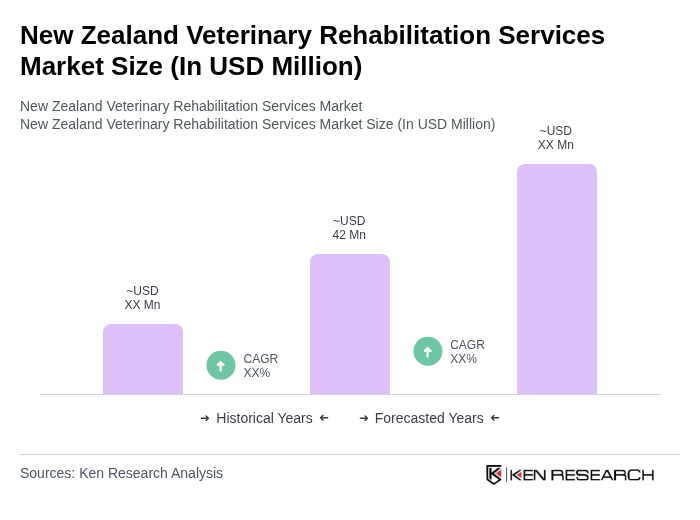
The New Zealand Veterinary Rehabilitation Services Market, valued at USD 42 million, is growing due to increased pet ownership, awareness of rehab benefits, and advancements in therapies like hydrotherapy.

Region:Asia

Author(s):Geetanshi

Product Code:KRAE0517

Pages:95

Published On:February 2026
About the Report

Base Year 2024

New Zealand Veterinary Rehabilitation Services Market Overview

  • The New Zealand Veterinary Rehabilitation Services Market is valued at USD 42 million, based on a five-year historical analysis. This growth is primarily driven by the increasing awareness of pet health and wellness, alongside a rise in the number of pet owners seeking specialized care for their animals. The market is also supported by advancements in veterinary technology and rehabilitation techniques, pet humanization trends, and rising prevalence of musculoskeletal and orthopedic disorders among animals, which enhance treatment outcomes for various animal conditions.
  • Key cities such as Auckland, Wellington, and Christchurch dominate the market due to their higher population densities and a greater concentration of veterinary practices. These urban areas have a more significant number of pet owners who are willing to invest in rehabilitation services, thus creating a robust demand for specialized veterinary care. The presence of leading veterinary hospitals and rehabilitation centers in these cities further strengthens their market position.
  • The Veterinary Surgeons Act 1999, issued by the Veterinary Council of New Zealand, requires veterinary rehabilitation facilities to adhere to specific standards of care and treatment protocols, including registration of practitioners, compliance with professional conduct rules, and maintenance of hygiene and welfare standards for animal treatments. This regulation ensures the safety and efficacy of rehabilitation practices, thereby enhancing the overall quality of veterinary services available to pet owners and promoting better health outcomes for animals.
New Zealand Veterinary Rehabilitation Services Market Size

New Zealand Veterinary Rehabilitation Services Market Segmentation

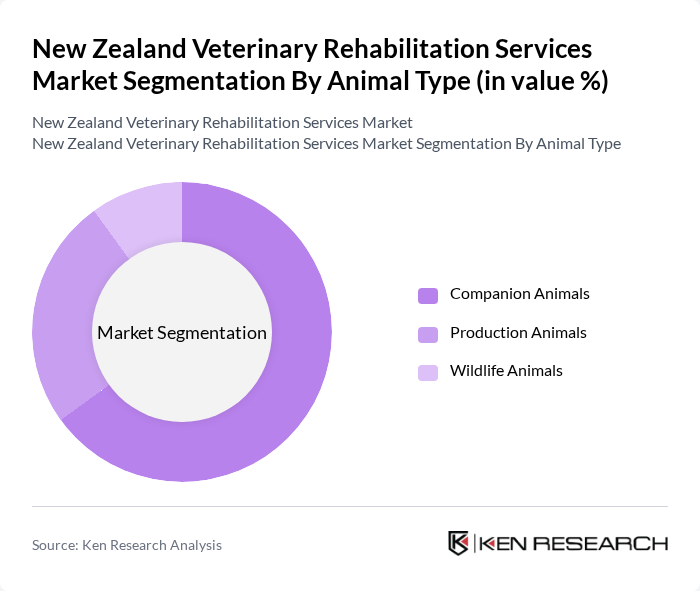
By Animal Type:The market is segmented into three primary categories: Companion Animals, Production Animals, and Wildlife Animals. Among these, Companion Animals dominate the market due to the increasing trend of pet ownership and the growing awareness of animal health and wellness. Pet owners are increasingly seeking rehabilitation services for their pets, particularly for conditions arising from injuries or surgeries. This segment is characterized by a high demand for personalized care and specialized treatment options.
New Zealand Veterinary Rehabilitation Services Market segmentation by Animal Type.

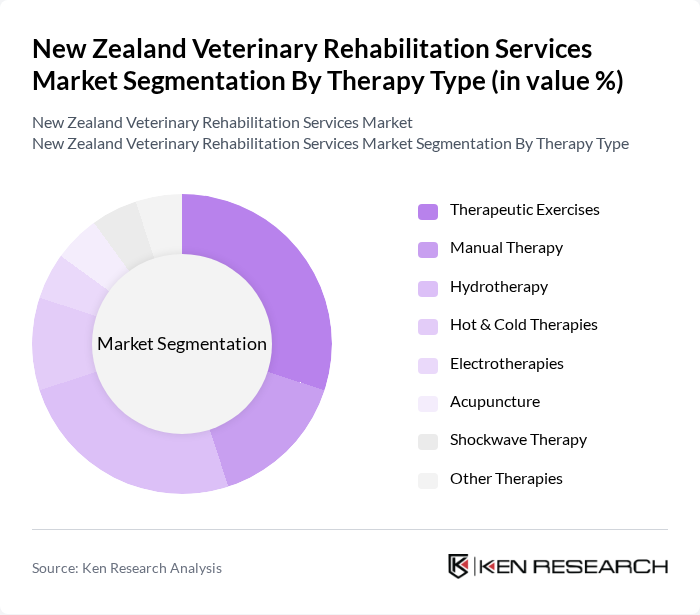
By Therapy Type:The market is further segmented into various therapy types, including Therapeutic Exercises, Manual Therapy, Hydrotherapy, Hot & Cold Therapies, Electrotherapies, Acupuncture, Shockwave Therapy, and Other Therapies. Among these, Therapeutic Exercises and Hydrotherapy are leading the market due to their effectiveness in treating a wide range of conditions in animals. These therapies are increasingly being adopted by veterinary rehabilitation centers as they provide significant benefits in recovery and rehabilitation processes.
New Zealand Veterinary Rehabilitation Services Market segmentation by Therapy Type.

New Zealand Veterinary Rehabilitation Services Market Competitive Landscape

The New Zealand Veterinary Rehabilitation Services Market is characterized by a dynamic mix of regional and international players. Leading participants such as Vetlife, Animates, Pet Doctors, Vetspecs, The Animal Rehabilitation Centre, VetRehab, Canine Rehabilitation Institute, Animal Physiotherapy New Zealand, VetPhysio, Pawsitive Steps, Animal Health Centre, Vetcare, The Pet Rehabilitation Clinic, Kiwi Vet, Animal Wellness Centre contribute to innovation, geographic expansion, and service delivery in this space.

Vetlife

1994

Christchurch, New Zealand

Animates

1989

Auckland, New Zealand

Pet Doctors

2005

Auckland, New Zealand

Vetspecs

2005

Wellington, New Zealand

The Animal Rehabilitation Centre

2010

Christchurch, New Zealand

Company

Establishment Year

Headquarters

Revenue Growth Rate (CAGR 2020-2024)

Market Share (%)

EBITDA Margin (%)

Client Acquisition Cost (CAC)

Customer Lifetime Value (CLV)

Repeat Business Rate (%)

New Zealand Veterinary Rehabilitation Services Market Industry Analysis

Growth Drivers

  • Increasing Pet Ownership and Spending on Pet Health:In New Zealand, pet ownership has reached approximately 68% of households, with over 1.1 million dogs and 1.2 million cats reported in future. The pet care market is projected to exceed NZD 2.5 billion in future, reflecting a growing trend where pet owners are increasingly willing to invest in health services, including rehabilitation. This trend is driven by the emotional bond between pets and owners, leading to higher spending on veterinary care and rehabilitation services.
  • Rising Awareness of Animal Rehabilitation Benefits:The awareness of the benefits of veterinary rehabilitation has significantly increased, with a reported 40% rise in inquiries about rehabilitation services in future. Pet owners are becoming more informed about the advantages of rehabilitation for recovery from injuries and surgeries. This shift is supported by educational campaigns from veterinary associations, which have led to a greater acceptance of rehabilitation as a standard part of pet healthcare, thus driving demand for these services.
  • Advancements in Veterinary Technology and Techniques:The veterinary sector in New Zealand has seen substantial advancements in rehabilitation technologies, such as underwater treadmills and laser therapy equipment, with investments exceeding NZD 15 million in future. These innovations enhance treatment efficacy and attract pet owners seeking the best care for their animals. As technology continues to evolve, it is expected to further improve rehabilitation outcomes, thereby increasing the market's growth potential in the coming years.

Market Challenges

  • Limited Awareness Among Pet Owners:Despite the growing interest in veterinary rehabilitation, a significant portion of pet owners remains unaware of available services. Approximately 30% of pet owners surveyed in future indicated they had never heard of rehabilitation options. This lack of awareness poses a challenge for service providers, as it limits the potential customer base and hinders the overall growth of the rehabilitation market in New Zealand.
  • High Costs Associated with Rehabilitation Services:The average cost of veterinary rehabilitation services in New Zealand can range from NZD 100 to NZD 200 per session, which may deter some pet owners from seeking these services. With many households facing economic pressures, particularly in the wake of inflation rates projected at 3.5% in future, affordability becomes a significant barrier. This challenge necessitates strategies to make rehabilitation more accessible to a broader audience.

New Zealand Veterinary Rehabilitation Services Market Future Outlook

The future of the New Zealand veterinary rehabilitation services market appears promising, driven by increasing pet ownership and advancements in technology. As pet owners become more aware of the benefits of rehabilitation, demand is expected to rise. Additionally, the integration of telemedicine and remote consultations is likely to enhance service accessibility. Collaborations with pet insurance companies may also facilitate broader adoption of rehabilitation services, ensuring that more pets receive necessary care and improving overall market dynamics.

Market Opportunities

  • Expansion of Telemedicine in Veterinary Care:The rise of telemedicine presents a significant opportunity for veterinary rehabilitation services. With an estimated 25% of consultations expected to be conducted online in future, this trend can enhance access to rehabilitation advice and follow-up care, particularly for rural pet owners, thereby expanding the market reach and improving service delivery.
  • Development of New Rehabilitation Technologies:Continuous innovation in rehabilitation technologies, such as wearable health monitors and advanced therapeutic devices, offers substantial market opportunities. With an investment forecast of NZD 10 million in research and development in future, these advancements can lead to more effective treatment options, attracting a larger clientele and enhancing the overall quality of care in veterinary rehabilitation.

Scope of the Report

SegmentSub-Segments
By Animal Type

Companion Animals

Production Animals

Wildlife Animals

By Therapy Type

Therapeutic Exercises

Manual Therapy

Hydrotherapy

Hot & Cold Therapies

Electrotherapies

Acupuncture

Shockwave Therapy

Other Therapies

By Indication

Post-Surgery

Traumatic Injuries

Acute & Chronic Diseases

Developmental Abnormalities

Other Indications

By End-Use

Veterinary Rehab Centers & Hospitals

Rescue & Shelter Homes

Rehab Sanctuaries

Others

Key Target Audience

Investors and Venture Capitalist Firms

Government and Regulatory Bodies (e.g., Ministry for Primary Industries, Veterinary Council of New Zealand)

Veterinary Clinics and Hospitals

Animal Rehabilitation Centers

Pet Insurance Companies

Animal Welfare Organizations

Pharmaceutical and Medical Device Manufacturers

Pet Supply Retailers

Players Mentioned in the Report:

Vetlife

Animates

Pet Doctors

Vetspecs

The Animal Rehabilitation Centre

VetRehab

Canine Rehabilitation Institute

Animal Physiotherapy New Zealand

VetPhysio

Pawsitive Steps

Animal Health Centre

Vetcare

The Pet Rehabilitation Clinic

Kiwi Vet

Animal Wellness Centre

Table of Contents

Market Assessment Phase

1. Executive Summary and Approach


2. New Zealand Veterinary Rehabilitation Services Market Overview

2.1 Key Insights and Strategic Recommendations

2.2 New Zealand Veterinary Rehabilitation Services Market Overview

2.3 Definition and Scope

2.4 Evolution of Market Ecosystem

2.5 Timeline of Key Regulatory Milestones

2.6 Value Chain & Stakeholder Mapping

2.7 Business Cycle Analysis

2.8 Policy & Incentive Landscape


3. New Zealand Veterinary Rehabilitation Services Market Analysis

3.1 Growth Drivers

3.1.1 Increasing pet ownership and spending on pet health
3.1.2 Rising awareness of animal rehabilitation benefits
3.1.3 Advancements in veterinary technology and techniques
3.1.4 Growing demand for specialized veterinary services

3.2 Market Challenges

3.2.1 Limited awareness among pet owners
3.2.2 High costs associated with rehabilitation services
3.2.3 Shortage of qualified veterinary rehabilitation professionals
3.2.4 Regulatory hurdles in service delivery

3.3 Market Opportunities

3.3.1 Expansion of telemedicine in veterinary care
3.3.2 Development of new rehabilitation technologies
3.3.3 Partnerships with pet insurance companies
3.3.4 Increasing focus on preventive care and wellness

3.4 Market Trends

3.4.1 Growth of holistic and alternative therapies
3.4.2 Integration of rehabilitation into standard veterinary practice
3.4.3 Rise in demand for personalized pet care solutions
3.4.4 Increased collaboration between veterinarians and rehabilitation specialists

3.5 Government Regulation

3.5.1 Licensing requirements for veterinary rehabilitation practitioners
3.5.2 Standards for veterinary rehabilitation facilities
3.5.3 Regulations on the use of rehabilitation equipment
3.5.4 Guidelines for animal welfare in rehabilitation practices

4. SWOT Analysis


5. Stakeholder Analysis


6. Porter's Five Forces Analysis


7. New Zealand Veterinary Rehabilitation Services Market Market Size, 2019-2024

7.1 By Value

7.2 By Volume

7.3 By Average Selling Price


8. New Zealand Veterinary Rehabilitation Services Market Segmentation

8.1 By Animal Type

8.1.1 Companion Animals
8.1.2 Production Animals
8.1.3 Wildlife Animals

8.2 By Therapy Type

8.2.1 Therapeutic Exercises
8.2.2 Manual Therapy
8.2.3 Hydrotherapy
8.2.4 Hot & Cold Therapies
8.2.5 Electrotherapies
8.2.6 Acupuncture
8.2.7 Shockwave Therapy
8.2.8 Other Therapies

8.3 By Indication

8.3.1 Post-Surgery
8.3.2 Traumatic Injuries
8.3.3 Acute & Chronic Diseases
8.3.4 Developmental Abnormalities
8.3.5 Other Indications

8.4 By End-Use

8.4.1 Veterinary Rehab Centers & Hospitals
8.4.2 Rescue & Shelter Homes
8.4.3 Rehab Sanctuaries
8.4.4 Others

9. New Zealand Veterinary Rehabilitation Services Market Competitive Analysis

9.1 Market Share of Key Players

9.2 Cross Comparison of Key Players

9.2.1 Company Name
9.2.2 Revenue Growth Rate (CAGR 2020-2024)
9.2.3 Market Share (%)
9.2.4 EBITDA Margin (%)
9.2.5 Client Acquisition Cost (CAC)
9.2.6 Customer Lifetime Value (CLV)
9.2.7 Repeat Business Rate (%)
9.2.8 Average Revenue Per User (ARPU)
9.2.9 Net Promoter Score (NPS)
9.2.10 Total Addressable Market Penetration (%)

9.3 SWOT Analysis of Top Players

9.4 Pricing Analysis

9.5 Detailed Profile of Major Companies

9.5.1 Vetlife
9.5.2 Animates
9.5.3 Pet Doctors
9.5.4 Vetspecs
9.5.5 The Animal Rehabilitation Centre
9.5.6 VetRehab
9.5.7 Canine Rehabilitation Institute
9.5.8 Animal Physiotherapy New Zealand
9.5.9 VetPhysio
9.5.10 Pawsitive Steps
9.5.11 Animal Health Centre
9.5.12 Vetcare
9.5.13 The Pet Rehabilitation Clinic
9.5.14 Kiwi Vet
9.5.15 Animal Wellness Centre

10. New Zealand Veterinary Rehabilitation Services Market End-User Analysis

10.1 Procurement Behavior of Key Ministries

10.1.1 Budget allocation for animal health services
10.1.2 Decision-making processes for rehabilitation services
10.1.3 Collaboration with private rehabilitation providers
10.1.4 Evaluation criteria for service providers

10.2 Corporate Spend on Infrastructure & Energy

10.2.1 Investment in rehabilitation facilities
10.2.2 Funding for veterinary research and development
10.2.3 Expenditure on training and certification
10.2.4 Budget for marketing and outreach

10.3 Pain Point Analysis by End-User Category

10.3.1 Challenges faced by pet owners
10.3.2 Issues for veterinary clinics
10.3.3 Concerns of animal shelters
10.3.4 Needs of breeders

10.4 User Readiness for Adoption

10.4.1 Awareness of rehabilitation services
10.4.2 Willingness to pay for services
10.4.3 Availability of information and resources
10.4.4 Perceived effectiveness of rehabilitation

10.5 Post-Deployment ROI and Use Case Expansion

10.5.1 Measurement of treatment outcomes
10.5.2 Client feedback and satisfaction
10.5.3 Opportunities for service expansion
10.5.4 Long-term benefits for animal health

11. New Zealand Veterinary Rehabilitation Services Market Future Size, 2025-2030

11.1 By Value

11.2 By Volume

11.3 By Average Selling Price


Go-To-Market Strategy Phase

1. Whitespace Analysis + Business Model Canvas

1.1 Market gaps and opportunities

1.2 Value proposition development

1.3 Revenue model exploration

1.4 Key partnerships identification

1.5 Customer segments analysis

1.6 Cost structure assessment

1.7 Channels and customer relationships


2. Marketing and Positioning Recommendations

2.1 Branding strategies

2.2 Product USPs

2.3 Target audience identification

2.4 Marketing channels selection

2.5 Messaging and communication strategy

2.6 Digital marketing tactics

2.7 Community engagement initiatives


3. Distribution Plan

3.1 Urban retail vs rural NGO tie-ups

3.2 Online vs offline distribution strategies

3.3 Partnerships with veterinary clinics

3.4 Logistics and supply chain considerations

3.5 Distribution channel optimization

3.6 Customer access strategies

3.7 Feedback loops for distribution improvement


4. Channel & Pricing Gaps

4.1 Underserved routes

4.2 Pricing bands

4.3 Competitor pricing analysis

4.4 Value-based pricing strategies

4.5 Discounts and promotions

4.6 Pricing transparency initiatives

4.7 Customer perception of pricing


5. Unmet Demand & Latent Needs

5.1 Category gaps

5.2 Consumer segments

5.3 Emerging trends in pet care

5.4 Innovations in rehabilitation services

5.5 Customer feedback analysis

5.6 Market research findings

5.7 Future demand projections


6. Customer Relationship

6.1 Loyalty programs

6.2 After-sales service

6.3 Customer engagement strategies

6.4 Feedback and improvement mechanisms

6.5 Community building initiatives

6.6 Personalization of services

6.7 Customer education and resources


7. Value Proposition

7.1 Sustainability

7.2 Integrated supply chains

7.3 Unique service offerings

7.4 Customer-centric approach

7.5 Long-term health benefits

7.6 Competitive advantages

7.7 Brand loyalty factors


8. Key Activities

8.1 Regulatory compliance

8.2 Branding

8.3 Distribution setup

8.4 Training and development

8.5 Marketing and outreach

8.6 Quality assurance processes

8.7 Performance monitoring


9. Entry Strategy Evaluation

9.1 Domestic Market Entry Strategy

9.1.1 Product mix
9.1.2 Pricing band
9.1.3 Packaging

9.2 Export Entry Strategy

9.2.1 Target countries
9.2.2 Compliance roadmap

10. Entry Mode Assessment

10.1 JV

10.2 Greenfield

10.3 M&A

10.4 Distributor Model


11. Capital and Timeline Estimation

11.1 Capital requirements

11.2 Timelines


12. Control vs Risk Trade-Off

12.1 Ownership vs Partnerships


13. Profitability Outlook

13.1 Breakeven analysis

13.2 Long-term sustainability


14. Potential Partner List

14.1 Distributors

14.2 JVs

14.3 Acquisition targets


15. Execution Roadmap

15.1 Phased Plan for Market Entry

15.1.1 Market Setup
15.1.2 Market Entry
15.1.3 Growth Acceleration
15.1.4 Scale & Stabilize

15.2 Key Activities and Milestones

15.2.1 Milestone tracking
15.2.2 Activity scheduling
15.2.3 Resource allocation

Research Methodology

ApproachModellingSample

Phase 1: Approach1

Desk Research

  • Analysis of industry reports from veterinary associations and rehabilitation organizations in New Zealand
  • Review of government publications and statistics related to animal health and rehabilitation services
  • Examination of academic journals and case studies focusing on veterinary rehabilitation practices and outcomes

Primary Research

  • Interviews with veterinarians specializing in rehabilitation and physiotherapy for animals
  • Surveys conducted with pet owners who have utilized rehabilitation services for their animals
  • Focus groups with veterinary clinic managers to understand service offerings and market needs

Validation & Triangulation

  • Cross-validation of findings through comparison with international veterinary rehabilitation trends
  • Triangulation of data from primary interviews and secondary research sources
  • Sanity checks through expert panel reviews consisting of veterinary professionals and market analysts

Phase 2: Market Size Estimation1

Top-down Assessment

  • Estimation of total veterinary expenditure in New Zealand, focusing on rehabilitation services
  • Segmentation of the market by types of rehabilitation services offered (e.g., physiotherapy, hydrotherapy)
  • Incorporation of demographic data on pet ownership and trends in pet health awareness

Bottom-up Modeling

  • Collection of service pricing data from leading veterinary rehabilitation clinics
  • Estimation of service volume based on clinic capacity and average client turnover
  • Analysis of revenue generation per service type to establish a comprehensive market size

Forecasting & Scenario Analysis

  • Multi-factor regression analysis incorporating pet ownership growth and increasing health consciousness
  • Scenario modeling based on potential regulatory changes affecting veterinary practices
  • Development of baseline, optimistic, and pessimistic market growth projections through 2030

Phase 3: CATI Sample Composition1

Scope Item/SegmentSample SizeTarget Respondent Profiles
Veterinary Clinics Offering Rehabilitation Services45Veterinarians, Clinic Owners
Pet Owners Utilizing Rehabilitation Services75Pet Owners, Animal Caregivers
Animal Physiotherapists and Rehabilitation Specialists40Rehabilitation Practitioners, Veterinary Technicians
Pet Health and Wellness Organizations30Health Program Coordinators, Policy Makers
Industry Experts and Veterinary Educators25Veterinary Educators, Industry Analysts

Frequently Asked Questions

What is the current value of the New Zealand Veterinary Rehabilitation Services Market?

The New Zealand Veterinary Rehabilitation Services Market is valued at approximately USD 42 million, reflecting a growing trend in pet health and wellness, as well as advancements in veterinary technology and rehabilitation techniques.

What factors are driving growth in the New Zealand Veterinary Rehabilitation Services Market?

Which cities in New Zealand are leading in veterinary rehabilitation services?

What regulations govern veterinary rehabilitation services in New Zealand?

Other Regional/Country Reports

Indonesia Veterinary Rehabilitation Services Market Report Size Share Growth Drivers Trends Opportunities And Forecast

Malaysia Veterinary Rehabilitation Services Market Report Size Share Growth Drivers Trends Opportunities And Forecast

KSA Veterinary Rehabilitation Services Market Report Size Share Growth Drivers Trends Opportunities And Forecast

APAC Veterinary Rehabilitation Services Market Report Size Share Growth Drivers Trends Opportunities And Forecast

SEA Veterinary Rehabilitation Services Market Report Size Share Growth Drivers Trends Opportunities And Forecast

Vietnam Veterinary Rehabilitation Services Market Report Size Share Growth Drivers Trends Opportunities And Forecast

Why Buy From Us?

Refine Robust Result (RRR) Framework

What makes us stand out is that our consultants follow Robust, Refine and Result (RRR) methodology. Robust for clear definitions, approaches and sanity checking, Refine for differentiating respondents' facts and opinions, and Result for presenting data with story.

Our Reach Is Unmatched

We have set a benchmark in the industry by offering our clients with syndicated and customized market research reports featuring coverage of entire market as well as meticulous research and analyst insights.

Shifting the Research Paradigm

While we don't replace traditional research, we flip the method upside down. Our dual approach of Top Bottom & Bottom Top ensures quality deliverable by not just verifying company fundamentals but also looking at the sector and macroeconomic factors.

More Insights-Better Decisions

With one step in the future, our research team constantly tries to show you the bigger picture. We help with some of the tough questions you may encounter along the way: How is the industry positioned? Best marketing channel? KPI's of competitors? By aligning every element, we help maximize success.

Transparency and Trust

Our report gives you instant access to the answers and sources that other companies might choose to hide. We elaborate each steps of research methodology we have used and showcase you the sample size to earn your trust.

Round the Clock Support

If you need any support, we are here! We pride ourselves on universe strength, data quality, and quick, friendly, and professional service.

Why Clients Choose Us?

400000+
Reports in repository
150+
Consulting projects a year
100+
Analysts
8000+
Client Queries in 2022








