Ken Research Logo

Oman Asphalt Mixing Plants Market Report Size, Share, Growth Drivers, Trends, Opportunities & Forecast 2025–2030

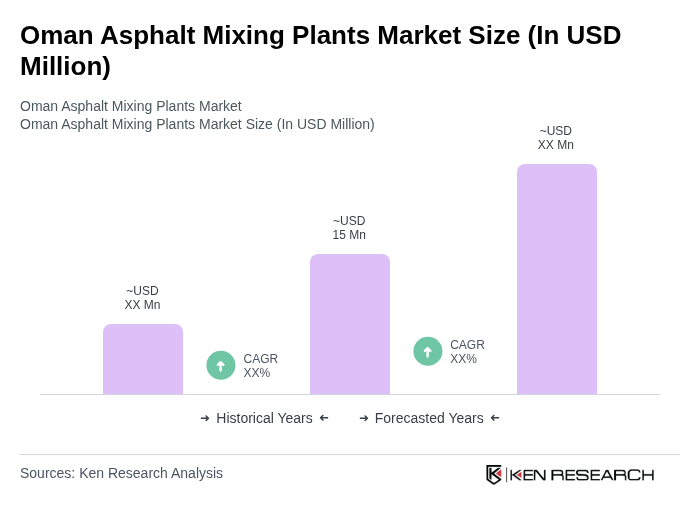
The Oman Asphalt Mixing Plants Market, worth USD 15 million, grows due to road construction demands under government initiatives, emphasizing sustainability and urban expansion.

Region:Middle East

Author(s):Rebecca

Product Code:KRAD6189

Pages:93

Published On:December 2025
About the Report

Base Year 2024

Oman Asphalt Mixing Plants Market Overview

  • The Oman Asphalt Mixing Plants Market is valued at USD 15 million, based on a five-year historical analysis and its proportion of the Middle East & Africa asphalt mixing plant market, which generated revenue of about USD 296.5 million for the region. This growth is primarily driven by the increasing demand for road construction and infrastructure development, fueled by government initiatives and investments in transportation projects under Oman Vision 2040, national road connectivity programs, and logistics corridor upgrades. The expansion of urban areas and the need for improved road networks, including expressways, dualisation of main corridors, and urban arterial road upgrades, have significantly contributed to the market's growth.
  • Muscat, the capital city, along with Dhofar and Al Batinah regions, dominate the Oman Asphalt Mixing Plants Market due to their strategic importance in infrastructure projects and concentration of national highways, ports, industrial estates, and logistics hubs. These areas are witnessing substantial investments in road construction and urban development, including port access roads, free zones, tourism corridors, and industrial road networks, making them key players in the asphalt mixing plants sector. The concentration of construction activities in these regions further enhances their market dominance by driving steady demand for high-capacity stationary plants near major quarries and more mobile/portable plants for dispersed projects.
  • In 2023, the Omani government strengthened requirements on the use of sustainable materials and environmentally responsible practices in road construction through instruments such as the Environmental Permit Regulations issued by the Environment Authority under Royal Decree 114/2001, which require asphalt plants and road projects to obtain permits addressing emissions, waste, and resource efficiency. This regulatory framework aims to promote environmentally friendly practices and reduce the carbon footprint of asphalt production by encouraging the use of reclaimed asphalt pavement (RAP), warm-mix technologies, and emission control systems in asphalt plants. The initiative is expected to drive the adoption of low-emission and energy-efficient asphalt mixing plants, aligning Oman's road sector with global sustainability goals and regional net-zero transitions.
Oman Asphalt Mixing Plants Market Size

Oman Asphalt Mixing Plants Market Segmentation

By Type:The market is segmented into various types of asphalt mixing plants, including stationary batch mix plants, stationary continuous (drum) mix plants, mobile/portable asphalt mixing plants, and compact/containerised asphalt mixing plants. Each type serves different operational needs and project requirements, with stationary configurations typically preferred for high-volume highway and expressway works and mobile/compact plants increasingly adopted for remote projects, maintenance works, and time-bound urban jobs where rapid setup and relocation are essential.
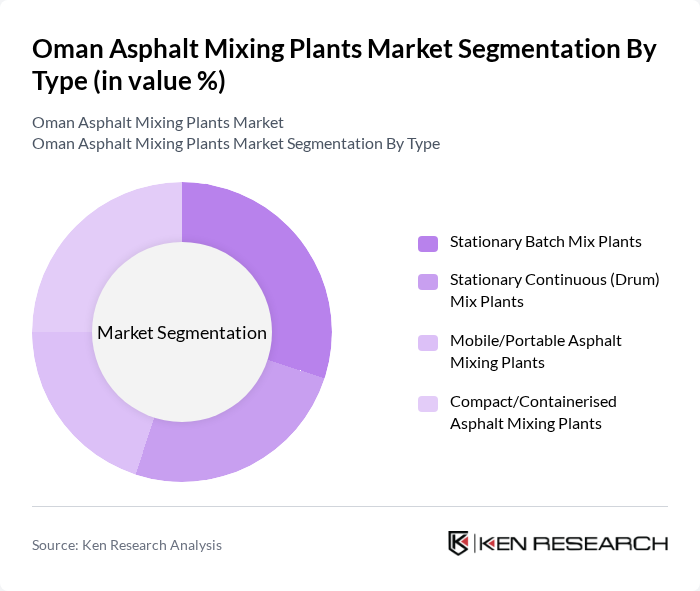
Oman Asphalt Mixing Plants Market segmentation by Type.

By End-User:The end-user segmentation includes government and municipal road authorities, EPC and infrastructure contractors, ready-mix and asphalt producers, and oil & gas/industrial site developers. Each end-user category has distinct requirements and influences the demand for asphalt mixing plants in Oman, with public sector road authorities driving specification standards and long-term highway programs, EPC and infrastructure contractors demanding high throughput and reliability for turnkey projects, commercial asphalt producers focusing on plant efficiency and mix flexibility, and oil & gas/industrial developers requiring durable pavement solutions for heavy-duty internal road networks and logistics facilities.
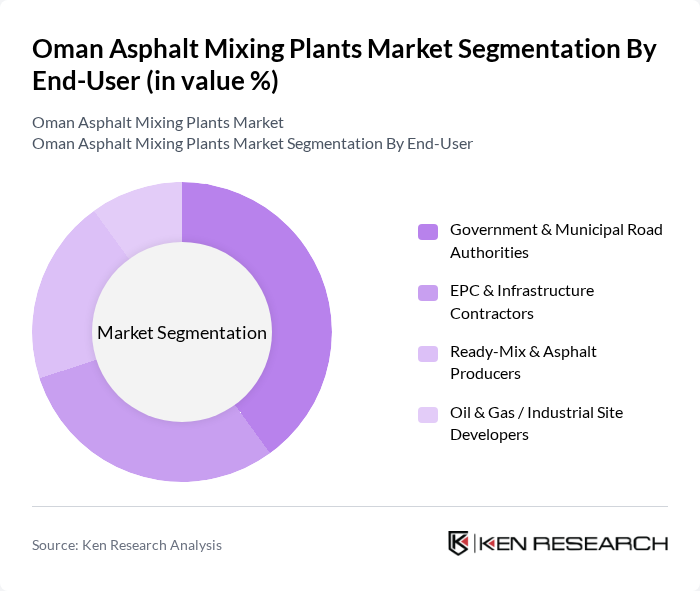
Oman Asphalt Mixing Plants Market segmentation by End-User.

Oman Asphalt Mixing Plants Market Competitive Landscape

The Oman Asphalt Mixing Plants Market is characterized by a dynamic mix of regional and international players. Leading participants such as Oman Asphalt LLC, Al Tasnim Enterprises LLC (Asphalt & Contracting Division), Galfar Engineering & Contracting SAOG (Roads & Bridges Division), STFA Oman LLC, Larsen & Toubro Oman LLC, Sinohydro Corporation Limited – Oman Operations, Strabag Oman LLC, Al Rawas Asphalt & Transport LLC, Al Jazeera Engineering & Construction LLC, Al Kiyumi Global LLC (Roads & Infrastructure), Al Nab’a Infrastructure & Asphalt LLC, Oman Road Engineering Company LLC, Al Shanfari Asphalt & Road Contracting LLC, Carillion Alawi LLC, Khalid Bin Ahmed & Sons LLC (Infrastructure Division) contribute to innovation, geographic expansion, and service delivery in this space.

Oman Asphalt LLC

2004

Muscat, Oman

Al Tasnim Enterprises LLC

1976

Muscat, Oman

Galfar Engineering & Contracting SAOG

1972

Muscat, Oman

STFA Oman LLC

1988

Muscat, Oman

Larsen & Toubro Oman LLC

1980

Muscat, Oman

Company

Establishment Year

Headquarters

Installed Asphalt Mixing Capacity in Oman (TPH)

Annual Asphalt Mix Production Volume in Oman (tonnes)

Revenue from Asphalt Mixing Plants / Asphalt Products in Oman

Number of Operational Plants & Locations in Oman

Market Share in Oman Asphalt Mixing Plants / Asphalt Supply

Order Backlog / Secured Road & Infrastructure Projects

Oman Asphalt Mixing Plants Market Industry Analysis

Growth Drivers

  • Increasing Infrastructure Development:The Omani government allocated approximately OMR 1.5 billion (USD 3.9 billion) for infrastructure projects in future, focusing on road construction and maintenance. This investment is expected to drive demand for asphalt mixing plants, as quality road networks are essential for economic growth. The construction sector is projected to contribute 6.5% to the GDP, highlighting the critical role of asphalt in supporting infrastructure development.
  • Rising Demand for Quality Road Construction:With a growing population of over 5 million, Oman faces increasing pressure to enhance its road infrastructure. The Ministry of Transport and Communications reported a 15% rise in road construction projects in future, emphasizing the need for high-quality asphalt. This demand is further fueled by the need for safer, more durable roads, which directly impacts the market for asphalt mixing plants.
  • Government Investments in Transportation:The Omani government is prioritizing transportation infrastructure, with a projected investment of OMR 1 billion (USD 2.6 billion) in future. This funding is aimed at expanding and upgrading road networks, which will significantly increase the demand for asphalt mixing plants. Enhanced transportation infrastructure is vital for economic diversification and regional connectivity, further driving market growth.

Market Challenges

  • High Initial Capital Investment:The establishment of asphalt mixing plants requires substantial initial capital, often exceeding OMR 500,000 (USD 1.3 million). This high investment can deter new entrants and limit the expansion of existing facilities. Additionally, the long payback period associated with such investments can pose financial risks, particularly in a fluctuating economic environment, impacting overall market growth.
  • Fluctuating Raw Material Prices:The asphalt industry is heavily influenced by the volatility of raw material prices, particularly crude oil, which saw fluctuations of up to 30% in future. Such price instability can significantly affect production costs for asphalt mixing plants, leading to unpredictable profit margins. This challenge necessitates effective supply chain management and strategic planning to mitigate financial risks associated with raw material procurement.

Oman Asphalt Mixing Plants Market Future Outlook

The Oman asphalt mixing plants market is poised for significant growth, driven by ongoing infrastructure investments and a focus on quality road construction. As urbanization accelerates, the demand for efficient and sustainable asphalt solutions will increase. The integration of advanced technologies, such as IoT and eco-friendly practices, will further enhance operational efficiency. Additionally, public-private partnerships are expected to play a crucial role in expanding market opportunities, fostering innovation and collaboration within the industry.

Market Opportunities

  • Expansion of Public-Private Partnerships:The Omani government is actively promoting public-private partnerships (PPPs) to enhance infrastructure development. This approach is expected to attract private investment, facilitating the establishment of new asphalt mixing plants. By leveraging private sector expertise and resources, Oman can improve project delivery timelines and quality, creating a favorable environment for market growth.
  • Adoption of Eco-Friendly Technologies:There is a growing trend towards sustainable construction practices in Oman, with an increasing emphasis on eco-friendly asphalt technologies. The government aims to reduce carbon emissions by 20% by future, encouraging the adoption of green technologies in asphalt production. This shift presents significant opportunities for manufacturers to innovate and differentiate their offerings in the competitive market landscape.

Scope of the Report

SegmentSub-Segments
By Type

Stationary Batch Mix Plants

Stationary Continuous (Drum) Mix Plants

Mobile/Portable Asphalt Mixing Plants

Compact/Containerised Asphalt Mixing Plants

By End-User

Government & Municipal Road Authorities

EPC & Infrastructure Contractors

Ready-Mix & Asphalt Producers

Oil & Gas / Industrial Site Developers

By Application

National & Expressway Road Construction

Urban Roads & Municipal Infrastructure

Airport Runways & Taxiways

Industrial Yards, Ports & Parking Areas

By Capacity

Up to 80 TPH

–160 TPH

–240 TPH

Above 240 TPH

By Technology

Hot Mix Asphalt (HMA) Plants

Warm Mix Asphalt (WMA) Plants

Cold & Recycled Asphalt (RAP/RAS) Plants

Low-Emission & Energy-Efficient Plants

By Region

Muscat Governorate

Dhofar (Salalah & Surrounding Areas)

Al Batinah North & South

Al Sharqiyah & Interior Governorates

By Investment Source

Government-Funded Projects

Private Domestic Investments

Foreign Direct Investments (FDI)

Public-Private Partnerships (PPP)

Key Target Audience

Investors and Venture Capitalist Firms

Government and Regulatory Bodies (e.g., Ministry of Transport, Oman Environmental Authority)

Manufacturers and Producers of Asphalt Mixing Plants

Construction and Infrastructure Development Companies

Suppliers of Raw Materials for Asphalt Production

Local and Regional Contractors

Industry Associations (e.g., Oman Contractors Association)

Financial Institutions and Banks

Players Mentioned in the Report:

Oman Asphalt LLC

Al Tasnim Enterprises LLC (Asphalt & Contracting Division)

Galfar Engineering & Contracting SAOG (Roads & Bridges Division)

STFA Oman LLC

Larsen & Toubro Oman LLC

Sinohydro Corporation Limited Oman Operations

Strabag Oman LLC

Al Rawas Asphalt & Transport LLC

Al Jazeera Engineering & Construction LLC

Al Kiyumi Global LLC (Roads & Infrastructure)

Al Naba Infrastructure & Asphalt LLC

Oman Road Engineering Company LLC

Al Shanfari Asphalt & Road Contracting LLC

Carillion Alawi LLC

Khalid Bin Ahmed & Sons LLC (Infrastructure Division)

Table of Contents

Market Assessment Phase

1. Executive Summary and Approach


2. Oman Asphalt Mixing Plants Market Overview

2.1 Key Insights and Strategic Recommendations

2.2 Oman Asphalt Mixing Plants Market Overview

2.3 Definition and Scope

2.4 Evolution of Market Ecosystem

2.5 Timeline of Key Regulatory Milestones

2.6 Value Chain & Stakeholder Mapping

2.7 Business Cycle Analysis

2.8 Policy & Incentive Landscape


3. Oman Asphalt Mixing Plants Market Analysis

3.1 Growth Drivers

3.1.1 Increasing Infrastructure Development
3.1.2 Rising Demand for Quality Road Construction
3.1.3 Government Investments in Transportation
3.1.4 Technological Advancements in Mixing Equipment

3.2 Market Challenges

3.2.1 High Initial Capital Investment
3.2.2 Fluctuating Raw Material Prices
3.2.3 Regulatory Compliance Issues
3.2.4 Limited Skilled Workforce

3.3 Market Opportunities

3.3.1 Expansion of Public-Private Partnerships
3.3.2 Adoption of Eco-Friendly Technologies
3.3.3 Increasing Urbanization
3.3.4 Export Opportunities in Neighboring Markets

3.4 Market Trends

3.4.1 Shift Towards Modular Asphalt Mixing Plants
3.4.2 Integration of IoT in Plant Operations
3.4.3 Focus on Sustainable Practices
3.4.4 Growth of Mobile Asphalt Mixing Solutions

3.5 Government Regulation

3.5.1 Environmental Compliance Standards
3.5.2 Quality Assurance Regulations
3.5.3 Safety Standards for Construction Equipment
3.5.4 Licensing and Operational Permits

4. SWOT Analysis


5. Stakeholder Analysis


6. Porter's Five Forces Analysis


7. Oman Asphalt Mixing Plants Market Size, 2019-2024

7.1 By Value

7.2 By Volume

7.3 By Average Selling Price


8. Oman Asphalt Mixing Plants Market Segmentation

8.1 By Type

8.1.1 Stationary Batch Mix Plants
8.1.2 Stationary Continuous (Drum) Mix Plants
8.1.3 Mobile/Portable Asphalt Mixing Plants
8.1.4 Compact/Containerised Asphalt Mixing Plants

8.2 By End-User

8.2.1 Government & Municipal Road Authorities
8.2.2 EPC & Infrastructure Contractors
8.2.3 Ready-Mix & Asphalt Producers
8.2.4 Oil & Gas / Industrial Site Developers

8.3 By Application

8.3.1 National & Expressway Road Construction
8.3.2 Urban Roads & Municipal Infrastructure
8.3.3 Airport Runways & Taxiways
8.3.4 Industrial Yards, Ports & Parking Areas

8.4 By Capacity

8.4.1 Up to 80 TPH
8.4.2 80–160 TPH
8.4.3 160–240 TPH
8.4.4 Above 240 TPH

8.5 By Technology

8.5.1 Hot Mix Asphalt (HMA) Plants
8.5.2 Warm Mix Asphalt (WMA) Plants
8.5.3 Cold & Recycled Asphalt (RAP/RAS) Plants
8.5.4 Low-Emission & Energy-Efficient Plants

8.6 By Region

8.6.1 Muscat Governorate
8.6.2 Dhofar (Salalah & Surrounding Areas)
8.6.3 Al Batinah North & South
8.6.4 Al Sharqiyah & Interior Governorates

8.7 By Investment Source

8.7.1 Government-Funded Projects
8.7.2 Private Domestic Investments
8.7.3 Foreign Direct Investments (FDI)
8.7.4 Public-Private Partnerships (PPP)

9. Oman Asphalt Mixing Plants Market Competitive Analysis

9.1 Market Share of Key Players

9.2 Cross Comparison of Key Players

9.2.1 Company Name
9.2.2 Installed Asphalt Mixing Capacity in Oman (TPH)
9.2.3 Annual Asphalt Mix Production Volume in Oman (tonnes)
9.2.4 Revenue from Asphalt Mixing Plants / Asphalt Products in Oman
9.2.5 Number of Operational Plants & Locations in Oman
9.2.6 Market Share in Oman Asphalt Mixing Plants / Asphalt Supply
9.2.7 Order Backlog / Secured Road & Infrastructure Projects
9.2.8 Average Plant Utilization Rate (%)
9.2.9 Share of Projects Using RAP / Sustainable Mixes (%)
9.2.10 Service Coverage (After-Sales, Spare Parts & Maintenance Network)

9.3 SWOT Analysis of Top Players

9.4 Pricing Analysis

9.5 Detailed Profile of Major Companies

9.5.1 Oman Asphalt LLC
9.5.2 Al Tasnim Enterprises LLC (Asphalt & Contracting Division)
9.5.3 Galfar Engineering & Contracting SAOG (Roads & Bridges Division)
9.5.4 STFA Oman LLC
9.5.5 Larsen & Toubro Oman LLC
9.5.6 Sinohydro Corporation Limited – Oman Operations
9.5.7 Strabag Oman LLC
9.5.8 Al Rawas Asphalt & Transport LLC
9.5.9 Al Jazeera Engineering & Construction LLC
9.5.10 Al Kiyumi Global LLC (Roads & Infrastructure)
9.5.11 Al Nab’a Infrastructure & Asphalt LLC
9.5.12 Oman Road Engineering Company LLC
9.5.13 Al Shanfari Asphalt & Road Contracting LLC
9.5.14 Carillion Alawi LLC
9.5.15 Khalid Bin Ahmed & Sons LLC (Infrastructure Division)

10. Oman Asphalt Mixing Plants Market End-User Analysis

10.1 Procurement Behavior of Key Ministries

10.1.1 Ministry of Transport
10.1.2 Ministry of Housing
10.1.3 Ministry of Regional Municipalities
10.1.4 Others

10.2 Corporate Spend on Infrastructure & Energy

10.2.1 Infrastructure Development Budgets
10.2.2 Energy Sector Investments
10.2.3 Public Works Expenditures
10.2.4 Others

10.3 Pain Point Analysis by End-User Category

10.3.1 Delays in Project Timelines
10.3.2 Quality Control Issues
10.3.3 Cost Overruns
10.3.4 Others

10.4 User Readiness for Adoption

10.4.1 Awareness of New Technologies
10.4.2 Training and Skill Development Needs
10.4.3 Financial Readiness
10.4.4 Others

10.5 Post-Deployment ROI and Use Case Expansion

10.5.1 Performance Metrics Tracking
10.5.2 Long-term Cost Savings
10.5.3 Scalability of Solutions
10.5.4 Others

11. Oman Asphalt Mixing Plants Market Future Size, 2025-2030

11.1 By Value

11.2 By Volume

11.3 By Average Selling Price


Go-To-Market Strategy Phase

1. Whitespace Analysis + Business Model Canvas

1.1 Market Gaps Identification

1.2 Business Model Development


2. Marketing and Positioning Recommendations

2.1 Branding Strategies

2.2 Product USPs


3. Distribution Plan

3.1 Urban Retail Strategies

3.2 Rural NGO Tie-ups


4. Channel & Pricing Gaps

4.1 Underserved Routes

4.2 Pricing Bands Analysis


5. Unmet Demand & Latent Needs

5.1 Category Gaps

5.2 Consumer Segments


6. Customer Relationship

6.1 Loyalty Programs

6.2 After-sales Service


7. Value Proposition

7.1 Sustainability Initiatives

7.2 Integrated Supply Chains


8. Key Activities

8.1 Regulatory Compliance

8.2 Branding Efforts

8.3 Distribution Setup


9. Entry Strategy Evaluation

9.1 Domestic Market Entry Strategy

9.1.1 Product Mix Considerations
9.1.2 Pricing Band Strategy
9.1.3 Packaging Solutions

9.2 Export Entry Strategy

9.2.1 Target Countries Identification
9.2.2 Compliance Roadmap Development

10. Entry Mode Assessment

10.1 Joint Ventures

10.2 Greenfield Investments

10.3 Mergers & Acquisitions

10.4 Distributor Model


11. Capital and Timeline Estimation

11.1 Capital Requirements

11.2 Timelines for Implementation


12. Control vs Risk Trade-Off

12.1 Ownership Considerations

12.2 Partnerships Evaluation


13. Profitability Outlook

13.1 Breakeven Analysis

13.2 Long-term Sustainability Strategies


14. Potential Partner List

14.1 Distributors

14.2 Joint Ventures

14.3 Acquisition Targets


15. Execution Roadmap

15.1 Phased Plan for Market Entry

15.1.1 Market Setup
15.1.2 Market Entry
15.1.3 Growth Acceleration
15.1.4 Scale & Stabilize

15.2 Key Activities and Milestones

15.2.1 Milestone Planning
15.2.2 Activity Tracking

Research Methodology

ApproachModellingSample

Phase 1: Approach1

Desk Research

  • Industry reports from Oman’s Ministry of Transport, Communications and Information Technology
  • Market analysis publications from regional construction and infrastructure development agencies
  • Statistical data from the National Centre for Statistics and Information (NCSI) on asphalt consumption

Primary Research

  • Interviews with project managers at major construction firms involved in road development
  • Surveys with asphalt plant operators regarding production capacity and technology adoption
  • Field interviews with government officials overseeing infrastructure projects and regulations

Validation & Triangulation

  • Cross-validation of data through multiple industry sources and expert opinions
  • Triangulation of market size estimates from production, consumption, and import/export data
  • Sanity checks through feedback from industry stakeholders and expert panels

Phase 2: Market Size Estimation1

Top-down Assessment

  • Analysis of national infrastructure spending trends and their impact on asphalt demand
  • Segmentation of the market by application areas such as roads, airports, and commercial projects
  • Incorporation of government initiatives aimed at enhancing road infrastructure

Bottom-up Modeling

  • Volume estimates based on production capacities of existing asphalt mixing plants in Oman
  • Cost analysis derived from operational expenses and pricing strategies of local suppliers
  • Estimation of market share based on sales data from key players in the asphalt sector

Forecasting & Scenario Analysis

  • Multi-variable regression analysis considering economic growth, urbanization rates, and road development plans
  • Scenario modeling based on potential changes in government policies and infrastructure funding
  • Development of baseline, optimistic, and pessimistic forecasts through 2030

Phase 3: CATI Sample Composition1

Scope Item/SegmentSample SizeTarget Respondent Profiles
Road Construction Projects100Project Managers, Civil Engineers
Asphalt Plant Operations60Plant Managers, Technical Directors
Government Infrastructure Initiatives40Policy Makers, Regulatory Officials
Private Sector Construction Firms50Business Development Managers, Procurement Officers
Consulting Firms in Construction40Market Analysts, Industry Consultants

Frequently Asked Questions

What is the current value of the Oman Asphalt Mixing Plants Market?

The Oman Asphalt Mixing Plants Market is valued at approximately USD 15 million, contributing to the broader Middle East & Africa asphalt mixing plant market, which generated around USD 296.5 million.

What factors are driving the growth of the Oman Asphalt Mixing Plants Market?

Which regions in Oman dominate the Asphalt Mixing Plants Market?

What are the types of asphalt mixing plants available in Oman?

Other Regional/Country Reports

Saudi Arabia Asphalt Mixing Plants Market Size, Share, Trends & Forecast 2025–2030

Indonesia Asphalt Mixing Plants Market

Malaysia Asphalt Mixing Plants Market

APAC Asphalt Mixing Plants Market

SEA Asphalt Mixing Plants Market

Vietnam Asphalt Mixing Plants Market

Other Adjacent Reports

Qatar Asphalt Pavers Market

UAE Bitumen MarketSaudi Arabia Construction Aggregates (Crushed Stone & Sand) Market Size, Share, Growth Drivers, Trends, Opportunities, Competitive Landscape & Forecast 2025–2030

Philippines Road Rollers Market

KSA Concrete Mixing Plants Market

Egypt Quarrying Equipment Market

Egypt Pavement Maintenance Services Market

South Africa Construction Machinery Rental Market

Indonesia Infrastructure Development Consulting Market

UAE Sustainable Construction Materials Market

Why Buy From Us?

Refine Robust Result (RRR) Framework

What makes us stand out is that our consultants follow Robust, Refine and Result (RRR) methodology. Robust for clear definitions, approaches and sanity checking, Refine for differentiating respondents' facts and opinions, and Result for presenting data with story.

Our Reach Is Unmatched

We have set a benchmark in the industry by offering our clients with syndicated and customized market research reports featuring coverage of entire market as well as meticulous research and analyst insights.

Shifting the Research Paradigm

While we don't replace traditional research, we flip the method upside down. Our dual approach of Top Bottom & Bottom Top ensures quality deliverable by not just verifying company fundamentals but also looking at the sector and macroeconomic factors.

More Insights-Better Decisions

With one step in the future, our research team constantly tries to show you the bigger picture. We help with some of the tough questions you may encounter along the way: How is the industry positioned? Best marketing channel? KPI's of competitors? By aligning every element, we help maximize success.

Transparency and Trust

Our report gives you instant access to the answers and sources that other companies might choose to hide. We elaborate each steps of research methodology we have used and showcase you the sample size to earn your trust.

Round the Clock Support

If you need any support, we are here! We pride ourselves on universe strength, data quality, and quick, friendly, and professional service.

Why Clients Choose Us?

400000+
Reports in repository
150+
Consulting projects a year
100+
Analysts
8000+
Client Queries in 2022








