About the Report
Base Year 2024Oman Container Market Overview
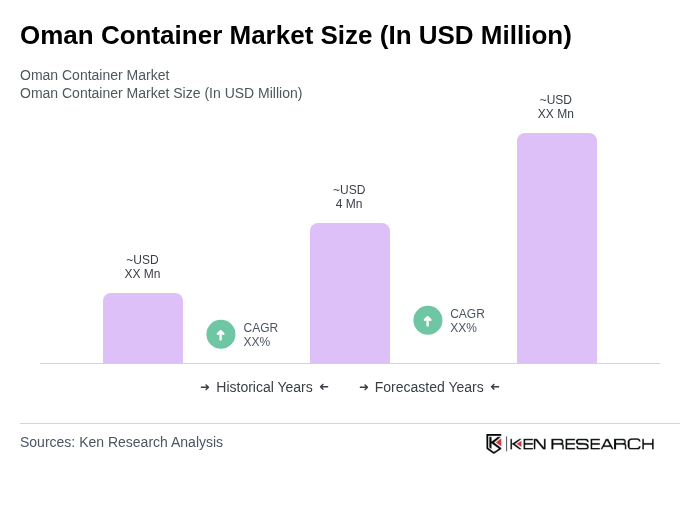
- The Oman Container Market is valued at USD 4 million, based on a five?year historical analysis. The market is characterized by container throughput of approximately 4.2 million TEUs handled across Salalah and Sohar ports, with additional substantial volumes at Duqm serving as an integrated zone and at industry-wide capacity expansions at Salalah valued at USD 300 million. Growth is driven by rapid expansion of deep-water ports, strategic investments aligned with Oman Vision 2040, and surging regional trade flows.
- Key players in this market include Asyad Group, which manages significant operations through Salalah, Sohar, and Duqm, supported by Port of Rotterdam’s involvement and joint ventures driving efficiency and capacity enhancement. Dynamics are influenced by strategic location advantages, public-private collaboration, and development of integrated logistics and industrial infrastructure rather than by individual equipment suppliers.
- In 2024, Oman’s government announced a strategic plan to enhance maritime capacity, including a USD 300 million expansion of Salalah Port and a USD 550 million investment consortium for Duqm Port development within the Special Economic Zone. This initiative aims to support green industries and position Oman as a logistics hub under Vision 2040.
Oman Container Market Segmentation
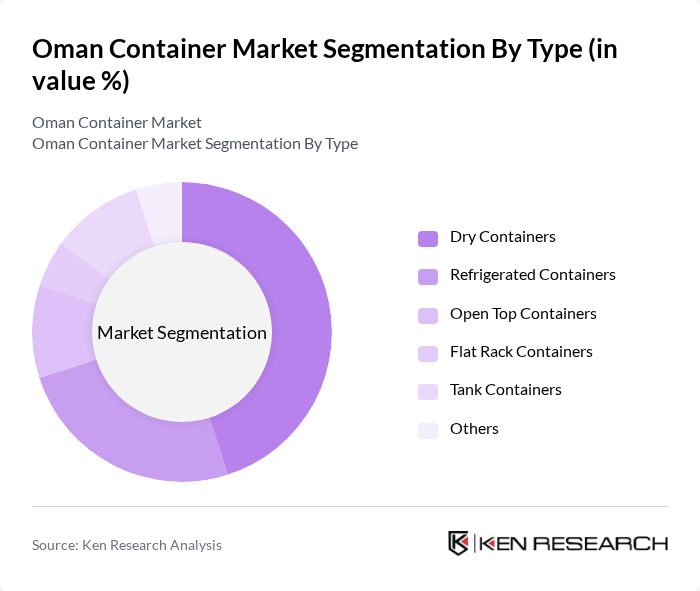
By Type:The container market is segmented into various types, including dry containers, refrigerated containers, open top containers, flat rack containers, tank containers, and others. Among these, dry containers dominate the market due to their versatility and widespread use in transporting a variety of goods. The increasing demand for efficient logistics solutions and the growth of e-commerce have further propelled the usage of dry containers, making them a preferred choice for many shipping companies.
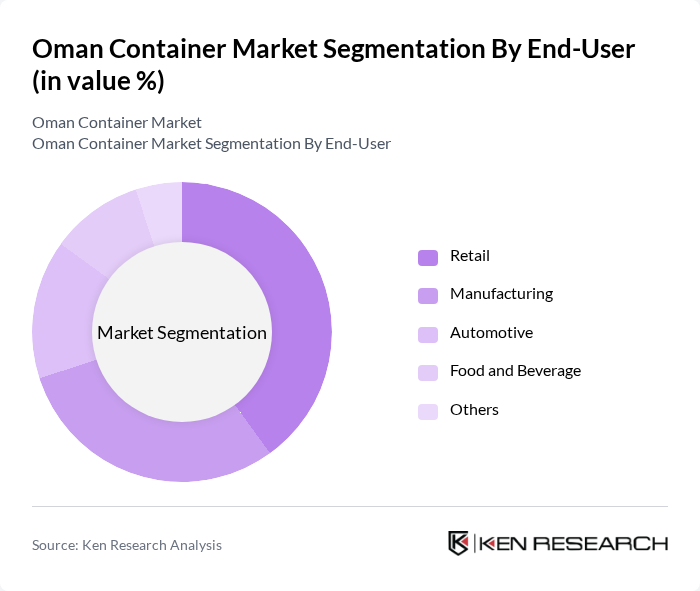
By End-User:The end-user segmentation includes retail, manufacturing, automotive, food and beverage, and others. The retail sector is the leading end-user of containers, driven by the rapid growth of e-commerce and the need for efficient supply chain management. Retailers increasingly rely on containerized shipping to ensure timely delivery of goods, which has significantly boosted the demand for containers in this sector.
Oman Container Market Competitive Landscape
The Oman Container Market is characterized by a dynamic mix of regional and international players. Leading participants such as Oman Shipping Company, Port of Salalah, Sohar Port and Freezone, Oman Container Lines, Gulf Agency Company, APM Terminals, Oman International Container Terminal, Muscat Container Terminal, Al Jazeera Shipping Company, Oman Global Logistics Group, National Shipping Company of Saudi Arabia, Maersk Line, MSC Mediterranean Shipping Company, CMA CGM Group, and Hapag-Lloyd AG contribute to innovation, geographic expansion, and service delivery in this space.
Oman Container Market Industry Analysis
Growth Drivers
- Substantial Cargo Throughput via Ports:Omani ports handled 137 million tonnes of general, bulk, and liquid cargo in the future, a significant increase from 119 million tonnes in the previous year. This growth reflects enhanced trade activity and improved port efficiency, particularly at Salalah, Sohar, and Duqm. The increase in cargo volumes is indicative of a robust logistics sector, which is essential for supporting the container market's expansion.
- High Container Handling Capacity at Salalah Port:The expansion of Salalah Port’s container terminal has increased its handling capacity to 6.5 million TEUs. This upgrade allows the port to accommodate larger container vessels, thereby enhancing its throughput capabilities. The strategic positioning of Salalah as a transshipment hub further solidifies its role in regional trade, driving demand for container services.
- Increased Container TEU Volumes in H1 2025:The ports of Salalah, Sohar, and Duqm reported handling 2,427,195 TEUs in the first half of the future, compared to 2,173,508 TEUs in the first half of the previous year. This 11.7% increase in container volumes indicates a strong demand trajectory, suggesting that the growth trend observed in the previous year is likely to continue, bolstering the overall container market in Oman.
Market Challenges
- Regional Security Disruptions Impacting Container Volumes:Salalah Port experienced a decline in container volumes, dropping to 1.679 million containers in the first half of the previous year from 1.999 million in the first half of the year before that. This reduction is attributed to disruptions along the Red Sea route, which have forced shipping lines to alter their routes, negatively impacting container throughput and overall trade efficiency.
- Heavy Dependency on Hydrocarbon Revenues:Oil and gas revenues continue to account for approximately 85% of the Omani government's income. This heavy reliance on hydrocarbons makes the economy vulnerable to fluctuations in global oil prices, which can hinder investments in trade infrastructure and limit the growth potential of the container market.
Oman Container Market Future Outlook
The Oman container market is poised for a recovery driven by ongoing port capacity expansions and efficiency improvements. Salalah and Sohar ports are expected to enhance their operational capabilities, with Salalah projected to handle nearly 4.5 million TEUs in the future. Additionally, the government's commitment to economic diversification will support growth in logistics and manufacturing sectors, further bolstering container demand. Continued investments in digital infrastructure will also play a crucial role in optimizing supply chain processes and enhancing competitiveness.
Market Opportunities
- Transshipment Hub and Industrial Gateway Expansion:Sohar Port and Freezone achieved a throughput of nearly 900,000 TEUs in the previous year. This growth presents significant investment opportunities in expanding value chain operations around free zones, which can enhance container trade and logistics capabilities in the region.
- Growing Digital and Smart Port Applications:With 5.8 million mobile broadband subscriptions and approximately 578,000 fixed broadband subscriptions as of September in the previous year, Oman is well-positioned to leverage digital technologies. This infrastructure can support IoT-enabled logistics, port automation, and smart tracking solutions, driving efficiency in container handling and operations.
Scope of the Report
| Segment | Sub-Segments |
|---|---|
| By Type | Dry Containers Refrigerated Containers Open Top Containers Flat Rack Containers Tank Containers Others |
| By End-User | Retail Manufacturing Automotive Food and Beverage Others |
| By Region | Muscat Salalah Sohar Duqm |
| By Application | International Shipping Domestic Transport Warehousing Logistics Services Others |
| By Container Size | foot Containers foot Containers foot Containers Others |
| By Ownership Model | Owned Containers Leased Containers Others |
| By Service Type | Freight Forwarding Customs Brokerage Container Maintenance Others |
Key Target Audience
Investors and Venture Capitalist Firms
Government and Regulatory Bodies (e.g., Ministry of Transport, Communications and Information Technology)
Shipping and Logistics Companies
Port Authorities (e.g., Port of Salalah Authority)
Freight Forwarders
Customs and Border Control Agencies (e.g., Royal Oman Police - Customs)
Infrastructure Development Firms
Trade and Export Promotion Agencies (e.g., Oman Chamber of Commerce and Industry)
Players Mentioned in the Report:
Oman Shipping Company
Port of Salalah
Sohar Port and Freezone
Oman Container Lines
Gulf Agency Company
APM Terminals
Oman International Container Terminal
Muscat Container Terminal
Al Jazeera Shipping Company
Oman Global Logistics Group
National Shipping Company of Saudi Arabia
Maersk Line
MSC Mediterranean Shipping Company
CMA CGM Group
Hapag-Lloyd AG
Table of Contents
Market Assessment Phase
1. Executive Summary and Approach
2. Oman Container Market Overview
2.1 Key Insights and Strategic Recommendations
2.2 Oman Container Market Overview
2.3 Definition and Scope
2.4 Evolution of Market Ecosystem
2.5 Timeline of Key Regulatory Milestones
2.6 Value Chain & Stakeholder Mapping
2.7 Business Cycle Analysis
2.8 Policy & Incentive Landscape
3. Oman Container Market Analysis
3.1 Growth Drivers
3.1.1 Increasing Trade Volumes
3.1.2 Strategic Location of Ports
3.1.3 Government Investment in Infrastructure
3.1.4 Rising Demand for Efficient Logistics
3.2 Market Challenges
3.2.1 High Operational Costs
3.2.2 Regulatory Compliance Issues
3.2.3 Limited Technological Adoption
3.2.4 Competition from Regional Ports
3.3 Market Opportunities
3.3.1 Expansion of Free Trade Zones
3.3.2 Development of Smart Port Technologies
3.3.3 Increased Foreign Direct Investment
3.3.4 Growth in E-commerce Logistics
3.4 Market Trends
3.4.1 Automation in Container Handling
3.4.2 Sustainability Initiatives in Shipping
3.4.3 Digitalization of Supply Chain Processes
3.4.4 Shift Towards Intermodal Transportation
3.5 Government Regulation
3.5.1 Customs Modernization Initiatives
3.5.2 Environmental Compliance Standards
3.5.3 Port Authority Regulations
3.5.4 Trade Facilitation Policies
4. SWOT Analysis
5. Stakeholder Analysis
6. Porter's Five Forces Analysis
7. Oman Container Market Market Size, 2019-2024
7.1 By Value
7.2 By Volume
7.3 By Average Selling Price
8. Oman Container Market Segmentation
8.1 By Type
8.1.1 Dry Containers
8.1.2 Refrigerated Containers
8.1.3 Open Top Containers
8.1.4 Flat Rack Containers
8.1.5 Tank Containers
8.1.6 Others
8.2 By End-User
8.2.1 Retail
8.2.2 Manufacturing
8.2.3 Automotive
8.2.4 Food and Beverage
8.2.5 Others
8.3 By Region
8.3.1 Muscat
8.3.2 Salalah
8.3.3 Sohar
8.3.4 Duqm
8.4 By Application
8.4.1 International Shipping
8.4.2 Domestic Transport
8.4.3 Warehousing
8.4.4 Logistics Services
8.4.5 Others
8.5 By Container Size
8.5.1 20-foot Containers
8.5.2 40-foot Containers
8.5.3 45-foot Containers
8.5.4 Others
8.6 By Ownership Model
8.6.1 Owned Containers
8.6.2 Leased Containers
8.6.3 Others
8.7 By Service Type
8.7.1 Freight Forwarding
8.7.2 Customs Brokerage
8.7.3 Container Maintenance
8.7.4 Others
9. Oman Container Market Competitive Analysis
9.1 Market Share of Key Players
9.2 Cross Comparison of Key Players
9.2.1 Company Name
9.2.2 Group Size (Large, Medium, or Small as per industry convention)
9.2.3 Revenue Growth Rate
9.2.4 Market Penetration Rate
9.2.5 Customer Retention Rate
9.2.6 Operational Efficiency Ratio
9.2.7 Pricing Strategy
9.2.8 Average Delivery Time
9.2.9 Customer Satisfaction Score
9.2.10 Innovation Index
9.3 SWOT Analysis of Top Players
9.4 Pricing Analysis
9.5 Detailed Profile of Major Companies
9.5.1 Oman Shipping Company
9.5.2 Port of Salalah
9.5.3 Sohar Port and Freezone
9.5.4 Oman Container Lines
9.5.5 Gulf Agency Company
9.5.6 APM Terminals
9.5.7 Oman International Container Terminal
9.5.8 Muscat Container Terminal
9.5.9 Al Jazeera Shipping Company
9.5.10 Oman Global Logistics Group
9.5.11 National Shipping Company of Saudi Arabia
9.5.12 Maersk Line
9.5.13 MSC Mediterranean Shipping Company
9.5.14 CMA CGM Group
9.5.15 Hapag-Lloyd AG
10. Oman Container Market End-User Analysis
10.1 Procurement Behavior of Key Ministries
10.1.1 Ministry of Transport
10.1.2 Ministry of Commerce and Industry
10.1.3 Ministry of Finance
10.1.4 Others
10.2 Corporate Spend on Infrastructure & Energy
10.2.1 Logistics Companies
10.2.2 Manufacturing Firms
10.2.3 Retail Chains
10.2.4 Others
10.3 Pain Point Analysis by End-User Category
10.3.1 Delays in Customs Clearance
10.3.2 High Transportation Costs
10.3.3 Limited Availability of Containers
10.3.4 Others
10.4 User Readiness for Adoption
10.4.1 Awareness of Container Options
10.4.2 Willingness to Invest in Technology
10.4.3 Training and Support Needs
10.4.4 Others
10.5 Post-Deployment ROI and Use Case Expansion
10.5.1 Cost Savings Analysis
10.5.2 Efficiency Gains
10.5.3 Scalability of Solutions
10.5.4 Others
11. Oman Container Market Future Size, 2025-2030
11.1 By Value
11.2 By Volume
11.3 By Average Selling Price
Go-To-Market Strategy Phase
1. Whitespace Analysis + Business Model Canvas
1.1 Market Gaps Identification
1.2 Business Model Development
2. Marketing and Positioning Recommendations
2.1 Branding Strategies
2.2 Product USPs
3. Distribution Plan
3.1 Urban Retail vs Rural NGO Tie-ups
4. Channel & Pricing Gaps
4.1 Underserved Routes
4.2 Pricing Bands
5. Unmet Demand & Latent Needs
5.1 Category Gaps
5.2 Consumer Segments
6. Customer Relationship
6.1 Loyalty Programs
6.2 After-sales Service
7. Value Proposition
7.1 Sustainability
7.2 Integrated Supply Chains
8. Key Activities
8.1 Regulatory Compliance
8.2 Branding
8.3 Distribution Setup
9. Entry Strategy Evaluation
9.1 Domestic Market Entry Strategy
9.1.1 Product Mix
9.1.2 Pricing Band
9.1.3 Packaging
9.2 Export Entry Strategy
9.2.1 Target Countries
9.2.2 Compliance Roadmap
10. Entry Mode Assessment
10.1 JV
10.2 Greenfield
10.3 M&A
10.4 Distributor Model
11. Capital and Timeline Estimation
11.1 Capital Requirements
11.2 Timelines
12. Control vs Risk Trade-Off
12.1 Ownership vs Partnerships
13. Profitability Outlook
13.1 Breakeven Analysis
13.2 Long-term Sustainability
14. Potential Partner List
14.1 Distributors
14.2 JVs
14.3 Acquisition Targets
15. Execution Roadmap
15.1 Phased Plan for Market Entry
15.1.1 Market Setup
15.1.2 Market Entry
15.1.3 Growth Acceleration
15.1.4 Scale & Stabilize
15.2 Key Activities and Milestones
15.2.1 Activity Planning
15.2.2 Milestone Tracking
Research Methodology
Phase 1: Approach1
Desk Research
- Analysis of trade statistics from the Oman Ports and Maritime Authority
- Review of industry reports from the Oman Chamber of Commerce and Industry
- Examination of government publications on infrastructure development and logistics policies
Primary Research
- Interviews with logistics managers at major shipping companies operating in Oman
- Surveys with port authorities and customs officials regarding container throughput
- Field interviews with freight forwarders and shipping agents to understand operational challenges
Validation & Triangulation
- Cross-validation of data from multiple sources including trade associations and government reports
- Triangulation of findings from primary interviews with secondary data insights
- Sanity checks through expert panel discussions with industry veterans
Phase 2: Market Size Estimation1
Top-down Assessment
- Estimation of total container traffic based on historical data from Oman’s major ports
- Segmentation of market size by container type (e.g., dry, refrigerated) and trade routes
- Incorporation of projected growth rates from regional trade agreements and economic forecasts
Bottom-up Modeling
- Collection of operational data from leading shipping lines regarding container utilization rates
- Cost analysis based on service pricing models from logistics providers
- Volume calculations based on average container sizes and turnover rates in the market
Forecasting & Scenario Analysis
- Multi-variable regression analysis incorporating GDP growth, trade volume, and port capacity
- Scenario modeling based on potential changes in trade policies and global supply chain dynamics
- Development of baseline, optimistic, and pessimistic forecasts through 2030
Phase 3: CATI Sample Composition1
| Scope Item/Segment | Sample Size | Target Respondent Profiles |
|---|---|---|
| Container Shipping Operations | 100 | Logistics Managers, Operations Directors |
| Port Authority Insights | 80 | Port Managers, Customs Officials |
| Freight Forwarding Practices | 70 | Freight Forwarders, Supply Chain Analysts |
| Trade Compliance and Regulations | 60 | Compliance Officers, Legal Advisors |
| Market Trends and Innovations | 90 | Industry Experts, Research Analysts |
Frequently Asked Questions
What is the current value of the Oman Container Market?
The Oman Container Market is valued at approximately USD 4 million, based on a five-year historical analysis. This valuation reflects the market's growth driven by increased container throughput and strategic investments in port infrastructure.
How many TEUs are handled by Oman's major ports?
What are the key drivers of growth in the Oman Container Market?
Which companies are major players in the Oman Container Market?
Other Regional/Country Reports
Indonesia Container Market
Malaysia Container Market
KSA Container Market
APAC Container Market
SEA Container Market
Other Adjacent Reports
Japan Port Infrastructure Market
Turkey Logistics Services MarketBelgium Shipping and Freight Market
GCC Road Express (Parcel & LTL) E-commerce Logistics Market Size, Share, Growth Drivers, Trends, Opportunities, Competitive Landscape & Forecast 2025–2030Japan Industrial Equipment Market
Qatar Supply Chain Management Market Report Size Share Growth Drivers Trends Opportunities & Forecast 2025–2030Oman Maritime Security Market
Mexico Smart Port Solutions Market
Saudi Arabia refrigerated transport market report Size, Share, Growth Drivers, Trends, Opportunities & Forecast 2025–2030South Korea Bulk Cargo Market
Why Buy From Us?

What makes us stand out is that our consultants follow Robust, Refine and Result (RRR) methodology. Robust for clear definitions, approaches and sanity checking, Refine for differentiating respondents' facts and opinions, and Result for presenting data with story.

We have set a benchmark in the industry by offering our clients with syndicated and customized market research reports featuring coverage of entire market as well as meticulous research and analyst insights.

While we don't replace traditional research, we flip the method upside down. Our dual approach of Top Bottom & Bottom Top ensures quality deliverable by not just verifying company fundamentals but also looking at the sector and macroeconomic factors.

With one step in the future, our research team constantly tries to show you the bigger picture. We help with some of the tough questions you may encounter along the way: How is the industry positioned? Best marketing channel? KPI's of competitors? By aligning every element, we help maximize success.

Our report gives you instant access to the answers and sources that other companies might choose to hide. We elaborate each steps of research methodology we have used and showcase you the sample size to earn your trust.

If you need any support, we are here! We pride ourselves on universe strength, data quality, and quick, friendly, and professional service.