About the Report
Base Year 2024Listen to the audio summary
Oman Herbicides Market Overview
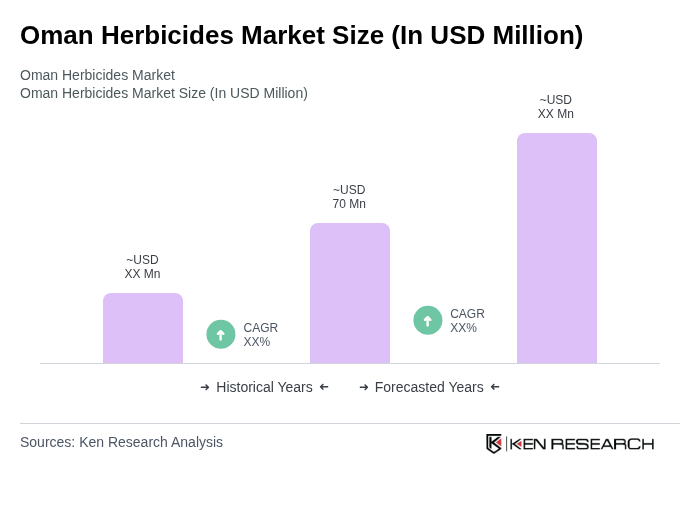
- The Oman Herbicides Market is valued at USD 70 million, based on a five-year historical analysis. This growth is primarily driven by the increasing demand for agricultural productivity, the adoption of advanced farming techniques, and the need for effective weed management solutions in high-value crop cultivation. Enhanced focus on food security and sustainable crop yields continues to fuel herbicide usage, particularly in cereals, grains, and horticultural crops.
- Muscat, Salalah, and Sohar remain the dominant cities in the Oman Herbicides Market. Muscat, as the capital, benefits from a well-established agricultural infrastructure and access to advanced technologies. Salalah’s fertile land and favorable climate support robust crop production, while Sohar’s strategic logistics position strengthens its role as a distribution hub for agrochemicals and herbicides. These cities collectively drive market demand and distribution efficiency.
- In 2023, the Omani government enacted the “Ministerial Decision No. 120/2023 on the Regulation of Pesticide Registration and Use,” issued by the Ministry of Agricultural, Fisheries and Water Resources. This regulation mandates the registration and use of environmentally friendly herbicides, sets compliance standards for product safety, and encourages farmers to adopt integrated pest management (IPM) strategies. The regulation covers product approval, labeling, usage thresholds, and periodic monitoring to ensure sustainable agricultural practices and minimize environmental impact.
Oman Herbicides Market Segmentation
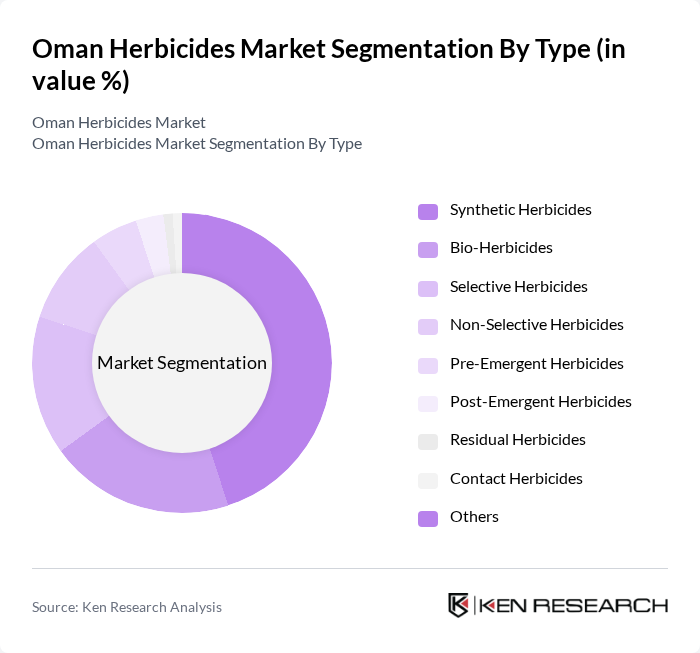
By Type:The herbicides market in Oman is segmented into synthetic herbicides, bio-herbicides, selective herbicides, non-selective herbicides, pre-emergent herbicides, post-emergent herbicides, residual herbicides, contact herbicides, and others.Synthetic herbicidescontinue to dominate due to their proven effectiveness and broad-spectrum weed control. Farmers favor these for their reliability and rapid action. However, there is a noticeable shift towardbio-herbicidesand integrated pest management approaches, driven by regulatory incentives and increased awareness of sustainability in agriculture.
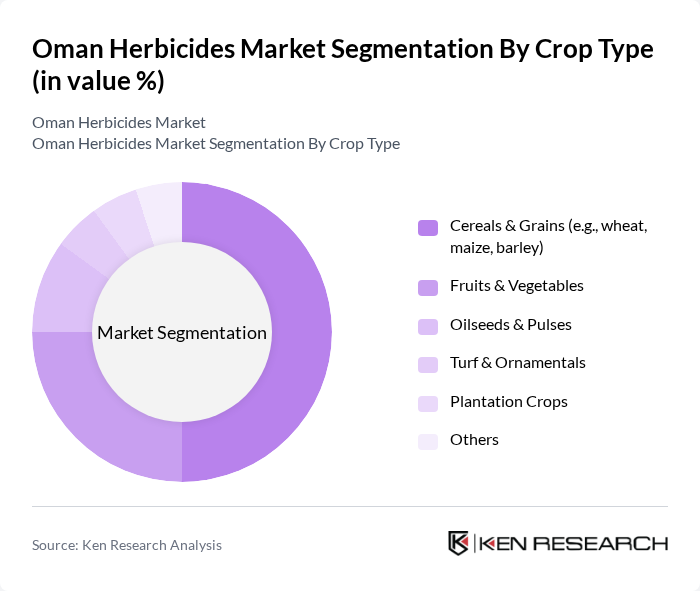
By Crop Type:The herbicides market is further segmented by crop type, including cereals & grains, fruits & vegetables, oilseeds & pulses, turf & ornamentals, plantation crops, and others.Cereals and grains(such as wheat, maize, and barley) represent the largest segment, reflecting their central role in Oman's food security and agricultural output. The expansion of fruit and vegetable cultivation is also increasing demand for specialized herbicide solutions to maximize yield and quality.
Oman Herbicides Market Competitive Landscape
The Oman Herbicides Market is characterized by a dynamic mix of regional and international players. Leading participants such as BASF SE, Syngenta AG, Bayer CropScience AG, Corteva Agriscience, FMC Corporation, UPL Limited, ADAMA Agricultural Solutions Ltd., Nufarm Limited, Sumitomo Chemical Co., Ltd., Marrone Bio Innovations, Inc., Albaugh LLC, Belchim Crop Protection NV/SA, Cheminova A/S (now part of FMC Corporation), Isagro S.p.A. (now part of Gowan Company), Arysta LifeScience Corporation (now part of UPL Limited) contribute to innovation, geographic expansion, and service delivery in this space.
Oman Herbicides Market Industry Analysis
Growth Drivers
- Increasing Agricultural Productivity:The agricultural sector in Oman has seen a significant increase in productivity, with crop yields rising by approximately 15% from 2020 to future. This growth is driven by the adoption of advanced agricultural practices and the use of herbicides, which enhance crop health and yield. The Ministry of Agriculture and Fisheries has reported that the total cultivated area has expanded to 1.3 million hectares, necessitating effective weed management solutions to sustain this growth.
- Rising Demand for Food Security:Oman’s population is projected to reach 5.7 million in future, increasing the demand for food security. The government aims to achieve 85% self-sufficiency in key crops in future, which requires efficient agricultural inputs, including herbicides. The Food and Agriculture Organization (FAO) indicates that food production must increase by 70% globally to meet future demands, emphasizing the need for effective weed control in Oman’s agricultural strategies.
- Adoption of Modern Farming Techniques:The shift towards modern farming techniques in Oman is evident, with over 35% of farmers now utilizing precision agriculture technologies. This trend is supported by government initiatives that promote the use of herbicides to optimize crop management. The introduction of smart farming tools has led to a 25% reduction in herbicide application rates while maintaining crop yields, showcasing the efficiency of modern agricultural practices in enhancing productivity.
Market Challenges
- Environmental Concerns Regarding Herbicide Use:The increasing awareness of environmental issues related to herbicide use poses a significant challenge for the market. Reports indicate that approximately 45% of consumers express concerns about chemical residues in food products. This has led to stricter regulations and a push for sustainable practices, which may limit the use of certain herbicides and impact market growth. The Ministry of Environment has initiated studies to assess the ecological impact of herbicides, further complicating market dynamics.
- Regulatory Compliance and Approval Processes:The regulatory landscape for herbicides in Oman is becoming increasingly complex, with lengthy approval processes for new products. Currently, it takes an average of 20 months for herbicides to receive regulatory approval, which can hinder innovation and market entry. The Ministry of Agriculture has implemented stricter guidelines to ensure safety and efficacy, creating barriers for new entrants and potentially stifling competition in the herbicide market.
Oman Herbicides Market Future Outlook
The Oman herbicides market is poised for significant transformation as it adapts to evolving agricultural practices and consumer preferences. The increasing emphasis on sustainable agriculture and the integration of precision farming technologies are expected to drive innovation in herbicide formulations. Additionally, the collaboration between agricultural research institutions and private companies will likely enhance the development of eco-friendly herbicides, aligning with global trends towards sustainability. This dynamic environment presents both challenges and opportunities for stakeholders in the herbicide sector.
Market Opportunities
- Expansion of Export Markets:Oman’s strategic location offers significant opportunities for exporting herbicides to neighboring countries. The Gulf Cooperation Council (GCC) market is projected to grow, with demand for herbicides increasing by 12% annually. This presents a lucrative opportunity for local manufacturers to expand their reach and enhance revenue through exports, leveraging Oman’s favorable trade agreements and agricultural initiatives.
- Development of Bio-Based Herbicides:The global shift towards organic farming is creating a demand for bio-based herbicides. The market for bio-herbicides is expected to grow by 18% in the next five years. Omani companies can capitalize on this trend by investing in research and development of bio-based alternatives, aligning with consumer preferences for sustainable agricultural practices and reducing reliance on synthetic chemicals.
Scope of the Report
| Segment | Sub-Segments |
|---|---|
| By Type | Synthetic Herbicides Bio-Herbicides Selective Herbicides Non-Selective Herbicides Pre-Emergent Herbicides Post-Emergent Herbicides Residual Herbicides Contact Herbicides Others |
| By Crop Type | Cereals & Grains (e.g., wheat, maize, barley) Fruits & Vegetables Oilseeds & Pulses Turf & Ornamentals Plantation Crops Others |
| By Application | Crop Protection Non-Crop Protection Soil Management Others |
| By Formulation | Liquid Formulations Granular Formulations Soluble Concentrates Others |
| By Distribution Channel | Direct Sales Retail Stores Online Sales Distributors Others |
| By Geography | Muscat Salalah Sohar Nizwa Others |
| By Policy Support | Subsidies Tax Exemptions Research Grants Others |
Key Target Audience
Investors and Venture Capitalist Firms
Government and Regulatory Bodies (e.g., Ministry of Agriculture and Fisheries, Oman Environmental Authority)
Manufacturers and Producers
Distributors and Retailers
Agricultural Cooperatives
Pesticide and Herbicide Importers
Industry Associations (e.g., Oman Agricultural Association)
Financial Institutions
Players Mentioned in the Report:
BASF SE
Syngenta AG
Bayer CropScience AG
Corteva Agriscience
FMC Corporation
UPL Limited
ADAMA Agricultural Solutions Ltd.
Nufarm Limited
Sumitomo Chemical Co., Ltd.
Marrone Bio Innovations, Inc.
Albaugh LLC
Belchim Crop Protection NV/SA
Cheminova A/S (now part of FMC Corporation)
Isagro S.p.A. (now part of Gowan Company)
Arysta LifeScience Corporation (now part of UPL Limited)
Table of Contents
Market Assessment Phase
1. Executive Summary and Approach
2. Oman Herbicides Market Overview
2.1 Key Insights and Strategic Recommendations
2.2 Oman Herbicides Market Overview
2.3 Definition and Scope
2.4 Evolution of Market Ecosystem
2.5 Timeline of Key Regulatory Milestones
2.6 Value Chain & Stakeholder Mapping
2.7 Business Cycle Analysis
2.8 Policy & Incentive Landscape
3. Oman Herbicides Market Analysis
3.1 Growth Drivers
3.1.1 Increasing agricultural productivity
3.1.2 Rising demand for food security
3.1.3 Adoption of modern farming techniques
3.1.4 Government initiatives for agricultural development
3.2 Market Challenges
3.2.1 Environmental concerns regarding herbicide use
3.2.2 Regulatory compliance and approval processes
3.2.3 Competition from organic alternatives
3.2.4 Price volatility of raw materials
3.3 Market Opportunities
3.3.1 Expansion of export markets
3.3.2 Development of bio-based herbicides
3.3.3 Technological advancements in herbicide formulations
3.3.4 Collaborations with agricultural research institutions
3.4 Market Trends
3.4.1 Shift towards sustainable agriculture
3.4.2 Increasing use of precision agriculture
3.4.3 Growth in integrated pest management practices
3.4.4 Rising consumer awareness about herbicide residues
3.5 Government Regulation
3.5.1 Registration and approval of herbicides
3.5.2 Labeling and safety standards
3.5.3 Restrictions on certain chemical compounds
3.5.4 Incentives for sustainable farming practices
4. SWOT Analysis
5. Stakeholder Analysis
6. Porter's Five Forces Analysis
7. Oman Herbicides Market Market Size, 2019-2024
7.1 By Value
7.2 By Volume
7.3 By Average Selling Price
8. Oman Herbicides Market Segmentation
8.1 By Type
8.1.1 Synthetic Herbicides
8.1.2 Bio-Herbicides
8.1.3 Selective Herbicides
8.1.4 Non-Selective Herbicides
8.1.5 Pre-Emergent Herbicides
8.1.6 Post-Emergent Herbicides
8.1.7 Residual Herbicides
8.1.8 Contact Herbicides
8.1.9 Others
8.2 By Crop Type
8.2.1 Cereals & Grains (e.g., wheat, maize, barley)
8.2.2 Fruits & Vegetables
8.2.3 Oilseeds & Pulses
8.2.4 Turf & Ornamentals
8.2.5 Plantation Crops
8.2.6 Others
8.3 By Application
8.3.1 Crop Protection
8.3.2 Non-Crop Protection
8.3.3 Soil Management
8.3.4 Others
8.4 By Formulation
8.4.1 Liquid Formulations
8.4.2 Granular Formulations
8.4.3 Soluble Concentrates
8.4.4 Others
8.5 By Distribution Channel
8.5.1 Direct Sales
8.5.2 Retail Stores
8.5.3 Online Sales
8.5.4 Distributors
8.5.5 Others
8.6 By Geography
8.6.1 Muscat
8.6.2 Salalah
8.6.3 Sohar
8.6.4 Nizwa
8.6.5 Others
8.7 By Policy Support
8.7.1 Subsidies
8.7.2 Tax Exemptions
8.7.3 Research Grants
8.7.4 Others
9. Oman Herbicides Market Competitive Analysis
9.1 Market Share of Key Players
9.2 KPIs for Cross Comparison of Key Players
9.2.1 Company Name
9.2.2 Group Size (Large, Medium, or Small as per industry convention)
9.2.3 Oman Herbicides Revenue (USD, latest year)
9.2.4 Revenue Growth Rate (CAGR %)
9.2.5 Market Share in Oman (%)
9.2.6 Product Portfolio Breadth (Number of Herbicide SKUs)
9.2.7 Distribution Network Coverage (Number of Outlets/Regions)
9.2.8 Local Partnerships/Distributor Agreements (Count)
9.2.9 Registration Status with Omani Authorities (Yes/No)
9.2.10 R&D Investment as % of Revenue
9.2.11 Sustainability/ESG Initiatives (Qualitative/Quantitative)
9.3 SWOT Analysis of Top Players
9.4 Pricing Analysis
9.5 Detailed Profile of Major Companies
9.5.1 BASF SE
9.5.2 Syngenta AG
9.5.3 Bayer CropScience AG
9.5.4 Corteva Agriscience
9.5.5 FMC Corporation
9.5.6 UPL Limited
9.5.7 ADAMA Agricultural Solutions Ltd.
9.5.8 Nufarm Limited
9.5.9 Sumitomo Chemical Co., Ltd.
9.5.10 Marrone Bio Innovations, Inc.
9.5.11 Albaugh LLC
9.5.12 Belchim Crop Protection NV/SA
9.5.13 Cheminova A/S (now part of FMC Corporation)
9.5.14 Isagro S.p.A. (now part of Gowan Company)
9.5.15 Arysta LifeScience Corporation (now part of UPL Limited)
10. Oman Herbicides Market End-User Analysis
10.1 Procurement Behavior of Key Ministries
10.1.1 Ministry of Agriculture and Fisheries
10.1.2 Ministry of Environment and Climate Affairs
10.1.3 Ministry of Regional Municipalities and Water Resources
10.1.4 Others
10.2 Corporate Spend on Infrastructure & Energy
10.2.1 Agricultural Sector Investments
10.2.2 Research and Development Expenditure
10.2.3 Infrastructure Development for Distribution
10.2.4 Others
10.3 Pain Point Analysis by End-User Category
10.3.1 Farmers
10.3.2 Agricultural Cooperatives
10.3.3 Distributors
10.3.4 Others
10.4 User Readiness for Adoption
10.4.1 Awareness of Herbicide Benefits
10.4.2 Training and Support Needs
10.4.3 Financial Readiness
10.4.4 Others
10.5 Post-Deployment ROI and Use Case Expansion
10.5.1 Measurement of Effectiveness
10.5.2 Long-term Cost Savings
10.5.3 Expansion into New Crop Types
10.5.4 Others
11. Oman Herbicides Market Future Size, 2025-2030
11.1 By Value
11.2 By Volume
11.3 By Average Selling Price
Go-To-Market Strategy Phase
1. Whitespace Analysis + Business Model Canvas
1.1 Market Gaps Identification
1.2 Business Model Development
2. Marketing and Positioning Recommendations
2.1 Branding Strategies
2.2 Product USPs
3. Distribution Plan
3.1 Urban Retail Strategies
3.2 Rural NGO Tie-ups
4. Channel & Pricing Gaps
4.1 Underserved Routes
4.2 Pricing Bands
5. Unmet Demand & Latent Needs
5.1 Category Gaps
5.2 Consumer Segments
6. Customer Relationship
6.1 Loyalty Programs
6.2 After-sales Service
7. Value Proposition
7.1 Sustainability Initiatives
7.2 Integrated Supply Chains
8. Key Activities
8.1 Regulatory Compliance
8.2 Branding Efforts
8.3 Distribution Setup
9. Entry Strategy Evaluation
9.1 Domestic Market Entry Strategy
9.1.1 Product Mix
9.1.2 Pricing Band
9.1.3 Packaging Considerations
9.2 Export Entry Strategy
9.2.1 Target Countries
9.2.2 Compliance Roadmap
10. Entry Mode Assessment
10.1 Joint Ventures
10.2 Greenfield Investments
10.3 Mergers & Acquisitions
10.4 Distributor Model
11. Capital and Timeline Estimation
11.1 Capital Requirements
11.2 Timelines
12. Control vs Risk Trade-Off
12.1 Ownership Considerations
12.2 Partnerships
13. Profitability Outlook
13.1 Breakeven Analysis
13.2 Long-term Sustainability
14. Potential Partner List
14.1 Distributors
14.2 Joint Ventures
14.3 Acquisition Targets
15. Execution Roadmap
15.1 Phased Plan for Market Entry
15.1.1 Market Setup
15.1.2 Market Entry
15.1.3 Growth Acceleration
15.1.4 Scale & Stabilize
15.2 Key Activities and Milestones
15.2.1 Milestone Planning
15.2.2 Activity Tracking
Research Methodology
Phase 1: Approach1
Desk Research
- Analysis of market reports from agricultural and chemical industry associations in Oman
- Review of government publications and agricultural policies impacting herbicide usage
- Examination of academic journals and research papers on herbicide efficacy and environmental impact
Primary Research
- Interviews with agronomists and agricultural extension officers in Oman
- Surveys with local farmers regarding herbicide preferences and usage patterns
- Discussions with distributors and retailers of herbicides to understand market dynamics
Validation & Triangulation
- Cross-validation of findings with data from international herbicide market reports
- Triangulation of insights from primary interviews with secondary data sources
- Sanity checks through expert panels comprising agronomy specialists and market analysts
Phase 2: Market Size Estimation1
Top-down Assessment
- Estimation of total herbicide market size based on national agricultural output data
- Segmentation of market by herbicide type, application method, and crop category
- Incorporation of growth trends in organic farming and integrated pest management practices
Bottom-up Modeling
- Collection of sales data from major herbicide manufacturers operating in Oman
- Estimation of average herbicide usage per hectare across different crop types
- Calculation of market size based on volume sold and average pricing of herbicides
Forecasting & Scenario Analysis
- Multi-variable forecasting using historical growth rates and projected agricultural trends
- Scenario analysis based on potential regulatory changes and environmental sustainability initiatives
- Development of baseline, optimistic, and pessimistic market growth scenarios through 2030
Phase 3: CATI Sample Composition1
| Scope Item/Segment | Sample Size | Target Respondent Profiles |
|---|---|---|
| Cereal Crop Herbicide Usage | 100 | Farmers, Agronomists |
| Vegetable Crop Herbicide Preferences | 70 | Horticulturists, Agricultural Retailers |
| Herbicide Distribution Channels | 50 | Distributors, Supply Chain Managers |
| Impact of Regulations on Herbicide Use | 40 | Policy Makers, Environmental Consultants |
| Trends in Organic Herbicide Alternatives | 60 | Organic Farmers, Agricultural Researchers |
Frequently Asked Questions
What is the current value of the Oman Herbicides Market?
The Oman Herbicides Market is valued at approximately USD 70 million, reflecting a five-year historical analysis. This growth is driven by increasing agricultural productivity and the need for effective weed management solutions in high-value crop cultivation.
Which cities are the key players in the Oman Herbicides Market?
What recent regulations have impacted the herbicide market in Oman?
What types of herbicides are available in the Oman market?
Other Regional/Country Reports
Indonesia herbicides industry
Malaysia herbicides industry
KSA herbicides industry
APAC herbicides industry
SEA herbicides industry
Vietnam herbicides industry
Other Adjacent Reports
Why Buy From Us?

What makes us stand out is that our consultants follow Robust, Refine and Result (RRR) methodology. Robust for clear definitions, approaches and sanity checking, Refine for differentiating respondents' facts and opinions, and Result for presenting data with story.

We have set a benchmark in the industry by offering our clients with syndicated and customized market research reports featuring coverage of entire market as well as meticulous research and analyst insights.

While we don't replace traditional research, we flip the method upside down. Our dual approach of Top Bottom & Bottom Top ensures quality deliverable by not just verifying company fundamentals but also looking at the sector and macroeconomic factors.

With one step in the future, our research team constantly tries to show you the bigger picture. We help with some of the tough questions you may encounter along the way: How is the industry positioned? Best marketing channel? KPI's of competitors? By aligning every element, we help maximize success.

Our report gives you instant access to the answers and sources that other companies might choose to hide. We elaborate each steps of research methodology we have used and showcase you the sample size to earn your trust.

If you need any support, we are here! We pride ourselves on universe strength, data quality, and quick, friendly, and professional service.