About the Report
Base Year 2024Oman Packed Pickles Market Overview
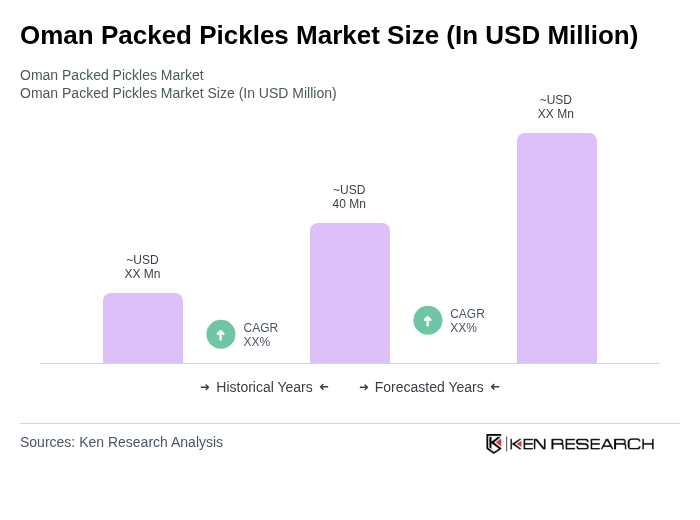
- The Oman Packed Pickles Market is valued at USD 40 million, based on a five-year historical analysis and aligning with the country-level packed pickles growth trajectory reported for Oman. This growth is primarily driven by increasing consumer demand for convenient and ready-to-eat food products and the rising trend of snacking, as well as the incorporation of pickles as flavor enhancers in various cuisines, which is consistent with broader packed pickles demand patterns. The market has seen a steady rise in popularity supported by the growing consumer interest in fermented and preserved foods, with global evidence that pickles are associated with perceived digestive and probiotic benefits, especially when produced through lactic acid fermentation.
- Muscat and Dhofar are the dominant regions in the Oman Packed Pickles Market, primarily due to their larger population bases, higher consumer spending power, and stronger urban concentration compared with other governorates. The urbanization in these areas has led to an increase in the number of supermarkets, hypermarkets, and specialty grocery outlets, in line with the broader expansion of organized retail in the Gulf region, making packed food products, including pickles, more accessible to consumers. Additionally, the cultural significance of pickled and preserved vegetables in Middle Eastern and Gulf cuisines supports regular household consumption, reinforcing their popularity in these regions.
- In 2023, the Omani government implemented regulations to enhance food safety standards in the packed food sector, including packed pickles, through instruments such as the Gulf Technical Regulation on the Labelling of Prepackaged Foodstuffs (GSO 9/2013) adopted and enforced by the Ministry of Commerce, Industry and Investment Promotion and the Ministry of Health. This regulation mandates that all prepackaged food products must undergo compliance with harmonized Gulf standards for safety and quality and adhere to specific Arabic/English labeling requirements, including clear ingredient lists, nutrition information where applicable, expiry dates, and country of origin, ensuring that consumers are well-informed about the products they purchase.
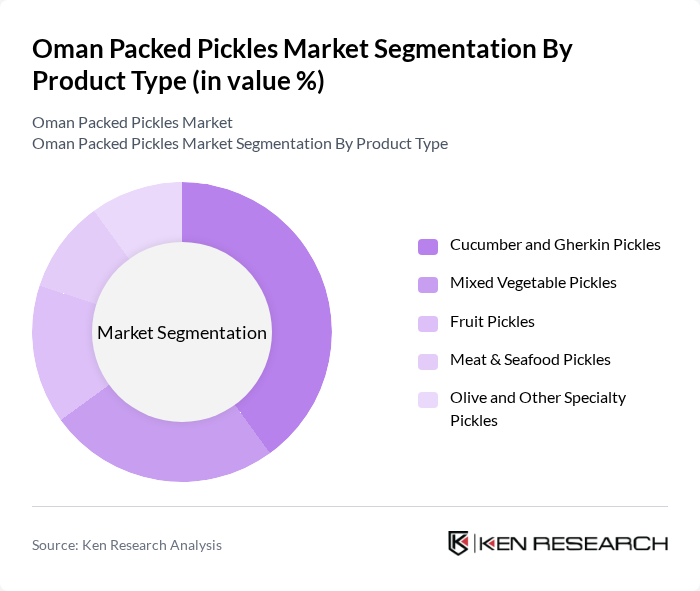
Oman Packed Pickles Market Segmentation
By Product Type:The product type segmentation includes various categories such as Cucumber and Gherkin Pickles, Mixed Vegetable Pickles, Fruit Pickles, Meat & Seafood Pickles, and Olive and Other Specialty Pickles. This structure is consistent with global packed pickles classifications that distinguish between vegetable (especially cucumber), fruit, and meat/seafood-based pickles. Among these, Cucumber and Gherkin Pickles dominate the market due to their widespread use in salads, sandwiches, burgers, and as standalone snacks, mirroring the global pattern where cucumber pickles hold the largest product share. The increasing trend of convenient, flavorful accompaniments and the popularity of pickles as a condiment in quick-service and casual dining formats have further boosted their demand. Mixed Vegetable Pickles also hold a significant share, appealing to consumers looking for diverse flavor profiles and the inclusion of regional vegetables, which aligns with the growing interest in traditional, locally inspired recipes across the Middle East.
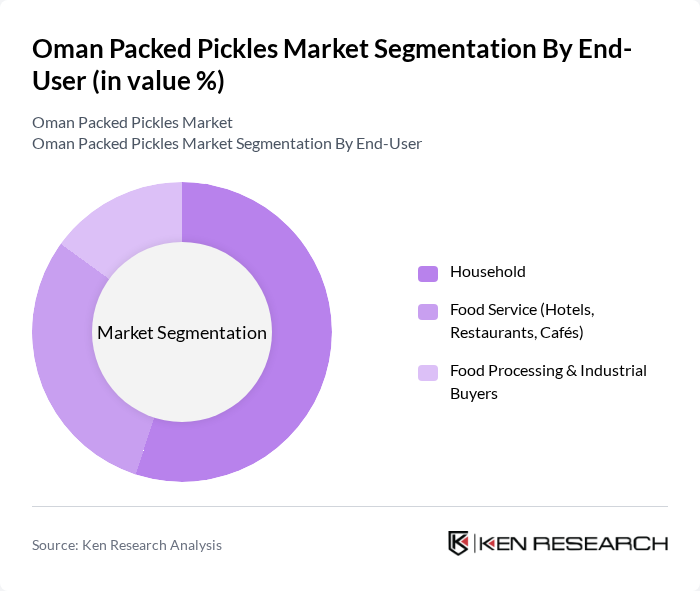
By End-User:The end-user segmentation includes Household, Food Service (Hotels, Restaurants, Cafés), and Food Processing & Industrial Buyers. This segmentation is aligned with global packed pickles usage, where household consumption typically accounts for the largest share of demand. The Household segment leads the market, driven by the growing trend of home cooking, the role of pickles as an everyday table condiment in Middle Eastern and South Asian–influenced diets, and the availability of a wide range of retail pack sizes catering to family consumption. The Food Service sector is also significant, as restaurants, cafés, and quick-service outlets incorporate pickles into sandwiches, grills, shawarmas, and combo meals to enhance flavor profiles and offer value-added sides, in line with global menu trends that increasingly use pickles as flavor enhancers. The Food Processing segment is growing as manufacturers use pickles and pickled ingredients in ready meals, sauces, and sandwich spreads, supporting bulk and institutional demand.
Oman Packed Pickles Market Competitive Landscape
The Oman Packed Pickles Market is characterized by a dynamic mix of regional and international players. Leading participants such as Al Ahlia Foods, Oman Foodstuff Factory LLC (Oman Canning Company), A’Saffa Foods SAOG, Al Jazeera Food Products Co., Al Reef Food Industries, National Food Products Company, Altowiq Trading & Food Industries, Al Mudhish (Dhofar Food & Investment Co.), Mazoon Dairy & Food Industries (Pickled Products Line), Private Label & House Brands (Major Retailers in Oman), Regional Import Brands (India, Pakistan, Jordan, Lebanon), Emerging Local SME Pickle Manufacturers, Key Co-Packing and Contract Manufacturing Partners, Major HORECA-Focused Suppliers, and Niche Organic and Gourmet Pickle Brands contribute to innovation, geographic expansion, and service delivery in this space, aligning with the broader trend in the packed pickles market where manufacturers focus on product innovation, premiumization, and expanded distribution channels.
Oman Packed Pickles Market Industry Analysis
Growth Drivers
- Increasing Consumer Demand for Convenience Foods:The Omani food market is witnessing a significant shift towards convenience foods, with a reported increase in demand by 15% in future. This trend is driven by busy lifestyles and a growing preference for ready-to-eat options. According to the Oman National Center for Statistics and Information, the convenience food sector is projected to reach a value of OMR 1.2 billion in future, further boosting the packed pickles segment as consumers seek quick meal accompaniments.
- Expansion of Retail and E-commerce Channels:The retail landscape in Oman is evolving, with a 20% increase in the number of supermarkets and hypermarkets from 2022 to future. E-commerce sales in the food sector have surged by 30%, driven by the pandemic's impact on shopping habits. This expansion provides packed pickles brands with greater visibility and accessibility, allowing them to reach a broader consumer base and cater to the growing online shopping trend, which is expected to continue into future.
- Cultural Significance of Pickles in Omani Cuisine:Pickles hold a vital place in Omani culinary traditions, with over 70% of households incorporating them into daily meals. The Ministry of Heritage and Culture reports that traditional pickling methods are being preserved, while modern variations are gaining popularity. This cultural affinity not only sustains demand but also encourages local producers to innovate, creating unique flavors that resonate with both local and expatriate consumers, thus enhancing market growth.
Market Challenges
- Competition from Local and International Brands:The packed pickles market in Oman faces intense competition, with over 50 local brands and numerous international players vying for market share. This saturation leads to price wars and challenges in brand differentiation. According to industry reports, the competitive landscape is expected to intensify as new entrants emerge, making it crucial for existing brands to innovate and enhance their marketing strategies to maintain consumer loyalty.
- Fluctuating Raw Material Prices:The packed pickles industry is significantly affected by the volatility of raw material prices, particularly for vegetables and spices. In future, prices for key ingredients rose by 10-15% due to supply chain disruptions and climatic factors. This fluctuation poses a challenge for manufacturers in maintaining profit margins while ensuring product affordability. As a result, companies must adopt strategic sourcing and inventory management practices to mitigate these risks.
Oman Packed Pickles Market Future Outlook
The Oman packed pickles market is poised for growth, driven by evolving consumer preferences and increasing health consciousness. As more consumers seek out organic and artisanal options, brands that innovate with unique flavors and sustainable practices will likely thrive. Additionally, the expansion of e-commerce platforms will facilitate greater market penetration, allowing brands to reach diverse demographics. The focus on product transparency and ethical sourcing will further shape the market landscape, aligning with global trends towards healthier eating habits.
Market Opportunities
- Introduction of Innovative Flavors and Varieties:There is a growing opportunity for brands to introduce innovative flavors that cater to diverse palates. With a 25% increase in interest for fusion foods among Omani consumers, companies can capitalize on this trend by developing unique pickle varieties that blend traditional and modern tastes, potentially increasing market share and consumer engagement.
- Growth in Export Potential to Neighboring Countries:Oman’s strategic location offers significant export potential for packed pickles to neighboring GCC countries. In future, exports of food products increased by 18%, indicating a robust demand for Omani food items abroad. By leveraging this trend, local producers can expand their market reach, tapping into the growing appetite for ethnic foods in the region.
Scope of the Report
| Segment | Sub-Segments |
|---|---|
| By Product Type | Cucumber and Gherkin Pickles Mixed Vegetable Pickles Fruit Pickles Meat & Seafood Pickles Olive and Other Specialty Pickles |
| By End-User | Household Food Service (Hotels, Restaurants, Cafés) Food Processing & Industrial Buyers |
| By Packaging Type | Glass Jars Plastic Jars & Containers Pouches & Stand-Up Bags Cans Other Packaging (Buckets, Bulk) |
| By Distribution Channel | Supermarkets/Hypermarkets Grocery & Convenience Stores Specialty & Traditional Stores Online Retail Foodservice & Institutional Channels |
| By Region | Muscat Dhofar Al Batinah Al Dakhiliyah Other Regions |
| By Price Range | Economy Mid-Range Premium |
| By Flavor Profile | Dill and Sour Sweet Spicy Mixed/Other Flavors |
Key Target Audience
Investors and Venture Capitalist Firms
Government and Regulatory Bodies (e.g., Ministry of Commerce, Industry and Investment Promotion)
Manufacturers and Producers of Pickles
Distributors and Retailers of Food Products
Food Safety and Standards Authorities (e.g., Oman Food Safety Authority)
Importers and Exporters of Food Products
Packaging Suppliers and Technology Providers
Industry Associations (e.g., Oman Chamber of Commerce and Industry)
Players Mentioned in the Report:
Al Ahlia Foods
Oman Foodstuff Factory LLC (Oman Canning Company)
ASaffa Foods SAOG
Al Jazeera Food Products Co.
Al Reef Food Industries
National Food Products Company
Altowiq Trading & Food Industries
Al Mudhish (Dhofar Food & Investment Co.)
Mazoon Dairy & Food Industries (Pickled Products Line)
Private Label & House Brands (Major Retailers in Oman)
Regional Import Brands (India, Pakistan, Jordan, Lebanon)
Emerging Local SME Pickle Manufacturers
Key Co-Packing and Contract Manufacturing Partners
Major HORECA-Focused Suppliers
Niche Organic and Gourmet Pickle Brands
Table of Contents
Market Assessment Phase
1. Executive Summary and Approach
2. Oman Packed Pickles Market Overview
2.1 Key Insights and Strategic Recommendations
2.2 Oman Packed Pickles Market Overview
2.3 Definition and Scope
2.4 Evolution of Market Ecosystem
2.5 Timeline of Key Regulatory Milestones
2.6 Value Chain & Stakeholder Mapping
2.7 Business Cycle Analysis
2.8 Policy & Incentive Landscape
3. Oman Packed Pickles Market Analysis
3.1 Growth Drivers
3.1.1 Increasing consumer demand for convenience foods
3.1.3 Expansion of retail and e-commerce channels
3.1.4 Cultural significance of pickles in Omani cuisine
3.2 Market Challenges
3.2.1 Competition from local and international brands
3.2.2 Fluctuating raw material prices
3.2.3 Regulatory compliance and food safety standards
3.2.4 Limited awareness of product varieties among consumers
3.3 Market Opportunities
3.3.1 Introduction of innovative flavors and varieties
3.3.2 Growth in export potential to neighboring countries
3.3.3 Collaborations with local restaurants and food services
3.3.4 Increasing interest in organic and artisanal products
3.4 Market Trends
3.4.1 Shift towards sustainable packaging solutions
3.4.2 Rise of online grocery shopping
3.4.3 Growing popularity of ethnic foods
3.4.4 Increased focus on product transparency and labeling
3.5 Government Regulation
3.5.1 Food safety regulations and standards
3.5.2 Import/export regulations for food products
3.5.3 Labeling requirements for packaged foods
3.5.4 Environmental regulations affecting packaging materials
4. SWOT Analysis
5. Stakeholder Analysis
6. Porter's Five Forces Analysis
7. Oman Packed Pickles Market Market Size, 2019-2024
7.1 By Value
7.2 By Volume
7.3 By Average Selling Price
8. Oman Packed Pickles Market Segmentation
8.1 By Product Type
8.1.1 Cucumber and Gherkin Pickles
8.1.2 Mixed Vegetable Pickles
8.1.3 Fruit Pickles
8.1.4 Meat & Seafood Pickles
8.1.5 Olive and Other Specialty Pickles
8.2 By End-User
8.2.1 Household
8.2.2 Food Service (Hotels, Restaurants, Cafés)
8.2.3 Food Processing & Industrial Buyers
8.3 By Packaging Type
8.3.1 Glass Jars
8.3.2 Plastic Jars & Containers
8.3.3 Pouches & Stand-Up Bags
8.3.4 Cans
8.3.5 Other Packaging (Buckets, Bulk)
8.4 By Distribution Channel
8.4.1 Supermarkets/Hypermarkets
8.4.2 Grocery & Convenience Stores
8.4.3 Specialty & Traditional Stores
8.4.4 Online Retail
8.4.5 Foodservice & Institutional Channels
8.5 By Region
8.5.1 Muscat
8.5.2 Dhofar
8.5.3 Al Batinah
8.5.4 Al Dakhiliyah
8.5.5 Other Regions
8.6 By Price Range
8.6.1 Economy
8.6.2 Mid-Range
8.6.3 Premium
8.7 By Flavor Profile
8.7.1 Dill and Sour
8.7.2 Sweet
8.7.3 Spicy
8.7.4 Mixed/Other Flavors
9. Oman Packed Pickles Market Competitive Analysis
9.1 Market Share of Key Players
9.2 Cross Comparison of Key Players
9.2.1 Company Name
9.2.2 Group Size (Large, Medium, or Small as per industry convention)
9.2.3 Oman Packed Pickles Revenue (OMR, Latest Year)
9.2.4 3-Year Revenue CAGR (%) – Oman Packed Pickles
9.2.5 EBITDA Margin (%) – Oman Packed Pickles Business
9.2.6 Market Share in Oman Packed Pickles (%)
9.2.7 Numeric & Weighted Distribution Coverage (%)
9.2.8 Average Realized Price per Kg/Litre (OMR)
9.2.9 SKU Count and Product Range Breadth
9.2.10 Private Label vs Branded Sales Mix (%)
9.2.11 Export Revenue Share (%) from Oman
9.2.12 Marketing Spend as % of Sales
9.2.13 Brand Awareness / Preference Score (Survey-Based)
9.3 SWOT Analysis of Top Players
9.4 Pricing Analysis
9.5 Detailed Profile of Major Companies
9.5.1 Al Ahlia Foods
9.5.2 Oman Foodstuff Factory LLC (Oman Canning Company)
9.5.3 A’Saffa Foods SAOG
9.5.4 Al Jazeera Food Products Co.
9.5.5 Al Reef Food Industries
9.5.6 National Food Products Company
9.5.7 Altowiq Trading & Food Industries
9.5.8 Al Mudhish (Dhofar Food & Investment Co.)
9.5.9 Mazoon Dairy & Food Industries (Pickled Products Line)
9.5.10 Private Label & House Brands (Major Retailers in Oman)
9.5.11 Regional Import Brands (India, Pakistan, Jordan, Lebanon)
9.5.12 Emerging Local SME Pickle Manufacturers
9.5.13 Key Co-Packing and Contract Manufacturing Partners
9.5.14 Major HORECA-Focused Suppliers
9.5.15 Niche Organic and Gourmet Pickle Brands
10. Oman Packed Pickles Market End-User Analysis
10.1 Procurement Behavior of Key Ministries
10.1.1 Ministry of Agriculture and Fisheries
10.1.2 Ministry of Commerce and Industry
10.1.3 Ministry of Health
10.1.4 Ministry of Education
10.2 Corporate Spend on Infrastructure & Energy
10.2.1 Investment in Food Processing Facilities
10.2.2 Budget Allocation for Local Sourcing
10.2.3 Expenditure on Quality Control Measures
10.2.4 Funding for Marketing Initiatives
10.3 Pain Point Analysis by End-User Category
10.3.1 Supply Chain Disruptions
10.3.2 Quality Assurance Challenges
10.3.3 Price Volatility of Raw Materials
10.3.4 Limited Product Awareness
10.4 User Readiness for Adoption
10.4.1 Consumer Interest in New Flavors
10.4.2 Willingness to Pay for Premium Products
10.4.3 Adoption of Online Purchasing
10.4.4 Feedback Mechanisms for Product Improvement
10.5 Post-Deployment ROI and Use Case Expansion
10.5.1 Increased Sales from New Product Lines
10.5.2 Enhanced Brand Loyalty
10.5.3 Expansion into New Markets
10.5.4 Improved Customer Engagement Strategies
11. Oman Packed Pickles Market Future Size, 2025-2030
11.1 By Value
11.2 By Volume
11.3 By Average Selling Price
Go-To-Market Strategy Phase
1. Whitespace Analysis + Business Model Canvas
1.1 Market Gaps Identification
1.2 Value Proposition Development
1.3 Revenue Streams Analysis
1.4 Cost Structure Evaluation
1.5 Key Partnerships Exploration
1.6 Customer Segmentation
1.7 Channels of Distribution
2. Marketing and Positioning Recommendations
2.1 Branding Strategies
2.2 Product USPs
2.3 Target Audience Identification
2.4 Communication Strategy
2.5 Digital Marketing Approaches
2.6 Promotional Activities
2.7 Market Positioning
3. Distribution Plan
3.1 Urban Retail Strategies
3.2 Rural NGO Tie-ups
3.3 Direct-to-Consumer Channels
3.4 Wholesale Distribution
3.5 E-commerce Partnerships
3.6 Logistics and Supply Chain Management
3.7 Inventory Management Solutions
4. Channel & Pricing Gaps
4.1 Underserved Routes
4.2 Pricing Bands Analysis
4.3 Competitor Pricing Strategies
4.4 Consumer Price Sensitivity
4.5 Discounting Strategies
4.6 Bundling Opportunities
4.7 Price Optimization Techniques
5. Unmet Demand & Latent Needs
5.1 Category Gaps
5.2 Consumer Segments Analysis
5.3 Product Development Opportunities
5.4 Market Entry Strategies
5.5 Customer Feedback Mechanisms
5.6 Trend Analysis
5.7 Future Demand Projections
6. Customer Relationship
6.1 Loyalty Programs
6.2 After-sales Service
6.3 Customer Engagement Strategies
6.4 Feedback Collection Methods
6.5 Community Building Initiatives
6.6 Customer Support Systems
6.7 Relationship Management Tools
7. Value Proposition
7.1 Sustainability Initiatives
7.2 Integrated Supply Chains
7.3 Quality Assurance Practices
7.4 Unique Selling Points
7.5 Customer-Centric Innovations
7.6 Brand Storytelling
7.7 Market Differentiation Strategies
8. Key Activities
8.1 Regulatory Compliance
8.2 Branding Initiatives
8.3 Distribution Setup
8.4 Marketing Campaigns
8.5 Product Development
8.6 Training and Development
8.7 Performance Monitoring
9. Entry Strategy Evaluation
9.1 Domestic Market Entry Strategy
9.1.1 Product Mix Considerations
9.1.2 Pricing Band Analysis
9.1.3 Packaging Innovations
9.2 Export Entry Strategy
9.2.1 Target Countries Identification
9.2.2 Compliance Roadmap Development
10. Entry Mode Assessment
10.1 Joint Ventures
10.2 Greenfield Investments
10.3 Mergers & Acquisitions
10.4 Distributor Model Evaluation
11. Capital and Timeline Estimation
11.1 Capital Requirements Analysis
11.2 Timelines for Market Entry
12. Control vs Risk Trade-Off
12.1 Ownership vs Partnerships
13. Profitability Outlook
13.1 Breakeven Analysis
13.2 Long-term Sustainability Strategies
14. Potential Partner List
14.1 Distributors
14.2 Joint Ventures
14.3 Acquisition Targets
15. Execution Roadmap
15.1 Phased Plan for Market Entry
15.1.1 Market Setup
15.1.2 Market Entry
15.1.3 Growth Acceleration
15.1.4 Scale & Stabilize
15.2 Key Activities and Milestones
15.2.1 Activity Planning
15.2.2 Milestone Tracking
Research Methodology
Phase 1: Approach1
Desk Research
- Analysis of market reports from local and regional food industry associations
- Review of government publications on food safety regulations and import/export data
- Examination of consumer behavior studies and trends in the Omani food sector
Primary Research
- Interviews with key stakeholders in the food processing industry, including pickle manufacturers
- Surveys conducted with retailers and distributors of packed pickles in Oman
- Focus group discussions with consumers to understand preferences and purchasing behavior
Validation & Triangulation
- Cross-validation of findings through multiple data sources, including trade publications and market surveys
- Triangulation of qualitative insights from interviews with quantitative data from surveys
- Sanity checks through expert reviews from industry veterans and market analysts
Phase 2: Market Size Estimation1
Top-down Assessment
- Estimation of market size based on national food consumption statistics and growth rates
- Segmentation of the market by product type, including various flavors and packaging sizes
- Incorporation of demographic data to assess potential market expansion opportunities
Bottom-up Modeling
- Collection of sales data from leading packed pickle brands in Oman
- Estimation of average retail prices and volume sold across different distribution channels
- Analysis of production capacities and operational efficiencies of local manufacturers
Forecasting & Scenario Analysis
- Development of forecasting models based on historical sales data and market trends
- Scenario analysis considering factors such as economic conditions and consumer preferences
- Projections for market growth under various regulatory and competitive scenarios through 2030
Phase 3: CATI Sample Composition1
| Scope Item/Segment | Sample Size | Target Respondent Profiles |
|---|---|---|
| Retail Distribution of Packed Pickles | 80 | Store Managers, Category Buyers |
| Consumer Preferences for Pickle Varieties | 120 | Household Consumers, Food Enthusiasts |
| Market Trends in Food Processing | 60 | Food Technologists, Product Development Managers |
| Export Opportunities for Omani Pickles | 50 | Export Managers, Trade Analysts |
| Health and Safety Regulations Impact | 40 | Regulatory Affairs Specialists, Quality Control Managers |
Frequently Asked Questions
What is the current value of the Oman Packed Pickles Market?
The Oman Packed Pickles Market is valued at approximately USD 40 million, reflecting a steady growth trajectory driven by increasing consumer demand for convenient and ready-to-eat food products.
Which regions dominate the Oman Packed Pickles Market?
What are the main drivers of growth in the Oman Packed Pickles Market?
What types of pickles are popular in Oman?
Other Regional/Country Reports
Indonesia Packed Pickles Market
Malaysia Packed Pickles Market
KSA Packed Pickles Market
APAC Packed Pickles Market
SEA Packed Pickles Market
Vietnam Packed Pickles Market
Other Adjacent Reports
South Korea Convenience Foods Market
South Africa Fermented Foods Market
Global Condiments Market Outlook 2030Kuwait Sauces Market
Vietnam Snack Foods Market
Malaysia Ready-to-Eat Foods Market
Oman Preserved Foods Market
Oman Canned Foods Market Size Share Growth Drivers Trends Opportunities & Forecast 2025–2030KSA food packaging market size, share, growth drivers, trends, opportunities & forecast 2025–2030 Organic Foods MarketWhy Buy From Us?

What makes us stand out is that our consultants follow Robust, Refine and Result (RRR) methodology. Robust for clear definitions, approaches and sanity checking, Refine for differentiating respondents' facts and opinions, and Result for presenting data with story.

We have set a benchmark in the industry by offering our clients with syndicated and customized market research reports featuring coverage of entire market as well as meticulous research and analyst insights.

While we don't replace traditional research, we flip the method upside down. Our dual approach of Top Bottom & Bottom Top ensures quality deliverable by not just verifying company fundamentals but also looking at the sector and macroeconomic factors.

With one step in the future, our research team constantly tries to show you the bigger picture. We help with some of the tough questions you may encounter along the way: How is the industry positioned? Best marketing channel? KPI's of competitors? By aligning every element, we help maximize success.

Our report gives you instant access to the answers and sources that other companies might choose to hide. We elaborate each steps of research methodology we have used and showcase you the sample size to earn your trust.

If you need any support, we are here! We pride ourselves on universe strength, data quality, and quick, friendly, and professional service.