About the Report
Base Year 2024Oman SME Financing Market Overview
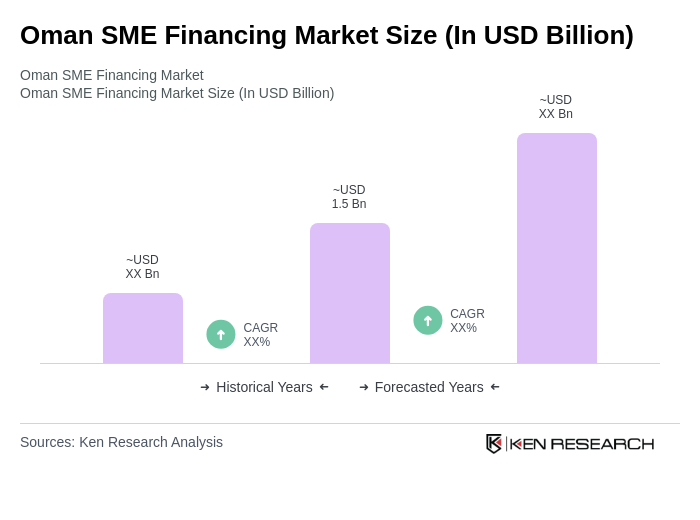
- The Oman SME Financing Market is valued at USD 1.5 billion, based on a five-year historical analysis. This growth is primarily driven by the increasing recognition of SMEs as vital contributors to economic diversification and job creation, alongside government initiatives aimed at enhancing access to finance for these enterprises.
- Muscat, the capital city, is the dominant hub for SME financing due to its concentration of financial institutions and government support programs. Other notable regions include Salalah and Sohar, which benefit from strategic investments and infrastructure development, fostering a conducive environment for SMEs.
- In 2023, the Omani government implemented the SME Development Law, which aims to streamline the regulatory framework for SMEs. This law includes provisions for easier access to financing, tax incentives, and support for innovation, thereby enhancing the overall business environment for small and medium enterprises.
Oman SME Financing Market Segmentation
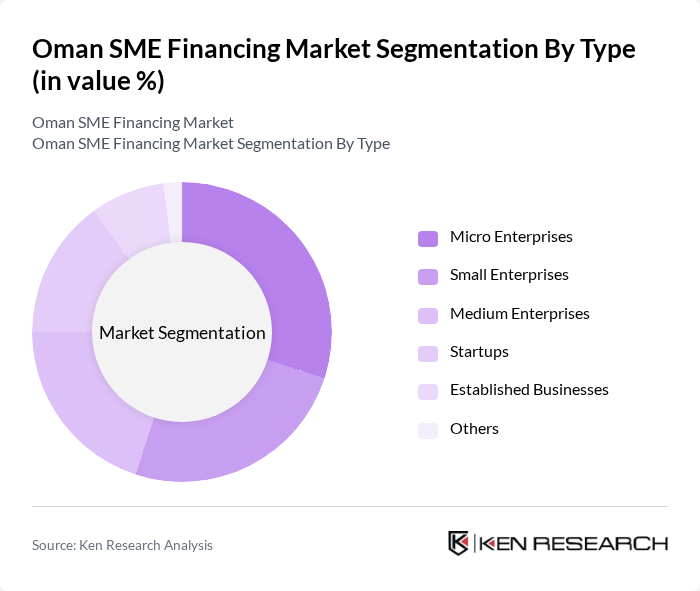
By Type:The market is segmented into various types of enterprises, including micro, small, medium, startups, established businesses, and others. Micro enterprises are often the most prevalent due to their lower capital requirements and the ability to cater to local markets. Small and medium enterprises also play a significant role, driven by their capacity to scale operations and contribute to economic growth. Startups are gaining traction, particularly in technology and innovation sectors, while established businesses leverage their market presence to secure financing for expansion.
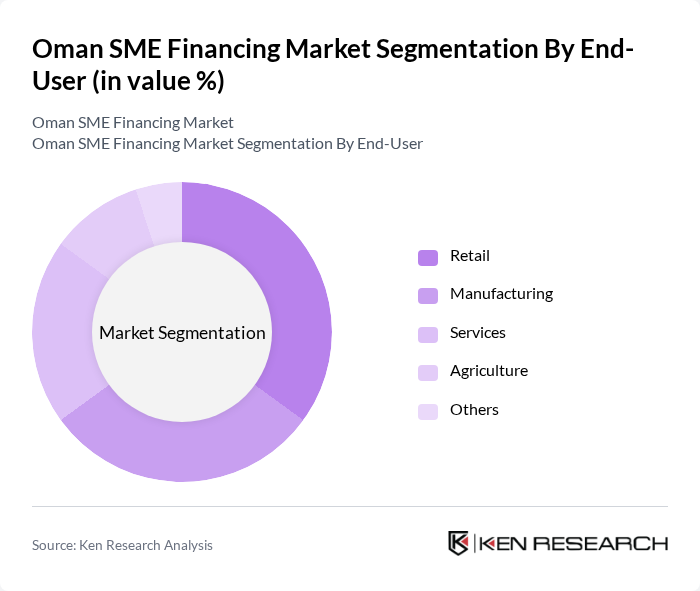
By End-User:The end-user segmentation includes retail, manufacturing, services, agriculture, and others. The retail sector is the largest end-user of SME financing, driven by the growing consumer market and demand for diverse products. The manufacturing sector follows closely, benefiting from government initiatives aimed at boosting local production. The services sector, including hospitality and IT, is also expanding rapidly, while agriculture remains a vital area for financing due to its importance in food security and rural development.
Oman SME Financing Market Competitive Landscape
The Oman SME Financing Market is characterized by a dynamic mix of regional and international players. Leading participants such as Bank Muscat, Oman Arab Bank, National Bank of Oman, Dhofar Insurance Company, Oman Development Bank, Alizz Islamic Bank, Bank Sohar, Muscat Finance, Oman International Bank, Oman Investment Authority, Al Izz Islamic Bank, Oman National Investments Development Company, Al Maha Financial Services, Al Batinah Development Company, Oman Oil Company contribute to innovation, geographic expansion, and service delivery in this space.
Oman SME Financing Market Industry Analysis
Growth Drivers
- Increasing Government Support for SMEs:The Omani government has allocated OMR 200 million (approximately USD 520 million) to support SMEs through various initiatives in future. This funding aims to enhance access to finance, improve infrastructure, and provide training programs. Additionally, the government has established the Oman Development Bank, which has disbursed over OMR 150 million in loans to SMEs, fostering a conducive environment for entrepreneurial growth and innovation.
- Rising Entrepreneurial Activity:In future, Oman witnessed a 15% increase in new business registrations, totaling approximately 10,000 new SMEs. This surge is driven by a growing entrepreneurial spirit among the youth, supported by government initiatives and incubator programs. The Ministry of Commerce and Industry reported that 60% of these new businesses are in the services sector, indicating a shift towards diverse economic activities and increased job creation.
- Access to Digital Financing Solutions:The digital financing landscape in Oman has expanded significantly, with over 30 fintech companies operating in the market by future. These platforms have facilitated more than OMR 50 million in loans to SMEs, providing faster and more accessible financing options. The rise of mobile banking and online lending platforms has enabled entrepreneurs to secure funds with minimal paperwork, enhancing financial inclusion and supporting business growth.
Market Challenges
- Limited Awareness of Financing Options:Despite the availability of various financing options, a significant portion of Omani entrepreneurs remains unaware of these resources. A survey conducted in the past indicated that 40% of SMEs do not utilize available financing due to a lack of information. This gap in awareness hinders the growth potential of many businesses, as they miss out on opportunities for funding and support that could enhance their operations.
- Stringent Lending Criteria:Many financial institutions in Oman impose strict lending criteria, which can be a barrier for SMEs seeking financing. In future, it was reported that only 30% of loan applications from SMEs were approved, primarily due to inadequate collateral and credit history. This challenge limits access to necessary funds, stifling growth and innovation within the SME sector, which is crucial for economic diversification.
Oman SME Financing Market Future Outlook
The future of the Oman SME financing market appears promising, driven by increasing government initiatives and a growing emphasis on digital solutions. As the government continues to implement supportive policies, including credit guarantee schemes and tax incentives, SMEs are likely to experience improved access to financing. Additionally, the rise of fintech solutions will further enhance financial inclusion, enabling more entrepreneurs to secure funding and contribute to economic growth in the region.
Market Opportunities
- Expansion of Microfinance Institutions:The microfinance sector in Oman is poised for growth, with over 15 institutions currently operating. In future, these institutions are expected to increase their loan disbursements by 20%, providing essential funding to underserved entrepreneurs. This expansion will enhance financial access for low-income individuals, fostering entrepreneurship and economic development.
- Development of Fintech Solutions:The fintech landscape in Oman is rapidly evolving, with projections indicating that investments in fintech could reach OMR 30 million by future. This growth presents opportunities for innovative financing solutions tailored to SMEs, such as peer-to-peer lending and crowdfunding platforms. These developments will facilitate easier access to capital, driving business growth and diversification in the economy.
Scope of the Report
| Segment | Sub-Segments |
|---|---|
| By Type | Micro Enterprises Small Enterprises Medium Enterprises Startups Established Businesses Others |
| By End-User | Retail Manufacturing Services Agriculture Others |
| By Investment Source | Bank Loans Venture Capital Government Grants Private Equity Others |
| By Financing Type | Equity Financing Debt Financing Hybrid Financing Microfinancing Others |
| By Business Sector | Technology Healthcare Tourism Construction Others |
| By Loan Size | Small Loans Medium Loans Large Loans Others |
| By Policy Support | Subsidies Tax Exemptions Grants Others |
Key Target Audience
Investors and Venture Capitalist Firms
Government and Regulatory Bodies (e.g., Ministry of Commerce, Industry and Investment Promotion)
Financial Institutions (e.g., Oman Development Bank)
Microfinance Institutions
Business Incubators and Accelerators
Trade Associations and Chambers of Commerce
Private Equity Firms
Export Credit Agencies
Players Mentioned in the Report:
Bank Muscat
Oman Arab Bank
National Bank of Oman
Dhofar Insurance Company
Oman Development Bank
Alizz Islamic Bank
Bank Sohar
Muscat Finance
Oman International Bank
Oman Investment Authority
Al Izz Islamic Bank
Oman National Investments Development Company
Al Maha Financial Services
Al Batinah Development Company
Oman Oil Company
Table of Contents
Market Assessment Phase
1. Executive Summary and Approach
2. Oman SME Financing Market Overview
2.1 Key Insights and Strategic Recommendations
2.2 Oman SME Financing Market Overview
2.3 Definition and Scope
2.4 Evolution of Market Ecosystem
2.5 Timeline of Key Regulatory Milestones
2.6 Value Chain & Stakeholder Mapping
2.7 Business Cycle Analysis
2.8 Policy & Incentive Landscape
3. Oman SME Financing Market Analysis
3.1 Growth Drivers
3.1.1 Increasing Government Support for SMEs
3.1.2 Rising Entrepreneurial Activity
3.1.3 Access to Digital Financing Solutions
3.1.4 Growing Demand for Alternative Financing Options
3.2 Market Challenges
3.2.1 Limited Awareness of Financing Options
3.2.2 Stringent Lending Criteria
3.2.3 Economic Fluctuations Impacting Cash Flow
3.2.4 Lack of Financial Literacy Among Entrepreneurs
3.3 Market Opportunities
3.3.1 Expansion of Microfinance Institutions
3.3.2 Development of Fintech Solutions
3.3.3 Collaboration with International Funding Bodies
3.3.4 Increasing Focus on Sustainable Business Practices
3.4 Market Trends
3.4.1 Shift Towards Digital Banking Solutions
3.4.2 Rise of Peer-to-Peer Lending Platforms
3.4.3 Emphasis on ESG (Environmental, Social, Governance) Criteria
3.4.4 Growth of Crowdfunding as a Financing Option
3.5 Government Regulation
3.5.1 Implementation of SME Development Policies
3.5.2 Introduction of Credit Guarantee Schemes
3.5.3 Regulation of Microfinance Institutions
3.5.4 Tax Incentives for SME Investments
4. SWOT Analysis
5. Stakeholder Analysis
6. Porter's Five Forces Analysis
7. Oman SME Financing Market Market Size, 2019-2024
7.1 By Value
7.2 By Volume
7.3 By Average Selling Price
8. Oman SME Financing Market Segmentation
8.1 By Type
8.1.1 Micro Enterprises
8.1.2 Small Enterprises
8.1.3 Medium Enterprises
8.1.4 Startups
8.1.5 Established Businesses
8.1.6 Others
8.2 By End-User
8.2.1 Retail
8.2.2 Manufacturing
8.2.3 Services
8.2.4 Agriculture
8.2.5 Others
8.3 By Investment Source
8.3.1 Bank Loans
8.3.2 Venture Capital
8.3.3 Government Grants
8.3.4 Private Equity
8.3.5 Others
8.4 By Financing Type
8.4.1 Equity Financing
8.4.2 Debt Financing
8.4.3 Hybrid Financing
8.4.4 Microfinancing
8.4.5 Others
8.5 By Business Sector
8.5.1 Technology
8.5.2 Healthcare
8.5.3 Tourism
8.5.4 Construction
8.5.5 Others
8.6 By Loan Size
8.6.1 Small Loans
8.6.2 Medium Loans
8.6.3 Large Loans
8.6.4 Others
8.7 By Policy Support
8.7.1 Subsidies
8.7.2 Tax Exemptions
8.7.3 Grants
8.7.4 Others
9. Oman SME Financing Market Competitive Analysis
9.1 Market Share of Key Players
9.2 Cross Comparison of Key Players
9.2.1 Company Name
9.2.2 Group Size (Large, Medium, or Small as per industry convention)
9.2.3 Revenue Growth Rate
9.2.4 Customer Acquisition Cost
9.2.5 Average Loan Size
9.2.6 Default Rate
9.2.7 Market Penetration Rate
9.2.8 Customer Retention Rate
9.2.9 Pricing Strategy
9.2.10 Return on Investment (ROI)
9.3 SWOT Analysis of Top Players
9.4 Pricing Analysis
9.5 Detailed Profile of Major Companies
9.5.1 Bank Muscat
9.5.2 Oman Arab Bank
9.5.3 National Bank of Oman
9.5.4 Dhofar Insurance Company
9.5.5 Oman Development Bank
9.5.6 Alizz Islamic Bank
9.5.7 Bank Sohar
9.5.8 Muscat Finance
9.5.9 Oman International Bank
9.5.10 Oman Investment Authority
9.5.11 Al Izz Islamic Bank
9.5.12 Oman National Investments Development Company
9.5.13 Al Maha Financial Services
9.5.14 Al Batinah Development Company
9.5.15 Oman Oil Company
10. Oman SME Financing Market End-User Analysis
10.1 Procurement Behavior of Key Ministries
10.1.1 Ministry of Commerce, Industry and Investment Promotion
10.1.2 Ministry of Finance
10.1.3 Ministry of Agriculture, Fisheries and Water Resources
10.2 Corporate Spend on Infrastructure & Energy
10.2.1 Investment in Renewable Energy Projects
10.2.2 Infrastructure Development Initiatives
10.2.3 Public-Private Partnerships
10.3 Pain Point Analysis by End-User Category
10.3.1 Access to Capital
10.3.2 Regulatory Compliance Challenges
10.3.3 Market Competition
10.4 User Readiness for Adoption
10.4.1 Awareness of Financing Options
10.4.2 Digital Literacy Levels
10.4.3 Willingness to Engage with Financial Institutions
10.5 Post-Deployment ROI and Use Case Expansion
10.5.1 Measurement of Financial Performance
10.5.2 Expansion into New Markets
10.5.3 Diversification of Product Offerings
11. Oman SME Financing Market Future Size, 2025-2030
11.1 By Value
11.2 By Volume
11.3 By Average Selling Price
Go-To-Market Strategy Phase
1. Whitespace Analysis + Business Model Canvas
1.1 Identification of Market Gaps
1.2 Value Proposition Development
1.3 Revenue Streams Analysis
1.4 Cost Structure Evaluation
1.5 Key Partnerships Identification
1.6 Customer Segments Definition
1.7 Channels for Delivery
2. Marketing and Positioning Recommendations
2.1 Branding Strategies
2.2 Product USPs
2.3 Target Audience Identification
2.4 Communication Strategy
2.5 Digital Marketing Approaches
3. Distribution Plan
3.1 Urban Retail Strategies
3.2 Rural NGO Tie-ups
3.3 Online Distribution Channels
3.4 Partnerships with Local Businesses
4. Channel & Pricing Gaps
4.1 Underserved Routes
4.2 Pricing Bands Analysis
4.3 Competitor Pricing Comparison
5. Unmet Demand & Latent Needs
5.1 Category Gaps Identification
5.2 Consumer Segments Analysis
5.3 Emerging Trends Exploration
6. Customer Relationship
6.1 Loyalty Programs Development
6.2 After-sales Service Strategies
6.3 Customer Feedback Mechanisms
7. Value Proposition
7.1 Sustainability Initiatives
7.2 Integrated Supply Chains
7.3 Unique Selling Points
8. Key Activities
8.1 Regulatory Compliance
8.2 Branding Efforts
8.3 Distribution Setup
9. Entry Strategy Evaluation
9.1 Domestic Market Entry Strategy
9.1.1 Product Mix Considerations
9.1.2 Pricing Band Strategy
9.1.3 Packaging Options
9.2 Export Entry Strategy
9.2.1 Target Countries Identification
9.2.2 Compliance Roadmap Development
10. Entry Mode Assessment
10.1 Joint Ventures
10.2 Greenfield Investments
10.3 Mergers & Acquisitions
10.4 Distributor Model Evaluation
11. Capital and Timeline Estimation
11.1 Capital Requirements Analysis
11.2 Timelines for Implementation
12. Control vs Risk Trade-Off
12.1 Ownership vs Partnerships
12.2 Risk Management Strategies
13. Profitability Outlook
13.1 Breakeven Analysis
13.2 Long-term Sustainability Strategies
14. Potential Partner List
14.1 Distributors Identification
14.2 Joint Ventures Opportunities
14.3 Acquisition Targets
15. Execution Roadmap
15.1 Phased Plan for Market Entry
15.1.1 Market Setup
15.1.2 Market Entry
15.1.3 Growth Acceleration
15.1.4 Scale & Stabilize
15.2 Key Activities and Milestones
15.2.1 Activity Planning
15.2.2 Milestone Tracking
Research Methodology
Phase 1: Approach1
Desk Research
- Analysis of government reports on SME financing trends in Oman
- Review of financial institutions' publications and annual reports
- Examination of market studies and white papers from industry associations
Primary Research
- Interviews with financial analysts specializing in SME financing
- Surveys targeting SME owners across various sectors in Oman
- Focus group discussions with representatives from local banks and microfinance institutions
Validation & Triangulation
- Cross-validation of findings with data from the Central Bank of Oman
- Triangulation of insights from primary interviews and secondary data sources
- Sanity checks through expert panel reviews involving industry veterans
Phase 2: Market Size Estimation1
Top-down Assessment
- Estimation of total available market based on national economic indicators
- Segmentation of the SME financing market by industry and financing type
- Incorporation of government initiatives aimed at boosting SME growth
Bottom-up Modeling
- Collection of data on loan disbursements from major banks and financial institutions
- Analysis of average loan sizes and repayment terms across different sectors
- Estimation of market penetration rates for various financing products
Forecasting & Scenario Analysis
- Multi-factor regression analysis incorporating GDP growth and SME sector performance
- Scenario modeling based on potential regulatory changes and economic conditions
- Development of baseline, optimistic, and pessimistic forecasts through 2030
Phase 3: CATI Sample Composition1
| Scope Item/Segment | Sample Size | Target Respondent Profiles |
|---|---|---|
| Manufacturing SMEs | 100 | Business Owners, Financial Managers |
| Service Sector SMEs | 80 | Entrepreneurs, Operations Managers |
| Retail SMEs | 70 | Store Managers, Financial Analysts |
| Technology Startups | 60 | Founders, CTOs, Financial Advisors |
| Microfinance Institutions | 50 | Loan Officers, Branch Managers |
Frequently Asked Questions
What is the current value of the Oman SME Financing Market?
The Oman SME Financing Market is valued at approximately USD 1.5 billion, reflecting significant growth driven by the recognition of SMEs as essential for economic diversification and job creation, along with supportive government initiatives.
Which regions in Oman are prominent for SME financing?
What is the SME Development Law in Oman?
What types of enterprises are included in the Oman SME Financing Market?
Other Regional/Country Reports
Indonesia SME Financing Market Size, Share, Growth Drivers & Forecast 2025–2030
Malaysia SME Financing Market Size, Share, Growth Drivers & Forecast 2025–2030
KSA SME Financing Market Size, Share, Growth Drivers & Forecast 2025–2030
APAC SME Financing Market Size, Share, Growth Drivers & Forecast 2025–2030
SEA SME Financing Market Size, Share, Growth Drivers & Forecast 2025–2030
Vietnam SME Financing Market Size, Share, Growth Drivers & Forecast 2025–2030
Other Adjacent Reports
Thailand Venture Capital Market
Saudi Arabia Private Equity MarketBelgium Fintech Lending MarketBahrain SME Insurance Market
KSA Crowdfunding MarketOman Islamic Banking Market Size, Share, Growth Drivers & Forecast 2025–2030South Africa Commercial Banking Market
Egypt Business Consulting Market
Vietnam Startup Incubation Market
Why Buy From Us?

What makes us stand out is that our consultants follow Robust, Refine and Result (RRR) methodology. Robust for clear definitions, approaches and sanity checking, Refine for differentiating respondents' facts and opinions, and Result for presenting data with story.

We have set a benchmark in the industry by offering our clients with syndicated and customized market research reports featuring coverage of entire market as well as meticulous research and analyst insights.

While we don't replace traditional research, we flip the method upside down. Our dual approach of Top Bottom & Bottom Top ensures quality deliverable by not just verifying company fundamentals but also looking at the sector and macroeconomic factors.

With one step in the future, our research team constantly tries to show you the bigger picture. We help with some of the tough questions you may encounter along the way: How is the industry positioned? Best marketing channel? KPI's of competitors? By aligning every element, we help maximize success.

Our report gives you instant access to the answers and sources that other companies might choose to hide. We elaborate each steps of research methodology we have used and showcase you the sample size to earn your trust.

If you need any support, we are here! We pride ourselves on universe strength, data quality, and quick, friendly, and professional service.