About the Report
Base Year 2024Oman Thermal Conductive Additives Market Overview
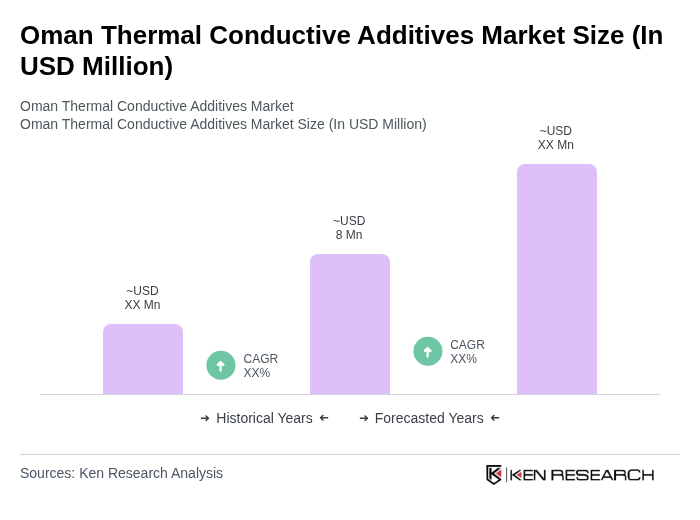
- The Oman Thermal Conductive Additives Market is valued at USD 8 million, based on a five-year historical analysis and Oman’s share within the Middle East and Africa thermal conductive filler/additives market.This growth is primarily driven by the increasing demand for efficient thermal management solutions in electronics, automotive, electrical equipment, and thermally conductive plastics, where Oman is seeing steady adoption of lightweight, heat‑resistant materials.The rising need for high-performance materials that can withstand elevated operating temperatures, support compact designs, and provide effective heat dissipation has significantly contributed to the market's expansion.
- Muscat, Salalah, and Sohar are the dominant cities in the Oman Thermal Conductive Additives Market. Muscat, as the capital, serves as a central hub for trade, commerce, and electronics distribution, attracting numerous manufacturers and suppliers of plastics, adhesives, and thermal management materials.Salalah's strategic location and free‑zone infrastructure enhance its role in logistics and distribution for industrial and packaging applications, while Sohar's industrial port and adjacent industrial estates facilitate the import of fillers, polymers, and specialty chemicals and the export of finished thermal management components, making these cities pivotal in the market landscape.
- In 2023, the Omani government strengthened regulations and standards related to chemical substances, industrial safety, and environmental performance that are directly applicable to thermal conductive additives and compounds. Under instruments such as the Environmental Protection and Pollution Control Law issued by Royal Decree 114/2001 and its implementing regulations administered by the Environment Authority, manufacturers and importers of chemical and polymeric materials must comply with controls on emissions, waste handling, and hazardous substances, aligning products with international safety and environmental standards.These requirements, along with industrial permitting and conformity assessment overseen by the Ministry of Commerce, Industry and Investment Promotion and the Oman Standards and Metrology Department, are expected to foster innovation in low‑emission, high‑performance thermal management solutions in the market.
Oman Thermal Conductive Additives Market Segmentation
By Additive Type:
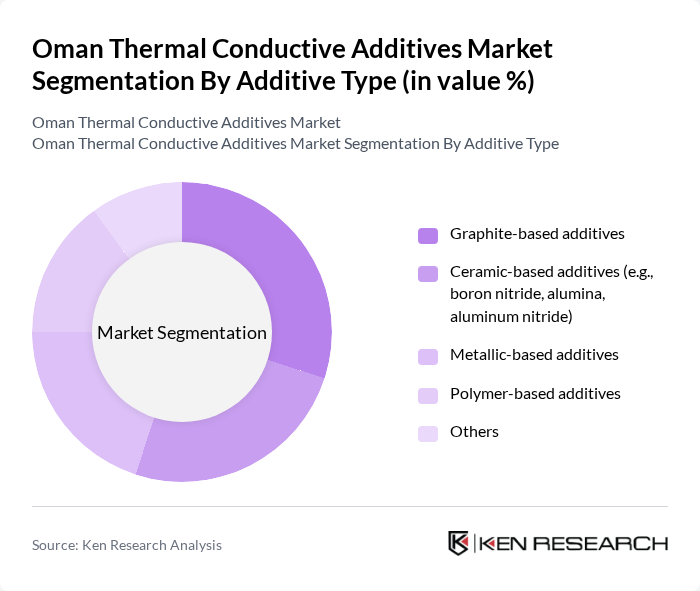
The additive type segment is dominated by graphite-based or broader carbon-based additives, which are favored for their excellent thermal conductivity, relatively low density, and cost-effectiveness in polymer and adhesive systems.These additives are widely used in electronics, automotive, and thermally conductive plastics applications, where efficient heat dissipation and electrical control are critical.The growing trend towards miniaturization and higher power density in electronic devices further drives the demand for high-performance graphite- and carbon-based solutions, making them a leading choice among manufacturers across the thermal management value chain.
By End-Use Industry:
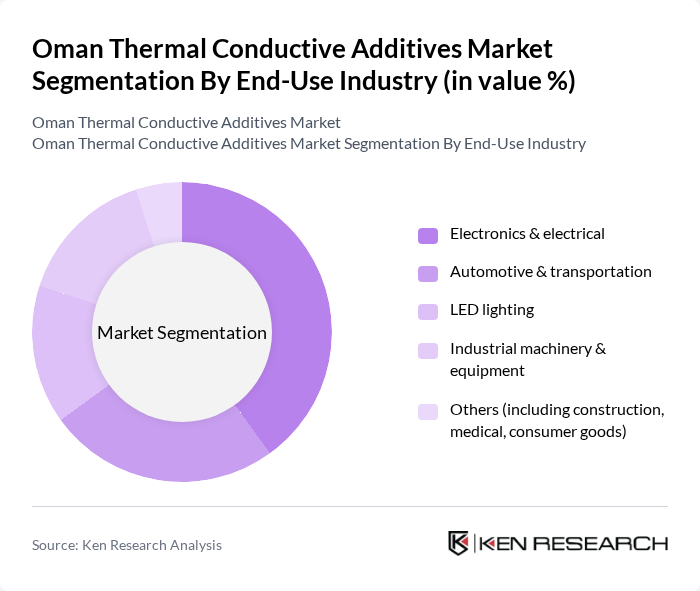
The electronics and electrical sector is the largest end-use industry for thermal conductive additives globally and in the wider Middle East, accounting for a significant portion of demand due to printed circuit boards, thermal interface materials, encapsulants, and thermally conductive plastics used in devices and power electronics.The rapid advancement of technology, increasing penetration of consumer electronics, telecommunications equipment, and power infrastructure, and the move towards higher power density and 5G‑class hardware have led to a surge in the need for effective thermal management solutions.This trend, combined with rising adoption of electric and hybrid vehicles in the region, is expected to continue, solidifying the electronics and electrical sector's position as the dominant end-user in the market.
Oman Thermal Conductive Additives Market Competitive Landscape
The Oman Thermal Conductive Additives Market is characterized by a dynamic mix of regional and international players. Leading participants such as Cabot Corporation, 3M Company, Momentive Performance Materials Inc., Henkel AG & Co. KGaA, DuPont de Nemours, Inc., Mitsubishi Chemical Group Corporation, BASF SE, Huntsman Corporation, LG Chem Ltd., Avient Corporation (including former PolyOne and A. Schulman), RTP Company, Solvay S.A., Eastman Chemical Company, Kaneka Corporation, and selected regional and local players in Oman / GCC contribute to innovation, geographic expansion, and service delivery in this space.
Oman Thermal Conductive Additives Market Industry Analysis
Growth Drivers
- Increasing Demand for Energy-Efficient Materials:The global push for energy efficiency is driving the demand for thermal conductive additives in Oman. In future, the energy efficiency market is projected to reach $1.8 trillion, with a significant portion attributed to construction and manufacturing sectors. This trend is supported by the Omani government's commitment to reducing energy consumption by 20% by 2030, creating a favorable environment for thermal conductive additives that enhance energy efficiency in various applications.
- Growth in Electronics and Automotive Sectors:The electronics and automotive industries in Oman are experiencing robust growth, with the electronics market expected to reach $1.5 billion in future. This growth is fueled by increased consumer demand for advanced electronic devices and electric vehicles, which require effective thermal management solutions. The automotive sector alone is projected to grow at a rate of 7% annually, further driving the need for high-performance thermal conductive additives in these applications.
- Rising Awareness of Thermal Management Solutions:As industries become more aware of the importance of thermal management, the demand for thermal conductive additives is increasing. In future, the global thermal management market is expected to exceed $12 billion, with Oman contributing significantly due to its expanding industrial base. This awareness is leading to investments in innovative thermal management solutions, thereby boosting the adoption of thermal conductive additives across various sectors, including construction and manufacturing.
Market Challenges
- High Cost of Advanced Thermal Conductive Additives:One of the primary challenges facing the Oman thermal conductive additives market is the high cost associated with advanced materials. For instance, premium thermal conductive additives can cost up to $55 per kilogram, which can deter small and medium-sized enterprises from adopting these solutions. This cost barrier limits market penetration and slows down the overall growth of the thermal conductive additives sector in Oman.
- Limited Awareness Among End-Users:Despite the benefits of thermal conductive additives, there remains a significant knowledge gap among end-users in Oman. Many industries are still unaware of the advantages these materials offer for thermal management. This lack of awareness can hinder market growth, as companies may continue to rely on traditional materials that do not provide optimal thermal performance, thereby missing out on potential efficiency gains and cost savings.
Oman Thermal Conductive Additives Market Future Outlook
The future of the Oman thermal conductive additives market appears promising, driven by increasing investments in research and development and a growing emphasis on sustainability. As industries seek to enhance energy efficiency and reduce environmental impact, the demand for innovative thermal management solutions is expected to rise. Furthermore, collaborations between manufacturers and technology providers will likely lead to the development of advanced materials tailored for specific applications, fostering market growth and innovation in the coming years.
Market Opportunities
- Expansion in Renewable Energy Applications:The shift towards renewable energy sources presents a significant opportunity for thermal conductive additives. With Oman aiming to generate 35% of its energy from renewables by 2030, the demand for materials that enhance thermal management in solar panels and wind turbines is expected to increase, creating a lucrative market for additive manufacturers.
- Development of New Composite Materials:The ongoing research into new composite materials that incorporate thermal conductive additives offers substantial market potential. As industries seek lightweight and high-performance materials, the integration of these additives can enhance product performance, leading to increased adoption in sectors such as aerospace and automotive, thereby driving market growth.
Scope of the Report
| Segment | Sub-Segments |
|---|---|
| By Additive Type | Graphite-based additives Ceramic-based additives (e.g., boron nitride, alumina, aluminum nitride) Metallic-based additives Polymer-based additives Others |
| By End-Use Industry | Electronics & electrical Automotive & transportation LED lighting Industrial machinery & equipment Others (including construction, medical, consumer goods) |
| By Application | Electronics cooling & thermal interface materials Encapsulation & potting compounds LED modules and lighting components Automotive powertrain & battery thermal management Others |
| By Material Form | Powders Pastes & greases Films & sheets Fibers & masterbatches Others |
| By Thermal Conductivity Range | Below 1 W/mK –5 W/mK –10 W/mK Above 10 W/mK |
| By Region (Oman) | Muscat Salalah Sohar Nizwa Others |
| By Performance Characteristics | High thermal conductivity Electrical insulation High temperature resistance Lightweight & processability Others |
Key Target Audience
Investors and Venture Capitalist Firms
Government and Regulatory Bodies (e.g., Ministry of Commerce, Industry and Investment Promotion)
Manufacturers and Producers of Thermal Conductive Additives
Distributors and Retailers of Chemical Products
Construction and Building Material Companies
Automotive Manufacturers and Suppliers
Electronics and Electrical Equipment Manufacturers
Energy Sector Companies and Renewable Energy Firms
Players Mentioned in the Report:
Cabot Corporation
3M Company
Momentive Performance Materials Inc.
Henkel AG & Co. KGaA
DuPont de Nemours, Inc.
Mitsubishi Chemical Group Corporation
BASF SE
Huntsman Corporation
LG Chem Ltd.
Avient Corporation (including former PolyOne and A. Schulman)
RTP Company
Solvay S.A.
Eastman Chemical Company
Kaneka Corporation
Selected regional and local players in Oman / GCC
Table of Contents
Market Assessment Phase
1. Executive Summary and Approach
2. Oman Thermal Conductive Additives Market Overview
2.1 Key Insights and Strategic Recommendations
2.2 Oman Thermal Conductive Additives Market Overview
2.3 Definition and Scope
2.4 Evolution of Market Ecosystem
2.5 Timeline of Key Regulatory Milestones
2.6 Value Chain & Stakeholder Mapping
2.7 Business Cycle Analysis
2.8 Policy & Incentive Landscape
3. Oman Thermal Conductive Additives Market Analysis
3.1 Growth Drivers
3.1.1 Increasing demand for energy-efficient materials
3.1.2 Growth in electronics and automotive sectors
3.1.3 Rising awareness of thermal management solutions
3.1.4 Technological advancements in additive manufacturing
3.2 Market Challenges
3.2.1 High cost of advanced thermal conductive additives
3.2.2 Limited awareness among end-users
3.2.3 Regulatory hurdles in material approvals
3.2.4 Competition from alternative materials
3.3 Market Opportunities
3.3.1 Expansion in renewable energy applications
3.3.2 Development of new composite materials
3.3.3 Increasing investments in R&D
3.3.4 Collaborations with technology providers
3.4 Market Trends
3.4.1 Shift towards sustainable and eco-friendly additives
3.4.2 Growing integration of IoT in thermal management
3.4.3 Customization of additives for specific applications
3.4.4 Rise in demand for lightweight materials
3.5 Government Regulation
3.5.1 Standards for thermal conductivity testing
3.5.2 Environmental regulations on material usage
3.5.3 Incentives for energy-efficient products
3.5.4 Compliance requirements for import/export
4. SWOT Analysis
5. Stakeholder Analysis
6. Porter's Five Forces Analysis
7. Oman Thermal Conductive Additives Market Market Size, 2019-2024
7.1 By Value
7.2 By Volume
7.3 By Average Selling Price
8. Oman Thermal Conductive Additives Market Segmentation
8.1 By Additive Type
8.1.1 Graphite-based additives
8.1.2 Ceramic-based additives (e.g., boron nitride, alumina, aluminum nitride)
8.1.3 Metallic-based additives
8.1.4 Polymer-based additives
8.1.5 Others
8.2 By End-Use Industry
8.2.1 Electronics & electrical
8.2.2 Automotive & transportation
8.2.3 LED lighting
8.2.4 Industrial machinery & equipment
8.2.5 Others (including construction, medical, consumer goods)
8.3 By Application
8.3.1 Electronics cooling & thermal interface materials
8.3.2 Encapsulation & potting compounds
8.3.3 LED modules and lighting components
8.3.4 Automotive powertrain & battery thermal management
8.3.5 Others
8.4 By Material Form
8.4.1 Powders
8.4.2 Pastes & greases
8.4.3 Films & sheets
8.4.4 Fibers & masterbatches
8.4.5 Others
8.5 By Thermal Conductivity Range
8.5.1 Below 1 W/mK
8.5.2 1–5 W/mK
8.5.3 5–10 W/mK
8.5.4 Above 10 W/mK
8.6 By Region (Oman)
8.6.1 Muscat
8.6.2 Salalah
8.6.3 Sohar
8.6.4 Nizwa
8.6.5 Others
8.7 By Performance Characteristics
8.7.1 High thermal conductivity
8.7.2 Electrical insulation
8.7.3 High temperature resistance
8.7.4 Lightweight & processability
8.7.5 Others
9. Oman Thermal Conductive Additives Market Competitive Analysis
9.1 Market Share of Key Players
9.2 Cross Comparison of Key Players
9.2.1 Company name
9.2.2 Group size (large, medium, or small as per industry convention)
9.2.3 Oman thermal conductive additives revenue (USD million)
9.2.4 3-year CAGR in segment revenue (%)
9.2.5 EBITDA margin from Oman operations (%)
9.2.6 Market share in Oman thermal conductive additives market (%)
9.2.7 Average selling price vs. market average (index)
9.2.8 R&D intensity (% of revenue)
9.2.9 Number of thermal-conductive grades / SKUs offered in Oman
9.2.10 Installed capacity in Oman / GCC (tons per year)
9.2.11 Utilization rate of relevant capacity (%)
9.2.12 Distribution reach (number of active distributors / key accounts)
9.2.13 Customer concentration (share of top 5 clients, %)
9.2.14 On-time delivery performance (%)
9.2.15 Customer satisfaction / NPS score
9.3 SWOT Analysis of Top Players
9.4 Pricing Analysis
9.5 Detailed Profile of Major Companies
9.5.1 Cabot Corporation
9.5.2 3M Company
9.5.3 Momentive Performance Materials Inc.
9.5.4 Henkel AG & Co. KGaA
9.5.5 DuPont de Nemours, Inc.
9.5.6 Mitsubishi Chemical Group Corporation
9.5.7 BASF SE
9.5.8 Huntsman Corporation
9.5.9 LG Chem Ltd.
9.5.10 Avient Corporation (including former PolyOne and A. Schulman)
9.5.11 RTP Company
9.5.12 Solvay S.A.
9.5.13 Eastman Chemical Company
9.5.14 Kaneka Corporation
9.5.15 Selected regional and local players in Oman / GCC
10. Oman Thermal Conductive Additives Market End-User Analysis
10.1 Procurement Behavior of Key Ministries
10.1.1 Government procurement policies
10.1.2 Budget allocation for thermal management solutions
10.1.3 Evaluation criteria for suppliers
10.1.4 Contracting processes
10.2 Corporate Spend on Infrastructure & Energy
10.2.1 Investment trends in energy-efficient technologies
10.2.2 Budgeting for thermal conductive materials
10.2.3 Long-term contracts with suppliers
10.2.4 Impact of economic conditions on spending
10.3 Pain Point Analysis by End-User Category
10.3.1 Challenges in sourcing quality materials
10.3.2 Issues with supply chain reliability
10.3.3 Need for customized solutions
10.3.4 Cost constraints
10.4 User Readiness for Adoption
10.4.1 Awareness of thermal conductive additives
10.4.2 Training and support requirements
10.4.3 Integration with existing systems
10.4.4 Feedback mechanisms for improvement
10.5 Post-Deployment ROI and Use Case Expansion
10.5.1 Measurement of performance improvements
10.5.2 Case studies of successful implementations
10.5.3 Scalability of solutions
10.5.4 Future investment considerations
11. Oman Thermal Conductive Additives Market Future Size, 2025-2030
11.1 By Value
11.2 By Volume
11.3 By Average Selling Price
Go-To-Market Strategy Phase
1. Whitespace Analysis + Business Model Canvas
1.1 Market gaps and opportunities
2. Marketing and Positioning Recommendations
2.1 Branding strategies
2.2 Product USPs
3. Distribution Plan
3.1 Urban retail vs rural NGO tie-ups
4. Channel & Pricing Gaps
4.1 Underserved routes
4.2 Pricing bands
5. Unmet Demand & Latent Needs
5.1 Category gaps
5.2 Consumer segments
6. Customer Relationship
6.1 Loyalty programs
6.2 After-sales service
7. Value Proposition
7.1 Sustainability
7.2 Integrated supply chains
8. Key Activities
8.1 Regulatory compliance
8.2 Branding
8.3 Distribution setup
9. Entry Strategy Evaluation
9.1 Domestic Market Entry Strategy
9.1.1 Product mix
9.1.2 Pricing band
9.1.3 Packaging
9.2 Export Entry Strategy
9.2.1 Target countries
9.2.2 Compliance roadmap
10. Entry Mode Assessment
10.1 JV, Greenfield, M&A, Distributor Model
11. Capital and Timeline Estimation
11.1 Capital requirements
11.2 Timelines
12. Control vs Risk Trade-Off
12.1 Ownership vs Partnerships
13. Profitability Outlook
13.1 Breakeven analysis
13.2 Long-term sustainability
14. Potential Partner List
14.1 Distributors
14.2 JVs
14.3 Acquisition targets
15. Execution Roadmap
15.1 Phased Plan for Market Entry
15.1.1 Market Setup
15.1.2 Market Entry
15.1.3 Growth Acceleration
15.1.4 Scale & Stabilize
15.2 Key Activities and Milestones
15.2.1 Milestone tracking
15.2.2 Activity scheduling
Research Methodology
Phase 1: Approach1
Desk Research
- Analysis of industry reports from Oman’s Ministry of Commerce and Industry
- Review of academic journals focusing on thermal conductive materials and additives
- Examination of market trends and forecasts from trade associations in the chemical sector
Primary Research
- Interviews with product managers at leading thermal conductive additive manufacturers
- Surveys with end-users in electronics, automotive, and construction sectors
- Field visits to manufacturing plants to gather insights on production processes
Validation & Triangulation
- Cross-validation of findings through multiple data sources including trade publications
- Triangulation of market data with insights from industry experts and stakeholders
- Sanity checks through feedback from a panel of thermal materials specialists
Phase 2: Market Size Estimation1
Top-down Assessment
- Estimation of market size based on national consumption of thermal conductive additives
- Segmentation by application areas such as electronics, automotive, and construction
- Incorporation of growth rates from related industries and government initiatives
Bottom-up Modeling
- Collection of sales data from key manufacturers and distributors in Oman
- Estimation of average pricing for various types of thermal conductive additives
- Volume estimates based on production capacities and market demand forecasts
Forecasting & Scenario Analysis
- Utilization of time-series analysis to project future market trends through 2030
- Scenario modeling based on economic growth, technological advancements, and regulatory changes
- Development of best-case, worst-case, and most-likely market scenarios
Phase 3: CATI Sample Composition1
| Scope Item/Segment | Sample Size | Target Respondent Profiles |
|---|---|---|
| Electronics Manufacturing | 120 | Product Engineers, R&D Managers |
| Automotive Industry Applications | 90 | Procurement Managers, Quality Assurance Heads |
| Construction Material Suppliers | 80 | Sales Directors, Technical Support Engineers |
| Research Institutions and Universities | 60 | Academic Researchers, Material Scientists |
| Government Regulatory Bodies | 40 | Policy Makers, Environmental Compliance Officers |
Frequently Asked Questions
What is the current value of the Oman Thermal Conductive Additives Market?
The Oman Thermal Conductive Additives Market is valued at approximately USD 8 million, reflecting a historical analysis of the market's growth and its position within the broader Middle East and Africa thermal conductive filler/additives market.
What factors are driving the growth of the Oman Thermal Conductive Additives Market?
Which cities are the main hubs for the Oman Thermal Conductive Additives Market?
What are the main types of thermal conductive additives used in Oman?
Other Regional/Country Reports
Other Adjacent Reports
KSA Thermally Conductive Plastics Market
APAC thermal interface materials market size, share, growth drivers, trends, opportunities & forecast 2025–2030Brazil Electronics Thermal Management Market
UAE Automotive Thermal Management MarketIndia Polymer Additives Market Outlook to 2022Brazil Carbon-Based Additives Market
UAE Adhesives and Sealants MarketMalaysia Composite Materials Market
Kuwait Renewable Energy Materials Market
USA Specialty Chemicals Market Size Share Growth Drivers Trends Opportunities & Forecast 2025–2030Why Buy From Us?

What makes us stand out is that our consultants follow Robust, Refine and Result (RRR) methodology. Robust for clear definitions, approaches and sanity checking, Refine for differentiating respondents' facts and opinions, and Result for presenting data with story.

We have set a benchmark in the industry by offering our clients with syndicated and customized market research reports featuring coverage of entire market as well as meticulous research and analyst insights.

While we don't replace traditional research, we flip the method upside down. Our dual approach of Top Bottom & Bottom Top ensures quality deliverable by not just verifying company fundamentals but also looking at the sector and macroeconomic factors.

With one step in the future, our research team constantly tries to show you the bigger picture. We help with some of the tough questions you may encounter along the way: How is the industry positioned? Best marketing channel? KPI's of competitors? By aligning every element, we help maximize success.

Our report gives you instant access to the answers and sources that other companies might choose to hide. We elaborate each steps of research methodology we have used and showcase you the sample size to earn your trust.

If you need any support, we are here! We pride ourselves on universe strength, data quality, and quick, friendly, and professional service.