About the Report
Base Year 2024Indonesia Thermal Conductive Additives Market Overview
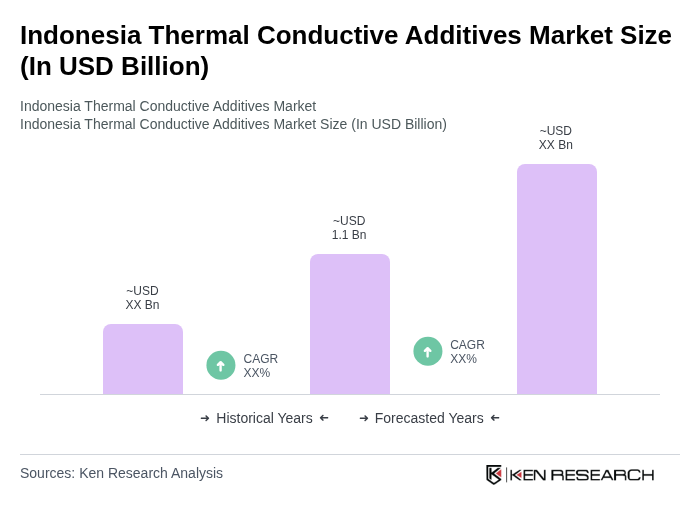
- The Indonesia Thermal Conductive Additives Market is valued at USD 1.1 billion, based on a five-year historical analysis. This valuation is consistent with the position of Asia-Pacific as the largest regional market for thermally conductive additives globally and Indonesia’s role as a fast-growing manufacturing hub within Southeast Asia.This growth is primarily driven by the increasing demand for efficient thermal management solutions across electronics, automotive, LED lighting, and consumer goods, where thermally conductive additives are used to dissipate heat in polymers and composites.The rising trend of miniaturization in electronic devices, growth in power electronics and LED systems, and the growing adoption of electric vehicles—requiring improved battery, inverter, and control unit thermal management—are significant factors contributing to the market’s expansion.
- Key regions dominating the market include Java and Sumatra, primarily due to their robust industrial base and concentration of manufacturing activities.Java, being the country’s primary economic and manufacturing hub, hosts numerous electronics assembly operations, automotive manufacturing, and supporting plastics and chemicals processing industries that increasingly integrate thermally conductive compounds.Sumatra’s growing industrial and resource-processing sectors, including metals, petrochemicals, and basic materials, also contribute to demand for thermal conductive additives used in equipment components, power infrastructure, and industrial electrical applications.
- In 2023, the Indonesian government implemented regulations aimed at enhancing energy efficiency in manufacturing processes. A key framework is the Government Regulation No. 18 of 2016 on Electricity Business Provision issued by the Government of Indonesia, which underpins subsequent energy-efficiency policies in industry, and is operationalized through the National Energy Conservation Master Plan (RIKEN) and the Regulation of the Minister of Energy and Mineral Resources No. 14 of 2012 on Energy Management.These instruments require large industrial energy users to implement energy management systems, conduct periodic energy audits, and adopt technologies and materials that improve energy performance, which encourages the uptake of advanced thermal management solutions and thermally conductive additives in equipment, electrical components, and production systems.
Indonesia Thermal Conductive Additives Market Segmentation
By Additive Type:
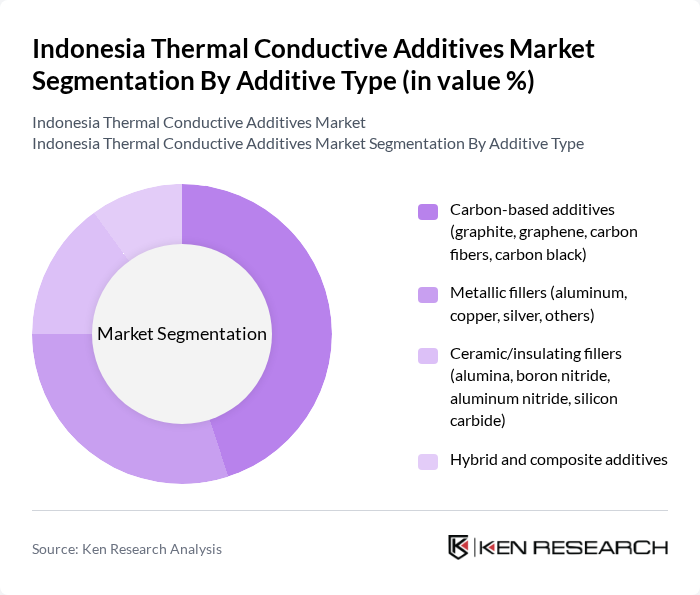
The additive type segmentation includes carbon-based additives, metallic fillers, ceramic/insulating fillers, and hybrid and composite additives, which aligns with standard global segmentation for thermally conductive additives.Among these, carbon-based additives, particularly graphite, graphene, and carbon fibers, are increasingly adopted due to their high intrinsic thermal conductivity and favorable strength-to-weight ratio, which support lightweight thermal management solutions in polymers.The electronics and automotive sectors are expanding the use of carbon-based additives in thermally conductive compounds, TIMs (thermal interface materials), and housings for power electronics and LED modules. Metallic fillers, such as aluminum and copper, also hold a substantial share, driven by their excellent and well-characterized thermal properties and suitability in applications where higher density is acceptable and electrical conductivity is either desired or can be managed.Ceramic/insulating fillers, including alumina, boron nitride, aluminum nitride, and silicon carbide, are gaining traction where electrical insulation and high thermal conductivity are required simultaneously, such as in electronic encapsulants, LED packaging, and EV powertrain components.Overall, carbon-based additives are expected to maintain a leading position, complemented by growing use of ceramic fillers in high-performance and electrically insulating applications.
By Resin Compatibility:
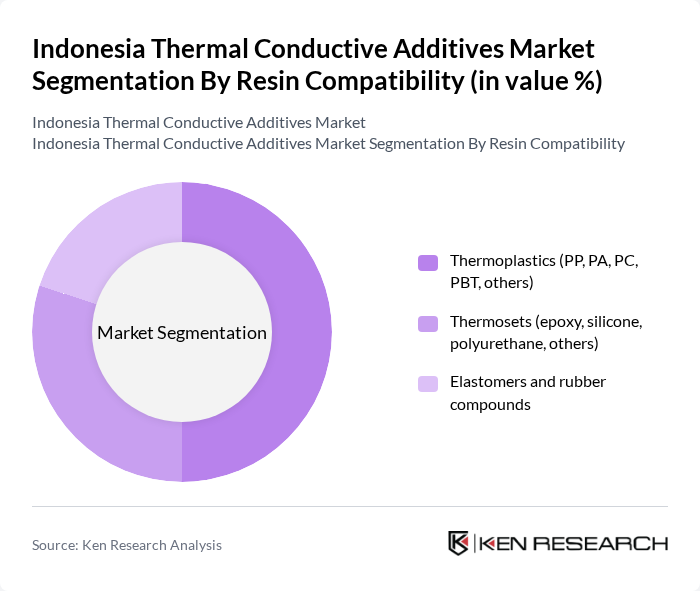
This segmentation includes thermoplastics, thermosets, and elastomers and rubber compounds, in line with global market practice for thermally conductive plastic additives.Thermoplastics, particularly polypropylene, polyamide, polycarbonate, and PBT, dominate usage due to their versatility, established processing routes, and suitability for high-volume molded parts in automotive, E&E, and consumer goods.The automotive and electronics industries favor thermoplastics for lightweight, design flexibility, and recyclability, and are increasingly formulating thermally conductive grades for battery components, connectors, housings, and LED fixtures.Thermosets, such as epoxy and silicone, are also gaining traction in potting compounds, encapsulants, gap fillers, and thermal interface materials where high thermal stability, low creep, and long-term reliability under thermal cycling are critical.Elastomers and rubber compounds are used in gaskets, pads, and vibration-damping components that must combine flexibility with improved heat dissipation. Overall, thermoplastics are expected to lead the resin compatibility segment due to their widespread application base and ongoing development of high-performance thermally conductive formulations.
Indonesia Thermal Conductive Additives Market Competitive Landscape
The Indonesia Thermal Conductive Additives Market is characterized by a dynamic mix of regional and international players. Leading participants such as 3M Company, Henkel AG & Co. KGaA, Dow Inc., Honeywell International Inc., Parker Hannifin Corporation, DIC Corporation, Shin-Etsu Chemical Co., Ltd., Mitsubishi Chemical Group Corporation, Toray Industries, Inc., PT. Chandra Asri Petrochemical Tbk, PT. Pertamina (Persero), PT. Indonesia Asahan Aluminium (INALUM), PT. Timah Tbk, PT. Pupuk Kaltim, PT. Krakatau Steel (Persero) Tbk contribute to innovation, geographic expansion, and service delivery in this space, leveraging their portfolios in thermally conductive plastics, specialty additives, electronic materials, and metal-based fillers to address growing thermal management needs in Indonesia’s electronics, automotive, and industrial sectors.
Indonesia Thermal Conductive Additives Market Industry Analysis
Growth Drivers
- Increasing Demand for Energy-Efficient Materials:The Indonesian government aims to reduce energy consumption by 20%, driving the demand for energy-efficient materials. The construction sector, which contributes 10% to the national GDP, is increasingly adopting thermal conductive additives to enhance energy efficiency in buildings. This shift is supported by a projected increase in energy prices, which is expected to rise by 15% in the next year, further incentivizing the use of advanced materials.
- Growth in Electronics and Automotive Sectors:Indonesia's electronics market is projected to reach USD 40 billion, with a significant portion allocated to thermal management solutions. The automotive sector, contributing 4% to GDP, is also expanding, with a forecasted production of 1.5 million vehicles. This growth is driving the demand for thermal conductive additives, essential for improving the performance and longevity of electronic components and automotive parts.
- Rising Awareness of Thermal Management Solutions:As industries increasingly recognize the importance of thermal management, the demand for thermal conductive additives is surging. Awareness campaigns led by industry associations are expected to reach over 5,000 manufacturers, highlighting the benefits of these additives. This growing awareness is crucial, especially in sectors like electronics and automotive, where effective thermal management can enhance product reliability and performance.
Market Challenges
- High Production Costs of Thermal Conductive Additives:The production costs for thermal conductive additives in Indonesia are approximately 30% higher than in neighboring countries due to limited local sourcing of raw materials. This cost disparity poses a significant challenge for manufacturers, particularly small and medium enterprises, which struggle to compete with imported alternatives. The high costs can deter potential customers from adopting these advanced materials, impacting market growth.
- Limited Awareness Among End-Users:Despite the benefits of thermal conductive additives, many end-users in Indonesia remain unaware of their advantages. A survey indicated that only 25% of manufacturers in the electronics and automotive sectors are familiar with these materials. This lack of awareness can hinder market penetration and slow down the adoption of innovative thermal management solutions, limiting overall market growth potential.
Indonesia Thermal Conductive Additives Market Future Outlook
The future of the Indonesia thermal conductive additives market appears promising, driven by increasing investments in research and development, particularly in nanotechnology and sustainable materials. As industries prioritize energy efficiency and environmental sustainability, the demand for innovative thermal management solutions is expected to rise. Additionally, collaborations between manufacturers and technology providers will likely enhance product offerings, leading to improved performance and wider adoption across various sectors, including electronics and automotive.
Market Opportunities
- Expansion in Renewable Energy Applications:The Indonesian government aims to increase renewable energy usage to 23%, creating opportunities for thermal conductive additives in solar panels and wind turbines. This shift will likely drive demand for materials that enhance energy efficiency and thermal management in renewable energy systems, presenting a significant market opportunity.
- Development of New Composite Materials:The ongoing research into new composite materials is expected to open avenues for thermal conductive additives in various applications. With an estimated investment of USD 200 million in material science research, innovations in composites will likely enhance product performance, creating new market segments and increasing the demand for advanced thermal management solutions.
Scope of the Report
| Segment | Sub-Segments |
|---|---|
| By Additive Type | Carbon-based additives (graphite, graphene, carbon fibers, carbon black) Metallic fillers (aluminum, copper, silver, others) Ceramic/insulating fillers (alumina, boron nitride, aluminum nitride, silicon carbide) Hybrid and composite additives |
| By Resin Compatibility | Thermoplastics (PP, PA, PC, PBT, others) Thermosets (epoxy, silicone, polyurethane, others) Elastomers and rubber compounds |
| By Application | Electrical & electronics (E&E) Automotive & electric vehicles LED lighting Consumer goods & appliances Industrial equipment & power electronics Aerospace & defense |
| By Form | Powders and granules Masterbatches and pellets Pastes, greases, and gels Pre-compounded concentrates |
| By Distribution Channel | Direct sales to OEMs Industrial distributors Online/technical platforms System integrators and compounders |
| By Region | Java Sumatra Kalimantan Sulawesi Others |
| By Customer Type | Material manufacturers and compounders OEMs Tier-1 and Tier-2 suppliers Distributors and traders |
Key Target Audience
Investors and Venture Capitalist Firms
Government and Regulatory Bodies (e.g., Badan Standardisasi Nasional, Kementerian Perindustrian)
Manufacturers and Producers of Thermal Conductive Additives
Distributors and Retailers of Chemical Products
Automotive and Electronics Manufacturers
Industry Associations (e.g., Asosiasi Kimia Indonesia)
Financial Institutions and Banks
Raw Material Suppliers
Players Mentioned in the Report:
3M Company
Henkel AG & Co. KGaA
Dow Inc.
Honeywell International Inc.
Parker Hannifin Corporation
DIC Corporation
Shin-Etsu Chemical Co., Ltd.
Mitsubishi Chemical Group Corporation
Toray Industries, Inc.
PT. Chandra Asri Petrochemical Tbk
PT. Pertamina (Persero)
PT. Indonesia Asahan Aluminium (INALUM)
PT. Timah Tbk
PT. Pupuk Kaltim
PT. Krakatau Steel (Persero) Tbk
Table of Contents
Market Assessment Phase
1. Executive Summary and Approach
2. Indonesia Thermal Conductive Additives Market Overview
2.1 Key Insights and Strategic Recommendations
2.2 Indonesia Thermal Conductive Additives Market Overview
2.3 Definition and Scope
2.4 Evolution of Market Ecosystem
2.5 Timeline of Key Regulatory Milestones
2.6 Value Chain & Stakeholder Mapping
2.7 Business Cycle Analysis
2.8 Policy & Incentive Landscape
3. Indonesia Thermal Conductive Additives Market Analysis
3.1 Growth Drivers
3.1.1 Increasing demand for energy-efficient materials
3.1.2 Growth in electronics and automotive sectors
3.1.3 Rising awareness of thermal management solutions
3.1.4 Government initiatives promoting advanced materials
3.2 Market Challenges
3.2.1 High production costs of thermal conductive additives
3.2.2 Limited awareness among end-users
3.2.3 Stringent regulatory requirements
3.2.4 Competition from alternative materials
3.3 Market Opportunities
3.3.1 Expansion in renewable energy applications
3.3.2 Development of new composite materials
3.3.3 Increasing investments in R&D
3.3.4 Collaborations with technology providers
3.4 Market Trends
3.4.1 Shift towards sustainable and eco-friendly materials
3.4.2 Advancements in nanotechnology
3.4.3 Integration of smart materials in products
3.4.4 Growing focus on lightweight materials in automotive
3.5 Government Regulation
3.5.1 Standards for thermal conductivity in materials
3.5.2 Environmental regulations on material usage
3.5.3 Incentives for energy-efficient products
3.5.4 Compliance requirements for manufacturing processes
4. SWOT Analysis
5. Stakeholder Analysis
6. Porter's Five Forces Analysis
7. Indonesia Thermal Conductive Additives Market Market Size, 2019-2024
7.1 By Value
7.2 By Volume
7.3 By Average Selling Price
8. Indonesia Thermal Conductive Additives Market Segmentation
8.1 By Additive Type
8.1.1 Carbon-based additives (graphite, graphene, carbon fibers, carbon black)
8.1.2 Metallic fillers (aluminum, copper, silver, others)
8.1.3 Ceramic/insulating fillers (alumina, boron nitride, aluminum nitride, silicon carbide)
8.1.4 Hybrid and composite additives
8.2 By Resin Compatibility
8.2.1 Thermoplastics (PP, PA, PC, PBT, others)
8.2.2 Thermosets (epoxy, silicone, polyurethane, others)
8.2.3 Elastomers and rubber compounds
8.3 By Application
8.3.1 Electrical & electronics (E&E)
8.3.2 Automotive & electric vehicles
8.3.3 LED lighting
8.3.4 Consumer goods & appliances
8.3.5 Industrial equipment & power electronics
8.3.6 Aerospace & defense
8.4 By Form
8.4.1 Powders and granules
8.4.2 Masterbatches and pellets
8.4.3 Pastes, greases, and gels
8.4.4 Pre-compounded concentrates
8.5 By Distribution Channel
8.5.1 Direct sales to OEMs
8.5.2 Industrial distributors
8.5.3 Online/technical platforms
8.5.4 System integrators and compounders
8.6 By Region
8.6.1 Java
8.6.2 Sumatra
8.6.3 Kalimantan
8.6.4 Sulawesi
8.6.5 Others
8.7 By Customer Type
8.7.1 Material manufacturers and compounders
8.7.2 OEMs
8.7.3 Tier-1 and Tier-2 suppliers
8.7.4 Distributors and traders
9. Indonesia Thermal Conductive Additives Market Competitive Analysis
9.1 Market Share of Key Players
9.2 Cross Comparison of Key Players
9.2.1 Company name
9.2.2 Indonesia thermal conductive additives revenue (USD, latest year)
9.2.3 3-year revenue CAGR in Indonesia thermal conductive additives (%)
9.2.4 EBITDA margin from thermal conductive additives business (%)
9.2.5 Market share in Indonesia thermal conductive additives market (%)
9.2.6 Capacity installed in Indonesia (tons/year)
9.2.7 Capacity utilization rate (%)
9.2.8 R&D spend as % of sales (thermal additives)
9.2.9 Number of thermal conductive additive SKUs/grades
9.2.10 Average selling price by key product family (USD/kg)
9.2.11 Customer concentration (top 5 customers’ share %)
9.2.12 Export share of Indonesia production (%)
9.2.13 On-time delivery rate (%)
9.2.14 Average contract tenure with key OEMs (years)
9.2.15 ESG/energy-efficiency certification coverage (% of portfolio)
9.3 SWOT Analysis of Top Players
9.4 Pricing Analysis
9.5 Detailed Profile of Major Companies
9.5.1 3M Company
9.5.2 Henkel AG & Co. KGaA
9.5.3 Dow Inc.
9.5.4 Honeywell International Inc.
9.5.5 Parker Hannifin Corporation
9.5.6 DIC Corporation
9.5.7 Shin-Etsu Chemical Co., Ltd.
9.5.8 Mitsubishi Chemical Group Corporation
9.5.9 Toray Industries, Inc.
9.5.10 PT. Chandra Asri Petrochemical Tbk
9.5.11 PT. Pertamina (Persero)
9.5.12 PT. Indonesia Asahan Aluminium (INALUM)
9.5.13 PT. Timah Tbk
9.5.14 PT. Pupuk Kaltim
9.5.15 PT. Krakatau Steel (Persero) Tbk
10. Indonesia Thermal Conductive Additives Market End-User Analysis
10.1 Procurement Behavior of Key Ministries
10.1.1 Government procurement policies.
10.1.2 Budget allocation for thermal materials.
10.1.3 Evaluation criteria for suppliers.
10.1.4 Contracting processes.
10.2 Corporate Spend on Infrastructure & Energy
10.2.1 Investment trends in energy-efficient solutions.
10.2.2 Budgeting for thermal management systems.
10.2.3 Corporate sustainability initiatives.
10.2.4 Partnerships with technology providers.
10.3 Pain Point Analysis by End-User Category
10.3.1 Cost constraints.
10.3.2 Quality assurance issues.
10.3.3 Supply chain disruptions.
10.3.4 Technical support requirements.
10.4 User Readiness for Adoption
10.4.1 Awareness of thermal conductive additives.
10.4.2 Training and education needs.
10.4.3 Infrastructure readiness.
10.4.4 Adoption barriers.
10.5 Post-Deployment ROI and Use Case Expansion
10.5.1 Measurement of performance improvements.
10.5.2 Case studies of successful implementations.
10.5.3 Feedback mechanisms for continuous improvement.
10.5.4 Future expansion opportunities.
11. Indonesia Thermal Conductive Additives Market Future Size, 2025-2030
11.1 By Value
11.2 By Volume
11.3 By Average Selling Price
Go-To-Market Strategy Phase
1. Whitespace Analysis + Business Model Canvas
1.1 Market gaps identification.
1.2 Value proposition development.
1.3 Revenue model exploration.
1.4 Customer segmentation analysis.
1.5 Competitive landscape overview.
1.6 Key partnerships identification.
1.7 Resource allocation strategy.
2. Marketing and Positioning Recommendations
2.1 Branding strategies.
2.2 Product USPs.
2.3 Target market identification.
2.4 Communication strategies.
2.5 Digital marketing initiatives.
2.6 Customer engagement tactics.
2.7 Performance metrics.
3. Distribution Plan
3.1 Urban retail strategies.
3.2 Rural NGO tie-ups.
3.3 E-commerce integration.
3.4 Logistics optimization.
3.5 Channel partner selection.
3.6 Inventory management.
3.7 Distribution cost analysis.
4. Channel & Pricing Gaps
4.1 Underserved routes.
4.2 Pricing bands analysis.
4.3 Competitor pricing strategies.
4.4 Customer willingness to pay.
4.5 Price elasticity assessment.
4.6 Discounting strategies.
4.7 Value-based pricing models.
5. Unmet Demand & Latent Needs
5.1 Category gaps identification.
5.2 Consumer segments analysis.
5.3 Product development opportunities.
5.4 Market entry barriers.
5.5 Customer feedback incorporation.
5.6 Trend analysis.
5.7 Future demand forecasting.
6. Customer Relationship
6.1 Loyalty programs.
6.2 After-sales service.
6.3 Customer feedback loops.
6.4 Relationship management strategies.
6.5 Community engagement initiatives.
6.6 Customer education programs.
6.7 Retention strategies.
7. Value Proposition
7.1 Sustainability initiatives.
7.2 Integrated supply chains.
7.3 Cost-saving measures.
7.4 Quality assurance processes.
7.5 Innovation in product offerings.
7.6 Customer-centric approaches.
7.7 Competitive advantages.
8. Key Activities
8.1 Regulatory compliance.
8.2 Branding efforts.
8.3 Distribution setup.
8.4 Market research activities.
8.5 Training and development.
8.6 Performance monitoring.
8.7 Stakeholder engagement.
9. Entry Strategy Evaluation
9.1 Domestic Market Entry Strategy
9.1.1 Product mix considerations.
9.1.2 Pricing band analysis.
9.1.3 Packaging strategies.
9.2 Export Entry Strategy
9.2.1 Target countries identification.
9.2.2 Compliance roadmap development.
10. Entry Mode Assessment
10.1 JV opportunities.
10.2 Greenfield investments.
10.3 M&A considerations.
10.4 Distributor model evaluation.
10.5 Risk assessment.
10.6 Strategic fit analysis.
10.7 Long-term sustainability planning.
11. Capital and Timeline Estimation
11.1 Capital requirements analysis.
11.2 Timelines for market entry.
11.3 Resource allocation planning.
11.4 Financial projections.
11.5 Funding sources identification.
11.6 Risk management strategies.
11.7 Milestone tracking.
12. Control vs Risk Trade-Off
12.1 Ownership considerations.
12.2 Partnerships evaluation.
12.3 Risk mitigation strategies.
12.4 Control mechanisms.
12.5 Long-term relationship management.
12.6 Performance monitoring.
12.7 Exit strategies.
13. Profitability Outlook
13.1 Breakeven analysis.
13.2 Long-term sustainability assessment.
13.3 Profit margin optimization.
13.4 Revenue growth strategies.
13.5 Cost management practices.
13.6 Financial health monitoring.
13.7 Investment return analysis.
14. Potential Partner List
14.1 Distributors identification.
14.2 JV opportunities exploration.
14.3 Acquisition targets assessment.
14.4 Strategic alliances development.
14.5 Partnership evaluation criteria.
14.6 Collaboration opportunities.
14.7 Network expansion strategies.
15. Execution Roadmap
15.1 Phased Plan for Market Entry
15.1.1 Market Setup.
15.1.2 Market Entry.
15.1.3 Growth Acceleration.
15.1.4 Scale & Stabilize.
15.2 Key Activities and Milestones
15.2.1 Activity planning.
15.2.2 Milestone tracking.
15.2.3 Performance evaluation.
15.2.4 Resource allocation.
Research Methodology
Phase 1: Approach1
Desk Research
- Analysis of industry reports from Indonesian chemical associations and market research firms
- Review of academic publications and technical papers on thermal conductive additives
- Examination of government publications and trade statistics related to the chemical industry
Primary Research
- Interviews with product managers at leading manufacturers of thermal conductive additives
- Surveys with end-users in electronics, automotive, and construction sectors
- Field visits to production facilities to gather insights on manufacturing processes and challenges
Validation & Triangulation
- Cross-validation of findings through multiple data sources including trade publications and expert opinions
- Triangulation of market data with insights from industry experts and stakeholders
- Sanity checks through comparative analysis of historical market trends and forecasts
Phase 2: Market Size Estimation1
Top-down Assessment
- Estimation of market size based on national consumption data of thermal conductive materials
- Segmentation by application areas such as electronics, automotive, and construction
- Incorporation of growth rates from related sectors and emerging technologies
Bottom-up Modeling
- Collection of sales data from key manufacturers and distributors of thermal conductive additives
- Estimation of market share based on production capacities and sales volumes
- Analysis of pricing strategies and cost structures across different product categories
Forecasting & Scenario Analysis
- Development of predictive models using historical data and market trends
- Scenario analysis based on potential regulatory changes and technological advancements
- Creation of multiple forecast scenarios including baseline, optimistic, and pessimistic outlooks through 2030
Phase 3: CATI Sample Composition1
| Scope Item/Segment | Sample Size | Target Respondent Profiles |
|---|---|---|
| Electronics Manufacturing | 100 | Product Engineers, R&D Managers |
| Automotive Component Suppliers | 80 | Procurement Managers, Quality Assurance Heads |
| Construction Material Producers | 70 | Technical Directors, Product Development Managers |
| Thermal Management Solutions Providers | 60 | Sales Managers, Application Engineers |
| Research Institutions and Universities | 50 | Academic Researchers, Industry Analysts |
Frequently Asked Questions
What is the current value of the Indonesia Thermal Conductive Additives Market?
The Indonesia Thermal Conductive Additives Market is valued at approximately USD 1.1 billion, reflecting its significant role as a fast-growing manufacturing hub in Southeast Asia and the largest regional market for thermally conductive additives globally.
What are the main drivers of growth in the Indonesia Thermal Conductive Additives Market?
Which regions in Indonesia dominate the Thermal Conductive Additives Market?
What types of additives are included in the Indonesia Thermal Conductive Additives Market?
Other Regional/Country Reports
Other Adjacent Reports
Brazil Electronic Materials Market
Saudi Arabia Automotive Plastics Market Report Size Share Growth Drivers Trends Opportunities & Forecast 2025–2030Indonesia LED Lighting Components Market
South Korea Electric Vehicle Battery Materials Market
Qatar Composite Materials Market
USA Specialty Chemicals Market Size Share Growth Drivers Trends Opportunities & Forecast 2025–2030Indonesia Energy Efficient Building Materials Market
Egypt Renewable Energy Components Market
Why Buy From Us?

What makes us stand out is that our consultants follow Robust, Refine and Result (RRR) methodology. Robust for clear definitions, approaches and sanity checking, Refine for differentiating respondents' facts and opinions, and Result for presenting data with story.

We have set a benchmark in the industry by offering our clients with syndicated and customized market research reports featuring coverage of entire market as well as meticulous research and analyst insights.

While we don't replace traditional research, we flip the method upside down. Our dual approach of Top Bottom & Bottom Top ensures quality deliverable by not just verifying company fundamentals but also looking at the sector and macroeconomic factors.

With one step in the future, our research team constantly tries to show you the bigger picture. We help with some of the tough questions you may encounter along the way: How is the industry positioned? Best marketing channel? KPI's of competitors? By aligning every element, we help maximize success.

Our report gives you instant access to the answers and sources that other companies might choose to hide. We elaborate each steps of research methodology we have used and showcase you the sample size to earn your trust.

If you need any support, we are here! We pride ourselves on universe strength, data quality, and quick, friendly, and professional service.