Philippines Canoe Kayak Equipments Market Report Size Share Growth Drivers Trends Opportunities & Forecast 2025–2030

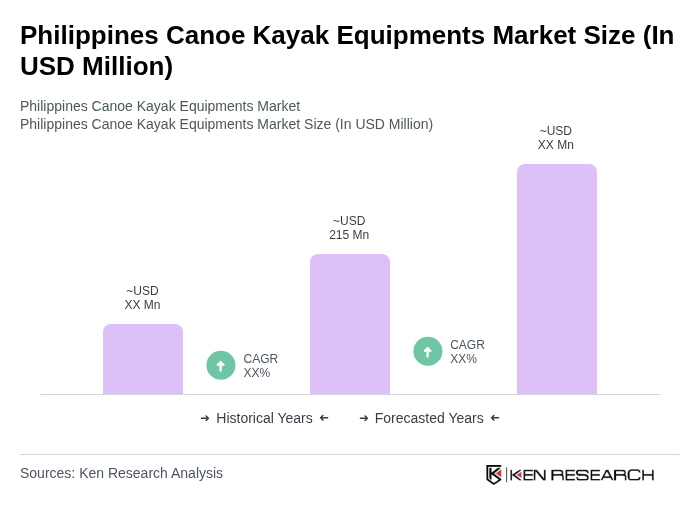
Philippines canoe kayak market grows with outdoor recreation, tourism, and health trends, valued at $215M.

Region:Asia

Author(s):Dev

Product Code:KRAC1444

Pages:99

Published On:December 2025
About the Report

Base Year 2024

Philippines Canoe Kayak Equipments Market Overview

  • The Philippines Canoe Kayak Equipments Market is valued at USD 215 million, based on recent analysis. Growth is driven by rising participation in outdoor recreation and water sports fueled by abundant coastlines and tourism, alongside growing health and wellness awareness and corporate interest in team-building through paddlesports activities. The influence of social media showcasing adventure experiences further elevates demand, while rental operators and tourism providers expand fleets to meet recreational needs.
  • Key players in this market include operators in adventure tourism and rental services in the Philippines, where local geography supports water-based recreation and tourism demand propels equipment uptake. Key segments include paddles, personal flotation devices, and accessories tailored to niche activities such as white-water rafting and eco-tourism, backed by innovation in lightweight and specialized designs. Global players in related paddlesports equipment markets are influencing standards and offerings in the Philippines through product trends and distribution channels.
  • In 2024, the Philippine government announced a strategic initiative to enhance water sports tourism, which includes investments in infrastructure and facilities to attract international aquatic events. This initiative aims to boost local economies and increase community participation in water sports, thereby fostering a more vibrant paddlesports culture.
Philippines Canoe Kayak Equipments Market Size

Philippines Canoe Kayak Equipments Market Segmentation

By Type:The market is segmented into various types of equipment, including kayaks, canoes, and accessories such as paddles and life jackets. Among these, kayaks dominate the market due to their versatility and popularity among recreational users. The increasing trend of eco-tourism and adventure sports has further propelled the demand for kayaks, making them a preferred choice for both casual paddlers and serious enthusiasts.
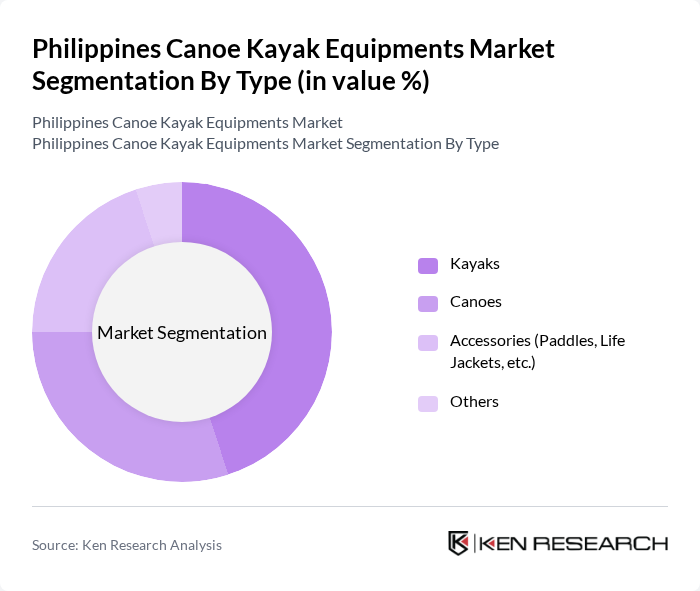
Philippines Canoe Kayak Equipments Market segmentation by Type.

By End-User:The end-user segmentation includes recreational users, professional athletes, and educational institutions. Recreational users represent the largest segment, driven by the growing interest in outdoor activities and water sports. The rise in health consciousness and the desire for leisure activities have led to an increase in participation among families and individuals, making this segment a key driver of market growth.
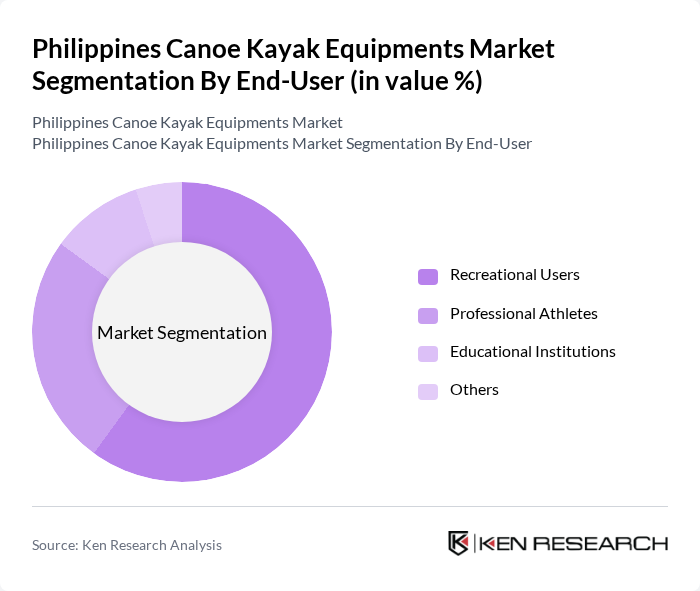
Philippines Canoe Kayak Equipments Market segmentation by End-User.

Philippines Canoe Kayak Equipments Market Competitive Landscape

The Philippines Canoe Kayak Equipments Market is characterized by a dynamic mix of regional and international players. Leading participants such as Confluence Outdoors, Perception Kayaks, Old Town Canoe, Dagger Kayaks, Wilderness Systems, Pelican International, Hobie Cat, Aqua-Bound, Necky Kayaks, Sea Eagle, Riot Kayaks, Advanced Elements, BIC Sport, Emotion Kayaks, Intex Recreation Corp. contribute to innovation, geographic expansion, and service delivery in this space.

Confluence Outdoors

1996

Golden, Colorado, USA

Perception Kayaks

1975

Greenville, South Carolina, USA

Old Town Canoe

1898

Old Town, Maine, USA

Dagger Kayaks

1988

Greenville, South Carolina, USA

Wilderness Systems

1986

Greenville, South Carolina, USA

Company

Establishment Year

Headquarters

Group Size (Large, Medium, or Small as per industry convention).

Revenue Growth Rate.

Market Penetration Rate.

Customer Retention Rate.

Pricing Strategy.

Product Diversification Index.

Philippines Canoe Kayak Equipments Market Industry Analysis

Growth Drivers

  • Expanding Water Sports Equipment Revenue:The water sports equipment market in the Philippines is projected to generate **US$29.04 million** in revenue by 2025. This growth reflects a significant increase in consumer spending on non-motorized water activities, such as canoeing and kayaking, indicating a rising interest in these recreational pursuits. The increasing participation in water sports is a key driver for the canoe and kayak equipment market, as more individuals seek outdoor activities that promote health and wellness ((https://www.statista.com/outlook/emo/toys-hobby/sports-equipment/water-sports-equipment/philippines?utm_source=openai)).
  • Rapid Market Growth Rate:The canoe and kayak equipment market is experiencing a remarkable growth rate, with a projected compound annual growth rate (CAGR) of **55.81% from 2020 to 2024**. Notably, the market is expected to witness a staggering **152.58% growth from 2023 to 2024**. This explosive demand for canoeing and kayaking equipment highlights the increasing popularity of these activities among Filipinos, driven by a growing awareness of outdoor recreation and adventure sports ((https://www.6wresearch.com/industry-report/philippines-canoeing-and-kayaking-equipment-market?utm_source=openai)).
  • Massive Investment Approvals via BOI:From January to November in the future, the Philippines Board of Investments (BOI) approved investments totaling **PHP 1.58 trillion**, with the manufacturing sector receiving **PHP 30.40 billion**. This influx of investment capital fosters a favorable environment for the production of sports equipment, including canoes and kayaks. The positive investment climate is expected to enhance local manufacturing capabilities, thereby supporting the growth of the canoe and kayak equipment market ((https://www.dti.gov.ph/dti-news-archived/dti-investment-approvals-soar-php-1-58t-november-2024-up-44?utm_source=openai)).

Market Challenges

  • High Import Tariffs on Sports Equipment:The Philippines imposes an average import tariff of **20%** on sports equipment, including canoes and kayaks. This high tariff significantly raises the retail prices of imported equipment, limiting affordability for consumers and restricting access to quality products. As a result, the market faces challenges in attracting price-sensitive customers who may opt for alternative recreational activities instead ((https://www.6wresearch.com/industry-report/philippines-canoeing-and-kayaking-equipment-market?utm_source=openai)).
  • Limited Local Manufacturing Share:Currently, domestic production accounts for only **15%** of the total sports equipment market in the Philippines. This heavy reliance on imports makes the market vulnerable to supply chain disruptions and fluctuating costs. The limited local manufacturing capacity hinders the growth potential of the canoe and kayak equipment market, as consumers may face challenges in accessing locally produced, affordable options ((https://www.6wresearch.com/industry-report/philippines-canoeing-and-kayaking-equipment-market?utm_source=openai)).

Philippines Canoe Kayak Equipments Market Future Outlook

The future outlook for the Philippines canoe and kayak equipment market appears promising, driven by increasing consumer interest in outdoor activities and water sports. Innovations in equipment materials and design are expected to enhance safety and performance, attracting more enthusiasts. Additionally, the government's "Proudly Filipino" industrial policy, effective in the future, aims to boost local manufacturing capabilities, potentially leading to a more robust domestic market for canoe and kayak equipment. This combination of factors is likely to foster sustainable growth in the sector.

Market Opportunities

  • Export-oriented Manufacturing Channels:The Philippine Economic Zone Authority (PEZA) anticipates **US$3.9 billion** in export revenue from approved investments in the future. This growth in export-oriented manufacturing channels presents a significant opportunity for canoe and kayak equipment producers to expand their market reach beyond domestic borders, tapping into international demand for water sports gear ((https://www.peza.gov.ph/press-releases/peza-and-ecozone-industry-undeterred-%E2%80%94-approves-more-investments-exceeding-2024?utm_source=openai)).
  • Domestic Market Niche Expansion:With water sports revenue projected to reach **US$29.04 million** by 2025, there is a growing local consumer base for canoe and kayak equipment. Companies can capitalize on this trend by targeting canoe and kayak enthusiasts, as well as rental operators, to meet the increasing demand for recreational water activities ((https://www.statista.com/outlook/emo/toys-hobby/sports-equipment/water-sports-equipment/philippines?utm_source=openai)).

Scope of the Report

SegmentSub-Segments
By Type

Kayaks

Canoes

Accessories (Paddles, Life Jackets, etc.)

Others

By End-User

Recreational Users

Professional Athletes

Educational Institutions

Others

By Distribution Channel

Online Retail

Specialty Stores

Sports Equipment Retailers

Others

By Material

Plastic

Fiberglass

Inflatable

Others

By Price Range

Budget

Mid-Range

Premium

Others

By Brand Preference

Local Brands

International Brands

Emerging Brands

Others

By Usage Frequency

Occasional Users

Regular Users

Frequent Users

Others

Key Target Audience

Investors and Venture Capitalist Firms

Government and Regulatory Bodies (e.g., Department of Tourism, National Commission for Culture and the Arts)

Manufacturers and Producers

Distributors and Retailers

Local Sports Associations

Outdoor and Adventure Tourism Operators

Event Organizers for Water Sports Competitions

Financial Institutions

Players Mentioned in the Report:

Confluence Outdoors

Perception Kayaks

Old Town Canoe

Dagger Kayaks

Wilderness Systems

Pelican International

Hobie Cat

Aqua-Bound

Necky Kayaks

Sea Eagle

Riot Kayaks

Advanced Elements

BIC Sport

Emotion Kayaks

Intex Recreation Corp.

Table of Contents

Market Assessment Phase

1. Executive Summary and Approach


2. Philippines Canoe Kayak Equipments Market Overview

2.1 Key Insights and Strategic Recommendations

2.2 Philippines Canoe Kayak Equipments Market Overview

2.3 Definition and Scope

2.4 Evolution of Market Ecosystem

2.5 Timeline of Key Regulatory Milestones

2.6 Value Chain & Stakeholder Mapping

2.7 Business Cycle Analysis

2.8 Policy & Incentive Landscape


3. Philippines Canoe Kayak Equipments Market Analysis

3.1 Growth Drivers

3.1.1 Increasing popularity of water sports
3.1.2 Government initiatives promoting outdoor activities
3.1.3 Rising disposable income among consumers
3.1.4 Growth in tourism and adventure sports

3.2 Market Challenges

3.2.1 Limited access to quality equipment
3.2.2 High import tariffs on equipment
3.2.3 Environmental concerns affecting water bodies
3.2.4 Competition from alternative recreational activities

3.3 Market Opportunities

3.3.1 Expansion of rental services for kayaks and canoes
3.3.2 Development of eco-friendly equipment
3.3.3 Collaboration with tourism agencies
3.3.4 Introduction of training programs for enthusiasts

3.4 Market Trends

3.4.1 Increasing demand for lightweight and portable equipment
3.4.2 Growth in online sales channels
3.4.3 Rising interest in eco-tourism
3.4.4 Technological advancements in equipment design

3.5 Government Regulation

3.5.1 Safety regulations for water sports
3.5.2 Environmental protection laws
3.5.3 Licensing requirements for rental services
3.5.4 Import regulations for sporting goods

4. SWOT Analysis


5. Stakeholder Analysis


6. Porter's Five Forces Analysis


7. Philippines Canoe Kayak Equipments Market Market Size, 2019-2024

7.1 By Value

7.2 By Volume

7.3 By Average Selling Price


8. Philippines Canoe Kayak Equipments Market Segmentation

8.1 By Type

8.1.1 Kayaks
8.1.2 Canoes
8.1.3 Accessories (Paddles, Life Jackets, etc.)
8.1.4 Others

8.2 By End-User

8.2.1 Recreational Users
8.2.2 Professional Athletes
8.2.3 Educational Institutions
8.2.4 Others

8.3 By Distribution Channel

8.3.1 Online Retail
8.3.2 Specialty Stores
8.3.3 Sports Equipment Retailers
8.3.4 Others

8.4 By Material

8.4.1 Plastic
8.4.2 Fiberglass
8.4.3 Inflatable
8.4.4 Others

8.5 By Price Range

8.5.1 Budget
8.5.2 Mid-Range
8.5.3 Premium
8.5.4 Others

8.6 By Brand Preference

8.6.1 Local Brands
8.6.2 International Brands
8.6.3 Emerging Brands
8.6.4 Others

8.7 By Usage Frequency

8.7.1 Occasional Users
8.7.2 Regular Users
8.7.3 Frequent Users
8.7.4 Others

9. Philippines Canoe Kayak Equipments Market Competitive Analysis

9.1 Market Share of Key Players

9.2 Cross Comparison of Key Players

9.2.1 Company Name.
9.2.2 Group Size (Large, Medium, or Small as per industry convention).
9.2.3 Revenue Growth Rate.
9.2.4 Market Penetration Rate.
9.2.5 Customer Retention Rate.
9.2.6 Pricing Strategy.
9.2.7 Product Diversification Index.
9.2.8 Brand Recognition Score.
9.2.9 Distribution Efficiency.
9.2.10 Customer Satisfaction Index.

9.3 SWOT Analysis of Top Players

9.4 Pricing Analysis

9.5 Detailed Profile of Major Companies

9.5.1 Confluence Outdoors
9.5.2 Perception Kayaks
9.5.3 Old Town Canoe
9.5.4 Dagger Kayaks
9.5.5 Wilderness Systems
9.5.6 Pelican International
9.5.7 Hobie Cat
9.5.8 Aqua-Bound
9.5.9 Necky Kayaks
9.5.10 Sea Eagle
9.5.11 Riot Kayaks
9.5.12 Advanced Elements
9.5.13 BIC Sport
9.5.14 Emotion Kayaks
9.5.15 Intex Recreation Corp.

10. Philippines Canoe Kayak Equipments Market End-User Analysis

10.1 Procurement Behavior of Key Ministries

10.1.1 Budget Allocation for Sports Equipment
10.1.2 Procurement Processes and Regulations
10.1.3 Preferred Suppliers and Brands
10.1.4 Seasonal Procurement Trends

10.2 Corporate Spend on Infrastructure & Energy

10.2.1 Investment in Recreational Facilities
10.2.2 Sponsorship of Water Sports Events
10.2.3 Partnerships with Equipment Suppliers
10.2.4 Budgeting for Employee Wellness Programs

10.3 Pain Point Analysis by End-User Category

10.3.1 Accessibility to Quality Equipment
10.3.2 Affordability of Equipment
10.3.3 Availability of Training and Support
10.3.4 Maintenance and Repair Services

10.4 User Readiness for Adoption

10.4.1 Awareness of Equipment Options
10.4.2 Willingness to Invest in Quality
10.4.3 Interest in Training Programs
10.4.4 Feedback on Current Equipment

10.5 Post-Deployment ROI and Use Case Expansion

10.5.1 Measurement of User Satisfaction
10.5.2 Analysis of Usage Patterns
10.5.3 Opportunities for Upselling
10.5.4 Long-term Engagement Strategies

11. Philippines Canoe Kayak Equipments Market Future Size, 2025-2030

11.1 By Value

11.2 By Volume

11.3 By Average Selling Price


Go-To-Market Strategy Phase

1. Whitespace Analysis + Business Model Canvas

1.1 Identification of Market Gaps

1.2 Business Model Framework


2. Marketing and Positioning Recommendations

2.1 Branding Strategies

2.2 Product USPs


3. Distribution Plan

3.1 Urban Retail Strategies

3.2 Rural NGO Tie-ups


4. Channel & Pricing Gaps

4.1 Underserved Routes

4.2 Pricing Bands


5. Unmet Demand & Latent Needs

5.1 Category Gaps

5.2 Consumer Segments


6. Customer Relationship

6.1 Loyalty Programs

6.2 After-sales Service


7. Value Proposition

7.1 Sustainability Initiatives

7.2 Integrated Supply Chains


8. Key Activities

8.1 Regulatory Compliance

8.2 Branding Efforts

8.3 Distribution Setup


9. Entry Strategy Evaluation

9.1 Domestic Market Entry Strategy

9.1.1 Product Mix Considerations
9.1.2 Pricing Band Analysis
9.1.3 Packaging Strategies

9.2 Export Entry Strategy

9.2.1 Target Countries
9.2.2 Compliance Roadmap

10. Entry Mode Assessment

10.1 Joint Ventures

10.2 Greenfield Investments

10.3 Mergers & Acquisitions

10.4 Distributor Model


11. Capital and Timeline Estimation

11.1 Capital Requirements

11.2 Timelines for Implementation


12. Control vs Risk Trade-Off

12.1 Ownership Considerations

12.2 Partnerships Evaluation


13. Profitability Outlook

13.1 Breakeven Analysis

13.2 Long-term Sustainability


14. Potential Partner List

14.1 Distributors

14.2 Joint Ventures

14.3 Acquisition Targets


15. Execution Roadmap

15.1 Phased Plan for Market Entry

15.1.1 Market Setup
15.1.2 Market Entry
15.1.3 Growth Acceleration
15.1.4 Scale & Stabilize

15.2 Key Activities and Milestones

15.2.1 Milestone Planning
15.2.2 Activity Tracking

Research Methodology

ApproachModellingSample

Phase 1: Approach1

Desk Research

  • Industry reports from local sports associations and government agencies
  • Market analysis from trade publications focused on water sports and outdoor activities
  • Statistical data from the Philippine Statistics Authority regarding recreational equipment sales

Primary Research

  • Interviews with manufacturers and distributors of canoe and kayak equipment
  • Surveys with retailers specializing in water sports gear
  • Field interviews with professional athletes and recreational users of canoe and kayak equipment

Validation & Triangulation

  • Cross-validation of findings through multiple data sources including sales data and expert opinions
  • Triangulation of market trends from consumer feedback and industry forecasts
  • Sanity checks through expert panel reviews comprising industry veterans and market analysts

Phase 2: Market Size Estimation1

Top-down Assessment

  • Analysis of national sports participation rates and their correlation with equipment sales
  • Estimation of market size based on historical sales data and growth trends in outdoor sports
  • Incorporation of government initiatives promoting water sports and tourism

Bottom-up Modeling

  • Volume estimates based on sales data from leading retailers and e-commerce platforms
  • Cost analysis of canoe and kayak equipment including manufacturing and distribution expenses
  • Market segmentation by product type, including kayaks, canoes, paddles, and accessories

Forecasting & Scenario Analysis

  • Multi-factor regression analysis considering factors like tourism growth and environmental awareness
  • Scenario planning based on potential changes in consumer preferences and economic conditions
  • Baseline, optimistic, and pessimistic projections for market growth through 2030

Phase 3: CATI Sample Composition1

Scope Item/SegmentSample SizeTarget Respondent Profiles
Canoe and Kayak Retailers100Store Owners, Sales Managers
Manufacturers of Water Sports Equipment80Production Managers, Product Development Heads
Professional Athletes and Coaches60Competitive Canoeists, Kayak Coaches
Recreational Users and Enthusiasts90Outdoor Activity Participants, Club Members
Tourism Operators Offering Water Sports70Tour Operators, Activity Coordinators

Frequently Asked Questions

What is the current value of the Philippines Canoe Kayak Equipments Market?

The Philippines Canoe Kayak Equipments Market is valued at approximately USD 215 million, driven by increasing participation in outdoor recreation and water sports, as well as growing health and wellness awareness among consumers.

What factors are driving growth in the canoe kayak equipment market in the Philippines?

Who are the key players in the Philippines Canoe Kayak Equipments Market?

What types of equipment are included in the Philippines Canoe Kayak Equipments Market?

Other Regional/Country Reports

Indonesia Canoe Kayak Equipments Market

Malaysia Canoe Kayak Equipments Market

KSA Canoe Kayak Equipments Market

APAC Canoe Kayak Equipments Market

SEA Canoe Kayak Equipments Market

Vietnam Canoe Kayak Equipments Market

Other Adjacent Reports

UAE adventure tourism market report Size, Share, Growth Drivers, Trends, Opportunities & Forecast 2025–2030

Thailand Water Sports Equipment Market

Oman Outdoor Recreation Market

KSA Sports Equipment Rental Market

KSA Eco-Tourism Market

Qatar Team-Building Activities Market

Brazil Health and Wellness Market

Gcc Lightweight Materials Market Size, Share, Growth Drivers, Trends, Opportunities & Forecast 2025–2030India Sports Apparel Market Outlook to 2030

Brazil Recreational Boating Market

Why Buy From Us?

Refine Robust Result (RRR) Framework

What makes us stand out is that our consultants follow Robust, Refine and Result (RRR) methodology. Robust for clear definitions, approaches and sanity checking, Refine for differentiating respondents' facts and opinions, and Result for presenting data with story.

Our Reach Is Unmatched

We have set a benchmark in the industry by offering our clients with syndicated and customized market research reports featuring coverage of entire market as well as meticulous research and analyst insights.

Shifting the Research Paradigm

While we don't replace traditional research, we flip the method upside down. Our dual approach of Top Bottom & Bottom Top ensures quality deliverable by not just verifying company fundamentals but also looking at the sector and macroeconomic factors.

More Insights-Better Decisions

With one step in the future, our research team constantly tries to show you the bigger picture. We help with some of the tough questions you may encounter along the way: How is the industry positioned? Best marketing channel? KPI's of competitors? By aligning every element, we help maximize success.

Transparency and Trust

Our report gives you instant access to the answers and sources that other companies might choose to hide. We elaborate each steps of research methodology we have used and showcase you the sample size to earn your trust.

Round the Clock Support

If you need any support, we are here! We pride ourselves on universe strength, data quality, and quick, friendly, and professional service.

Why Clients Choose Us?

400000+
Reports in repository
150+
Consulting projects a year
100+
Analysts
8000+
Client Queries in 2022








