About the Report
Base Year 2024Philippines Loader Market Overview
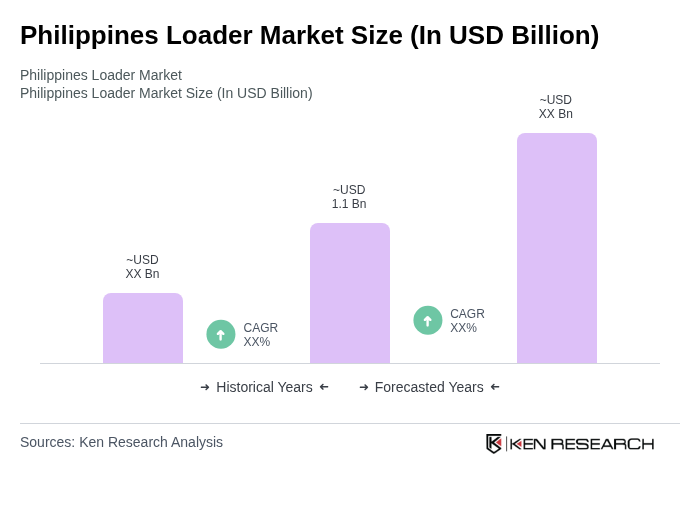
- The Philippines Loader Market is valued at USD 1.1 billion, based on a five-year historical analysis. This market size reflects the broader construction equipment segment, with loaders representing a significant share due to the rapid expansion of the construction and mining sectors, increasing urbanization, and ongoing infrastructure development initiatives. The demand for loaders, particularly in construction projects, continues to surge as the government prioritizes improvements in transportation and logistics networks, including major expressway and railway projects.
- Metro Manila, Cebu, and Davao remain the dominant regions in the Philippines Loader Market. Metro Manila leads due to its high concentration of construction activities, urban development projects, and proximity to major ports. Cebu and Davao follow closely, benefiting from regional infrastructure investments, economic growth, and increased deployment of loaders for both public and private sector projects. Luzon, which includes Metro Manila, absorbs the bulk of machines deployed for large-scale infrastructure, while Visayas (Cebu) and Mindanao (Davao) show strong growth in equipment demand.
- The Philippine government’s “Build Better More” Infrastructure Program, under the Department of Public Works and Highways (DPWH), allocates approximately USD 10 billion for the development of roads, bridges, and public transport systems. This binding initiative, established in 2023, mandates compliance with procurement and safety standards for heavy equipment, including loaders, under the DPWH Standard Specifications for Public Works and Highways, 2023. The program aims to enhance national infrastructure capabilities, driving increased demand for loaders and other construction equipment to support these extensive projects.
Philippines Loader Market Segmentation
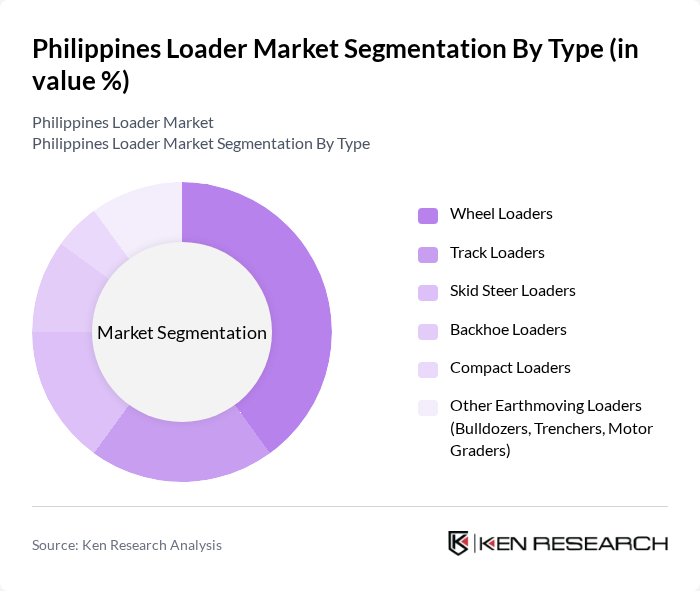
By Type:The loader market can be segmented into Wheel Loaders, Track Loaders, Skid Steer Loaders, Backhoe Loaders, Compact Loaders, and Other Earthmoving Loaders such as Bulldozers, Trenchers, and Motor Graders. Wheel loaders dominate due to their versatility in material handling and earthmoving, while track loaders and skid steers are favored for urban infill and confined site operations. Backhoe loaders and compact loaders are increasingly adopted for municipal and infrastructure maintenance. Other earthmoving loaders, including bulldozers, trenchers, and motor graders, serve specialized roles in road construction, mining, and land development.
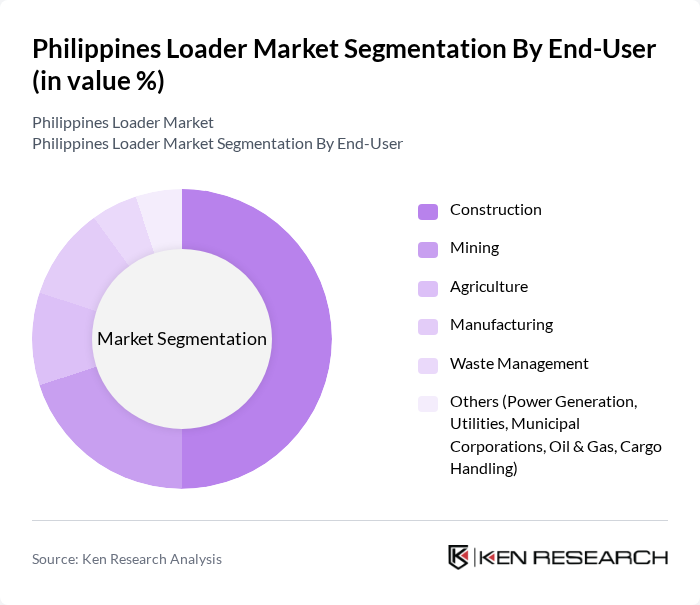
By End-User:The loader market is segmented by end-user industries, including Construction, Mining, Agriculture, Manufacturing, Waste Management, and Others such as Power Generation, Utilities, Municipal Corporations, Oil & Gas, and Cargo Handling. Construction remains the largest end-user, driven by ongoing infrastructure projects and urban expansion. Mining continues to be a major segment due to resource extraction activities, while agriculture and manufacturing adopt loaders for material handling and site preparation. Waste management and utility sectors increasingly utilize compact and specialized loaders for operational efficiency.
Philippines Loader Market Competitive Landscape
The Philippines Loader Market is characterized by a dynamic mix of regional and international players. Leading participants such as Caterpillar Inc., Komatsu Ltd., Volvo Construction Equipment, Hitachi Construction Machinery, JCB, Doosan Infracore, Hyundai Construction Equipment, SANY Group, Liebherr Group, CASE Construction Equipment, Wacker Neuson, Terex Corporation, Bobcat Company, Manitou Group, Yanmar Co., Ltd., XCMG Group, Sumitomo Construction Machinery, Kubota Corporation, Shantui Construction Machinery Co., Ltd., LiuGong Machinery Co., Ltd. contribute to innovation, geographic expansion, and service delivery in this space.
Philippines Loader Market Industry Analysis
Growth Drivers
- Increasing Infrastructure Development:The Philippine government allocated approximately PHP 1.2 trillion (USD 21 billion) for infrastructure projects in future, focusing on roads, bridges, and public transport systems. This investment is expected to drive demand for loaders, as construction activities require efficient material handling. The ongoing "Build, Build, Build" program aims to enhance connectivity and stimulate economic growth, further solidifying the loader market's expansion in the region.
- Rising Demand in Agriculture:The agricultural sector in the Philippines contributes around PHP 1.8 trillion (USD 32 billion) to the national economy, with a significant portion reliant on mechanization. In future, the government plans to invest PHP 50 billion (USD 900 million) in agricultural modernization, increasing the need for loaders to enhance productivity. This trend is driven by the need for efficient land preparation, crop handling, and post-harvest processing, boosting loader sales in rural areas.
- Urbanization and Construction Boom:The urban population in the Philippines is projected to reach 56% in future, leading to increased construction activities in urban areas. The construction sector is expected to grow by PHP 300 billion (USD 5.3 billion) in future, driven by residential and commercial projects. This urbanization trend necessitates the use of loaders for efficient material transport, creating a robust demand for various loader types in metropolitan regions.
Market Challenges
- High Initial Investment Costs:The average cost of a new loader in the Philippines ranges from PHP 2 million to PHP 5 million (USD 36,000 to USD 90,000), which poses a significant barrier for small and medium enterprises. Many potential buyers are deterred by these high upfront costs, limiting market penetration. This challenge is exacerbated by the need for additional investments in maintenance and operational training, further straining financial resources.
- Limited Access to Financing:Access to financing remains a critical challenge in the Philippines, with only 30% of small businesses able to secure loans for equipment purchases. The high-interest rates, averaging 8-12%, further complicate financing options for loaders. This limited access restricts the ability of companies to invest in modern machinery, hindering growth in the loader market and affecting overall productivity in various sectors.
Philippines Loader Market Future Outlook
The Philippines loader market is poised for significant growth, driven by ongoing infrastructure projects and increasing mechanization in agriculture. As urbanization accelerates, demand for efficient construction equipment will rise, particularly in metropolitan areas. Additionally, the integration of advanced technologies, such as IoT and electric loaders, will enhance operational efficiency. The government's commitment to public works and agricultural modernization will further support market expansion, creating a favorable environment for loader manufacturers and service providers.
Market Opportunities
- Expansion in Renewable Energy Projects:The Philippine government aims to increase renewable energy capacity to 15,000 MW in future, creating opportunities for loaders in solar and wind farm construction. This shift towards sustainable energy will require specialized loaders for site preparation and equipment installation, presenting a lucrative market segment for manufacturers.
- Increasing Demand for Rental Services:The loader rental market is expected to grow as companies seek cost-effective solutions. With an estimated 10% increase in rental demand in future, businesses are opting for rental services to avoid high capital expenditures. This trend offers opportunities for rental companies to expand their fleets and cater to diverse customer needs across various sectors.
Scope of the Report
| Segment | Sub-Segments |
|---|---|
| By Type | Wheel Loaders Track Loaders Skid Steer Loaders Backhoe Loaders Compact Loaders Other Earthmoving Loaders (Bulldozers, Trenchers, Motor Graders) |
| By End-User | Construction Mining Agriculture Manufacturing Waste Management Others (Power Generation, Utilities, Municipal Corporations, Oil & Gas, Cargo Handling) |
| By Application | Material Handling Earthmoving Excavation and Mining Demolition Landscaping Transportation Others |
| By Payload Capacity | Less than 1 Ton 3 Tons 5 Tons More than 5 Tons Others |
| By Distribution Channel | Direct Sales Dealers and Distributors Online Sales Rental Services Others |
| By Region | Luzon Visayas Mindanao |
| By Financing Type | Cash Purchase Financing Options Leasing Others |
Key Target Audience
Investors and Venture Capitalist Firms
Government and Regulatory Bodies (e.g., Department of Trade and Industry, Department of Public Works and Highways)
Manufacturers and Producers
Distributors and Retailers
Construction and Infrastructure Companies
Mining and Quarrying Firms
Logistics and Transportation Companies
Financial Institutions
Players Mentioned in the Report:
Caterpillar Inc.
Komatsu Ltd.
Volvo Construction Equipment
Hitachi Construction Machinery
JCB
Doosan Infracore
Hyundai Construction Equipment
SANY Group
Liebherr Group
CASE Construction Equipment
Wacker Neuson
Terex Corporation
Bobcat Company
Manitou Group
Yanmar Co., Ltd.
XCMG Group
Sumitomo Construction Machinery
Kubota Corporation
Shantui Construction Machinery Co., Ltd.
LiuGong Machinery Co., Ltd.
Table of Contents
Market Assessment Phase
1. Executive Summary and Approach
2. Philippines Loader Market Overview
2.1 Key Insights and Strategic Recommendations
2.2 Philippines Loader Market Overview
2.3 Definition and Scope
2.4 Evolution of Market Ecosystem
2.5 Timeline of Key Regulatory Milestones
2.6 Value Chain & Stakeholder Mapping
2.7 Business Cycle Analysis
2.8 Policy & Incentive Landscape
3. Philippines Loader Market Analysis
3.1 Growth Drivers
3.1.1 Increasing Infrastructure Development
3.1.2 Rising Demand in Agriculture
3.1.3 Urbanization and Construction Boom
3.1.4 Government Investment in Public Works
3.2 Market Challenges
3.2.1 High Initial Investment Costs
3.2.2 Limited Access to Financing
3.2.3 Competition from Alternative Equipment
3.2.4 Regulatory Compliance Issues
3.3 Market Opportunities
3.3.1 Expansion in Renewable Energy Projects
3.3.2 Technological Advancements in Loader Design
3.3.3 Growth in E-commerce and Logistics
3.3.4 Increasing Demand for Rental Services
3.4 Market Trends
3.4.1 Adoption of Electric Loaders
3.4.2 Integration of IoT in Loader Operations
3.4.3 Focus on Sustainability and Eco-friendly Practices
3.4.4 Customization and Specialization of Loaders
3.5 Government Regulation
3.5.1 Emission Standards for Heavy Machinery
3.5.2 Safety Regulations for Construction Equipment
3.5.3 Import Tariffs on Loader Equipment
3.5.4 Incentives for Local Manufacturing
4. SWOT Analysis
5. Stakeholder Analysis
6. Porter's Five Forces Analysis
7. Philippines Loader Market Market Size, 2019-2024
7.1 By Value
7.2 By Volume
7.3 By Average Selling Price
8. Philippines Loader Market Segmentation
8.1 By Type
8.1.1 Wheel Loaders
8.1.2 Track Loaders
8.1.3 Skid Steer Loaders
8.1.4 Backhoe Loaders
8.1.5 Compact Loaders
8.1.6 Other Earthmoving Loaders (Bulldozers, Trenchers, Motor Graders)
8.2 By End-User
8.2.1 Construction
8.2.2 Mining
8.2.3 Agriculture
8.2.4 Manufacturing
8.2.5 Waste Management
8.2.6 Others (Power Generation, Utilities, Municipal Corporations, Oil & Gas, Cargo Handling)
8.3 By Application
8.3.1 Material Handling
8.3.2 Earthmoving
8.3.3 Excavation and Mining
8.3.4 Demolition
8.3.5 Landscaping
8.3.6 Transportation
8.3.7 Others
8.4 By Payload Capacity
8.4.1 Less than 1 Ton
8.4.2 1-3 Tons
8.4.3 3-5 Tons
8.4.4 More than 5 Tons
8.4.5 Others
8.5 By Distribution Channel
8.5.1 Direct Sales
8.5.2 Dealers and Distributors
8.5.3 Online Sales
8.5.4 Rental Services
8.5.5 Others
8.6 By Region
8.6.1 Luzon
8.6.2 Visayas
8.6.3 Mindanao
8.7 By Financing Type
8.7.1 Cash Purchase
8.7.2 Financing Options
8.7.3 Leasing
8.7.4 Others
9. Philippines Loader Market Competitive Analysis
9.1 Market Share of Key Players
9.2 Cross Comparison of Key Players
9.2.1 Company Name
9.2.2 Group Size (Large, Medium, or Small as per industry convention)
9.2.3 Annual Revenue (USD or PHP)
9.2.4 Revenue Growth Rate (%)
9.2.5 Market Share (%)
9.2.6 Market Penetration Rate (Units Sold or Installed Base)
9.2.7 Product Portfolio Breadth (Number of Loader Models)
9.2.8 Customer Retention Rate (%)
9.2.9 Average Deal Size (USD or PHP)
9.2.10 Pricing Strategy (Premium, Value, Volume)
9.2.11 Product Diversification Index
9.2.12 Operational Efficiency Ratio
9.2.13 Brand Recognition Score
9.2.14 After-Sales Service Coverage (Number of Service Centers or Regions)
9.3 SWOT Analysis of Top Players
9.4 Pricing Analysis
9.5 Detailed Profile of Major Companies
9.5.1 Caterpillar Inc.
9.5.2 Komatsu Ltd.
9.5.3 Volvo Construction Equipment
9.5.4 Hitachi Construction Machinery
9.5.5 JCB
9.5.6 Doosan Infracore
9.5.7 Hyundai Construction Equipment
9.5.8 SANY Group
9.5.9 Liebherr Group
9.5.10 CASE Construction Equipment
9.5.11 Wacker Neuson
9.5.12 Terex Corporation
9.5.13 Bobcat Company
9.5.14 Manitou Group
9.5.15 Yanmar Co., Ltd.
9.5.16 XCMG Group
9.5.17 Sumitomo Construction Machinery
9.5.18 Kubota Corporation
9.5.19 Shantui Construction Machinery Co., Ltd.
9.5.20 LiuGong Machinery Co., Ltd.
10. Philippines Loader Market End-User Analysis
10.1 Procurement Behavior of Key Ministries
10.1.1 Government Budget Allocations
10.1.2 Procurement Processes and Timelines
10.1.3 Preferred Supplier Lists
10.1.4 Evaluation Criteria for Bids
10.2 Corporate Spend on Infrastructure & Energy
10.2.1 Investment Trends in Construction
10.2.2 Budgeting for Heavy Equipment
10.2.3 Long-term Infrastructure Plans
10.2.4 Impact of Economic Policies
10.3 Pain Point Analysis by End-User Category
10.3.1 Equipment Reliability Issues
10.3.2 Maintenance and Support Challenges
10.3.3 Cost Management Concerns
10.3.4 Training and Skill Gaps
10.4 User Readiness for Adoption
10.4.1 Awareness of Loader Technologies
10.4.2 Willingness to Invest in New Equipment
10.4.3 Training and Support Needs
10.4.4 Feedback Mechanisms for Improvement
10.5 Post-Deployment ROI and Use Case Expansion
10.5.1 Performance Metrics Tracking
10.5.2 Case Studies of Successful Implementations
10.5.3 Opportunities for Upscaling
10.5.4 Long-term Cost Savings Analysis
11. Philippines Loader Market Future Size, 2025-2030
11.1 By Value
11.2 By Volume
11.3 By Average Selling Price
Go-To-Market Strategy Phase
1. Whitespace Analysis + Business Model Canvas
1.1 Market Gaps Identification
1.2 Business Model Framework
2. Marketing and Positioning Recommendations
2.1 Branding Strategies
2.2 Product USPs
3. Distribution Plan
3.1 Urban Retail vs Rural NGO Tie-ups
4. Channel & Pricing Gaps
4.1 Underserved Routes
4.2 Pricing Bands
5. Unmet Demand & Latent Needs
5.1 Category Gaps
5.2 Consumer Segments
6. Customer Relationship
6.1 Loyalty Programs
6.2 After-sales Service
7. Value Proposition
7.1 Sustainability
7.2 Integrated Supply Chains
8. Key Activities
8.1 Regulatory Compliance
8.2 Branding
8.3 Distribution Setup
9. Entry Strategy Evaluation
9.1 Domestic Market Entry Strategy
9.1.1 Product Mix
9.1.2 Pricing Band
9.1.3 Packaging
9.2 Export Entry Strategy
9.2.1 Target Countries
9.2.2 Compliance Roadmap
10. Entry Mode Assessment
10.1 JV
10.2 Greenfield
10.3 M&A
10.4 Distributor Model
11. Capital and Timeline Estimation
11.1 Capital Requirements
11.2 Timelines
12. Control vs Risk Trade-Off
12.1 Ownership vs Partnerships
13. Profitability Outlook
13.1 Breakeven Analysis
13.2 Long-term Sustainability
14. Potential Partner List
14.1 Distributors
14.2 JVs
14.3 Acquisition Targets
15. Execution Roadmap
15.1 Phased Plan for Market Entry
15.1.1 Market Setup
15.1.2 Market Entry
15.1.3 Growth Acceleration
15.1.4 Scale & Stabilize
15.2 Key Activities and Milestones
15.2.1 Activity Timeline
15.2.2 Milestone Tracking
Research Methodology
Phase 1: Approach1
Desk Research
- Industry reports from government agencies and trade associations in the Philippines
- Market analysis publications focusing on construction and infrastructure development
- Statistical data from the Philippine Statistics Authority regarding loader sales and usage
Primary Research
- Interviews with key stakeholders in the construction and mining sectors
- Surveys targeting equipment rental companies and their operational insights
- Field visits to construction sites to observe loader usage and gather firsthand data
Validation & Triangulation
- Cross-validation of findings with multiple industry experts and stakeholders
- Triangulation of data from sales reports, market trends, and regulatory frameworks
- Sanity checks through expert panel discussions to ensure data reliability
Phase 2: Market Size Estimation1
Top-down Assessment
- Analysis of national infrastructure spending and its correlation with loader demand
- Segmentation of the market by end-user industries such as construction, mining, and agriculture
- Incorporation of government infrastructure projects and their projected impact on loader sales
Bottom-up Modeling
- Volume estimates based on historical sales data from leading loader manufacturers
- Operational cost analysis of loader ownership versus rental models
- Calculation of market size based on average selling prices and projected sales volumes
Forecasting & Scenario Analysis
- Multi-factor regression analysis considering economic growth, urbanization rates, and infrastructure development
- Scenario planning based on potential changes in government policies and investment in public works
- Baseline, optimistic, and pessimistic forecasts through 2030 based on varying economic conditions
Phase 3: CATI Sample Composition1
| Scope Item/Segment | Sample Size | Target Respondent Profiles |
|---|---|---|
| Construction Sector Loaders | 60 | Project Managers, Equipment Procurement Officers |
| Mining Industry Loaders | 50 | Operations Managers, Site Supervisors |
| Agricultural Equipment Loaders | 40 | Farm Managers, Agricultural Equipment Dealers |
| Loader Rental Services | 40 | Rental Business Owners, Fleet Managers |
| Government Infrastructure Projects | 40 | Public Works Officials, Project Coordinators |
Frequently Asked Questions
What is the current value of the Philippines Loader Market?
The Philippines Loader Market is valued at approximately USD 1.1 billion, reflecting significant growth driven by the construction and mining sectors, urbanization, and infrastructure development initiatives.
Which regions dominate the Philippines Loader Market?
What are the key drivers of growth in the Philippines Loader Market?
What types of loaders are available in the Philippines?
Other Regional/Country Reports
Indonesia Loader Market Size, Share, Growth Drivers, Trends, Opportunities & Forecast 2025–2030
Malaysia Loader Market Size, Share, Growth Drivers, Trends, Opportunities & Forecast 2025–2030
KSA Loader Market Size, Share, Growth Drivers, Trends, Opportunities & Forecast 2025–2030
APAC Loader Market Size, Share, Growth Drivers, Trends, Opportunities & Forecast 2025–2030
SEA Loader Market Size, Share, Growth Drivers, Trends, Opportunities & Forecast 2025–2030
Vietnam Loader Market Size, Share, Growth Drivers, Trends, Opportunities & Forecast 2025–2030
Other Adjacent Reports
Japan Dump Truck Market
Qatar Concrete Mixer Market
Philippines Asphalt Paver Market
Global Forklift Market Size, Share & Forecast, By Class, Power Source & End-Use Industry, 2026-2031Middle East telehandler market report size, share, growth drivers, trends, opportunities & forecast 2025–2030Philippines Aerial Work Platform Market Size, Share & Forecast, By Product Type, Power Source & End-Use Industry, 2026–2031Bahrain Drilling Rig Market
Mexico Compactor Market
Why Buy From Us?

What makes us stand out is that our consultants follow Robust, Refine and Result (RRR) methodology. Robust for clear definitions, approaches and sanity checking, Refine for differentiating respondents' facts and opinions, and Result for presenting data with story.

We have set a benchmark in the industry by offering our clients with syndicated and customized market research reports featuring coverage of entire market as well as meticulous research and analyst insights.

While we don't replace traditional research, we flip the method upside down. Our dual approach of Top Bottom & Bottom Top ensures quality deliverable by not just verifying company fundamentals but also looking at the sector and macroeconomic factors.

With one step in the future, our research team constantly tries to show you the bigger picture. We help with some of the tough questions you may encounter along the way: How is the industry positioned? Best marketing channel? KPI's of competitors? By aligning every element, we help maximize success.

Our report gives you instant access to the answers and sources that other companies might choose to hide. We elaborate each steps of research methodology we have used and showcase you the sample size to earn your trust.

If you need any support, we are here! We pride ourselves on universe strength, data quality, and quick, friendly, and professional service.