About the Report
Base Year 2024Philippines Online Loan & BNPL Market Overview
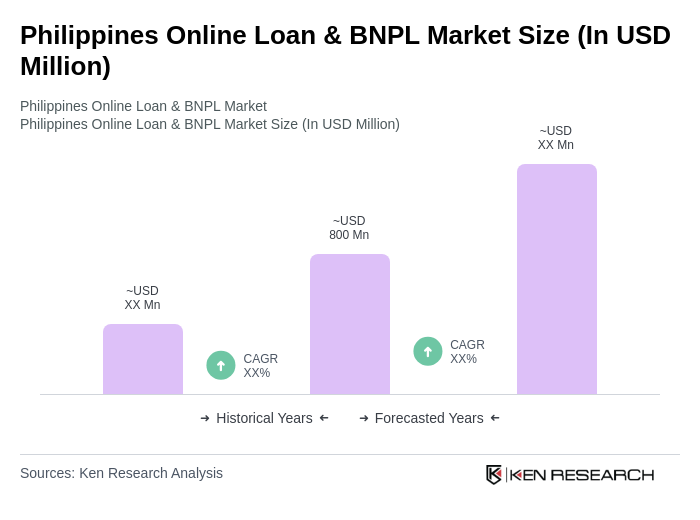
- The Philippines Online Loan & BNPL Market is valued at approximatelyUSD 800 million, based on a five-year historical analysis of digital lending and BNPL transactions. This growth is primarily driven by the increasing adoption of digital financial services, rapid expansion of e-commerce, and a rising demand for accessible credit solutions among both consumers and businesses. The market has seen robust annual growth, supported by the proliferation of mobile apps and digital platforms, with over 58 million downloads recorded in 2024 alone, indicating strong consumer engagement and digital readiness .
- Metro Manila, Cebu, and Davao remain the dominant cities in the Philippines Online Loan & BNPL Market. Their dominance is attributed to high population density, robust economic activity, and a significant concentration of tech-savvy consumers who increasingly utilize online platforms for financial services. These urban centers benefit from advanced digital infrastructure and higher rates of smartphone penetration, further accelerating market adoption .
- In 2023, the Bangko Sentral ng Pilipinas (BSP) implemented the “Guidelines on the Regulation of Online Lending Platforms and Financing Companies,” issued under BSP Circular No. 1133, 2023. This regulation mandates comprehensive disclosure of loan terms and interest rates, enforces strict transparency standards, and requires licensed entities to adhere to consumer protection protocols, including operational thresholds and compliance audits. The guidelines aim to prevent predatory lending practices and foster a safer borrowing environment for all consumers .
Philippines Online Loan & BNPL Market Segmentation
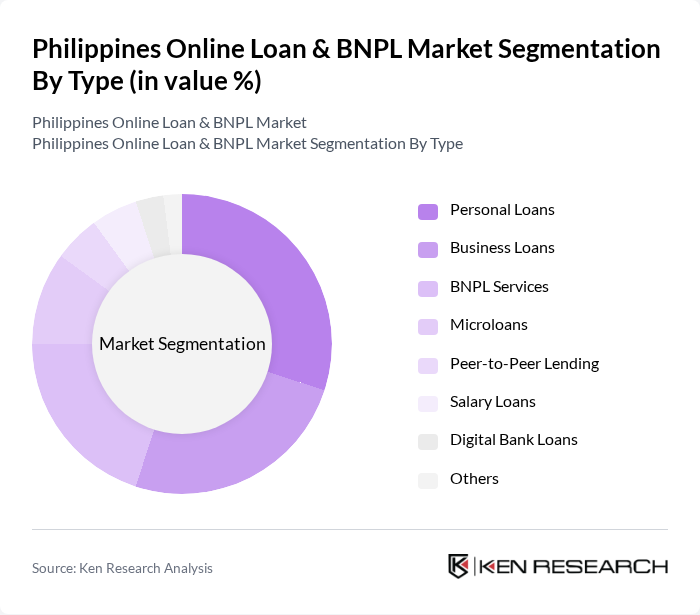
By Type:The market is segmented into Personal Loans, Business Loans, BNPL Services, Microloans, Peer-to-Peer Lending, Salary Loans, Digital Bank Loans, and Others. Each subsegment addresses distinct consumer and business needs, reflecting the Philippines’ diverse financial ecosystem. Personal Loans and BNPL Services are favored for their quick approval and flexible terms, while Microloans and Peer-to-Peer Lending cater to underserved and unbanked populations. Digital Bank Loans are gaining traction due to seamless integration with mobile banking and e-wallet platforms .
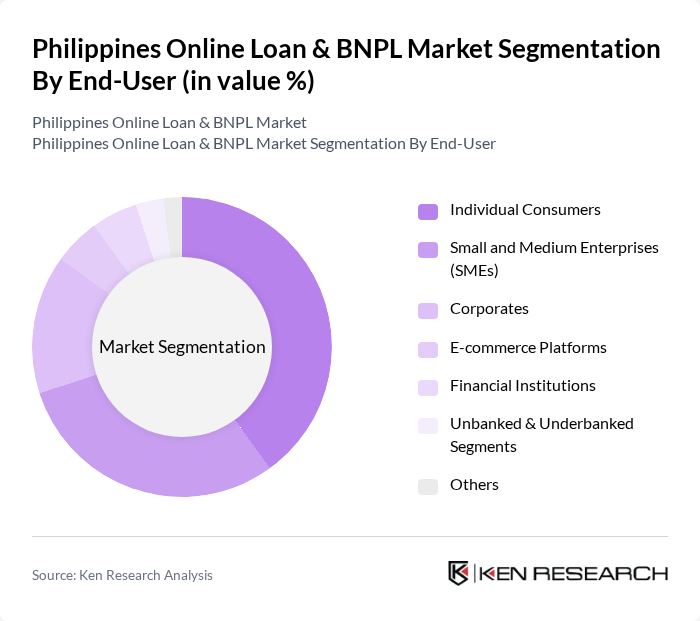
By End-User:The end-user segmentation includes Individual Consumers, Small and Medium Enterprises (SMEs), Corporates, E-commerce Platforms, Financial Institutions, Unbanked & Underbanked Segments, and Others. Individual Consumers and SMEs are the primary drivers of demand, leveraging online loans and BNPL services for personal finance management and business expansion. E-commerce platforms and financial institutions increasingly integrate BNPL solutions to enhance customer experience and broaden financial inclusion .
Philippines Online Loan & BNPL Market Competitive Landscape
The Philippines Online Loan & BNPL Market is characterized by a dynamic mix of regional and international players. Leading participants such as Cashalo, Home Credit Philippines, Tala Philippines, GCredit (GCash), PayMaya (Maya Bank), Grab Financial Group, Loan Ranger, Digido Finance Corp., JuanHand, Atome Philippines, BillEase, LenddoEFL, First Circle, Kiva Philippines, SeedIn Technology Inc. contribute to innovation, geographic expansion, and service delivery in this space.
Philippines Online Loan & BNPL Market Industry Analysis
Growth Drivers
- Increasing Smartphone Penetration:As of future, the Philippines boasts a smartphone penetration rate of approximately76%, translating to aroundapproximately 85 million users. This widespread access to mobile technology facilitates online loan applications and Buy Now Pay Later (BNPL) services, enabling consumers to access credit conveniently. The growing reliance on smartphones for financial transactions is expected to drive the online lending market, as more Filipinos seek quick and accessible credit solutions through mobile platforms.
- Rising Demand for Quick Credit Solutions:In future, the demand for quick credit solutions in the Philippines is projected to reachover 10 million loan applications annually, reflecting a significant increase from previous years. This surge is driven by consumers' need for immediate financial assistance, particularly in emergencies. The convenience of online loans and BNPL services allows users to secure funds rapidly, catering to the fast-paced lifestyle of urban Filipinos, thus propelling market growth.
- Expansion of E-commerce Platforms:The e-commerce sector in the Philippines is expected to generate approximatelyover USD 16 billion in revenue, with a significant portion attributed to BNPL services. As online shopping becomes increasingly popular, e-commerce platforms are integrating BNPL options to enhance customer experience and drive sales. This trend not only boosts consumer spending but also encourages the adoption of online loans, creating a symbiotic relationship between e-commerce and financial services.
Market Challenges
- High Default Rates:The Philippines faces a concerning default rate of aroundapproximately 10%in the online lending sector as of future. This high rate poses a significant challenge for lenders, as it impacts profitability and increases the cost of capital. The prevalence of defaults is often attributed to inadequate credit assessments and the financial instability of borrowers, necessitating improved risk management strategies to mitigate losses and ensure sustainable growth in the market.
- Regulatory Compliance Complexities:The regulatory landscape for online lending in the Philippines is becoming increasingly complex, withnumerous new regulations introduced in recent periods. Compliance with these regulations requires significant investment in legal and operational frameworks, which can be particularly challenging for smaller fintech companies. Navigating these complexities can hinder market entry and expansion, limiting competition and innovation within the online loan and BNPL sectors.
Philippines Online Loan & BNPL Market Future Outlook
The Philippines online loan and BNPL market is poised for significant transformation in the coming years, driven by technological advancements and evolving consumer preferences. As digital-first lending becomes the norm, companies will increasingly leverage alternative credit scoring models to enhance accessibility. Additionally, the integration of artificial intelligence in credit assessments will streamline processes, improving customer experience. These trends indicate a robust future for the market, with potential for increased financial inclusion and tailored loan products catering to diverse consumer needs.
Market Opportunities
- Untapped Rural Markets:Approximately55%of the Philippine population resides in rural areas, where access to traditional banking services is limited. Targeting these underserved markets presents a significant opportunity for online lenders and BNPL providers to expand their customer base. By offering tailored financial products that cater to the unique needs of rural consumers, companies can drive financial inclusion and foster economic growth in these regions.
- Partnerships with Fintech Companies:Collaborating with fintech firms can enhance the service offerings of traditional lenders, allowing them to leverage innovative technologies and customer insights. In future, partnerships are expected to increase, enabling lenders to develop more efficient credit assessment tools and personalized loan products. This synergy can lead to improved customer acquisition and retention, ultimately driving growth in the online loan and BNPL markets.
Scope of the Report
| Segment | Sub-Segments |
|---|---|
| By Type | Personal Loans Business Loans BNPL Services Microloans Peer-to-Peer Lending Salary Loans Digital Bank Loans Others |
| By End-User | Individual Consumers Small and Medium Enterprises (SMEs) Corporates E-commerce Platforms Financial Institutions Unbanked & Underbanked Segments Others |
| By Application | Retail Purchases Emergency Expenses Business Expansion Education Financing Medical Expenses Bill Payments Others |
| By Distribution Channel | Online Platforms Mobile Applications Direct Sales Partnerships with Retailers Agent Networks Others |
| By Customer Segment | Millennials Gen Z Working Professionals Retirees Self-Employed Others |
| By Loan Amount | Below PHP 10,000 PHP 10,000 - PHP 50,000 PHP 50,000 - PHP 100,000 Above PHP 100,000 |
| By Loan Tenure | Short-term (up to 6 months) Medium-term (6 months to 2 years) Long-term (above 2 years) |
Key Target Audience
Investors and Venture Capitalist Firms
Government and Regulatory Bodies (e.g., Bangko Sentral ng Pilipinas, Securities and Exchange Commission)
Microfinance Institutions
Payment Gateway Providers
Telecommunications Companies
Retail Chains and E-commerce Platforms
Fintech Startups
Consumer Advocacy Groups
Players Mentioned in the Report:
Cashalo
Home Credit Philippines
Tala Philippines
GCredit (GCash)
PayMaya (Maya Bank)
Grab Financial Group
Loan Ranger
Digido Finance Corp.
JuanHand
Atome Philippines
BillEase
LenddoEFL
First Circle
Kiva Philippines
SeedIn Technology Inc.
Table of Contents
Market Assessment Phase
1. Executive Summary and Approach
2. Philippines Online Loan & BNPL Market Overview
2.1 Key Insights and Strategic Recommendations
2.2 Philippines Online Loan & BNPL Market Overview
2.3 Definition and Scope
2.4 Evolution of Market Ecosystem
2.5 Timeline of Key Regulatory Milestones
2.6 Value Chain & Stakeholder Mapping
2.7 Business Cycle Analysis
2.8 Policy & Incentive Landscape
3. Philippines Online Loan & BNPL Market Analysis
3.1 Growth Drivers
3.1.1 Increasing smartphone penetration
3.1.2 Rising demand for quick credit solutions
3.1.3 Expansion of e-commerce platforms
3.1.4 Growing financial inclusion initiatives
3.2 Market Challenges
3.2.1 High default rates
3.2.2 Regulatory compliance complexities
3.2.3 Limited consumer awareness
3.2.4 Competition from traditional banks
3.3 Market Opportunities
3.3.1 Untapped rural markets
3.3.2 Partnerships with fintech companies
3.3.3 Development of tailored loan products
3.3.4 Integration of AI for credit scoring
3.4 Market Trends
3.4.1 Shift towards digital-first lending
3.4.2 Rise of alternative credit scoring models
3.4.3 Increased focus on customer experience
3.4.4 Growth of BNPL services in retail
3.5 Government Regulation
3.5.1 Implementation of the Consumer Act
3.5.2 Licensing requirements for lenders
3.5.3 Data privacy regulations
3.5.4 Interest rate caps on loans
4. SWOT Analysis
5. Stakeholder Analysis
6. Porter's Five Forces Analysis
7. Philippines Online Loan & BNPL Market Market Size, 2019-2024
7.1 By Value
7.2 By Volume
7.3 By Average Selling Price
8. Philippines Online Loan & BNPL Market Segmentation
8.1 By Type
8.1.1 Personal Loans
8.1.2 Business Loans
8.1.3 BNPL Services
8.1.4 Microloans
8.1.5 Peer-to-Peer Lending
8.1.6 Salary Loans
8.1.7 Digital Bank Loans
8.1.8 Others
8.2 By End-User
8.2.1 Individual Consumers
8.2.2 Small and Medium Enterprises (SMEs)
8.2.3 Corporates
8.2.4 E-commerce Platforms
8.2.5 Financial Institutions
8.2.6 Unbanked & Underbanked Segments
8.2.7 Others
8.3 By Application
8.3.1 Retail Purchases
8.3.2 Emergency Expenses
8.3.3 Business Expansion
8.3.4 Education Financing
8.3.5 Medical Expenses
8.3.6 Bill Payments
8.3.7 Others
8.4 By Distribution Channel
8.4.1 Online Platforms
8.4.2 Mobile Applications
8.4.3 Direct Sales
8.4.4 Partnerships with Retailers
8.4.5 Agent Networks
8.4.6 Others
8.5 By Customer Segment
8.5.1 Millennials
8.5.2 Gen Z
8.5.3 Working Professionals
8.5.4 Retirees
8.5.5 Self-Employed
8.5.6 Others
8.6 By Loan Amount
8.6.1 Below PHP 10,000
8.6.2 PHP 10,000 - PHP 50,000
8.6.3 PHP 50,000 - PHP 100,000
8.6.4 Above PHP 100,000
8.7 By Loan Tenure
8.7.1 Short-term (up to 6 months)
8.7.2 Medium-term (6 months to 2 years)
8.7.3 Long-term (above 2 years)
9. Philippines Online Loan & BNPL Market Competitive Analysis
9.1 Market Share of Key Players
9.2 Cross Comparison of Key Players
9.2.1 Company Name
9.2.2 Group Size (Large, Medium, or Small as per industry convention)
9.2.3 Customer Acquisition Cost (CAC)
9.2.4 Loan Approval Rate (%)
9.2.5 Average Loan Amount (PHP)
9.2.6 Default Rate (%)
9.2.7 Customer Retention Rate (%)
9.2.8 Pricing Strategy (Interest Rate, Fees)
9.2.9 Revenue Growth Rate (%)
9.2.10 Market Penetration Rate (%)
9.2.11 Number of Active Users
9.2.12 App Download Volume
9.2.13 Net Promoter Score (NPS)
9.2.14 Portfolio Quality (Non-Performing Loan Ratio)
9.3 SWOT Analysis of Top Players
9.4 Pricing Analysis
9.5 Detailed Profile of Major Companies
9.5.1 Cashalo
9.5.2 Home Credit Philippines
9.5.3 Tala Philippines
9.5.4 GCredit (GCash)
9.5.5 PayMaya (Maya Bank)
9.5.6 Grab Financial Group
9.5.7 Loan Ranger
9.5.8 Digido Finance Corp.
9.5.9 JuanHand
9.5.10 Atome Philippines
9.5.11 BillEase
9.5.12 LenddoEFL
9.5.13 First Circle
9.5.14 Kiva Philippines
9.5.15 SeedIn Technology Inc.
10. Philippines Online Loan & BNPL Market End-User Analysis
10.1 Procurement Behavior of Key Ministries
10.1.1 Budget Allocation for Loans
10.1.2 Decision-Making Processes
10.1.3 Preferred Loan Types
10.2 Corporate Spend on Infrastructure & Energy
10.2.1 Investment in Digital Solutions
10.2.2 Financing for Expansion Projects
10.2.3 Budgeting for Employee Benefits
10.3 Pain Point Analysis by End-User Category
10.3.1 Accessibility of Loan Products
10.3.2 Complexity of Application Processes
10.3.3 Interest Rate Concerns
10.4 User Readiness for Adoption
10.4.1 Awareness of Online Loan Options
10.4.2 Comfort with Digital Transactions
10.4.3 Trust in Financial Institutions
10.5 Post-Deployment ROI and Use Case Expansion
10.5.1 Evaluation of Loan Impact
10.5.2 Opportunities for Upselling
10.5.3 Customer Feedback Mechanisms
11. Philippines Online Loan & BNPL Market Future Size, 2025-2030
11.1 By Value
11.2 By Volume
11.3 By Average Selling Price
Go-To-Market Strategy Phase
1. Whitespace Analysis + Business Model Canvas
1.1 Identification of Market Gaps
1.2 Value Proposition Development
1.3 Revenue Streams
1.4 Key Partnerships
1.5 Customer Segments
1.6 Cost Structure
1.7 Channels
2. Marketing and Positioning Recommendations
2.1 Branding Strategies
2.2 Product USPs
3. Distribution Plan
3.1 Urban Retail vs Rural NGO Tie-ups
4. Channel & Pricing Gaps
4.1 Underserved Routes
4.2 Pricing Bands
5. Unmet Demand & Latent Needs
5.1 Category Gaps
5.2 Consumer Segments
6. Customer Relationship
6.1 Loyalty Programs
6.2 After-sales Service
7. Value Proposition
7.1 Sustainability
7.2 Integrated Supply Chains
8. Key Activities
8.1 Regulatory Compliance
8.2 Branding
8.3 Distribution Setup
9. Entry Strategy Evaluation
9.1 Domestic Market Entry Strategy
9.1.1 Product Mix
9.1.2 Pricing Band
9.1.3 Packaging
9.2 Export Entry Strategy
9.2.1 Target Countries
9.2.2 Compliance Roadmap
10. Entry Mode Assessment
10.1 JV
10.2 Greenfield
10.3 M&A
10.4 Distributor Model
11. Capital and Timeline Estimation
11.1 Capital Requirements
11.2 Timelines
12. Control vs Risk Trade-Off
12.1 Ownership vs Partnerships
13. Profitability Outlook
13.1 Breakeven Analysis
13.2 Long-term Sustainability
14. Potential Partner List
14.1 Distributors
14.2 JVs
14.3 Acquisition Targets
15. Execution Roadmap
15.1 Phased Plan for Market Entry
15.1.1 Market Setup
15.1.2 Market Entry
15.1.3 Growth Acceleration
15.1.4 Scale & Stabilize
15.2 Key Activities and Milestones
15.2.1 Activity Timeline
15.2.2 Milestone Tracking
Research Methodology
Phase 1: Approach1
Desk Research
- Analysis of government reports on financial inclusion and digital lending trends in the Philippines
- Review of industry publications and white papers on the BNPL (Buy Now Pay Later) landscape
- Examination of online loan platforms' user statistics and market penetration data from financial regulatory bodies
Primary Research
- Interviews with executives from leading online loan and BNPL service providers
- Surveys targeting consumers who have utilized online loan services or BNPL options
- Focus group discussions with financial advisors and fintech experts to gather insights on market dynamics
Validation & Triangulation
- Cross-validation of findings through multiple data sources, including consumer feedback and financial reports
- Triangulation of qualitative insights from interviews with quantitative data from surveys
- Sanity checks conducted through expert panel reviews to ensure data reliability and accuracy
Phase 2: Market Size Estimation1
Top-down Assessment
- Estimation of the total addressable market (TAM) for online loans and BNPL based on national consumer spending data
- Segmentation of the market by demographics, including age, income level, and urban vs. rural distribution
- Incorporation of macroeconomic indicators such as GDP growth and inflation rates affecting consumer borrowing behavior
Bottom-up Modeling
- Collection of transaction volume data from major online loan and BNPL platforms
- Analysis of average loan amounts and repayment terms to derive revenue estimates
- Estimation of market share for emerging players based on user acquisition rates and growth trajectories
Forecasting & Scenario Analysis
- Development of predictive models using historical growth rates and market trends
- Scenario analysis based on potential regulatory changes and shifts in consumer behavior towards digital finance
- Creation of baseline, optimistic, and pessimistic forecasts for market growth through 2030
Phase 3: CATI Sample Composition1
| Scope Item/Segment | Sample Size | Target Respondent Profiles |
|---|---|---|
| Online Loan Users | 100 | Consumers aged 18-45, recent borrowers |
| BNPL Service Users | 90 | Consumers aged 20-40, frequent BNPL users |
| Financial Advisors | 60 | Financial consultants, personal finance coaches |
| Fintech Executives | 50 | CEOs, CTOs, and product managers from fintech firms |
| Regulatory Bodies | 40 | Officials from financial regulatory agencies |
Frequently Asked Questions
What is the current value of the Philippines Online Loan and BNPL market?
The Philippines Online Loan and BNPL market is valued at approximately USD 800 million, driven by the increasing adoption of digital financial services and the rapid expansion of e-commerce, with significant consumer engagement reflected in over 58 million app downloads in 2024.
Which cities dominate the Philippines Online Loan and BNPL market?
What regulations govern online lending in the Philippines?
What types of loans are available in the Philippines Online Loan and BNPL market?
Other Regional/Country Reports
Indonesia Online Loan & BNPL Market
Malaysia Online Loan & BNPL Market
KSA Online Loan & BNPL Market
APAC Online Loan & BNPL Market
Other Adjacent Reports
Japan Fintech Services Market
UAE E-commerce Platforms Market
Belgium Microfinance Solutions Market
Mexico Credit Scoring Technology Market
Middle East mobile wallet market size, share, growth drivers, trends, opportunities & forecast 2025–2030Indonesia Peer-to-Peer Lending Market Size, Share & Forecast, By Product Type, Customer Segment & Institution Type, 2026–2032South Korea Financial Inclusion Market
Belgium Regulatory Compliance Software Market
UAE Consumer Credit MarketWhy Buy From Us?

What makes us stand out is that our consultants follow Robust, Refine and Result (RRR) methodology. Robust for clear definitions, approaches and sanity checking, Refine for differentiating respondents' facts and opinions, and Result for presenting data with story.

We have set a benchmark in the industry by offering our clients with syndicated and customized market research reports featuring coverage of entire market as well as meticulous research and analyst insights.

While we don't replace traditional research, we flip the method upside down. Our dual approach of Top Bottom & Bottom Top ensures quality deliverable by not just verifying company fundamentals but also looking at the sector and macroeconomic factors.

With one step in the future, our research team constantly tries to show you the bigger picture. We help with some of the tough questions you may encounter along the way: How is the industry positioned? Best marketing channel? KPI's of competitors? By aligning every element, we help maximize success.

Our report gives you instant access to the answers and sources that other companies might choose to hide. We elaborate each steps of research methodology we have used and showcase you the sample size to earn your trust.

If you need any support, we are here! We pride ourselves on universe strength, data quality, and quick, friendly, and professional service.