About the Report
Base Year 2024Philippines Pacific Bone Grafts Substitutes Market Overview
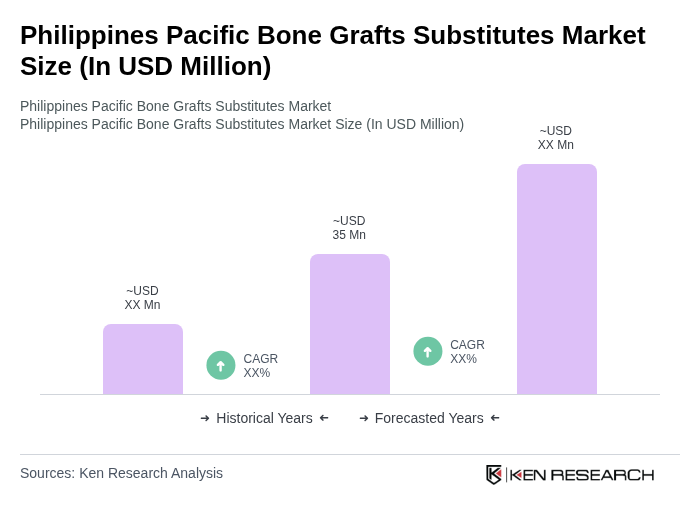
- The Philippines Pacific Bone Grafts Substitutes Market is valued at USD 35 million, based on a five-year historical analysis and benchmarking against the Asia Pacific bone grafts and substitutes market size and the country’s share in regional orthopedic procedure volumes. This growth is primarily driven by the increasing prevalence of orthopedic and musculoskeletal disorders, a steady rise in trauma and road traffic injuries, advancements in spinal fusion and joint reconstruction techniques, and a rising geriatric population in the Philippines. The demand for bone graft substitutes is further fueled by growing awareness of minimally invasive surgeries, shorter recovery time, and the wider availability of synthetic and bioactive bone graft materials that reduce donor-site morbidity and disease transmission risks.
- Metro Manila, Cebu, and Davao are the dominant regions in the Philippines Pacific Bone Grafts Substitutes Market. Metro Manila, being the capital, has a concentration of advanced tertiary and specialty hospitals, orthopedic centers, and spine surgery facilities, while Cebu and Davao serve as key healthcare hubs in the Visayas and Mindanao regions, respectively, attracting patients from surrounding provinces. The presence of major hospitals, specialty orthopedic and trauma clinics, and medical tourism-oriented facilities in these areas significantly contributes to the market's growth through higher procedure volumes for spinal fusion, joint replacement, and trauma reconstruction.
- The Universal Health Care (UHC) Act, enacted as Republic Act No. 11223 by the Government of the Philippines in 2019 and implemented through the Department of Health and the Philippine Health Insurance Corporation, aims to provide equitable access to quality healthcare services for all citizens by automatically enrolling all Filipinos into the National Health Insurance Program and expanding benefit packages. This regulation supports the adoption of advanced medical technologies, including bone graft substitutes, by strengthening financing for hospital and specialty care, encouraging upgrades in hospital capabilities, and integrating quality and cost-effectiveness considerations into reimbursement and service delivery standards, thereby enhancing the overall healthcare infrastructure and promoting the growth of the market.
Philippines Pacific Bone Grafts Substitutes Market Segmentation
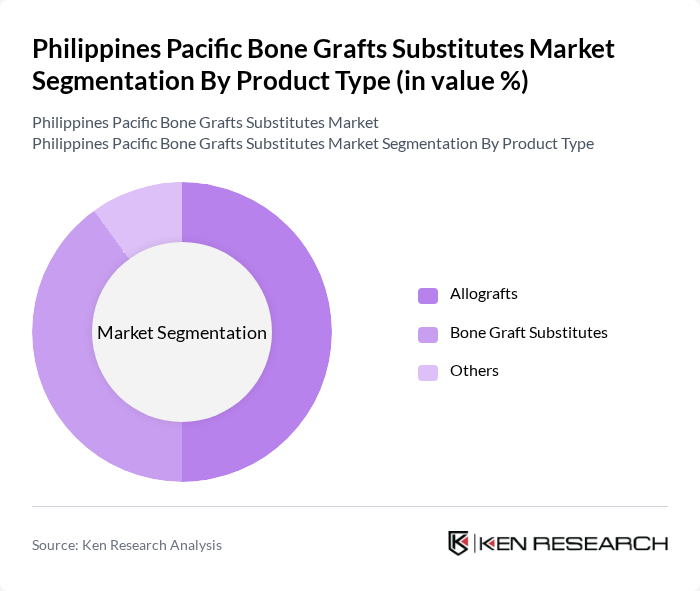
By Product Type:The product type segmentation includes Allografts, Bone Graft Substitutes, and Others. Allografts are widely used due to their effectiveness and availability, particularly in spinal fusion and orthopedic trauma procedures, where they offer structural support and osteoconductive properties. Bone Graft Substitutes (primarily synthetic and bioactive materials) are gaining strong traction due to their synthetic nature, consistent quality, and reduced risk of disease transmission and donor-site complications compared with traditional autografts and allografts. The "Others" category includes various innovative products such as composite grafts, growth factor–enhanced grafts, and specialized formulations tailored for dental, craniofacial, and revision orthopedic surgeries.
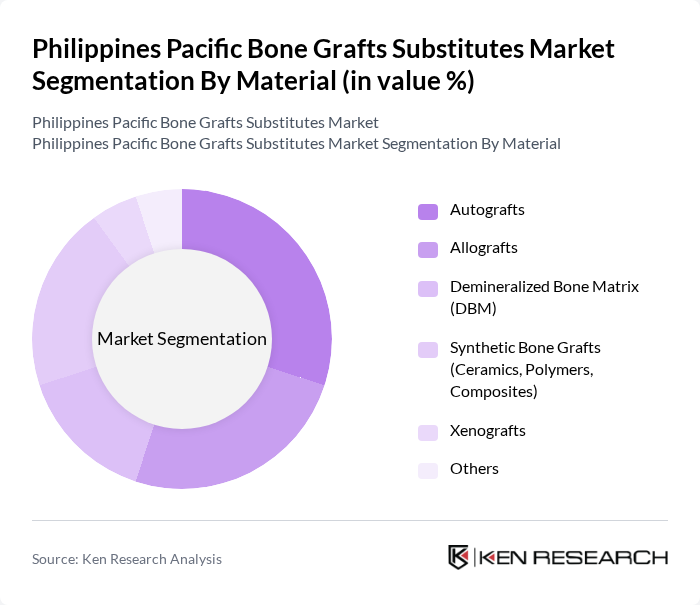
By Material:The material segmentation includes Autografts, Allografts, Demineralized Bone Matrix (DBM), Synthetic Bone Grafts (Ceramics, Polymers, Composites), Xenografts, and Others. Autografts are preferred for their excellent biocompatibility and osteogenic potential, and they remain a clinical reference standard in many spinal and orthopedic procedures despite donor-site morbidity. Allografts and DBM are widely used for their osteoconductive and, in the case of DBM, osteoinductive properties, particularly in spine and trauma indications. Synthetic Bone Grafts (ceramics such as hydroxyapatite and tricalcium phosphate, polymers, and composites) are increasingly popular due to their customizable mechanical properties, controlled resorption, consistent manufacturing quality, and lower risk of infection or disease transmission. Xenografts and the "Others" category encompass emerging bioactive and composite materials, including collagen-based matrices and next-generation bioresorbable scaffolds, which are being developed and adopted for specific applications in dental, cranio-maxillofacial, and complex reconstructive surgeries.
Philippines Pacific Bone Grafts Substitutes Market Competitive Landscape
The Philippines Pacific Bone Grafts Substitutes Market is characterized by a dynamic mix of regional and international players. Leading participants such as Medtronic plc, Stryker Corporation, Zimmer Biomet Holdings, Inc., DePuy Synthes (Johnson & Johnson), Smith & Nephew plc, Orthofix Holdings, Inc., Bioventus LLC, AlloSource, Geistlich Pharma AG, Baxter International Inc., MTF Biologics, Xtant Medical Holdings, Inc., SeaSpine Holdings Corporation, BoneSupport AB, Local and Regional Players (Philippines & Southeast Asia) contribute to innovation, geographic expansion, and service delivery in this space.
Philippines Pacific Bone Grafts Substitutes Market Industry Analysis
Growth Drivers
- Increasing Incidence of Bone-Related Disorders:The Philippines has seen a significant rise in bone-related disorders, with approximately 1.5 million cases reported annually. Conditions such as osteoporosis and fractures are becoming more prevalent, particularly among the aging population. According to the Department of Health, the incidence of osteoporosis is expected to increase by 20% in future, driving demand for effective bone graft substitutes. This growing patient base is a crucial factor propelling market growth.
- Rising Geriatric Population:The geriatric population in the Philippines is projected to reach 10 million in future, representing a significant demographic shift. This age group is particularly susceptible to bone-related issues, necessitating advanced treatment options. The Philippine Statistics Authority indicates that the elderly population will account for about 9% of the total population in future, creating a substantial market for bone graft substitutes. This demographic trend is a key driver for market expansion.
- Advancements in Surgical Techniques:Innovations in surgical techniques, such as minimally invasive procedures, are enhancing the effectiveness of bone graft substitutes. The Philippine healthcare sector is increasingly adopting these advanced methods, with over 30% of orthopedic surgeries now utilizing minimally invasive techniques. This shift is supported by the Philippine Orthopedic Association, which reports improved patient outcomes and reduced recovery times, further stimulating demand for innovative bone graft solutions in the market.
Market Challenges
- Limited Awareness Among Healthcare Professionals:Despite advancements in bone graft technologies, there remains a significant knowledge gap among healthcare professionals in the Philippines. A survey conducted by the Philippine Medical Association revealed that over 40% of orthopedic surgeons are not fully aware of the latest bone graft substitutes available. This lack of awareness can hinder the adoption of these products, posing a challenge to market growth and limiting patient access to effective treatments.
- Stringent Regulatory Requirements:The regulatory landscape for medical devices in the Philippines is complex, with stringent requirements imposed by the Food and Drug Administration (FDA). The approval process for new bone graft substitutes can take up to 18 months, delaying market entry for innovative products. This regulatory burden can deter investment in research and development, limiting the availability of advanced solutions in the market and posing a significant challenge to growth.
Philippines Pacific Bone Grafts Substitutes Market Future Outlook
The Philippines Pacific Bone Grafts Substitutes Market is poised for significant growth, driven by demographic shifts and technological advancements. As the geriatric population increases and awareness of bone-related disorders rises, the demand for innovative solutions will likely escalate. Furthermore, the integration of digital health solutions and personalized medicine is expected to enhance treatment efficacy. These trends indicate a promising future for the market, with opportunities for growth in both healthcare infrastructure and research investments.
Market Opportunities
- Expansion of Healthcare Infrastructure:The Philippine government is investing heavily in healthcare infrastructure, with a budget allocation of PHP 200 billion for future. This investment aims to improve access to advanced medical technologies, including bone graft substitutes. Enhanced facilities will facilitate better patient care and increase the adoption of innovative treatment options, creating a favorable environment for market growth.
- Increasing Investment in R&D:The Philippine government and private sector are increasing investments in research and development, with a projected growth of 15% in R&D funding in future. This focus on innovation is expected to lead to the development of new and improved bone graft substitutes, addressing unmet medical needs and enhancing treatment options for patients, thereby driving market expansion.
Scope of the Report
| Segment | Sub-Segments |
|---|---|
| By Product Type | Allografts Bone Graft Substitutes Others |
| By Material | Autografts Allografts Demineralized Bone Matrix (DBM) Synthetic Bone Grafts (Ceramics, Polymers, Composites) Xenografts Others |
| By Application | Spinal Fusion Joint Reconstruction Craniomaxillofacial Dental Trauma & Other Orthopedic Applications |
| By End-User | Hospitals Specialty Clinics Ambulatory Surgical Centers Others |
| By Distribution Channel | Direct Sales to Healthcare Providers Distributor / Dealer Network Group Purchasing Organizations (GPOs) & Tender-Based Procurement Online / E-Procurement Platforms Others |
| By Region | Luzon Visayas Mindanao Others |
| By Patient Demographics | Pediatric Patients Adult Patients Geriatric Patients Others |
Key Target Audience
Investors and Venture Capitalist Firms
Government and Regulatory Bodies (e.g., Department of Health, Food and Drug Administration of the Philippines)
Manufacturers and Producers
Distributors and Retailers
Healthcare Providers and Hospitals
Medical Device Importers
Industry Associations (e.g., Philippine Medical Device Industry Association)
Financial Institutions
Players Mentioned in the Report:
Medtronic plc
Stryker Corporation
Zimmer Biomet Holdings, Inc.
DePuy Synthes (Johnson & Johnson)
Smith & Nephew plc
Orthofix Holdings, Inc.
Bioventus LLC
AlloSource
Geistlich Pharma AG
Baxter International Inc.
MTF Biologics
Xtant Medical Holdings, Inc.
SeaSpine Holdings Corporation
BoneSupport AB
Local and Regional Players (Philippines & Southeast Asia)
Table of Contents
Market Assessment Phase
1. Executive Summary and Approach
2. Philippines Pacific Bone Grafts Substitutes Market Overview
2.1 Key Insights and Strategic Recommendations
2.2 Philippines Pacific Bone Grafts Substitutes Market Overview
2.3 Definition and Scope
2.4 Evolution of Market Ecosystem
2.5 Timeline of Key Regulatory Milestones
2.6 Value Chain & Stakeholder Mapping
2.7 Business Cycle Analysis
2.8 Policy & Incentive Landscape
3. Philippines Pacific Bone Grafts Substitutes Market Analysis
3.1 Growth Drivers
3.1.1 Increasing incidence of bone-related disorders
3.1.2 Rising geriatric population
3.1.3 Advancements in surgical techniques
3.1.4 Growing demand for minimally invasive procedures
3.2 Market Challenges
3.2.2 Limited awareness among healthcare professionals
3.2.3 Stringent regulatory requirements
3.2.4 Competition from alternative treatments
3.3 Market Opportunities
3.3.1 Expansion of healthcare infrastructure
3.3.2 Increasing investment in R&D
3.3.3 Collaborations with local healthcare providers
3.3.4 Growing medical tourism in the Philippines
3.4 Market Trends
3.4.1 Shift towards synthetic bone grafts
3.4.2 Rising adoption of 3D printing technology
3.4.3 Increased focus on personalized medicine
3.4.4 Integration of digital health solutions
3.5 Government Regulation
3.5.1 FDA regulations on medical devices
3.5.2 Compliance with Good Manufacturing Practices (GMP)
3.5.3 Licensing requirements for healthcare facilities
3.5.4 Import regulations for medical products
4. SWOT Analysis
5. Stakeholder Analysis
6. Porter's Five Forces Analysis
7. Philippines Pacific Bone Grafts Substitutes Market Market Size, 2019-2024
7.1 By Value
7.2 By Volume
7.3 By Average Selling Price
8. Philippines Pacific Bone Grafts Substitutes Market Segmentation
8.1 By Product Type
8.1.1 Allografts
8.1.2 Bone Graft Substitutes
8.1.3 Others
8.2 By Material
8.2.1 Autografts
8.2.2 Allografts
8.2.3 Demineralized Bone Matrix (DBM)
8.2.4 Synthetic Bone Grafts (Ceramics, Polymers, Composites)
8.2.5 Xenografts
8.2.6 Others
8.3 By Application
8.3.1 Spinal Fusion
8.3.2 Joint Reconstruction
8.3.3 Craniomaxillofacial
8.3.4 Dental
8.3.5 Trauma & Other Orthopedic Applications
8.4 By End-User
8.4.1 Hospitals
8.4.2 Specialty Clinics
8.4.3 Ambulatory Surgical Centers
8.4.4 Others
8.5 By Distribution Channel
8.5.1 Direct Sales to Healthcare Providers
8.5.2 Distributor / Dealer Network
8.5.3 Group Purchasing Organizations (GPOs) & Tender-Based Procurement
8.5.4 Online / E-Procurement Platforms
8.5.5 Others
8.6 By Region
8.6.1 Luzon
8.6.2 Visayas
8.6.3 Mindanao
8.6.4 Others
8.7 By Patient Demographics
8.7.1 Pediatric Patients
8.7.2 Adult Patients
8.7.3 Geriatric Patients
8.7.4 Others
9. Philippines Pacific Bone Grafts Substitutes Market Competitive Analysis
9.1 Market Share of Key Players
9.2 Cross Comparison of Key Players
9.2.1 Company Name
9.2.2 Group Size (Large, Medium, or Small as per industry convention)
9.2.3 Philippines Revenue (Latest Year)
9.2.4 3-Year Revenue CAGR (Philippines)
9.2.5 Philippines Market Share (%)
9.2.6 ASP Deviation vs Market Average (%)
9.2.7 Gross Margin (%) – Philippines Bone Grafts & Substitutes
9.2.8 R&D Intensity (% of Global Revenue)
9.2.9 Product Registration Count (Philippines FDA)
9.2.10 Hospital Account Penetration (Top 100 Hospitals, % Covered)
9.2.11 Tender Win Rate (%) in Public Sector
9.2.12 Channel Mix (Direct vs Distributor, % of Sales)
9.2.13 On-time Delivery Rate (%)
9.2.14 Brand Awareness and Preference Score (Survey-Based)
9.2.15 Net Promoter Score (NPS) – Key Clinical Stakeholders
9.3 SWOT Analysis of Top Players
9.4 Pricing Analysis
9.5 Detailed Profile of Major Companies
9.5.1 Medtronic plc
9.5.2 Stryker Corporation
9.5.3 Zimmer Biomet Holdings, Inc.
9.5.4 DePuy Synthes (Johnson & Johnson)
9.5.5 Smith & Nephew plc
9.5.6 Orthofix Holdings, Inc.
9.5.7 Bioventus LLC
9.5.8 AlloSource
9.5.9 Geistlich Pharma AG
9.5.10 Baxter International Inc.
9.5.11 MTF Biologics
9.5.12 Xtant Medical Holdings, Inc.
9.5.13 SeaSpine Holdings Corporation
9.5.14 BoneSupport AB
9.5.15 Local and Regional Players (Philippines & Southeast Asia)
10. Philippines Pacific Bone Grafts Substitutes Market End-User Analysis
10.1 Procurement Behavior of Key Ministries
10.1.1 Budget Allocation for Medical Supplies
10.1.2 Decision-Making Process
10.1.3 Supplier Selection Criteria
10.1.4 Contract Management Practices
10.2 Corporate Spend on Infrastructure & Energy
10.2.1 Investment in Healthcare Facilities
10.2.2 Spending on Medical Equipment
10.2.3 Budget for Training and Development
10.2.4 Others
10.3 Pain Point Analysis by End-User Category
10.3.1 Challenges in Supply Chain Management
10.3.2 Quality Assurance Issues
10.3.3 Cost Management Concerns
10.3.4 Others
10.4 User Readiness for Adoption
10.4.1 Awareness of Bone Graft Substitutes
10.4.2 Training Needs for Healthcare Providers
10.4.3 Infrastructure Readiness
10.4.4 Others
10.5 Post-Deployment ROI and Use Case Expansion
10.5.1 Measurement of Clinical Outcomes
10.5.2 Cost-Benefit Analysis
10.5.3 Expansion into New Applications
10.5.4 Others
11. Philippines Pacific Bone Grafts Substitutes Market Future Size, 2025-2030
11.1 By Value
11.2 By Volume
11.3 By Average Selling Price
Go-To-Market Strategy Phase
1. Whitespace Analysis + Business Model Canvas
1.1 Market Gaps Identification
1.2 Value Proposition Development
1.3 Revenue Model Exploration
1.4 Customer Segmentation
1.5 Competitive Landscape Analysis
1.6 Key Partnerships
1.7 Risk Assessment
2. Marketing and Positioning Recommendations
2.1 Branding Strategies
2.2 Product USPs
2.3 Target Audience Identification
2.4 Marketing Channels
2.5 Messaging Framework
2.6 Campaign Planning
2.7 Performance Metrics
3. Distribution Plan
3.1 Urban Retail Strategies
3.2 Rural NGO Tie-Ups
3.3 Online Distribution Channels
3.4 Logistics and Supply Chain Management
3.5 Partnership with Distributors
3.6 Inventory Management
3.7 Performance Evaluation
4. Channel & Pricing Gaps
4.1 Underserved Routes
4.2 Pricing Bands Analysis
4.3 Competitor Pricing Strategies
4.4 Customer Willingness to Pay
4.5 Value-Based Pricing
4.6 Discount Strategies
4.7 Pricing Optimization
5. Unmet Demand & Latent Needs
5.1 Category Gaps
5.2 Consumer Segments
5.3 Product Development Opportunities
5.4 Market Entry Barriers
5.5 Customer Feedback Mechanisms
5.6 Future Trends Analysis
5.7 Strategic Recommendations
6. Customer Relationship
6.1 Loyalty Programs
6.2 After-Sales Service
6.3 Customer Engagement Strategies
6.4 Feedback and Improvement Processes
6.5 Relationship Management Tools
6.6 Customer Retention Strategies
6.7 Performance Metrics
7. Value Proposition
7.1 Sustainability Initiatives
7.2 Integrated Supply Chains
7.3 Unique Selling Points
7.4 Customer-Centric Approach
7.5 Competitive Advantages
7.6 Market Differentiation Strategies
7.7 Value Communication
8. Key Activities
8.1 Regulatory Compliance
8.2 Branding Initiatives
8.3 Distribution Setup
8.4 Training and Development
8.5 Performance Monitoring
8.6 Stakeholder Engagement
8.7 Continuous Improvement
9. Entry Strategy Evaluation
9.1 Domestic Market Entry Strategy
9.1.1 Product Mix
9.1.2 Pricing Band
9.1.3 Packaging
9.2 Export Entry Strategy
9.2.1 Target Countries
9.2.2 Compliance Roadmap
10. Entry Mode Assessment
10.1 Joint Ventures
10.2 Greenfield Investments
10.3 Mergers & Acquisitions
10.4 Distributor Model
10.5 Risk Assessment
10.6 Strategic Fit Analysis
10.7 Performance Metrics
11. Capital and Timeline Estimation
11.1 Capital Requirements
11.2 Timelines
11.3 Funding Sources
11.4 Financial Projections
11.5 Risk Management Strategies
11.6 Milestone Tracking
11.7 Performance Evaluation
12. Control vs Risk Trade-Off
12.1 Ownership vs Partnerships
12.2 Risk Mitigation Strategies
12.3 Control Mechanisms
12.4 Performance Metrics
12.5 Strategic Recommendations
12.6 Future Outlook
12.7 Stakeholder Engagement
13. Profitability Outlook
13.1 Breakeven Analysis
13.2 Long-Term Sustainability
13.3 Financial Health Indicators
13.4 Market Positioning
13.5 Strategic Recommendations
13.6 Future Growth Opportunities
13.7 Performance Metrics
14. Potential Partner List
14.1 Distributors
14.2 Joint Ventures
14.3 Acquisition Targets
14.4 Strategic Alliances
14.5 Partnership Evaluation Criteria
14.6 Risk Assessment
14.7 Performance Metrics
15. Execution Roadmap
15.1 Phased Plan for Market Entry
15.1.1 Market Setup
15.1.2 Market Entry
15.1.3 Growth Acceleration
15.1.4 Scale & Stabilize
15.2 Key Activities and Milestones
15.2.1 Activity Planning
15.2.2 Milestone Tracking
15.2.3 Performance Evaluation
Research Methodology
Phase 1: Approach1
Desk Research
- Analysis of industry reports from healthcare and orthopedic associations in the Philippines
- Review of academic journals and publications on bone graft substitutes and their applications
- Examination of government health statistics and market regulations affecting bone graft products
Primary Research
- Interviews with orthopedic surgeons and healthcare professionals specializing in bone graft procedures
- Surveys with hospital procurement managers regarding purchasing trends and preferences
- Focus groups with patients who have undergone procedures involving bone graft substitutes
Validation & Triangulation
- Cross-validation of findings through multiple expert interviews and industry reports
- Triangulation of data from healthcare providers, manufacturers, and regulatory bodies
- Sanity checks through feedback from a panel of orthopedic specialists and market analysts
Phase 2: Market Size Estimation1
Top-down Assessment
- Estimation of market size based on national healthcare expenditure and orthopedic surgery statistics
- Segmentation of the market by product type, including synthetic and natural bone graft substitutes
- Incorporation of demographic trends and aging population statistics influencing demand
Bottom-up Modeling
- Collection of sales data from leading manufacturers of bone graft substitutes in the Philippines
- Estimation of market penetration rates based on hospital and clinic adoption of new technologies
- Volume and pricing analysis based on historical sales data and projected growth rates
Forecasting & Scenario Analysis
- Multi-variable forecasting using trends in surgical procedures and advancements in biomaterials
- Scenario analysis based on potential regulatory changes and healthcare policy impacts
- Development of baseline, optimistic, and pessimistic market growth projections through 2030
Phase 3: CATI Sample Composition1
| Scope Item/Segment | Sample Size | Target Respondent Profiles |
|---|---|---|
| Orthopedic Surgeons | 90 | Surgeons specializing in bone graft procedures |
| Hospital Procurement Managers | 60 | Managers responsible for purchasing medical supplies |
| Healthcare Policy Makers | 40 | Officials involved in healthcare regulations and policies |
| Patients with Bone Graft Experience | 75 | Individuals who have undergone bone graft surgeries |
| Medical Device Manufacturers | 55 | Executives from companies producing bone graft substitutes |
Frequently Asked Questions
What is the current value of the Philippines Pacific Bone Grafts Substitutes Market?
The Philippines Pacific Bone Grafts Substitutes Market is valued at approximately USD 35 million, reflecting a significant growth driven by the increasing prevalence of orthopedic disorders and advancements in surgical techniques.
What factors are driving the growth of the bone graft substitutes market in the Philippines?
Which regions in the Philippines are leading in the bone graft substitutes market?
How does the Universal Health Care Act impact the bone graft substitutes market?
Other Regional/Country Reports
Indonesia Bone Grafts Substitutes Market
Malaysia Bone Grafts Substitutes Market
APAC Bone Grafts Substitutes Market
SEA Bone Grafts Substitutes Market
Other Adjacent Reports
Egypt Trauma Fixation Market
Saudi Arabia Biomaterials Market Report Size Share Growth Drivers Trends Opportunities & Forecast 2025–2030Qatar Regenerative Medicine Market Report Size Share Growth Drivers Trends Opportunities & Forecast 2025–2030UAE Dental Bone Grafts Market
Philippines Osteobiologics Market
Global minimally invasive surgery market report size, share, growth drivers, trends, opportunities & forecast 2025–2030Bahrain Musculoskeletal Disorders Treatment Market
Why Buy From Us?

What makes us stand out is that our consultants follow Robust, Refine and Result (RRR) methodology. Robust for clear definitions, approaches and sanity checking, Refine for differentiating respondents' facts and opinions, and Result for presenting data with story.

We have set a benchmark in the industry by offering our clients with syndicated and customized market research reports featuring coverage of entire market as well as meticulous research and analyst insights.

While we don't replace traditional research, we flip the method upside down. Our dual approach of Top Bottom & Bottom Top ensures quality deliverable by not just verifying company fundamentals but also looking at the sector and macroeconomic factors.

With one step in the future, our research team constantly tries to show you the bigger picture. We help with some of the tough questions you may encounter along the way: How is the industry positioned? Best marketing channel? KPI's of competitors? By aligning every element, we help maximize success.

Our report gives you instant access to the answers and sources that other companies might choose to hide. We elaborate each steps of research methodology we have used and showcase you the sample size to earn your trust.

If you need any support, we are here! We pride ourselves on universe strength, data quality, and quick, friendly, and professional service.