About the Report
Base Year 2024Saudi Arabia Bone Grafts Substitutes Market Overview
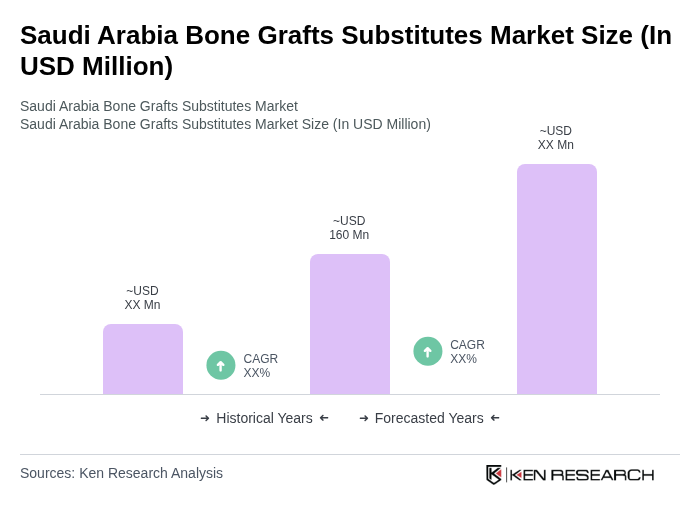
- The Saudi Arabia Bone Grafts Substitutes Market is valued at USD 160 million, based on a five-year historical analysis integrating overall orthopedic and spinal bone grafts with the rapidly expanding dental bone graft substitute segment in the Kingdom. This growth is primarily driven by the increasing prevalence of orthopedic, spine, and dental surgeries, the rising incidence of trauma and road traffic injuries, and a growing geriatric population requiring joint replacement and fracture fixation procedures. The market is also supported by advancements in synthetic and biomimetic materials, wider adoption of minimally invasive spine and dental implant procedures, and greater availability of preformed bone graft products that improve handling, effectiveness, and safety.
- Key cities such as Riyadh, Jeddah, and Dammam dominate the market due to their advanced healthcare infrastructure, tertiary care referral hospitals, and high concentration of orthopedic, spine, and dental specialists. These urban centers host state-of-the-art public and private hospitals, high-volume dental implant clinics, and specialty orthopedic and trauma centers that perform a significant share of joint replacement, spine fusion, and implant-based dental procedures, thereby driving the demand for bone graft substitutes. Additionally, the presence of leading healthcare providers and better reimbursement and private insurance coverage in these regions further supports utilization of premium graft materials.
- In 2023, the Saudi Food and Drug Authority (SFDA) strengthened the regulatory framework for medical devices, including bone graft and bone substitute products, under the Medical Devices Law and the Implementing Regulations for Medical Devices and Products issued by the Saudi Food and Drug Authority in 2021. These rules require manufacturers and importers of bone graft substitutes to obtain SFDA marketing authorization, comply with conformity assessment and quality management requirements aligned with international standards, and submit clinical evaluation or performance data demonstrating safety and efficacy before products can be placed on the Saudi market. The regulations also mandate post?market surveillance, vigilance reporting of adverse events, proper labeling in Arabic and English, and registration of devices and economic operators in the SFDA Ghad system, collectively enhancing patient safety and product quality in the bone graft substitutes segment.
Saudi Arabia Bone Grafts Substitutes Market Segmentation
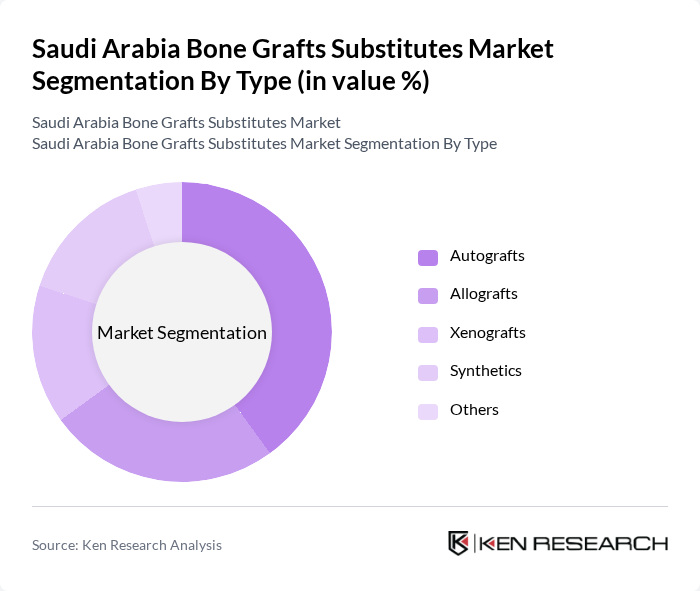
By Type:The market can be segmented into various types of bone graft substitutes, including Autografts, Allografts, Xenografts, Synthetics, and Others. Autografts remain widely used because of their osteogenic potential and biocompatibility, but their use is increasingly complemented or replaced by allografts and synthetic substitutes to reduce donor site morbidity and operative time. Allografts are common in orthopedic and spine procedures, while xenografts and specialized bovine- or porcine-derived materials are extensively used in dental bone grafting across Saudi Arabia. Synthetic grafts, including ceramic, composite, and polymer-based products, are gaining share due to consistent availability, absence of disease transmission risk, and favorable handling characteristics.
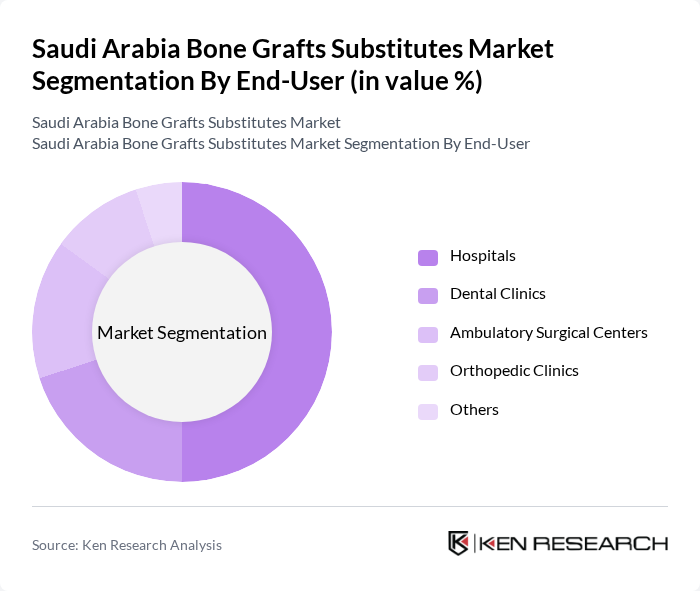
By End-User:The end-user segmentation includes Hospitals, Dental Clinics, Ambulatory Surgical Centers, Orthopedic Clinics, and Others. Hospitals are the leading end-users due to their comprehensive orthopedic, trauma, spine, and maxillofacial surgery capabilities, as well as their role as referral centers for complex cases. Dental clinics, particularly implant-focused and oral surgery centers, represent a growing share of demand in line with the strong expansion of the Saudi dental bone graft substitute market. Ambulatory surgical centers and specialized orthopedic clinics also contribute meaningfully as they increasingly perform day?care arthroscopy, sports injury, and minor spine procedures utilizing advanced graft materials.
Saudi Arabia Bone Grafts Substitutes Market Competitive Landscape
The Saudi Arabia Bone Grafts Substitutes Market is characterized by a dynamic mix of regional and international players. Leading participants such as Medtronic, Stryker Corporation, Zimmer Biomet, DePuy Synthes (Johnson & Johnson), Integra LifeSciences, Dentsply Sirona, BioHorizons, Inc., Henry Schein, Inc., RTI Surgical, AlloSource, Thimar Al Jazirah Medical Company, Bioventus, Orthofix Medical, Xtant Medical, Geistlich Pharma North America contribute to innovation, geographic expansion, and service delivery in this space.
Saudi Arabia Bone Grafts Substitutes Market Industry Analysis
Growth Drivers
- Increasing Prevalence of Orthopedic Surgeries:The demand for bone graft substitutes in Saudi Arabia is significantly driven by the rising number of orthopedic surgeries, which reached approximately 160,000 procedures in future. This increase is attributed to factors such as sports injuries, road accidents, and degenerative diseases. The Saudi Ministry of Health has reported a 10% annual increase in orthopedic surgeries, indicating a growing need for effective bone grafting solutions to support recovery and rehabilitation.
- Rising Geriatric Population:The geriatric population in Saudi Arabia is projected to reach 5 million in future, representing a significant demographic shift. This increase is associated with a higher incidence of bone-related disorders, such as osteoporosis and fractures, necessitating advanced bone graft substitutes. The World Health Organization estimates that 25% of the elderly population will require orthopedic interventions, further driving the demand for innovative grafting solutions tailored to this age group.
- Advancements in Bone Grafting Technologies:Technological innovations in bone grafting, including the development of synthetic and bioactive materials, are enhancing the effectiveness of treatments. In future, investments in R&D for bone graft substitutes in Saudi Arabia exceeded SAR 250 million, leading to the introduction of products with improved biocompatibility and faster healing times. These advancements are crucial in meeting the growing expectations of both healthcare providers and patients for safer and more effective surgical outcomes.
Market Challenges
- High Cost of Advanced Bone Graft Substitutes:The financial burden associated with advanced bone graft substitutes poses a significant challenge in Saudi Arabia. The average cost of these substitutes can range from SAR 6,000 to SAR 18,000 per procedure, which may limit accessibility for many patients. This high cost is often compounded by limited insurance coverage, leading to a disparity in treatment options available to different socioeconomic groups within the population.
- Regulatory Hurdles and Approval Processes:The regulatory landscape for medical devices in Saudi Arabia is complex, with stringent approval processes that can delay the introduction of new bone graft substitutes. The Saudi Food and Drug Authority (SFDA) requires extensive clinical data and compliance with international standards, which can take several years to fulfill. This regulatory environment can hinder innovation and slow down market entry for potentially beneficial products, impacting overall market growth.
Saudi Arabia Bone Grafts Substitutes Market Future Outlook
The future of the bone graft substitutes market in Saudi Arabia appears promising, driven by ongoing advancements in medical technology and an increasing focus on patient-centered care. As healthcare infrastructure expands, particularly in rural areas, access to orthopedic services is expected to improve. Additionally, the integration of minimally invasive surgical techniques will likely enhance the adoption of innovative bone graft substitutes, catering to the evolving needs of patients and healthcare providers alike.
Market Opportunities
- Expansion of Healthcare Infrastructure:The Saudi government is investing heavily in healthcare infrastructure, with plans to build over 35 new hospitals in future. This expansion will increase access to orthopedic services, creating a larger market for bone graft substitutes. Enhanced facilities will also facilitate the adoption of advanced technologies, improving patient outcomes and driving demand for innovative grafting solutions.
- Increasing Investment in R&D for Innovative Products:With over SAR 350 million allocated for healthcare R&D in future, there is a significant opportunity for the development of novel bone graft substitutes. This investment will likely lead to breakthroughs in materials and techniques, fostering a competitive market environment. Companies that capitalize on this trend can position themselves as leaders in the evolving landscape of orthopedic solutions.
Scope of the Report
| Segment | Sub-Segments |
|---|---|
| By Type | Autografts Allografts Xenografts Synthetics Others |
| By End-User | Hospitals Dental Clinics Ambulatory Surgical Centers Orthopedic Clinics Others |
| By Application | Spinal Fusion Orthopedic Surgery Dental Bone Grafting Trauma & Fracture Repair Others |
| By Material | Natural (Autograft/Allograft/Xenograft) Ceramics Polymers Composites Others |
| By Distribution Channel | Direct Sales Distributors Online Sales Others |
| By Region | Northern & Central Western Eastern Southern |
| By Patient Demographics | Age Group (Pediatric, Adult, Geriatric) Gender Socioeconomic Status Others |
Key Target Audience
Investors and Venture Capitalist Firms
Government and Regulatory Bodies (e.g., Saudi Food and Drug Authority, Ministry of Health)
Manufacturers and Producers
Distributors and Retailers
Healthcare Providers and Hospitals
Medical Device Importers
Industry Associations
Pharmaceutical Companies
Players Mentioned in the Report:
Medtronic
Stryker Corporation
Zimmer Biomet
DePuy Synthes (Johnson & Johnson)
Integra LifeSciences
Dentsply Sirona
BioHorizons, Inc.
Henry Schein, Inc.
RTI Surgical
AlloSource
Thimar Al Jazirah Medical Company
Bioventus
Orthofix Medical
Xtant Medical
Geistlich Pharma North America
Table of Contents
Market Assessment Phase
1. Executive Summary and Approach
2. Saudi Arabia Bone Grafts Substitutes Market Overview
2.1 Key Insights and Strategic Recommendations
2.2 Saudi Arabia Bone Grafts Substitutes Market Overview
2.3 Definition and Scope
2.4 Evolution of Market Ecosystem
2.5 Timeline of Key Regulatory Milestones
2.6 Value Chain & Stakeholder Mapping
2.7 Business Cycle Analysis
2.8 Policy & Incentive Landscape
3. Saudi Arabia Bone Grafts Substitutes Market Analysis
3.1 Growth Drivers
3.1.1 Increasing prevalence of orthopedic surgeries
3.1.2 Rising geriatric population
3.1.3 Advancements in bone grafting technologies
3.1.4 Growing awareness and acceptance of bone graft substitutes
3.2 Market Challenges
3.2.1 High cost of advanced bone graft substitutes
3.2.2 Regulatory hurdles and approval processes
3.2.3 Limited availability of skilled professionals
3.2.4 Competition from traditional bone grafting methods
3.3 Market Opportunities
3.3.1 Expansion of healthcare infrastructure
3.3.2 Increasing investment in R&D for innovative products
3.3.3 Collaborations with healthcare providers
3.3.4 Growing demand for minimally invasive surgeries
3.4 Market Trends
3.4.1 Shift towards synthetic bone graft substitutes
3.4.2 Integration of 3D printing technology
3.4.3 Focus on biocompatibility and bioactivity
3.4.4 Rise in patient-specific solutions
3.5 Government Regulation
3.5.1 Stricter quality control measures
3.5.2 Enhanced clinical trial requirements
3.5.3 Guidelines for marketing and distribution
3.5.4 Support for local manufacturing initiatives
4. SWOT Analysis
5. Stakeholder Analysis
6. Porter's Five Forces Analysis
7. Saudi Arabia Bone Grafts Substitutes Market Market Size, 2019-2024
7.1 By Value
7.2 By Volume
7.3 By Average Selling Price
8. Saudi Arabia Bone Grafts Substitutes Market Segmentation
8.1 By Type
8.1.1 Autografts
8.1.2 Allografts
8.1.3 Xenografts
8.1.4 Synthetics
8.1.5 Others
8.2 By End-User
8.2.1 Hospitals
8.2.2 Dental Clinics
8.2.3 Ambulatory Surgical Centers
8.2.4 Orthopedic Clinics
8.2.5 Others
8.3 By Application
8.3.1 Spinal Fusion
8.3.2 Orthopedic Surgery
8.3.3 Dental Bone Grafting
8.3.4 Trauma & Fracture Repair
8.3.5 Others
8.4 By Material
8.4.1 Natural (Autograft/Allograft/Xenograft)
8.4.2 Ceramics
8.4.3 Polymers
8.4.4 Composites
8.4.5 Others
8.5 By Distribution Channel
8.5.1 Direct Sales
8.5.2 Distributors
8.5.3 Online Sales
8.5.4 Others
8.6 By Region
8.6.1 Northern & Central
8.6.2 Western
8.6.3 Eastern
8.6.4 Southern
8.7 By Patient Demographics
8.7.1 Age Group (Pediatric, Adult, Geriatric)
8.7.2 Gender
8.7.3 Socioeconomic Status
8.7.4 Others
9. Saudi Arabia Bone Grafts Substitutes Market Competitive Analysis
9.1 Market Share of Key Players
9.2 KPIs for Cross Comparison of Key Players
9.2.1 Company Name
9.2.2 Group Size (Large, Medium, or Small as per industry convention)
9.2.3 Saudi Arabia Revenue Growth Rate
9.2.4 Market Share in Saudi Arabia
9.2.5 SFDA Approval Count
9.2.6 Product Portfolio Breadth (No. of Bone Graft Products)
9.2.7 Local Distribution Network Coverage
9.2.8 R&D Investment in MENA Region
9.2.9 Hospital Contract Wins in KSA
9.2.10 Clinician Adoption Rate
9.3 SWOT Analysis of Top Players
9.4 Pricing Analysis
9.5 List of Major Companies
9.5.1 Medtronic
9.5.2 Stryker Corporation
9.5.3 Zimmer Biomet
9.5.4 DePuy Synthes (Johnson & Johnson)
9.5.5 Integra LifeSciences
9.5.6 Dentsply Sirona
9.5.7 BioHorizons, Inc.
9.5.8 Henry Schein, Inc.
9.5.9 RTI Surgical
9.5.10 AlloSource
9.5.11 Thimar Al Jazirah Medical Company
9.5.12 Bioventus
9.5.13 Orthofix Medical
9.5.14 Xtant Medical
9.5.15 Geistlich Pharma North America
10. Saudi Arabia Bone Grafts Substitutes Market End-User Analysis
10.1 Procurement Behavior of Key Ministries
10.1.1 Budget Allocation for Healthcare
10.1.2 Decision-Making Processes
10.1.3 Preferred Suppliers
10.1.4 Compliance Requirements
10.2 Corporate Spend on Infrastructure & Energy
10.2.1 Investment Trends in Healthcare Facilities
10.2.2 Spending on Medical Equipment
10.2.3 Budgeting for Research and Development
10.3 Pain Point Analysis by End-User Category
10.3.1 Challenges in Supply Chain Management
10.3.2 Quality Assurance Issues
10.3.3 Cost Management Concerns
10.4 User Readiness for Adoption
10.4.1 Training and Education Needs
10.4.2 Technology Acceptance Levels
10.5 Post-Deployment ROI and Use Case Expansion
10.5.1 Measurement of Success Metrics
10.5.2 Opportunities for Upselling
11. Saudi Arabia Bone Grafts Substitutes Market Future Size, 2025-2030
11.1 By Value
11.2 By Volume
11.3 By Average Selling Price
Go-To-Market Strategy Phase
1. Whitespace Analysis + Business Model Canvas
1.1 Market Gaps Identification
1.2 Value Proposition Development
1.3 Revenue Streams Analysis
1.4 Cost Structure Evaluation
1.5 Key Partnerships Exploration
1.6 Customer Segmentation
1.7 Channels of Distribution
2. Marketing and Positioning Recommendations
2.1 Branding Strategies
2.2 Product USPs
2.3 Target Market Identification
2.4 Communication Strategies
2.5 Digital Marketing Approaches
3. Distribution Plan
3.1 Urban Retail Strategies
3.2 Rural NGO Tie-ups
3.3 Logistics and Supply Chain Management
4. Channel & Pricing Gaps
4.1 Underserved Routes
4.2 Pricing Bands Analysis
4.3 Competitor Pricing Strategies
5. Unmet Demand & Latent Needs
5.1 Category Gaps Identification
5.2 Consumer Segments Analysis
5.3 Product Development Opportunities
6. Customer Relationship
6.1 Loyalty Programs
6.2 After-sales Service Enhancements
6.3 Customer Feedback Mechanisms
7. Value Proposition
7.1 Sustainability Initiatives
7.2 Integrated Supply Chains
7.3 Competitive Advantages
8. Key Activities
8.1 Regulatory Compliance
8.2 Branding Efforts
8.3 Distribution Setup
9. Entry Strategy Evaluation
9.1 Domestic Market Entry Strategy
9.1.1 Product Mix Considerations
9.1.2 Pricing Band Strategy
9.1.3 Packaging Innovations
9.2 Export Entry Strategy
9.2.1 Target Countries Analysis
9.2.2 Compliance Roadmap Development
10. Entry Mode Assessment
10.1 Joint Ventures
10.2 Greenfield Investments
10.3 Mergers & Acquisitions
10.4 Distributor Model Evaluation
11. Capital and Timeline Estimation
11.1 Capital Requirements Analysis
11.2 Timelines for Implementation
12. Control vs Risk Trade-Off
12.1 Ownership Considerations
12.2 Partnerships Evaluation
13. Profitability Outlook
13.1 Breakeven Analysis
13.2 Long-term Sustainability Strategies
14. Potential Partner List
14.1 Distributors
14.2 Joint Ventures
14.3 Acquisition Targets
15. Execution Roadmap
15.1 Phased Plan for Market Entry
15.1.1 Market Setup
15.1.2 Market Entry
15.1.3 Growth Acceleration
15.1.4 Scale & Stabilize
15.2 Key Activities and Milestones
15.2.1 Milestone Planning
15.2.2 Activity Tracking
Research Methodology
Phase 1: Approach1
Desk Research
- Analysis of industry reports from healthcare and orthopedic associations in Saudi Arabia
- Review of published market studies and white papers on bone graft substitutes
- Examination of government health statistics and regulatory frameworks affecting the market
Primary Research
- Interviews with orthopedic surgeons and healthcare professionals specializing in bone graft procedures
- Surveys conducted with hospital procurement managers regarding purchasing trends
- Focus groups with patients who have undergone procedures involving bone graft substitutes
Validation & Triangulation
- Cross-validation of findings through multiple expert interviews and industry insights
- Triangulation of data from healthcare providers, manufacturers, and regulatory bodies
- Sanity checks through peer reviews and expert panel discussions
Phase 2: Market Size Estimation1
Top-down Assessment
- Estimation of market size based on national healthcare expenditure and orthopedic surgery statistics
- Segmentation of the market by product type, including synthetic and natural bone graft substitutes
- Incorporation of demographic trends and aging population statistics influencing demand
Bottom-up Modeling
- Collection of sales data from leading manufacturers and distributors of bone graft substitutes
- Estimation of market share based on volume sold across various healthcare facilities
- Analysis of pricing strategies and average costs associated with different types of bone grafts
Forecasting & Scenario Analysis
- Utilization of historical growth rates to project future market trends through 2030
- Scenario analysis based on potential regulatory changes and technological advancements
- Development of baseline, optimistic, and pessimistic forecasts to account for market volatility
Phase 3: CATI Sample Composition1
| Scope Item/Segment | Sample Size | Target Respondent Profiles |
|---|---|---|
| Orthopedic Surgeons | 90 | Surgeons specializing in bone graft procedures |
| Hospital Procurement Managers | 70 | Managers responsible for purchasing medical supplies |
| Healthcare Policy Makers | 40 | Officials involved in healthcare regulations and policies |
| Patients with Bone Graft Experience | 80 | Individuals who have undergone bone graft surgeries |
| Medical Device Distributors | 60 | Distributors of orthopedic and bone graft products |
Frequently Asked Questions
What is the current value of the Saudi Arabia Bone Grafts Substitutes Market?
The Saudi Arabia Bone Grafts Substitutes Market is valued at approximately USD 160 million, reflecting a comprehensive analysis of orthopedic, spinal, and dental bone graft substitutes within the region.
What factors are driving the growth of the bone graft substitutes market in Saudi Arabia?
Which cities in Saudi Arabia are leading in the bone graft substitutes market?
What types of bone graft substitutes are available in the Saudi market?
Other Regional/Country Reports
Indonesia Bone Grafts Substitutes Market
Malaysia Bone Grafts Substitutes Market
KSA Bone Grafts Substitutes Market
APAC Bone Grafts Substitutes Market
Other Adjacent Reports
Japan Spinal Fusion Devices Market
Saudi Arabia Biomaterials Market Report Size Share Growth Drivers Trends Opportunities & Forecast 2025–2030Qatar Regenerative Medicine Market Report Size Share Growth Drivers Trends Opportunities & Forecast 2025–2030Philippines Tissue Engineering Market Report Size Share Growth Drivers Trends Opportunities & Forecast 2025–2030Singapore Orthobiologics Market
GCC joint replacement market report Size, Share, Growth Drivers, Trends, Opportunities & Forecast 2025–2030KSA Trauma Fixation Devices Market
Global minimally invasive surgery market report size, share, growth drivers, trends, opportunities & forecast 2025–2030Why Buy From Us?

What makes us stand out is that our consultants follow Robust, Refine and Result (RRR) methodology. Robust for clear definitions, approaches and sanity checking, Refine for differentiating respondents' facts and opinions, and Result for presenting data with story.

We have set a benchmark in the industry by offering our clients with syndicated and customized market research reports featuring coverage of entire market as well as meticulous research and analyst insights.

While we don't replace traditional research, we flip the method upside down. Our dual approach of Top Bottom & Bottom Top ensures quality deliverable by not just verifying company fundamentals but also looking at the sector and macroeconomic factors.

With one step in the future, our research team constantly tries to show you the bigger picture. We help with some of the tough questions you may encounter along the way: How is the industry positioned? Best marketing channel? KPI's of competitors? By aligning every element, we help maximize success.

Our report gives you instant access to the answers and sources that other companies might choose to hide. We elaborate each steps of research methodology we have used and showcase you the sample size to earn your trust.

If you need any support, we are here! We pride ourselves on universe strength, data quality, and quick, friendly, and professional service.