Philippines Rechargeable Pli Poly Lithium Ion Batteries Industry Size, Share, Growth Drivers, Trends, Opportunities & Forecast 2025–2030

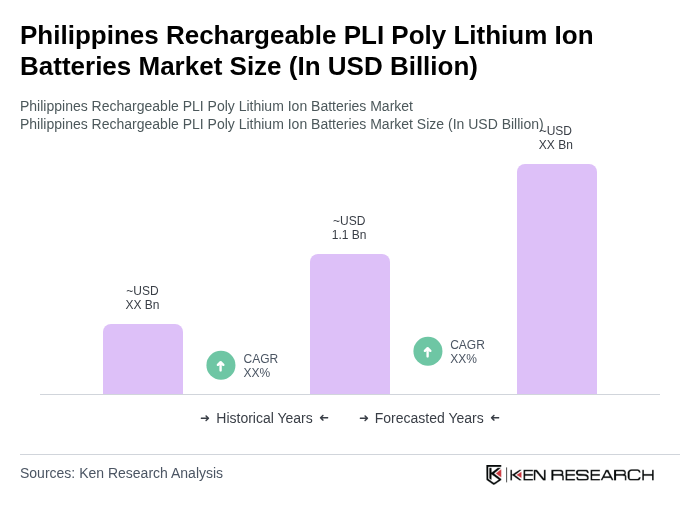
Philippines rechargeable PLI poly lithium ion batteries market at USD 1.1 Bn, fueled by EV adoption, renewable energy, and consumer electronics demand.

Region:Asia

Author(s):Shubham

Product Code:KRAD6682

Pages:97

Published On:December 2025
About the Report

Base Year 2024

Philippines Rechargeable PLI Poly Lithium Ion Batteries Market Overview

  • The Philippines Rechargeable PLI Poly Lithium Ion Batteries Market is valued at USD 1.1 billion, based on a five-year historical analysis. This growth is primarily driven by the increasing demand for electric vehicles, consumer electronics, and renewable energy storage solutions, as lithium-ion batteries are the preferred technology for EVs, residential and commercial solar-plus-storage, and portable devices in the country. The rising awareness of environmental sustainability, expansion of EV charging infrastructure, and government initiatives to promote clean energy and electric mobility have further fueled the market's expansion.
  • Metro Manila, Cebu, and Davao are the dominant cities in the Philippines for the rechargeable PLI poly lithium-ion batteries market. Metro Manila leads due to its high population density, concentration of technology, automotive, and electronics assembly firms, and as the primary hub for utility-scale and commercial energy storage projects. Cebu and Davao are emerging hubs for electric two- and three-wheeler deployment, solar and renewable energy projects, and associated battery storage systems, which contribute to the overall market growth through increasing demand in transport and distributed energy applications.
  • The Philippine government has implemented the Electric Vehicle Industry Development Act (EVIDA) or Republic Act No. 11697, issued by the Congress of the Philippines and signed into law in 2022, which aims to promote the development and use of electric vehicles and their components, including lithium-ion batteries. This regulation provides measures such as zero excise tax for certain EVs, incentives under the Strategic Investment Priority Plan, mandated EV charging in parking facilities, and support for local EV and battery-related manufacturing, fostering a supportive environment for the growth of the rechargeable PLI poly lithium-ion batteries market.
Philippines Rechargeable PLI Poly Lithium Ion Batteries Market Size

Philippines Rechargeable PLI Poly Lithium Ion Batteries Market Segmentation

By Type:The market can be segmented into various types of lithium-ion polymer batteries, each catering to different applications and industries.
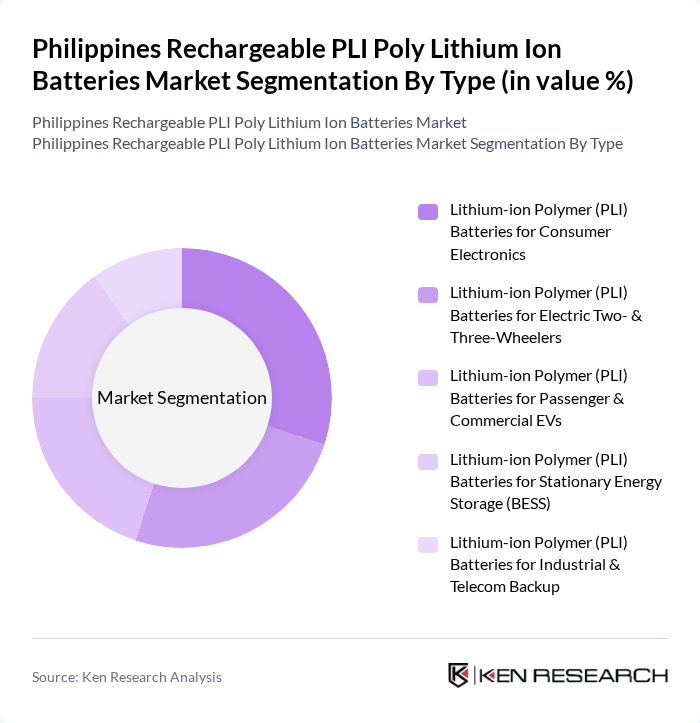
Philippines Rechargeable PLI Poly Lithium Ion Batteries Market segmentation by Type.

The lithium-ion polymer (PLI) batteries for consumer electronics segment is currently dominating the market due to the high demand for portable electronic devices such as smartphones, laptops, tablets, and wearables, which predominantly use lithium-ion chemistries for their high energy density and long cycle life. This segment benefits from rapid technological advancements, miniaturization, and consumer preferences for lightweight, high-capacity batteries. The increasing trend of smart devices, IoT-enabled gadgets, and connected home electronics further drives the demand for these batteries. Additionally, the growing focus on sustainability, energy efficiency standards in electronics, and extended device runtime is expected to bolster this segment's growth.

By End-User:The market can also be segmented based on the end-users of lithium-ion polymer batteries, which include various industries and sectors.
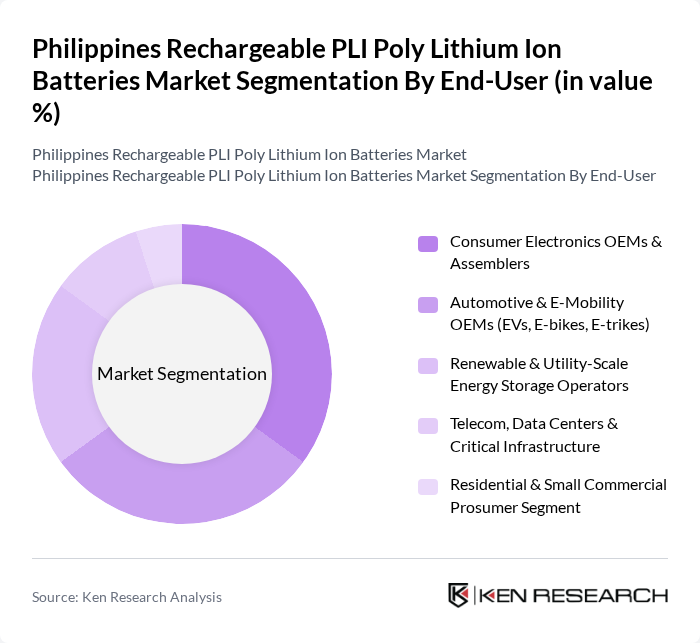
Philippines Rechargeable PLI Poly Lithium Ion Batteries Market segmentation by End-User.

The consumer electronics OEMs and assemblers segment is leading the market due to the continuous demand for portable devices and gadgets assembled in or imported into the Philippines, which rely heavily on lithium-ion and lithium-polymer cells. The proliferation of smartphones, laptops, and wearable technology has significantly increased the need for high-performance batteries, supported by rising internet penetration and mobile-first usage patterns. Additionally, the automotive and e-mobility OEMs segment is also witnessing substantial growth, driven by the rising adoption of electric cars, e-bikes, and e-trikes, as well as fiscal and non-fiscal incentives under EVIDA and related policies that promote electric mobility and charging infrastructure. The shift towards renewable energy storage solutions, including utility-scale and behind-the-meter battery energy storage systems paired with solar and wind, is further enhancing the demand for lithium-ion polymer batteries across various applications.

Philippines Rechargeable PLI Poly Lithium Ion Batteries Market Competitive Landscape

The Philippines Rechargeable PLI Poly Lithium Ion Batteries Market is characterized by a dynamic mix of regional and international players. Leading participants such as Aboitiz Power Corporation, ACEN Corporation (Ayala Group), Manila Electric Company (Meralco) and Meralco PowerGen Corporation, First Gen Corporation, Solar Philippines Power Project Holdings, Inc., Energy Development Corporation (EDC), San Miguel Global Power Holdings Corp., Shell Energy Philippines / Pilipinas Shell Petroleum Corporation, Philippine Batteries Inc. (Motolite), Narada Asia Pacific Philippines, Inc., Huawei Technologies Philippines, Inc. (ESS & Lithium Battery Solutions), Sungrow Power Supply Co., Ltd. – Philippines Operations, Trina Solar Energy Development Philippines, Inc. (Storage & ESS Solutions), Hitachi Energy Philippines Corporation, Yokogawa Philippines, Inc. (BESS Integration & Energy Management) contribute to innovation, geographic expansion, and service delivery in this space.

Aboitiz Power Corporation

1998

Taguig City, Philippines

ACEN Corporation (Ayala Group)

2020

Makati City, Philippines

Manila Electric Company (Meralco)

1903

Pasig City, Philippines

First Gen Corporation

1998

Pasig City, Philippines

Energy Development Corporation (EDC)

1976

Pasig City, Philippines

Company

Establishment Year

Headquarters

Share of Revenue from Philippines vs. Global Operations (%)

3-Year Revenue CAGR from PLI Lithium-ion Battery Business (%)

Market Share by Key Application Segment (EV, BESS, Consumer Electronics)

Average Selling Price per kWh by Technology (NMC, LFP Polymer)

R&D Intensity (% of Revenue Spent on Battery & BMS Innovation)

Localization Level (Share of Assembly/Integration Done in the Philippines)

Philippines Rechargeable PLI Poly Lithium Ion Batteries Market Industry Analysis

Growth Drivers

  • Increasing Demand for Renewable Energy Storage Solutions:The Philippines is experiencing a surge in renewable energy projects, with a target of 20,000 MW of renewable energy capacity in future. This growth is driven by the need for energy security and sustainability, leading to a projected increase in demand for rechargeable lithium-ion batteries for energy storage systems. The government’s commitment to renewable energy is expected to create a market worth approximately PHP 15 billion in future, significantly boosting battery demand.
  • Government Initiatives Promoting Electric Vehicles:The Philippine government aims to have 1 million electric vehicles (EVs) on the road in future, supported by the Electric Vehicle Industry Development Act. This initiative includes incentives such as tax exemptions and subsidies for EV manufacturers and buyers. As a result, the demand for rechargeable lithium-ion batteries is projected to increase, with an estimated market value of PHP 10 billion in future, driven by the growing EV infrastructure and consumer adoption.
  • Rising Consumer Electronics Market:The consumer electronics sector in the Philippines is projected to reach PHP 300 billion in future, fueled by increasing smartphone penetration and demand for portable devices. This growth directly correlates with the rising need for efficient rechargeable lithium-ion batteries. As consumers seek longer-lasting battery solutions, manufacturers are expected to invest heavily in battery technology, further driving market growth and innovation in the rechargeable battery segment.

Market Challenges

  • High Initial Investment Costs:The high upfront costs associated with the production and installation of rechargeable lithium-ion battery systems pose a significant barrier to market entry. For instance, the average cost of a lithium-ion battery system can exceed PHP 1 million, making it less accessible for small businesses and consumers. This financial hurdle can slow down the adoption of battery technologies, particularly in rural areas where funding is limited.
  • Limited Recycling Infrastructure:The Philippines currently lacks a robust recycling infrastructure for lithium-ion batteries, which poses environmental and economic challenges. With an estimated 1,500 tons of lithium-ion batteries expected to reach end-of-life in future, the absence of effective recycling processes can lead to increased waste and environmental hazards. This challenge necessitates urgent investment in recycling technologies and facilities to ensure sustainable battery lifecycle management.

Philippines Rechargeable PLI Poly Lithium Ion Batteries Market Future Outlook

The future of the rechargeable lithium-ion battery market in the Philippines appears promising, driven by increasing investments in renewable energy and electric vehicle infrastructure. As the government continues to implement supportive policies, the market is expected to witness significant growth. Additionally, advancements in battery technology and recycling processes will likely enhance sustainability and efficiency. The integration of smart technologies in battery management systems will further optimize performance, positioning the Philippines as a key player in the Southeast Asian battery market landscape.

Market Opportunities

  • Expansion of Electric Vehicle Infrastructure:The ongoing development of EV charging stations across urban areas presents a significant opportunity for battery manufacturers. With over 500 charging stations planned in future, this infrastructure growth will drive demand for high-capacity rechargeable lithium-ion batteries, enhancing market potential and encouraging consumer adoption of electric vehicles.
  • Growth in Off-Grid Energy Solutions:The increasing need for off-grid energy solutions in rural areas is creating new market opportunities. With approximately 20 million Filipinos lacking access to reliable electricity, the demand for portable and efficient battery storage systems is expected to rise. This trend will encourage investments in innovative battery technologies tailored for off-grid applications, further expanding the market landscape.

Scope of the Report

SegmentSub-Segments
By Type

Lithium-ion Polymer (PLI) Batteries for Consumer Electronics

Lithium-ion Polymer (PLI) Batteries for Electric Two- & Three-Wheelers

Lithium-ion Polymer (PLI) Batteries for Passenger & Commercial EVs

Lithium-ion Polymer (PLI) Batteries for Stationary Energy Storage (BESS)

Lithium-ion Polymer (PLI) Batteries for Industrial & Telecom Backup

By End-User

Consumer Electronics OEMs & Assemblers

Automotive & E-Mobility OEMs (EVs, E-bikes, E-trikes)

Renewable & Utility-Scale Energy Storage Operators

Telecom, Data Centers & Critical Infrastructure

Residential & Small Commercial Prosumer Segment

By Region

NCR & South Luzon (Metro Manila, CALABARZON)

North & Central Luzon

Visayas

Mindanao

By Technology

Lithium Nickel Manganese Cobalt (NMC) Polymer Cells

Lithium Iron Phosphate (LFP) Polymer Cells

High-Energy-Density Pouch Cells

High-Power & Fast-Charging Polymer Cells

By Application

Grid-Connected Battery Energy Storage Systems (Front-of-the-Meter)

Behind-the-Meter C&I Storage and Microgrids

Off-Grid & Island Electrification Systems

UPS, Backup Power and Telecom Power Systems

By Investment Source

Domestic Private Investment

Foreign Direct Investment (FDI) in Battery & Storage Projects

Public-Private Partnerships (PPP) for BESS & EV Infrastructure

Multilateral & Development Finance-Backed Projects

By Policy Support

Incentives under Electric Vehicle Industry Development Act (EVIDA)

Fiscal Incentives via CREATE Act and PEZA/BOI Programs

Renewable Portfolio Standards (RPS) & Green Energy Auction Program (GEAP)

Net Metering, Green Energy Option & Other Support Mechanisms

Key Target Audience

Investors and Venture Capitalist Firms

Government and Regulatory Bodies (e.g., Department of Energy, Department of Trade and Industry)

Manufacturers and Producers

Distributors and Retailers

Battery Technology Developers

Renewable Energy Companies

Automotive Manufacturers

Telecommunications Providers

Players Mentioned in the Report:

Aboitiz Power Corporation

ACEN Corporation (Ayala Group)

Manila Electric Company (Meralco) and Meralco PowerGen Corporation

First Gen Corporation

Solar Philippines Power Project Holdings, Inc.

Energy Development Corporation (EDC)

San Miguel Global Power Holdings Corp.

Shell Energy Philippines / Pilipinas Shell Petroleum Corporation

Philippine Batteries Inc. (Motolite)

Narada Asia Pacific Philippines, Inc.

Huawei Technologies Philippines, Inc. (ESS & Lithium Battery Solutions)

Sungrow Power Supply Co., Ltd. Philippines Operations

Trina Solar Energy Development Philippines, Inc. (Storage & ESS Solutions)

Hitachi Energy Philippines Corporation

Yokogawa Philippines, Inc. (BESS Integration & Energy Management)

Table of Contents

Market Assessment Phase

1. Executive Summary and Approach


2. Philippines Rechargeable PLI Poly Lithium Ion Batteries Market Overview

2.1 Key Insights and Strategic Recommendations

2.2 Philippines Rechargeable PLI Poly Lithium Ion Batteries Market Overview

2.3 Definition and Scope

2.4 Evolution of Market Ecosystem

2.5 Timeline of Key Regulatory Milestones

2.6 Value Chain & Stakeholder Mapping

2.7 Business Cycle Analysis

2.8 Policy & Incentive Landscape


3. Philippines Rechargeable PLI Poly Lithium Ion Batteries Market Analysis

3.1 Growth Drivers

3.1.1 Increasing demand for renewable energy storage solutions
3.1.2 Government initiatives promoting electric vehicles
3.1.3 Rising consumer electronics market
3.1.4 Technological advancements in battery efficiency

3.2 Market Challenges

3.2.1 High initial investment costs
3.2.2 Limited recycling infrastructure
3.2.3 Supply chain disruptions
3.2.4 Regulatory compliance complexities

3.3 Market Opportunities

3.3.1 Expansion of electric vehicle infrastructure
3.3.2 Growth in off-grid energy solutions
3.3.3 Increasing adoption of smart grid technologies
3.3.4 Partnerships with tech companies for innovation

3.4 Market Trends

3.4.1 Shift towards sustainable energy solutions
3.4.2 Rise in demand for portable power sources
3.4.3 Integration of IoT in battery management systems
3.4.4 Focus on battery lifecycle management

3.5 Government Regulation

3.5.1 Incentives for renewable energy projects
3.5.2 Standards for battery safety and performance
3.5.3 Regulations on battery disposal and recycling
3.5.4 Policies supporting electric vehicle adoption

4. SWOT Analysis


5. Stakeholder Analysis


6. Porter's Five Forces Analysis


7. Philippines Rechargeable PLI Poly Lithium Ion Batteries Market Size, 2019-2024

7.1 By Value

7.2 By Volume

7.3 By Average Selling Price


8. Philippines Rechargeable PLI Poly Lithium Ion Batteries Market Segmentation

8.1 By Type

8.1.1 Lithium-ion Polymer (PLI) Batteries for Consumer Electronics
8.1.2 Lithium-ion Polymer (PLI) Batteries for Electric Two- & Three-Wheelers
8.1.3 Lithium-ion Polymer (PLI) Batteries for Passenger & Commercial EVs
8.1.4 Lithium-ion Polymer (PLI) Batteries for Stationary Energy Storage (BESS)
8.1.5 Lithium-ion Polymer (PLI) Batteries for Industrial & Telecom Backup

8.2 By End-User

8.2.1 Consumer Electronics OEMs & Assemblers
8.2.2 Automotive & E-Mobility OEMs (EVs, E-bikes, E-trikes)
8.2.3 Renewable & Utility-Scale Energy Storage Operators
8.2.4 Telecom, Data Centers & Critical Infrastructure
8.2.5 Residential & Small Commercial Prosumer Segment

8.3 By Region

8.3.1 NCR & South Luzon (Metro Manila, CALABARZON)
8.3.2 North & Central Luzon
8.3.3 Visayas
8.3.4 Mindanao

8.4 By Technology

8.4.1 Lithium Nickel Manganese Cobalt (NMC) Polymer Cells
8.4.2 Lithium Iron Phosphate (LFP) Polymer Cells
8.4.3 High-Energy-Density Pouch Cells
8.4.4 High-Power & Fast-Charging Polymer Cells

8.5 By Application

8.5.1 Grid-Connected Battery Energy Storage Systems (Front-of-the-Meter)
8.5.2 Behind-the-Meter C&I Storage and Microgrids
8.5.3 Off-Grid & Island Electrification Systems
8.5.4 UPS, Backup Power and Telecom Power Systems

8.6 By Investment Source

8.6.1 Domestic Private Investment
8.6.2 Foreign Direct Investment (FDI) in Battery & Storage Projects
8.6.3 Public-Private Partnerships (PPP) for BESS & EV Infrastructure
8.6.4 Multilateral & Development Finance-Backed Projects

8.7 By Policy Support

8.7.1 Incentives under Electric Vehicle Industry Development Act (EVIDA)
8.7.2 Fiscal Incentives via CREATE Act and PEZA/BOI Programs
8.7.3 Renewable Portfolio Standards (RPS) & Green Energy Auction Program (GEAP)
8.7.4 Net Metering, Green Energy Option & Other Support Mechanisms

9. Philippines Rechargeable PLI Poly Lithium Ion Batteries Market Competitive Analysis

9.1 Market Share of Key Players

9.2 Cross Comparison of Key Players

9.2.1 Installed Lithium-ion Polymer Battery Capacity in the Philippines (MWh)
9.2.2 Share of Revenue from Philippines vs. Global Operations (%)
9.2.3 3-Year Revenue CAGR from PLI Lithium-ion Battery Business (%)
9.2.4 Market Share by Key Application Segment (EV, BESS, Consumer Electronics)
9.2.5 Average Selling Price per kWh by Technology (NMC, LFP Polymer)
9.2.6 R&D Intensity (% of Revenue Spent on Battery & BMS Innovation)
9.2.7 Localization Level (Share of Assembly/Integration Done in the Philippines)
9.2.8 Project Pipeline in the Philippines (Announced/Under-construction MWh)
9.2.9 Strategic Alliances with Filipino Utilities, EV OEMs & Telecom Operators (Count)
9.2.10 After-Sales Network Coverage (Service Points / Regions Covered)

9.3 SWOT Analysis of Top Players

9.4 Pricing Analysis

9.5 Detailed Profile of Major Companies

9.5.1 Aboitiz Power Corporation
9.5.2 ACEN Corporation (Ayala Group)
9.5.3 Manila Electric Company (Meralco) and Meralco PowerGen Corporation
9.5.4 First Gen Corporation
9.5.5 Solar Philippines Power Project Holdings, Inc.
9.5.6 Energy Development Corporation (EDC)
9.5.7 San Miguel Global Power Holdings Corp.
9.5.8 Shell Energy Philippines / Pilipinas Shell Petroleum Corporation
9.5.9 Philippine Batteries Inc. (Motolite)
9.5.10 Narada Asia Pacific Philippines, Inc.
9.5.11 Huawei Technologies Philippines, Inc. (ESS & Lithium Battery Solutions)
9.5.12 Sungrow Power Supply Co., Ltd. – Philippines Operations
9.5.13 Trina Solar Energy Development Philippines, Inc. (Storage & ESS Solutions)
9.5.14 Hitachi Energy Philippines Corporation
9.5.15 Yokogawa Philippines, Inc. (BESS Integration & Energy Management)

10. Philippines Rechargeable PLI Poly Lithium Ion Batteries Market End-User Analysis

10.1 Procurement Behavior of Key Ministries

10.1.1 Energy procurement strategies.
10.1.2 Budget allocation for renewable projects.
10.1.3 Collaboration with private sectors.
10.1.4 Compliance with environmental regulations.

10.2 Corporate Spend on Infrastructure & Energy

10.2.1 Investment in renewable energy projects.
10.2.2 Budget for energy efficiency upgrades.
10.2.3 Funding for research and development.
10.2.4 Partnerships with technology providers.

10.3 Pain Point Analysis by End-User Category

10.3.1 High energy costs for businesses.
10.3.2 Reliability of energy supply.
10.3.3 Need for sustainable energy solutions.
10.3.4 Regulatory compliance challenges.

10.4 User Readiness for Adoption

10.4.1 Awareness of battery technologies.
10.4.2 Willingness to invest in renewable solutions.
10.4.3 Training and support needs.
10.4.4 Integration with existing systems.

10.5 Post-Deployment ROI and Use Case Expansion

10.5.1 Measurement of energy savings.
10.5.2 Expansion into new applications.
10.5.3 Long-term sustainability assessments.
10.5.4 User feedback and improvement cycles.

11. Philippines Rechargeable PLI Poly Lithium Ion Batteries Market Future Size, 2025-2030

11.1 By Value

11.2 By Volume

11.3 By Average Selling Price


Go-To-Market Strategy Phase

1. Whitespace Analysis + Business Model Canvas

1.1 Market gaps identification.

1.2 Value proposition development.

1.3 Revenue model exploration.

1.4 Customer segmentation analysis.

1.5 Competitive landscape overview.

1.6 Key partnerships identification.

1.7 Risk assessment and mitigation.


2. Marketing and Positioning Recommendations

2.1 Branding strategies.

2.2 Product USPs.

2.3 Target audience definition.

2.4 Communication channels selection.

2.5 Marketing budget allocation.

2.6 Performance metrics establishment.

2.7 Feedback mechanisms implementation.


3. Distribution Plan

3.1 Urban retail strategies.

3.2 Rural NGO tie-ups.

3.3 E-commerce integration.

3.4 Logistics and supply chain management.

3.5 Distribution partnerships.

3.6 Inventory management practices.

3.7 Customer service enhancements.


4. Channel & Pricing Gaps

4.1 Underserved routes analysis.

4.2 Pricing bands evaluation.

4.3 Competitor pricing comparison.

4.4 Value-based pricing strategies.

4.5 Discount and promotion strategies.

4.6 Price elasticity assessment.

4.7 Customer willingness to pay analysis.


5. Unmet Demand & Latent Needs

5.1 Category gaps identification.

5.2 Consumer segments analysis.

5.3 Product development opportunities.

5.4 Market entry barriers assessment.

5.5 Customer feedback incorporation.

5.6 Future trends forecasting.

5.7 Strategic recommendations.


6. Customer Relationship

6.1 Loyalty programs design.

6.2 After-sales service enhancements.

6.3 Customer engagement strategies.

6.4 Feedback collection methods.

6.5 Relationship management tools.

6.6 Community building initiatives.

6.7 Customer education programs.


7. Value Proposition

7.1 Sustainability initiatives.

7.2 Integrated supply chains.

7.3 Cost-saving measures.

7.4 Quality assurance practices.

7.5 Innovation in product offerings.

7.6 Customer-centric approach.

7.7 Long-term partnerships.


8. Key Activities

8.1 Regulatory compliance strategies.

8.2 Branding initiatives.

8.3 Distribution setup processes.

8.4 Market research activities.

8.5 Training and development programs.

8.6 Performance monitoring systems.

8.7 Stakeholder engagement efforts.


9. Entry Strategy Evaluation

9.1 Domestic Market Entry Strategy

9.1.1 Product mix considerations.
9.1.2 Pricing band analysis.
9.1.3 Packaging strategies.

9.2 Export Entry Strategy

9.2.1 Target countries identification.
9.2.2 Compliance roadmap development.

10. Entry Mode Assessment

10.1 Joint Venture opportunities.

10.2 Greenfield investment analysis.

10.3 M&A considerations.

10.4 Distributor model evaluation.


11. Capital and Timeline Estimation

11.1 Capital requirements assessment.

11.2 Timelines for market entry.


12. Control vs Risk Trade-Off

12.1 Ownership considerations.

12.2 Partnerships evaluation.


13. Profitability Outlook

13.1 Breakeven analysis.

13.2 Long-term sustainability strategies.


14. Potential Partner List

14.1 Distributors identification.

14.2 Joint Ventures opportunities.

14.3 Acquisition targets analysis.


15. Execution Roadmap

15.1 Phased Plan for Market Entry

15.1.1 Market Setup.
15.1.2 Market Entry.
15.1.3 Growth Acceleration.
15.1.4 Scale & Stabilize.

15.2 Key Activities and Milestones


Research Methodology

ApproachModellingSample

Phase 1: Approach1

Desk Research

  • Analysis of industry reports from government agencies and trade associations in the Philippines
  • Review of academic publications and white papers on lithium-ion battery technology and market trends
  • Examination of market statistics and forecasts from reputable market research firms

Primary Research

  • Interviews with key stakeholders in the battery manufacturing sector, including executives and engineers
  • Surveys conducted with distributors and retailers of rechargeable lithium-ion batteries
  • Field visits to manufacturing plants to gather insights on production processes and capacity

Validation & Triangulation

  • Cross-validation of data through multiple sources, including trade publications and industry news
  • Triangulation of findings from primary interviews with secondary data to ensure consistency
  • Sanity checks performed by consulting with industry experts and analysts

Phase 2: Market Size Estimation1

Top-down Assessment

  • Estimation of market size based on national energy consumption and battery usage trends
  • Segmentation of the market by application areas such as consumer electronics, electric vehicles, and renewable energy storage
  • Incorporation of government policies promoting electric mobility and renewable energy initiatives

Bottom-up Modeling

  • Collection of sales data from leading battery manufacturers and distributors in the Philippines
  • Estimation of production capacity and output from local manufacturing facilities
  • Analysis of pricing strategies and cost structures to derive revenue estimates

Forecasting & Scenario Analysis

  • Development of market forecasts using historical data and growth trends in the electric vehicle sector
  • Scenario analysis based on potential regulatory changes and technological advancements in battery technology
  • Creation of multiple forecast scenarios (baseline, optimistic, and pessimistic) through 2030

Phase 3: CATI Sample Composition1

Scope Item/SegmentSample SizeTarget Respondent Profiles
Consumer Electronics Market120Product Managers, Retail Buyers
Electric Vehicle Manufacturers90Engineering Leads, Supply Chain Managers
Renewable Energy Storage Solutions75Project Managers, Technical Directors
Battery Recycling Initiatives60Sustainability Managers, Operations Supervisors
Distribution and Retail Channels85Sales Directors, Marketing Managers

Frequently Asked Questions

What is the current value of the Philippines Rechargeable PLI Poly Lithium Ion Batteries Market?

The Philippines Rechargeable PLI Poly Lithium Ion Batteries Market is valued at approximately USD 1.1 billion, driven by the increasing demand for electric vehicles, consumer electronics, and renewable energy storage solutions.

What factors are driving the growth of the lithium-ion battery market in the Philippines?

Which cities are the main hubs for the rechargeable lithium-ion battery market in the Philippines?

What is the Electric Vehicle Industry Development Act (EVIDA) in the Philippines?

Other Regional/Country Reports

Indonesia Rechargeable Pli Poly Lithium Ion Batteries Industry

Malaysia Rechargeable Pli Poly Lithium Ion Batteries Industry

KSA Rechargeable Pli Poly Lithium Ion Batteries Industry

APAC Rechargeable Pli Poly Lithium Ion Batteries Industry

SEA Rechargeable Pli Poly Lithium Ion Batteries Industry

Vietnam Rechargeable Pli Poly Lithium Ion Batteries Industry

Other Adjacent Reports

Saudi Arabia electric vehicle battery market Size, Share, Growth Drivers, Trends, Opportunities & Forecast 2025–2030

South Korea Renewable Energy Storage Market

Brazil Consumer Electronics Battery Market

KSA battery recycling market report size, share, growth drivers, trends, opportunities & forecast 2025–2030

Indonesia Solar Power Storage Market

Bahrain Battery Management Systems Market

Qatar Lithium Mining Market

Qatar Electric Mobility Market

UAE Portable Power Devices Market

Bahrain Energy Storage Systems Market

Why Buy From Us?

Refine Robust Result (RRR) Framework

What makes us stand out is that our consultants follow Robust, Refine and Result (RRR) methodology. Robust for clear definitions, approaches and sanity checking, Refine for differentiating respondents' facts and opinions, and Result for presenting data with story.

Our Reach Is Unmatched

We have set a benchmark in the industry by offering our clients with syndicated and customized market research reports featuring coverage of entire market as well as meticulous research and analyst insights.

Shifting the Research Paradigm

While we don't replace traditional research, we flip the method upside down. Our dual approach of Top Bottom & Bottom Top ensures quality deliverable by not just verifying company fundamentals but also looking at the sector and macroeconomic factors.

More Insights-Better Decisions

With one step in the future, our research team constantly tries to show you the bigger picture. We help with some of the tough questions you may encounter along the way: How is the industry positioned? Best marketing channel? KPI's of competitors? By aligning every element, we help maximize success.

Transparency and Trust

Our report gives you instant access to the answers and sources that other companies might choose to hide. We elaborate each steps of research methodology we have used and showcase you the sample size to earn your trust.

Round the Clock Support

If you need any support, we are here! We pride ourselves on universe strength, data quality, and quick, friendly, and professional service.

Why Clients Choose Us?

400000+
Reports in repository
150+
Consulting projects a year
100+
Analysts
8000+
Client Queries in 2022








