About the Report
Base Year 2024Philippines Takaful Insurance Market Overview
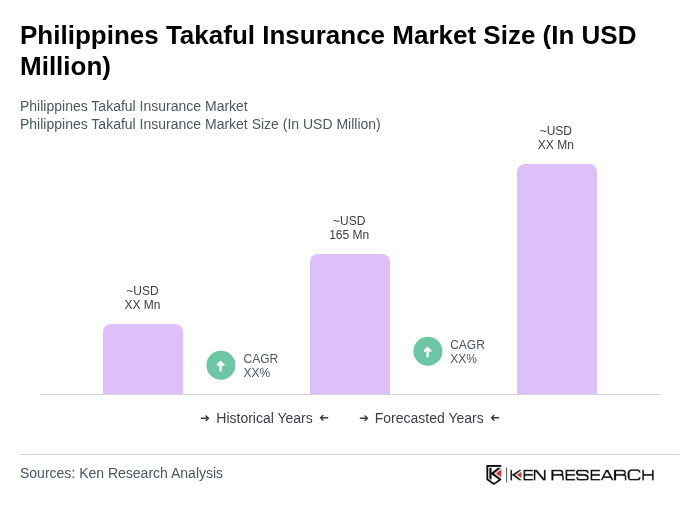
- The Philippines Takaful Insurance Market is valued at USD 165 million, based on a five-year historical analysis. This growth is primarily driven by the increasing awareness of Shariah-compliant financial products, the rising demand for insurance solutions among the Muslim population in the country, and the Insurance Commission granting the first official takaful license in November 2024 establishing a legal regulatory foundation. The market has seen a steady increase in participation from both local and international players, contributing to its overall expansion.
- Key cities such as Manila, Cebu, and Davao dominate the Takaful insurance market due to their significant urban populations and economic activities. Manila, being the capital, serves as a financial hub, while Cebu and Davao are vital centers for trade and commerce, attracting a diverse customer base seeking Takaful products.
- The Circular Letter No. 2024-77 issued by the Insurance Commission in 2024 provides the regulatory framework for Takaful operations, requiring Shariah supervisory board oversight, participant funds segregation, and compliance with mutual risk-sharing principles for Takaful operators. This regulation promotes the growth of Islamic finance, including Takaful insurance, by enabling licensing and standardized product approvals to ensure Shariah principles and enhance consumer confidence in these financial products.
Philippines Takaful Insurance Market Segmentation
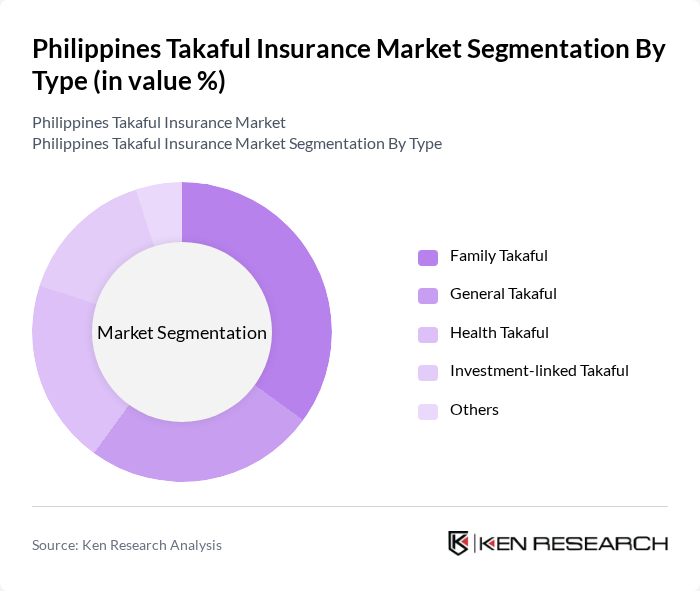
By Type:The Takaful insurance market can be segmented into various types, including Family Takaful, General Takaful, Health Takaful, Investment-linked Takaful, and Others. Each of these segments caters to different consumer needs and preferences, with Family Takaful being particularly popular among individuals seeking financial protection for their families. General Takaful covers a wide range of risks, while Health Takaful addresses the growing demand for health insurance solutions. Investment-linked Takaful products appeal to those looking for investment opportunities alongside insurance coverage.
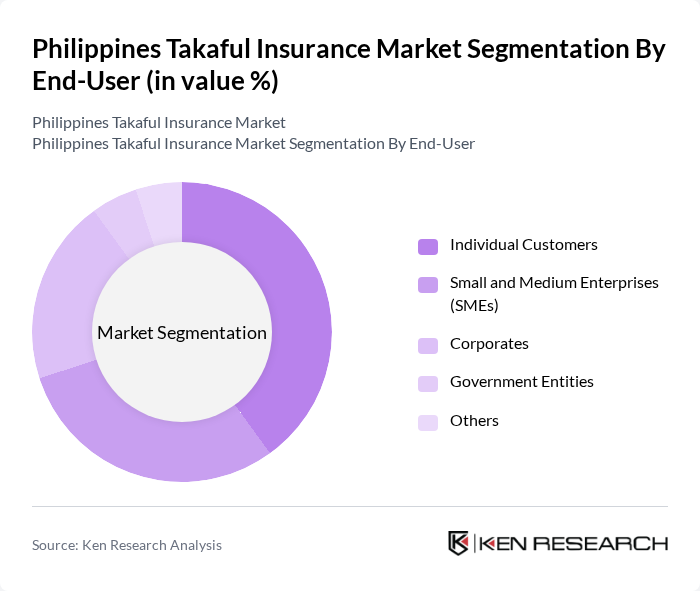
By End-User:The end-user segmentation includes Individual Customers, Small and Medium Enterprises (SMEs), Corporates, Government Entities, and Others. Individual customers represent a significant portion of the market, driven by the increasing awareness of the importance of insurance. SMEs are also emerging as a vital segment, as they seek affordable and Shariah-compliant insurance solutions to protect their businesses. Corporates and government entities are gradually recognizing the benefits of Takaful products, contributing to the market's growth.
Philippines Takaful Insurance Market Competitive Landscape
The Philippines Takaful Insurance Market is characterized by a dynamic mix of regional and international players. Leading participants such as Al-Aman Takaful, Abu Dhabi Islamic Bank Takaful, Philippine Takaful Insurance Corporation, FWD Life Insurance Corporation, Prudentialife Takaful, Great Eastern Takaful, Sun Life Financial, Manulife Philippines, BPI-Philam Life Assurance Corporation, EastWest Ageas Life Insurance, Insular Life Assurance Company, AXA Philippines, Standard Insurance, Pioneer Life Inc., AIA Philippines contribute to innovation, geographic expansion, and service delivery in this space.
Philippines Takaful Insurance Market Industry Analysis
Growth Drivers
- Increasing Awareness of Islamic Finance:The Philippines has seen a significant rise in awareness of Islamic finance, with the number of Islamic banks increasing from 5 in the past to 10 in the future. This growth is supported by the Bangko Sentral ng Pilipinas (BSP), which reported a 15% increase in Islamic banking assets, reaching approximately PHP 120 billion in the future. This heightened awareness is driving interest in Takaful products, aligning with the country's growing Muslim population, which is projected to reach 14 million in the future.
- Rising Demand for Ethical Investment Options:The demand for ethical investment options is surging, with the global Islamic finance market valued at USD 3.2 trillion in the future. In the Philippines, Takaful products are increasingly viewed as ethical alternatives to conventional insurance, appealing to both Muslim and non-Muslim consumers. The Securities and Exchange Commission (SEC) reported a 20% increase in Sharia-compliant investment products, indicating a growing market for Takaful as consumers seek socially responsible financial solutions.
- Government Support for Islamic Financial Products:The Philippine government has actively supported the development of Islamic finance, with the enactment of the Republic Act No. 11439 in the past, which regulates Islamic banking and finance. This legislative framework has facilitated the establishment of Takaful providers, contributing to a 30% increase in Takaful premiums collected, amounting to PHP 6 billion in the future. Such government initiatives are crucial in fostering a conducive environment for Takaful growth.
Market Challenges
- Limited Understanding of Takaful Products:Despite the growth in awareness, there remains a significant knowledge gap regarding Takaful products among consumers. A survey by the Insurance Commission revealed that only 30% of the population understands Takaful principles. This lack of understanding hampers market penetration, as potential customers are hesitant to engage with products they do not fully comprehend, limiting the overall growth potential of the Takaful market.
- Competition from Conventional Insurance:The Takaful market faces stiff competition from conventional insurance providers, which dominate the market with a 90% share. In the future, conventional insurance premiums reached PHP 350 billion, overshadowing Takaful's PHP 6 billion. This competitive landscape poses a challenge for Takaful providers to differentiate their offerings and attract customers who are accustomed to traditional insurance products, thereby stunting growth in the sector.
Philippines Takaful Insurance Market Future Outlook
The Philippines Takaful insurance market is poised for significant growth, driven by increasing consumer awareness and government support. As the middle-class population expands, more individuals are likely to seek ethical financial products. Additionally, the integration of technology in Takaful operations will enhance customer engagement and streamline processes. With a focus on developing customized products and expanding into underserved markets, Takaful providers can capitalize on emerging trends, positioning themselves for a robust future in the insurance landscape.
Market Opportunities
- Digital Transformation in Insurance Services:The digital transformation of insurance services presents a significant opportunity for Takaful providers. With over 80 million internet users in the Philippines as of the future, leveraging digital platforms can enhance customer outreach and streamline service delivery, potentially increasing Takaful adoption rates significantly.
- Expansion into Rural Markets:Expanding Takaful services into rural markets can unlock new customer segments. Approximately 50% of the Philippine population resides in rural areas, where access to insurance is limited. Targeting these underserved communities with tailored Takaful products can drive growth and improve financial inclusion, benefiting both providers and consumers.
Scope of the Report
| Segment | Sub-Segments |
|---|---|
| By Type | Family Takaful General Takaful Health Takaful Investment-linked Takaful Others |
| By End-User | Individual Customers Small and Medium Enterprises (SMEs) Corporates Government Entities Others |
| By Distribution Channel | Direct Sales Brokers Agents Online Platforms Others |
| By Coverage Type | Comprehensive Coverage Limited Coverage Customizable Coverage Others |
| By Customer Demographics | Age Group (Youth, Adults, Seniors) Income Level (Low, Middle, High) Geographic Location (Urban, Rural) Others |
| By Product Features | Flexible Premium Payment Options Shariah-compliant Investment Options Family Benefits Others |
| By Policy Duration | Short-term Policies Long-term Policies Others |
Key Target Audience
Investors and Venture Capitalist Firms
Government and Regulatory Bodies (e.g., Insurance Commission of the Philippines)
Islamic Financial Institutions
Microfinance Institutions
Industry Associations (e.g., Philippine Takaful Association)
Insurance Brokers and Agents
Corporate Clients and Businesses
Technology Providers for Insurance Solutions
Players Mentioned in the Report:
Al-Aman Takaful
Abu Dhabi Islamic Bank Takaful
Philippine Takaful Insurance Corporation
FWD Life Insurance Corporation
Prudentialife Takaful
Great Eastern Takaful
Sun Life Financial
Manulife Philippines
BPI-Philam Life Assurance Corporation
EastWest Ageas Life Insurance
Insular Life Assurance Company
AXA Philippines
Standard Insurance
Pioneer Life Inc.
AIA Philippines
Table of Contents
Market Assessment Phase
1. Executive Summary and Approach
2. Philippines Takaful Insurance Market Overview
2.1 Key Insights and Strategic Recommendations
2.2 Philippines Takaful Insurance Market Overview
2.3 Definition and Scope
2.4 Evolution of Market Ecosystem
2.5 Timeline of Key Regulatory Milestones
2.6 Value Chain & Stakeholder Mapping
2.7 Business Cycle Analysis
2.8 Policy & Incentive Landscape
3. Philippines Takaful Insurance Market Analysis
3.1 Growth Drivers
3.1.1 Increasing Awareness of Islamic Finance
3.1.2 Rising Demand for Ethical Investment Options
3.1.3 Government Support for Islamic Financial Products
3.1.4 Expanding Middle-Class Population
3.2 Market Challenges
3.2.1 Limited Understanding of Takaful Products
3.2.2 Regulatory Compliance Issues
3.2.3 Competition from Conventional Insurance
3.2.4 Economic Volatility
3.3 Market Opportunities
3.3.1 Digital Transformation in Insurance Services
3.3.2 Expansion into Rural Markets
3.3.3 Development of Customized Takaful Products
3.3.4 Strategic Partnerships with Financial Institutions
3.4 Market Trends
3.4.1 Growth of Micro-Takaful Products
3.4.2 Increasing Use of Technology in Takaful Operations
3.4.3 Focus on Customer-Centric Services
3.4.4 Rise of Sustainable and Green Takaful Options
3.5 Government Regulation
3.5.1 Implementation of Islamic Financial Laws
3.5.2 Regulatory Framework for Takaful Operations
3.5.3 Consumer Protection Regulations
3.5.4 Tax Incentives for Takaful Providers
4. SWOT Analysis
5. Stakeholder Analysis
6. Porter's Five Forces Analysis
7. Philippines Takaful Insurance Market Market Size, 2019-2024
7.1 By Value
7.2 By Volume
7.3 By Average Selling Price
8. Philippines Takaful Insurance Market Segmentation
8.1 By Type
8.1.1 Family Takaful
8.1.2 General Takaful
8.1.3 Health Takaful
8.1.4 Investment-linked Takaful
8.1.5 Others
8.2 By End-User
8.2.1 Individual Customers
8.2.2 Small and Medium Enterprises (SMEs)
8.2.3 Corporates
8.2.4 Government Entities
8.2.5 Others
8.3 By Distribution Channel
8.3.1 Direct Sales
8.3.2 Brokers
8.3.3 Agents
8.3.4 Online Platforms
8.3.5 Others
8.4 By Coverage Type
8.4.1 Comprehensive Coverage
8.4.2 Limited Coverage
8.4.3 Customizable Coverage
8.4.4 Others
8.5 By Customer Demographics
8.5.1 Age Group (Youth, Adults, Seniors)
8.5.2 Income Level (Low, Middle, High)
8.5.3 Geographic Location (Urban, Rural)
8.5.4 Others
8.6 By Product Features
8.6.1 Flexible Premium Payment Options
8.6.2 Shariah-compliant Investment Options
8.6.3 Family Benefits
8.6.4 Others
8.7 By Policy Duration
8.7.1 Short-term Policies
8.7.2 Long-term Policies
8.7.3 Others
9. Philippines Takaful Insurance Market Competitive Analysis
9.1 Market Share of Key Players
9.2 Cross Comparison of Key Players
9.2.1 Company Name
9.2.2 Group Size (Large, Medium, or Small as per industry convention)
9.2.3 Premium Growth Rate
9.2.4 Customer Retention Rate
9.2.5 Claims Settlement Ratio
9.2.6 Distribution Channel Efficiency
9.2.7 Pricing Strategy
9.2.8 Market Penetration Rate
9.2.9 Product Diversification Index
9.2.10 Customer Satisfaction Score
9.3 SWOT Analysis of Top Players
9.4 Pricing Analysis
9.5 Detailed Profile of Major Companies
9.5.1 Al-Aman Takaful
9.5.2 Abu Dhabi Islamic Bank Takaful
9.5.3 Philippine Takaful Insurance Corporation
9.5.4 FWD Life Insurance Corporation
9.5.5 Prudentialife Takaful
9.5.6 Great Eastern Takaful
9.5.7 Sun Life Financial
9.5.8 Manulife Philippines
9.5.9 BPI-Philam Life Assurance Corporation
9.5.10 EastWest Ageas Life Insurance
9.5.11 Insular Life Assurance Company
9.5.12 AXA Philippines
9.5.13 Standard Insurance
9.5.14 Pioneer Life Inc.
9.5.15 AIA Philippines
10. Philippines Takaful Insurance Market End-User Analysis
10.1 Procurement Behavior of Key Ministries
10.1.1 Budget Allocation for Takaful Products
10.1.2 Decision-Making Processes
10.1.3 Evaluation Criteria for Takaful Providers
10.1.4 Others
10.2 Corporate Spend on Infrastructure & Energy
10.2.1 Investment in Takaful Products
10.2.2 Budgeting for Risk Management
10.2.3 Others
10.3 Pain Point Analysis by End-User Category
10.3.1 Lack of Awareness
10.3.2 Complexity of Products
10.3.3 Service Delivery Issues
10.3.4 Others
10.4 User Readiness for Adoption
10.4.1 Awareness Levels
10.4.2 Perceived Value of Takaful
10.4.3 Others
10.5 Post-Deployment ROI and Use Case Expansion
10.5.1 Measurement of ROI
10.5.2 Expansion Opportunities
10.5.3 Others
11. Philippines Takaful Insurance Market Future Size, 2025-2030
11.1 By Value
11.2 By Volume
11.3 By Average Selling Price
Go-To-Market Strategy Phase
1. Whitespace Analysis + Business Model Canvas
1.1 Market Gaps Identification
1.2 Business Model Development
2. Marketing and Positioning Recommendations
2.1 Branding Strategies
2.2 Product USPs
3. Distribution Plan
3.1 Urban Retail vs Rural NGO Tie-ups
4. Channel & Pricing Gaps
4.1 Underserved Routes
4.2 Pricing Bands
5. Unmet Demand & Latent Needs
5.1 Category Gaps
5.2 Consumer Segments
6. Customer Relationship
6.1 Loyalty Programs
6.2 After-sales Service
7. Value Proposition
7.1 Sustainability
7.2 Integrated Supply Chains
8. Key Activities
8.1 Regulatory Compliance
8.2 Branding
8.3 Distribution Setup
9. Entry Strategy Evaluation
9.1 Domestic Market Entry Strategy
9.1.1 Product Mix
9.1.2 Pricing Band
9.1.3 Packaging
9.2 Export Entry Strategy
9.2.1 Target Countries
9.2.2 Compliance Roadmap
10. Entry Mode Assessment
10.1 JV
10.2 Greenfield
10.3 M&A
10.4 Distributor Model
11. Capital and Timeline Estimation
11.1 Capital Requirements
11.2 Timelines
12. Control vs Risk Trade-Off
12.1 Ownership vs Partnerships
13. Profitability Outlook
13.1 Breakeven Analysis
13.2 Long-term Sustainability
14. Potential Partner List
14.1 Distributors
14.2 JVs
14.3 Acquisition Targets
15. Execution Roadmap
15.1 Phased Plan for Market Entry
15.1.1 Market Setup
15.1.2 Market Entry
15.1.3 Growth Acceleration
15.1.4 Scale & Stabilize
15.2 Key Activities and Milestones
15.2.1 Milestone Planning
Research Methodology
Phase 1: Approach1
Desk Research
- Analysis of regulatory frameworks governing Takaful insurance in the Philippines
- Review of industry reports and publications from the Insurance Commission of the Philippines
- Examination of market trends and consumer behavior studies related to Islamic finance
Primary Research
- Interviews with executives from leading Takaful insurance providers
- Surveys targeting potential policyholders to gauge awareness and interest
- Focus group discussions with community leaders and Islamic scholars
Validation & Triangulation
- Cross-validation of findings with data from financial institutions and Islamic banks
- Triangulation of insights from primary interviews and secondary data sources
- Sanity checks through expert panels comprising industry veterans and academics
Phase 2: Market Size Estimation1
Top-down Assessment
- Estimation of total insurance market size and proportion attributed to Takaful
- Analysis of demographic trends influencing demand for Sharia-compliant products
- Incorporation of economic indicators such as GDP growth and disposable income levels
Bottom-up Modeling
- Collection of data on policy issuance and premium volumes from Takaful operators
- Estimation of average premium rates based on product offerings and coverage types
- Calculation of market penetration rates among target demographics
Forecasting & Scenario Analysis
- Multi-factor analysis considering socio-economic changes and regulatory developments
- Scenario modeling based on varying levels of market acceptance and competition
- Projections of market growth through 2030 under different economic conditions
Phase 3: CATI Sample Composition1
| Scope Item/Segment | Sample Size | Target Respondent Profiles |
|---|---|---|
| Individual Policyholders | 120 | Muslim Community Members, Young Professionals |
| Corporate Clients | 80 | HR Managers, Finance Directors |
| Insurance Brokers | 60 | Insurance Agents, Financial Advisors |
| Regulatory Bodies | 40 | Insurance Commission Officials, Policy Analysts |
| Islamic Finance Experts | 50 | Academics, Islamic Scholars |
Frequently Asked Questions
What is the current value of the Philippines Takaful Insurance Market?
The Philippines Takaful Insurance Market is valued at approximately USD 165 million, reflecting a steady growth driven by increased awareness of Shariah-compliant financial products and rising demand among the Muslim population.
What are the main types of Takaful insurance available in the Philippines?
Which cities are the primary markets for Takaful insurance in the Philippines?
What regulatory framework governs Takaful operations in the Philippines?
Other Regional/Country Reports
Other Adjacent Reports
Egypt Islamic Banking Market
Kuwait Islamic Finance Market Size, Share, Growth Drivers, Opportunities & Forecast 2025–2030Bahrain Conventional Insurance Market
Saudi Arabia Health Insurance Market Size, Share & Forecast, By Product Type, Customer Segment & Distribution Channel, 2026-2032Qatar Life Insurance Market Size, Share & Forecast, By Product Type, Customer Segment & Distribution Channel, 2026–2032Kuwait General Insurance Market Size, Share & Forecast, By Product Type, Customer Segment & Distribution Channel, 2025-2032South Africa Investment Management Market
Oman Microfinance Market Size, Share & Forecast, By Product Type, Customer Segment & Distribution Channel, 2025-2032Comoros Fintech MarketGermany Reinsurance MarketWhy Buy From Us?

What makes us stand out is that our consultants follow Robust, Refine and Result (RRR) methodology. Robust for clear definitions, approaches and sanity checking, Refine for differentiating respondents' facts and opinions, and Result for presenting data with story.

We have set a benchmark in the industry by offering our clients with syndicated and customized market research reports featuring coverage of entire market as well as meticulous research and analyst insights.

While we don't replace traditional research, we flip the method upside down. Our dual approach of Top Bottom & Bottom Top ensures quality deliverable by not just verifying company fundamentals but also looking at the sector and macroeconomic factors.

With one step in the future, our research team constantly tries to show you the bigger picture. We help with some of the tough questions you may encounter along the way: How is the industry positioned? Best marketing channel? KPI's of competitors? By aligning every element, we help maximize success.

Our report gives you instant access to the answers and sources that other companies might choose to hide. We elaborate each steps of research methodology we have used and showcase you the sample size to earn your trust.

If you need any support, we are here! We pride ourselves on universe strength, data quality, and quick, friendly, and professional service.