About the Report
Base Year 2024Thailand Takaful Insurance Market Overview
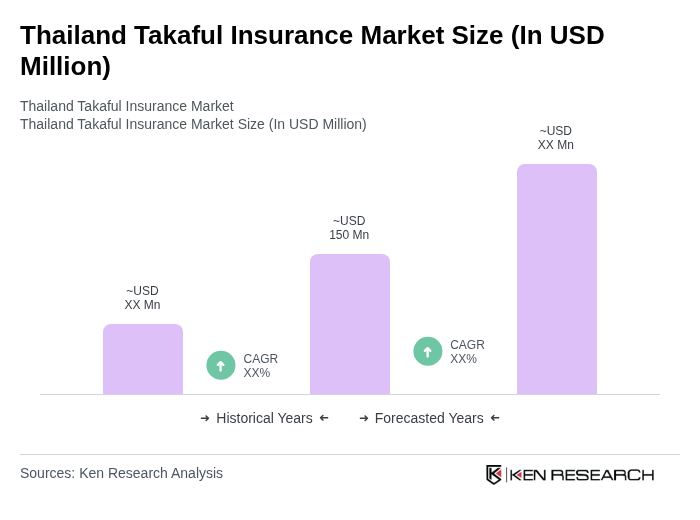
- The Thailand Takaful Insurance Market is valued at USD 150 million, based on a five-year historical analysis. This growth is primarily driven by increasing awareness of Sharia-compliant financial products, rising disposable incomes, a growing middle class seeking financial security, digital transformation, and rising demand for ethical and sustainable insurance solutions. The market has seen a steady rise in demand for Takaful products as consumers become more educated about the benefits of cooperative insurance models.
- Key players in this market are concentrated in urban centers such as Bangkok, Chiang Mai, and Pattaya. These cities dominate due to their higher population density, economic activity, and the presence of financial institutions that promote Takaful products. The urban population's increasing interest in alternative insurance solutions has further fueled market growth in these regions.
- The Takaful Rules, 2019 issued by the Office of Insurance Commission (OIC), require Takaful operators to establish Sharia supervisory boards for product approval, maintain separate participant investment funds with risk-sharing mechanisms, and comply with capital adequacy ratios of at least THB 100 million for licensing. This regulation ensures Sharia compliance across operations, including investment restrictions on non-halal assets, annual audits, and consumer disclosure standards.
Thailand Takaful Insurance Market Segmentation
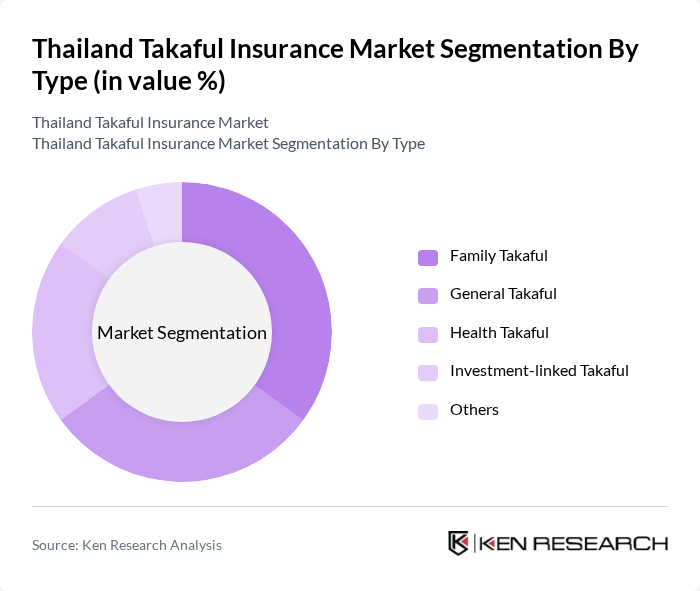
By Type:The market is segmented into various types of Takaful products, including Family Takaful, General Takaful, Health Takaful, Investment-linked Takaful, and Others. Family Takaful is gaining traction due to its focus on long-term savings and protection, while Health Takaful is increasingly popular as healthcare costs rise. General Takaful covers a wide range of risks, appealing to both individuals and businesses.
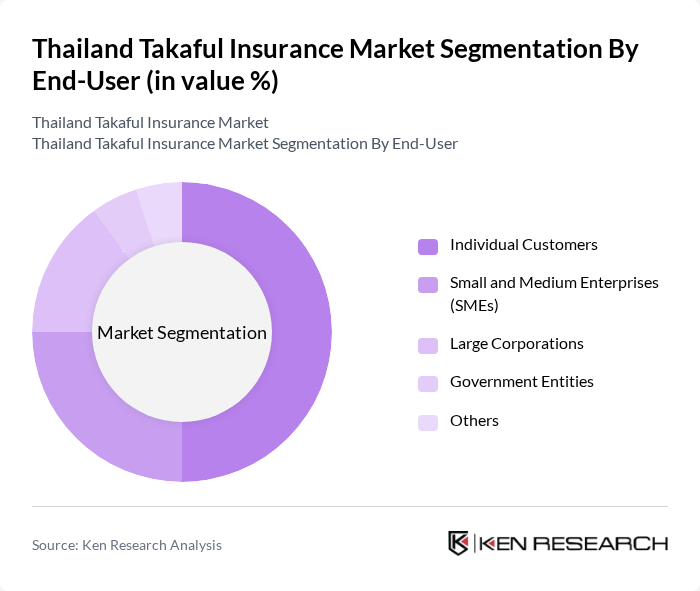
By End-User:The Takaful market serves various end-users, including Individual Customers, Small and Medium Enterprises (SMEs), Large Corporations, Government Entities, and Others. Individual customers are the primary consumers, driven by the need for personal financial security. SMEs and large corporations are increasingly recognizing the benefits of Takaful for employee welfare and risk management.
Thailand Takaful Insurance Market Competitive Landscape
The Thailand Takaful Insurance Market is characterized by a dynamic mix of regional and international players. Leading participants such as Bangkok Takaful, Thai Islamic Insurance, Takaful Thailand, Al Baraka Takaful, CIMB Takaful, FWD Takaful, Prudential Takaful, Allianz Takaful, Zurich Takaful, AIA Takaful, Manulife Takaful, Generali Takaful, Great Eastern Takaful, Tokio Marine Takaful, MSIG Takaful contribute to innovation, geographic expansion, and service delivery in this space.
Thailand Takaful Insurance Market Industry Analysis
Growth Drivers
- Increasing Awareness of Islamic Finance:The awareness of Islamic finance principles has surged, with over 60% of the Thai Muslim population, approximately 4.8 million individuals, now recognizing Takaful as a viable alternative to conventional insurance. This growing understanding is supported by educational initiatives and community outreach programs, which have increased the number of Takaful policyholders by 15% annually. The Islamic Financial Services Board reported that the global Islamic finance market reached $4 trillion in future, further validating this trend.
- Government Support for Takaful Products:The Thai government has actively promoted Takaful products, implementing policies that encourage their adoption. In future, the government allocated 1.5 billion THB to support Islamic finance initiatives, including Takaful. This funding aims to enhance financial literacy and accessibility, particularly in rural areas where Takaful penetration is low. Additionally, the establishment of the Islamic Bank of Thailand has facilitated the growth of Takaful offerings, contributing to a 25% increase in new policies issued in the last year.
- Rising Demand for Ethical Investment Options:There is a notable shift towards ethical investment options among Thai consumers, with 50% of individuals expressing interest in socially responsible financial products. This trend is reflected in the increasing demand for Takaful, which aligns with ethical and Sharia-compliant investment principles. The Thai Takaful market has seen a 35% rise in family Takaful plans, indicating a growing preference for products that not only provide financial security but also adhere to ethical standards, appealing to a broader demographic.
Market Challenges
- Limited Consumer Understanding of Takaful:Despite the growth in awareness, a significant portion of the population remains unfamiliar with Takaful principles. Approximately 75% of potential customers lack a clear understanding of how Takaful operates, which hinders market penetration. This knowledge gap is particularly pronounced in non-Muslim communities, where misconceptions about Islamic finance persist. Educational campaigns are essential to bridge this gap and enhance consumer confidence in Takaful products.
- Regulatory Compliance Issues:Takaful providers face stringent regulatory requirements that can impede operational efficiency. In future, the Thai Insurance Commission reported that compliance costs for Takaful operators increased by 30%, primarily due to evolving regulations. These challenges can deter new entrants and limit the growth of existing providers. Additionally, the lack of a comprehensive regulatory framework specifically tailored for Takaful can create uncertainties, affecting market stability and investor confidence.
Thailand Takaful Insurance Market Future Outlook
The future of the Thailand Takaful insurance market appears promising, driven by technological advancements and a growing emphasis on ethical finance. The integration of digital platforms is expected to enhance customer engagement and streamline operations, making Takaful products more accessible. Furthermore, as consumer preferences shift towards sustainable and socially responsible investments, Takaful providers are likely to innovate and develop tailored products that meet these demands, fostering market growth and expanding their customer base.
Market Opportunities
- Growth in Digital Takaful Solutions:The rise of digital technology presents a significant opportunity for Takaful providers. With over 55 million internet users in Thailand, digital platforms can facilitate easier access to Takaful products. By leveraging mobile applications and online services, companies can enhance customer experience and reach previously underserved demographics, potentially increasing policy uptake by 35% in the next few years.
- Expansion into Underserved Regions:There is considerable potential for Takaful providers to expand into underserved regions, particularly in southern Thailand, where the Muslim population is concentrated. With approximately 2.2 million Muslims residing in these areas, targeted marketing and localized product offerings could significantly increase market penetration. This expansion could lead to a 45% increase in policy subscriptions, addressing the financial needs of these communities effectively.
Scope of the Report
| Segment | Sub-Segments |
|---|---|
| By Type | Family Takaful General Takaful Health Takaful Investment-linked Takaful Others |
| By End-User | Individual Customers Small and Medium Enterprises (SMEs) Large Corporations Government Entities Others |
| By Distribution Channel | Direct Sales Brokers Online Platforms Agents Others |
| By Coverage Type | Comprehensive Coverage Basic Coverage Customizable Plans Others |
| By Customer Demographics | Age Group (Youth, Adults, Seniors) Income Level (Low, Middle, High) Geographic Location (Urban, Rural) Others |
| By Product Features | Flexible Premium Payments Additional Riders Loyalty Benefits Others |
| By Policy Duration | Short-term Policies Long-term Policies Others |
Key Target Audience
Investors and Venture Capitalist Firms
Government and Regulatory Bodies (e.g., Office of Insurance Commission, Ministry of Finance)
Islamic Financial Institutions
Takaful Operators and Providers
Reinsurers
Shariah Advisory Boards
Insurance Brokers and Agents
Industry Associations (e.g., Thai General Insurance Association)
Players Mentioned in the Report:
Bangkok Takaful
Thai Islamic Insurance
Takaful Thailand
Al Baraka Takaful
CIMB Takaful
FWD Takaful
Prudential Takaful
Allianz Takaful
Zurich Takaful
AIA Takaful
Manulife Takaful
Generali Takaful
Great Eastern Takaful
Tokio Marine Takaful
MSIG Takaful
Table of Contents
Market Assessment Phase
1. Executive Summary and Approach
2. Thailand Takaful Insurance Market Overview
2.1 Key Insights and Strategic Recommendations
2.2 Thailand Takaful Insurance Market Overview
2.3 Definition and Scope
2.4 Evolution of Market Ecosystem
2.5 Timeline of Key Regulatory Milestones
2.6 Value Chain & Stakeholder Mapping
2.7 Business Cycle Analysis
2.8 Policy & Incentive Landscape
3. Thailand Takaful Insurance Market Analysis
3.1 Growth Drivers
3.1.1 Increasing Awareness of Islamic Finance
3.1.2 Government Support for Takaful Products
3.1.3 Rising Demand for Ethical Investment Options
3.1.4 Expansion of Distribution Channels
3.2 Market Challenges
3.2.1 Limited Consumer Understanding of Takaful
3.2.2 Regulatory Compliance Issues
3.2.3 Competition from Conventional Insurance
3.2.4 Economic Volatility
3.3 Market Opportunities
3.3.1 Growth in Digital Takaful Solutions
3.3.2 Expansion into Underserved Regions
3.3.3 Partnerships with Financial Institutions
3.3.4 Development of Customized Products
3.4 Market Trends
3.4.1 Increasing Use of Technology in Takaful
3.4.2 Shift Towards Sustainable and Ethical Products
3.4.3 Growing Interest in Family Takaful Plans
3.4.4 Enhanced Customer Engagement Strategies
3.5 Government Regulation
3.5.1 Regulatory Framework for Takaful Operations
3.5.2 Guidelines for Product Development
3.5.3 Consumer Protection Regulations
3.5.4 Tax Incentives for Takaful Providers
4. SWOT Analysis
5. Stakeholder Analysis
6. Porter's Five Forces Analysis
7. Thailand Takaful Insurance Market Market Size, 2019-2024
7.1 By Value
7.2 By Volume
7.3 By Average Selling Price
8. Thailand Takaful Insurance Market Segmentation
8.1 By Type
8.1.1 Family Takaful
8.1.2 General Takaful
8.1.3 Health Takaful
8.1.4 Investment-linked Takaful
8.1.5 Others
8.2 By End-User
8.2.1 Individual Customers
8.2.2 Small and Medium Enterprises (SMEs)
8.2.3 Large Corporations
8.2.4 Government Entities
8.2.5 Others
8.3 By Distribution Channel
8.3.1 Direct Sales
8.3.2 Brokers
8.3.3 Online Platforms
8.3.4 Agents
8.3.5 Others
8.4 By Coverage Type
8.4.1 Comprehensive Coverage
8.4.2 Basic Coverage
8.4.3 Customizable Plans
8.4.4 Others
8.5 By Customer Demographics
8.5.1 Age Group (Youth, Adults, Seniors)
8.5.2 Income Level (Low, Middle, High)
8.5.3 Geographic Location (Urban, Rural)
8.5.4 Others
8.6 By Product Features
8.6.1 Flexible Premium Payments
8.6.2 Additional Riders
8.6.3 Loyalty Benefits
8.6.4 Others
8.7 By Policy Duration
8.7.1 Short-term Policies
8.7.2 Long-term Policies
8.7.3 Others
9. Thailand Takaful Insurance Market Competitive Analysis
9.1 Market Share of Key Players
9.2 Cross Comparison of Key Players
9.2.1 Company Name
9.2.2 Group Size (Large, Medium, or Small as per industry convention)
9.2.3 Premium Growth Rate
9.2.4 Customer Retention Rate
9.2.5 Claims Settlement Ratio
9.2.6 Distribution Channel Efficiency
9.2.7 Pricing Strategy
9.2.8 Market Penetration Rate
9.2.9 Product Diversification Index
9.2.10 Customer Satisfaction Score
9.3 SWOT Analysis of Top Players
9.4 Pricing Analysis
9.5 Detailed Profile of Major Companies
9.5.1 Bangkok Takaful
9.5.2 Thai Islamic Insurance
9.5.3 Takaful Thailand
9.5.4 Al Baraka Takaful
9.5.5 CIMB Takaful
9.5.6 FWD Takaful
9.5.7 Prudential Takaful
9.5.8 Allianz Takaful
9.5.9 Zurich Takaful
9.5.10 AIA Takaful
9.5.11 Manulife Takaful
9.5.12 Generali Takaful
9.5.13 Great Eastern Takaful
9.5.14 Tokio Marine Takaful
9.5.15 MSIG Takaful
10. Thailand Takaful Insurance Market End-User Analysis
10.1 Procurement Behavior of Key Ministries
10.1.1 Budget Allocation for Takaful Products
10.1.2 Decision-Making Processes
10.1.3 Evaluation Criteria for Takaful Providers
10.1.4 Contract Management Practices
10.2 Corporate Spend on Infrastructure & Energy
10.2.1 Investment Trends in Takaful
10.2.2 Budgeting for Risk Management
10.2.3 Spending on Compliance and Regulation
10.2.4 Others
10.3 Pain Point Analysis by End-User Category
10.3.1 Lack of Awareness
10.3.2 Complexity of Products
10.3.3 Service Delivery Issues
10.3.4 Others
10.4 User Readiness for Adoption
10.4.1 Technology Adoption Levels
10.4.2 Training and Support Needs
10.4.3 Feedback Mechanisms
10.4.4 Others
10.5 Post-Deployment ROI and Use Case Expansion
10.5.1 Measurement of ROI
10.5.2 Case Studies of Successful Implementations
10.5.3 Future Use Cases
10.5.4 Others
11. Thailand Takaful Insurance Market Future Size, 2025-2030
11.1 By Value
11.2 By Volume
11.3 By Average Selling Price
Go-To-Market Strategy Phase
1. Whitespace Analysis + Business Model Canvas
1.1 Market Gaps Identification
1.2 Value Proposition Development
1.3 Revenue Streams Analysis
1.4 Cost Structure Evaluation
1.5 Key Partnerships Exploration
1.6 Customer Segmentation
1.7 Channels and Customer Relationships
2. Marketing and Positioning Recommendations
2.1 Branding Strategies
2.2 Product USPs
2.3 Target Market Identification
2.4 Communication Strategies
2.5 Digital Marketing Approaches
2.6 Customer Engagement Tactics
2.7 Performance Metrics
3. Distribution Plan
3.1 Urban Retail Strategies
3.2 Rural NGO Tie-ups
3.3 Online Distribution Channels
3.4 Partnerships with Financial Institutions
3.5 Direct Sales Force Optimization
3.6 Multi-Channel Distribution Approach
3.7 Performance Tracking
4. Channel & Pricing Gaps
4.1 Underserved Routes
4.2 Pricing Bands Analysis
4.3 Competitor Pricing Strategies
4.4 Customer Price Sensitivity
4.5 Value-Based Pricing Models
4.6 Discount and Promotion Strategies
4.7 Pricing Optimization Techniques
5. Unmet Demand & Latent Needs
5.1 Category Gaps Identification
5.2 Consumer Segments Analysis
5.3 Product Development Opportunities
5.4 Market Entry Strategies
5.5 Customer Feedback Integration
5.6 Future Trends Anticipation
5.7 Performance Metrics
6. Customer Relationship
6.1 Loyalty Programs
6.2 After-sales Service Enhancements
6.3 Customer Feedback Mechanisms
6.4 Relationship Management Strategies
6.5 Customer Retention Tactics
6.6 Performance Metrics
6.7 Case Studies
7. Value Proposition
7.1 Sustainability Initiatives
7.2 Integrated Supply Chains
7.3 Unique Selling Points
7.4 Customer-Centric Approaches
7.5 Performance Metrics
7.6 Market Differentiation Strategies
8. Key Activities
8.1 Regulatory Compliance
8.2 Branding Initiatives
8.3 Distribution Setup
8.4 Training and Development
8.5 Performance Monitoring
8.6 Stakeholder Engagement
8.7 Risk Management Strategies
9. Entry Strategy Evaluation
9.1 Domestic Market Entry Strategy
9.1.1 Product Mix Considerations
9.1.2 Pricing Band Analysis
9.1.3 Packaging Strategies
9.2 Export Entry Strategy
9.2.1 Target Countries Identification
9.2.2 Compliance Roadmap Development
10. Entry Mode Assessment
10.1 Joint Ventures
10.2 Greenfield Investments
10.3 Mergers & Acquisitions
10.4 Distributor Model Evaluation
10.5 Risk Assessment
10.6 Performance Metrics
11. Capital and Timeline Estimation
11.1 Capital Requirements
11.2 Timelines for Implementation
11.3 Financial Projections
11.4 Funding Sources
11.5 Performance Metrics
12. Control vs Risk Trade-Off
12.1 Ownership Considerations
12.2 Partnership Opportunities
12.3 Risk Mitigation Strategies
12.4 Performance Metrics
13. Profitability Outlook
13.1 Breakeven Analysis
13.2 Long-term Sustainability Strategies
13.3 Financial Health Monitoring
13.4 Performance Metrics
14. Potential Partner List
14.1 Distributors
14.2 Joint Ventures
14.3 Acquisition Targets
14.4 Strategic Alliances
14.5 Performance Metrics
15. Execution Roadmap
15.1 Phased Plan for Market Entry
15.1.1 Market Setup
15.1.2 Market Entry
15.1.3 Growth Acceleration
15.1.4 Scale & Stabilize
15.2 Key Activities and Milestones
15.2.1 Activity Planning
15.2.2 Milestone Tracking
15.2.3 Performance Metrics
Research Methodology
Phase 1: Approach1
Desk Research
- Analysis of industry reports from the Office of Insurance Commission (OIC) of Thailand
- Review of market trends and statistics from the Thai Insurance Association
- Examination of regulatory frameworks and guidelines from the Ministry of Finance
Primary Research
- Interviews with executives from leading Takaful insurance providers in Thailand
- Surveys targeting insurance agents and brokers specializing in Takaful products
- Focus groups with consumers to understand perceptions and awareness of Takaful insurance
Validation & Triangulation
- Cross-validation of findings with data from financial reports of Takaful companies
- Triangulation of insights from primary interviews with secondary data trends
- Sanity checks through expert panels comprising industry veterans and regulatory officials
Phase 2: Market Size Estimation1
Top-down Assessment
- Estimation of total insurance market size and Takaful's share based on historical growth rates
- Segmentation of market size by product lines such as family Takaful and general Takaful
- Incorporation of demographic trends and economic indicators affecting insurance uptake
Bottom-up Modeling
- Collection of premium data from Takaful providers to establish baseline revenue figures
- Analysis of policy issuance rates and average premium per policy across segments
- Estimation of growth rates based on consumer adoption trends and market penetration
Forecasting & Scenario Analysis
- Multi-variable forecasting using economic growth, regulatory changes, and consumer behavior
- Scenario analysis based on potential shifts in market dynamics and competitive landscape
- Development of baseline, optimistic, and pessimistic forecasts through 2030
Phase 3: CATI Sample Composition1
| Scope Item/Segment | Sample Size | Target Respondent Profiles |
|---|---|---|
| Family Takaful Products | 120 | Policyholders, Financial Advisors |
| General Takaful Products | 100 | Insurance Agents, Risk Managers |
| Corporate Takaful Solutions | 80 | Corporate Insurance Buyers, CFOs |
| Consumer Awareness and Perception | 100 | General Public, Financial Literacy Advocates |
| Regulatory Impact Assessment | 60 | Regulatory Officials, Compliance Officers |
Frequently Asked Questions
What is the current value of the Thailand Takaful Insurance Market?
The Thailand Takaful Insurance Market is valued at approximately USD 150 million, reflecting a steady growth driven by increasing awareness of Sharia-compliant financial products and rising disposable incomes among consumers.
What factors are driving the growth of Takaful insurance in Thailand?
What are the main types of Takaful products available in Thailand?
Who are the primary consumers of Takaful insurance in Thailand?
Other Regional/Country Reports
Other Adjacent Reports
Egypt Sharia-Compliant Finance Market
Indonesia Conventional Insurance Market
Saudi Arabia Health Insurance MarketSaudi Arabia Life Insurance Market Size, Share & Forecast, By Product Type, Customer Segment & Distribution Channel, 2026–2031Qatar General Insurance MarketThailand Investment-Linked Insurance Market
UAE insurtech market size, share, growth drivers, trends, opportunities & forecast 2025–2030Brazil Ethical Investment Market
Oman Microfinance MarketWhy Buy From Us?

What makes us stand out is that our consultants follow Robust, Refine and Result (RRR) methodology. Robust for clear definitions, approaches and sanity checking, Refine for differentiating respondents' facts and opinions, and Result for presenting data with story.

We have set a benchmark in the industry by offering our clients with syndicated and customized market research reports featuring coverage of entire market as well as meticulous research and analyst insights.

While we don't replace traditional research, we flip the method upside down. Our dual approach of Top Bottom & Bottom Top ensures quality deliverable by not just verifying company fundamentals but also looking at the sector and macroeconomic factors.

With one step in the future, our research team constantly tries to show you the bigger picture. We help with some of the tough questions you may encounter along the way: How is the industry positioned? Best marketing channel? KPI's of competitors? By aligning every element, we help maximize success.

Our report gives you instant access to the answers and sources that other companies might choose to hide. We elaborate each steps of research methodology we have used and showcase you the sample size to earn your trust.

If you need any support, we are here! We pride ourselves on universe strength, data quality, and quick, friendly, and professional service.