Qatar Aluminum Forging Market

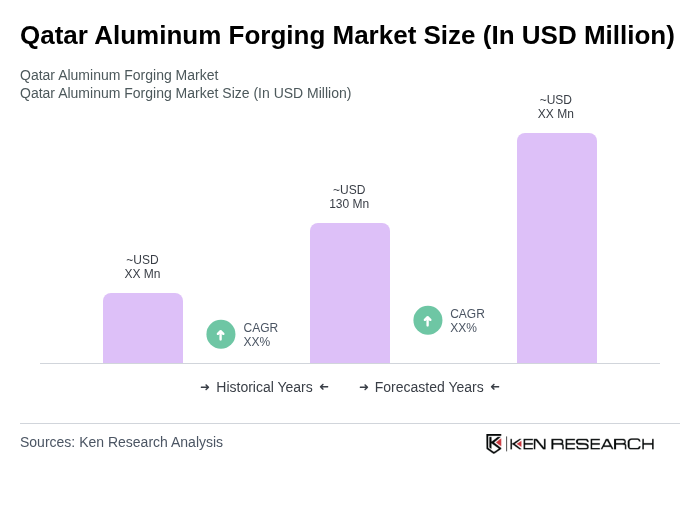
Qatar Aluminum Forging Market, valued at USD 130 million, grows due to lightweight material demand in automotive and aerospace, supported by infrastructure projects.

Region:Middle East

Author(s):Geetanshi

Product Code:KRAD7332

Pages:85

Published On:December 2025
About the Report

Base Year 2024

Qatar Aluminum Forging Market Overview

  • The Qatar Aluminum Forging Market is valued at USD 130 million, based on a five-year historical analysis and its share within the wider Middle East and Africa aluminum forging market and GCC metal forging market. This growth is primarily driven by the increasing demand for lightweight materials in various industries, particularly automotive and aerospace at the regional level, along with strong usage in oil and gas, construction, and industrial equipment, where forged aluminum components are preferred for strength-to-weight and corrosion resistance. The market is also supported by advancements in forging and forming technologies, including precision closed-die processes and improved heat-treatment techniques, which enhance production efficiency, dimensional accuracy, and mechanical performance of forged parts.
  • Key production and consumption hubs for aluminum and metal forgings in Qatar are primarily concentrated in and around Doha and adjacent industrial zones such as Mesaieed Industrial City, Ras Laffan Industrial City, and the Dukhan area, rather than individual cities acting as “players.” These locations benefit from proximity to ports and logistics corridors, access to primary aluminum from smelters, and co-location with downstream metalworking, oil and gas, and construction-related industries, which facilitates efficient supply chain operations and clustering of fabrication and forging job shops. Additionally, government industrial and localization programs under Qatar National Vision 2030 and related manufacturing initiatives encourage downstream metals processing, including value-added forged components for energy, infrastructure, and transport applications.
  • In 2023, the Qatari government continued to reinforce environmental and energy-efficiency requirements applicable to aluminum and metal processing facilities, including forging operations, through instruments such as the Environment Protection Law No. 30 of 2002 and implementing regulations issued by the Ministry of Environment and Climate Change, which govern industrial emissions, waste management, and resource efficiency. In parallel, the National Climate Change Action Plan of the State of Qatar 2021–2030 issued by the Ministry of Environment and Climate Change promotes lower-carbon industrial production, encouraging measures such as energy-efficiency improvements, heat recovery, cleaner fuels, and reduced waste generation in energy-intensive sectors including metals. These frameworks are designed to align industrial activities with national sustainability and decarbonization goals, while supporting the competitiveness of local manufacturers in export and regional value chains.
Qatar Aluminum Forging Market Size

Qatar Aluminum Forging Market Segmentation

By Forging Type:

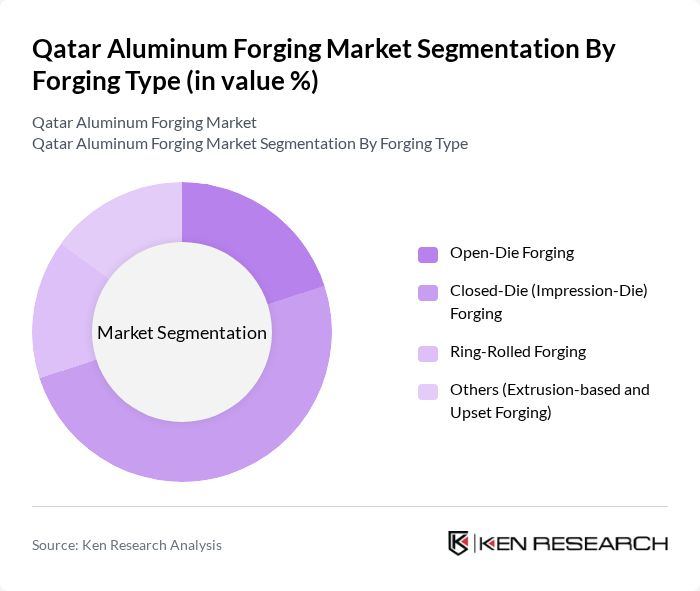
Qatar Aluminum Forging Market segmentation by Forging Type.

The forging type segment includes Open-Die Forging, Closed-Die (Impression-Die) Forging, Ring-Rolled Forging, and Others (Extrusion-based and Upset Forging). At a global and regional level, Closed-Die Forging is widely used for near-net-shape, high-precision aluminum components in automotive, aerospace, and industrial machinery due to its ability to deliver tight tolerances and repeatable quality at medium to high volumes, and it can be considered the leading subsegment in technologically advanced applications. The demand for lightweight and high-strength components, particularly forged suspension parts, wheel hubs, structural brackets, and aircraft fittings, has further propelled the growth of this subsegment as manufacturers seek to optimize performance, reduce vehicle and equipment weight, and improve fuel efficiency and payload capacity.

By End-User Industry:
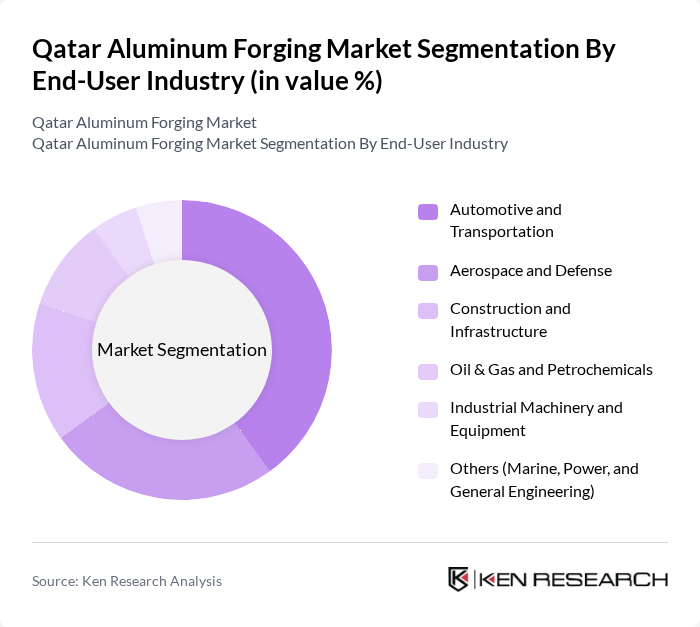
Qatar Aluminum Forging Market segmentation by End-User Industry.

This segment encompasses Automotive and Transportation, Aerospace and Defense, Construction and Infrastructure, Oil & Gas and Petrochemicals, Industrial Machinery and Equipment, and Others (Marine, Power, and General Engineering). Across the GCC and Middle East, automotive and broader transportation applications—covering commercial vehicles, rail, and off-highway equipment—represent a major demand area for forged metal components, though oil and gas, power, and construction remain very significant end-users of forgings in Qatar. The growing adoption of lightweight and corrosion-resistant aluminum forgings in transport equipment, alongside requirements for high-integrity parts such as flanges, valves, fittings, and connectors in oil and gas and petrochemicals, supports a diversified end-use profile that increasingly reflects global trends toward efficiency, reliability, and reduced lifecycle emissions.

Qatar Aluminum Forging Market Competitive Landscape

The Qatar Aluminum Forging Market is characterized by a dynamic mix of regional and international players. Leading participants such as Qatar Aluminium Manufacturing Company Q.P.S.C. (QAMCO), Qatar Aluminium Limited (Qatalum), Gulf International Services Q.P.S.C. – GIS (Industrial & Energy Services Group), Qatar Industrial Manufacturing Company Q.P.S.C. (QIMC), Mannai Trading Company W.L.L. – Engineering & Industrial Division, Saudi Aluminium Industries Company (SALUMCO), Gulf Extrusions Co. LLC, Al Ghurair Group – Aluminium & Metal Fabrication Division, Alcoa Corporation, Howmet Aerospace Inc., Kobe Steel, Ltd. (KOBELCO), Bharat Forge Ltd., Otto Fuchs KG, Constellium SE, Local Fabricators & Forging Job Shops (Selected SMEs in Qatar and GCC) contribute to innovation, geographic expansion, and service delivery in this space, leveraging their capabilities in primary aluminum production, extrusion, machining, and forging to serve regional demand across automotive, aerospace, oil and gas, power, and infrastructure value chains.

Qatar Aluminium Manufacturing Company Q.P.S.C. (QAMCO)

2018

Doha, Qatar

Qatar Aluminium Limited (Qatalum)

2007

Mesaieed Industrial City, Qatar

Gulf International Services Q.P.S.C. – GIS

2008

Doha, Qatar

Qatar Industrial Manufacturing Company Q.P.S.C. (QIMC)

1990

Doha, Qatar

Mannai Trading Company W.L.L.

1950

Doha, Qatar

Company

Establishment Year

Headquarters

Installed Forging Capacity in Qatar (Tonnes/Year)

Share of Revenue from Aluminum Forgings (%)

Revenue Growth from Aluminum Forging Business (CAGR %)

Product & Application Breadth (No. of Forged Product Families Served)

End-user Diversification Index (Automotive / Aerospace / Oil & Gas / Others)

Average Capacity Utilization Rate (%)

Qatar Aluminum Forging Market Industry Analysis

Growth Drivers

  • Increasing Demand for Lightweight Materials in Automotive:The automotive sector in Qatar is projected to grow significantly, with vehicle production expected to reach 200,000 units in future. This surge is driven by a shift towards lightweight materials, which enhance fuel efficiency and reduce emissions. Aluminum forging, known for its strength-to-weight ratio, is increasingly favored, with demand for aluminum components expected to rise by 15,000 tons annually, reflecting a robust trend towards sustainable automotive manufacturing.
  • Expansion of Construction and Infrastructure Projects:Qatar's ongoing infrastructure development, particularly in preparation for the FIFA World Cup and beyond, has led to a substantial increase in construction activities. The government allocated approximately $200 billion for infrastructure projects, including roads, bridges, and stadiums. This investment is expected to drive the demand for aluminum forging products, with an estimated increase of 25% in demand for construction-related aluminum components in future, supporting the sector's growth.
  • Technological Advancements in Forging Processes:The aluminum forging industry in Qatar is witnessing rapid technological advancements, particularly in automation and precision forging techniques. Investments in advanced machinery and processes are projected to exceed $50 million in future. These innovations enhance production efficiency and product quality, enabling manufacturers to meet the increasing demand for high-performance aluminum components, particularly in automotive and aerospace applications, thereby driving market growth.

Market Challenges

  • High Initial Investment Costs:The aluminum forging industry requires significant capital investment, with initial setup costs for advanced forging facilities estimated at around $30 million. This financial barrier can deter new entrants and limit the expansion of existing players. Additionally, the high costs associated with acquiring state-of-the-art technology and skilled labor further exacerbate the challenge, potentially hindering market growth in the short term.
  • Fluctuating Raw Material Prices:The aluminum market is subject to price volatility, influenced by global supply and demand dynamics. In future, aluminum prices fluctuated between $2,200 and $2,600 per ton, impacting production costs for manufacturers. This unpredictability poses a significant challenge for aluminum forging companies in Qatar, as it complicates budgeting and financial planning, potentially leading to reduced profit margins and investment hesitancy.

Qatar Aluminum Forging Market Future Outlook

The future of the aluminum forging market in Qatar appears promising, driven by increasing demand from various sectors, particularly automotive and construction. As the country continues to invest in infrastructure and technological advancements, the market is expected to adapt to evolving consumer preferences, emphasizing lightweight and sustainable materials. Furthermore, the integration of automation and Industry 4.0 practices will likely enhance production efficiency, positioning the industry for robust growth in the coming years.

Market Opportunities

  • Growing Demand from the Aerospace Sector:The aerospace industry in Qatar is expanding, with projected investments of $10 billion in future. This growth presents significant opportunities for aluminum forging manufacturers, as lightweight and durable components are essential for aircraft production. The increasing focus on fuel efficiency and performance in aviation will drive demand for high-quality aluminum forgings, creating a lucrative market segment.
  • Potential for Export to Neighboring Regions:Qatar's strategic location offers a unique opportunity for aluminum forging companies to export products to neighboring Gulf Cooperation Council (GCC) countries. With a combined market size of over $50 billion in construction and automotive sectors, tapping into this regional demand can significantly enhance revenue streams for local manufacturers, fostering growth and competitiveness in the market.

Scope of the Report

SegmentSub-Segments
By Forging Type

Open-Die Forging

Closed-Die (Impression-Die) Forging

Ring-Rolled Forging

Others (Extrusion-based and Upset Forging)

By End-User Industry

Automotive and Transportation

Aerospace and Defense

Construction and Infrastructure

Oil & Gas and Petrochemicals

Industrial Machinery and Equipment

Others (Marine, Power, and General Engineering)

By Application

Structural & Chassis Components (Beams, Frames, Brackets)

Powertrain, Engine & Drivetrain Components

Flanges, Fittings, and Pressure-containing Parts

Aerospace-grade Components (Landing Gear, Fittings, Hubs)

Others (Custom Forged Parts and Fasteners)

By Manufacturing Process

Conventional Hydraulic/Mechanical Forging

CNC & Closed-Die Automated Forging

Isothermal / Precision Forging

Others (Hybrid and Integrated Machining–Forging Lines)

By Alloy / Material Grade

Series Aluminum Alloys (Aerospace-grade)

Series Aluminum Alloys (Marine & Structural)

Series Aluminum Alloys (General Engineering & Construction)

Series Aluminum Alloys (High-strength Applications)

Others (1000, 3000, and Specialty Alloys)

By Sales / Distribution Channel

Direct Sales to OEMs

Sales via Local Distributors / Stockists

Project-based EPC & Fabricator Contracts

Others (Export Traders and Online B2B Platforms)

By Region

Doha

Al Rayyan

Al Wakrah

Al Khor & Al Thakhira

Umm Salal, Al Daayen & Others

Key Target Audience

Investors and Venture Capitalist Firms

Government and Regulatory Bodies (e.g., Qatar Ministry of Commerce and Industry)

Aluminum Forging Manufacturers

Raw Material Suppliers

Machinery and Equipment Suppliers

Industry Associations (e.g., Qatar Chamber of Commerce)

Logistics and Supply Chain Companies

Financial Institutions and Banks

Players Mentioned in the Report:

Qatar Aluminium Manufacturing Company Q.P.S.C. (QAMCO)

Qatar Aluminium Limited (Qatalum)

Gulf International Services Q.P.S.C. GIS (Industrial & Energy Services Group)

Qatar Industrial Manufacturing Company Q.P.S.C. (QIMC)

Mannai Trading Company W.L.L. Engineering & Industrial Division

Saudi Aluminium Industries Company (SALUMCO)

Gulf Extrusions Co. LLC

Al Ghurair Group Aluminium & Metal Fabrication Division

Alcoa Corporation

Howmet Aerospace Inc.

Kobe Steel, Ltd. (KOBELCO)

Bharat Forge Ltd.

Otto Fuchs KG

Constellium SE

Local Fabricators & Forging Job Shops (Selected SMEs in Qatar and GCC)

Table of Contents

Market Assessment Phase

1. Executive Summary and Approach


2. Qatar Aluminum Forging Market Overview

2.1 Key Insights and Strategic Recommendations

2.2 Qatar Aluminum Forging Market Overview

2.3 Definition and Scope

2.4 Evolution of Market Ecosystem

2.5 Timeline of Key Regulatory Milestones

2.6 Value Chain & Stakeholder Mapping

2.7 Business Cycle Analysis

2.8 Policy & Incentive Landscape


3. Qatar Aluminum Forging Market Analysis

3.1 Growth Drivers

3.1.1 Increasing demand for lightweight materials in automotive
3.1.2 Expansion of construction and infrastructure projects
3.1.3 Technological advancements in forging processes
3.1.4 Rising focus on energy efficiency and sustainability

3.2 Market Challenges

3.2.1 High initial investment costs
3.2.2 Fluctuating raw material prices
3.2.3 Limited skilled labor availability
3.2.4 Stringent regulatory compliance requirements

3.3 Market Opportunities

3.3.1 Growing demand from the aerospace sector
3.3.2 Potential for export to neighboring regions
3.3.3 Development of innovative forging techniques
3.3.4 Increasing investments in renewable energy projects

3.4 Market Trends

3.4.1 Shift towards automation in manufacturing
3.4.2 Adoption of Industry 4.0 practices
3.4.3 Rising use of recycled aluminum in forging
3.4.4 Growing emphasis on product customization

3.5 Government Regulation

3.5.1 Environmental protection regulations
3.5.2 Safety standards for manufacturing processes
3.5.3 Import/export tariffs on aluminum products
3.5.4 Incentives for sustainable manufacturing practices

4. SWOT Analysis


5. Stakeholder Analysis


6. Porter's Five Forces Analysis


7. Qatar Aluminum Forging Market Market Size, 2019-2024

7.1 By Value

7.2 By Volume

7.3 By Average Selling Price


8. Qatar Aluminum Forging Market Segmentation

8.1 By Forging Type

8.1.1 Open-Die Forging
8.1.2 Closed-Die (Impression-Die) Forging
8.1.3 Ring-Rolled Forging
8.1.4 Others (Extrusion-based and Upset Forging)

8.2 By End-User Industry

8.2.1 Automotive and Transportation
8.2.2 Aerospace and Defense
8.2.3 Construction and Infrastructure
8.2.4 Oil & Gas and Petrochemicals
8.2.5 Industrial Machinery and Equipment
8.2.6 Others (Marine, Power, and General Engineering)

8.3 By Application

8.3.1 Structural & Chassis Components (Beams, Frames, Brackets)
8.3.2 Powertrain, Engine & Drivetrain Components
8.3.3 Flanges, Fittings, and Pressure-containing Parts
8.3.4 Aerospace-grade Components (Landing Gear, Fittings, Hubs)
8.3.5 Others (Custom Forged Parts and Fasteners)

8.4 By Manufacturing Process

8.4.1 Conventional Hydraulic/Mechanical Forging
8.4.2 CNC & Closed-Die Automated Forging
8.4.3 Isothermal / Precision Forging
8.4.4 Others (Hybrid and Integrated Machining–Forging Lines)

8.5 By Alloy / Material Grade

8.5.1 2000 Series Aluminum Alloys (Aerospace-grade)
8.5.2 5000 Series Aluminum Alloys (Marine & Structural)
8.5.3 6000 Series Aluminum Alloys (General Engineering & Construction)
8.5.4 7000 Series Aluminum Alloys (High-strength Applications)
8.5.5 Others (1000, 3000, and Specialty Alloys)

8.6 By Sales / Distribution Channel

8.6.1 Direct Sales to OEMs
8.6.2 Sales via Local Distributors / Stockists
8.6.3 Project-based EPC & Fabricator Contracts
8.6.4 Others (Export Traders and Online B2B Platforms)

8.7 By Region

8.7.1 Doha
8.7.2 Al Rayyan
8.7.3 Al Wakrah
8.7.4 Al Khor & Al Thakhira
8.7.5 Umm Salal, Al Daayen & Others

9. Qatar Aluminum Forging Market Competitive Analysis

9.1 Market Share of Key Players

9.2 Cross Comparison of Key Players

9.2.1 Company Name
9.2.2 Installed Forging Capacity in Qatar (Tonnes/Year)
9.2.3 Share of Revenue from Aluminum Forgings (%)
9.2.4 Revenue Growth from Aluminum Forging Business (CAGR %)
9.2.5 Product & Application Breadth (No. of Forged Product Families Served)
9.2.6 End-user Diversification Index (Automotive / Aerospace / Oil & Gas / Others)
9.2.7 Average Capacity Utilization Rate (%)
9.2.8 Order Book Visibility / Average Contract Tenure (Months)
9.2.9 Export Intensity (% of Forging Revenue from Exports)
9.2.10 EBITDA Margin from Forging Operations (%)
9.2.11 Capital Intensity (Forging-related Capex per Tonne of Capacity)
9.2.12 Quality & Certification Coverage (ISO 9001, IATF 16949, AS9100, API, etc.)
9.2.13 R&D / Technology Spend (% of Revenue)

9.3 SWOT Analysis of Top Players

9.4 Pricing Analysis

9.5 Detailed Profile of Major Companies

9.5.1 Qatar Aluminium Manufacturing Company Q.P.S.C. (QAMCO)
9.5.2 Qatar Aluminium Limited (Qatalum)
9.5.3 Gulf International Services Q.P.S.C. – GIS (Industrial & Energy Services Group)
9.5.4 Qatar Industrial Manufacturing Company Q.P.S.C. (QIMC)
9.5.5 Mannai Trading Company W.L.L. – Engineering & Industrial Division
9.5.6 Saudi Aluminium Industries Company (SALUMCO)
9.5.7 Gulf Extrusions Co. LLC
9.5.8 Al Ghurair Group – Aluminium & Metal Fabrication Division
9.5.9 Alcoa Corporation
9.5.10 Howmet Aerospace Inc.
9.5.11 Kobe Steel, Ltd. (KOBELCO)
9.5.12 Bharat Forge Ltd.
9.5.13 Otto Fuchs KG
9.5.14 Constellium SE
9.5.15 Local Fabricators & Forging Job Shops (Selected SMEs in Qatar and GCC)

10. Qatar Aluminum Forging Market End-User Analysis

10.1 Procurement Behavior of Key Ministries

10.1.1 Ministry of Transport and Communications
10.1.2 Ministry of Municipality and Environment
10.1.3 Ministry of Energy and Industry
10.1.4 Others

10.2 Corporate Spend on Infrastructure & Energy

10.2.1 Major Infrastructure Projects
10.2.2 Energy Sector Investments
10.2.3 Public-Private Partnerships
10.2.4 Others

10.3 Pain Point Analysis by End-User Category

10.3.1 Automotive Sector Challenges
10.3.2 Aerospace Sector Challenges
10.3.3 Construction Sector Challenges
10.3.4 Others

10.4 User Readiness for Adoption

10.4.1 Awareness of Forging Technologies
10.4.2 Training and Skill Development Needs
10.4.3 Investment Readiness
10.4.4 Others

10.5 Post-Deployment ROI and Use Case Expansion

10.5.1 ROI Measurement Techniques
10.5.2 Case Studies of Successful Implementations
10.5.3 Future Use Case Opportunities
10.5.4 Others

11. Qatar Aluminum Forging Market Future Size, 2025-2030

11.1 By Value

11.2 By Volume

11.3 By Average Selling Price


Go-To-Market Strategy Phase

1. Whitespace Analysis + Business Model Canvas

1.1 Market Gaps Identification

1.2 Business Model Development


2. Marketing and Positioning Recommendations

2.1 Branding Strategies

2.2 Product USPs


3. Distribution Plan

3.1 Urban Retail Strategies

3.2 Rural NGO Tie-ups


4. Channel & Pricing Gaps

4.1 Underserved Routes

4.2 Pricing Bands Analysis


5. Unmet Demand & Latent Needs

5.1 Category Gaps

5.2 Consumer Segments


6. Customer Relationship

6.1 Loyalty Programs

6.2 After-sales Service


7. Value Proposition

7.1 Sustainability Initiatives

7.2 Integrated Supply Chains


8. Key Activities

8.1 Regulatory Compliance

8.2 Branding Efforts

8.3 Distribution Setup


9. Entry Strategy Evaluation

9.1 Domestic Market Entry Strategy

9.1.1 Product Mix Considerations
9.1.2 Pricing Band Strategy
9.1.3 Packaging Solutions

9.2 Export Entry Strategy

9.2.1 Target Countries Identification
9.2.2 Compliance Roadmap Development

10. Entry Mode Assessment

10.1 Joint Ventures

10.2 Greenfield Investments

10.3 Mergers & Acquisitions

10.4 Distributor Model Evaluation


11. Capital and Timeline Estimation

11.1 Capital Requirements

11.2 Timelines for Implementation


12. Control vs Risk Trade-Off

12.1 Ownership Considerations

12.2 Partnerships Evaluation


13. Profitability Outlook

13.1 Breakeven Analysis

13.2 Long-term Sustainability Strategies


14. Potential Partner List

14.1 Distributors

14.2 Joint Ventures

14.3 Acquisition Targets


15. Execution Roadmap

15.1 Phased Plan for Market Entry

15.1.1 Market Setup
15.1.2 Market Entry
15.1.3 Growth Acceleration
15.1.4 Scale & Stabilize

15.2 Key Activities and Milestones

15.2.1 Milestone Planning
15.2.2 Activity Tracking

Research Methodology

ApproachModellingSample

Phase 1: Approach1

Desk Research

  • Industry reports from the Qatar Chamber of Commerce and relevant trade associations
  • Market analysis publications focusing on aluminum forging trends and forecasts
  • Government publications detailing manufacturing regulations and import/export statistics

Primary Research

  • Interviews with key stakeholders in the aluminum forging industry, including manufacturers and suppliers
  • Surveys targeting engineers and production managers in the automotive and aerospace sectors
  • Field visits to manufacturing plants to gather firsthand insights on production processes

Validation & Triangulation

  • Cross-validation of data through multiple industry sources and expert opinions
  • Triangulation of market size estimates using production, consumption, and trade data
  • Sanity checks conducted through expert panel discussions and feedback sessions

Phase 2: Market Size Estimation1

Top-down Assessment

  • Analysis of national aluminum consumption trends and their impact on the forging market
  • Segmentation of the market by end-user industries such as automotive, aerospace, and construction
  • Incorporation of macroeconomic indicators and government initiatives promoting local manufacturing

Bottom-up Modeling

  • Collection of production data from leading aluminum forging companies in Qatar
  • Estimation of market size based on unit production costs and average selling prices
  • Volume estimates derived from historical production data and projected growth rates

Forecasting & Scenario Analysis

  • Development of forecasting models based on historical growth patterns and market drivers
  • Scenario analysis considering factors such as economic fluctuations and technological advancements
  • Creation of baseline, optimistic, and pessimistic forecasts through 2030

Phase 3: CATI Sample Composition1

Scope Item/SegmentSample SizeTarget Respondent Profiles
Automotive Aluminum Forging100Production Managers, Quality Engineers
Aerospace Component Manufacturing80Design Engineers, Operations Managers
Construction Industry Applications70Project Managers, Procurement Specialists
General Manufacturing Insights90Manufacturing Executives, Supply Chain Analysts
Market Trends and Innovations60Industry Analysts, R&D Managers

Frequently Asked Questions

What is the current value of the Qatar Aluminum Forging Market?

The Qatar Aluminum Forging Market is valued at approximately USD 130 million, reflecting its significance within the broader Middle East and Africa aluminum forging market, driven by demand across various industries such as automotive, aerospace, and construction.

What factors are driving growth in the Qatar Aluminum Forging Market?

Which industries are the primary consumers of aluminum forgings in Qatar?

What types of forging processes are used in the Qatar Aluminum Forging Market?

Other Regional/Country Reports

Indonesia Aluminum Forging Market

Malaysia Aluminum Forging Market

KSA Aluminum Forging Market

APAC Aluminum Forging Market

SEA Aluminum Forging Market

Vietnam Aluminum Forging Market

Other Adjacent Reports

Vietnam Aluminum Extrusion MarketKSA metal casting market Size, Share, Growth Drivers, Trends, Opportunities & Forecast 2025–2030

South Africa Steel Forging Market

Japan Automotive Components Market

Bahrain Aerospace Components Market

Brazil Oil and Gas Equipment Market

India Construction Materials Market Outlook to 2030

Singapore Industrial Machinery Market

Gcc Lightweight Materials Market Size, Share, Growth Drivers, Trends, Opportunities & Forecast 2025–2030

Qatar Precision Forging Market

Why Buy From Us?

Refine Robust Result (RRR) Framework

What makes us stand out is that our consultants follow Robust, Refine and Result (RRR) methodology. Robust for clear definitions, approaches and sanity checking, Refine for differentiating respondents' facts and opinions, and Result for presenting data with story.

Our Reach Is Unmatched

We have set a benchmark in the industry by offering our clients with syndicated and customized market research reports featuring coverage of entire market as well as meticulous research and analyst insights.

Shifting the Research Paradigm

While we don't replace traditional research, we flip the method upside down. Our dual approach of Top Bottom & Bottom Top ensures quality deliverable by not just verifying company fundamentals but also looking at the sector and macroeconomic factors.

More Insights-Better Decisions

With one step in the future, our research team constantly tries to show you the bigger picture. We help with some of the tough questions you may encounter along the way: How is the industry positioned? Best marketing channel? KPI's of competitors? By aligning every element, we help maximize success.

Transparency and Trust

Our report gives you instant access to the answers and sources that other companies might choose to hide. We elaborate each steps of research methodology we have used and showcase you the sample size to earn your trust.

Round the Clock Support

If you need any support, we are here! We pride ourselves on universe strength, data quality, and quick, friendly, and professional service.

Why Clients Choose Us?

400000+
Reports in repository
150+
Consulting projects a year
100+
Analysts
8000+
Client Queries in 2022