Ken Research Logo

Qatar architectural engineering construction services market report Size, Share, Growth Drivers, Trends, Opportunities & Forecast 2025–2030

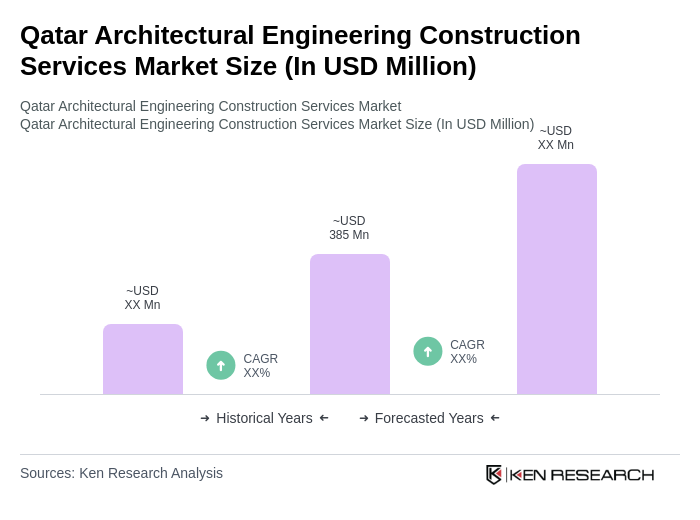
Qatar Architectural Engineering Construction Services Market is worth USD 385 Mn, fueled by mega projects like Lusail City and infrastructure investments under National Vision 2030.

Region:Middle East

Author(s):Geetanshi

Product Code:KRAC4456

Pages:99

Published On:October 2025
About the Report

Base Year 2024

Qatar Architectural Engineering Construction Services Market Overview

  • The Qatar Architectural Engineering Construction Services Market is valued at USD 385 million, based on a five-year historical analysis. This growth is primarily driven by the country's ambitious infrastructure projects, including legacy developments following the FIFA World Cup 2022 and ongoing urban development initiatives such as Lusail City. The demand for architectural and engineering services has surged as Qatar continues to invest heavily in its infrastructure to support economic diversification and population growth, with the government allocating QAR 197 billion (approximately USD 54 billion) for new construction projects including roads, metro systems, airports, hospitals, and educational facilities.
  • Key players in this market include Doha (Ad Dawhah), which serves as the capital and economic hub, and Lusail, a planned city that is central to Qatar's vision for urban development. These cities dominate the market due to their strategic importance in hosting major events and projects, attracting both local and international investments, and fostering a conducive environment for construction activities. Lusail City's control center leverages AI analytics and IoT integration to coordinate construction activities across USD 250 billion in pipeline projects, enabling real-time monitoring across 35 square kilometers of development.
  • Qatar's development framework is governed by the Qatar National Vision 2030, launched in 2008 by the General Secretariat for Development Planning, which establishes a comprehensive roadmap for sustainable development and infrastructure enhancement. This strategic framework mandates that all major construction and infrastructure projects align with four pillars: human development, social development, economic development, and environmental development. The Vision requires project proponents to demonstrate compliance with sustainability standards, incorporate local content requirements, and undergo environmental impact assessments for projects exceeding specified thresholds. These requirements are operationalized through sector-specific regulations issued by relevant ministries, ensuring that projects contribute to national development goals while enhancing the overall efficiency and effectiveness of the architectural engineering construction services sector.
Qatar Architectural Engineering Construction Services Market Size

Qatar Architectural Engineering Construction Services Market Segmentation

By Type:The market is segmented into various types, including Residential Construction, Commercial Construction, Industrial Construction, Infrastructure Development (Transportation), Energy and Utilities Construction, Renovation and Remodeling, Project Management Services, and Specialized Engineering Services. Among these, Infrastructure Development is the leading segment, driven by significant government investments in transportation, utilities, and public facilities. The focus on enhancing connectivity and urban infrastructure, including the expansion of the Doha Metro network through The Blue Line project and the multibillion-dollar Sharq Bridge connecting Katara Cultural Village to Hamad International Airport, has led to a surge in demand for specialized engineering services. Digital services and city planning services represent rapidly growing subsegments within the architectural and engineering services category, with sustainability services and technical engineering also gaining prominence as Qatar emphasizes green construction methods and smart city development.
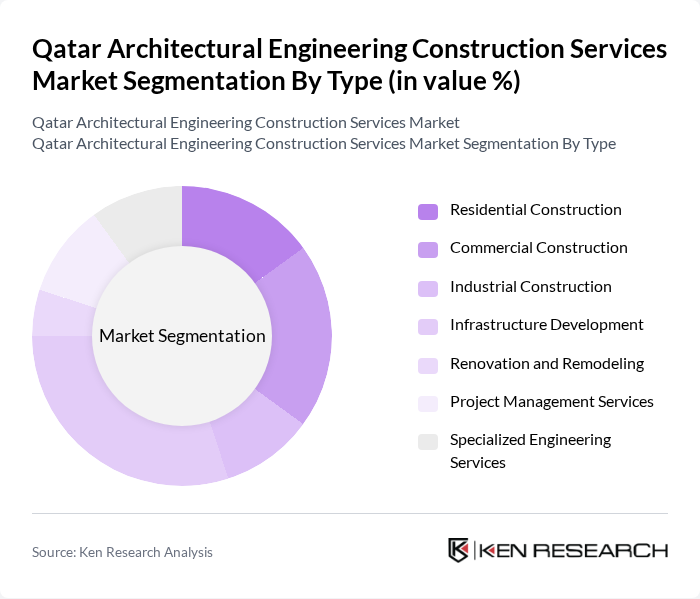
Qatar Architectural Engineering Construction Services Market segmentation by Type.

By End-User:The market is categorized into Government & Public Sector, Private Sector (Developers, Corporates), and Institutional & Non-Profit Organizations. The Government & Public Sector segment is the most dominant, as it accounts for a significant portion of construction projects funded by national budgets. This segment's growth is fueled by large-scale infrastructure initiatives and public works, which are essential for supporting Qatar's economic development and urbanization efforts. The government's commitment to hosting the 2030 Asian Games and implementing the Second National Development Strategy under the current Emir has further strengthened public sector investment. Additionally, public-private partnerships are increasingly being utilized, with Qatar set to award projects valued at USD 85 billion by 2030 through PPP mechanisms, facilitating greater private sector participation in infrastructure development.
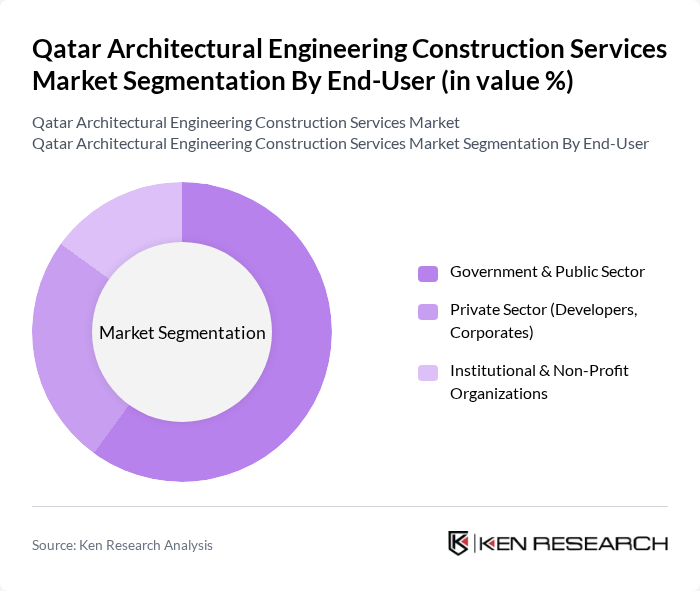
Qatar Architectural Engineering Construction Services Market segmentation by End-User.

Qatar Architectural Engineering Construction Services Market Competitive Landscape

The Qatar Architectural Engineering Construction Services Market is characterized by a dynamic mix of regional and international players. Leading participants such as HBK Contracting Company W.L.L., Galfar Al Misnad Engineering and Contracting W.L.L., Midmac Contracting Co. W.L.L., Qatari Diar Real Estate Investment Company, Arab Engineering Bureau, Al Jaber Engineering, Dar Al-Handasah Consultants (Shair and Partners), KEO International Consultants, AECOM, WSP Global Inc., Turner Construction Company, CEG International, Al Habtoor Group, Consolidated Contractors Company (CCC), Qatar Engineering & Construction Company (QCon), United Development Company (UDC), Bojamhoor Trading & Contracting, Contraco W.L.L., Madina Group W.L.L., Palmera Landscape contribute to innovation, geographic expansion, and service delivery in this space.

HBK Contracting Company W.L.L.

1965

Doha, Qatar

Galfar Al Misnad Engineering and Contracting W.L.L.

1977

Doha, Qatar

Midmac Contracting Co. W.L.L.

1975

Doha, Qatar

Qatari Diar Real Estate Investment Company

2004

Doha, Qatar

Arab Engineering Bureau

1966

Doha, Qatar

Company

Establishment Year

Headquarters

Group Size (Large, Medium, or Small as per industry convention)

Annual Revenue (QAR/USD)

Revenue Growth Rate (%)

Market Share (%)

Number of Projects Delivered (Last 5 Years)

Average Project Value (QAR/USD)

Qatar Architectural Engineering Construction Services Market Industry Analysis

Growth Drivers

  • Increasing Infrastructure Development:Qatar's infrastructure development is projected to reach QAR 220 billion in future, driven by the National Vision 2030 initiative. This includes extensive investments in transportation, healthcare, and education sectors. The government aims to enhance connectivity and public services, which will significantly boost demand for architectural engineering and construction services. The completion of major projects like the Doha Metro and Hamad International Airport further exemplifies this growth trajectory, creating a robust environment for industry expansion.
  • Government Investment in Mega Projects:The Qatari government has allocated approximately QAR 120 billion for mega projects in future, focusing on the FIFA World Cup legacy and beyond. This investment encompasses stadiums, hotels, and urban developments, fostering a surge in construction activities. The commitment to large-scale projects not only stimulates job creation but also attracts international firms, enhancing competition and innovation within the local market. Such initiatives are pivotal in shaping Qatar's architectural landscape and economic growth.
  • Rising Urbanization Rates:Qatar's urbanization rate is expected to reach 99% in future, driven by population growth and economic opportunities. This rapid urbanization necessitates the development of residential, commercial, and public infrastructure. The influx of expatriates and the growing middle class are contributing to increased housing demand, prompting investments in urban planning and construction. As cities expand, the need for innovative architectural solutions and sustainable practices becomes paramount, further propelling the construction services market.

Market Challenges

  • Fluctuating Material Costs:The construction industry in Qatar faces significant challenges due to fluctuating material costs, which can vary by as much as 20% annually. Factors such as global supply chain disruptions and geopolitical tensions impact the availability and pricing of essential materials like steel and cement. These fluctuations can lead to project delays and budget overruns, making it difficult for firms to maintain profitability and adhere to project timelines, ultimately affecting the overall market stability.
  • Skilled Labor Shortages:The architectural engineering construction sector in Qatar is grappling with a skilled labor shortage, with estimates indicating a deficit of around 35,000 workers in future. This shortage is exacerbated by stringent labor laws and the high demand for specialized skills in construction and engineering. As projects scale up, the inability to source qualified labor can hinder project execution, increase labor costs, and impact the quality of construction, posing a significant challenge to industry growth.

Qatar Architectural Engineering Construction Services Market Future Outlook

The future of Qatar's architectural engineering construction services market appears promising, driven by ongoing government initiatives and a focus on sustainable development. As the country continues to invest in infrastructure and mega projects, the demand for innovative construction solutions will rise. Additionally, the integration of advanced technologies such as Building Information Modeling (BIM) and smart city concepts will reshape the industry landscape, enhancing efficiency and sustainability. The emphasis on green building practices will further align with global trends, positioning Qatar as a leader in sustainable construction.

Market Opportunities

  • Growth in Green Building Initiatives:The Qatar Green Building Council aims to increase the number of certified green buildings to 1,200 in future. This initiative presents significant opportunities for construction firms specializing in sustainable practices, as demand for eco-friendly materials and energy-efficient designs rises. Companies that adapt to these trends can enhance their market position and contribute to environmental sustainability.
  • Expansion of Smart City Projects:Qatar's commitment to developing smart cities, with an investment of QAR 25 billion in future, opens avenues for architectural firms to innovate. These projects focus on integrating technology into urban planning, enhancing connectivity, and improving quality of life. Firms that leverage smart technologies in their designs can capitalize on this trend, positioning themselves as leaders in the evolving construction landscape.

Scope of the Report

SegmentSub-Segments
By Type

Residential Construction

Commercial Construction

Industrial Construction

Infrastructure Development

Renovation and Remodeling

Project Management Services

Specialized Engineering Services

By End-User

Government & Public Sector

Private Sector (Developers, Corporates)

Institutional & Non-Profit Organizations

By Project Size

Small Scale Projects (< QAR 50 million)

Medium Scale Projects (QAR 50–500 million)

Large Scale Projects (> QAR 500 million)

By Service Type

Architectural Design Services

Structural & Civil Engineering Services

MEP (Mechanical, Electrical, Plumbing) Engineering

Construction & Project Management

Consulting & Advisory Services

By Contract Type

Fixed-Price Contracts

Cost-Plus Contracts

Design-Build Contracts

EPC (Engineering, Procurement, Construction) Contracts

Time and Materials Contracts

By Geographic Focus

Doha Metropolitan Area

Lusail & Northern Municipalities

Southern & Western Qatar

Industrial Zones (e.g., Ras Laffan, Mesaieed)

By Investment Source

Domestic Investment

Foreign Direct Investment

Public-Private Partnerships

Government Funding

Key Target Audience

Investors and Venture Capitalist Firms

Government and Regulatory Bodies (e.g., Ministry of Municipality, Qatar National Tourism Council)

Real Estate Developers

Construction Contractors

Architectural Firms

Engineering Consultancies

Infrastructure and Utility Providers

Financial Institutions

Players Mentioned in the Report:

HBK Contracting Company W.L.L.

Galfar Al Misnad Engineering and Contracting W.L.L.

Midmac Contracting Co. W.L.L.

Qatari Diar Real Estate Investment Company

Arab Engineering Bureau

Al Jaber Engineering

Dar Al-Handasah Consultants (Shair and Partners)

KEO International Consultants

AECOM

WSP Global Inc.

Turner Construction Company

CEG International

Al Habtoor Group

Consolidated Contractors Company (CCC)

Qatar Engineering & Construction Company (QCon)

United Development Company (UDC)

Bojamhoor Trading & Contracting

Contraco W.L.L.

Madina Group W.L.L.

Palmera Landscape

Table of Contents

Market Assessment Phase

1. Executive Summary and Approach


2. Qatar Architectural Engineering Construction Services Market Overview

2.1 Key Insights and Strategic Recommendations

2.2 Qatar Architectural Engineering Construction Services Market Overview

2.3 Definition and Scope

2.4 Evolution of Market Ecosystem

2.5 Timeline of Key Regulatory Milestones

2.6 Value Chain & Stakeholder Mapping

2.7 Business Cycle Analysis

2.8 Policy & Incentive Landscape


3. Qatar Architectural Engineering Construction Services Market Analysis

3.1 Growth Drivers

3.1.1 Increasing Infrastructure Development
3.1.2 Government Investment in Mega Projects
3.1.3 Rising Urbanization Rates
3.1.4 Demand for Sustainable Building Practices

3.2 Market Challenges

3.2.1 Fluctuating Material Costs
3.2.2 Skilled Labor Shortages
3.2.3 Regulatory Compliance Issues
3.2.4 Competition from International Firms

3.3 Market Opportunities

3.3.1 Growth in Green Building Initiatives
3.3.2 Expansion of Smart City Projects
3.3.3 Increased Public-Private Partnerships
3.3.4 Technological Advancements in Construction

3.4 Market Trends

3.4.1 Adoption of BIM Technology
3.4.2 Focus on Modular Construction
3.4.3 Integration of IoT in Building Management
3.4.4 Emphasis on Energy Efficiency

3.5 Government Regulation

3.5.1 Building Code Revisions
3.5.2 Environmental Impact Assessments
3.5.3 Labor Law Updates
3.5.4 Safety Standards Enforcement

4. SWOT Analysis


5. Stakeholder Analysis


6. Porter's Five Forces Analysis


7. Qatar Architectural Engineering Construction Services Market Market Size, 2019-2024

7.1 By Value

7.2 By Volume

7.3 By Average Selling Price


8. Qatar Architectural Engineering Construction Services Market Segmentation

8.1 By Type

8.1.1 Residential Construction
8.1.2 Commercial Construction
8.1.3 Industrial Construction
8.1.4 Infrastructure Development
8.1.5 Renovation and Remodeling
8.1.6 Project Management Services
8.1.7 Specialized Engineering Services

8.2 By End-User

8.2.1 Government & Public Sector
8.2.2 Private Sector (Developers, Corporates)
8.2.3 Institutional & Non-Profit Organizations

8.3 By Project Size

8.3.1 Small Scale Projects (< QAR 50 million)
8.3.2 Medium Scale Projects (QAR 50–500 million)
8.3.3 Large Scale Projects (> QAR 500 million)

8.4 By Service Type

8.4.1 Architectural Design Services
8.4.2 Structural & Civil Engineering Services
8.4.3 MEP (Mechanical, Electrical, Plumbing) Engineering
8.4.4 Construction & Project Management
8.4.5 Consulting & Advisory Services

8.5 By Contract Type

8.5.1 Fixed-Price Contracts
8.5.2 Cost-Plus Contracts
8.5.3 Design-Build Contracts
8.5.4 EPC (Engineering, Procurement, Construction) Contracts
8.5.5 Time and Materials Contracts

8.6 By Geographic Focus

8.6.1 Doha Metropolitan Area
8.6.2 Lusail & Northern Municipalities
8.6.3 Southern & Western Qatar
8.6.4 Industrial Zones (e.g., Ras Laffan, Mesaieed)

8.7 By Investment Source

8.7.1 Domestic Investment
8.7.2 Foreign Direct Investment
8.7.3 Public-Private Partnerships
8.7.4 Government Funding

9. Qatar Architectural Engineering Construction Services Market Competitive Analysis

9.1 Market Share of Key Players

9.2 Cross Comparison of Key Players

9.2.1 Company Name
9.2.2 Group Size (Large, Medium, or Small as per industry convention)
9.2.3 Annual Revenue (QAR/USD)
9.2.4 Revenue Growth Rate (%)
9.2.5 Market Share (%)
9.2.6 Number of Projects Delivered (Last 5 Years)
9.2.7 Average Project Value (QAR/USD)
9.2.8 Project Completion Rate (%)
9.2.9 On-Time Delivery Rate (%)
9.2.10 Safety Record (Lost Time Injury Frequency Rate - LTIFR)
9.2.11 Sustainability/Green Building Certifications (# LEED/BREEAM/GSAS Projects)
9.2.12 Client Retention Rate (%)
9.2.13 Employee Headcount
9.2.14 Innovation Index (Patents, Digital Adoption, BIM Usage)
9.2.15 Local Content/‘Qatarization’ Compliance (%)

9.3 SWOT Analysis of Top Players

9.4 Pricing Analysis

9.5 Detailed Profile of Major Companies

9.5.1 HBK Contracting Company W.L.L.
9.5.2 Galfar Al Misnad Engineering and Contracting W.L.L.
9.5.3 Midmac Contracting Co. W.L.L.
9.5.4 Qatari Diar Real Estate Investment Company
9.5.5 Arab Engineering Bureau
9.5.6 Al Jaber Engineering
9.5.7 Dar Al-Handasah Consultants (Shair and Partners)
9.5.8 KEO International Consultants
9.5.9 AECOM
9.5.10 WSP Global Inc.
9.5.11 Turner Construction Company
9.5.12 CEG International
9.5.13 Al Habtoor Group
9.5.14 Consolidated Contractors Company (CCC)
9.5.15 Qatar Engineering & Construction Company (QCon)
9.5.16 United Development Company (UDC)
9.5.17 Bojamhoor Trading & Contracting
9.5.18 Contraco W.L.L.
9.5.19 Madina Group W.L.L.
9.5.20 Palmera Landscape

10. Qatar Architectural Engineering Construction Services Market End-User Analysis

10.1 Procurement Behavior of Key Ministries

10.1.1 Ministry of Municipality
10.1.2 Ministry of Transport and Communications
10.1.3 Ministry of Energy and Industry

10.2 Corporate Spend on Infrastructure & Energy

10.2.1 Major Corporate Investments
10.2.2 Trends in Corporate Spending
10.2.3 Impact of Economic Conditions

10.3 Pain Point Analysis by End-User Category

10.3.1 Delays in Project Approvals
10.3.2 Budget Constraints
10.3.3 Quality Assurance Issues

10.4 User Readiness for Adoption

10.4.1 Awareness of New Technologies
10.4.2 Training and Skill Development
10.4.3 Financial Readiness

10.5 Post-Deployment ROI and Use Case Expansion

10.5.1 Measurement of ROI
10.5.2 Case Studies of Successful Projects
10.5.3 Future Use Case Opportunities

11. Qatar Architectural Engineering Construction Services Market Future Size, 2025-2030

11.1 By Value

11.2 By Volume

11.3 By Average Selling Price


Go-To-Market Strategy Phase

1. Whitespace Analysis + Business Model Canvas

1.1 Market Gaps Identification

1.2 Business Model Development


2. Marketing and Positioning Recommendations

2.1 Branding Strategies

2.2 Product USPs


3. Distribution Plan

3.1 Urban Retail Strategies

3.2 Rural NGO Tie-Ups


4. Channel & Pricing Gaps

4.1 Underserved Routes

4.2 Pricing Bands Analysis


5. Unmet Demand & Latent Needs

5.1 Category Gaps

5.2 Consumer Segments


6. Customer Relationship

6.1 Loyalty Programs

6.2 After-Sales Service


7. Value Proposition

7.1 Sustainability Initiatives

7.2 Integrated Supply Chains


8. Key Activities

8.1 Regulatory Compliance

8.2 Branding Efforts

8.3 Distribution Setup


9. Entry Strategy Evaluation

9.1 Domestic Market Entry Strategy

9.1.1 Product Mix Considerations
9.1.2 Pricing Band Strategy
9.1.3 Packaging Options

9.2 Export Entry Strategy

9.2.1 Target Countries
9.2.2 Compliance Roadmap

10. Entry Mode Assessment

10.1 Joint Ventures

10.2 Greenfield Investments

10.3 Mergers & Acquisitions

10.4 Distributor Model


11. Capital and Timeline Estimation

11.1 Capital Requirements

11.2 Timelines for Implementation


12. Control vs Risk Trade-Off

12.1 Ownership Considerations

12.2 Partnerships Evaluation


13. Profitability Outlook

13.1 Breakeven Analysis

13.2 Long-Term Sustainability


14. Potential Partner List

14.1 Distributors

14.2 Joint Ventures

14.3 Acquisition Targets


15. Execution Roadmap

15.1 Phased Plan for Market Entry

15.1.1 Market Setup
15.1.2 Market Entry
15.1.3 Growth Acceleration
15.1.4 Scale & Stabilize

15.2 Key Activities and Milestones

15.2.1 Milestone Planning
15.2.2 Activity Tracking

Research Methodology

ApproachModellingSample

Phase 1: Approach1

Desk Research

  • Analysis of government publications and reports on construction regulations in Qatar
  • Review of industry reports from local and international construction associations
  • Examination of market trends through academic journals and architectural engineering publications

Primary Research

  • Interviews with key stakeholders including architects, engineers, and project managers in Qatar
  • Surveys targeting construction firms and contractors operating in the region
  • Focus group discussions with industry experts and regulatory bodies

Validation & Triangulation

  • Cross-validation of findings through multiple data sources including trade publications and expert opinions
  • Triangulation of quantitative data from surveys with qualitative insights from interviews
  • Sanity checks conducted through expert panel reviews to ensure data reliability

Phase 2: Market Size Estimation1

Top-down Assessment

  • Estimation of market size based on national construction expenditure and GDP contribution
  • Segmentation of the market by construction type (residential, commercial, infrastructure)
  • Incorporation of government initiatives and investments in infrastructure development

Bottom-up Modeling

  • Collection of project-level data from major construction projects in Qatar
  • Analysis of firm-level financials and operational metrics from leading construction companies
  • Estimation of market size based on project volume and average contract values

Forecasting & Scenario Analysis

  • Multi-factor regression analysis incorporating economic indicators and population growth
  • Scenario modeling based on potential changes in government policy and investment trends
  • Development of baseline, optimistic, and pessimistic forecasts through 2030

Phase 3: CATI Sample Composition1

Scope Item/SegmentSample SizeTarget Respondent Profiles
Residential Construction Projects50Project Managers, Architects
Commercial Building Developments40Construction Managers, Real Estate Developers
Infrastructure Projects (Roads, Bridges)45Civil Engineers, Urban Planners
Green Building Initiatives30Sustainability Consultants, Environmental Engineers
Public Sector Construction Contracts50Government Officials, Procurement Officers

Frequently Asked Questions

What is the current value of the Qatar Architectural Engineering Construction Services Market?

The Qatar Architectural Engineering Construction Services Market is valued at approximately USD 385 million, driven by significant investments in infrastructure projects and urban development initiatives, particularly following the FIFA World Cup 2022 and ongoing projects like Lusail City.

What are the key drivers of growth in the Qatar construction market?

Which segment leads the Qatar Architectural Engineering Construction Services Market?

What challenges does the Qatar construction industry face?

Other Regional/Country Reports

Indonesia Architectural Engineering Construction Services Market

Malaysia Architectural Engineering Construction Services Market

KSA Architectural Engineering Construction Services Market

APAC Architectural Engineering Construction Services Market

SEA Architectural Engineering Construction Services Market

Vietnam Architectural Engineering Construction Services Market

Other Adjacent Reports

UAE Construction Equipment Market

UAE Building Materials Market

Brazil Real Estate Development Market

Kuwait Infrastructure Project Management Market

Bahrain Sustainable Building Services Market

Oman Urban Planning Services Market

Philippines Civil Engineering Consulting Market

UAE Interior Design Services Market

South Africa Construction Software Solutions Market

Germany Facility Management Services Market

Why Buy From Us?

Refine Robust Result (RRR) Framework

What makes us stand out is that our consultants follow Robust, Refine and Result (RRR) methodology. Robust for clear definitions, approaches and sanity checking, Refine for differentiating respondents' facts and opinions, and Result for presenting data with story.

Our Reach Is Unmatched

We have set a benchmark in the industry by offering our clients with syndicated and customized market research reports featuring coverage of entire market as well as meticulous research and analyst insights.

Shifting the Research Paradigm

While we don't replace traditional research, we flip the method upside down. Our dual approach of Top Bottom & Bottom Top ensures quality deliverable by not just verifying company fundamentals but also looking at the sector and macroeconomic factors.

More Insights-Better Decisions

With one step in the future, our research team constantly tries to show you the bigger picture. We help with some of the tough questions you may encounter along the way: How is the industry positioned? Best marketing channel? KPI's of competitors? By aligning every element, we help maximize success.

Transparency and Trust

Our report gives you instant access to the answers and sources that other companies might choose to hide. We elaborate each steps of research methodology we have used and showcase you the sample size to earn your trust.

Round the Clock Support

If you need any support, we are here! We pride ourselves on universe strength, data quality, and quick, friendly, and professional service.

Why Clients Choose Us?

400000+
Reports in repository
150+
Consulting projects a year
100+
Analysts
8000+
Client Queries in 2022








