Qatar Cannabis Vertical Farming Market Report Size Share Growth Drivers Trends Opportunities & Forecast 2025–2030

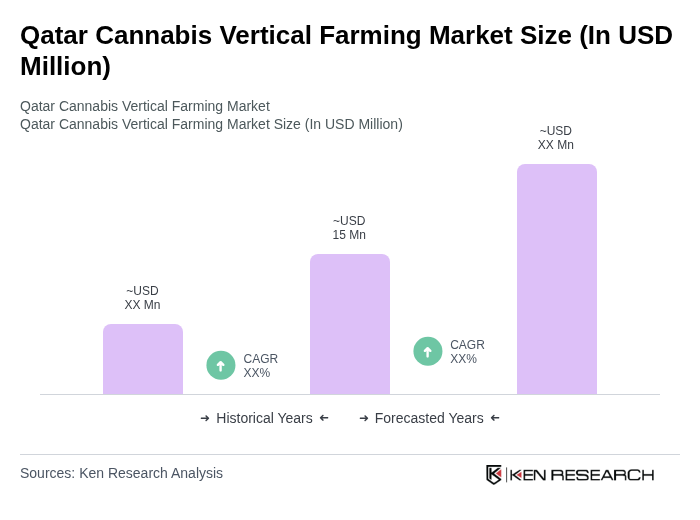
Qatar Cannabis Vertical Farming Market is worth USD 15 Mn, fueled by demand for sustainable agriculture, hydroponics, and government initiatives for food security.

Region:Middle East

Author(s):Dev

Product Code:KRAA3921

Pages:93

Published On:January 2026
About the Report

Base Year 2024

Qatar Cannabis Vertical Farming Market Overview

  • The Qatar Cannabis Vertical Farming Market is valued at USD 15 million, based on a five-year historical analysis of the broader Qatar vertical farming market and its current scale. This growth is primarily driven by increasing demand for sustainable agricultural practices, advancements in controlled-environment agriculture and hydroponic systems, and the global trend toward high-value crops such as medicinal cannabis supported by vertical farming technologies. The market is also supported by investments in research and development focused on climate-resilient cultivation, precision irrigation, and energy-efficient lighting, which enhance cultivation techniques and product quality.
  • Key players in this market include leading agricultural and vertical farming operators located in major Qatari municipalities such as Doha and Al Rayyan, which dominate due to their strategic investments in agricultural technology and infrastructure. These locations benefit from government-backed food security initiatives, availability of logistics infrastructure, and proximity to dense urban demand centers, making them attractive locations for vertical farming initiatives and facilitating efficient distribution to retailers, hospitality, and institutional buyers.
  • In 2023, Qatar’s government continued to advance regulations and programs promoting sustainable agricultural practices, including vertical farming, under frameworks such as the Qatar National Environment and Climate Change Strategy 2021 and the Third National Development Strategy, implemented by the Ministry of Municipality and related authorities. These initiatives aim to enhance food security and reduce reliance on imports by encouraging local production of high-value crops through controlled-environment agriculture. They are supported by measures such as concessional land and greenhouse support schemes, subsidized inputs, and preferential financing for farms adopting innovative technologies such as hydroponics and vertical farming systems.
Qatar Cannabis Vertical Farming Market Size

Qatar Cannabis Vertical Farming Market Segmentation

By Growth Mechanism:The market is segmented into three primary growth mechanisms: Hydroponics, Aeroponics, and Aquaponics. Hydroponics is the most widely adopted method due to its high water-use efficiency and precise nutrient delivery, making it particularly suitable for Qatar’s arid conditions and limited freshwater resources. Aeroponics is gaining traction for its ability to deliver higher yields per unit area with very low water consumption, which appeals to technologically advanced operators focused on high-margin crops. Aquaponics, which integrates recirculating aquaculture with plant cultivation, serves niche segments prioritizing circular resource use and low-waste production models.
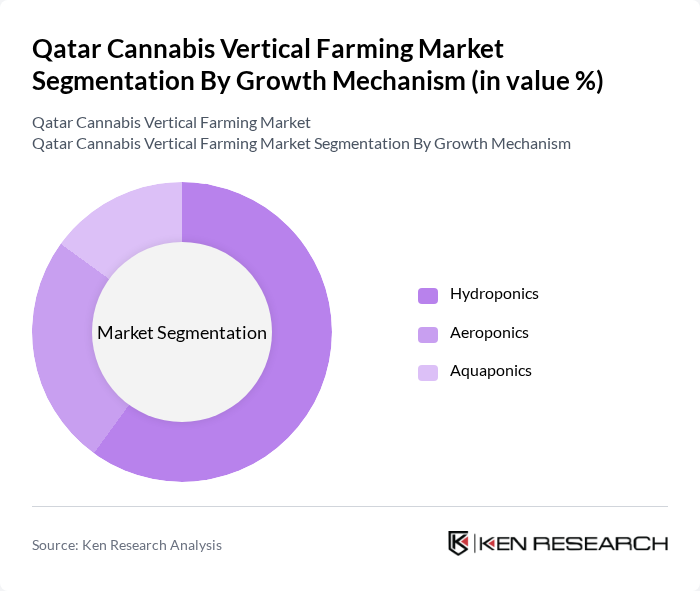
Qatar Cannabis Vertical Farming Market segmentation by Growth Mechanism.

By Structure:The market is divided into Building-based Vertical Farms and Container-based Vertical Farms, in line with the broader Qatar vertical farming industry structure. Building-based vertical farms dominate due to their scalability, ability to leverage existing urban or peri-urban buildings, and suitability for integrating advanced climate-control and automation systems, which is critical in Qatar’s desert climate. Container-based farms are emerging as a flexible and modular alternative, particularly attractive for pilot projects, remote sites, and operators seeking rapid deployment with lower initial fixed infrastructure commitments.
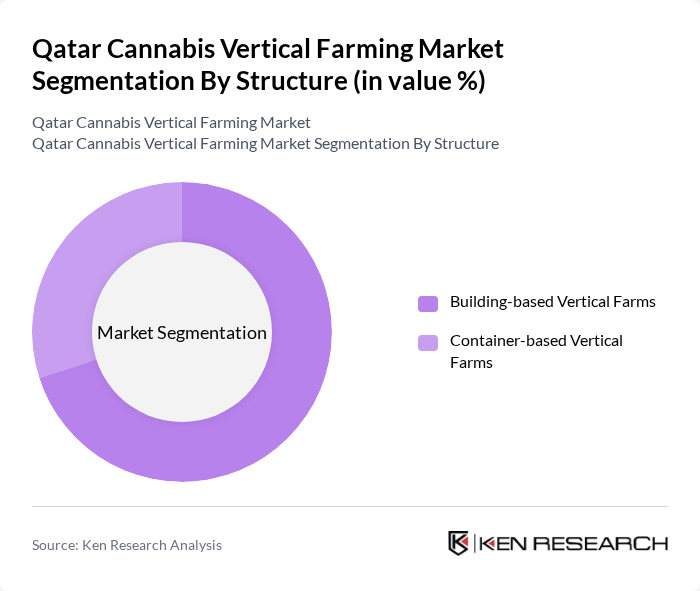
Qatar Cannabis Vertical Farming Market segmentation by Structure.

Qatar Cannabis Vertical Farming Market Competitive Landscape

The Qatar Cannabis Vertical Farming Market is characterized by a dynamic mix of regional and international players active in vertical farming and advanced protected agriculture. Leading participants such as Agrico Qatar, Safwa Farms, Qatar Greenhouse Company, Elite Agro Projects Qatar (YAS Holding), Future Green Solutions, Al Sulaiteen Agricultural & Industrial Complex (SAIC), Baladna Food Industries, Qatar University Agricultural Research Center, Green Oasis Establishment, Eco Farm Qatar, Agrico Hydroponics, Vertical Harvest Qatar, Smart Farm Qatar, Qatar National Food Security Program, Other Emerging Vertical Farming & Cannabis Technology Players contribute to innovation, geographic expansion, and service delivery in this space.

Agrico Qatar

2011

Doha, Qatar

Safwa Farms

2009

Al Rayyan, Qatar

Qatar Greenhouse Company

2012

Doha, Qatar

Elite Agro Projects Qatar (YAS Holding)

2018

Doha, Qatar

Future Green Solutions

2019

Doha, Qatar

Company

Establishment Year

Headquarters

Total Installed Vertical Farming Capacity (m² / number of racks)

Annual Cannabis Production Volume (kg)

Revenue and Revenue Growth Rate from Cannabis Vertical Farming

EBITDA Margin from Cannabis Operations

Capex per m² of Cultivation Area

Yield per m² per Year

Qatar Cannabis Vertical Farming Market Industry Analysis

Growth Drivers

  • Increasing Demand for Sustainable Agriculture:The global shift towards sustainable agriculture is evident, with Qatar's agricultural sector aiming to reduce its carbon footprint. In future, the country is projected to invest approximately QAR 1.8 billion in sustainable farming technologies. This investment aligns with Qatar's National Vision 2030, which emphasizes food security and environmental sustainability, driving the demand for innovative vertical farming solutions that utilize less land and water while maximizing yield.
  • Technological Advancements in Vertical Farming:The integration of advanced technologies such as hydroponics and aeroponics is revolutionizing vertical farming in Qatar. By future, the adoption of these technologies is expected to increase by 35%, enhancing crop yields and reducing resource consumption. The Qatar Science and Technology Park is actively supporting startups in this sector, fostering innovation and attracting investments that further propel technological advancements in cannabis cultivation.
  • Supportive Government Policies:The Qatari government is actively promoting vertical farming through favorable policies and incentives. In future, the government plans to allocate QAR 600 million to support agricultural innovation, including vertical farming initiatives. This financial backing, coupled with regulatory frameworks that encourage sustainable practices, is expected to create a conducive environment for cannabis vertical farming, attracting both local and foreign investments.

Market Challenges

  • Regulatory Uncertainties:The cannabis industry in Qatar faces significant regulatory challenges, with laws still evolving. As of future, the lack of clear regulations regarding cannabis cultivation and distribution creates uncertainty for investors. This ambiguity can deter potential stakeholders from entering the market, hindering growth and innovation in the vertical farming sector, which relies on stable regulatory frameworks to thrive.
  • High Initial Investment Costs:Establishing vertical farms requires substantial capital investment, often exceeding QAR 2.5 million for initial setup. In future, the high costs associated with advanced technology, infrastructure, and compliance with health standards pose a barrier for many potential entrants. This financial hurdle can limit the number of players in the market, slowing down the overall growth of the cannabis vertical farming industry in Qatar.

Qatar Cannabis Vertical Farming Market Future Outlook

The future of the cannabis vertical farming market in Qatar appears promising, driven by increasing consumer demand for sustainable and organic products. As the government continues to support agricultural innovation, the sector is likely to witness significant technological advancements. Additionally, the integration of IoT and renewable energy sources will enhance operational efficiency. By future, the market is expected to evolve, with a focus on developing high-quality cannabis products that cater to both local and international markets, fostering economic growth and sustainability.

Market Opportunities

  • Expansion into Export Markets:With the global cannabis market projected to reach USD 85 billion by future, Qatar has a significant opportunity to export its cannabis products. By leveraging its strategic location and developing high-quality products, the country can tap into international markets, potentially generating QAR 1.5 billion in export revenue by future, thus enhancing its economic diversification efforts.
  • Partnerships with Technology Providers:Collaborating with technology providers can enhance the efficiency and productivity of vertical farms. By future, forming strategic alliances with tech firms specializing in agricultural innovations could lead to a 30% increase in yield. Such partnerships will not only improve operational capabilities but also position Qatar as a leader in sustainable cannabis cultivation in the region.

Scope of the Report

SegmentSub-Segments
By Growth Mechanism

Hydroponics

Aeroponics

Aquaponics

By Structure

Building-based Vertical Farms

Container-based Vertical Farms

By Component

Irrigation Systems

Lighting (LED and Other Artificial Lighting)

Sensors & Monitoring Systems

Climate Control Systems

Building Materials and Grow Infrastructure

Others

By Application

Indoor Cannabis Cultivation

High-Density / Multi-Layer Farming

Controlled Environment Cultivation

Others

By Crop Type

Medical-Grade Cannabis (Flowers and Biomass)

Cannabis Oils and Extracts

High-CBD / Low-THC Varieties

Others

By End-User

Licensed Cannabis Producers

Pharmaceutical & Healthcare Companies

Research & Academic Institutions

Others

By Sales Channel

B2B (Pharma, Clinics, Institutional Buyers)

B2G (Government Procurement & Programs)

Export-Oriented Sales

Others

Key Target Audience

Investors and Venture Capitalist Firms

Government and Regulatory Bodies (e.g., Ministry of Public Health, Qatar Financial Centre Regulatory Authority)

Manufacturers and Producers of Cannabis Products

Distributors and Retailers of Cannabis Products

Technology Providers for Vertical Farming Solutions

Industry Associations related to Agriculture and Cannabis

Financial Institutions providing funding for agricultural projects

Real Estate Developers focusing on Agricultural Land

Players Mentioned in the Report:

Agrico Qatar

Safwa Farms

Qatar Greenhouse Company

Elite Agro Projects Qatar (YAS Holding)

Future Green Solutions

Al Sulaiteen Agricultural & Industrial Complex (SAIC)

Baladna Food Industries

Qatar University Agricultural Research Center

Green Oasis Establishment

Eco Farm Qatar

Agrico Hydroponics

Vertical Harvest Qatar

Smart Farm Qatar

Qatar National Food Security Program

Other Emerging Vertical Farming & Cannabis Technology Players

Table of Contents

Market Assessment Phase

1. Executive Summary and Approach


2. Qatar Cannabis Vertical Farming Market Overview

2.1 Key Insights and Strategic Recommendations

2.2 Qatar Cannabis Vertical Farming Market Overview

2.3 Definition and Scope

2.4 Evolution of Market Ecosystem

2.5 Timeline of Key Regulatory Milestones

2.6 Value Chain & Stakeholder Mapping

2.7 Business Cycle Analysis

2.8 Policy & Incentive Landscape


3. Qatar Cannabis Vertical Farming Market Analysis

3.1 Growth Drivers

3.1.1 Increasing Demand for Sustainable Agriculture
3.1.2 Technological Advancements in Vertical Farming
3.1.3 Supportive Government Policies
3.1.4 Rising Health Consciousness Among Consumers

3.2 Market Challenges

3.2.1 Regulatory Uncertainties
3.2.2 High Initial Investment Costs
3.2.3 Limited Awareness and Education
3.2.4 Competition from Traditional Farming Methods

3.3 Market Opportunities

3.3.1 Expansion into Export Markets
3.3.2 Partnerships with Technology Providers
3.3.3 Development of Organic Cannabis Products
3.3.4 Investment in Research and Development

3.4 Market Trends

3.4.1 Integration of IoT in Farming Practices
3.4.2 Shift Towards Organic and Natural Products
3.4.3 Increasing Use of Renewable Energy Sources
3.4.4 Growth of E-commerce in Cannabis Sales

3.5 Government Regulation

3.5.1 Licensing Requirements for Cultivation
3.5.2 Compliance with Health and Safety Standards
3.5.3 Restrictions on Marketing and Advertising
3.5.4 Taxation Policies on Cannabis Products

4. SWOT Analysis


5. Stakeholder Analysis


6. Porter's Five Forces Analysis


7. Qatar Cannabis Vertical Farming Market Market Size, 2019-2024

7.1 By Value

7.2 By Volume

7.3 By Average Selling Price


8. Qatar Cannabis Vertical Farming Market Segmentation

8.1 By Growth Mechanism

8.1.1 Hydroponics
8.1.2 Aeroponics
8.1.3 Aquaponics

8.2 By Structure

8.2.1 Building-based Vertical Farms
8.2.2 Container-based Vertical Farms

8.3 By Component

8.3.1 Irrigation Systems
8.3.2 Lighting (LED and Other Artificial Lighting)
8.3.3 Sensors & Monitoring Systems
8.3.4 Climate Control Systems
8.3.5 Building Materials and Grow Infrastructure
8.3.6 Others

8.4 By Application

8.4.1 Indoor Cannabis Cultivation
8.4.2 High-Density / Multi-Layer Farming
8.4.3 Controlled Environment Cultivation
8.4.4 Others

8.5 By Crop Type

8.5.1 Medical-Grade Cannabis (Flowers and Biomass)
8.5.2 Cannabis Oils and Extracts
8.5.3 High-CBD / Low-THC Varieties
8.5.4 Others

8.6 By End-User

8.6.1 Licensed Cannabis Producers
8.6.2 Pharmaceutical & Healthcare Companies
8.6.3 Research & Academic Institutions
8.6.4 Others

8.7 By Sales Channel

8.7.1 B2B (Pharma, Clinics, Institutional Buyers)
8.7.2 B2G (Government Procurement & Programs)
8.7.3 Export-Oriented Sales
8.7.4 Others

9. Qatar Cannabis Vertical Farming Market Competitive Analysis

9.1 Market Share of Key Players

9.2 Cross Comparison of Key Players

9.2.1 Company Name
9.2.2 Total Installed Vertical Farming Capacity (m² / number of racks)
9.2.3 Annual Cannabis Production Volume (kg)
9.2.4 Revenue and Revenue Growth Rate from Cannabis Vertical Farming
9.2.5 EBITDA Margin from Cannabis Operations
9.2.6 Capex per m² of Cultivation Area
9.2.7 Yield per m² per Year
9.2.8 Energy Consumption per kg of Output
9.2.9 Water Consumption per kg of Output
9.2.10 Average Selling Price per gram (Domestic vs Export)
9.2.11 Market Penetration (Number of Key Accounts / Contracts)
9.2.12 R&D Intensity (% of Revenue Spent on R&D)
9.2.13 Automation & Technology Adoption Level
9.2.14 Compliance & Certification Status (GMP, GACP, etc.)

9.3 SWOT Analysis of Top Players

9.4 Pricing Analysis

9.5 Detailed Profile of Major Companies

9.5.1 Agrico Qatar
9.5.2 Safwa Farms
9.5.3 Qatar Greenhouse Company
9.5.4 Elite Agro Projects Qatar (YAS Holding)
9.5.5 Future Green Solutions
9.5.6 Al Sulaiteen Agricultural & Industrial Complex (SAIC)
9.5.7 Baladna Food Industries
9.5.8 Qatar University Agricultural Research Center
9.5.9 Green Oasis Establishment
9.5.10 Eco Farm Qatar
9.5.11 Agrico Hydroponics
9.5.12 Vertical Harvest Qatar
9.5.13 Smart Farm Qatar
9.5.14 Qatar National Food Security Program
9.5.15 Other Emerging Vertical Farming & Cannabis Technology Players

10. Qatar Cannabis Vertical Farming Market End-User Analysis

10.1 Procurement Behavior of Key Ministries

10.1.1 Ministry of Agriculture
10.1.2 Ministry of Health
10.1.3 Ministry of Commerce
10.1.4 Others

10.2 Corporate Spend on Infrastructure & Energy

10.2.1 Investment in Vertical Farming Infrastructure
10.2.2 Energy Consumption Patterns
10.2.3 Budget Allocation for R&D
10.2.4 Others

10.3 Pain Point Analysis by End-User Category

10.3.1 Medical Cannabis Producers
10.3.2 Recreational Users
10.3.3 Research Institutions
10.3.4 Others

10.4 User Readiness for Adoption

10.4.1 Awareness Levels
10.4.2 Training and Support Needs
10.4.3 Financial Readiness
10.4.4 Others

10.5 Post-Deployment ROI and Use Case Expansion

10.5.1 ROI Measurement Techniques
10.5.2 Use Case Development
10.5.3 Long-term Sustainability Plans
10.5.4 Others

11. Qatar Cannabis Vertical Farming Market Future Size, 2025-2030

11.1 By Value

11.2 By Volume

11.3 By Average Selling Price


Go-To-Market Strategy Phase

1. Whitespace Analysis + Business Model Canvas

1.1 Market Gaps Identification

1.2 Business Model Development


2. Marketing and Positioning Recommendations

2.1 Branding Strategies

2.2 Product USPs


3. Distribution Plan

3.1 Urban Retail vs Rural NGO Tie-ups


4. Channel & Pricing Gaps

4.1 Underserved Routes

4.2 Pricing Bands


5. Unmet Demand & Latent Needs

5.1 Category Gaps

5.2 Consumer Segments


6. Customer Relationship

6.1 Loyalty Programs

6.2 After-sales Service


7. Value Proposition

7.1 Sustainability

7.2 Integrated Supply Chains


8. Key Activities

8.1 Regulatory Compliance

8.2 Branding

8.3 Distribution Setup


9. Entry Strategy Evaluation

9.1 Domestic Market Entry Strategy

9.1.1 Product Mix
9.1.2 Pricing Band
9.1.3 Packaging

9.2 Export Entry Strategy

9.2.1 Target Countries
9.2.2 Compliance Roadmap

10. Entry Mode Assessment

10.1 JV

10.2 Greenfield

10.3 M&A

10.4 Distributor Model


11. Capital and Timeline Estimation

11.1 Capital Requirements

11.2 Timelines


12. Control vs Risk Trade-Off

12.1 Ownership vs Partnerships


13. Profitability Outlook

13.1 Breakeven Analysis

13.2 Long-term Sustainability


14. Potential Partner List

14.1 Distributors

14.2 JVs

14.3 Acquisition Targets


15. Execution Roadmap

15.1 Phased Plan for Market Entry

15.1.1 Market Setup
15.1.2 Market Entry
15.1.3 Growth Acceleration
15.1.4 Scale & Stabilize

15.2 Key Activities and Milestones

15.2.1 Milestone Planning
15.2.2 Activity Tracking

Research Methodology

ApproachModellingSample

Phase 1: Approach1

Desk Research

  • Analysis of government publications and reports on agricultural policies in Qatar
  • Review of industry reports from agricultural and horticultural organizations
  • Examination of academic journals focusing on vertical farming and cannabis cultivation

Primary Research

  • Interviews with agricultural experts and consultants specializing in vertical farming
  • Surveys with cannabis industry stakeholders, including growers and distributors
  • Field visits to existing vertical farms and cannabis cultivation facilities in Qatar

Validation & Triangulation

  • Cross-validation of data from multiple sources, including trade associations and government agencies
  • Triangulation of findings from primary interviews with secondary research insights
  • Sanity checks through expert panels comprising agronomists and market analysts

Phase 2: Market Size Estimation1

Top-down Assessment

  • Estimation of market size based on national agricultural output and cannabis consumption trends
  • Segmentation of the market by product type, including medicinal and recreational cannabis
  • Incorporation of regulatory frameworks affecting vertical farming and cannabis production

Bottom-up Modeling

  • Collection of data on operational capacities of existing vertical farms in Qatar
  • Cost analysis based on inputs, technology, and labor for cannabis cultivation
  • Volume estimates derived from projected yields and market demand for cannabis products

Forecasting & Scenario Analysis

  • Development of growth scenarios based on regulatory changes and market acceptance
  • Multi-variable forecasting considering technological advancements in vertical farming
  • Baseline, optimistic, and pessimistic projections through 2030 based on market dynamics

Phase 3: CATI Sample Composition1

Scope Item/SegmentSample SizeTarget Respondent Profiles
Cannabis Cultivation Techniques60Agricultural Scientists, Vertical Farming Experts
Market Demand for Cannabis Products75Retail Managers, Cannabis Product Distributors
Regulatory Impact on Vertical Farming50Policy Makers, Legal Advisors in Agriculture
Consumer Preferences in Cannabis70End Consumers, Health and Wellness Advocates
Technological Innovations in Farming55Agri-tech Entrepreneurs, Research and Development Managers

Frequently Asked Questions

What is the current value of the Qatar Cannabis Vertical Farming Market?

The Qatar Cannabis Vertical Farming Market is valued at approximately USD 15 million, reflecting a five-year historical analysis of the broader vertical farming market in Qatar, driven by sustainable agricultural practices and advancements in cultivation technologies.

What are the primary growth mechanisms in Qatar's cannabis vertical farming?

Which locations in Qatar are leading in cannabis vertical farming?

How is the Qatari government supporting vertical farming initiatives?

Other Regional/Country Reports

Indonesia Cannabis Vertical Farming Market

Malaysia Cannabis Vertical Farming Market

KSA Cannabis Vertical Farming Market

APAC Cannabis Vertical Farming Market

SEA Cannabis Vertical Farming Market

Vietnam Cannabis Vertical Farming Market

Other Adjacent Reports

Why Buy From Us?

Refine Robust Result (RRR) Framework

What makes us stand out is that our consultants follow Robust, Refine and Result (RRR) methodology. Robust for clear definitions, approaches and sanity checking, Refine for differentiating respondents' facts and opinions, and Result for presenting data with story.

Our Reach Is Unmatched

We have set a benchmark in the industry by offering our clients with syndicated and customized market research reports featuring coverage of entire market as well as meticulous research and analyst insights.

Shifting the Research Paradigm

While we don't replace traditional research, we flip the method upside down. Our dual approach of Top Bottom & Bottom Top ensures quality deliverable by not just verifying company fundamentals but also looking at the sector and macroeconomic factors.

More Insights-Better Decisions

With one step in the future, our research team constantly tries to show you the bigger picture. We help with some of the tough questions you may encounter along the way: How is the industry positioned? Best marketing channel? KPI's of competitors? By aligning every element, we help maximize success.

Transparency and Trust

Our report gives you instant access to the answers and sources that other companies might choose to hide. We elaborate each steps of research methodology we have used and showcase you the sample size to earn your trust.

Round the Clock Support

If you need any support, we are here! We pride ourselves on universe strength, data quality, and quick, friendly, and professional service.

Why Clients Choose Us?

400000+
Reports in repository
150+
Consulting projects a year
100+
Analysts
8000+
Client Queries in 2022








